Embracing the Melodrama Part II #87: One False Move (dir by Carl Franklin)


One_false_moveWho doesn’t love Bill Paxton?

Seriously, he’s just one of those actors.  He’s appeared in a countless number of films and he’s played a lot of different characters.  He was a psycho vampire in Near Dark.  He was the underwater explorer who got stuck with all of the worst lines in Titanic.  In Frailty, he was a father who was driven to murder by heavenly visions.  He was the sleaziest of sleazes in Nightcrawler.  And, of course, in Big Love, he was an unrepentant polygamist.  In all of these roles, Paxton showed the quirkiness that has made him so beloved to film lovers like me.  Much like Kevin Bacon, it doesn’t matter what role Bill Paxton is playing.  You’re going to like him and you’re going to be happy to see him onscreen.

And yet, considering just how many popular films that he’s appeared in, it’s interesting to note that Bill Paxton’s best performance can be found in a film about which not many people seem to have heard.  That film is the 1992 Southern crime drama, One False Move.

Actually, it does the film a disservice to refer to it as merely being a crime drama.  I mean, it is a drama and it even has a properly dark ending to prove that fact.  And it is about criminals and police officers.  But ultimately, the film’s plot is just a starting point that the film uses to examine issues of culture, race, and guilt.  In the end, One False Movie is an unexpectedly poignant and penatrating character study of 5 very different people.

We start out with three criminals.  Ray (played by Billy Bob Thornton, who also co-wrote the script) is a career criminal, a white trash redneck who is not particularly smart but who is dangerous because he’s ruthless and he’s willing to whatever he need to do to survive.  (If you’ve lived in the country, you will recognize Ray’s type as soon as you see him.)  Ray’s girlfriend is Fantasia (Cynda Williams), a beautiful but insecure woman.  And finally, there’s Ray’s partner and former cellmate, Pluto (Michael Beach).  Of the three of them, Pluto is the most menacing, a knife-wielding sociopath with an IQ of 150.  Even though he’s working with Ray and Fantasia, Pluto always makes it clear that he considers himself to be both separate from and better than both of them.

Ray, Pluto, and Fantasia have just brutally murdered 6 people in Los Angeles, all of whom were friends of Fantasia’s.  Now, they’re making their way to Houston, planning on selling stolen cocaine.  Pursuing them are two LAPD detective, Cole (Jim Metzler) and McFeeley (Earl Billings).  When Cole and McFeeley come across evidence that the three criminals might have a connection with the tiny town of Star City, Arkansas, they call up the local sheriff.

And that’s where Bill Paxton shows up.

Paxton plays Sheriff Dale Dixon.  Dale’s nickname is Hurricane and it’s soon obvious why.  Like a hurricane, Dale never stops moving.  He’s a well-meaning but hyperactive good old boy who has a talent for saying exactly the wrong thing.  When he first talks to Cole and McFeeley over the phone, he amuses them with his enthusiastic bragging and briefly offends them with his casual racism.

Cole and McFeeley eventually end up taking a trip to Star City, so that they can investigate how the three criminals are connected to this tiny town.  When Dixon meets up with them, he asks them if they could help him get a job with the LAPD.  The two cops initially humor Dixon and laugh at him behind his back.  When Dixon’s wife (a wonderful performance from Natalie Canerday) asks Cole to keep Dixon safe, Cole assures her that Ray, Fantasia, and Pluto are probably not even going to come anywhere near Star City.

However, Dixon soon reveals to the two cops that Fantasia’s name is Lila and that her family lives in Star City.  What he doesn’t tell them, however, is that he and Lila have a personal connection of their own…

One False Move is a twisty and intense thriller, one that’s distinguished by strong performances from the entire cast.  (Even Metzler and Billings bring unexpected shadings to Cole and McFeeley, who, in any other film, would have been portrayed as being stock characters.)  But the film is truly dominated by Bill Paxton.  When we first meet Dixon, he seems like a joke.  We’re sure that he’ll somehow end up being the film’s hero (because that’s what happens in movies about small town sheriffs being underestimated by big city cops) but what we’re not expecting is that Dale is going to turn out to be such a multi-layered and fascinating character.  Just as Dale eventually starts to lower his defenses and reveal who he truly is, Paxton also starts to reign in his initially overwhelming performance and reveals himself to be a subtle and perceptive actor.  It’s a great performance that elevates the entire film.  Al Pacino won the 1992 Oscar for Best Actor for his performance in Scent of a Woman.  That award should have gone to the unnominated Bill Paxton.

It wouldn’t be fair to reveal One False Move‘s secrets.  It’s a film that you really should see for yourself.
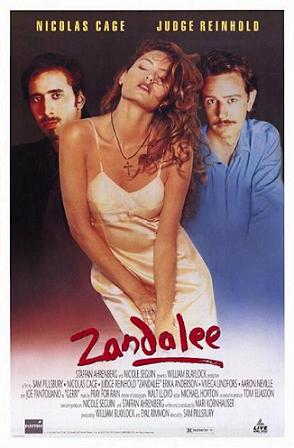
Embracing the Melodrama Part II #86: Zandalee (dir by Sam Pillsbury)


Zandalee

“I want to shake you naked and eat you alive…”

— Johnny (Nicolas Cage) in Zandalee (1991)

As you can probably guess from the quote above, Zandalee is a crazy little movie.

Zandalee takes place in New Orleans, which means that there’s a lot of rain, a lot of jazz, a lot of flamboyant accents, and a lot of sweat.  Zandalee (Erika Anderson) owns a boutique and spends most of her time jogging across the city.  (Zandalee has reddish hair, comes from a Catholic background, and runs a lot so naturally, I related to her.)

During one of her runs, Zandalee happens to pass a thief who is being chased by the police.  The thief flirts with her even while he’s being arrested.  The thief, interestingly enough, is played by a surprisingly hot Steve Buscemi.  Even more interesting is that, though his character makes a dramatic entrance and gets a lot of good lines, Buscemi doesn’t appear again until near the very end of the movie.  There’s really no point to Buscemi being in the film but somehow, it just seems right for him to suddenly be there.

And really, that’s the type of film that Zandalee is.  Odd characters pop up and then disappear.  Plot points are raised and then abandoned.  Events play out almost at random, as if Zandalee’s morning runs are taking her further and further into a dream world.

(It’s all a bit like Lost River, except for the fact that Zandalee is actually memorable in its weirdness, as opposed to just being annoying.)

Zandalee is married to Thierry (Judge Reinhold), a former poet who has abandoned his literary ambitions and taken over the family business.  Now, he’s mostly a figurehead who spends all of his time hanging out with drunk and uninteresting Philistines.  Thierry is so guilt-ridden over giving up poetry that he’s been rendered impotent.  Try as he might, he cannot make love.  As he puts it, while standing naked and staring out into the dark night, he is “a paraplegic of the soul.”

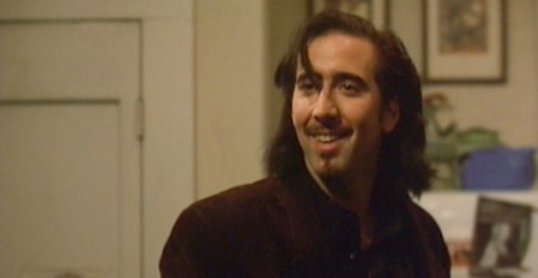
And then Johnny (Nicolas Cage) shows up.  Johnny was Thierry’s childhood friend.  Johnny is a painter and, from the minute he arrives, he’s giving Thierry a hard time for selling out.  Johnny also has long, stringy hair and a mustache and goatee.  He speaks in Nicolas Cage’s trademark muffled monotone, muttering lines of philosophical pretension.  When we first meet Johnny, he’s with Remy (Marisa Tomei, who much like Steve Buscemi, pops up and then vanishes and yet somehow it still seems totally appropriate that she’s in the film) but soon, Johnny has decided that he wants Zandalee.

Or, as he tells her when he approaches her during one of her runs, “I like it when you don’t wear anything underneath….”

Soon, Johnny and Zandalee are having a passionate affair.  Much as Zandalee once inspired Thierry’s poetry, she now inspires Johnny’s art.  Of course, Johnny is also inspired by cocaine.  Along with selling it and snorting it, Johnny also mixes it with olive oil and dips his fingers in it before fingering Zandalee.  And, as effective as some of these Johnny/Zandalee scenes are, it’s still impossible to watch all of this without thinking, “What the Hell, Nicolas Cage!?”

(Even by the standards of Nicolas Cage, Zandalee is a strange film.)

Anyway, eventually, Zandalee breaks it off with Johnny and Johnny’s paintings starts to suffer.  Thierry realizes what has been going on and it all leads to the scene below.

And, believe it or not, that all happens during the first hour!  Even after that epic dance off, there’s still another half hour of melodrama to go!  Zandalee is a seriously odd movie.

Zandalee can be viewed, in its uncensored entirety, on YouTube.  Usually, I’d embed the film at the bottom of this review but Zandalee is so extremely NSFW that it’s probably safer if you just go to YouTube and search for it yourself.

niccagezandaleeSeriously, Nic Cage wants you to do it.

Embracing the Melodrama Part II #85: Ghost (dir by Jerry Zucker)


Ghost_(1990_movie_poster)Along with it being a part of my series of melodramatic film reviews, there are actually two reasons why I recently watched Ghost.

First off, this 1990 film was nominated for best picture and it’s long been my goal to watch and review every single film ever nominated for best picture.

Secondly, my Aunt Kate absolutely loves this movie.  Ever since she first found out that I obsessively love movies, she has recommended that I watch this movie.  And she hasn’t been alone.  A lot of people both in and outside of my family have recommended this film to me.  And, since I tend to be a bit of a contrarian know-it-all, I originally assumed that any film loved by that many people had to be terrible.  However, because I love mi tia, I decided to watch Ghost.

I have to admit that I started to laugh when I saw Demi Moore sitting at her pottery wheel because I’ve seen that scene parodied in so many different TV shows and movies.  As soon as a shirtless Patrick Swayze sat down behind her and joined his hands to hers to help shape a ceramic phallic symbol, I started to giggle.  As Unchained Melody played in the background, I wanted to be snarky.  But then I realized something.  If you can manage watch the scene without comparing it to all the parody versions, it actually works.  Patrick Swayze looked good and he and Demi Moore had the type of amazing chemistry that more than made up for the fact that neither one of them was a very good actor.  (That said, Patrick was very good at projecting decency and Demi was very good at crying and that’s really all that Ghost required.)  And, if the scene has proven easy to parody, that doesn’t change the fact that it’s a very sincere scene.  It’s so sincere that it’s even willing to risk coming across as being silly.

Of course, the entire film isn’t just Demi, Patrick, and a pottery wheel.  There’s also Whoopi Goldberg as a fake medium-turned-real-medium and Tony Goldwyn as the best friend who turns out to be a sleazy villain.  And, of course, there’s the cartoonish demons who pop up every once in a while so that they can literally drag the recently deceased down to Hell.

Sam Wheat (Patrick Swayze) is the world’s most unlikely New York City-based banker.  He owns a beautiful apartment with his girlfriend Molly (Demi Moore) but he has commitment issues.  He can’t bring himself to say that he loves Molly.  Instead, he just says, “Ditto.”  And, from the minute he first utters those words, you know that his habit of saying “Ditto,” is going to be an important plot point.  Anton Chekhov told us that any gun introduced during the first chapter must be fired by the third chapter.  Ghost tells us that any “Ditto” uttered during the first 10 minutes must be repeated by the end of the first hour.

Sam’s best friend and co-worker is Carl (Tony Goldwyn).  At the start of the film, Sam and Carl have a sweet bromance going and some of the best scenes are just the two of them acting like guys.  (There’s a fun little scene where they freak out a group of strangers on an elevator.)  Goldwyn is so likable as Carl that it’s actually genuinely upsetting to discover that he’s arranged for Sam to be murdered.  (Why?  It all involved a lot of financial stuff that basically went right over my head.  Greed is not only the root of all evil but it leads to narrative confusion as well.)  When Sam dies, he comes back as a ghost but nobody can see him but his fellow ghosts.  Vincent Schiavelli has a great cameo as a very angry subway ghost who teaches Sam how “life” works when you’re dead.

(Of course, Schiavelli isn’t on screen for too long because he’s almost too angry for the world of Ghost.)

Eventually Sam discovers that only one living person can communicate with him.  Oda Mae Brown (Whoopi Goldberg) is a fake medium who is just as shocked as anyone to discover that she can speak with the dead.  Whoopi won an Oscar for her performance here and she’s certainly does bring some needed humor and life to Ghost.  With Swayze, Moore, and Goldwyn all giving extremely and sometimes overly dramatic performances, you’re happy to have Whoopi there.

Ghost is designed to appeal to your emotions and it succeeds in doing just that.  If you look at the film logically, you’re missing the point.  In many ways, the film is undeniably silly but I still got some tears in my eyes when I heard that “Ditto.”


Embracing the Melodrama Part II #84: The Forbidden Dance (dir by Greydon Clark)


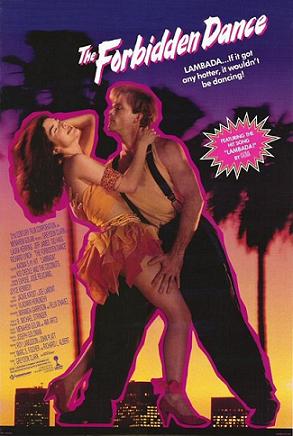
Forbidden_danceDANCE!

I love to dance, I loved to teach others how to dance, and I love watching other people dance.  If you’ve been reading my reviews for a while, then you know that I can not resist a film that features a lot of dancing.  It doesn’t matter if the director is inept.  It doesn’t matter if the script makes no sense.  It doesn’t matter if the actors don’t have a bit of acting talent to use to their advantage.  As long as the film features a lot of dancing, I’m happy.

Seriously, people, when in doubt … DANCE!

Let’s take the 1990 film The Forbidden Dance, for instance.  Now, if I wanted to be nit-picky, I could probably find a lot to criticize about this film.  I mean, this film even has a pro-environmental message and you know how annoyed I can get with message films.  And you know what?  You can do a google search and you can find all sorts of insanely negative reviews of this film.

But you know what?

I don’t really care about any of that.  This is, at heart, a dance film.  It features almost non-stop dancing, so I really can’t be too critical of it.  Add to that, it also features memorable performances from Sid Haig and the late Richard Lynch.  Unfortunately, neither Haig nor Lynch get out on the dance floor because, if they had, The Forbidden Dance would have been legendary.

The Forbidden Dance begins in the Brazilian rain forest.  A tribe of Native Brazilians is happily dancing and basically not bothering anyone.  As we learn later on in the film, the dance that they are doing is called the Lambada and apparently, the Brazilian government tried to ban it “because it was too sexy.”

(Amazingly enough and according to Wikipedia, the Lambada apparently was an actual dance craze back in 1990.  The Forbidden Dance came out on the exact same weekend as a competing film about the Lambada.  That film was called, appropriately enough, Lambada.  Strangely enough, two years ago, I randomly reviewed that film for this very site.)

Anyway, all the dancing and the fun is interrupted by the arrival of Benjamin Maxwell (Richard Lynch), a mercenary who works for a Big Evil Corporation.  Maxwell tells the tribe that they might want to stop dancing and leave because the rain forest is going to be destroyed.

Naturally enough, the tribe’s king responds to this by sending his daughter, Nisa (Laura Harring), to America.  Accompanying Nisa is Joa (Sid Haig), a witch doctor.  However, Nisa and Joa’s attempts to invade the headquarters of Big Evil Corporation results in Joa being arrested.

(Incidentally, you might recognize Laura Harring from David Lynch’s Mulholland Drive, where she played a similarly mysterious character who was lost and hunted in Los Angeles.)

Left to fend for herself, Nisa gets a job working as a maid for a wealthy family.  And while neither Mr. nor Mrs. Anderson has much interest in the backstory of the help, their son Jason (Jeff James) is a different story.  As Jason’s mother complains, Jason doesn’t have much interest in anything other than dancing.  And, when Jason spots Nisa dancing in her bedroom, he becomes intrigued with her.  Ignoring the snobbish reactions of his wealthy friends, Jason asks Nisa to teach him the Lambada!

And hey!  Guess what!  There’s going to be a dance contest and it’s going to be televised!  What better way to get a platform to protest the destruction of the Brazilian Rain Forest then by winning the contest?  Standing in the way of this plan: Benjamin Maxwell (who, in one icky scene, demands that Nisa dance for him), Jason’s parents and friends, and the fact that, through a complicated series of events, Nisa ends up being forced to dance in the sleaziest club in Los Angeles.

So, look — there’s all sorts of things that I could say about The Forbidden Dance but it features a lot of dancing so I’m inclined to be generous towards the film, especially since Laura Harring and Jeff James both know how to move and look really good dancing together.  I mean, the word Dance is right there in the title. The film promises dancing and it delivers.  Plus, it also delivers Sid Haig and Richard Lynch at their demented best.

So, why complain when you can … DANCE!?


Embracing the Melodrama Part II #83: Bad Influence (dir by Curtis Hanson)


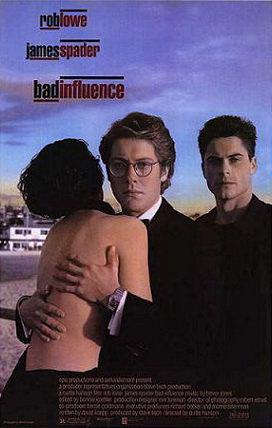
Bad_Influence_Film_PosterThough it may seem like a lifetime ago, it’s only been 6 weeks since I started on my latest series of reviews.  I am currently in the process of reviewing, in chronological order, 126 cinematic melodramas.  I started with the 1927 classic Sunrise and now, 82 reviews later, I have finally reached the 1990s.

(Of course, when I started this series of reviews, I somehow managed to convince myself that it would only take me 3 weeks to review 126 films.  Instead, it looks like it’s going to take two months.  So, I was only off by 5 weeks.)

Let’s start the 90s by taking a quick look at a 1990 film called Bad Influence.  I have to admit that, when I made out my list of films to review, Bad Influence was not even on my radar.  I was planning on launching my look at the 90s with a review of Ghost.  But then I saw The Avengers: Age of Ultron and I was so taken with James Spader’s performance as Ultron that  I decided to add a few James Spader films to Embracing the Melodrama.

In Bad Influence, James Spader is cast somewhat against type.  He plays Michael, who has a good job and is engaged to marry the wealthy and overbearing Ruth (who, I was surprised to learn from the end credits, was played by a pre-Desperate Housewives Marcia Cross).  Michael should be happy but instead, he feels oddly dissatisfied with his life.  He’s shy and meek and spends all of his time trying to do the right thing and conform to the petty demands of society.

One day, as he’s sitting in a bar, Michael makes the mistake of trying to flirt with a woman who is obviously having a bad day.  When the woman’s boyfriend shows up, he tells Michael to leave.  When Michael mutters that it’s a free country, the man responds by grabbing Michael.  However, before the fight can go any further, handsome and charming Alex (played, somewhat inevitably, by Rob Lowe) pops up out of nowhere, smashes a bottle, and scares the man off.

Michael and Alex become fast friends, with Michael viewing the extroverted and confident Alex as being everything that he wants to be.  (Meanwhile, Alex seems to appreciate the fact that Michael has money and a nice apartment.)  Under the influence of Alex, Michael starts to stand up for himself and even manages to get a big promotion at work.  At the same time, he also ends up cheating on his fiancée (while Alex films them) , helping Alex hold up a series of convenience stores, and beating up an obnoxious co-worker.

Ultimately, Bad Influence is a lot of sordid fun.  It’s a bit like Fight Club, minus the satire and the big identity twist.  (Michael and Alex are differently separate characters.)  Director Curtis Hanson (who is perhaps best known for L.A. Confidential) brings a lot of style to the film’s tawdry fun and keeps the action moving quickly enough that you don’t have too much time to obsess over what doesn’t make sense.

Finally, James Spader and Rob Lowe are just a lot of fun to watch.  Spader turns Michael into a sympathetic protagonist and Rob Lowe seems to be having a blast going full psycho in his role.

Bad Influence is a well-made B-movie and it’s a lot of fun.  You can watch it below!

Embracing the Melodrama Part II #82: Promised Land (dir by Michael Hoffman)


Promised_land_poster_(1987)When I made out my schedule of reviews for Embracing the Melodrama, I did not realize that I was setting myself up for a mini-marathon of Kiefer Sutherland movies but somehow, that’s exactly what happened!  No sooner had I watched and jotted down my impressions of Bright Lights, Big City and 1969, then I started watching a 1988 film called Promised Land (which should not be confused with the recent Matt Damon/Jon Krasinski fracking film).

And guess who stars in this particular film?

That’s right — Kiefer Sutherland!

Now, if Bright Lights, Big City featured Kiefer as a sociopath and 1969 featured Kiefer as a blonde-haired golden boy, Promised Land features Kiefer as a prototypical outsider.

Promised Land opens at a high school basketball game.  Hancock (Jason Gedrick) is the handsome and popular jock who is a star on the court and who is dating a cheerleader named Mary (Tracy Pollan).  Danny (Kiefer Sutherland) is the nerdy kid who gets good grades and who is nicknamed Senator because he wants to enter politics.  He has an obvious crush on Mary but also appears to have one on Hancock as well.  As Hancock runs up and down the court, nobody cheers louder than Danny.  Meanwhile, Hancock barely knows who Danny is.

Three years later and things have changed.  Hancock, having gone to college on an athletic scholarship just to drop out and return home, is now a vaguely fascistic police officer.  Mary has remained in college.  When she returns home for Christmas break, Hancock tries to rekindle their relationship but Mary has moved on.

Meanwhile, Danny has dropped out of school as well.  After spending a few years drifting around, he meets the lively, vivacious, and totally insane Bev (Meg Ryan).  He and Bev get married in Las Vegas and decide to head back to Danny’s hometown for Christmas…

Drama, violence, and tragedy follow!

But you already guessed that, didn’t you?  That’s one of the problems with Promised Land.  From the minute that Bev says that she wants to meet Danny’s family, you can tell exactly how this story is going to end.  And while a predictable plot can sometimes be redeemed by memorable performances, that’s not the case with Promised Land.  Kiefer Sutherland and Meg Ryan both give good and dangerous performances but Jason Gedrick and Tracy Pollan make for a boring couple.

(Interestingly enough, Tracy Pollan was also in Bright Lights, Big City.)

Promised Land does have some historical significance, in that it was the first film to ever be partially funded by the Sundance Institute.  Robert Redford is listed as an executive producer.  But, historical significance aside, there’s really not much about Promised Land to really recommend going to the effort to try to track it down.  It’s not so much bad as just very forgettable.

Embracing the Melodrama Part II #81: 1969 (dir by Ernest Thompson)


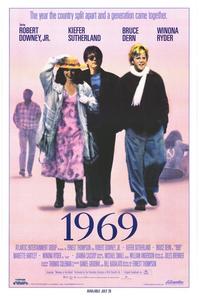
NineteensixtyninefilmIn 1988, the same year that he was forcing Michael J. Fox to snort cocaine in Bright Lights, Big City, Kiefer Sutherland played a far different role in the film 1969.

As you might guess from the film’s title, 1969 takes place in 1969.  Scott (Kiefer Sutherland) and Ralph (Robert Downey, Jr.) have just graduated from high school and are facing a future that involves either going to college or going to Vietnam.  Scott’s older brother, Alden (Christopher Wynne), has already enlisted in the army and has made their father, Cliff (Bruce Dern), proud in a way that Scott knows he will never be able to match.

So, Scott and Ralph make plans to go to college together and basically stay there until the war ends.  But, needless to say, things don’t work out as perfectly as Scott assumed that they would.  Scott and Ralph spend the summer on a road trip, during which time they meet the usual collection of hippies and fascists who always populate films like this.  They also discover that they have less in common than they thought.  Scott is an idealist who is convinced that he can change the world.  Ralph is far more fatalistic, a cynic who hides his pain behind a constant stream of sarcasm.

When Ralph is kicked out of school (and loses his draft deferment as a result), Alden is killed in Vietnam and Scott sees his father in a potentially compromising position with Ralph’s mother (Joanne Cassidy) (on the night of the moon landing no less!), the disillusioned Scott feels that he has to take action.  With the help of Ralph and Ralph’s sister, Beth (Winona Ryder), Scott breaks into the local draft office and tries to destroy all the records.

Now, if you guessed that the police arrive and that Scott and Beth eventually find themselves in a van, driving for the Canadian border, then you’ve probably seen countless other films that were set in the same year as 1969

1969 is a rather predictable film but, at the same time, it’s likable in much the same way that a rerun of Everybody Loves Raymond is likable.  It’s not something you really need to watch but, if you do watch it, you won’t necessarily be filled with regret.  I imagine that one reason why 1969 tends to show up on networks like Antenna and This TV so much is precisely because it is such a thoroughly inoffensive little movie.

The film also features some above average performances.  It’s not surprising that Robert Downey, Jr. and Winona Ryder both give good performances because, to a large extent, their characters mirror their own public personas.  But, considering that he’s best known for playing Jack Bauer in 24, it’s still somewhat surprising to see a much younger Kiefer Sutherland playing such an essentially gentle character and being totally convincing in the role.  (He already had that sexy growl of a voice, however.)  And finally, the film’s best performance comes from Bruce Dern.  Eternally befuddled and confused by the changes around him, Cliff is ultimately the film’s most sympathetic character, even if he wasn’t originally meant to be.

And needless to say, considering that the film is called 1969, it’s got a great soundtrack!


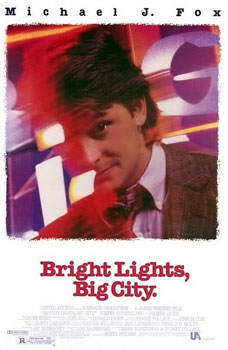
Embracing the Melodrama Part II #80: Bright Lights, Big City (dir by James Bridges)


Bright_Lights_Big_CityThe 1988 film Bright Lights, Big City is one of the many films from the late 80s in which Kiefer Sutherland plays a demonic character.  In this case, his character is so demonic that his name is — seriously, check this shit out — Tad Allagash.  Nobody named Tad Allagash has ever been a good guy!

Tad is the best friend of Jamie Conway (Michael J. Fox), an aspiring writer who has moved to New York City from some middle-America farm state and who now has a job as a fact checker at the New Yorker.  Jamie is still struggling to deal with both the death of his mother (played in flashbacks by Dianne Wiest) and the collapse of his marriage to Amanda (Phoebe Cates).  Tad helps out his depressed little friend by taking him out to the clubs and supplying him with so much cocaine that Jamie literally spends the entire film on the verge of having a geyser of blood shoot out from his powder-coated nostrils.

And the thing is, Tad knows that he’s not a good influence on Jamie’s life but he doesn’t care.  Whenever Jamie starts to get a little bit too wrapped up in his self-pity, Tad is there to make a tasteless joke.  Whenever Jamie tries to argue that he and Amanda aren’t really broken up, Tad is there to remind him that Amanda wants nothing to do with him.  Whenever Jamie starts to think that doing all of this cocaine is potentially ruining his life, Tad is there to cheerfully cut another line.  Tad makes no apologies for being Tad Allagash.  He’s too busy having a good time and it’s obvious that Sutherland’s having an even better time playing Tad.  As a result, Tad Allagash becomes the perfect antihero, the bad guy that you like despite yourself.

Unfortunately, Bright Lights, Big City isn’t about Tad Allagash.  You’re happy whenever Kiefer shows up but he doesn’t show up enough to actually save the film.  No, Bright Lights, Big City is the story of Jamie Conway and that’s why the film is a bit of a pain to sit through.  Despite having a great Irish name, Jamie Conway is one of the whiniest characters that I have ever seen in a film.  From the minute he first appears on screen and starts complaining about the failure of his marriage, you want someone to just tell him to shut up.  When he tells an alcoholic editor (Jason Robards) that his latest short story was autobiographical, you nod and think, “So, that’s why it hasn’t been published.”

Of course, since Jamie is the main character, everyone in the film feels sorry for him but he really is just insufferable.  There’s a lengthy scene where Jamie delivers a drunken monologue to a sympathetic coworker, Megan (played by Swoosie Kurtz).  And while Jamie goes on and on about how he first met Amanda and how their marriage fell apart (and how it was all her fault), poor Megan has to sit there and try to look sympathetic.  Personally, I would have kicked Jamie out of my apartment after the first minute of that whiny diatribe.  Megan has the patience of a saint.

There is some curiosity value to watching Michael J. Fox snort cocaine.  (I wonder if contemporary audiences shouted, “McFly!” as they watched Fox sniffing up the devil’s dandruff.)  But otherwise, Bright Lights, Big City is a relic of 80s cinema that can be safely forgotten.

Embracing the Melodrama Part II #79: Over the Top (dir by Menahem Golan)


OverthetopFor the longest time, whenever I would see a movie at the DFW Alamo Drafthouse, I would always found myself watching a clip that the Alamo management chose to show before the actual movie.  I can’t really remember the specific reason why they were showing the clip.  I imagine it was meant to advertise some special series of testosterone-fueled movies but I really couldn’t tell you for sure.

However, I will never forget the clip itself.

It basically featured Sylvester Stallone arm wrestling a bald giant with a mustache.  As they both struggled to see who would slam down whose wrist first, a crowd of rednecks went wild.  The bald giant growled and groaned.  Meanwhile, Sylvester Stallone was busy … stalloning.  Seriously, you would not believe some of the expressions that passed across Stallone’s face over the course of this one scene.

And finally, after much growling and a lot of constipated facial expressions, Stallone slammed down the guy’s wrist.  The crowed went wild.  Stallone stood up and did the Rocky pose with both of his arms raised in triumph.

Meanwhile, in the audience, I said, “What zee Hell did I just watch?”

(Yes, I did pronounce the with a z.  It was cuter that way.)

Well, it turns out that the scene was taken from a 1987 film called Over The Top.  Now, the scene itself isn’t included in the montage below but I think watching this video will still give you a general sense of what Over The Top is like.

Over The Top turns up on cable fairly regularly and that’s how, after several visits to the Alamo, that I ended up watching the actual film.  Over The Top is an appropriate title because the film’s melodrama truly is over-the-top.  It’s in no way good but it definitely has a “what the Hell am I watching” sort of appeal.

Stallone plays Lincoln Hawk and let’s just take a few minutes to appreciate that name.  When you’ve got a name like Lincoln Hawk, you know that you’re never going to be an accountant or a teacher or … well, really, anything that a person not named Lincoln Hawk would be.  Instead, when you’ve got a name like Lincoln Hawk, you become a truck driver.  And you marry a rich woman (played by Susan Blakely), despite the disapproval of her judgmental father (Robert Loggia).  You have a son and, if you have a sense of humor, you name him Booth Hawk.  Or, in the case of this film, you name him Michael Cutler Hawk (played by David Mendenhall, who was also in Space Raiders) and send him off to military school.

When Lincoln’s wife dies, her father takes custody of Michael.  Even after Lincoln rams his truck into the front of the mansion, Michael still wants to stay with his grandfather.  However, Lincoln can’t spend his time mourning the loss of his family.  He has big plans — like starting his own trucking company.

And how is Lincoln going to do that?

By winning the World Armwrestling Championship, of course!

(Oh come on … that makes total sense in a 1987 Sylvester Stallone movie sort of way!)

Will Lincoln win the championship?  Will Michael bond with his father?  Will Lincoln and his father-in-law develop a grudging respect?  If you don’t know the answer, you’ve never seen the movie before…

Remember how, when I was talking about the Kevin Bacon film Quicksilver, I mentioned how some films were obviously made by people who simply could not understand that not everyone was as fascinated by some silly activity as he or she was?  That’s definitely the case with Over The Top, a film that takes place in an alternative universe where everyone in the entire world is obsessed with arm wrestling.

And it’s all rather silly but it’s also very watchable, in much the same way that American Anthem was very watchable.  Over the Top is not a good film but it’s just so over the top that you owe it to yourself to see it at least once.

Embracing the Melodrama Part II #78: American Anthem (dir by Albert Magnoli)


American_anthem_poster

“He’s thrown a tripus!  Steve Tevere has thrown a tripus!  The most outstanding dismount tonight, or any night!” 

— Really Excited Announcer In American Anthem (1986)

Way back in March, I dvr’d a movie called American Anthem off of Encore.  I did this for two reasons.  First off, the film was described as having something to do with gymnastics and that’s always been my favorite part of the Summer Olympics.  Secondly, any film from the 1980s that has the word “American” in the title is sure to be fun or, at the very least, achingly sincere.

When I finally got around to watching American Anthem, I wasn’t expecting much.  The film turned out to be largely what I expected it would be: the story of gymnasts hoping to qualify for the Olympics and find some personal redemption along the way.  All of the stock characters were present.  We had Steve Tevere (Mitch Gaylord), the brooding rebel who had to decide between pursuing his Olympic dreams or working in a garage for the rest of his life.  We had Steve’s girlfriend, Julie (Janet Jones), who had to learn to be humble before she could be great.  We had Kirk (Stacy Maloney), Steve’s best friend and fellow gymnast.  We had kinda bitchy Becky Cameron (Maria Anz), who was Julie’s friend and rival.  And then there was Arthur (Andrew White), Julie’s crippled, musician cousin.  And let’s not forget Tracy Prescott (Jenny Ester), the 12 year-old gymnast with the impressive afro.  And, of course, there was Coach Sarnoff (Michael Pataki) who was tough, compassionate, and Russian.  The majority of the cast was made up of real-life gymnasts and, with the exception of the genuinely charismatic Stacy Maloney, they all gave performances that suggested that they should stick with gymnastics.

And yet, despite all of that, I absolutely loved American Anthem.  Now, don’t get me wrong.  For the most part, I loved it for all the wrong reasons.  My love for the film is not the type of love that would lead to me being quoted on the back of a Blu-ray case.  American Anthem is a thoroughly bad film but it’s also compulsively watchable.  From the minute that I started watching it, I became obsessed with American Anthem‘s bizarre ineptness.  Since that first night in March, I’ve rewatched American Anthem a few dozen times.  I’ve lost track of how many times that I have grimaced at the cutesy music that Sarnoff tried to force Julie to use for her floor routine.  I can imitate Becky’s squeal of pain when she’s tries to compete with an injured knee.  Whenever Julie and the girls start to chant, “Kirk!  Kirk!  Kirk!,” I chant with them.  And don’t even get me started on how much I love hearing, “He’s thrown a tripus!”

American Anthem is pure style.  This is one of the few films that I’ve seen that has absolutely no subtext.  There is literally nothing going on beneath the surface.  It’s almost as if somebody dared director Albert Magnoli to make a film that was just one big montage.  This is one of those films where the camera is always moving, the colors are always bright, and the soundtrack is always soaring.  Hardly anyone in the film can actually act but oh my God, everyone looks so good (in a 1986 sort of way, of course).

The other “great” thing about American Anthem is that there’s not a single cliché that the film doesn’t include and, as a result, you really don’t have to pay that much attention to the film to understand what’s going on.  To its credit, this film doesn’t even pretend to be anything other than a collection of clichés.  It’s almost as if the characters themselves realize that they are in a film and understand that they have no choice but to conform to what the audience has been conditioned to expect.

(Hmmm…I guess American Anthem does have a subtext.  And kind of a disturbing one at that!)

For instance, within minutes of meeting and despite having no chemistry, Steve and Julie are in love.  Why?  Because the only reason that they are in the film is to fall in love.  It has to be done.

Steve fights with his father (John Aprea) and we’re never quite sure why, beyond the fact that all brooding rebels fight with their fathers.  When his father shows up to watch his son compete, the triumphant music soars and it no longer matters that he’s been portrayed as being an abusive rageaholic up until that moment.

All of the characters tell us that Coach Sarnoff is the best, despite the fact that we don’t actually see any evidence of that fact.  But Sarnoff has to be the best because nobody ever makes a movie about athletes training under a merely adequate coach.

When Becky suddenly shows up at the final competition with a bandaged knee, it doesn’t matter that we don’t actually see her get injured beforehand or, for that matter, hear anything about it.  All that matters is that, in films like this, someone has to compete with an injury.  Becky is simply playing her part.

American Anthem.  It’s not a particularly good film but it sure is watchable.  And, as I’ve come to realize while writing this review, it’s a bit of an existential nightmare as well!

I don’t think I’m ever going to erase it from my DVR.

americananthem01