Bud Cort died on February 11th, at the age of 77. He was a beloved character actor, one who had a real skill for bringing eccentric characters to life. He became a star briefly with films like Brewster McCloud and especially Harold and Maude but Hollywood never really knew what to do with him. After he was nearly killed in a car accident in 1979, his momentum stalled. Smart directors still cast him because he always gave good performances but he spent most of his career in small roles. (In Heat, he was the obnoxious restaurant manager who drove Dennis Haysbert back into a life of crime.)
When Cort died, most of the stories focused on his performance in Harold and Maude. That was understandable. That said, I’ve always been touched by Cort’s performance in 1970’s MASHand I wanted to take a moment to just express how wonderful I thought he was in the role of Private Boone.
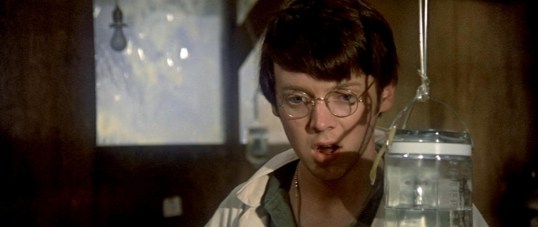
Though he had previously appeared in two earlier films, Cort got an “introducing” credit for his role in MASH. He played Boone, a usually quiet corpsman who speaks with a slight stutter. When a patient in Post-Op develops complications, Major Frank Burns (Robert Duvall) tells Boone to get a cardiac needle. Boone obviously isn’t sure what Burns needs but Burns snaps at him to get it. When Boone comes back with a needle, the patient has already died. Burns calls Boone an idiot for getting the wrong needle. Burns offers to get a nurse. “It’s too late, Boone,” Burns says, motioning at the dead man, “you killed him.” Burns walks away as Boone, a look of shock on his face, tries not to cry.
And I have to admit that I want to cry with him. It’s one of the more shocking scenes in Altman’s film and it works because of not only Robert Duvall’s memorably nasty turn as Burns but also Bud Cort’s emotional vulnerability of Boone. Boone, who is in Korea because he was drafted, has not only seen a man die but he’s been told that he’s responsible. With just the slightly cocking of his head and the sniffling of a young man who doesn’t want to cry on duty, Bud Cort shows us just how devastated Boone is.
And, of course, Boone was not responsible. Trapper John (Elliott Gould) takes one look at the patient’s chart and sees that it was Burns’s own incompetence that is to blame. When Trapper punches out Burns, it’s a cathartic moment. The only thing you regret is that Boone wasn’t in the room to see it.
That was Bud Cort’s big moment in MASH, though he appears throughout the film. Indeed, if you watch carefully, there’s a subplot in which Boone starts dating one of the nurses and eventually becomes much more confident in himself. We don’t know much about Boone but we do see that he’s become a member of the gang. Unlike Burns or David Arkin’s Sgt. Vollmer, Boone is accepted by the inhabitants of the Swamp.
He even gets to attend the mock suicide of Painless.. Reportedly, Boone’s line of “You’re throwing away your whole education,” was improvised on the spot by Bud Cort.
Mad bomber Rollo Dillon (Fred Ward) has been hired by terrorists to bomb a major American institution. Captain Ed Hocken (George Kennedy) and Detective Nordberg (O.J. Simpson) know that there’s only one man who can handle this job and his name is Frank Drebin (Leslie Nielsen). Frank, however, has retired from Police Squad and promised his wife, Jane (Priscilla Presley), that he is through with police work.
At heart, Frank remains a cop. He even dreams of shoot-outs. When he tries to do police work without Jane noticing, it backfires on him. Even though Frank lies and claims that he’s just having an affair, Jane leaves him. Frank, with nothing better to do, goes into prison undercover to gain Rollo’s confidence. After Rollo and Frank escape, Frank discovers that Rollo and his girlfriend (Anna Nicole Smith) is planning on bombing the Academy Awards!
The Naked Gun 33 1/3 is the weakest of the original Police Squad films, which is to say that it’s still pretty funny, even if some of the jokes no longer feel as fresh as they did in the previous films. It opens with a brilliant send-up of the shoot-out from The Untouchables and it ends with a perfect parody of the Academy Awards. (Pia Zadora singing This Could Be The Start Of Something Big is funny because it’s exactly the sort of thing that used to happen at the Oscars.) It’s in the middle section that the film drags, though there are still things that made me laugh, like a flashback to Frank, Ed, and Nordberg in the 70s. David Zucker did not return to direct this installment and his absence is definitely felt.
Leslie Nielsen is as funny as ever and he’s well-matched with George Kennedy and Priscila Presley. (OJ Simpson’s presence is as awkward as ever.) Fred Ward plays his villainous role straight, a smart move. But then you’ve got Anna Nicole Smith, who was such a terrible actress that her presence in the film doesn’t even work as a joke. Whenever Smith shows up, the film grinds to a halt. It’s the worst type of stunt casting.
This was Leslie Nielsen final performance as Frank Drebin. Even in a lesser film, he was still a comedic treasure.
1992’s The Player tells the story of Griffin Mill (Tim Robbins).
It’s not easy being Griffin Mill. From the outside, of course, it looks like he has the perfect life. He’s a studio executive with a nice house in Hollywood. He’s young. He’s up-and-coming. Some people, especially Griffin, suspect that he’ll be the president of the studio some day. By day, he sits in his office and listens to pitches from respected screenwriters like Buck Henry. (Henry has a great idea for The Graduate II!) During the afternoon, he might attends dailies and watch endless takes of actors like Scott Glenn and Lily Tomlin arguing with each other. Or he might go to lunch and take a minute to say hello to Burt Reynolds. (“Asshole,” Burt says as Griffin walks away.) At night, he might go to a nice party in a big mansion and mingle with actors who are both young and old. He might even run into and share some sharp words with Malcolm McDowell.
But Griffin’s life isn’t as easy as it seems. He’s constantly worried about his position in the studio, knowing that one box office failure could end his career. He fears that a new executive named Larry Levy (Peter Gallagher) is after his job. Two new screenwriters (Richard E. Grant and Dean Stockwell) keep bugging him to produce their downbeat, no-stars anti-capitol punishment film. His girlfriend (Cynthia Stevenson) wants to make good movies that mean something. Even worse, someone is sending Griffin threatening notes.
It doesn’t take long for Griffin to decide that the notes are coming from a screenwriter named Dave Kahane (Vincent D’Onofrio). Griffin’s attempt to arrange a meeting with Dave at a bar so that Griffin can offer him a production deal instead leads to Griffin murdering Dave in a parking lot. While the other writers in Hollywood mourn Dave’s death, Griffin starts a relationship with Dave’s artist girlfriend (Great Scacchi) and tried to hide his guilt from two investigating detectives (Whoopi Goldberg and Lyle Lovett). Worst of all, the notes keep coming. The writer, whomever they may be, is now not only threatening Griffin but also seems to know what Griffin did.
After spend more than a decade in the industry wilderness, Robert Altman made a critical and commercial comeback with The Player. It’s a satire of Hollywood but it’s also a celebration of the film industry, featuring 60 celebrities cameoing as themselves. Everyone, it seems, wanted to appear in a movie that portrayed studio execs as being sociopathic and screenwriters as being whiny and kind of annoying. The Player both loves and ridicules Hollywood and the often anonymous men who run the industry. Largely motivated by greed and self-preservation, Griffin may not love movies but he certainly loves controlling what the public sees. In the end, only one character in The Player sticks to her values and her ideals and, by the end of the movie, she’s out of a job. At the same time, Griffin has a social life that those in the audience can’t help but envy. He can’t step out of his office without running into someone famous.
The Player is one Altman’s most entertaining films, with the camera continually tracking from one location to another and giving as a vision of Hollywood that feels very much alive. Tim Robbins gives one of his best performances as Griffin Mill and Altman surrounds him with a great supporting cast. I especially liked Fred Ward as the studio’s head of security. With The Player, Altman mixes melodrama with a sharp and sometimes bizarre comedy, with dialogue so snappy that the film is as much a joy to listen to as to watch. That said, the real attraction of the film is spotting all of the celebrity cameos. (That and cheering when Bruce Willis saves Julia Roberts from certain death.) Altman was a director who often used his films to explore eccentric communities. With The Player, he opened up his own home.
Though the Academy of Motion Picture Arts and Sciences claim that the Oscars honor the best of the year, we all know that there are always worthy films and performances that end up getting overlooked. Sometimes, it’s because the competition too fierce. Sometimes, it’s because the film itself was too controversial. Often, it’s just a case of a film’s quality not being fully recognized until years after its initial released. This series of reviews takes a look at the films and performances that should have been nominated but were, for whatever reason, overlooked. These are the Unnominated.
Elliott Gould is Phillip Marlowe!
If I had to pick one sentence to describe the plot of 1973’s The Long Goodbye, that would be it. Robert Altman’s adaptation of the Raymond Chandler detective novel loosely follows Chandler’s original plot, though Altman did definitely make a few important changes. Altman moved the story from the 50s to the then-modern 70s, replacing Chandler’s hard-boiled Los Angeles with a satirical portrait of a self-obsessed California, populated by gurus and hippies. And Altman did change the ending of the book, taking what one could argue is a firmer stand than Chandler did in the novel. In the end, though, the film really is about the idea of Chandler’s tough detective being reimagined as Elliott Gould.
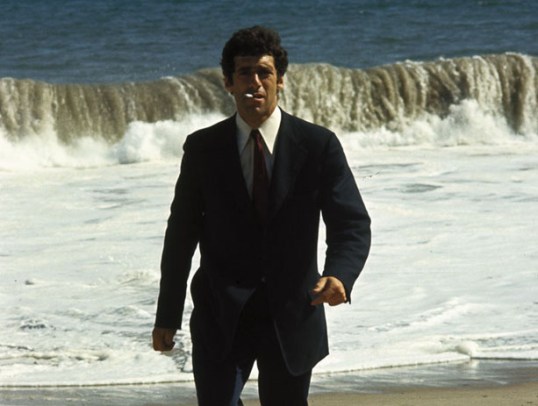
Rumpled, mumbling, and with a permanent five o’clock shadow, Gould plays Marlowe as being an outsider. He lives in a shabby apartment. His only companion is a cat who randomly abandons him (as cats tend to do). With his wardrobe that seems to consist of only one dark suit, Marlowe seems out-of-place in the California of the 70s. When Marlowe’s friend, Terry Lennox (Jim Bouton), asks Marlowe to drive him to Mexico, one gets the feeling that Lennox isn’t just asking because Marlowe’s a friend. He’s asking because he suspects Marlowe would never be a good enough detective to figure out what he’s actually doing.
After Terry’s wife is murdered, Marlowe is informed that 1) Terry has committed suicide and 2) Marlowe is now a suspect. Convinced that Terry would have never killed himself, Marlowe investigates on his own. He meets Marty Augustine (Mark Rydell), a gangster who demands that Marlowe recover some money that he claims Terry stole. Marty seems like an almost reasonable criminal until he smashes a coke bottle across his girlfriend’s face. (One of Marty’s bodyguards is played by a silent Arnold Schwarzenegger.) Meanwhile, Terry’s neighbors include an alcoholic writer named Roger Wade (Sterling Hayden) and his wife, Eileen (Nina van Pallandt). Like Marlowe, Roger is a man out-of-time, a Hemingwayesque writer who has found himself in a world that he is not capable of understanding. Henry Gibson, who would later memorably play Haven Hamilton in Altman’s Nashville, appears as Wade’s “doctor.”
Marlowe, with his shabby suits and a cigarette perpetually dangling from his mouth, gets next to no respect throughout the film. No one takes him seriously but Marlowe proves himself to be far more clever than anyone realizes. Elliott Gould gives one of his best performances as Marlowe, playing him as a man whose befuddled exterior hides a clear sense of right and wrong. Gould convinces us that Marlowe is a man who can solve the most complex of mysteries, even if he can’t figure out where his cat goes to in the middle of the night. His code makes him a hero but it also makes him an outsider in what was then the modern world. The film asks if there’s still a place for a man like Phillip Marlowe in a changing world and it leaves it to us to determine the answer.
Frequently funny but ultimately very serious, The Long Goodbye is one of the best detective films ever made. Just as Altman did with McCabe & Mrs. Miller, he uses the past to comment on what was then the present. And, just as with McCabe & Mrs. Miller, The Long Goodbye is a film that was initially released to mixed reviews, though it would later be acclaimed by future viewers and critics. Whereas McCabe & Mrs. Miller received an Oscar nomination for Julie Christie’s performance as Mrs. Miller, The Long Goodbye was thoroughly snubbed by the Academy. Altman, Gould, Hayden, and the film itself were all worthy of consideration but none received a nomination. Instead, that year, the Oscar for Best Picture went to The Sting, a far less cynical homage to the crime films of the past.
The Long Goodbye (1973, directed by Robert Altman)
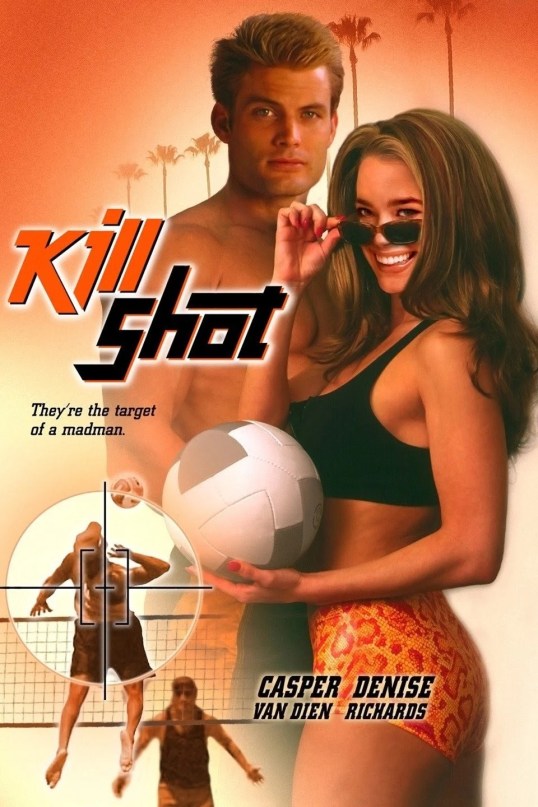
A group of college students all live in a California apartment complex that’s owned by Jake Mondello (Gianni Russo), who also owns a restaurant and sponsors a beach volleyball team. From the description that I read of the movie’s plot, I thought there would be a lot more beach volleyball and, from the title, I thought there would be a lot more thrills. Turns out I was wrong on both counts.
It’s pretty obvious that this was a pilot for a tv show that was inspired by Melrose Place. A lot of characters are introduced and they’re all shallow but pretty. Just like with Melrose Place, everyone has a drama and everyone has someone that they like but who they can’t tell about their feelings. Casper Van Dein is the most recognizable person in the cast. He plays a rich boy who likes to play volleyball and who falls for a poor girl. Other characters include Jacqueline Collen as a former volleyball star who is going back to college and who is being stalked by her ex (Jack Scalia), Catherine Lazo as the med student who loses her scholarship, and Ria Pavia as an abrasive science student who falls in love with her new roommate (Mushond Lee), even though he’s gay. Ernie Reyes, Jr. plays Koji, who is a computer nerd who says stuff like, “I just got a new CD-rom game.” He’s so good with computers that the police turn to him to help track phone calls and match finger prints. Denise Richards appears for two seconds and smiles at Casper. Gianni Russo is the worst actor in the movie but everyone loves Jake because Russo also wrote the script.
This was largely plotless and pointless. Casper was nice to look at but I didn’t care about any of the characters. There is a big beach volleyball game at the end but it only lasts for a few minutes and it was impossible to tell who was winning. One important character is taken out by a kill shot but no one notices. Watching the movie made me hate both the beach and volleyball.
Ezra Cohen (Jonah Hill) and Amirah Mohammed (Lauren London) have been dating for six months. Ezra is a Jewish atheist who works at a brokerage firm but who says his lifelong dream has been to be a podcaster. Lauren is Black and a devout Muslim. A graduate of Howard University, she is pursuing a career as a designer. Despite coming from very different backgrounds, Ezra and Amirah are deeply in love and want to get married. However, becoming engaged also means …. MEETING THE PARENTS!
Shelley and Arnold Cohen (played by Julia Louis-Dreyfus and David Duchovny) are self-styled progressives who immediately embarrass Ezra by going out of their way to trying to show how liberal and non-racist they are. Shelley, in particular, goes out of her way to bond with Amirah but it’s immediately obvious that Shelley views Amirah as being more someone to show off than as an actual human being. Meanwhile, Akbar Mohammed and Fatima Mohammed (played by Eddie Murphy and Nia Long) are members of the Nation of Islam who admire Louis Farrakhan and who claim that the Jews were behind the slave trade.
Just from that plot description, you can see a huge part of the problem with the new film, You People. Whereas Shelley’s problem is that she’s too quick to brag about how much she loves the idea of having a black daughter-in-law, Akbar’s problem is that he’s an anti-Semite. His main objections to Ezra are that 1) Ezra isn’t black and 2) Ezra’s Jewish. While Shelley takes Amirah shopping, Akbar tries to get Ezra killed by tricking him into wearing “the wrong colors” to a barbershop. While Shelley shows off Amirah to all of her liberal friends, Akbar shoves Ezra onto a basketball court. While Shelley is awkwardly trying to prove that she’s an ally, Akbar is inviting himself to Ezra’s wild Las Vegas bachelor party. (Akbar is disturbed to discover that Ezra has a “coke guy.” If this film had been made ten years ago, Ezra would have had a weed guy and it would have been easier to buy the film’s contention that Akbar is being unreasonable.) Shelley is certainly obnoxious and she fully deserves to get called out for her behavior. But Akbar is an anti-Semite who peddles the type of conspiracy theories that have been at the center of the alarming rise in recent hate crimes. Whereas Shelley is clueless, Akbar is actually malicious. And while that’s a story that one certainly could try to tell, it also makes it a bit difficult to buy the film’s fanciful ending. The movie ultimately can’t decide if it wants to be a fearless satire of race relations or a feel-good romcom. The tone of the film switches from scene to scene and Kenya Barris’s direction is so inconsistent that he makes Judd Apatow look like a disciplined filmmaker by comparison.
The cast is full of talent but the characters are largely one-dimensional. Jonah Hill is undoubtedly a good actor but he’s also nearly 40 years old and, with his full beard, he looks about ten years older, which makes it a bit hard to believe that he would be that concerned with getting the approval of his future in-laws. At first, a role of Akbar would seem ideal for Eddie Murphy but, with the exception of a scene where Akbar quizzes Ezra on his favorite Jay-Z song in an attempt to trick Ezra into saying the “n-word,” Murphy doesn’t really get to do much other than stand around with a pained expression on his face. Probably the most interesting performance in the film comes from Mike Epps, who plays Akbar’s brother and who is one of the few characters willing to call everyone out on their hypocrisy. But, unfortunately, Epps is only in a handful of scenes and the film uses him as more of a dramatic device than a fully rounded character.
As I watched You People, I couldn’t help but think about another film about an interracial wedding, Rachel Getting Married. That film provided a believable and multi-layered look at two different cultures coming together. You People, however, can’t quite make up its mind what it believes or what it wants to say and, unfortunately, what it does say is often said with a surprising lack of self-awareness. At times, it’s so proud of itself that it feels like it almost could have been written by Shelley Cohen.
With the Cannes Film Festival underway, I have been watching some of the past winners of the prestigious Palme d’Or. On Thursday night, Jeff and I watched the winner of the 1970 winner of the Grand Prix (as the Palme was known at the time), Robert Altman’s M*A*S*H.
There are, of course, three versions of M*A*S*H. All three of them deal with the same basic story of Dr. Hawkeye Pierce and his attempts to maintain his sanity while serving as a combat surgeon at the 4077th Mobile Army Surgical Hospital during the Korean war. All three of them mix comedy with the tragedy of war. However, each one of them takes their own unique approach to the material.
The one that everyone immediately thinks of is the old television series, which ran for 11 seasons and which can be found on Hulu and on several of the retro stations. The television series starred Alan Alda as Hawkeye. I’ve watched a handful of episodes and, while the episodes that I’ve seen were undeniably well-acted and well-written and they all had their heart in the right place, the show’s deification of Hawkeye can get to be a bit much. Not only is Hawkeye the best surgeon at the 4077th, he’s apparently the best surgeon in all of Korea. In fact, he may be the best surgeon on the entire planet. Not a single thing happens in the camp unless Hawkeye is somehow involved. When a nurse is killed by a landmine in one episode, the focus is not on the other nurses but instead on how Hawkeye feels about it. When bombs are falling too close to the camp, the focus is again only on Hawkeye and how much he hates the war. If you didn’t already know that he hated the war, Hawkeye will let you know. Wish Hawkeye a good morning and he’ll yell at you about how many people are going to be wounder by the end of the day. Even when one agrees with Hawkeye, the character’s self-righteousness can be a bit much.
Less well-known is the first version of M*A*S*H, a short and episodic novel that was published in 1968. The novel was written by Dr. Richard Hornberger, who actually had served in Korea at a M*A*S*H unit and who reportedly based Hawkeye on himself. The book is a rather breezy affair. Reading it, one can definitely tell that it was inspired by someone telling Hornberger, “Your stories about Korea are so funny and interesting, you should write them down!” The book avoids politics, reserving most of its ire for military red tape. Hornberger was a Republican who so disliked Alan Alda’s interpretation of Hawkeye that, when he wrote a sequel to M*A*S*H, he included a scene in which Hawkeye talked about how much he enjoyed beating up hippies.
And then there’s the version that came in between the book and the television series, the 1970 film from Robert Altman. The film retains the book’s episodic structure while also throwing in the anti-war politics that would define the television series. (Though the film was set in the 50s, Altman purposefully made no attempt to be historically accurate because he wanted it to be clear that this film was more about Vietnam than Korea.) From its opening, the film announces its outlook, with shots of helicopters carrying severely wounded (possibly dead) soldiers to the camp while a song called Suicide is Painless plays on the soundtrack. The song was written by director Robert Altman’s fourteen year-old son, Mike. Reportedly, it took Mike five minutes to come up with the lyrics. When the instrumental version of the song was later used as the theme song for the television series, Mike Altman made over a million dollars in royalties.
The film opens with Hawkeye Pierce (Donald Sutherland) and Duke Forrest (Tom Skerritt) arriving at the 4077th MASH in a stolen jeep and it ends with them getting sent home in the same jeep. Though Duke is set up to be a major character, he soon takes a backseat to another surgeon, the unfortunately nicknamed Trapper John (Elliott Gould). Much as with the television series, the movie centers around Hawkeye and Trapper John’s antics. When they’re not in the operating room, they’re drinking, carousing, and playing pranks that are far more mean-spirited than anything the television versions of the characters would have ever done. (Indeed, the book and movie versions of Hawkeye probably would have hated Alan Alda’s Hawkeye.) Unlike the television version of Hawkeye, the film’s Hawkeye is not the best surgeon in Korea. In fact, he’s not even the best surgeon at the 4077th. (That honor goes to Trapper.) Instead, he’s just one of many doctors on staff. They’re rotated in and then, at the end of their tour, they’re rotated out. Hawkeye loses as many patients as he saves. The film’s doctors are not miracle workers, nor are they crusaders. Instead, they are overworked, neurotic, often exhausted, and frequently bored whenever there aren’t any wounded to deal with. The film emphasizes that the doctors are as professional inside the Operating Room as they’re rambunctious outside of it. Unlike the television series, Hawkeye doesn’t joke while working. He’s usually too busy trying to stop his patients from bleeding to death to tell jokes or to complain about the war that brought them to the OR.
Indeed, the film version of M*A*S*H communicates its anti-war message not through indignant speeches but instead through bloody imagery. The operating room scenes don’t shy away from showing the ugliness of war and they are occasionally so visceral that they almost seem to shame the audience for have laughed just a few minutes earlier. One of the film’s more famous (and controversial) sequences features Hawkeye driving Frank Burns (Robert Duvall) to insanity by crudely taunting him about his affair with head nurse Margaret Houlihan (Sally Kellerman). Burns attacks Hawkeye, a response that actually seems rather justified even if it is played for laughs. A scene of Burns being driven out of the camp in straitjacket is followed by a close-up of a geyser of blood erupting from a wounded soldier’s throat. It’s a jarring transition but one that makes a stronger anti-war statement than any self-righteous monologue would have. While Hawkeye and Trapper are taunting Burns and Margaret, soldiers are still being sent off to die.
The humor in M*A*S*H is often brutally misogynistic. Margaret is described as being “a damn good nurse” but is continually humiliated because she believes in maintaining military discipline. One can disagree with her emphasis on following all of the proper regulations while also realizing the Hawkeye and Trapper’s treatment of her is unreasonably cruel. The scene where Trapper and Hawkeye expose her while she’s taking a shower is especially difficult to watch and there’s no way to justify their actions. It’s frat boy humor, the type of stuff that you would expect from a bunch of former college football players, which is what we’re told Hawkeye and Trapper are. (That, of course, is another huge difference between the film and television versions of the characters.) That said, it’s debatable whether or not were supposed to find either Hawkeye or Trapper to be heroic or even likable. As a director, Robert Altman shied away from making films with unambiguous heroes or villains. Just as Margaret could be a “damn good nurse” and a “regular army clown” at the same time, Hawkeye can be both a dedicated doctor and a bit of a jerk.
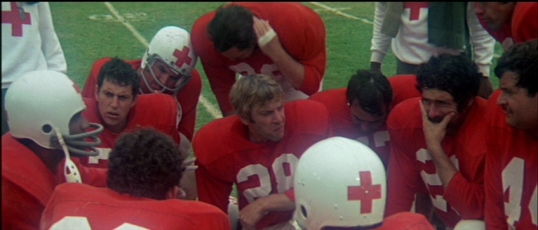
After 90 minutes of bloody operating room scenes and Trapper and Hawkeye making crude jokes, M*A*S*H suddenly becomes a sports film as the the 4077th plays a football game against their rivals, the 325th Evac Hospital. The change of tone can be a bit jarring but it’s perhaps the most important sequence in the film. For a few hours, the doctors bring “the American way of life” to Korea and the end result is a game that’s played for money and which is only won through cheating and deception. (Future blaxploitation star Fred Williamson made his film debut as the ringer who the 4077th recruits for the game.) For all of the broad comedy of the game, it’s followed by a shot of the doctors playing poker while a dead soldier is transported out of the camp, wrapped in a white sheet. Football may provided a distraction. The money may have provided an incentive. But the war continued and people still died.
Much of M*A*S*H‘s humor has aged terribly but the performances still hold up and the anti-war message is potent today. Though Sutherland and Gould are undeniably the stars of the film, M*A*S*H is a true ensemble film, full of the overlapping dialogue and the small character performances that Robert Altman’s films were known for. One reason why the film works is because it is an immersive experience, the viewer truly does feel as if they’ve been dropped in the middle of an operating field hospital. Though Hawkeye and Trapper may be at the center of the action, every character, from the camp’s colonel to the lowliest private, seems to have their own story playing out. This a film where paying attention to the little things happening in the background is often more rewarding than paying attention to the main action. I particularly liked the performances of David Arkin as the obsequies Staff Sergeant Vollmer and Bud Cort as Pvt. Warren Boone. Boone, especially, seems to have an interesting story going on in the background. The viewer just has to keep an eye out for him. Also be sure to keep an eye out for Rene Auberjonois, who reportedly improvised one of the film’s best-known lines when, after Margaret demands to know how Hawkeye reached a position of authority in the army medical corps, he deadpanned, “He was drafted.”
One of the first major studio films to be openly critical of the military and the war in Vietnam, M*A*S*H won the Palme d’Or, defeating films like Investigation of a Citizen Above Suspicion and The Strawberry Statement. Unlike many Palme winners, it was also a box office success in the United States. Though controversial, it received an Oscar nomination for Best Picture. However, unlike the Cannes jury, the Academy decided to honor a different film about war, Patton.
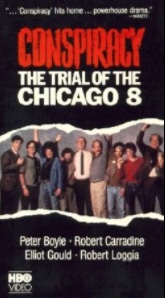
The year is 1969 and, in an Illinois courtroom, 8 political radicals stand accused of conspiring to disrupt the 1968 Democratic Convention. The prosecution is putting the entire anti-war movement on trial while the defendants are determined to disrupt the system, even if it means being convicted. The eight defendants come from all different sides of the anti-war movement. Jerry Rubin (Barry Miller) and Abbie Hoffman (Michael Lembeck) represent the intentionally absurd Yippies. Tom Hayden (Brian Benben) and Rennie Davis (Robert Carradine) are associated with the Students for a Democratic Society. Bobby Seale (Carl Lumbly) is one of the founders of the Black Panthers while David Dellinger (Peter Boyle) is a longtime peace activist. John Friones (David Kagan) and Lee Weiner (Robert Fieldsteel) represent the common activists, the people who traveled to Chicago to protest despite not being a leader of any of the various organizations. Prosecuting the Chicago 8 are Richard Schulz (David Clennon) and Tom Foran (Harris Yulin). Defending the 8 are two radical lawyers, Leonard Wienglass (Elliott Gould) and William Kunstler (Robert Loggia). Presiding over the trial is the fearsome and clearly biased Judge Julius Hoffman (David Opatoshu).
Conspiracy: The Trial of the Chicago 8 is a dramatization of the same story that inspired Aaron Sorkin’s The Trial of the Chicago 7 but, of the two films, it’s Jeremy Kagan’s The Trial of the Chicago 8 that provides a more valuable history lesson. By setting all of the action in the courtroom and recreating only what was said during the trial, director Jeremy Kagan and his cast avoid the contrived drama that marred so much of Sorkin’s film. Kagan trusts that the true story is interesting enough to stand on its own. Kagan includes documentary footage from the convention protest itself and also interviews with the people who were actually there. While Kagan may not have had the budget that Sorkin did, his film has the authenticity that Sorkin’s lacked. Kagan also has the better cast, with Michael Lembeck and Barry Miller both making Abbie Hoffman and Jerry Rubin into something more than the mere caricatures that they are often portrayed as being.
The Trial of the Chicago 8 was a film that Jeremy Kagan spent a decade trying to make. When he first tried to sell the idea behind the film to CBS in 1976, Kagan had Marlon Brando, Walter Matthau, George C. Scott, and Dustin Hoffman all willing to work for scale and take part in the production. CBS still passed on the project, saying that no one was interested in reliving the 60s. It wasn’t until 1987 that Jeremy Kagan was finally able to revive the film, this time with HBO. It actually worked out for the best because, with HBO, there was no need to try to come up with a “clean” version for the language that was used in the courtroom or in the interviews with the actual participants. The defendants could be themselves.
Though it has been overshadowed by Sorkin’s subsequent film, The Trial of the Chicago 8 is the definitive film about what happened in the aftermath of the the 1968 Democratic Convention.
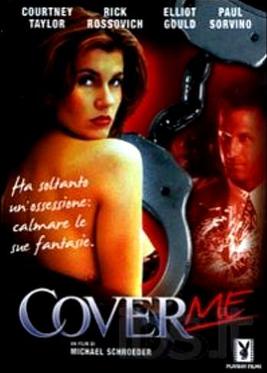
A serial killer is stalking Los Angeles, killing the models who have appeared in an adult magazine. Because they’re not very good at their jobs, neither Sgt. Bobby Colter (Rick Rossovich) nor Detective J.J. Davis (Paul Sorvino!) have come up with any leads that could lead them to the murderer. Facing a dead end, they come up with a brilliant idea. Maybe a cop could go undercover as an erotic model! Fortunately, Bobby just happens to be dating a surprisingly attractive cop named Holly (Courtney Taylor). You have to love it when a plan comes together.
At first, Holly is hesitant but, realizing that there’s no other possible way to get the killer off the streets (because it’s certainly not like Bobby or J.J. could actually do any police work on their own), she agrees to pose for some pictures. Soon, she’s appearing in the magazine, working as a stripper, and discovering that she enjoys her new uninhibited lifestyle. Meanwhile, the killer has noticed her. The killer, by the way, is Dimitri (Stephen Nichols), who frequently disguises himself as a woman and who is driven to kill by his mother. Dimitri’s identity is revealed early on in the film so this doesn’t count as a spoiler. Cover Me is a mystery but it’s a mystery where everyone figures it all out except for the people who are supposed to be figuring it out.
Cover Me was one of the many direct-to-video films that found a home on late night Cinemax in the 90s. These films were advertised as being “erotic thrillers,” though there was usually little about them that was either erotic or thrilling. Cover Me was produced by Playboy and distributed by Paramount, which means that Hugh Hefner probably used to show up on set, wearing his sea captain’s hat and asking the strippers if they wanted to come back to the mansion and help him look for his Viagra. Because it’s a Playboy film, Cover Me has higher production values than the typical 90s erotic thriller but it’s still interesting that a company best known for publishing an adult magazine would produce a film about a killer targeting nude models. In the 70s, Playboy produced things like Roman Polanski’s adaptation of MacBeth, a cinematic triumph regardless of how one feels about Polanski as a human being. By the time the 90s rolled around, they were producing slightly less classy versions of Stripped to Kill.
Still, Cover Me is better than many of the other erotic thrillers that came out during the direct-to-video era. That doesn’t mean that it was a good movie, of course. There’s a reason why “Skinemax” was go-to punchline during the 1990s. As opposed to many of the other movies of the era and the genre, Cover Me has a talented cast that tries to make the best of the material that they’ve been given. I don’t know how Rick Rossovich went from appearing in The Terminator and Top Gun to starring in something like Cover Me but he delivers his lines with a straight face, which could not have always been easy. Paul Sorvino, Elliott Gould, and Corbin Bernsen are also on hand, all playing their parts like pros. (Between L.A. Law and Psych, Bernsen was a mainstay in these type of films, almost always playing either a pimp, a pornographer, or a strip club owner.) Finally, there’s Courtney Taylor, who is actually pretty good in the role of Holly. Though the role really only calls for her to be sexy, Taylor still plays it with a lot of conviction. Taylor’s performance is natural and likable and she sells even the most clichéd dialogue. Just as when she starred in the fourth Prom Night film, Taylor is always better than her material. Unfortunately, Courtney Taylor appears to have stopped acting around 2000.
Cover Me was shot at the same time as an early CD-Rom game called Blue Heat, where I guess the player would step into Holly’s shoes and try to solve the case. Because the company that developed the game went out of business before the game was published, Blue Heat didn’t come out until two years after Cover Me. I’ve never played the game but, from what I’ve read online, it was a point-and-click game where you could go to various places in Los Angeles and search for clues and interrogate suspects. The game came with multiple endings, depending on the decisions you made. Did anyone ever play this game? Let me know in the comments!
As for Cover Me, it’s not great but it’s also not terrible, which is high praise when it come to late night CInemax.
As soon as Elliott Gould showed up, I knew he was going to die.
Now, of course, I should clarify that I didn’t think that Elliott Gould the actor was going to die. Instead, I thought that the character he was playing — Leonard Wellesley — was going to die. Leonard, after all, is a wealthy man who has no family left and who is in bad health. He keeps trying to give money to his caregiver, Katie (Camila Mendes). Katie consistently refuses the money, even though she could really use it. She and her husband, Adam (Jessie T. Usher), are drowning in debt. Even after Leonard hires Adam to work as his gardener, they’re still struggling to make ends meet. Still, Katie doesn’t want to take Leonard’s money because Katie doesn’t want to take advantage of him.
For the plot to move forwards, it’s necessary for Leonard to die, though not before changing his will to leave everything to Katie. Normally, when this happens in a movie, it turns out that the caregiver actually manipulated her employer into changing the will before murdering him but, in this case, Katie is totally innocent. It’s actually kind of a nice twist. As played by Camila Medes, Katie is someone who sincerely is trying to do the right thing, even if it means her life is occasionally difficult. As played by Elliott Gould, Leonard may be a bit eccentric but he’s still just sincerely trying to thank the person who made his final days bearable.
(Admittedly, another reason why I knew Leonard was going to die was because, whenever a veteran actor like Elliott Gould shows up in a movie like this, he’s usually going to end up playing someone who dies under mysterious circumstances. Call it the Rule of Eric Roberts.)
Moving into Leonard’s house, Katie and Adam are surprised to discover a large trunk of cash. While Katie wonders why exactly Leonard would have a huge trunk of money hidden away in his house, Adam is more concerned with what they can do with that money. While Katie tries to resist the urge to get greedy, Adam starts obsessing on the money. What else does Leonard have hidden around the house?
Meanwhile, a mysterious man named Hayden (Cam Gigandet) watches the house and plots his next move….
Dangerous Lies is a thriller that was released on Netflix back in April. This is probably one of those low-budget movies that would have been overlooked if not for the fact that everyone was pretty much locked inside their house when it was released. Watching Dangerous Lies provided a nice escape from the bad news of the pandemic. Speaking for myself, it was kind of fun to watch Katie and Adam explore their new home. After being stuck inside of mine for a month, the idea that I could suddenly inherit a mansion provided a nice bit of wish-fulfillment.
As for the film itself, it was a diverting thriller. Elliott Gould brought some unexpected depth to the role of Leonard and Camila Mendes and Jessie T. Usher were believable as the couple at the center of the story. They had a believable chemistry and Usher did a good job of portraying Adam’s losing struggle with his own greed. This is the type of simple but entertaining film that you watch if you have a few hours to kill in the afternoon and there’s nothing wrong with that.




 Through the Shattered Lens