1941’s THE MALTESE FALCON may not be the first film noir (most people agree that honor goes to 1940’s STRANGER ON THE THIRD FLOOR ). It’s not even the first version of Dashiell Hammett’s 1930 detective story – there was a Pre Code film with Ricardo Cortez as Sam Spade that’s pretty good, and a 1936 remake titled SATAN MET A LADY with Warren William that’s not. But first-time director John Huston’s seminal shamus tale (Huston also wrote the amazingly intricate screenplay) virtually created many of the tropes that have become so familiar to fans of this dark stylistic genre:
THE HARD-BOILED DETECTIVE – Private investigators had been around since the dawn of cinema, from Sherlock Holmes to Philo Vance to Charlie Chan, but none quite like Humphrey Bogart’s Sam Spade. Both Cortez and William played the character as flippant skirt-chasers, but in Bogie’s hands, Sam Spade is a harder…
The original The House on Haunted Hill is a classic and one that we make it a point to share every Halloween. And since Erin shared the film’s poster earlier today, now seems like the perfect time to do so!
Before Stanley Kubrick became Stanley Kubrick, he made a pair of low-budget crime dramas in the mid-50’s that are standouts in the film noir canon. The second of these, THE KILLING, is a perfect movie in every way imaginable, showing flashes of the director’s genius behind the camera, featuring just about the toughest cast you’re likely to find in a film noir, and the toughest dialog as well, courtesy of hard-boiled author Jim Thompson.
THE KILLING is done semi-documentary style (with narration by Art Gilmore), and follows the planning, execution, and aftermath of a two million dollar racetrack heist. Sterling Hayden plays the mastermind behind the bold robbery, a career criminal looking for one last score. He’s aided and abetted by a moneyman (Jay C. Flippen ), a track bartender (Joe Sawyer ), a teller (Elisha Cook Jr. ), and a crooked cop (Ted de Corsia ). He…
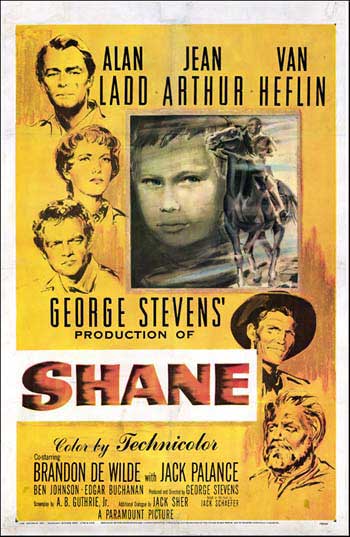
There’s a few ways in which you can view the 1953 film, Shane.
The more popular view is that it’s a Western about a man named Shane (Alan Ladd) who rides into town and gets a job working for the Starretts, Joe (Van Heflin) and Marian (Jean Arthur). Joe is a farmer who is determined to hold onto his land, despite the efforts of cattle baron Rufus Ryker (Emile Meyer) to force him off of it. While we don’t learn much about Shane’s background, it becomes apparent that he’s a man who can fight. That comes in handy when Ryker brings in a sinister gunfighter named Wilson (Jack Palance).
Another view is that Shane is the story of a man who just wants to settle down but, instead, finds himself continually hounded by an annoying little kid, to the extent that he finally gets involved in a gun battle just so he’ll have an excuse to leave town and get away from the little brat. Little Joey Starrett (Brandon deWilde) idolizes Shane from the minute that he comes riding up. When he hears that Shane refused to get into a fight at the local saloon, Joey demands to know whether it was true. He tells his mom that he loves Shane almost as much as he loves his father. When Shane does get into a brawl with all of Ryker’s men, Joey stands in the corner and eats candy. And then, when Shane tries to leave town, Joey runs behind him shouting, “Come back, Shane! Come back!”
Myself, I think of it as being the story of Frank Torrey (Elisha Cook, Jr.). Frank is the farmer that’s been nicknamed “Stonewall,” due to his status as a former Confederate and his quick temper. Stonewall may be smaller than the other farmers but he’s usually the quickest to take offense. Still, it’s impossible not to like him, largely because he’s played by Elisha Cook, Jr. When Wilson feels the need to put the farmers in their place, he does so by picking a fight with Torrey. Standing on a porch in the rain, looking down on the smaller man, Wilson starts to insult both him and the South. When Torrey finally starts to reach for his gun, Wilson shoots him dead. While Torrey lies in the mud, Wilson smirks. It’s a shocking scene, all the more so for being shown in a long shot. (By forcing those of us in the audience to keep our distance from the shooting, the film makes us feel as powerless as the farmers.) If you didn’t already hate Wilson and Ryker, you certainly will after this scene.
Shane is a deceptively simple film, one in which many of the details are left open for interpretation. We never learn anything about Shane’s background. He’s a man who shows up, tries to make a life for himself, and then leaves. He’s a marksman and an obviously experienced brawler but, unlike Ryker’s men, he never specifically looks for violence. In fact, he often seems to avoid it. Why? The film doesn’t tell us but there are hints that Shane is haunted by his past. Shane seems to want a chance to have a life like the Starretts but, once he’s forced to again draw his gun, he knows that possibility no longer exists.
Is Shane in love with Marian Starrett? It certainly seems so but, again, the film never specifically tells us. Instead, it all depends on how one interprets the often terse dialogue and the occasional glances that Marian and Shane exchance. When Shane and Joe get into a fist fight to determine who will face Ryker and Wilson, is Shane really trying to protect Joe or is it that he knows Marian will be heart-broken if her husband is killed?
One thing’s for sure. Little Joey sure does love Shane. “Come back, Shane!” Little Joey follows Shane everywhere, with a wide-eyed look on his face. To be honest, it didn’t take too long for me to get sick of Little Joey. Whenever director George Stevens needed a reaction shot, he would cut to Joey looking dumb-founded. Brandon deWilde was 11 years when he appeared in Shane and he was nominated for an Oscar but he’s actually pretty annoying in the role. Elisha Cook, Jr. was far more impressive and deserving of a nomination.
I know that many people consider Shane to be a classic. I thought it was good, as long as the action was focused on the adults. Alan Ladd plays Shane like a man who is afraid to get too comfortable in any situation and the film works best when it compares his reticence to Wilson’s cocky confidence. Whenever Joey took center stage, I found myself wanting to cover my ears.
Shane was nominated for Best Picture but lost to From Here To Eternity.
For today’s horror on the lens, we have a real treat! (We’ll get to the tricks later…)
Long before he achieved holiday immortality by playing the father in A Christmas Story, Darren McGavin played journalist Carl Kolchak in the 1972 made-for-TV movie, The Night Stalker. Kolchak is investigating a series of murders in Las Vegas, all of which involve victims being drained of their blood. Kolchak thinks that the murderer might be a vampire. Everyone else thinks that he’s crazy.
When this movie first aired, it was the highest rated made-for-TV movie of all time. Eventually, it led to a weekly TV series in which Kolchak investigated various paranormal happenings. Though the TV series did not last long, it’s still regularly cited as one of the most influential shows ever made.
Anyway, The Night Stalker is an effective little vampire movie and Darren McGavin gives a great performance as Carl Kolchak.
Emperor of the North Pole is the story of depression-era hobos and one man who is determined to kill them.
The year is 1933 and Shack (Ernest Borgnine) is one of the toughest conductors around. At a time when destitute and desperate men are riding the rails in search of work and food, Shack has declared that no one will ride his train for free. When Shack is first introduced, the sadistic conductor is seen shoving a hobo off of his train and onto the tracks. Shack smiles with satisfaction when the man is chopped in half under the train’s wheels.
A-No.1 (Lee Marvin) is a legend, the unofficial king of the hobos. A grizzled veteran, A-No. 1 has been riding the rails for most of his life. (The title comes from the hobo saying that great hobos, like A-No. 1, are like the Emperor of the North Pole, the ruler of a vast wasteland). A-No. 1 is determined to do what no hobo has ever done, successfully hitch a ride on Shack’s train. He even tags a water tower, announcing to everyone that he intends to take Shack’s train all the way to Portland.
If A-No. 1 did not have enough to worry about with Shack determined to get him, he is also being tailed by Cigaret (Keith Carradine), a young and cocky hobo who is determined to become as big a legend as A-No. 1. Cigaret and A. No. 1 may work together but they never trust each other.
Like many of Robert Aldrich’s later films, Emperor of the North Pole is too long and the rambling narrative often promises more than it can deliver. Like almost all movies that were released at the time, Emperor of North Pole attempts to turn its story into a contemporary allegory, with Shack standing in for the establishment, A-No. 1 representing the liberal anti-establishment, and, most problematically, Cigaret serving as a symbol for the callow counter culture, eager to take credit for A-No. 1’s accomplishments but not willing to put in any hard work himself.
As an allegory, Emperor of the North Pole is too heavy-handed but, as a gritty adventure film, it works wonderfully. Lee Marvin is perfectly cast as the wise, no-nonsense A-No. 1. This was the sixth film in which Marvin and Borgnine co-starred and the two old pros both go at each other with gusto. Carradine does the best he can with an underwritten part but this is Borgnine and Marvin’s film all the way. Marvin’s trademark underacting meshes perfectly with Borgnine’s trademark overacting, with the movie making perfect use of both men’s distinctive screen personas. As staged by Aldrich, the final fight between Shack and A-No. 1 is a classic.
Even at a time when almost every anti-establishment film of the early 70s is being rediscovered, Emperor of the North Pole remains unjustly obscure. When it was first released, it struggled at the box office. Unsure of how to sell a movie about hobos and worrying that audiences were staying away because they thought it might be a Christmas film, 20th Century Fox pulled the movie from circulation and then rereleased it under a slightly altered name: Emperor of the North. As far as titles go, Emperor of the North makes even less sense than Emperor of the North Pole. Even with the title change, Emperor of the North Pole flopped at the box office but, fortunately for him, Aldrich was already working on what would become his biggest hit: The Longest Yard.
Keep an eye out for Lance Henriksen, in one of his earliest roles. Supposedly, he plays a railroad worker. If you spot him, let me know because I have watched Emperor of the North Pole three times and I still can’t find him.
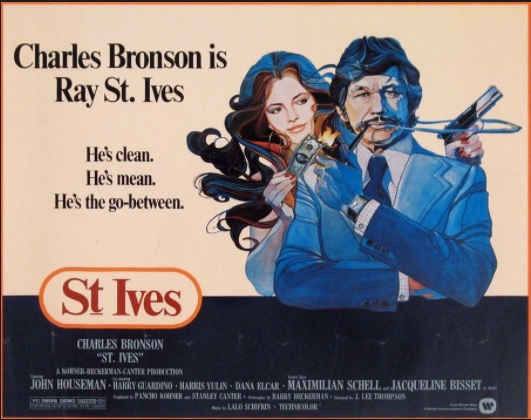
Raymond St. Ives (Charles Bronson) is a former cop-turned-writer who desperately needs money. Abner Procane (John Houseman) is a wealthy and cultured burglar who needs someone to serve as a go-between. Five of Procane’s ledgers have been stolen. The thieves are demanding a ransom and Procane believes that St. Ives is just the man to deliver the money. But every time that St. Ives tries to deliver the money, another person ends up getting murdered and St. Ives ends up looking more and more like a suspect. Who is the murderer? Is it Janet (Jacqueline Bisset), the seductive woman who lives in Procane’s mansion? Is it Procane’s eccentric psychiatrist (Maximillian Schell)? Could it be the two cops (Harry Guardino and Harris Yulin) who somehow show up at every murder scene? Only Ray St. Ives can solve the case!
Charles Bronson is best remembered for playing men of few words, the type who never hesitated to pull the trigger and do what they had to do. St. Ives was one of the few films in which Bronson got to play a cerebral character. Ray St. Ives may get into his share of fights but he spends most of the film examining clues and trying to solve a mystery. The mystery itself is not as important as the quirky people who St. Ives meets while solving it. St. Ives has a great, only in the 70s type of cast. Along with those already mentioned, keep an eye out for Robert Englund, Jeff Goldblum, Dana Elcar, Dick O’Neill, Daniel J. Travanti, Micheal Lerner, and Elisha Cook, Jr. It’s definitely different from the stereotypical Charles Bronson film, which is why it is also one of my favorites of his films. As this film shows, Bronson was an underrated actor. In St. Ives, Bronson proves that, not only could he have played Mike Hammer, he could have played Philip Marlowe a well.
St. Ives is historically significant because it was the first Bronson film to be directed by J. Lee Thompson. Thompson would go on to direct the majority of the films Bronson made for Cannon in 1980s, eventually even taking over the Death Wish franchise from Michael Winner.
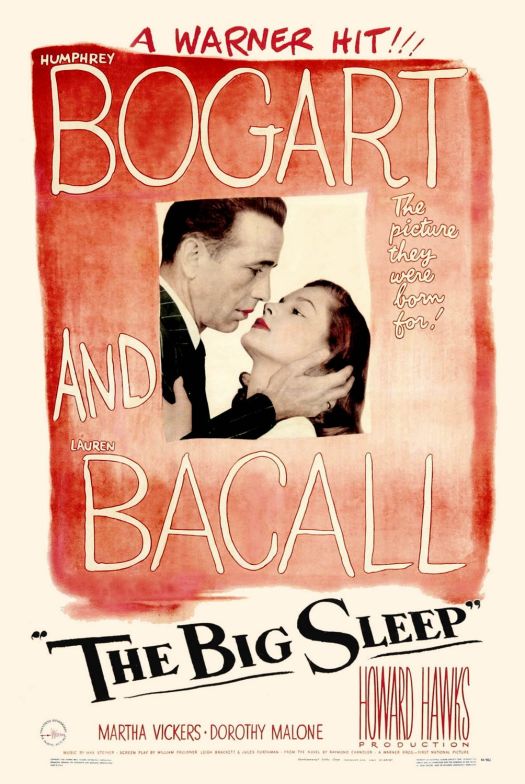
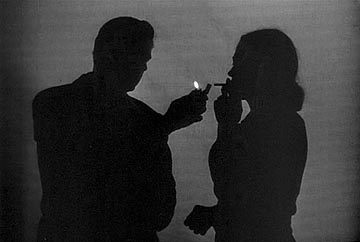
It’s been a long time since we last visited with Raymond Chandler’s fictional “knight-errant”, PI Philip Marlowe. Way too long, so let’s take a look at THE BIG SLEEP, starring Humphrey Bogart as the definitive screen Marlowe. This 1946 Howard Hawks film was a follow-up to 1944’s hit TO HAVE AND HAVE NOT, which introduced audiences (and Bogie) to luscious Lauren Bacall . The pair was dynamite together onscreen, and off as well, marrying a year later. Their May/December romance was one of Hollywood’s greatest love stories, lasting until Bogart’s death from cancer in 1957.
For me to try and explain the plot here would be futile, as it takes more twists and turns than a “Balinese belly dancer”. Marlowe is hired by elderly General Sternwood, whose sexy young daughter Carmen is being blackmailed. The General’s other daughter Vivien, a sexy divorcee, is also in trouble. This takes Our Man Marlowe…
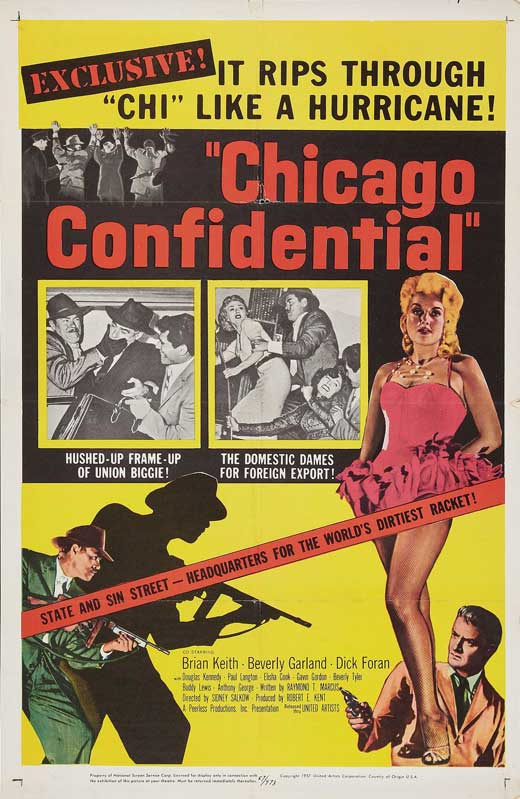
CHICAGO CONFIDENTIAL is just a routine ‘B’ crime drama, one of many churned out in the 50’s. Yet the performances of stars Brian Keith , Beverly Garland , and an above-average supporting cast helped elevate the by-the-numbers material into something watchable. It’s those Familiar Faces we all know and love from countless movies that made CHICAGO CONFIDENTIAL work for me.
The story revolves around racketeers muscling in on the Worker’s National Union so they can bring their “numbers rackets and ‘B’ girls” to the city. Politically ambitious State’s Attorney Jim Fremont is dead set on busting them up, and when the union’s treasurer is murdered, the finger of suspicion is pointed at honest Union President Artie Blane. Blane’s been framed by his rival, VP Ken Harrison, who takes his orders from “disbarred attorney” Alan Dixon, “one of the masterminds of the old Capone gang”. Blane is brought to trial and, thanks to some chicanery by an “old derelict” with the…


 Emperor of the North Pole is the story of depression-era hobos and one man who is determined to kill them.

 Through the Shattered Lens