Retro Television Review: Fantasy Island 7.14 “Lady of the house/Mrs. Brandell’s Favorites”


Welcome to Retro Television Reviews, a feature where we review some of our favorite and least favorite shows of the past!  On Tuesdays, I will be reviewing the original Fantasy Island, which ran on ABC from 1977 to 1984.  The show is once again on Tubi!

Justice for Tattoo!

Episode 7.14 “Lady of the House/Mrs. Brandell’s Favorites”

(Dir by Bob Sweeney, originally aired on February 25th, 1984)

This was one of the Fantasy Island episode that was not on my DVR.  However, now that the show is once again streaming in its entirety on Tubi, I was still able to watch it. Lucky me.

This is probably the worst episode of Fantasy Island that I’ve ever seen.

This episode gets off to a bad start with Mr. Roarke informing Lawrence that there will only be one guest with a fantasy this week.  That guest is Esther Brandell (Polly Bergen).  Whenever there’s only one guest and that guest is played by a middle-aged actress who was big in the 50s and the 60s, you know you’re about to spend an hour watching an hour of awkward melodrama that you’re supposed to excuse by saying, “She was great in Kisses For My President!”

Mrs. Brandell says that she’s a former sorority house mother who wants her three favorite sorority girls to be her bridesmaids at her wedding.  Actually, Mrs. Brandell was a former madam and the three “sorority girls” all worked for her.  Bebe (Lauren Tewes), Coleen (Randi Oakes), and Lynn (Shelley Smith) have all moved on and want to keep their past a secret.  Over the course of the episode, each will admit the truth to their current partner and each will realize that Mrs. Brandell really did protect and care about them.

This episode basically features the same scene over and over again.  Each of the girls works up the courage (or the anger) to admit that they were once a prostitute.  Their significant other reacts.  One guy tries to blackmail Mrs. Brandell.  Another reveals that he knew all along because “I’m an investigative reporter.”  Bebe’s idiot boyfriend (Dick Gautier) refuses to believe Bebe and insists that she sleep with another man for money so that he’ll be convinced.  What?  Bebe realizes that’s not her lifestyle anymore and she really does love her idiot boyfriend, the same one who pimped her out to some random guy on the Island.

And, through the whole thing, Polly Bergen delivers her lines in a voice that sounds like she just finished smoking a pack of cigarettes.  The truth of the matter is that Bergen is absolutely lousy in the role but the script is probably as much to blame as Bergen herself.  Every scene feels like it’s been cribbed from an old Barbra Stanwyck melodrama.  At the end of the episode, the vice cop (Robert Brown) who used to bust her shows up at the wedding.  “Everybody freeze!” he says.  Oh, thank God, everyone’s getting busted for overacting.  Oh wait — Mrs. Brandell (a widow) is marrying him!

The episode ends with the wedding, which would be touching if any of these characters were actually interesting.  Lawrence gives away the bride because I guess they had do something to justify paying Christopher Hewett’s salary.

This was not a good trip to the Island.  Is this season over yet?

A Blast From The Past: Wait Until Dark (dir by Barry Davis)


Malibu, CA will not be reviewed tonight so that we might bring you this special presentation….

My retro television reviews will return next week but, for now, why not enjoy something even better than me discussing my hatred of Malibu, CA?  1982’s Wait Until Dark is a videotaped record of a stage production of Frederick Knott’s classic play about a blind woman who is menaced by three criminals.  (I assume it was filmed for PBS.  According to Lettrboxd, this aired on television on June 20th, 1982.)  This play was famously adapted into an Audrey Hepburn film in 1967.  The production below gives us a chance to see how the suspense plays out in a theatrical setting.  The cast, including Katharine Ross and Stacy Keach, is excellent!

And now, here is Wait Until Dark….


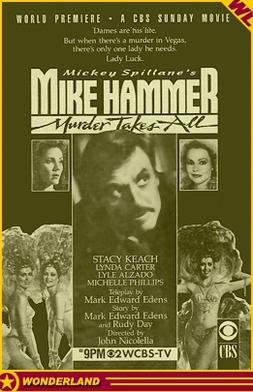
Mike Hammer: Murder Takes All (1989, directed by John Nicollela)


Entertainer Johnny Roman (Ed Winter, best-known as the crazed Colonel Flagg on M*A*S*H) sends an invitation to New York P.I. Mike Hammer (Stacy Keach), asking him to come to Vegas for a job.  Hammer refuses.  Vegas is not for him.  He’s pure New York.  So, someone has Hammer abducted and thrown out of an airplane over Vegas.  Luckily, they gave Hammer a parachute.  Unluckily, for them, Hammer is now in Las Vegas and he’s pissed off.

Johnny, who says he had nothing to do with the kidnapping and just wants Hammer to help him deal with a singer who has been stealing from him, is killed by an explosive device while hosting a telethon.  Everyone suspects Hammer.  When the singer that Hammer was supposed to investigate also turns up dead, Hammer is again suspected.  Hammer has to clear his name while dealing with guest stars ranging from Lynda Carter to Michelle Phillips to Jim Carrey.

Stacy Keach was Mike Hammer for most of the 80s, playing Mickey Spillane’s notorious detective in a television series and in several made-for-TV movies, like this one.  Television was an awkward fit for Mike Hammer, or at least Hammer the way he was imagined in the books.  Mike Hammer was written to be a killer with his own brand of justice.  He was not written to be a nice person.  Instead, he was the brutal but intelligent warrior that you hoped would be on your side.  The television version of Mike Hammer was considered to be violent for the era but the show still toned down Hammer’s signature brutality.  Keach’s Hammer still killed people but he no longer gloated about it.  Stacy Keach, with his trademark intensity, was a good pick for Mike Hammer, even if the show’s scripts often let him down.

This movie is hamstrung by the fact that it was made-for-TV.  Hammer is not happy about being in Las Vegas but he can’t go off on the city in the same way that he would have in one of Mickey Spillane’s novels.  Keach still gives a good and tough performance as Hammer, getting as close to the character as anyone could under the restrictions of 80s network television.  The mystery is interesting, though Hammer doesn’t really solve it as much as he just waits until all the other suspects have been killed.  The main attraction of this one is the amount of guest stars who show up.  Lynda Carter is a great femme fatale and it’s always good to see Michelle Phillips, even in a small role.  Jim Carrey, in his pre-In Living Color days, plays an accountant and does okay with a serious role.

Who could play Mike Hammer today?  It’s hard to say.  There aren’t many believably tough actors around anymore and even those who do seem like they could hold their own in a fight don’t have the gritty world-weariness that the character requires.  (Just try to imagine Dwayne Johnson reenacting the end of I, the Jury.)  A few years ago, I would have said Frank Grillo.  In the 90s, Bruce Willis would have been the perfect Hammer.  Today, though, Mike Hammer’s time may finally have passed.

Retro Television Review: Fantasy Island 5.14 “Daddy’s Little Girl/The Whistle”


Welcome to Retro Television Reviews, a feature where we review some of our favorite and least favorite shows of the past!  On Tuesdays, I will be reviewing the original Fantasy Island, which ran on ABC from 1977 to 1984.  Unfortunately, the show has been removed from most streaming sites.  Fortunately, I’ve got nearly every episode on my DVR.
This week, the stars align and John Carradine shows up on Fantasy Island.

Episode 5.14 “Daddy’s Little Girl/The Whistle”

(Dir by Don Chaffey and Don Weis, originally aired on January 30th, 1982)

The plane is landing and Mr. Roarke and Julie are getting ready to meet their guests for the weekend.  But wait a minute — where’s Tattoo!?  Roarke explains that Tattoo has volunteered to spend the weekend learning how to do CPR.  When a voluptuous nurse walks by, Julie rolls her eyes and says that Tattoo only cares about learning “mouth-to-mouth.”

“Julie!” Mr. Roarke snaps, even though Julie is probably correct.

Anyway, any episode without Tattoo feels strange and that’s certainly true of this episode.  There are two fantasies, one of which was dramatically better than the other.  The lesser of the two fantasies involves Christa Ackland (Genie Francis) and her efforts to find out the identity of her father.  All she knows is that her mother (Carolyn Jones) knew her father in the Philippines during World War II.  Christa is going to be married on Fantasy Island and she wants her real father to give her away.

Three men, all of whom served in the Air Force together, step forward and claim, one after the other, to be Christa’s father.  When Christa finally confronts her mother, she learns that her father is not Gene (John Ericson), Al (Alan Hale, Jr.), or Bert (Gene Nelson).  Instead, he was a guy named …. well, Guy.  Guy was shot down while on a mission.  Gene, Al, and Bert all explain that the stepped forward and claimed to be her father out of loyalty to Guy and because they didn’t want Christa to learn on her wedding say that her father was dead.  (Apparently, they felt that information would be better received after the honeymoon.)  Christa is surprisingly forgiving.  She realizes that her stepfather (William Windom) has more than earned the right to give her away.  Christa marries George Stickney (James Daughton, the head of the evil frat in Animal House) and Julie cries at the wedding.  Awwww!

The main problem with this storyline was that Genie Francis gave a surprisingly bad performance as Christa.  Instead of coming across as someone who truly wanted to know about her real father, she instead came across as being petulant and more than a little self-righteous.  Carolyn Jones, William Windom, and the three potential fathers were all likable but none could make up for the unsympathetic lead character.

The other fantasy was a bit more fun, even if was impossible to follow the story.  Iconologist Adrian Brilles (Edward Winters) dreams of making a great discovery that will bring him fame and prove his theories about ancient hieroglyphics to be correct.  Mr. Roarke sends him to a ghost town that is also the home of a museum of ancient artifacts.  Working with curator Leila Proctor (Ann Turkel), Adrian discovers what he describes as being “the Rosetta Stone of hieroglyphics.”  He also discovers an ancient whistle that will grant him three wishes.

There are a few townspeople, all of whom take a lot of interest in Adrian’s work.  Their leader is the town’s mortician and he’s played by — YES! — JOHN CARRADINE!  And though Carradine doesn’t get to do much and was obviously physically frail when he filmed this episode, his famous voice and his piercing stare combine to make the Mortician a memorable character.  There’s also a fairly ridiculous scene where the townspeople reveal their true selves, which means dancing around while wearing rubber demon masks.  It’s silly but it’s effective.

It’s never quite clear what’s happening at the ghost town, beyond the three wishes being a set up to bring the demonic townspeople into the world and to cost Adrian his soul.  Fortunately, Mr. Roarke pops up and gives Adrian some cryptic advice about the third wish being the most important.  For his first wish, Adrian wishes for the townspeople to be their true selves.  (Cue the demon dance.)  For his second wish, he goes for fame and adulation.  For his third wish, he cancels the first two wishes and this somehow set free not only his soul but Leila’s as well.

Yep, it doesn’t make much sense but it’s got John Carradine and a bunch of horror imagery so it’s fun.  That’s all I really ask for when it comes to Fantasy Island.  The whistle fantasy makes up for the wedding fantasy and the lack of Tattoo.  This was a worthwhile trip to the Island.

Retro Television Reviews: The Love Boat 2.3 “Rocky/Julie’s Dilemma/Who’s Who?”


Welcome to Retro Television Reviews, a feature where we review some of our favorite and least favorite shows of the past!  On Wednesdays, I will be reviewing the original Love Boat, which aired on ABC from 1977 to 1986!  The series can be streamed on Paramount Plus!

This week, Julie’s parents set sail on The Love Boat!

Episode 2.3 “Rocky/Julie’s Dilemma/Who’s Who?”

(Dir by Allen Baron and Roger Duchowny, originally aired on September 23rd, 1978)

After last week’s hurricane and hostage situation, things calm down a bit for this week’s episode of The Love Boat.

Julie is super-excited because her parents, Bill (Norman Fell) and Martha (Betty Garrett), are going to be on this cruise.  Her parents, meanwhile, are only slightly excited about seeing where Julie works and getting to see all of the members of the crew.  They would perhaps be more excited if not for the fact that they’re planning on getting a divorce as soon as the cruise is over.  They haven’t told Julie, of course.  In fact, they tell Captain Stubing before they tell Julie.  Why would they tell someone whom they’ve only know for ten minutes before they would tell their own daughter?  What awful parents!

When they do eventually tell Julie, she has an emotional breakdown and runs through the corridors of the ship, sobbing.  Listen, I’ve been there.  When my parents told me that they were getting divorced, I had a difficult time with it as well.  Of course, I was twelve years old, whereas Julie is in her late 20s.  Still, it’s never easy.  Fortunately, Julie realizes that her parents still love each other so she just sets them up with different people on the boat so that they can get jealous and fall back in love.  And it works!  Julie’s parents get back together….

Which is nice, I guess.  I mean, one doesn’t watch The Love Boat because one wants to see a realistic story about the complexities of love and marriage.  Still, the show made it look so simple that it got on my nerves.  It’s not that simple and any actual child of divorce can tell you that.  Again, it’s The Love Boat so perhaps I shouldn’t judge too harshly but I would have had so much more respect for the show if Bill and Martha had told Julie that they were still getting a divorce at the end of the cruise.  It would have been a lot more honest than presenting a story where a marriage can be saved by wishful thinking.

While Julie was trying to save her parent’s marriage and prevent several years of awkward holidays, a young girl named Rocky (Melissa Gilbert) was developing her first crush on a boy named Norman (Jimmy Baio).  It was actually a sweet little story and both Melissa Gilbert and Jimmy Baio gave likable performances.  When Rocky learned that her family would be moving after the cruise, she was upset until she learned that their new home would be in El Paso, which was also where Norman and his family lived.  Again, it was simple but sweet.  And it went along well with the divorce storyline.  While one relationship nearly ended, another began.

Finally, in the silliest story of the week, TV network censor Pat (Dody Goodman) boards the ship and is told that she will be sharing a cabin with Marion Atkins.  That’s fine with Pat.  Her main concern is making sure that nothing shocking or sordid happens on the cruise.  However, it turns out that Marion Atkins (played by James Coco) is actually a guy!  Fortunately, Marion turns out to be just as puritanical as Pat.  He even brings a bunch of pamphlets on chastity with him for the cruise.  Pat and Marion first meet while wandering around the ship and they fall very chastely in love.  Since their morals forbid them from following each other to their  cabin, they somehow manage to go nearly the entire cruise without realizing that they are living together.  When they do realize that they’re cabinmates, they resolve to get married as soon as the boat docks.  This whole story was just incredibly dumb and not in a fun way either.  Obviously, The Love Boat was taking a swipe at the same network censors who probably insisted that the show be relatively discreet about what was going on behind the closed doors of the ship’s cabins.  But Pat and Marion were both so incredibly clueless that it was hard to care about them one way or the other.

This was a bit of uneven episode but, in the end, the boat still looked like a fun place on which to hang out and work.  And really, that’s the important thing.

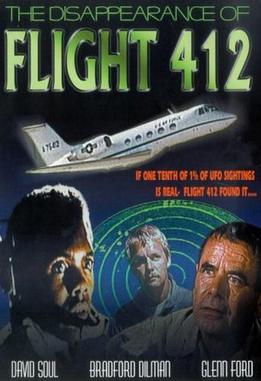
The Disappearance of Flight 412 (1974, directed by Jud Taylor)


Because of recent electrical surges aboard its aircrafts, the commander of the Whitney Air Force Base 458th Radar Test Group sends a four-man crew up in Flight 412 to try to figure out what’s happening.  Colonel Pete Moore (Glenn Ford) and Major Mike Dunning (Bradford DIllman) assume that it will just be a routine flight.  Instead, they find themselves at the center of a government cover-up when Captain Bishop (David Soul) and the other members of the crew spot what appears to be a UFO.  When two jets are sent out to intercept the object, the jets vanish.

Suddenly, Flight 412 is ordered to land at a seemingly deserted military base in the desert.  When they do, the airplane is impounded and the crew is forced to undergo an 18-hour debriefing led by government agents.  The agents demand that the crew members sign a statement saying that they didn’t see anything strange in the air before the jets vanished.  Until all four of the men sign the release, the crew of Flight 412 are officially considered to be missing and will not be released until they agree to deny what they saw.

Meanwhile, Col. Moore tries to learn what happened to his men but the government, led by Col. Trottman (Guy Stockwell), is not eager to tell him.

This movie was made-for-television, at a time when people claiming to have been abducted by aliens was still a relatively new phenomenon.  It was also made during the Watergate hearing and in the wake of the release of the Pentagon Papers, so the film’s sinister government conspiracy probably felt relevant to viewers in a way that it wouldn’t have just a few years earlier.  I appreciated that the movie took a semi-documentary approach to the story but that it tried to be serious and even-handed.  The film shows how witnesses can be fooled or coerced into saying that they saw the opposite of what they actually did see.  Unfortunately, The Disappearance of Fight 412 is ultimately done in by its own cheapness.  The overreliance on familiar stock footage doesn’t help the film’s credibility and there’s too many familiar faces in the cast for the audience to forget that they’re just watching a TV movie.  The Disappearance of Flight 412 doesn’t really succeed but it is still interesting as an early attempt to make a serious film about the possibility of alien abduction and the government covering up the existence of UFOs..  Three years after this film first aired, Steven Spielberg would introduce these ideas to an even bigger audience with Close Encounters of The Third Kind.

Porky’s II: The Next Day (1983, directed by Bob Clark)


The teens of Angel Beach, Florida are back!  They’re still trying to get laid, they’re still playing pranks on each other, and, this time, they’re …. FIGHTING THE KLAN!?

Porky’s II continues with the first Porky’s mix of raunchiness and social commentary.  While Pee Wee (Dan Monahan) tries to get back at his friends for spending the whole previous movie making fun of the size of his dick, the other members of the large ensemble cast thwart an attempt by the Klan to keep them from putting on a Shakespearean showcase.  The Klan is upset that a Seminole has been cast as Romeo so they burn a cross and do everything they can to sabotage the production.  Also trying to keep the show from going on is the hypocritical Rev. Bubba Flavel (Bill Wiley) and Mrs. Balbricker (Nancy Parsons), who both consider Shakespeare’s plays to be obscene.  When Wendy (Kaki Hunter) discovers that one of the county commissioners has been lying about supporting the play, she humiliates him in public by pretending to vomit in a fountain and accusing him of impregnating her.  It’s slightly funnier than it sounds but just slightly.

The first Porky’s took a stand against anti-Semitism while the second Porky’s takes a stand against censorship and the Klan.  That’s actually pretty cool when you consider that both of these films are usually just thought of as being dumb sex comedies.  Just like the first film, Porky’s II may be raunchy but it has a conscience.  That was due to director Bob Clark, who obviously meant for the Porky’s films to be about more than just T&A.

Unfortunately, Porky’s II is never as funny as the first Porky’s.  Too many of the jokes are recycled from the first film and the cast’s habit of laughing at their own “humorous” lines is even more grating the second time around.  Even the film’s most famous scene, where Wendy humiliates the duplicitous commissioner, goes on for too long and doesn’t have as much of a payoff as it should.  The best scenes in the film are the scenes that were lifted from Hamlet, Romero & Juliet, and A Midsummer Night’s Dream.  You wouldn’t expect the ensemble of Porky’s to feature that many Shakespearean actors but apparently it did.  Fans of A Christmas Story, which was also directed by Clark and which came out the same year as Porky’s II, will especially want to pay attention to the MacBeth sword fight scene just because the famous holiday leg lamp makes an appearance.

Porky’s II is nowhere near as good or memorable as the first Porky’s but its heart is in the right place.  While not as big of a success as the first Porky’s, it still did well enough to lead to Porky’s III, which I’ll review tomorrow.

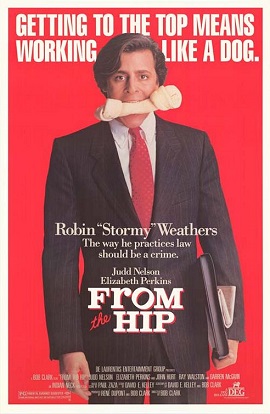
Insomnia File No. 8: From the Hip (dir by Bob Clark)


What’s an Insomnia File? You know how some times you just can’t get any sleep and, at about three in the morning, you’ll find yourself watching whatever you can find on cable? This feature is all about those insomnia-inspired discoveries!

From_the_Hip_(film)

Last night, if you discovered that you couldn’t get any sleep around two in the morning, you could have turned to Showtime and watched the 1987 film, From The Hip.

In From the Hip, Judd Nelson plays a character named Robin Weathers.  Of course, his nickname is Stormy.  Robin has just graduated from law school and is working at a prestigious law firm.  He’s ambitious, he’s outspoken, and he’s totally frustrated.  As his co-workers (played, quite well, by David Alan Grier and Dan Monahan) continually remind him, nobody gets to try a case during their first year out of law school.  They advise him to be patient and to wait his turn.

However, a man who is capable of being patient would not be nicknamed Stormy.  It just wouldn’t make any sense.  So, Stormy Weathers schemes his way into the courtroom.  One morning, he intentionally withholds information from the senior partners, going out of his way to keep them from realizing that a trial is scheduled to begin that afternoon.  When senior partner Craig Duncan (Darren McGavin) discovers what Stormy has done, he fires him and makes sure that he never get hired at another law firm … oh wait.  No, he doesn’t because that would make too much sense.  Instead, he allows Stormy to try the case because, at this point, Stormy is the only one who knows anything about it.

The case is a simple assault case that involves two bankers and should be resolved easily but Stormy manages to drag it out for several days and his flamboyant style catches the attention of the media.  The other partners in the law firm — who are all old and boring — want to fire Stormy but Stormy’s client says that, if Stormy is fired, he’ll take his business and his money elsewhere.  Stormy becomes a minor celebrity but — in a rather clever little twist — it turns out that he and the prosecuting attorney are old friends from law school and they conspired to make each other look good.

Anyway, Stormy is now so famous that he gets assigned to defend a college professor, named Benoit (John Hurt), who has been accused of murder.  When it quickly becomes obvious that Benoit is not only guilty but will probably murder again, Stormy is forced to choose between ambition and morality…

When my friend Evelyn and I first started to watch From the Hip last night, I really thought I was going to hate it.  The hot pink neon credits screamed, “Bad 80s movie!” and, because I happen to know quite a few lawyers, I tend to be a 100 times more critical of movies about lawyers than I am when it comes to movies about, say, homicidal fishermen.

And, honestly, From The Hip is a heavily flawed film.  Judd Nelson is miscast and the scenes with his politically conscious girlfriend (Elizabeth Perkins) are painfully shallow and reek of limousine liberalism.  But, if you can get through the weak opening, the film itself is watchable and enjoyable in a dumb sort of way.  John Hurt does a great job as a sociopath and, miscast as he may be, it’s still fun to watch Nelson go insane in court.

From The Hip is not a great film but, in its way, it’s an enjoyable little time capsule.  Believe it or not, there was a time when Judd Nelson starred in a movies that were actually released in theaters.

Previous Insomnia Files:

  1. Story of Mankind
  2. Stag
  3. Love Is A Gun
  4. Nina Takes A Lover
  5. Black Ice
  6. Frogs For Snakes
  7. Fair Game