An Offer You Can’t Refuse: The Last Gangster (dir by Edward Ludwig)


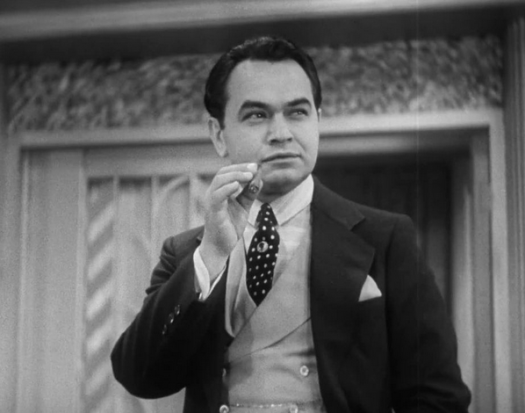
In 1937’s The Last Gangster, Edward G. Robinson plays Al Capone.

Well, actually, that’s not technically true.  The character he’s playing is named Joe Krozac.  However, Joe is a ruthless killer and gangster.  He’s made his fortune through smuggling alcohol during prohibition.  Despite his fearsome reputation, Joe is a family man who loves his wife Tayla (Rose Stradner) and who is overjoyed when he learns that she’s pregnant.  To top it all off, Joe is eventually arrested for and convicted of tax evasion.  He gets sent to Alcatraz, where he finds himself being bullied by another inmate (John Carradine) and waiting for his chance to regain his freedom.

In other words, Edward G. Robinson is playing Al Capone.

Krozac does eventually get out of prison but, by that point, Tayla has moved on.  She’s married Paul North (James Stewart), a former tabloid reporter who was so outraged by how his newspaper exploited Tayla’s grief that he resigned his position.  Joe Krozac’s son has grown up with the name Paul North, Jr. and he has no idea that his father is actually a notorious gangster.

Krozac wants to get his son back but his gang, now led by Curly (Lionel Stander), has other ideas.  They want Krozac to reveal where he hid the money that he made during his gangster days.  As well, an old rival (Alan Bazter) not only wants to get revenge on Krovac but also on Krovac’s son.  Joe Krovac, fresh out of prison, finds himself torn between getting his revenge on his wife and protecting his son.  This being a 30s gangster film, it leads to shoot-outs, car chases, and plenty of hardboiled dialogue.

Edward G. Robinson and Jimmy Stewart in the same movie, how could I n0t watch this!?  I was actually a bit disappointed to discover that, even though both Robinson and Stewart give their customarily fine performances, they don’t spend much time acting opposite each other.  Indeed, it sometimes seem like the two men are appearing in different pictures.

Robinson is appearing in one of the gangster films that made him famous.  (Indeed, the film’s opening credits feature footage that was lifted from some of Robinson’s previous films.)  He gives a tough and snarling performance but also one that suggests that, as bad as he is, he’s nowhere near as bad as the other gangsters that are working against him.  His gangster is ultimately redeemed by his love for his son, though the Production Code still insists that Joe Krozac has to pay for his life of crime.

Stewart, meanwhile, plays his typical romantic part, portraying Paul as being an incurable optimist, a happy go-getter who still has a sense of right-and-wrong and a conscience.  Stewart isn’t in much of the film.  This is definitely Robinson’s movie.  But still, there’s a genuine charm to the scenes in which Paul romances the distrustful Tayla.  Not even being forced to wear a silly mustache (which is the film’s way of letting us know that time has passed) can diminish Stewart’s natural charm.

If you like 30s gangster films, like I do, you should enjoy The Last Gangster.  I would have liked it a bit more if Robinson and Stewart had shared more scenes but regardless, this film features these two men doing what they did best.  This is an offer that you can’t refuse.
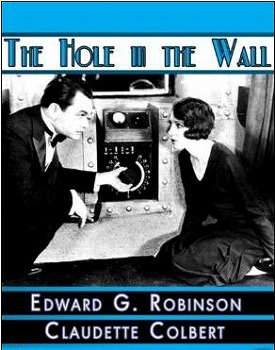
Film Review: The Hole In The Wall (dir by Robert Florey)


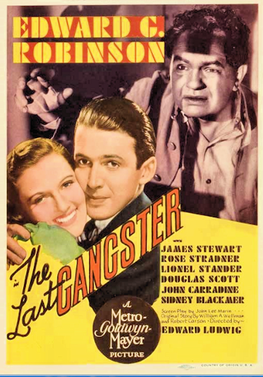
Released in 1929, at the dawn of the sound era, The Hole In The Wall tells the story of The Fox (Edward G. Robinson) and two women known as Madame Mysteria.

The Fox is a con artist, a veteran criminal who takes care of the people working for him.  He may not be an upstanding citizen but he seems to truly care about his sidekick Goofy (Donald Meek) and his partner-in-crime, Madame Mysteria (Nellie Savage).  Madame Mysteria is a fake psychic.  She sits in a chair and does readings while The Fox sends her a series of electric shocks in morse code to let her know what she should say about each victim of their con.  They’ve got a pretty good thing going until Madame Mysteria is killed in a train accident.

(Since this film is from 1929, the train accident is recreated with a miniature train that falls off a track in what appears to be a plastic city.  Basically, it looks like a primitive YouTube video made by an enthusiastic toy train hobbyist.  It may not be convincing but there’s something charming about just how cheap it all is.)

Shortly after Mysteria is killed, Jean Oliver (Claudette Colbert) wanders into The Fox’s shop.  Jean is looking for a job and for revenge.  As she explains it, she used to have a good job in a department store until her manager accused her of stealing.  Though Jean was innocent, she still spent some time in jail.  Her life was ruined.  Now, she wants to be the new Madame Mysteria and she wants to kidnap the daughter of the woman who accused her.  She doesn’t want to get any ransom or anything like that.  Instead, she wants to raise the little girl to become a criminal.  Fox and Goofy agree, which leads me to wonder if the Fox is really as clever as he thinks he is.  Is Jean really the only person they could find to be the new Madame Mysteria?  Surely they could find a Madame Mysteria who doesn’t demand they commit a major felony just for her services.  Still, kidnap the little girl they do and strangely enough, she never seems to be upset over being taken from her parents.  (Even more strangely, we don’t actually see or learn the details of how she was kidnapped.  She just suddenly shows up at the Fox’s home.)  Goofy becomes a babysitter and Jean becomes Madame Mysteria.

By an amazing coincidence, the reporter (boring David Newell) who decides to write a story on the amazing psychic Made Mysteria just happens to be Jean’s ex-boyfriend!  While the Fox falls in love with Jean and the police search for the abducted child, Jean herself starts talking to the dead….

In many ways, The Hole In The Wall is typical of the melodramas that came out during the early sound era.  The majority of the supporting actors are still adjusting to acting with sound and the action often feels rather stagey.  That said, it’s an entertaining film, largely due to the performance of Claudette Colbert and Edward G. Robinson, both of whom were just starting their careers and on the cusp of stardom.  This was Robinson’s first role as a gangster and he snarls with style while Colbert actually keeps the audience guessing at her motivations.  The Hole In The Wall is definitely a film from a different era but, for a film that was made nearly 100 years ago, it holds up remarkably well.

10 Oscar Snubs From the 1940s


Ah, the 40s! For most of the decade, the world was at war and the Academy’s nominations reflected that fact. The best picture lineups alternated between patriotic films that encouraged the battle against evil and darker films that contemplated both the mistakes of the past and what threats might be waiting in the future.  With the Academy being even more aware than usual that films and awards could be used to send a message, the snubs continued.

1940: John Carradine Is Not Nominated For The Grapes of Wrath

John Carradine’s first credited film appearance was in 1930 but Carradine himself claimed that he had appeared as an uncredited extra in over 70 films before getting that first credit.  Carradine would continue to work until his death 58 years later.  John Carradine did so many films that he was still appearing in new releases in the 90s, years after his death.  He appeared in over 234 films and in countless television shows.  He was a favorite of not only Fred Olen Ray’s but also John Ford’s.

Unfortunately, Carradine was never nominated for an Oscar, despite the fact that he did appear in some classic films.  (He also appeared in a lot of B-movies, which is perhaps one reason why the Academy was hesitant to honor him.)  Personally, I think Carradine most deserved a nomination for playing “Pastor” Jim Casy in John Ford’s The Grapes of Wrath.  Carradine is ideally cast as the former preacher turned labor activist.  When he’s alive, he gives the Joads hope.  When he dies, both the Joads and the audience start to realize how difficult things are truly going to be.

1942: Ronald Reagan Is Not Nominated For Best Supporting Actor For Kings Row

Kings Row is an enjoyably over-the-top small town melodrama and future President Ronald Reagan is fantastic in the film, with his natural optimism providing a nice contrast to the truly terrible things that happen to him and his loved ones over the course of the film.  Reagan was not nominated for this performance, the one that both he and the most of the critics agreed was his best, but he should have been.

1943: Hangmen Also Die Is Not Nominated For Best Picture

Fritz Lang’s anti-Nazi classic was not nominated for Best Picture and only received two nominations (for Sound and Score).  That year, the Best Picture winner was another anti-Nazi classic, Casablanca.

1943: Shadow Of A Doubt Is Ignored

Today, it is recognized as one of Hitchcock’s best but, in 1943, Shadow of a Doubt couldn’t even score a nomination for Joseph Cotten’s wonderfully diabolical turn as Uncle Charlie.  One gets the feeling that the film’s satirical jibes at small town America and its theme of evil hiding behind a normal façade were not what the Academy was looking for at the height of World War II.  It’s a shame because, in many ways, Cotten’s Uncle Charlie was the perfect symbol of the enemy that the Allies were fighting.

1944: Tallulah Bankhead In Not Nominated For Best Actress For Lifeboat

Unlike Shadow of a Doubt, Hitchcock’s Lifeboat received several Oscar nominations.  However, Tallulah Bankhead was not nominated for Best Actress.  Perhaps the Academy was scared of what she might say if she won.

1944: Fred MacMurray and Edward G. Robinson Are Not Nominated For Double Indemnity

For all the nominations that this classic noir received, somehow neither Fred MacMurray nor Edward G. Robinson were nominated for their roles.  Both actors are brilliantly cast against type in this film.  MacMurray uses his trademark casual glibness to portray Walter Neff as being an arrogant man who is hardly as clever as he thinks that he is.  Meanwhile, Robinson’s more introspective performance leaves you with little doubt that, if anyone can solve this case, it’s him.  While Barbara Stanwyck was (rightfully) nominated, it’s had to believe that both MacMurray and Robinson were snubbed.

1946: Thomas Mitchell and Lionel Barrymore Are Not Nominated For Best Supporting Actor For It’s A Wonderful Life

As wonderful as James Stewart and Donna Reed are, it just wouldn’t be Bedford Falls without Uncle Billy and Mr. Potter!  Thomas Mitchell breaks your heart in the scene where he tries to remember what he did with the lost money.  And, for audiences who had just lived through the Great Depression, Lionel Barrymore represented every businessman who cared more about money than people.  It’s impossible to imagine the film without them …. or without Henry Travers, for that matter!  Seriously, very few films have received three best supporting actor nominations but It’s A Wonderful Life deserved to be one of them.

1948: Humphrey Bogart Is Not Nominated For Best Actor For The Treasure of the Sierra Madre

The Treasure of the Sierra Madre received four Oscar nominations.  Somehow, not one of those nominations was not for Humphrey Bogart.

1948 and 1949: Red River, Fort Apache, and She Wore A Yellow Ribbon Are Not Nominated For Best Picture

The public may have loved Westerns but the Academy largely shied away from them, with a few notable exceptions.  Howard Hawks’s Red River and John Ford’s Fort Apache and She Wore A Yellow Ribbon are today all recognized as being classic Hollywood films.  However, the Academy, then at the height of its bias towards “genre” films, didn’t honor any of them.

1949: James Cagney Is Not Nominated For Best Actor For White Heat

“Top of the world, ma!”  Maybe so, but not top of the Oscars.  The Academy was always more interested in honoring Cagney for being a song-and-dance man than for honoring him for his iconic gangster roles.

Agree?  Disagree?  Do you have an Oscar snub that you think is even worse than the 10 listed here?  Let us know in the comments!

Up next: Get ready to hate the commies and to love Ike because the 50s are coming!

10 Oscar Snubs From The 1930s


Ah, the 1930s. America was mired in the Great Depression. FDR was plotting to pack the courts.  The American public, sick of playing by the rules and getting little in return, began to admire gangsters and outlaws.  The horror genre became the new way to vent about societal insecurity. In Europe, leaders were trying to ignore what was happening in Italy, Spain, and Germany. As for the Academy, it was still growing and developing and finding itself. With people flocking to the movies and the promise of an escape from reality, the Academy Awards went from being an afterthought to a major cultural event.

And, of course, the snubs continued.

1930 — 1931: Crime Doesn’t Pay For Little Caesar and The Public Enemy 

When people think about the 1930s, gangsters are probably one of the first things that come to mind.  In the 30s, audiences flocked to movies about tough and streetwise criminals who did what they had to do in order to survive during the Depression.  Unfortunately, the Academy was not always as quick to embrace the gangster genre.  Though The Public Enemy did pick up a nomination for its screenplay, both it and Little Caesar were largely ignored by the Academy.  Not only did the films fail to score nominations for Best Picture but neither James Cagney nor Edward G. Robinson would be nominated for bringing their title characters to life.  It’s a crime, I tells ya.

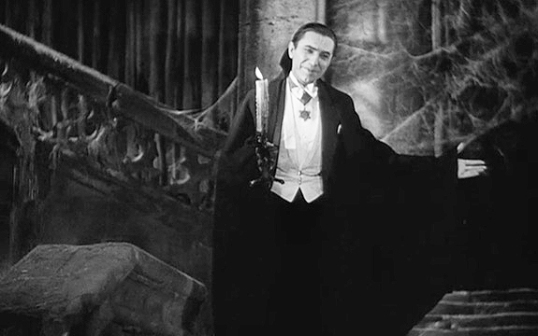
1930 — 1931: Bela Lugosi Is Not Nominated For Best Actor For Dracula

Admittedly, the 1931 version of Dracula is a bit of a creaky affair, one that feels quite stagey to modern audiences.  But Bela Lugosi’s performance in the title role holds up well, despite the number of times that it has been parodied.  Unfortunately, from the start, the Academy was hesitant about honoring the horror genre.

Frankenstein (1931, dir by James Whale)

1931 — 1932: Boris Karloff Is Not Nominated For Best Actor For Frankenstein

Again, the Academy snubbed an iconic horror star.  Not only was Boris Karloff not nominated for Frankenstein but the film itself was not nominated for Best Picture, despite being infinitely better than at least one of the 8 films that were nominated.  (That film, by the way, was Bad Girl.  When is the last time that anyone watched that one?)  In fairness to the Academy, they did honor one horror film at that year’s awards.  Fredric March won Best Actor for Dr. Jekyll and Mr. Hyde.  Of course, he also tied with Wallace Beery, who was nominated for The Champ.  Obviously, the Academy still had to work out its feelings towards the horror genre, a process that continues to this very day.

1932 — 1933: King Kong Is Not Nominated For Best Picture

Oh, poor King Kong.  Film audiences loved him but the Academy totally ignored both him and his film.  Unfortunately, back in 1933, the Academy had yet to introduce a category for special effects.

1932 — 1933: Duck Soup Is Ignored By The Academy

King Kong was not the only worthy film to be ignored at the 1932-1933 Oscars.  The Marx Brothers’s greatest film also went unnominated.

1934: The Scarlet Empress Is Not Nominated For Best Picture

Josef von Sternberg’s surreal historical epic was totally ignored by the Academy.  Not only did it miss out on being nominated for Best Picture but the sterling work of Marlene Dietrich and Sam Jaffe was ignored as well.  How was the opulent set design ignored?  How did it not even pick up a nomination for costume design?  My guess is that Paramount chose to promote Cleopatra at expense of The Scarlet Empress.  Either the way, the Best Picture Oscar was won by one of my favorite films, It Happened One Night.

1935: Fred Astaire and Ginger Rogers Are Not Nominated For Top Hat

Top Hat scored a best picture nomination but the film’s two stars went unnominated.

1936: My Man Godfrey Is Nominated For Everything But Best Picture

My Man Godfrey, a classic screwball comedy, was nominated for Best Actor, Best Actress, Best Supporting Actor, Best Supporting Actress, Best Director, and Best Screenplay but somehow, it was not nominated for Best Picture.  It’s a shame because My Man Godfrey, along being a very funny movie, is also a film that epitomizes an era.  Certainly, it’s far more entertaining today than the film that won Best Picture that year, The Great Ziegfeld.  (Interestingly enough, William Powell played the title role in both Godfrey and Ziegfeld.)

1937: Humphrey Bogart Is Not Nominated For Best Supporting Actor in Dead End

Dead End featured one of Bogart’s best gangster roles.  As a gangster who returns to his old neighborhood and is rejected by his own mother, Bogart was both menacing and, at times, sympathetic.  Like Cagney and Robinson, Bogart definitely deserved a nomination for his portrayal of what it was like to live a life of crime.  Unfortunately, Bogart was an actor who was taken for granted for much of his career.  It wasn’t until he played Rick Blaine in Casablanca that the Academy would finally nominate him.

The Adventures of Robin Hood (1938, dir by Michael Curtiz)

1938: Errol Flynn Is Not Nominated For Best Actor In The Adventures of Robin Hood

This is truly one of the more shocking snubs in Academy history.  Errol Flynn’s performance as Robin Hood pretty much set the standard for every actor who followed him.  Russell Crowe is undoubtedly a better actor than Flynn was but Crowe’s dour interpretation of Robin could in no way compete with the joie de vivre that Flynn brought to the role.

Agree?  Disagree?  Do you have an Oscar snub that you think is even worse than the 10 listed here?  Let us know in the comments!

Up next: 1940s, in which Hollywood joins the war effort and the snubs continue!

Dead End (1937, dir by William Wyler)

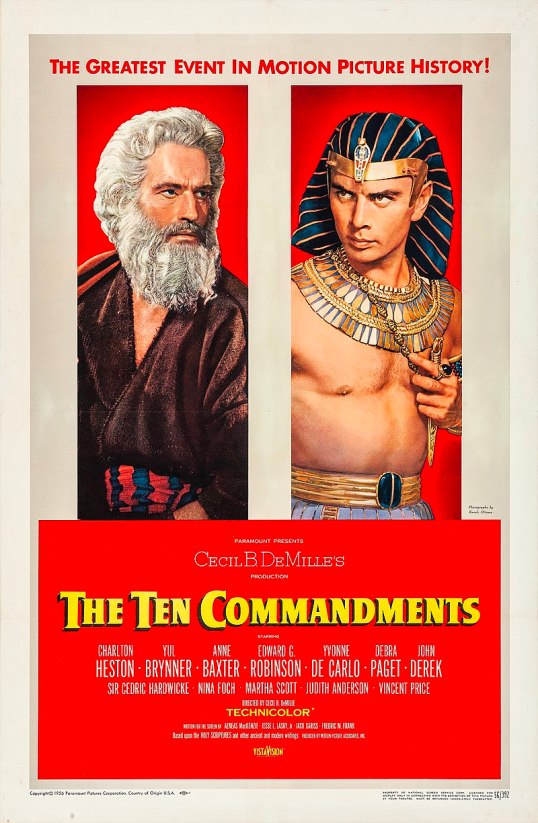
Film Review: The Ten Commandments (dir by Cecil B. DeMille)


Though you may not know it if you’ve only seen the film during one of its annual showings on television, the 1956 religious epic, The Ten Commandments, originally opened with director Cecil B. DeMille standing on a stage.  Speaking directly to the audience, DeMille explains that, though the film they’re about to see me take some dramatic license with the story of Moses, it still based on not just the Bible but also the accounts of Philo, Josephus and Eusebius.  He also tells us that The Ten Commandments is more than just an adaptation of the Book of Exodus.  Instead, it’s a film about every man’s desire to be free.

Demille concludes with: “The story will take 3 hours and 29 minutes to unfold.  There will be an intermission. Thank you for your attention.”

To be honest, it’s kind of a sweet moment.  Cecil B. DeMille is a name that is so associated with (occasionally overblown) epic filmmaking that it’s easy to forget that DeMille was one of the most important names in the artistic development of American cinema.  He was there from the beginning and, unlike a lot of other filmmakers, he was equally successful in both the silent and the sound era.  Say what you will about his films, DeMille was a showman and he handles the introduction like a pro.  At the same time, there’s a real sincerity to DeMille’s tone.  After you listen to him, you’d almost feel guilty if you didn’t sit through all 3 hours and 29 minutes of his film.

That sincerity extends throughout the entire film.  Yes, The Ten Commandments is a big, long epic and some members of its all-star cast are more convincing in their roles than others.  And yes, the film can seem a bit campy to modern viewers.  (In fact, it wouldn’t surprise me if it seemed a bit campy to viewers in 1956 as well.)  Yes, The Ten Commandments does feature Anne Baxter saying, “Oh Moses!  You sweet adorable fool!”  But it doesn’t matter.  Even the most ludicrous of dialogue just seem right.  The film is just so sincere that it’s difficult not to enjoy it.

In the Book of Exodus, Moses is described as having a speech impediment and even tries to use it as an excuse to get out of going to Egypt.  That’s actually one of the reasons why Moses brought Aaron with him to Egypt, so that Aaron could speak for him.  In the movie, Moses is played by Charlton Heston, who comes across as if he’s never felt a moment of insecurity over the course of his entire life.  But no matter.  Heston may not by the Moses of Exodus but he’s the perfect Moses for the DeMille version.  When Heston says that Egypt will be visited by plagues until his adopted brother Ramses (Yul Brynner) agrees to allow the Jews to leave Egypt, you believe every word.  (Aaron, incidentally, is played by the legendary John Carradine.  He doesn’t get too much other than respectfully stand a few feet behind Charlton Heston but still: John Carradine!)

And really, anyone who dismisses The Ten Commandments out-of-hand should go back and, at the very least, watch the scene where the Angel of Death descends upon Egypt.  The scene where Moses and his family shelter in place while the screams of distraught mothers echo throughout the city is chilling.  Ramses may spend most of the film as a petulant villain but you almost feel sorry for him when you see him mourning over his dead son.  When he sets off after Moses, it’s not just because he’s doing what villains do.  He’s seeking vengeance for the loss of his first born.  For that brief moment, Ramses goes form being a melodramatic bad guy to being someone with whom the viewer can empathize.  Brynner, with his burning intensity, gives a great performance as Ramses.

As I said before, this film has what, in 1956, would have been considered an all-star cast.  Watching the names as they show up during the opening credits — Cedrick Hardwicke!  Yvonne DeCarlo!  Woody Strode!  Debra Paget! — is like stepping into a TCM fever dream.  Some of the performers give better performance than others.  And yet, even the worst performer feels as if they just naturally belong in the world that DeMille has created.  John Derek may seem rather smarmy as Joshua but his callowness provides a good contrast to the upright sincerity of Heston’s performance as Moses.  Edward G. Robinson’s cries of, “Where is your God now!?” may have provided endless fodder for impersonators but just try to imagine the film without him.  Even Vincent Price is in this thing!  He doesn’t have his famous mustache but, as soon as you hear his voice and see that famous glare, you know that it’s him.

Of course, when you’re growing up and The Ten Commandments is on TV every year, you mostly just want to see the scene where Moses parts the Red Sea.  The Ten Commandments was nominated for seven Oscars but it only won one, for its special effects.  (The prize for Best Picture went to another epic, Around The World In 80 Days.)  Today, the film’s special effects may no longer amaze viewers but there’s still something rather charming about the Red Sea parting and then crashing in on the Egyptian army.  The scene where the Earth opens up and swallows those who worshiped the Golden Calf remains impressive, if just because all of the extras really look terrified that they might die.  And while the Pillar of Fire may look a bit cartoonish to modern eyes, that’s a huge part of the film’s appeal.

The Ten Commandments is a big, long, sometimes silly, sometimes effective, and always entertaining epic.  It’s a grand spectacle and one that I usually watch every year when it shows up on television.  I missed this year’s showing but, fortunately, I own it on DVD.  It’s a sincere epic and a difficult one not to like.


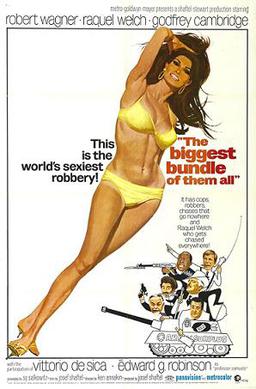
The Biggest Bundle Of Them All (1968, directed by Ken Annakin)


Harry Price (Robert Wagner) is a small-time tough guy with big plans.  He and his gang of accomplices fly over to Italy and plot to kidnap Cesare Celli (Vittorio De Sica), a retired mafia don who is reputed to be worth millions.  However, after snatching Celli from a wedding, Harry discovers that Celli is actually flat broke.  Trying to be helpful, Celli suggests that Harry call up the local gangsters and demand that they pay a ransom for Celli’s release.  When everyone refuses to pay, Celli comes up with another plan.  Celli takes over Harry’s gang and, with the help of Celli’s old friend, Prof. Samuels (Edward G. Robinson), plots to steal $5,000,000 worth of platinum ingots from a train.

Complicating matters is that Harry and his gang are not exactly master criminals.  Benny (Godfrey Cambridge) is a violinist who has moral objections to carrying a gun and who also refuses to cross a picket line, even in the course of a robbery.  (“I’m a union man!”)  Tozzi (Francesco Mule) is more interested in having a good dinner than pulling off the perfect heist.  Davey (Davy Kaye) is short, which is apparently a problem for some reason.  Finally, Harry’s girlfriend, Juliana (Raquel Welch), is more interested in dancing than in committing crimes.  Still, Celli is determined to use them to pull off the heist of the century and, even more importantly, to help prove that this old criminal has still got what it takes.

The Biggest Bundle of Them All was an attempt at a wacky heist film.  Unfortunately, at the time that the film was made, Robert Wagner and “wacky” didn’t belong anywhere near each other.  Wagner stiffly delivers lines like, “I’ve had it, baby.  Can you dig it?” and looks thoroughly out-of-place.  Godfrey Cambridge and Edward G. Robinson have a few funny scenes but both Kaye and Mule are wasted in one-note role while De Sica looks like he’s trying to figure out how he went from Bicycle Thieves to this.  Everyone in the movie just goes through the motions.  Even while they’re robbing the train, the cast seems to be indifferent.

It almost doesn’t matter, though, because this is a Raquel Welch film.  Welch doesn’t have much of a character to play but she looks amazing while doing it and that really is the appeal of any film that Welch made in the late 60s and early 70s.  Welch spends a good deal of the film in a bikini and is undeniably sexy, particularly in the scene where Wagner sends her to seduce De Sica.  She also gets to share a dance with Edward G. Robinson, which is such a goofy and fun scene that it’s almost worth the price of admission.  (Regardless of what fun they may have been having on-screen, Robert Wagner later wrote in his autobiography that, off-screen, Robinson grew so annoyed with Welch’s chronic lateness on the set that he yelled at her until she was in tears.)

Even Raquel Welch in a bikini can only carry a film so far and The Biggest Bundle of Them All is ultimately too disjointed to work.  Director Ken Annakin tries to recreate the same sort of frantic comedy that was at the heart of his previous film, Those Magnificent Men in Their Flying Machines, but the end result falls flatter than 5 million dollars worth of platinum ingots sliding out of an airplane.

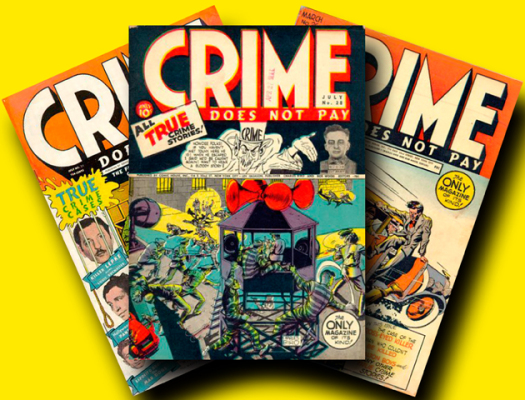
Cleaning Out the DVR #24: Crime Does Not Pay!


gary loggins's avatarcracked rear viewer

We’re way overdue for a Cleaning Out the DVR post – haven’t done one since back in April! – so let’s jump right in with 4 capsule reviews of 4 classic crime films:

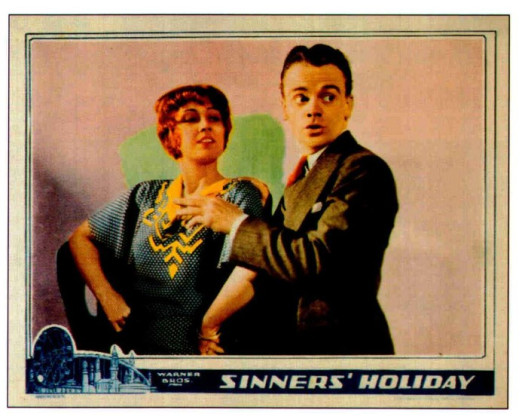
SINNERS’ HOLIDAY (Warner Brothers 1930; D: John Adolfi) – Early talkie interesting as the screen debut of James Cagney , mixed up in “the booze racket”, who shoots bootlegger Warren Hymer, and who’s penny arcade owner maw Lucille LaVerne covers up by pinning the murder on daughter Evalyn Knapp’s ex-con boyfriend Grant Withers. Some pretty racy Pre-Code elements include Joan Blondell as Cagney’s “gutter floozie” main squeeze. Film’s 60 minute running time makes it speed by, aided by some fluid for the era camerawork. Fun Fact: Cagney and Blondell appeared in the original Broadway play “Penny Arcade”; when superstar entertainer Al Jolson bought the rights, he insisted Jimmy and Joan be cast in the film version, and…

View original post 549 more words

Royal Flush: THE CINCINNATI KID (MGM 1965)


gary loggins's avatarcracked rear viewer

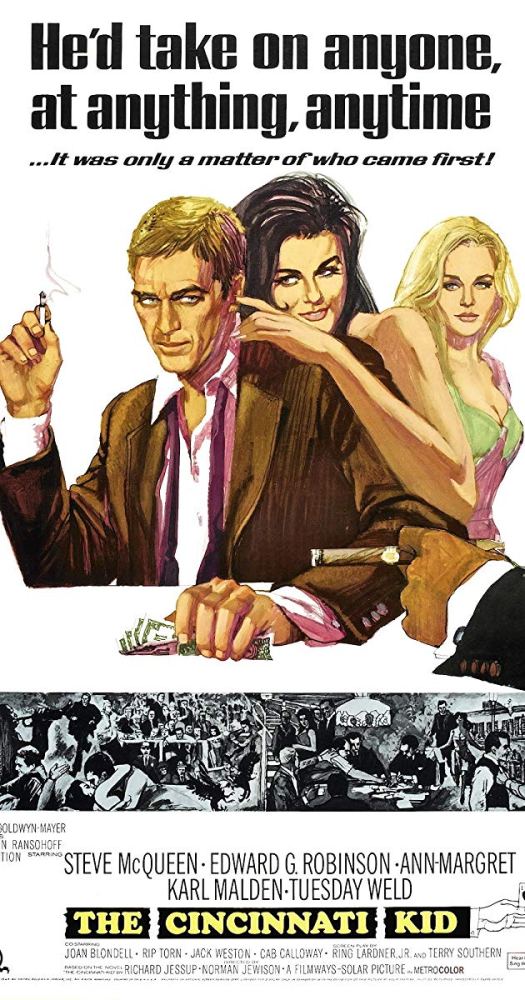
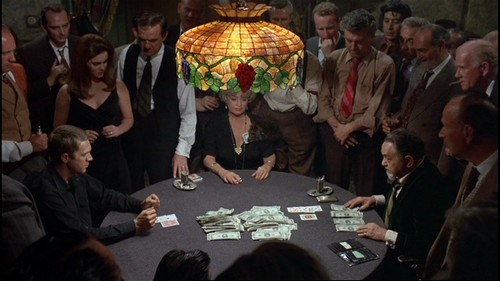
There are movies about the high-stakes world of poker, and then there’s THE CINCINNATI KID. This gripping look at backroom gambling has long been a favorite of mine because of the high-powered all-star cast led by two acting icons from two separate generations – “The Epitome of Cool” Steve McQueen and “Original Gangster” Edward G. Robinson . The film was a breakthrough for director Norman Jewison, who went after this from lightweight fluff like 40 POUNDS OF TROUBLE and SEND ME NO FLOWERS to weightier material like IN THE HEAT OF THE NIGHT and THE THOMAS CROWN AFFAIR.

The film revolves around a poker showdown between up and coming young stud Eric Stoner, known as The Kid, and veteran Lancey Howard, venerated in card playing circles as The Man. This theme of young tyro vs old pro wasn’t exactly groundbreaking, having been hashed and rehashed in countless Westerns over the…

View original post 564 more words

Pre Code Confidential #28: Edward G. Robinson in LITTLE CAESAR (Warner Brothers 1931)


gary loggins's avatarcracked rear viewer

Gangster movies were nothing new in 1931. Josef von Sternberg’s UNDERWORLD (1927), Lewis Milestone’s THE RACKET (1928), and Bryan Foy’s LIGHTS OF NEW YORK (1929) had all dealt with urban organized crime onscreen (and Foy’s drama was the first “all-talking picture” to hit cinemas). But when Edward G. Robinson rat-a-tatted his way through Mervyn LeRoy’s LITTLE CAESAR, the gangster genre had finally arrived – with a vengeance! This highly influential flick opened the floodgates for a variety of films about mobsters, killers, and other assorted no-goodniks, and made an unlikely star out of the pugnacious Eddie G.

The film concerns the rise and fall of Rico “Little Caesar” Bandello, a small-time hood from the sticks who, along with partner in crime Joe Massara, moves to the big city and blasts his way up the ranks to become a gang boss. The diminutive Robinson exudes star power as the psychotic sociopath…

View original post 472 more words

Fever Dreams: Fritz Lang’s THE WOMAN IN THE WINDOW (RKO/International Pictures 1944)


gary loggins's avatarcracked rear viewer

Back in 2016, I did a post expounding on one of my favorite films noir, 1945’s SCARLET STREET . This dark masterpiece of corruption starred the titanic trio of Edward G. Robinson, Joan Bennett, and Dan Duryea in a sordid tale directed by German legend Fritz Lang, with moody cinematography courtesy of Milton Krasner. Recently, I viewed a film this team made the year previous, THE WOMAN IN THE WINDOW, with a screenplay by producer Nunnally Johnson. Comparisons were inevitable, but though there are certainly similarities between the two films, this one stands on its own as a powerful entry in the film noir canon. With all that talent, would you expect anything less?

Robinson plays college professor Richard Wanley, an intellectual lecturing on the psychology of homicide to his students. He’s a happily married father of two kids, left alone while the fam visits relatives. Whaley goes to his…

View original post 405 more words