Welcome back to the decadently dark world of film noir, where crime, corruption, lust, and murder await. Let’s step out of the light and deep into the shadows with these five fateful tales:
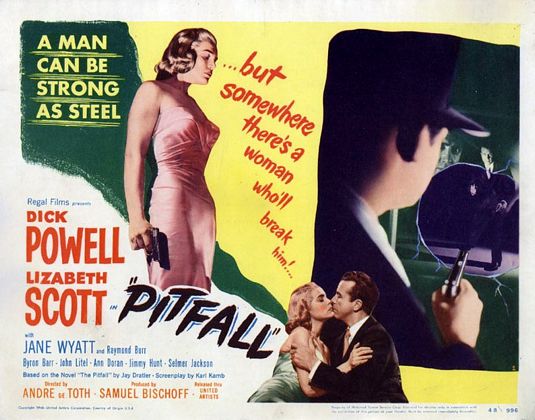
PITFALL (United Artists 1948, D: Andre DeToth) Dick Powell is an insurance man who feels he’s stuck in a rut, living in safe suburbia with his wife and kid (Jane Wyatt, Jimmy Hunt). Then he meets hot model Lizabeth Scott on a case and falls into a web of lies, deceit, and ultimately murder. Raymond Burr costars as a creepy PI who has designs on Scott himself. A good cast in a good (not great) drama with a disappointing ending. Fun Fact: The part of Scott’s embezzler boyfriend is played by one Byron Barr, who is not the Byron Barr that later changed his name to Gig Young.
THE BRIBE (MGM 1949, D:Robert Z. Leonard) Despite an…
The 12th film contained in Mill Creek’s Fabulous Forties box set is the classic film noirD.O.A. Before I get into reviewing this film, there’s an oddity that I feel the need to point out. According to the back of the Fabulous Forties box, D.O.A. was released in 1949. However, according to Wikipedia, imdb, and almost every other source out there, D.O.A. was released in 1950. In short, it’s debatable whether or not D.O.A. actually belongs in the Fabulous Forties box set but it really doesn’t matter. D.O.A. is a classic and, along with Night of the Living Dead, it is undoubtedly one of the best B-movies to ever slip into the public domain.
D.O.A. opens with a lengthy tracking shot, following a man named Frank Bigelow (Edmond O’Brien) as he walks through the hallways of a San Francisco police station. Frank walks with a slow, halting movement and it’s obvious that he is not a healthy man. When he finally steps into a detective’s office, Frank announces that he’s come to the station to report a murder — his own.
Frank is a small-town accountant who came to San Francisco for a vacation. After a long night of drinking, Frank woke up feeling ill. When he went to a doctor, he was informed of two things. Number one, he was in overall good health. Number two, he only had a few days to live. Sometime during the previous night, Frank was poisoned with a “luminous toxin.” There was no antidote.
The rest of the film follows Frank as he attempts to figure out who poisoned him and why. It’s an intriguing mystery and I’m not going to ruin it by going into too many details. Over the course of his investigation, the increasingly desperate Frank comes across a gangster named Majak (Luther Adler). This leads to a lengthy scene in which Majak’s psychotic henchman, Chester (Neville Brand), repeatedly punches Frank in the stomach. It’s a scene that, even in our far more desensitized times, made me cringe. I can only imagine how audiences in 1950 reacted.
(There’s also a shoot-out at a drug store that can stand alongside almost any modern-day action sequence. Regardless of whether the film was made in 1949 or 1950, it still feels like a movie that could have just as easily been made in 2016.)
But really, the mystery is secondary. Instead, D.O.A. is truly about Frank and how he deals with the knowledge that he is going to die. Before being poisoned, Frank is the epitome of complacent, middle-class suburbia. He’s engaged to Paula (Pamela Britton) but he’s in no hurry to marry her. He’s got all the time in the world. When Frank goes to San Francisco, he epitomizes the bourgeoisie on vacation. He goes to the 1940s equivalent of a hipster nightclub, not because he’s actually interested in what the scene is all about but because he’s a tourist looking for a story to tell the folks back home. When he checks into his hotel, he leers at every passing woman with a casual sexism that would not be out-of-place on an old episode of Mad Men. Frank is floating through life, confident in his own complacency.
It’s only after he’s poisoned that Frank actually starts to live. He goes from being passive to being aggressive. Knowing that he’s going to die, he no longer has anything to lose. Only with death approaching does Frank actually start to live. Frank’s realization that he waited to long to live makes his final line all the more poignant.
D.O.A. is a classic! Watch it below, you won’t be sorry!
I first got my DVR service from DirecTV just in time for last year’s TCM Summer of Darkness series, and there’s still a ton of films I haven’t gotten around to viewing… until now! So without further ado, let’s dive right into the fog-shrouded world of film noir:
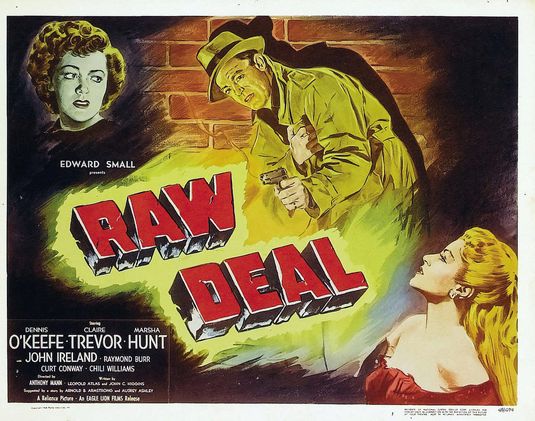
RAW DEAL (Eagle-Lion 1948, D: Anthony Mann)
This tough-talking film seems to cram every film noir trope in the book into its 79 minutes. Gangster Dennis O’Keefe busts out of prison with the help of his moll ( Claire Trevor ), kidnaps social worker Marsha Hunt, and goes after the sadistic crime boss (Raymond Burr) who owes him fifty grand. Director Mann and DP John Alton make this flawed but effective ultra-low budget film work, with help from a great cast. Burr’s nasty, fire-obsessed kingpin is scary, and John Ireland as his torpedo has a great fight scene with O’Keefe. The flaming finale is well staged…
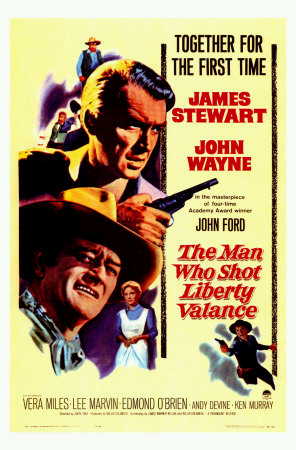
“When the legend become fact, print the legend.” — Maxwell Scott (Carleton Young) in The Man Who Shot Liberty Valance (1962)
Though I understand and respect their importance in the history of both American and Italian cinema, I have never really been a huge fan of westerns. Maybe its all the testosterone (“A man’s got to do what a man’s got to do…”) or maybe it’s all the dust but westerns have just never really been my thing.
However, I will always make an exception for The Man Who Shot Liberty Valance, which is not just a great western but a great film period.
But you already knew that. It’s a little bit intimidating to review a film that everyone already knows is great. I even opened this review with the exact same quote that everyone uses to open their reviews of The Man Who Shot Liberty Valance. To a certain extent, I feel like I should have found a quote that everyone hasn’t already heard a thousand times but then again, it’s a great quote from a great film and sometimes, there’s nothing wrong with agreeing with the critical consensus.
The Man Who Shot Liberty Valance opens with a train stopping in the small western town of Shinbone. The residents of the town — including newspaper editor Maxwell Scott (Carleton Young) — are shocked when Sen. Rance Stoddard (James Stewart) and his wife Hallie (Vera Miles) get off the train. Sen. Stoddard is considered to be a front-runner to become the next Vice President of the United States. Scott is even more shocked to discover why the Stoddards are in town. They’ve come to Shinbone to attend the funeral of an obscure rancher named Tom Doniphon (played, in flashback, by John Wayne).
Sitting in the funeral home with Doniphon’s coffin (and having reprimanded the local mortician for attempting to steal Tom’s boots), Rance tells Scott why he’s come to pay respect to Tom Doniphon. We see, in flashback, how Rance first came to Shinbone 25 years ago, an idealistic lawyer who — unlike most of the men in the west — refused to carry a gun. We see how Rance was robbed and assaulted by local outlaw Liberty Valance (a wonderfully intimidating and bullying Lee Marvin), we discover how Rance first met Hallie while working as a dishwasher and how he eventually taught her how to read, and we also see how he first met Tom Doniphon, the only man in town strong enough to intimidate Liberty Valance.
At first, Rance and Doniphon had an uneasy friendship, epitomized by the condescending way Doniphon would call Rance “pilgrim.” Doniphon was in love with Hallie and, when he attempted to teach Rance how to defend himself, he was largely did so for Hallie. Rance, meanwhile, was determined to bring law and society to the west.
And, eventually, Rance did just that. When Shinbone elected two delegates to the statehood convention in the territory’s capitol, Rance attempted to nominate Doniphon for the position but Doniphon refused it and nominated Rance instead, explaining that Rance understood “the law.” When Liberty Valance attempted to claim the other delegate spot, Rance and Doniphon worked together to make sure that it instead went to newspaper editor Dutton Peabody (Edmond O’Brien). And when Liberty Valance attempted to gun Rance down in the street, Rance shot him.
Or did he?
That’s the question that’s at the heart of The Man Who Shot Liberty Valance. However, as a film, The Man Who Shot Liberty Valance is far less interested in gunfights than it is in politics. Perhaps the most important scene in the film is not when Rance and Liberty meet out on that dark street. Instead, it’s the scene at the statehood convention where the reformers (represented by Rance) and the cattlemen (represented by John Carradine) battle over who will be the territory’s delegate to Washington. Between John Carradine orating, the horses riding in and out of the hall, Edmond O’Brien drinking, James Stewart looking humble, and John Wayne glowering in the background, this is one of the best political scenes ever put on film.
When Rance first arrives in the west, there is no political system in place. With the exception of the ineffectual town marshal (Andy Devine), there is no law. The peace is kept by men like Tom Doniphon and, oddly enough, by Liberty Valance as well. (Whether he realizes it or not, Shinbone’s fear of Liberty has caused the town to form into a community.) What little official law there is doesn’t matter because the majority of the Shinbone’s citizens can’t read.
When Rance arrives, he brings both education and the law. He makes Shinbone into a town that no longer needs Liberty Valance but, at the same time, it no longer need Tom Doniphon either. Hence, it’s Rance Stoddard who goes from dishwasher to U.S. Senator while Tom Doniphon dies forgotten. Rance represents progress and unfortunately, progress often means losing the good along with the bad things of the past.
(It’s no coincidence that when Rance and Hallie return to Shinbone, the first person that they see is the former town marshal, who no longer wears a star and who, we’re told, hasn’t for years. Time has passed by.)
It’s a bittersweet and beautiful film, one that features four great performances from Stewart, Wayne, Marvin, and Vera Miles. Personally, I like to think that maybe Sen. Stoddard had a daughter who married a man named Smith and maybe they had a son named Jefferson who later made his way to the Senate as well.
For today’s entry in the 44 Days of Paranoia, let’s take a look at the 1964 political thriller, Seven Days In May.
Directed by John Frankenheimer (who also directed the conspiracy classic, The Manchurian Candidate), Seven Days In May opens with unpopular President Jordan Lyman (Fredric March) on the verge of signing a treaty with the Russians. The chairman of the joint chiefs-of-staff, Gen. James Scott (Burt Lancaster), is opposed to the treaty and feels that Lyman’s actions will lead to the collapse of the U.S. When Scott’s aide, Jiggs Casey (Kirk Douglas), thinks that he’s come across evidence that Scott is planning a military coup, he takes his suspicions to the White House. Working with an alcoholic Senator (Edmond O’Brien) and a cynical political aide (Martin Balsam), the President launches his own investigation into Scott’s activities.
When it was first released, Seven Days In May was very successful with both critics and audiences. Edmond O’Brien even received an Oscar nomination for best supporting actor. When viewed today, however, Seven Days In May feels rather quaint. A good deal of the film’s suspense was meant to be generated by the question of whether or not Gen. Scott is actually planning a coup. However, for the modern viewer, it’s really not a question worth asking. For us, it’s easy to watch this film and shout, “Of course he’s planning on overthrowing the government! He’s the most obviously villainous character in the entire film!” The idea of a military conspiracy to overthrow the U.S. government was perhaps shocking back in 1964 but today, we take the existence of such conspiracies for granted.
Seven Days In May is definitely a product of its time. Unlike John Frankenheimer’s other well-known conspiracy film, The Manchurian Candidate, there’s no sly undercurrent of satire or subversion running through Seven Days In May. Instead, Seven Days In May epitomizes everything that we think of when we think about the early 60s. The film’s politics are liberal but not radically so. The President is such an honorable leader that he won’t resort to the politics of personal destruction and reveal that Scott has a mistress. Casey explains that he disagrees with the President’s politics but that he is bound by duty to reveal Gen. Scott’s subversion. Indeed, by the end of the film, it’s obvious that we’re meant to condemn Scott not because he might overthrow the President but because he would subvert the democratic process to do so. Seven Days In May is a film that tells viewers to support and respect their elected leaders, whether they be good or evil and whether they’re played by Fredric March or Burt Lancaster.
When I listened to Casey explain why he was informing on a man who he claimed to admire and agree with, I was reminded of some of the recent political debates that we’ve had deal with her in America. All of those debates can pretty much be summed up by whether we, as citizens, are obligated to support a law even if we personally don’t agree with it or to respect a leader even if we do not agree with him. The answer, according to Seven Days In May, would appear to be yes.
While Seven Days In May is often a bit too ponderous for its own good, it’s still a well-made and watchable film. If you’re a history nerd like me, you’ll enjoy the film as a portrait of its time. John Frankenheimer directs as if the movie is a film noir and the film’s shadowy black-and-white cinematography looks great. Finally, if you’re a fan of the old school movie stars, how can you not enjoy a film that features Kirk Douglas, Fredric March, and Burt Lancaster?
Thanks to TCM, I’ve gotten the chance to discover a lot of old films that I, otherwise, would have probably never even heard about. One of those films is A Cry In The Night, a low-budget, 1956 crime story that I randomly came across last month.
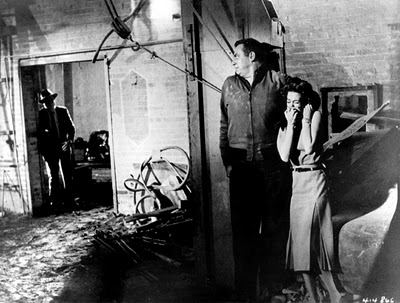
Harold Loftus (Raymond Burr) has issues. He lives in a shack, he’s totally dominated by his overbearing mother, and he spend most of his time secretly peeping at couples who are parked at the local lover’s lane. When he comes across Liz (Natalie Wood) and her boyfriend Owen (RIchard Anderson), he overpowers Owen and kidnaps Liz. Now, Owen must work with Liz’s overprotective policeman father, Dan (Edmond O’Brien), to track down Harold and Liz. Making things difficult is the fact that Dan blames Owen for the kidnapping and simply cannot bring himself to accept that his daughter was actually “one of those girls” who spent her Saturday night sitting in a car and sharing chaste kisses with her boyfriend.
(Seriously, the film made it sound like this was the worst possible thing that a girl could do with her time. I’m not sure if Dan was supposed to come across like a reactionary or if this was just a case of the film having been made in 1956. Personally, if that’s what the 50s were like, I’m glad I wasn’t born until the 80s.)
As directed by Frank Tuttle, A Cry In The Night tells its story in a stark, no-nonsense, semi-documentary manner. (There’s even narration at the beginning and end of the film.) O’Brien bellows his way through the role and Anderson’s colorless performance does little to make Owen seem like any less of a wimp. However, Raymond Burr makes for a disturbingly plausible pervert and Natalie Wood is well-cast as Liz. The film came out a year after Rebel Without A Cause and, watching her performance in A Cry In the Night, you can tell why Natalie Wood was Hollywood’s favorite vulnerable teenager.
I have to admit that I love films like A Cry In The Night, not so much because they’re great films (and, while always watchable, A Cry In The Night is certainly not a great film), but because they’re totally a product of their time. As opposed to the big budget extravaganzas that were churned out by the Hollywood studio system during the 50s and 60s, low-budget B-movies like A Cry In The Night were designed to exploit contemporary headlines and contemporary concerns and, therefore, provide a lot of insight into what was going on with the American psyche at the time.
A Cry In The Night combines several themes that ran through the majority of the films of the period. In the role of Harold, Raymond Burr is the epitome of the 1950s weirdo. As opposed to the normal, all-American boys who make out with their girls in cars, Harold can only bring himself to lurk about and attempt to catch a peek of what normal society does on Saturday night. When he kidnaps Liz, he’s not only threatening Natalie Wood, he is by extension attacking America itself. Meanwhile, Liz’s boyfriend comes across like the type of intellectual liberal who probably cast two ballots for Adlai Stevenson while her father is definitely an Eisenhower man. Boyfriend and father do not get along at first but what’s important is that they set aside their difference so that they can vanquish the other. By the end of the film, the father is willing to invite the boyfriend to dinner and the boyfriend has learned that sometimes, you have to be willing to fight.
For those of you who keep crying about how the solution for all of America’s problems lie in bipartisan compromise, A Cry In The Night is the film for you!
For the rest of us, A Cry In The Night is an occasionally entertaining time capsule.
As some of you may know, I’ve spent the past two years on a mission. It is my goal to eventually see and review every single film that has ever been nominated for best picture. After taking a few months off, I am now ready to continue that quest. For that reason, I recently sat down and watched the 1953 best picture nominee Julius Caesar.
Julius Caesar is an adaptation of William Shakespeare’s classic play about political intrigue, assassination, and demagoguery in ancient Rome. (Technically, what follows is full of spoilers but come on, people — it’s Shakespeare!) The citizens of Rome love their leader, Julius Caesar (played here by a very imperial Louis Calhern) but a group of senators led by Cassius (John Gielgud) fears that Caesar’s popularity will lead to the collapse of the Roman Republic. Cassius recruits Caesar’s close friend Brutus (James Mason) into a conspiracy to assassinate Caesar on the Ides of March. However, once the deed has been done and Brutus has explained the motives behind the assassination to the Roman public, the previously underestimated Mark Antony (Marlon Brando) delivers his famous “Lend me your ears!” speech and soon, the people of Rome turn against the conspirators. In the end, the conspiracy’s efforts to save the Roman Republic instead leads to the birth of the Roman Empire.
Speaking as someone who loves both Shakespeare and history, it was an interesting experience to watch this particular version of Julius Caesar. As directed by Joseph L. Mankiewicz (who later revisited the material in the infamous 1963 Best Picture nominee Cleopatra), Julius Caesar present a very traditional (and occasionally stagey) interpretation of Shakespeare’s play. However, by this point, we’ve become so used to Shakespeare being presented with a gimmick (like modern-day costumes, for instance) that the traditional approach almost feels like something new and unexpected. That said, Julius Caesar is definitely not the Shakespearean film to show to your friends who stubbornly insist that Shakespeare is boring or impossible to follow. Julius Caesar was obviously made by people who appreciate Shakespeare and that remains the film’s best audience.
When Julius Caesar was first released in 1953, it received a lot of attention because of the casting of Marlon Brando as Mark Antony. An outspoken method actor who had been nicknamed “the mumbler” precisely because of his own internalized style of acting, Brando was considered to be too contemporary of an actor to be an effective Shakespearean. Once the film was released, critics agreed that Brando had proven that, even while mumbling, he made for an electrifying Mark Antony and that, despite only having a few scenes, his charismatic presence dominated the entire film. Out of an impressive cast, Brando received the film’s only nomination for acting.
It is true that, even when seen today, Brando does dominate the entire film. He delivery of Mark Antony’s famous oration over Caesar’s bloody corpse remains one of the best Shakespearean performances to have ever been preserved on film. It’s odd to watch this young, sexy, and energetic Brando and compare him to the legendary eccentric that we all usually think of whenever we hear the man’s name.
That said, Brando’s performance would not be half as effective if it wasn’t surrounded by the more traditional (but no less compelling) performances of James Mason and John Gielgud. Mason brings a brooding intensity to the role of Brutus and Gielgud is the Cassius by which all future Cassiuses must be judged. Their performances might not be as flamboyant as Brando’s but they’re no less important. Ultimately, the clash between the acting style of Brando and the styles of Gielgud and Mason nicely parallel the conflict over the future of the Roman Republic.
Julius Caesar won the Oscar for best art design and was nominated for picture, actor, cinematography, and original score. Brando lost the award for best actor to Stalag 17’s William Holdenwhile the Oscar for best picture of 1953 went to a far more contemporary film, From Here To Eternity. Brando, however, would win best actor the next year for his performance in On The Waterfront.



 Through the Shattered Lens