Horror Film Review: Alligator (dir by Lewis Teague)


1980’s Alligator begins in 1968.  While on vacation in Florida, a teenage girl named Marisa Kendall purchases a baby alligator named Ramon.  When she returns home to Chicago, her jerk of a father flushes Ramon down the toilet.

12 years pass.  Marisa (Robin Riker) becomes a herpetologist.  As for Ramon, he actually survives being flushed down the toilet and thrives in the sewer.  He eats the carcasses of animals that had been a part of an experiment involving a growth serum.  The serum had the desired effect of making the animals bigger but it also increased their metabolism to the extent that they became aggressive and had to eat constantly.  Evil industrialist Slade (Dean Jagger) is convinced that, by tossing the carcasses in the sewer, he’s ensured that no one will ever find out about the experiments.  Instead, he’s turned Ramon into a giant alligator who is always hungry.  Soon, the super-intelligent alligator is ambushing and eating sewer workers.

Burned-out Detective Dave Madison (Robert Forster) teams up with Marisa to solve the mystery of why so many body parts are turning up in the sewers.  It’s not easy.  No one wants to admit that there might be a giant alligator living under the city.  Everyone wants to believe that’s just an urban legend.  But, after a tabloid reporter (Bart Braverman) manages to snap a few photographs of Ramon before being devoured, the police are forced to deal with the fact that they’ve got an alligator on their hands.  As Slade continues to try to cover up his involvement, big game hunter Colonel Brock (Henry Silva) comes to town and announces that he will be capturing the alligator.

Directed by Lewis Teague and written by John Sayles, Alligator is a dark comedy disguised as a horror film.  While numerous people get eaten and the film ends on a properly ominous note, Alligator is obviously not meant to be taken seriously.  The cast is full of good actors who send up their own images.  That’s especially true in the case of Henry Silva, who appears to be having a blast as the hyper macho Colonel Brock.  Robert Forster, meanwhile, delivers his lines with a self-aware weariness that seems a bit more appropriate for a noir hero than a film about a detective investigating a giant alligator.  One reason why the film works is because Forster, Silva, and the rest of the cast understood exactly what type of film they were appearing in and they delivered their overheated lines with just enough wit to let the viewer know that the film was in on the joke.  The big and somewhat stiff-looking alligator may not look entirely real and it may move somewhat awkwardly but ultimately, it’s the most likable character in the movie.  It just wants to relax in the sewers but, every few minutes, someone else is bugging him.

When first released, Alligator struggled at the box office but it has since gone on to become a cult favorite.  Quentin Tarantino is a self-described fan and he had said he was inspired to cast Robert Forster as Max Cherry in Jackie Brown after seeing him as Dave Madison in this film.  That’s not bad for a movie about a giant alligator!

Retro Television Review: The Glass House (dir by Tom Gries)


Welcome to Retro Television Reviews, a feature where we review some of our favorite and least favorite shows of the past!  On Sundays, I will be reviewing the made-for-television movies that used to be a primetime mainstay.  Today’s film is 1972’s The Glass House!  It  can be viewed on YouTube.

The Glass House starts with three men arriving at a location that will define the next few months of their lives.

Brian Courtland (Clu Gulager) is a veteran of the Vietnam War.  He spent part of his service working as a guard in the brig.  Now that he’s back in the United States and in need of a regular paycheck, he has gotten a job working as a prison guard.  Courtland is not naive about where he’s going to be working or who he is going to be working with.  But he is an idealist, one who tries to treat everyone fairly and who hopes that he will be able to do some sort of good in his new position.

Alan (Kristoffer Tabori) is a young man who has been arrested for selling marijuana.  He is quiet and just hoping to serve his time and then get on with his life.  His fellow prisoners have different plans for him.

Finally, Jonathan Paige (Alan Alda) is a liberal professor who, in a moment of rage, accidentally killed a man in a fight.  Convicted of manslaughter, Paige enters the prison in a daze and cannot stop flashing back to the one moment that changed his life forever.  Paige is assigned to work in the pharmacy, where he meets a prisoner-turned-activist named Lennox (Billy Dee Williams).  Paige struggles to retain his humanity despite the harsh conditions.

All three of the men find themselves having to deal with the attentions of Hugo Slocum (Vic Morrow), the predatory “king” of the prison.  Slocum expects Paige to help him run drugs though the the pharmacy.  Slocum preys on Alan and sends his gang to punish him when Alan refuses Slocum’s advances.  And Slocum expects that Courtland will just be another corrupt guard who agrees to look the other way when it comes to Slocum’s activities.  Courtland, however, turns out to have more integrity than anyone was expecting.

The Glass House opens with a title card, informing the viewer that the film was shot at an actual prison and that the majority of the people in the film were actual prisoners.  Not surprisingly, The Glass House does feel authentic in a way that a lot of other films about incarceration does not.  The prison is claustrophobic and dirty, with every crack in the wall reminding the prisoners and the viewer that no one cares about what happens there.  The extras have the blank look of men who understand that showing any emotion will be taken a sign of a weakness.  Made in 1972, at a time when America was still struggling to integrate, The Glass House takes place in an almost totally segregated world.  The black prisoners stick together.  The white prisoners stick together.  Everyone understands that’s the way that it will always be and, as we see by the end of the film, that’s the way the guards and the warden (Dean Jagger) prefer it because that means almost any incident can be written off as a being “a race riot.”

The real actors amongst the population do a good job of blending into the surroundings.  Alda, Williams, and Tabori all give good performance while Vic Morrow is truly menacing in the role of the vicious Slocum.  Slocum may not be particularly bright but, because he has no conscience, he is uniquely suited to thrive in a world with no morality.  The film’s best performance comes from Clu Gulager, who does a great job of portraying Courtland’s growing disgust with how the system works.

Though it’s over 50 years old, The Glass House is a still a powerful look at life on the fringes.  Society, for the most part, doesn’t really care much about what happens to the incarcerated.  This film makes a strong case that we probably should.  One is left with little doubt that, even if relatively harmless prisoners like Paige and Campbell survive being locked up with men like Slocum, they’ll still be incapable of returning to the “real world” afterwards.  The viewer, like Brian Courtland, is left to wonder how much corruption can be tolerated before enough is enough.

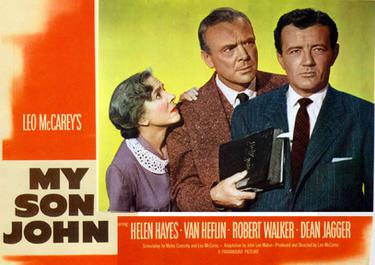
A Loyalty Day Film Review: My Son John (dir by Leo McCarey)


Oh my God, did you know that it’s Loyalty Day!?

Well, actually, it’s not Loyalty Day for everyone.  In fact, a lot of the world’s citizens are celebrating Communist May Day today.  However, here in the United States, it’s Loyalty Day.  Even if you are an American, it’s possible that you’ve never heard of Loyalty Day.  It was first celebrated in 1921 and it was intended to provide a non-Communist alternative to International Workers Day.  It wasn’t until 1955 that Loyalty Day was officially recognized by Congress.

From Wikipedia:

Loyalty Day is defined as follows in 36 U.S.C. § 115:

  • (a) Designation.— May 1 is Loyalty Day.
  • (b) Purpose.— Loyalty Day is a special day for the reaffirmation of loyalty to the United States and for the recognition of the heritage of American freedom.
  • (c) Proclamation.— The President is requested to issue a proclamation—
    • (1) calling on United States Government officials to display the flag of the United States on all Government buildings on Loyalty Day; and
    • (2) inviting the people of the United States to observe Loyalty Day with appropriate ceremonies in schools and other suitable places.

Though released before it officially became a holiday, the 1952 film, My Son John, is perfect for Loyalty Day.

The John of the title is John Jefferson (Robert Walker, in his final role), an employee of the State Department.  While his younger brothers (played by Richard Jaeckel and James Young) are two high school football stars who are looking forward to serving their country in Korea, John is an intellectual who considers concepts like patriotism to be simplistic and naive.  While his father (Dean Jagger) sings patriotic songs at the American Legion hall, John rolls his eyes at such middle class activities.  (“If you don’t like your Uncle Sammy,” move to another country, John’s father sings.)  The only person to whom John is especially close is his nervous mother, Lucille (Helen Hayes).

However, John is keeping a secret from even Lucille.  He’s a double agent, working for the communists!  With FBI agent Stedman (Van Heflin) hot on his trail, will John ever be able to see the light about the communists?  And, how will the communists respond to John having doubts about the cause?

My Son John was a dream project for Hollywood director Leo McCarey.  (It’s not a coincidence that the devoutly Catholic McCarey made a film about a devoutly Catholic family who discovers that one of their own has become a communist.)  McCarey carefully supervised every detail of the film and he was even able to talk stage legend Helen Hayes into starring in the film, her first in 14 years.  My Son John is full of scenes of shadowy communists, smug intellectuals, and all-American FBI agents marveling at the strength of Lucille Jefferson’s faith.  Everything that is today often cited as a negative aspect to living in the suburbs is presented as being a positive in My Son John.  The film’s communists come into a world of happy families, big houses, and well-manicured lawns and they set out to make everyone else as miserable as they are.  There’s nothing subtle about either McCarey’s approach or Helen Hayes’s performance but, as is often the case with propaganda, the film is crudely effective.

My Son John was Robert Walker’s final film.  In fact, he died before completing work on the film, leading the ending being rewritten.  (No longer would John personally deliver a commencement address.  Instead, his words come out of a tape player that has been rolled out on stage.  A holy light shines down on the player while The Battle Hymn of the Republic plays in the background.  It’s bizarre but it’s also probably the most memorable part of the movie.)  Scenes from Strangers On A Train were rather awkwardly spliced into final moments of My Son John, never mind the fact that Robert Walker’s gleefully evil performance as Bruno Antony had little in common with his self-tortured performance as John Jefferson.

Surprisingly, considering that My Son John was released at the height of the anti-Communist era, the film was not a success at the box office.  (Audiences seemed to better appreciate low-budget and pulpier anti-communist films, like I Was A Communist For The FBI.)  Still, thanks to the Internet, My Son John is still available to be viewed on this Loyalty Day.

So, remember — if you don’t like your Uncle Sammy …. well, actually, the cool thing about this country is that you don’t have to like your Uncle Sammy.  You have the right to decide for yourself how you feel about old Uncle Sammy.  That’s an idea that is worth being loyal to.

14 Days of Paranoia #10: The Brotherhood of the Bell (dir by Paul Wendkos)


First aired on television in 1970, The Brotherhood of the Bell tells the story of Andrew Patterson (Glenn Ford).

Andrew Patterson is a widely respected economics professor.  He is an influential academic, one who has a nice house, a beautiful wife (Rosemary Forsyth), and a father-in-law (Maurice Evans) who owns a very successful business.  Patterson is also a member the Brotherhood of the Bell, a secret society made up of successful men who all graduated from the prestigious College of St. George in San Francisco.  Patterson has been a member of the society for 22 years and he’s never really taken it that seriously.  He thinks of it as just being a collection of influential men who enjoy getting together and discussing their vision for the world.

That all changes when the man who brought Andrew to the Society, Chad Harmon (Dean Jagger), gives Andrew an assignment.  The Society wants him to deliver an envelope to his friend, Dr. Konstantin Horvathy (Eduard Franz).  Horvathy is up for a deanship that another member of the Society desires for himself.  Inside the envelope is damaging information that the Society has gathered about the people who helped Horvathy defect to the United States, information that will be made public unless Horvathy withdraws as a candidate.  Reluctantly, Andrew shows Horvathy the envelope.  Horvathy responds by committing suicide.

Stricken with guilt, Andrew decides to expose the existence of the Society but he discovers that won’t be easy.  Almost overnight, Andrew’s perfect life starts to collapse.  He loses his job.  The IRS launches an investigation of his father (Will Geer).  As Chad explains it, the Society is responsible for everything that Andrew has and, therefore, the Society can take everything away.  When Andrew goes public, he’s dismissed as just being paranoid and soon, Andrew truly is paranoid.  With his marriage in ruins, Andrew goes on a talk show and can only watch helplessly as his claims are dismissed by the host (William Conrad) and as the audience argues about whether or not the Society is a white plot, a communist plot, a Jewish plot, a Catholic plot, or a government plot.  Even the people who believe Andrew are too busy fighting amongst themselves to provide any help for him or to stand up to the unified power of the Brotherhood.  The host repeatedly rings a bell during the show, the better to mock everyone’s fears.  The film makes a good point.  Crazed theorists are often a conspiracy’s best friend.

An intelligently written and well-acted film, The Brotherhood of the Bell‘s main strength is the direction of Paul Wendkos.  The lighting gets darker and the camera angles become increasingly more skewed as Andrew’s paranoia grows.  In fact, Wendkos does such a good job of visualizing Andrew’s deteriorating mental state that it’s easy to wonder if maybe everyone is right and all of this really is just happening in Andrew’s head.  Though the film ends on a slightly triumphant note, it’s hard not to feel that it’s a temporary victory at best.  The Brotherhood of the Bell (which I imagine was based on Yales’s Skull and Crossbones) will always be there.

14 Days of Paranoia:

  1. Fast Money (1996)
  2. Deep Throat II (1974)
  3. The Passover Plot (1976)
  4. The Believers (1987)
  5. Payback (1999)
  6. Lockdown 2025 (2021)
  7. No Way Out (1987)
  8. Reality (2023)
  9. Chappaquiddick (2017)

The Hanged Man (1974, directed by Michael Caffey)


In this made-for-TV western, Steve Forrest stars as James Devlin.  A hired killer and a notorious outlaw, Devlin has finally been captured and is sent to the gallows.  At first, it seems as if the hanging’s been a success and Devlin’s life has been extinguished at the end of the rope.  But then, while his body is at the funeral home and is being prepared for burial, Devlin suddenly opens his eyes and reveals that he’s alive.

No one can figure out how Devlin manage to survive being hung, especially not Devlin.  However, Devlin is now alive and free to leave town.  Has Devlin been sent back to Earth to serve God or did he just get lucky?  Devlin may not be sure himself but he is determined to turn around his old ways.  That starts with protecting a widow (Sharon Acker) and her son (Bobby Eilbacher) from Lew Halleck (Cameron Mitchell), a greedy businessman who wants their land and is prepared to go to any lengths to get it.  Devlin is not only still as good with a gun as he was before his execution but, having survived his hanging, he can now read minds!

The Hanged Man was designed to be a pilot for a weekly TV series and watching it, it’s easy to imagine how the show would have developed.  Devlin would have traveled around the old west, helping out a new guest star every episode and presumably trying to discover why he had been returned to life.  It’s not a bad idea for a show, though the pilot film doesn’t do enough with it.  Despite the fact that Devlin might be undead and that he now has the power to read minds, it really is just a conventional western, featuring the saintly widow and the evil land baron and all of the other familiar tropes of the genre.  It may begin with Devlin coming back to life but it ends with a shoot-out that could have been lifted from any number of old TV shows.

Still, as far as made-for-TV westerns are concerned, this one is entertaining enough.  Steve Forrest is a good hero and, as always, Cameron Mitchell is a good villain.  I wish they had done more with the supernatural aspects of the story but The Hanged Man is good enough for undemanding fans of the genre.

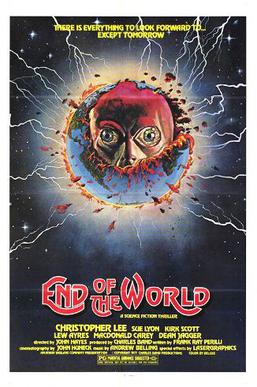
The TSL’s Horror Grindhouse: End of the World (dir by Charles Band)


http://www.youtube.com/watch?v=jXmvGqlp8NY

The 1977 film End of the World has got a great opening scene.  An obviously distraught priest (played by none other than Christopher Lee!) steps into an isolated diner.  He tells the counterman that he needs to use the phone.  The counterman says, “Sure, father.”  And then suddenly, everything in the dinner starts blowing up.  The phone, the coffee, the pinball machine, everything explodes.  The counterman ends up trying to unsuccessfully throw himself through a window.  The priest, looking rather confused, steps outside of the diner and he runs into …. his exact double!  Christopher Lee meets Christopher Lee!

Again, that’s a great opening and it’s really not a surprise that the rest of the film can’t live up to it.  Once the two Christopher Lees disappear into the darkness, the focus of the story shifts to a scientist named Andrew (Kirk Scott) and his wife, Sylvia (Sue Lyon, who years previously played Lolita).  Andrew spends a lot of time sitting in front of a boxy computer and staring at the screen.  He’s picking up strange transmissions from space and he’s trying to translate them.  Andrew goes home.  He and his wife got a party.  Andrew sits in front of the computer a while longer.  Andrew goes home.  Andrew goes to work.  Andrew keeps staring at the computer….

“Wait,” you’re saying at this point, “isn’t this is a Christopher Lee movie?”

Yes, it is.  Christopher Lee is indeed top-billed and he’s hardly in the movie at all.  I’d like to think that, when asked why by an intrepid reporter why he agreed to star in End of the World, Lee laughed and replied, “For the money, of course.”  But, according to Lee’s autobiography, he did the film because he was told that he would be appearing with a cast of distinguished actors like Jose Ferrer, Dean Jagger, and John Carradine.  Now, Dean Jagger does have a small cameo in the film but Ferrer and Carradine are nowhere to be seen.  Either they left the production or someone lied to Sir Christopher!

Anyway, back to the plot.  Eventually, Andrew figures out that the space transmissions are predicting natural disasters.  We don’t actually see any of these disasters because, after all, this is the end of the world on a very low budget.  But we are assured that the disasters are happening.  Andrew and Sylvia discover that the transmissions are coming from a convent in the middle of the desert.  Andrew and Sylvia go to investigate and they discover that the nuns are….

ALIENS!

Now, this is actually a pretty good twist and there are some vaguely humorous scenes of the the nuns working in a space lab.  It turns out that the nuns (and one of the Christopher Lees) are stranded on this planet because their spaceship broke down.  They don’t really like Earth, considering it to be an ugly and polluted place.  They’re planning on ending the world but they need to leave before the whole place blows up.  They demand that Andrew help them fix their transporter and they’re going to hold Sylvia hostage until he does so….

It’s all a bit silly but, as you’re watching the film, you can’t help but wish that it had been even sillier.  I mean, alien nuns and Father Christopher Lee?  That sounds like the makings of a certain type of classic!  But, unfortunately, the film never fully embraces the full potential of its absurdity.  It takes forever for Andrew and Sylvia to actually reach that convent and even the alien nuns become rather passé after a few minutes.  Christopher Lee is fun to watch as always and his character’s irritation with being stuck on Earth was obviously mirrored by Lee’s irritation with being in the film.  And, despite all else, let’s give credit where credit it is due — the title lives up to its promise.  The world may end in a pile of stock footage but an end is an end.

Anyway, this one is pretty much for Christopher Lee completists only.  Watch the opening and then fast forward to the end.

Bruce Lee vs. The Star Whackers: Game of Death (1978, directed by Robert Clouse)


Billy Lo (played by archival footage of Bruce Lee and two stand-ins) is the world’s biggest film star and the Syndicate (represented by Dean Jagger and Hugh O’Brian) want a piece of the action.  When Billy refuses to allow the Syndicate to take control of his career, the Syndicate responds by threatening both Billy and his girlfriend (Colleen Camp).  After a Syndicate hitman sneaks onto the set of Billy’s latest film and shoots him in the face, Billy allows the world to believe that he’s dead.  Using a variety of disguises, Billy seeks revenge on the Syndicate and all of its assassins, including the 7 foot tall Hakim (Kareem Abdul-Jabbar).

Lee’s original plan for the Game of Death was that it would feature him as a retired martial artist who, in order to save the lives of his family, had to make his way up a five-level pagoda, defeating a different guardian on each floor.  Each guardian would represent a different fighting style and the journey up the pagoda would allow Lee to discuss his beliefs regarding the principles of martial arts.  Serving as both director and star, Lee did during the making of the film, of cerebral edema though some said Lee was either murdered or that he had faked his own death.

Released seven years after his death, the final version Game of Death has little in common with Lee’s original vision.  Only about 11 minutes of footage from the original film was used in the revised version and most of Lee’s philosophical concerns were abandoned for a plot that, today, feels like it could have been lifted from Randy Quaid’s twitter timeline.  (Also, when watching the film today, it’s also impossible to watch the Syndicate’s assassins disguise Billy Lo’s shooting as an on-set accident without being reminded of what would happen to Brandon Lee on the set of The Crow.)  Game of Death opens with footage lifted from Lee’s battle with Chuck Norris at the end of Way of the Dragon and the other fight scenes are full of close-ups of Lee that were obviously lifted from other films.  There’s even a scene in Billy’s dressing room where a cardboard cut-out of Lee’s face has obviously been taped onto a mirror.  After Billy fakes his own death, footage of Bruce Lee’s actual funeral is shown, including a shot of Lee in his coffin.

If you can overlook the ethical issues of making a Bruce Lee film without the actual participation of Bruce Lee, Game of Death is actually a pretty entertaining movie.  Director Robert Clouse had previously directed Enter the Dragon and obviously knew how to direct a fight scene while even stock footage of Bruce Lee has more charisma than the average action star.  Best of all, Bruce Lee battles Kareem Adbul-Jabbar, in an epic scene that Lee himself directed for the original version of Game of Death.  When the 7’2 Kareem Abdul Jabber plants his foot in the middle of Bruce Lee’s chest, Game of Death achieves pop cultural immortality.

Thorny ethical concerns aside, Game of Death proves that Bruce Lee will live forever.

30 Days Of Noir #18: C-Man (dir by Joseph Lerner)


At the center of the 1949 film, C-Man, is a man named Cliff Holden (Dean Jagger).  When we first see Cliff, he’s cheerfully walking down the street in New York City, looking pretty happy underneath his new fedora.

And really, why shouldn’t Cliff be happy?  He’s a U.S. Customs agent!  He investigates crimes and tracks down smugglers and, perhaps most importantly, his best friend is a customs agent as well!  Who wouldn’t want to work with their best friend, right?  Anyway, Cliff eventually reaches his office and he discovers that nobody else appears to share his good mood.  For that matter, Cliff’s step losing its cheerful spring when he finds out that his best friend has been …. MURDERED!

His friend was investigating the theft of a very valuable necklace.  The Treasury Department has reason to believe that an international criminal named Matt Royal (Rene Paul) will be smuggling that necklace into the United States.  Looking to not only avenge his friend but also protect the reputation of the United States, Cliff takes over the case.  Using the name William Hannah, he flies out to Europe so that he can then board the same plane that Royal will be taking to the States.

While Cliff/William is waiting at the airport, he meets a Swiss woman, named Kathe van Bourne (Lottie Elwin), who is flying to New York so that she can be reunited with her fiancée, Joe.  However, after they board the plane, Kathe is suddenly taken ill.  Luckily, there’s a doctor on the plane, a courtly gentleman named Doc Spencer (John Carradine).  Spencer takes Kathe to the back of the plane to examine her and, while no one’s looking, he hides the necklace underneath a bandage that he wraps around her head.

Back in New York, Royal is pulled off the plane and thoroughly searched.  When it’s discovered that he doesn’t have the necklace, Cliff realizes what has happened.  However, Kathe has already been taken off in an ambulance and, when Cliff goes to Joe’s apartment, he discovers that Joe has been murdered….

C-Man is a film that kind of sneaks up and takes you by surprise.  That it was an extremely low-budget production is obvious from the minute the movie starts.  The black-and-white images are grainy.  The sets are small and sparsely furnished.  The whole film has a rather cheap and ragged feel, as if it might burst into flame and dissolve at any moment.  And yet, that low-budget feel works perfectly for the story that C-Man is telling.  Despite the oddly cheery narration that’s provided by Dean Jagger, this is a sordid tale about people on the fringes of society.  Watching C-Man feels like taking a trip to all of the places that most tourists would never want to visit during their trip to New York City.  For instance, when Cliff searches for the alcoholic Doc Spenser, his search leads him from one liquor store to another and it’s obvious that some of the desperate souls that Cliff passes on the streets weren’t actors.

Gail Kubick’s pounding and relentless score adds to the film’s overall dreamlike feel and Joseph Lerner’s direction is just quirky enough to keep things interesting.  (When one character is bludgeoned to death, the film suddenly starts to spin as if the viewer has become trapped in the killer’s madness.)  Dean Jagger seems a bit miscast as a the tough customs agent but the actors playing the criminals are all properly menacing.  Harry Landers, as the most violent of the jewel thieves, makes a particularly threatening impression.

All in all, C-Man is a surprisingly effective poverty row noir.

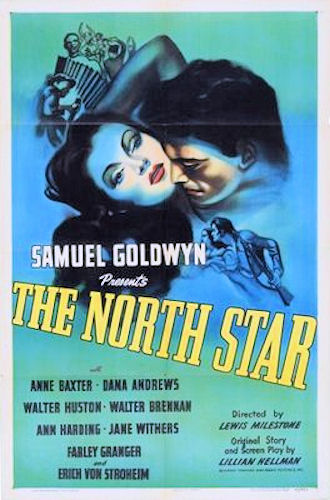
The Fabulous Forties #41: The North Star (dir by Lewis Milestone)


The North Star

The 40th film — wait a minute, I’m finally up to number 40!?  That means that there’s only ten more movies left to review!  And then I’ll be able to move on!  It’s always exiting for me whenever I’m doing a review series and I realize that I’m nearly done.

Anyway, where was I?

Oh yeah — the 40th film in Mill Creek’s Fabulous Forties box set was the 1943 war epic, The North Star.  This is one of the many war films to be included in the Fabulous Forties box set and I have to admit that they all kind of blend together for me.  Since these films were actually made at a time when America was at war, there really wasn’t much room for nuance.  Instead, every film follows pretty much the same formula: the Nazis invade, a combination of soldiers and villagers set aside their individual concerns and/or differences and team up to defeat the Nazis, there’s a big battle, a few good people sacrifice their lives, the Nazis are defeated, and the allies promise to keep fighting.

It’s a pretty predictable formula but that’s okay because it was all in the service of fighting the Nazis.  Could I legitimately point out that the villains in these movies are always kind of two-dimensional?  Sure, I could.  But you know what?  IT DOESN’T MATTER BECAUSE THEY’RE NAZIS!  Could I point out that the heroes are often idealized?  Sure, but again it doesn’t matter.  Why doesn’t it matter?  BECAUSE THEY’RE FIGHTING NAZIS!

That’s one reason why, even as our attitude towards war changes, World War II films will always be popular.  World War II was literally good vs evil.

Anyway, The North Star was a big studio tribute to America’s then ally, the Soviet Union.  When a farm in the Ukraine is occupied by the Nazis, the peasants and the farmers refuse to surrender.  They disappear into the surrounding hills and conduct guerilla warfare against the invading army.  It’s all pretty predictable but it’s also executed fairly well.  It doesn’t shy away from showing the brutality of war.  There’s a haunting scene in which we see the bodies of all of the villagers — including several children — who have been killed in a battle.

The Nazis are represented by Erich Von Stroheim.  Von Stroheim plays a German doctor who continually claims that he personally does not believe in the Nazi ideology and that he’s just following orders.  When wounded Nazi soldiers need blood transfusions, he takes the blood from the children of the village.  His rival, a Russian doctor, is played by all-American Walter Huston and indeed, all the Russians are played by American stars, the better to create a “we’re all in this together” type of spirit.  When Huston tells Von Stroheim that he is even worse than the committed Nazis because he recognized evil and chose to do nothing, he’s speaking for all of us.

Unfortunately, before the Nazis invade, The North Star devotes a lot of time to showing how idyllic life is in the communist collective and these scenes are so idealized that they totally ring false.  Everyone is so busy singing folk songs and talking about how happy they are being a part of a collective (as opposed to being an individual with concerns that are not shared by the other members of the collective) that it’s kind of unbearable.  Not surprisingly, The North Star was written by Lillian Hellman, who wrote some great melodramas (like The Little Foxes) but who was always at her most tedious when she was at her most overly political.

(Watching the opening of The North Star, I was reminded that I would be totally useless in a collectivist society.)

So, I have to admit, that I was rather annoyed with the villagers at first.  But then the Nazis invaded and I realized that we’re all in it together!  As I said earlier, you can forgive your heroes almost anything when they’re fighting Nazis.

The North Star is an above average war film and a below average piece of political propaganda.  See it as a double feature with The Last Chance.

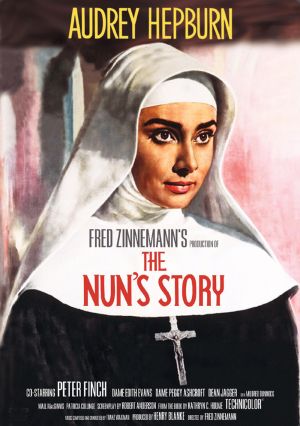
Lisa Watches An Oscar Nominee: The Nun’s Story (dir by Fred Zinnemann)


Nun_story

Happy Ash Wednesday!

So, earlier today, I got off work early so I could go to Noon Mass with my sister and we both got our ashes.  And I’m sure that will take some people by surprise because I’m not exactly the most faithful or devout of Catholics.  But what can I say?  I love the ornate ritual of it all.

And, as a part of my own personal ritual, I washed my forehead before I left the church.  Erin and I had a great vegetarian lunch at Cafe Brazil and then we came home and I turned on the TV and what should be finishing up on TCM but the 1959 best picture nominee, The Nun’s Story.  Fortunately, I had already set the DVR to record The Nun’s Story and so, on this most Catholic of days, I was able to watch this most Catholic of best picture nominees.

The Nun’s Story tells the story of Gaby (Audrey Hepburn), the daughter of a famous Belgian doctor (Dean Jagger).  At the start of the film, Gaby has entered a convent because she wants to become a missionary nursing sister in the Belgian Congo.  However, before Gaby can go to the Congo, she has to learn to give up her own rebellious streak and individual independence.  Taking the name Sister Luke, she excels at her medical training but, because it is felt that she is still too independently minded, she is not sent to the Congo but instead assigned to work in a mental hospital.  It’s there that her independent streak nearly gets her killed when she is fooled by a dangerous patient who claims to be the Archangel Gabriel.  It is only after she takes her final vows that Sister Luke is finally sent to the Congo and it is there that she’s forced to work with the abrasive agnostic Dr. Fortunati (Peter Finch).  Of course, as Sister Luke goes through her own spiritual struggles, the world inches closer and closer to the start of a second world war.  When war does break out, Sister Luke finds herself torn between her vow of obedience (which includes remaining political neutral) and the realities of living in a country that’s been occupied by the Nazis.

1959 was apparently a good year for religious films.  Not only did Ben-Hur win best picture, but The Nun’s Story also received 8 nominations.  Reportedly, The Nun’s Story was the most financially successful film to be released by Warner Bros, up to that point.  If Wikipedia is to be believed, it was also Audrey Hepburn’s personal favorite of the many movies that she made.

When seen today, probably the first thing that people notice about The Nun’s Story is that it’s extremely long and occasionally rather slow.  The film follows Gaby from the minute she enters the convent to the moment that she makes her final choice about whether to be obedient to herself or to her vows and, during that time, it examines every single detail of her life in glorious Technicolor.  A lot of emphasis is put on the rituals that Sister Luke goes through on her way to taking her final vows.  Now, if you’re like me, all of the rituals are fascinating to watch and produce a whole host of conflicting emotions.  Even as I found myself admiring Sister Luke’s dedication and her sacrifice, I still kept wondering — much as she did —  if it was all really worth giving up her independence.  But, I also have to admit that I found myself wondering if someone from a Protestant background would feel the same way.

To a certain extent, I really hate to say that you probably have to come from a Catholic background to truly enjoy any film.  But I certainly think that’s the case with The Nun’s Story.  But, even Protestants and skeptics will appreciate Audrey Hepburn’s wonderful lead performance.  She keeps this film grounded and makes her mostly internal conflict of faith compelling.  In a career that was full of great performance, this is one of Audrey’s best.