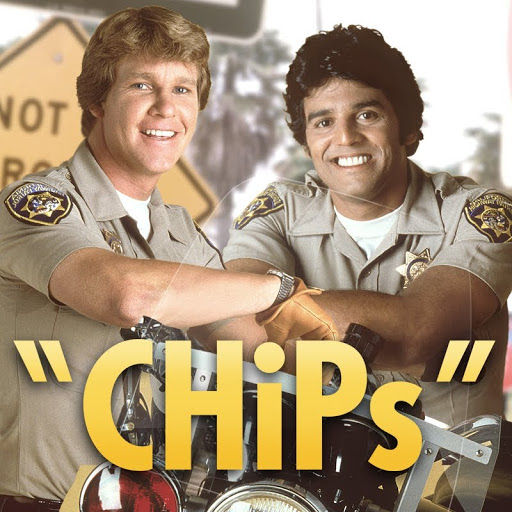
Welcome to Late Night Retro Television Reviews, a feature where we review some of our favorite and least favorite shows of the past! On Mondays, I will be reviewing CHiPs, which ran on NBC from 1977 to 1983. The entire show is currently streaming on Prime!
This week, not Ponch can smile his way out of the darkness.
Episode 4.8 “Wheels of Justice”
(Dir by Gordon Hessler, originally aired on December 21st, 1980)
The streets of Los Angeles are dangerous in this week’s episode.
Stan West (Basil Hoffman) is a reckless driver who is constantly causing accidents by driving too fast and making unsafe lane changes. He gets away with it because he keeps changing his name.
Arthur Holmes (Joshua Bryant) is a drunk who Jon and Ponch have pulled over several times. Arthur gets away with it by claiming, after every accident, that his wife was the one driving, Denise (Christine Belford) goes along with it, even though she hates the fact that she’s enabling her husband.
A group of cheerleaders drive around and do their cheers while driving!
Finally, a gas leak at the hospital leads to all the newborn babies being loaded into an ambulance for transport. When the ambulance is side-swiped by Stan, the babies end up at the station. Getraer gives everyone a lesson on how to properly soothe a crying baby. It’s cute but it’s also so manipulative that it leaves you feeling oddly used. But, hey, at least it’s cute!
This episode of CHiPs took a serious turn towards the end when the drunk driver swerved to avoid the cheerleaders and the end result is that his wife was thrown from the car and killed. When the car was shown crashing in slow motion, the wife’s mannequin actually fell out of the car. While I imagine that was probably not planned, it still created a memorably macabre image. In the end, Arthur ends up sobbing while Denise lies dead just a few feet away from him. That’s a pretty dark ending for an episode of CHiPs. Not even a quick scene of the officers holding the babies could change the fact that this was a really downbeat episode.
And you know what? There’s nothing wrong with that. Driving drunk is selfish, stupid, and dangerous and CHiPs deserves some credit for not holding back.
Welcome to Late Night Retro Television Reviews, a feature where we review some of our favorite and least favorite shows of the past! On Thursdays, I will be reviewing Highway to Heaven, which aired on NBC from 1984 to 1989. The entire show is currently streaming on Tubi and several other services!
This week, Jonathan and Mark take on prejudice.
Episode 4.4 “The People Next Door”
(Dir by Michael Landon, originally aired on October 21st, 1987)
Dr. William Martin (David Spielberg) is living a double life. His family and his neighbors know him as a white doctor who lives in a suburban community and who is a part of the homeowner’s community. He’s told his wife and his son that his parents died before he met them.
His mother knows him as Dr. Guillermo Martinez, who works at the free clinic in the economically disadvantaged area of town. Anna Martinez (Mariam Colon) works as a maid and has no idea that her son is married and that she’s a grandmother.
Guillermo changed his name and lied about his ethnicity so that he could get ahead as a doctor and it’s worked for him. His best friend is Brad Bowman (John Lawlor), the real estate agent who is dedicated to making sure that only “the right people” move into the neighborhood. But when Jonathan and Mark show up as rival real estate agents and hire Anna to help them clean up the house next door, William/Guillermo is forced to face the truth about who he is.
At the start of this episode, Jonathan tells Mark that their assignment is not only to show William the foolishness of denying his heritage but to also help William’s neighbors become more tolerant. They definitely help out William but they don’t really seem to have much luck with the neighbors. Brad Bowman (no relation!) is as much of a bigot at the end of the show as he was at the start. Jonathan and Mark do arrange for a black family to move into the empty house and then Jonathan and Mark promptly leave the neighborhood. So, I guess the responsibility for teaching everyone else tolerance is going to be on the new homeowners. This is one of those episodes where you wish Jonathan had actually gone to extremes to make his point, instead of just arranging for people to run into each other while wandering around the neighborhood. I know that some people would say, “Well, Brad’s just a bad person,” but wasn’t one the original themes of this show that everyone had the potential to see the light, learn the errors of their ways, and be redeemed?
While the show suggested that there was no hope for Brad to see the error of his ways, it also let Guillermo off way too easy. His wife was surprisingly understanding about her husband lying to her for years. And, in the end, his mother was surprisingly forgiving about him lying about the fact that she had a grandson. Jonathan scolded him briefly but that was pretty much it. My grandmother, who came to this country from Franco’s Spain, would not have been as forgiving.
This episode was well-intentioned but didn’t quite work.
Welcome to Late Night Retro Television Reviews, a feature where we review some of our favorite and least favorite shows of the past! On Wednesdays, I will be reviewing Monsters, which aired in syndication from 1988 to 1991. The entire series is streaming on YouTube.
This week, someone won’t stop calling!
Episode 3.21 “Talk Nice To Me”
(Dir by Ernest Farino, originally aired on February 17th, 1991)
A sexist newspaper columnist named Martin (Ed Marinaro) starts receiving phone calls from a woman (Tina Louise) with a sultry voice. She continually calls him, leaving message after message. She refuses to reveal her name or how she got Martin’s unlisted “private” number. (This episode aired during the landline era, before you could block numbers.) Martin tries everything to get her to stop calling. He disconnects his phone for two days but, as soon as he reconnects, she calls again. Martin can’t work. He can’t write. When he invites Linda (Teri Ann Lind) over to his apartment, his paranoia prove to be a real turn-off. He becomes convinced that the stalker has somehow entered his apartment. The truth is even more twisted….
This episode had potential but it was let down by a rather cartoonish performance by Ed Marinaro. I could buy Marinaro as a misogynist. I could even buy Marinaro as a womanizer. I couldn’t buy him as a successful newspaper columnist and, as a result, the whole “you’re going to lose your column!” subplot fell flat for me. That said, Martin’s apartment was an appropriately claustrophobic location and the idea of the nonstop caller was suitably creepy. This was not necessarily bad episode. It’s just an episode that could have been better than it was.
Only three more episode to go and we will have finished up with Monsters. Though uneven, the third season has still been a marked improvement over the first two. Even the third season episodes that don’t work quite as well as they should, like this one, are watchable.
Welcome to Late Night Retro Television Reviews, a feature where we review some of our favorite and least favorite shows of the past! On Thursdays, I will be reviewing Highway to Heaven, which aired on NBC from 1984 to 1989. The entire show is currently streaming on Freevee and several other services!
This week, Jonathan and Mark head to Broadway!
Episode 2.8 “The Smile In The Third Row”
(Dir by Michael Landon, originally aired on November 20th, 1985)
Fred Fusco (Lorne Greene) is a veteran actor who is appearing in a Broadway play. In the play, Fred plays a man who learns that he’s about to die. During the third act, Fred’s character actually does die and Fred ends the play with a monologue about owning the choices he made in his life before he ascends into Heaven (via a harness).
It’s a depressing play and the theater is usually half-empty whenever Fred performs. But one night, Fred claims that he spotted God sitting in the third row. Fred also says that God really enjoyed the show. When the news get out, the play becomes a huge success as audiences turn out to see a play endorsed by God. Fred becomes a huge celebrity and befriends a terminally ill boy who promises to say hi to God when he goes to Heaven. However, when Fred starts to talk about leaving his fortune to charity, both his sister (Mary Ann Gibson) and his nephew (David L. Lander) conspire to have him committed.
Fred also happens to be Jonathan and Mark’s later assignment. Mark gets a job at the theater while Jonathan puts on a collar and becomes Father Jonathan. While Mark is convinced that Fred is actually seeing God, Jonathan is skeptical because Jonathan doesn’t see God in the theater. Why, Jonathan asks, would God reveal himself to an actor but not an angel? There’s an interesting subtext here, as it quickly becomes obvious that Jonathan isn’t so much skeptical as he’s jealous. He even rather recklessly reveals to Fred that he’s an angel in his quest to convince Fred that he hasn’t actually seen God. Fred reveals that he’s willing to accept Jonathan’s word that he’s an angel but then asks why Jonathan is not willing to accept his word that he sees God in the theater.
Is God in the theater? At the end of the episode, Fred’s harness is broken but, at the end of the third act, he still ascends above the theater and then vanishes. The newspapers call it a hoax but the show suggests that, much like Elijah, he’s been assumed straight to Heaven. Is Fred meant to be a modern day Elijah? Would that therefore make his sister a modern-day Jezebel? Perhaps but, fortunately for her, she is never eaten by wild dogs.
As usual, there wasn’t much subtlety to be found in this episode of Highway to Heaven but it still worked surprisingly well. When Fred met the dying child, my first instinct was to roll my eyes at the obviousness of it all but those same eyes had tears in them by the time the scene was over. The episode benefitted greatly from Lorne Greene’s strong performance as Fred Fusco and Michael Landon’s strong portrayal of Jonathan’s mixed feelings about Fred’s claims. All in all, this was a strong episode.
Welcome to Late Night Retro Television Reviews, a feature where we review some of our favorite and least favorite shows of the past! On Mondays, I will be reviewing CHiPs, which ran on NBC from 1977 to 1983. The entire show is currently streaming on Freevee!
What would CHiPs be like without motorcycles? We’re about to find out.
Episode 1.20 “Rainy Day”
(Dir by Gordon Hessler, originally aired on March 2nd, 1978)
While riding his motorcycle on the California highway, Baker groans as he feels a drop of water. He tells Ponch that it’s going to rain and the two of them are going to end up getting stuck in a patrol car.
“It’s only sprinkling!” Ponch replies.
One jump cut later and Ponch and Baker are trapped in the middle of a downpour. Despite the heavy rain and the fact that they’re getting soaked, they still manage to save a teacher after a car swerves on the slick road and hits her school bus. (Apparently, in 1978, teachers also had to drive the school buses.) The teacher is young and attractive so, of course, Ponch tells her that she and her students can drop by the station and see him any time that they want.
As for the rain, it turns out that Baker was right. After giving them a hard time about their wet uniforms (and not even bothering to acknowledge that those uniforms got wet while Baker and Ponch were saving someone’s life), Getraer assigns them to a patrol car for the day. It’s a new patrol car so Getraer warns them not to get a scratch on it. Usually, I can kind of understand why Getraer is a bit weary of Ponch but, in this episode, the guy’s just a jerk about everything.
You can probably already guess what the main problem with this episode is. The appeal of CHiPs, at least from what I’ve seen so far, is that it features a lot of exciting motorcycle stunts. Chase scenes involving motorcycles are fun to watch because motorcycles can go extremely fast and they can weave in-and-out of traffic. The show works best when Ponch and Baker are on their motorcycles. This episodes put them in a bulky, slow-moving squad car. Even stuck in the car, Ponch and Baker manage to catch a car thief and they put an end to an illegal gambling casino that’s been hidden inside of an RV. But it really doesn’t matter because they’re in a squad car. There’s nothing exciting about a squad car.
And yes, the squad car does get trashed, specifically while Ponch and Baker are chasing a degenerate gambler (Herb Edelman) who was seeking revenge against the RV casino. Getraer is not happy about the damage to the car, despite the fact that there really wasn’t any way to avoid it and Ponch and Baker managed to prevent a lot of people from getting injured. Fortunately, Officer Grossman (Paul Linke) accidentally backs into the squad car, leaving it ambiguous as to who is responsible for what damage. Getraer will just have to get mad at everyone, I guess.
I love the rain so I did appreciate the fact that this episode featured a lot of it. But otherwise, the whole thing just felt off. I don’t care how wet it is outside. Baker and Ponch just do not belong in a car.
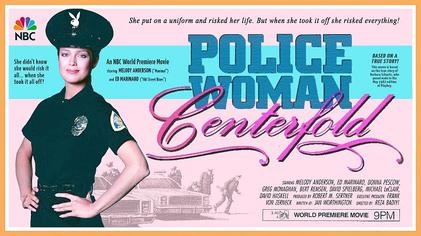
Welcome to Retro Television Reviews, a feature where we review some of our favorite and least favorite shows of the past! On Sundays, I will be reviewing the made-for-television movies that used to be a primetime mainstay. Today’s film is 1983’s Policewoman Centerfold. It can be viewed on Tubi!
Jennifer Oaks (Melody Anderson) is a former wild teen turned cop. While her friends from high school walk the streets, Jennifer rides in a squad car. It’s not always easy. She is one of the only women on the force and the men refuse to take care her seriously, no matter how times she proves herself as a police officer. Recently divorced, she live in a trailer park with her son, Tommy (Jerry Supiran). At the start of the film, her partner informs her that he’s going to be requesting a new partner because apparently, his wife has issues with him working with another woman.
Jennifer’s new partner is Nick Velano (Ed Mariano). “Are you Italian?” she asks him at one point, because I suppose the fact that his name was Nick Velano wasn’t enough of a clue. (For the record, Nick is Italian.) Though Jennifer says that she doesn’t date the people with whom she works, she makes an except for Nick. It turns out that Nick, along with being Italian, is an amateur photographer. After Jennifer says that she’s never felt attractive, Nick snaps a few pictures of her to prove her wrong. Jennifer is so impressed with the pictures that she mails them off to Centerfold Magazine. Nick, of course, is a huge fan of Centerfold, though he insists that he just reads the articles. That said, Nick is not happy when he discovers that Jennifer is going to appear in a pictorial. For that matter, neither is the police department. Neither are Jennifer’s parents. Neither is Tommy, especially after a bunch of older kids beat him up for having an attractive mom. (I’m not really sure what the logic was there.) However, Jennifer finds the experience to be liberating and she refuses to apologize for her decision. When the chief of police attempts to kick her off the force, Jennifer goes to court.
Centerfold Magazine is obviously meant to be a stand-in for Playboy. Of course, when I say that, I mean that it’s a stand-in for the way that Playboy liked to present itself as opposed to the reality. In Police Woman Centerfold, Centerfold is a progressive magazine that only employs the most professional and polite of photographers. In real life, Playboy was a tacky left-over from the late 60s and Hugh Hefner was a creepy old weirdo who lived in a dilapidated mansion and who was notorious for abandoning his models once they had fulfilled their purpose. In Police Woman Centerfold, Centerfold Magazine is so idealized that its portrayal verges on parody. It’s like one of those dreary communist propaganda films, where everyone in the collective can’t stop smiling and singing about how happy they are because there’s someone off camera pointing a gun at their head.
Fortunately, Melody Anderson gave a good performance in the main role, playing Jennifer as someone who had been beaten down by life but who still refused to give up hope for a better future. The film itself may not have always taken Jennifer’s story seriously but Anderson herself did and, as a result, this film a bit better than it has any right to be,
The great character actor Warren Oates appeared in a lot of fairly obscure movies but none are as obscure as Prime Time.
With a running time of barely 70 minutes, Prime Time is a comedic sketch film that was meant to capitalize on the then-recent success of The Groove Tube, Tunnelvision, The Kentucky Friend Movie, and the first season of Saturday Night Live. According to the Unknown Movies Page, Prime Time was financed independently and was picked up for distribution by Warner Bros. After the Warner execs saw the finished film, they decided it was unreleasable so the film’s production team sold the film to Cannon Pictures, who were famous for being willing to release anything. The movie played in a few cities under the terrible title American Raspberry and then went straight to VHS obscurity.
Sketch comedies are usually hit-and-miss and Prime Time is definitely more miss than hit. The majority of the film is made up of commercial parodies but, since most of the commercials being parodied are no longer on the air, the humor has aged terribly. There is also a wrap-around story. The President (George Furth) and a general (Dick O’Neill) try to figure out where the commercial parodies are coming from and stop them before the broadcast leads to a riot. There are a few funny bits (including Harry Shearer as a stranded trucker looking for a ride and Kinky Friedman singing a song about “Ol’ Ben Lucas who has a lot of mucus”) but, for the most part, the film is epitomized by a skit where people literally get shit dumped on their head. The film’s opens with an incredibly racist commercial for Trans Puerto Rican Airlines and it’s all downhill from there.
As for Warren Oates, he appears in an early skit. He and Robert Ridgely (best known for playing Col. James in Boogie Nights) play hunters who take part in the Charles Whitman Celebrity Invitational, climbing to the top of the Tower on the University of Texas campus and shooting at the people below. It’s even less funny now than it probably was in 1977.
How did Warren Oates end up in a movie like Prime Time? Even great actors have bills to pay. As for Prime Time, it is the one Warren Oates film that even the most dedicated Warren Oates fan won’t regret missing.
Continuing our journey into the dark Hell of the 1970s, we now take a quick look at the 1975 cop film, Hustle.
Taking place in Los Angeles, Hustle tells the story of several different people who find their lives intertwined in the desperate dance of existence. (Does that sound overdramatic? Well, that’s the type of film that this is.)
There’s Leo Sellers (Eddie Albert), a lawyer with bright rosy cheeks and a friendly manner. You look at Leo and you automatically assume that he must be a nice guy, the type of guy who puts on a fake beard and plays Santa Claus down at the local orphanage. But actually, Leo is a lawyer for the mob. He’s gotten rich through crime and his mansion hides all sorts of secrets. He also has a weakness for violently abusing prostitutes.
Speaking of prostitutes, one of Leo’s favorite is Nicole (Catherine Deneuve), an icy French beauty who survives by holding the world at a distance. Though Nicole doesn’t like Leo, she has to keep him happy because Leo could easily arrange for her to be deported back to France.
Nicole is also the girlfriend of Phil Gaines (Burt Reynolds), a cynical homicide detective who, like her, tries to keep the world at a distance. Phil is obsessed with old films and frequently speaks of how much he wishes the real world could be like a movie. Throughout the film, he talks about eventually moving to Rome.
Phil’s partner is Louis Belgrave (Paul Winfield), who is not quite as cynical as Phil but who is definitely getting there. Whereas Phil is always talking about how much the world has disappointed him, Louis mostly accepts things without complaint. He just wants to do his job and go home at the end of the day.
Phil and Louis’s boss is Santoro (Ernest Borgnine, giving a typical Ernest Borgnine performance). Santoro is not a bad guy but, in order to hold onto his job, he has to keep powerful men like Leo Sellers happy.
Santoro also has to deal with the complaints of people like the Hollingers. Marty Hollinger (Ben Johnson) is a veteran of the Korean War and handles the world in a gruff and suspicious manner. Paula (Eileen Brennan) is Marty’s wife and, as a result of his emotional distance, has recently started having an affair.
And then there’s Gloria (Colleen Brennan), Marty and Paula’s daughter. Gloria ran away from home a while ago and soon found herself working as a stripper, a porn actress, and eventually as a prostitute. When Gloria is found dead, Phil and Louis get the case. It’s obvious to them that Gloria committed suicide. It’s not so obvious to Marty, who is convinced that his daughter was murdered and, disgusted by Phil’s cynical attitude, sets out to investigate the case on his own.
One of the more interesting things about Hustle is that really is no murder mystery. Despite what Marty believes, Gloria really did commit suicide. Marty’s insistence that she was murdered has more to do with his guilt over being a bad father than it does with any real evidence. As Marty investigates his daughter’s life, he is exposed to a sordid world of strip clubs and prostitution. He discovers that Gloria’s clients included many powerful men and he decides that the last client she saw must have murdered Gloria.
That client is Leo Sellers. And while Leo may not have murdered Gloria, he is willing to kill Marty to keep his secret life from being exposed. Phil and Louis are forced to choose between remaining detached or protecting Marty from himself.
And, since this film was made in the 70s, it all ends on a really dark note!
Hustle shows up on Encore occasionally. It’s a strange film to watch, as it alternates between being a fairly predictable cop film and being a portrait of existential dread. The movie doesn’t really work; it’s too long, it features some amazingly pretentious dialogue, and Reynolds, Winfield, and Deneuve all seem to be bored with their characters. Probably the film’s best performance comes from Ben Johnson. I imagine that has to do with the fact that Johnson is playing the only character who behaves in a fairly consistent way.
And yet, if you’re like me and you’re fascinated with the nonstop fatalism of 70s cinema, Hustle does have some historical value. It’s one of those films that you watch and you wonder how anyone survived the 1970s!
During the late 1970s and early 1980s, one could hardly step into a theater during the fall or winter movie season without seeing a trailer for the newest Stephen King adaptation. His name had become synonymous with cinematic horror, and nearly every year brought a new film promising supernatural terror or psychological unease.
Among this wave of adaptations came a 1983 film that united two masters of the genre—Stephen King, the reigning literary giant of horror, and John Carpenter, the filmmaker who had already cemented his reputation with Halloween and The Thing. Their collaboration resulted in the sleek, deadly story of a boy and his car: Christine.
The film opens on the assembly line of a Plymouth factory in 1957, immediately signaling that something is off about this particular 1958 Plymouth Fury. From the first note of the retro rock soundtrack to the gleam of that deep crimson paint, Carpenter frames the car with both nostalgia and menace. The lighting in this opening feels almost clinical—bright, sterile, mechanical—yet Christine’s red sheen cuts violently through it, a visual omen that this machine is infused with something beyond metal and chrome. Carpenter wastes no time making it clear that this car is not an inanimate prop; it’s a living entity from the moment it’s born.
We’re soon introduced to the film’s human core—Arnie Cunningham (Keith Gordon), a shy, bookish teenager tormented by bullies and smothered by his controlling parents, and his best friend Dennis Guilder (John Stockwell), the confident star athlete who often looks out for him. One afternoon, during their drive home from school, Arnie spots a rusting, decrepit Plymouth Fury in the front yard of an old man named Roland D. LeBay. Where Dennis sees a heap of junk, Arnie sees perfection. Ignoring his friend’s concerns—and later, his parents’ outrage—Arnie buys the car and names it Christine.
As Arnie begins restoring Christine to her former glory, a transformation occurs—not just in the car, but in Arnie himself. The once timid, acne-scarred teenager grows into a confident, even arrogant young man, donning slicker clothes, sharper speech, and a darker aura. Christine becomes his obsession, his refuge, and ultimately, his identity.
Carpenter crafts this metamorphosis with eerie precision, pairing the car’s physical renewal with Arnie’s psychological decay. The cinematography shifts accordingly—the lighting grows darker, drenched in neon reds and shadowy blues, mirroring Christine’s two faces: seductive allure and demonic possession. Carpenter’s score, a pulsing blend of electronic rhythm and minimalistic dread, underscores these shifts. It functions almost like Christine’s heartbeat—steady, mechanical, and ominously sensual.
Between the vintage rock tracks that accompany Arnie’s moments of infatuation and the electronic motifs that follow Christine’s predatory stalks, Carpenter manipulates sound to blur the lines between teenage romance and supernatural horror. Every rev of the engine feels rhythmic, almost musical, as if the car itself communicates through vibration and tone rather than words.
Arnie’s newfound confidence even earns him Leigh Cabot (Alexandra Paul), the most desired girl in school—a relationship that initially feels like a symbol of his triumph. But Christine is no fairy tale. When Arnie’s bullies vandalize his beloved car, the story turns from eerie to vengeful.
In a now-iconic sequence, Christine repairs herself before Arnie’s stunned eyes—the crumpled metal expands, glass re-forms, headlights ignite like eyes opening from a nightmare. Carpenter lights the scene with a soft, golden underglow that turns mechanical resurrection into a hauntingly beautiful transformation. It’s both horrifying and hypnotic—a perfectly scored ballet of vengeance set to the hum of machinery and the director’s unmistakable electronic pulse.
What follows is a furious killing spree. Christine prowls the night streets for retribution, a creature of fire and gasoline more alive than metal should ever be.
While Carpenter’s adaptation diverges from King’s novel, it remains faithful to its emotional and thematic essence. King’s book delves deeply into the idea of objects absorbing the evil of their owners, suggesting that malevolence can linger in things as much as in people. Carpenter, however, turns the focus inward.
His version becomes a tragic character study—a battle for Arnie’s soul between the cold, seductive power of obsession and the fragile warmth of human connection. In one corner stands Christine, the car that offers Arnie unconditional love but demands total possession. In the other are Dennis and Leigh, desperate to save the friend they’re rapidly losing to something they can’t fully understand.
Carpenter’s signature touches—his electronic score, minimalist framing, and cynical tone—imbue the film with a dark romanticism. Christine is less a haunted object than a femme fatale: a mechanized embodiment of jealousy and desire. The film’s atmosphere bridges two eras, combining the nostalgic vibe of 1950s Americana with the grim realism of Reagan-era suburbia.
By the end, Christine becomes both a story of supernatural obsession and a commentary on teenage identity—the hunger to shed weakness, to command respect, and to control one’s fate, even at the cost of one’s soul.
Upon its release in December 1983, Christine performed modestly at the box office but was far from a failure. Over time, it has developed a strong cult following, cherished by both Carpenter devotees and Stephen King fans. Though often overshadowed by Carpenter’s heavier-hitting works like The Thing or Escape from New York, Christine remains one of his most technically polished films. It also stands as a fascinating bridge between studio horror and Carpenter’s independent sensibilities—where the shine of a Hollywood production mingles with the grit of a B-movie heart.
If Christine teaches any lesson, it’s that love and possession are two sides of the same coin. Arnie’s tragedy lies not in falling for the wrong woman, but in falling for one that burns with literal hellfire. In Carpenter’s vision, the road to damnation isn’t paved with good intentions—it’s lined with chrome, lit by headlights, and always hungry for one more ride.






 Through the Shattered Lens