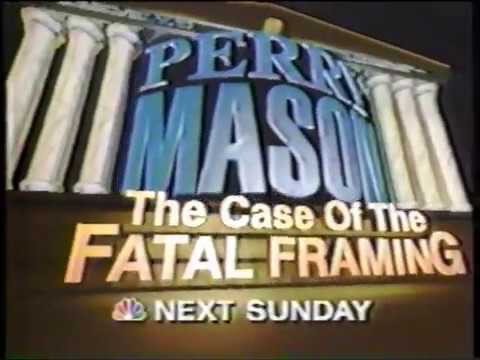
Truman York (David Soul), a painter who faked his death in a motorcycle accident five years earlier, reemerges because someone is selling forgeries of his work. When York turns up dead, a photographer (Mark Moses) is arrested for the crime. Luckily, the photographer went to college with Ken Malansky (William R. Moses) and Ken is able to convince Perry Mason (Raymond Burr) to take the case. (If you’re going to get arrested for murder, it helps to be a friend of Ken or Perry’s.)
I was disappointed with this entry in the Perry Mason series. It had potential but it never really reached it. I was more interested in how the artist faked his death for five years instead of figuring out who killed him. Raymond Burr was obviously unwell when he shot this movie and there were times when it was painful to watch him as he had to learn against a wall just to be able to stay standing while delivering his lines. I felt bad for Burr watching this because, even though he was great in the role of Perry Mason, it was obvious that he was in pain.
Maybe because Raymond Burr couldn’t do as much as usual, Ken got to do more than usual in this installment. What’s strange is that the accused photographer was also interrogating people and looking for clues. He had just been released on bail and he was on trial for murder. He should have been laying low instead of tracking down witnesses.
I love the Perry Mason films and I have so many good memories of watching them with my aunt. This one didn’t do it for me.
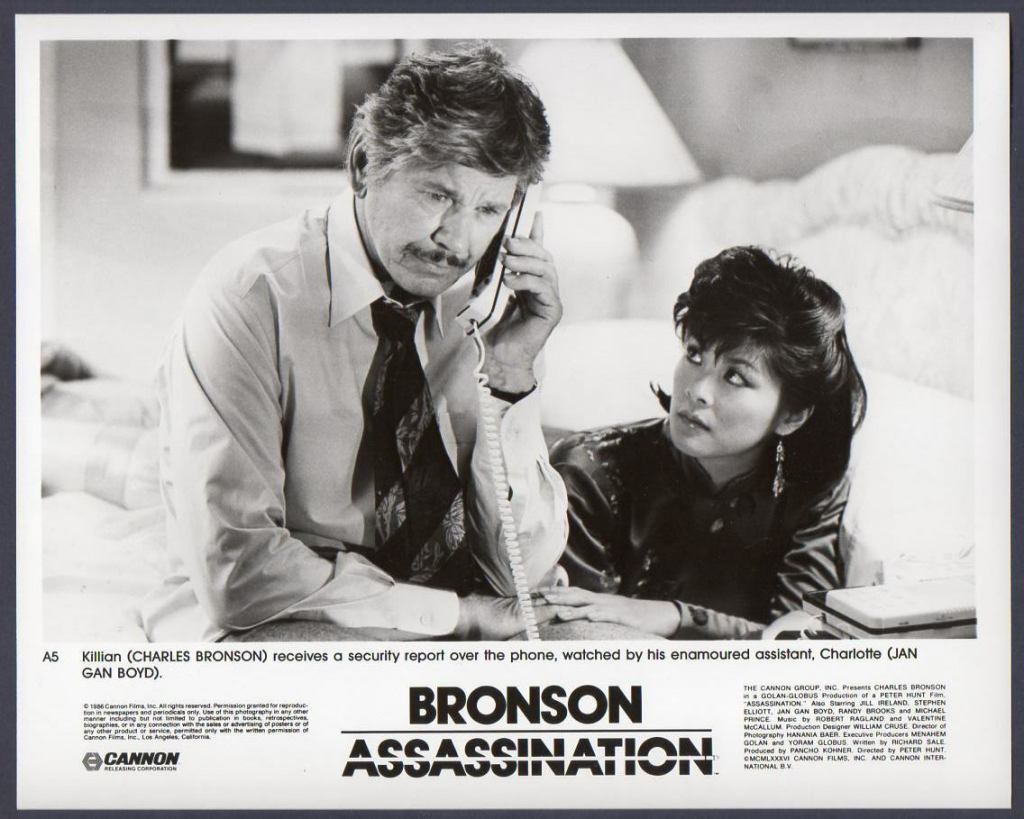
I wanted to take a moment and show some appreciation for actress Jan Gan Boyd on her birthday. Jan has been a part of my life since I was 13 years old since she co-starred with Charles Bronson in the 1987 Cannon film ASSASSINATION.
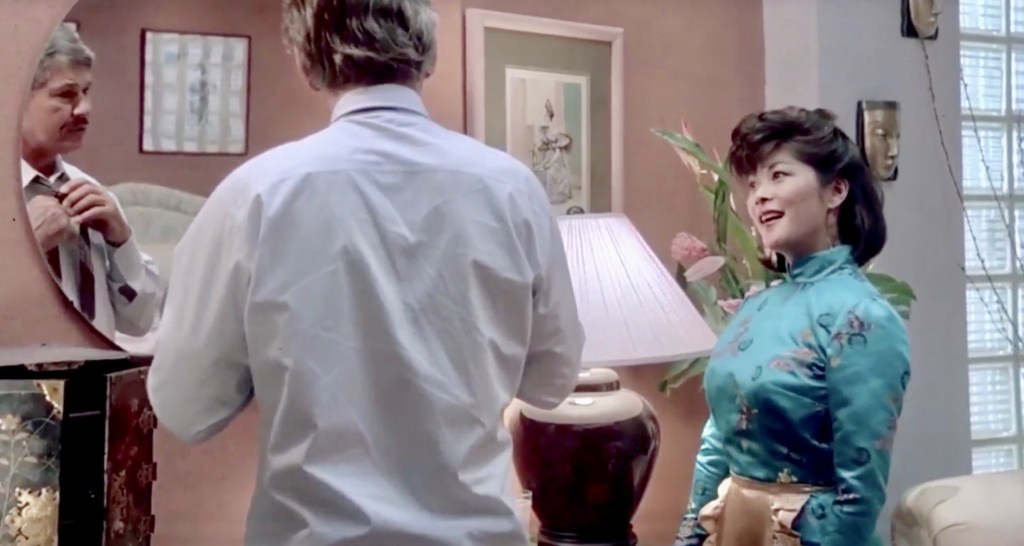
In a nutshell, the plot of ASSASSINATION revolves around secret service agent Jay Killian (Bronson), who finds himself in the position of trying to protect an extremely strong-willed first lady (Jill Ireland) from assassins trying to kill her. Jan plays Charlotte “Charlie” Chang, a member of the team assigned to protect the first lady, who has an extra special relationship with Killian. And while ASSASSINATION is not one of Charles Bronson’s best movies, I always liked Jan in the film. She had spunk and attitude, and her relationship with Bronson’s character is definitely unique in Bronson’s 80’s filmography. Believe it or not, Killian and Charlie had casual sex, and she survived the end of the movie to talk about it! As a matter of fact, her exchange with Killian the next morning leads to one of the great moments of Bronson dialogue:
Charlie Chang: “Killy, why don’t you move in here permanently?”
Jay Killian: “I don’t want to die of a terminal orgasm!”
I guess lines like that bond actors for life and Jan stayed friends with Charles Bronson and Jill Ireland all the way up to each of their deaths.
Jan got her start in the movies through her abilities as a trained dancer when she co-starred with Michael Douglas in the 1985 film, A CHORUS LINE, directed by Richard Attenborough. I think she’s one of the best characters in the film. And 1987 was a very busy year for Jan. After filming ASSASSINATION with Bronson, she would co-star with Martin Kove in the film STEELE JUSTICE, and then with David Soul in HARRY’S HONG KONG. She would spend the next few years of her career doing guest spots on shows like CHEERS, SISTERS, and SILK STALKINGS. It was at this point that she took a break from her career to get married and raise a family. Over the last few years, she has started to get involved in voice-over work, as well as appearing on shows like “Dance Dish,” where she discussed her time as a dancer and her work on A CHORUS LINE.
On a personal note, I must say that Jan Gan Boyd is one of the sweetest ladies I’ve ever met. My partner Eric Todd and I got the opportunity to interview her for an episode of the THIS WEEK IN CHARLES BRONSON podcast a couple of years ago. She told us some of the best stories about Charles Bronson and Jill Ireland, as well as what it was like to work with them on ASSASSINATION. She truly loved them in real life, and it was so fun sharing that time with her. As a matter of fact, over on our TWICB Facebook page, every January is now Jan-Gan-uary! I’ve attached a link to the podcast episode if you would like to hear more from Jan about her career and her work with Bronson, Michael Douglas, and Richard Attenborough.
I just heard that actor David Soul passed away yesterday, at the age of 80.
Horror fans, of course, will always remember David Soul for playing Ben Mears in Tobe Hooper’s adaptation of Salem’s Lot. Personally, I’ll remember him for his chilling performance as a vigilante motorcycle cop in 1973’s Magnum Force.
In the scene below, Soul and his fellow vigilantes confront Inspector Callahan in a parking garage. Though he doesn’t get the scene’s best line (“All of our heroes are dead,” is delivered by Kip Nevin), Soul does get to explain why he and his fellow motorcycle cops are doing what they’re doing.
It takes a good actor to believably intimidate Clint Eastwood.
Welcome to Retro Television Reviews, a feature where we review some of our favorite and least favorite shows of the past! On Mondays, I will be reviewing Miami Vice, which ran on NBC from 1984 to 1989. The entire show is currently streaming on Tubi!
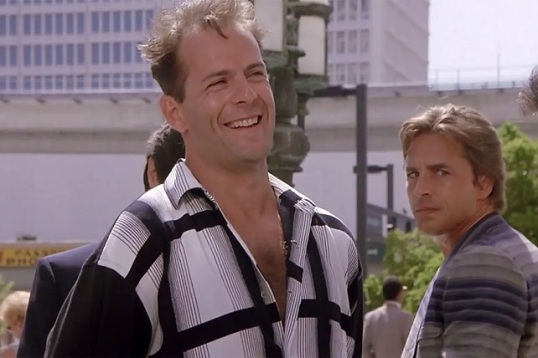
This week, Bruce Willis comes to Miami!
Episode 1.8 “No Exit”
(Dir by David Soul, originally aired on November 9th, 1984)
Tony Amato is a complete monster.
He’s an arms dealer, one who is responsible for machine guns showing up all over Miami. When he’s not selling guns to drug dealers, he’s plotting to sell rocket launchers to terrorists. He’s a crude and a violent man who has suddenly gotten very wealthy and who likes to show off his money. He lives in a pink, art deco mansion. He has a beautiful wife named Rita (Katherine Borowitz), who he regularly abuses. Miami Vice wants to arrest him to get the guns off the street. The federal government wants to arrest him so that they can get their rocket launchers back. And Rita …. well, Rita just wants to hire someone to kill him.
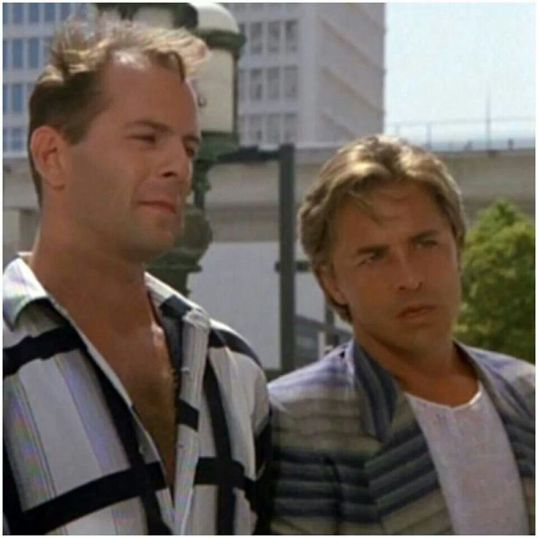
Tony Amato is a memorable character because of just how thoroughly evil he actually is. He’s a criminal because he enjoys it and it doesn’t bother him that his weapons can lead to innocent people dying. Tony is also memorable because he’s played by Bruce Willis. This was Willis’s first credited acting role. (He had appeared as an extra in a few movies before this.) Willis got the role on the recommendation of Don Johnson, who remembered Bruce as being the bartender at one of his favorite New York bars. Though there’s not a lot of depth to the role, Willis does get to show off the cocky confidence that would later become his trademark.
As for the episode, it’s dark even by the standards of Miami Vice. The episode opens with a violent chase and gunfight in the streets of Miami and it ends, just as the previous episode did, with an abused spouse probably throwing their life away to get revenge. We watch as Tubbs, Crockett, and Lester (Julio Oscar Mechesco) sneak into Tony’s mansion and manage to bug the place before Tony returns home. They set up their survelliance operation on Crockett’s boat. Of course, things pretty much fall apart as soon as the federal agents show up and demand to be allowed to oversee the operation.
While the Miami cops and the federal agents fight over jurisdiction, Crockett tries to help Rita escape from her husband. He approaches her while she’s waiting to meet with a hitman and convinces her to let the cops handle it. He promises her that he will put Tony away, even though he knows nothing is ever that simple. Both Katherine Borowitz and Don Johnson do a good job in their scenes together. Deep down, Crockett knows that he’s giving Rita false hope but he can’t bring himself to admit it.
Tubbs, once again, gets to break out his Jamaican accent as he goes undercover as a terrorist who is in the market for Tony’s rocket launchers. Through Tubbs’s hard work, Tony is arrested but, on the steps of the courthouse, two new government agents demand that Tony be released because they’ve determined him to be a potential asset in their own Central American operations. Tony smirks as his handcuffs are removed. Rita appears on the steps, demanding to know why Tony is being set free. She pulls a gun from her purse. We got a freeze frame of Sonny shouting, “NO!” as a gunshot echoes on the soundtrack. Tony may be dead (and we never specifically see whether Rita’s aim was true or not) but his guns are still on the streets, the people he sold to are still free, and the only person going to prison is going to be an abused wife.
Like I said, this was a dark episode. This is one of those episodes that left the viewer to wonder why Cockett and Tubbs even bothered to make the effort. In the end, all their hard work added up to nothing. For Crockett, the case became about saving Rita but the government was more concerned about their own shady schemes that protecting its citizens. Of course, even if Tony had been sent to prison, someone else would have taken his place. That’s life in Miami.
On tonight’s episode of The Hitchhiker, David Soul plays a greedy developer who runs afoul the Parisian underground. It turns out that thinking big is not always the fool-proof strategy that the developer thinks that it is. The cocky developer finds himself forced to confront his own dark side. Myself, I’m curious why the opening credits always feature The Hitchhiker walking through the desert but, since the 5th season began, he’s pretty much just exclusively been hanging out in France. Seriously, who is this guy?
Tonight, on Circle of Fear, Sheila Larken plays Holly Brown, a young artist who meets and falls madly in love with James Barlow (David Soul). Unfortunately, this leads to her being harassed by a frightening old man (Victor Jory) and it turns out that James has got a terrible secret of his own.
This melancholy story was the final episode of Circle of Fear, which was cancelled after its first and only season. This episode makes for a good note for the show to go out on. It originally aired on March 30th, 1973.
Circle of Fear may be over but Horrorthon continues! We’ll be back with more televised horror tomorrow!
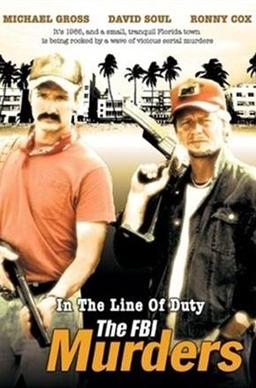
In The Line of Duty: The FBI Murders is the one that started it all. This was the first installment and it set the general format of all the In The Line of Duty films to follow. It was based on a true story. The movie was evenly split between the criminals and the members of the law enforcement trying to catch them. Here, the criminals were two bank robbers played by David Soul and, in an effective turn against type, Michael Gross. (When this film was released, Gross was best known as the wimpy father on Family Ties. Today, he’s better known as the survivalist from the Tremors films. He went on to play cops in two subsequent In The Line of Duty films.) The FBI agents pursuing them were played by Ronny Cox, Bruce Greenwood, and several other recognizable TV actors.
The FBI Murders was not only the first In The Line of Duty film but it was also the best. All of the subsequent installments, both good and bad, pale in comparison. Though the story is familiar and the foreshadowing is sometimes obvious (“Try not to get shot,” one FBI agent’s wife tells him), The FBI Murders still holds up today because of the strong cast and Dick Lowry’s direction of the final shootout between the cops and the criminals. No matter how many times David Soul gets shot, he keeps getting up and firing more rounds. Making this part of the film all the more effective is that it’s based on fact. During the actual incident, the real-life criminals played by Soul and Gross continued firing and killing even though they had been shot a tremendous number of times. Remarkably, it was discovered that neither had been on any type of pain-killing drug at the time. Instead, they were determined to just keep shooting until the end. Though the two men were outnumbered by the FBI, the agents were not prepared to go up against the military-grade weapons that the men were carrying with them.
The actors who play the FBI agents are all effective, especially Ronny Cox as the veteran who has seen it all. As with the other In The Line of Duty films, a lot of time is spend showing the comradery between the agents and how, even when they’re not at work, they’re all still together. In other In The Line of Duty films, the comradery could sometimes feel forced but, in The FBI Murders, it feels natural and scenes like Bruce Greenwood’s character finally getting a nickname and one of the older agents deciding to go on a stakeout just for old times sake carry a lot more emotional weight than you might expect. It makes the final shootout all the more powerful.
Eleven more In The Line of Duty films would follow but none of them would top The FBI Murders.
Though the Academy of Motion Picture Arts and Sciences claim that the Oscars honor the best of the year, we all know that there are always worthy films and performances that end up getting overlooked. Sometimes, it’s because the competition too fierce. Sometimes, it’s because the film itself was too controversial. Often, it’s just a case of a film’s quality not being fully recognized until years after its initial released. This series of reviews takes a look at the films and performances that should have been nominated but were, for whatever reason, overlooked. These are the Unnominated.
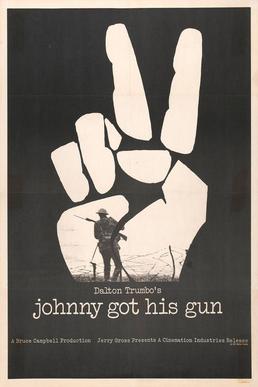
The 1971 anti-war film, Johnny Got His Gun, tells the story of Joe Bonham (played by Timothy Bottoms). When America enters World War I, Joe enlists in the Army. He leaves behind his small-town life. He leaves behind his patriotic father (Jason Robards) and his loving girlfriend (Kathy Fields). As he leaves, everyone tells him that he is doing the right thing to protect democracy. Joe’s a hero!
Joe expects war to be a glorious affair, one that will make a true man out of him. Instead, he’s hit by an artillery shell while huddled in a muddy trench. Though he survives the explosion, he loses his arms and his legs. He loses his face. He’s taken to a field hospital, where the doctors say that, though he’s alive, he’s incapable of feeling or thinking. He’s left alone in a room and is occasionally checked on by a sympathetic nurse (Diane Varsi).
The doctors are wrong. Joe can think. Even if he can’t see where he is now, he can still remember the life that he once had and the events that led him to the hospital. The film switches back and forth, from the black-and-white imagery of the hospital to the vivid color of Joe’s memories and fantasies. In his mind, Joe remembers his father, who encouraged him to go to war and perhaps was not the all-knowing figure that Joe originally assumed him to be. (The film makes good use of Jason Robards’s natural gravitas. Like Joe, the viewer initially assumes that Robards is correct about everything.) Joe also imagines several conversations with Jesus (a stoned-looking Donald Sutherland), who turns out to be surprisingly mellow and not always particularly helpful. Jesus suggest that Joe may just be naturally unlucky and he also suggests that Joe perhaps keep his distance from him because, sometimes, bad luck can rub off. Joe, meanwhile, wonders if he could be used as a traveling exhibit to portray the futility of war. When Joe finally realizes that a nurse has been checking on him, he tries to figure out a way to send a message to both her and the military that is keeping him alive in his captive state. S.O.S. …. help me….
Johnny Got His Gun is based on a novel by Dalton Trumbo. The novel was first published in 1939, at a time when the debate over whether the the U.S. should get involved in another war in Europe was running high. At the time, Trumbo was a Stalinist who opposed getting involved because Germany and Russia had signed a non-aggression pact. After the Germans invaded Russia in 1941, Trumbo and his publishers suspended reprinting of the book until the war was over with. Needless to say, this was all brought up in the 50s, when Trumbo was one of the more prominent writers to be blacklisted during the Red Scare. On the one hand, Dalton Trumbo does sound like he was more than a bit of a useful idiot for the Stalinists. On the other hand, if you’re going to suspend the printing of your anti-war polemic, it should definitely be because you want to help defeat the Nazis. In the end, what really matters is that Johnny Got His Gun is an undeniably well-written and effective book, one that works because it eschews the vapid sloganeering that one finds in so many works of left-wing literature and instead focuses on the emotions and thoughts of one human being.
The book was later rediscovered by the anti-war protestors of the 60s, which led to Dalton Trumbo directing a film adaptation. The film is a bit uneven. Dalton Trumbo was 65 years old when he directed the film and there are a few moments, especially in the scenes with Sutherland as Jesus, where he seems like he’s trying a bit too hard to duplicate the younger directors who were a part of the anti-war moment. However, the scenes in the military hospital are undeniably moving. The hospital scenes are shot in a noirish black-and-white and they effectively capture the stark horror of Joe’s situation. Left alone in his dark and shadowy room, Joe becomes the perfect symbol for all the war-related horrors that people choose to ignore. He becomes the embodiment of what war does to those who are scarred, both physically and mentally, by it. The scenes where Diane Varsi realizes that Joe is aware of what’s happened to him and that he can still feel are powerful and emotional. In fact, they work so well that it’s hard not to wish that the film could have done away with the fantasies and the flashbacks, despite the fact that Timothy Bottoms gives an appealing performance as the young and idealistic Joe.
Johnny Got His Gun didn’t receive any Oscar nominations. Should it have? The 1971 Best Picture line-up was a strong one, with the exception of Nicholas and Alexandra. Johnny Got His Gun was definitely superior to Nicholas and Alexandra. However, Dirty Harry is definitely superior to Johnny Got His Gun. (For that matter, Two-Lane Blacktop also came out in 1971 as well.) But, even if Johnny Got His Gun didn’t deserve to be one of the five Best Picture nominees, it did deserve some consideration for its cinematography and Diane Varsi’s performance. If the flashbacks and the fantasies were handled a bit more effectively, I would suggest that Jason Robards and Timothy Bottoms were worthy of consideration as well.
In conclusion, I should note that 1971 was a good year for Timothy Bottoms. Not only did he star in this film but he was also the star of The Last Picture Show.
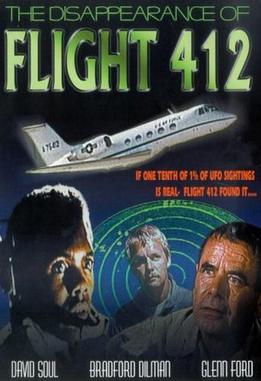
Because of recent electrical surges aboard its aircrafts, the commander of the Whitney Air Force Base 458th Radar Test Group sends a four-man crew up in Flight 412 to try to figure out what’s happening. Colonel Pete Moore (Glenn Ford) and Major Mike Dunning (Bradford DIllman) assume that it will just be a routine flight. Instead, they find themselves at the center of a government cover-up when Captain Bishop (David Soul) and the other members of the crew spot what appears to be a UFO. When two jets are sent out to intercept the object, the jets vanish.
Suddenly, Flight 412 is ordered to land at a seemingly deserted military base in the desert. When they do, the airplane is impounded and the crew is forced to undergo an 18-hour debriefing led by government agents. The agents demand that the crew members sign a statement saying that they didn’t see anything strange in the air before the jets vanished. Until all four of the men sign the release, the crew of Flight 412 are officially considered to be missing and will not be released until they agree to deny what they saw.
Meanwhile, Col. Moore tries to learn what happened to his men but the government, led by Col. Trottman (Guy Stockwell), is not eager to tell him.
This movie was made-for-television, at a time when people claiming to have been abducted by aliens was still a relatively new phenomenon. It was also made during the Watergate hearing and in the wake of the release of the Pentagon Papers, so the film’s sinister government conspiracy probably felt relevant to viewers in a way that it wouldn’t have just a few years earlier. I appreciated that the movie took a semi-documentary approach to the story but that it tried to be serious and even-handed. The film shows how witnesses can be fooled or coerced into saying that they saw the opposite of what they actually did see. Unfortunately, The Disappearance of Fight 412 is ultimately done in by its own cheapness. The overreliance on familiar stock footage doesn’t help the film’s credibility and there’s too many familiar faces in the cast for the audience to forget that they’re just watching a TV movie. The Disappearance of Flight 412 doesn’t really succeed but it is still interesting as an early attempt to make a serious film about the possibility of alien abduction and the government covering up the existence of UFOs.. Three years after this film first aired, Steven Spielberg would introduce these ideas to an even bigger audience with Close Encounters of The Third Kind.
Scott Bruin (Jeff Lester) is a high fashion photographer who is haunted by nightmares in which he strangles a naked woman in the swimming pool. His nymphomaniac girlfriend, Lena (Shannon Tweed!), is surprisingly understanding when she wakes up to discover Scott strangling her but Scott is worried that he might be losing his mind. His psychiatrist (David Soul) is not much help. When Scott has a violent vision in the middle of photo shoot, he freaks out. “Hey, are you on drugs?” one of the models asks.
Then Scott meets Kimberly (Adrienne Sachs) and she looks exactly like the woman from his dreams. When she invites him to back to her house, the house looks exactly like the house from his nightmares. Is Scott going crazy or is he seeing the future? And how is Kimberly’s ex, a cold businessman named Ken Strom (Marc Singer), involved?
Does anyone remember this movie? In the 90s, this used to be on HBO and Cinemax all of the time. It’s a typical sex-fueled, nudity-filled direct-to-video thriller but Nico Mastorakis, a Greek director who has obviously learned a lot from Brian DePalma, gives the movie an enjoyably slick sheen. Neither Jeff Lester nor Adrienne Sachs gives a good performance and the plot feels like it was made up on the spot but fans of Shannon Tweed in her Skinemax heyday might enjoy it.
In the Cold of the Night also features Tippi Hedren, playing Kimberly’s mother. She only appears in one scene and freaks out when she sees some birds. The scene ends with Adrienne Sachs looking directly at the camera and saying, “Mother simply hates birds!”


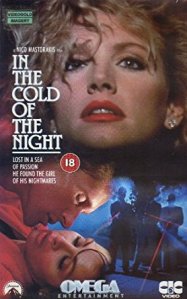 Scott Bruin (Jeff Lester) is a high fashion photographer who is haunted by nightmares in which he strangles a naked woman in the swimming pool. His nymphomaniac girlfriend, Lena (Shannon Tweed!), is surprisingly understanding when she wakes up to discover Scott strangling her but Scott is worried that he might be losing his mind. His psychiatrist (David Soul) is not much help. When Scott has a violent vision in the middle of photo shoot, he freaks out. “Hey, are you on drugs?” one of the models asks.
 Through the Shattered Lens