Horror Film Review: Dogs (dir by Burt Brinckerhoff)


I’ll admit it right now.  I’ve never really been a dog person.

That’s the way it’s been my entire life.  According to my sisters, I was bitten by a dog when I was two years old.  Needless to say, I don’t remember that happening but that still might explain why, when I was growing up, I was scared to death of dogs.  Seriously, if I was outside and I heard a dog barking or if I saw a dog running around loose (or even on a leash), I would immediately start shaking.  It didn’t help that, for some reason, I always seemed to run into the big dogs that wanted to jump and slobber all over me.  (“Don’t be scared,” one dog owner shouted at me, “that’ll just make him more wild,” as if it was somehow my responsibility to keep his dog under control.)

Then there was that time when was I was ten and I was visiting Lake Texoma with my family.  There was another family there and they had a big black dog with them.  When I first saw him, the dog was very friendly.  He ran up to me and, tentatively and with my sisters standing beside me for moral support, I even patted his head,.  He seemed so nice!  Finally, I had met a dog that didn’t scare me.  My family was really happy.  We went down to the lake and everyone told me how proud they were that I had managed to face a dog without running away.  As we came back from the lake, I saw the dog laying down next to his family’s van.  I smiled at the sight of him.  He raised his head, looked at me, and started to growl.  He wasn’t growling at my sisters or my parents.  He was growling at me.  Terrified, I went over to my family’s car and I ducked down behind it.  I could hear my Dad telling the dog to stop and then I heard the loudest barking and saw the dog running towards me.  I jumped in the car and locked the doors.  The dog’s owners eventually grabbed their dog and took him back to their van.  They said that I probably looked like someone who had been mean to it a few weeks earlier.  One thing that they did not really do was apologize.  Instead, they just made me feel like it was somehow my fault.  They didn’t seem sympathetic when my Mom explained that I was terrified of dogs.  When they realized my Dad was on the verge of punching someone, they retreated to their van and quickly left.  At that time, I decided that 1) I would never trust another dog and that 2) dog owners are the most selfish people on the planet.  I know that sounds harsh but seriously, I was traumatized!

As I grew up, I mellowed a bit.  I met nice dog owners who actually made the effort to control their pets.  I even met some friendly dogs and slowly realized that not all of them were going to try to kill me.  I became less scared of dogs but they still definitely make me nervous.  I still cringe when listening to the barking and I still reflexively step back whenever I see a big dog anywhere near me.  Now that I know more about dogs, I have to admit that I feel a little bit guilty about not liking them more.  Knowing that dogs actually blame themselves for me not liking them is kind of heart-breaking and I have been making more of an effort to be, if nothing else, at least polite to the canines who lives in the neighborhood.  That said, I’m a cat person and I’ll always be cat person.  Cats don’t care if you like them or not nor do they blame themselves if you’re in a bad mood, which is lot less of an emotional responsibility to deal with.
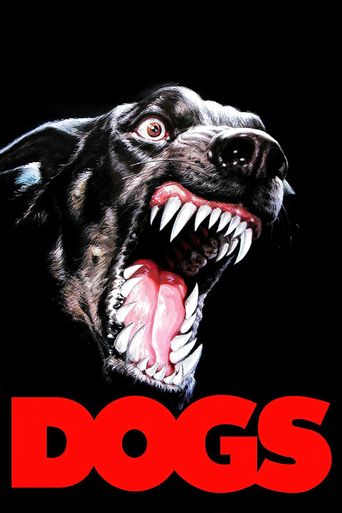
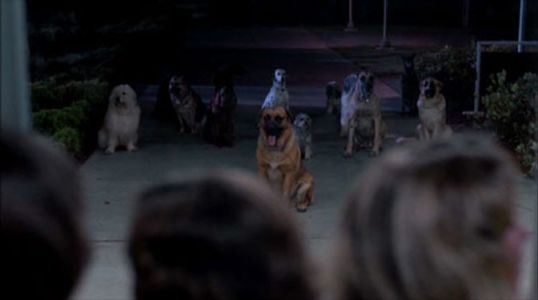
1977’s Dogs is a film that seems like it was especially made to give people like me nightmares.  It’s a pretty simple movie.  At a college in Southern California, the students and the faculty find themselves under siege from a bunch of dogs that have been driven mad by pheromones being sprayed into the atmosphere by a nearby, top secret government experiment.  Two professors (David McCallum and George Wyner) attempt to convince everyone to evacuate the college and the town but, in typical Jaws fashion, no one wants to admit the truth about what’s happening.  By the end, nearly everyone is dead (and the final scene of all the dead bodies spread across campus is genuinely haunting) and the cats are starting to hiss at humans.

Dogs is a low-budget drive-in flick but it’s still a frightening film, largely because the dogs are relentless and the victims may be largely stupid but they’re all stupid in realistic ways.  A group of college students is told to wait inside until George Wyner comes back for them but Wyner takes so long in returning that the terrified students decide to make a run for it themselves.  It doesn’t end well but it’s the sort of thing that I can actually imagine happening.  No one likes being told to wait and, with no idea of what’s actually going on, making a run for it might actually seem like as good an idea as any.  Even when the movie recreates the Psycho shower scene (with dogs instead of Norman Bates), it’s far more effective than it perhaps has any right to be.

Would this film be as effective from the point of view of someone who doesn’t have a history of being scared of dogs?  It’s a legitimate question.  Dogs aren’t like sharks.  Most people like dogs.  But when they’re barking and growling and determined to bite your throat, they can be pretty scary!  I’ll just say that Dogs is a film that seemed to be uniquely designed to give me nightmares.
Horror Film Review: The Wind (dir by Nico Mastorakis)


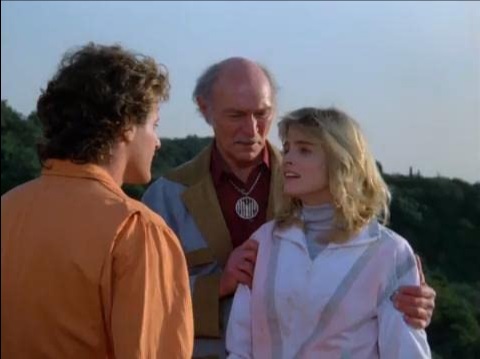
In 1986’s The Wind, Meg Foster stars as Sian Anderson.  Sian is a novelist who lives in Los Angeles with her wealthy boyfriend, John (David McCallum).  How wealthy is John?  He’s so wealthy that he can sit out by his pool with a telephone.  (That’s 80s wealthy!)  He’s so wealthy that, when Sian says that she’s going to go to Greece so she can work on her next novel, John rents out the Goodyear Blimp and has it say, “Bon Voyage.”

(It would have been funnier if it had said, “The World Is Yours.”)

On the Greek isle of Monemvasia, she rents the home of Elias Appleby (Robert Morley), an eccentric man who tells her that she must be careful during the night because the heavy winds can be deadly.  He probably also should have warned her that the handyman, Phil (Wings Hauser), was crazy.  No sooner has the wind started howling outside and Sian has started work on her latest novel (which, from what we hear of her writing, sounds absolutely awful), then wild-eyed Phil starts acting crazy and homicidal.  Isolated and too stupid to figure out how to use a Greek phone (and yes, that actually is a plot point), Sian tries to survive the night.

The Wind was directed by Greek journalist-turned-filmmaker Nico Mastorakis.  Anyone was has seen a previous Mastorakis film will immediately be able to spot that The Wind is a product of his somewhat unique aesthetic vision.  As with almost all of Mastorakis’s films, The Wind is both a thriller and a travelogue.  Yes, Phil is trying to kill Sian but — hey!  Look at how pretty the island is!  As well, in typical Mastorakis fashion, the cast is a hodgepodge of familiar faces who don’t all seem as if they belong in the same movie.  Along with Meg Foster, Wings Hauser, Robert Morley, and David McCallum, the film also features Steve Railsback as a friendly sailor who, stranded on the island by the wind, attempts to help Sian out.

The other big Mastorakis trademark is that none of the characters in the film seem to like each other.  That makes sense when it comes to Sian and Phil.  But what is one to make of the scene where Appleby gives Sian a tour of the home and the two of them, who have just met, immediately start snapping at each other for no reason?  They’ve just met and they really don’t have any reason to be arguing with each other.  But that’s what they do because this is a Nico Mastorakis film.

For me, the funniest part of the film involves John.  Worried that Phil is going to kill her, Sian finally gets to talk to John on the phone.  The connection is bad but John, who is sitting out by his pool, still clearly hears Sian say that someone is trying to kill her.  The line then goes dead.  John contacts the international operator and says that he has to make an emergency call to Greece but he’s not sure about the exact number.  The international operator replies that a call cannot be made with an exact number.  So, what does John?  He shrugs, hangs up,  gets in the swimming pool, swims a few laps and nearly misses it when Sian, hours later, calls him again.  To reiterate: John, a wealthy man with Goodyear Blimp connections, heard that the love of his life was isolated and in fear of her life and his response was to go for a swim.

On the plus side, The Wind is actually decently paced and Nico Mastorakis makes the use of his limited locations.  Meg Foster and Wing Hauser are both such eccentric performers that it’s impossible not be entertained by the sight of them acting opposite each other.  Even by his usual standards, Hauser is memorably unhinged here.  This film is ludicrous and a lot of fun.  It’s a Nico Mastorakis film, after all.

The Films of 2025: Dead Before They Wake (dir by Andy Crane and Nathan Shepka)


It’s always interesting to compare American films about the UK with the films made by the people who actually live there.

American films about the UK are all about meeting quirky people, visiting clean and brightly-lit castles, maybe falling in love with a member of royalty, and perhaps discovering that your father is actually a member of Parliament played by Colin Firth.  If the action moves out of London or into Scotland or Wales, one cab be assured that it will involve an American having car trouble outside of a goat farm and then meeting an eccentric but handsome veterinarian.  If the film takes place in Scotland, the veterinarian and his randy father will wear a kilt.  The same thing will happen if the film is set in Wales because most Americans don’t know the difference between Scotland and Wales.

Films about the UK that are actually made in the UK tend to be visually moody and full of people dealing with economic uncertainty while living in depressingly tiny flats.  The cities are often portrayed as being covered in graffiti and no one, not even the film’s hero, is ever particularly happy.  British films about the UK are full of melancholy, rainy atmosphere and are often as violent as American films about the UK are quirky.

Dead Before They Wake takes place and was filmed in some of the darkest corners of Glasgow.  Nathan Shepka plays Alex, a nightclub bouncer who occasionally takes on other jobs.  He’s someone who knows how to handle himself in a fight and he often returns to his small and cramped home with split knuckles and a bruised face.  At the same time, he’s also a loving son whose deaf and very ill father is in a retirement community.  (His father encourages Alex to settle down and get married.)  Outside of his father, the only person with whom he has an regular contact is Gemma (Grace Cordell), a teacher who moonlights as a stripper to make extra money.  (That said, she still finds herself receiving an eviction notice.)  Alex pays Gemma to have sex with him but it’s obvious that there’s something more to their relationship than just a transaction.  They’re two people lost in an increasingly dark world.

Alex is approached by a shabby but well-intentioned attorney named Evan (Sylvester McCoy).  Evan hires Alex to track down a 14 year-old girl who Evan believes has been abducted by a sex trafficking ring.  The girl’s mother is a heroin addict.  The girl’s father is a government official.  Alex reluctantly takes the job and he soon manages to link the girl’s disappearance to a low-rent operation run by Amar (Manjot Sumal).  Amar is someone who is very protective of his own teenage daughter but who has no problem with the idea of abducting girls who are the same age or younger and forcing them to work in his makeshift brothel.  While Alex tries to find a way to infiltrate Amar’s operation, a mysterious man named Holden (Patrick Bergin) watches from the shadows.

Though the plot may remind some of Taken, Dead Before They Wake is far more thoughtful than any Liam Neeson’s admittedly entertaining thrillers.  Alex is not a former secret agent with a precise set of skills.  He’s just a tough guy who knows how to throw (and take) a punch and his investigation of Amar’s operation pushes him over the edge not because he’s trying to rescue a family member but because Alex is a human being who cannot believe or forgive the amount of depravity that he discovers during his investigation.  Throughout the film, there are hints that Amar’s operation is actually fairly small-scale when compared to some of the others.  A meeting with a representative of a national syndicate brings to mind the scandals of the late British DJ Jimmy Savile, who may not be well-known in the States but who, in the UK, became a symbol of depravity when it was revealed, after his death, that he was a prolific pedophile and sex abuser whose actions were largely ignored and sometimes even covered up by the British establishment.

Throughout Dead Before They Wake, there are scenes and details that establish that the film is more than just a revenge flick.  Gemma’s struggle to survive financially is handled with sensitivity and Grace Cordell gives an authentic performance in the role.  The scene where she tries to hide her growing fear upon learning that a picture of her dancing has appeared online and been seen by at least one of her students is wonderfully-acted.  The film contrasts Alex’s small flat with the large home that is owned by Amar and the film opens with a disturbing scene that shows just how exactly Amar kidnaps the girls who he then gets hooked on drugs and forces to work for him.  Dead Before They Wake is about much more than just action.

Dead Before They Wake does have its flaws.  Towards the end of the film, we’re expected to believe that one character overlooked something so obvious that it momentarily makes it difficult for us to suspend our disbelief.  But, for the most part, this is a disturbing and effective thriller, one that concludes on a proper note of Scottish melancholy.

Late Night Retro Television Reviews: Monsters 1.1 “The Feverman”


Welcome to Late Night Retro Television Reviews, a feature where we review some of our favorite and least favorite shows of the past!  On Wednesdays, I will be reviewing Monsters, which aired in syndication from 1988 to 1991.  The entire show is streaming on Youtube.

Monsters was an anthology series that ran, in syndication, from 1988 to 1991.  It was produced by Richard Rubinstein and Mitchell Galin, who had previously produced another anthology series called Tales From The DarksideMonsters, unlike Tales, almost exclusively focused horror stories and, as the title suggests, each story featured at least one monster.  As well, each episode opened with a family of monsters sitting around a television and looking for something to watch.

Sounds like fun!  I’m looking forward to watching and reviewing this series for Through the Shattered Lens.

Episode 1.1 “The Feverman”

(Dir by Michal Gornick, originally aired on October 22nd, 1988)

Timothy Mason (John C. Vennema) is in a panic because his daughter (Michele Gornick) has a contracted a fever and is now on the verge of death.  When Mason’s friend, Dr. James Burke (Patrick Garner), is unable to lower the girl’s fever, Mason decides to take her to see the Boyle (David McCallum), the feverman.  A disreputable fellow who is never seen without a glass of liquor in his hand and a dingy crystal hanging out around his neck, Boyle claims that he can pull fevers out of those suffering.  He charges a good deal of money for his services but he also claims that, unlike the doctors of the world, he’s never lost a patient.  Indeed, Boyle claims that, if anyone brought to him died, he would die as well.

Burke goes with Mason to Boyle’s house and, when Boyle announces that he must be alone with Mason’s daughter in order to cure her, Burke denounces him as being a charlatan.  Still, Mason agrees to leave his daughter alone with Boyle in Boyle’s basement.  However, as Burke and Mason wait for Boyle to return from the basement, they grow impatient and Burke pressures Mason to disobey Boyle’s orders.  Finally, Burke and Mason head into the basement and that’s where they catch Boyle wrestling with this thing….

It turns out that Boyle wasn’t lying when he said that he could literally bring the fever out of a patient.  However, when Burke and Mason interrupt him, that allows the fever monster to once again reenter Mason’s daughter.  The crystal necklace falls off Boyle’s neck.  Boyle explains to Burke that he is now dying and he can no longer fight the fever.  And, because it’s all Burke’s fault, it is now Burke’s obligation to wear the crystal and battle the fever.

Realizing that he’s at fault, Burke puts on the crystal and he wrestles with the fever monster.  Burke manages to destroy the monster but, afterwards, he discovers that he cannot take the crystal off.  As Boyle explains it, Burke is the new feverman and he will now wear the crystal until the day he dies.  Mason, happy that his daughter is now cured, still refuses to stick around to talk to Burke afterwards.  Burke is now an outsider.  Resigned to his fate, Burke starts drinking and prepares to meet his next patient.

This was an effective episode, featuring a wonderfully dissolute performance from David McCallum as Boyle and plenty of grimy atmosphere.  Maybe it’s just because I’m still getting over having the flu last week but the fever monster totally freaked me out.  I imagine that creature probably is what a fever really would look like.  This episode was the exact right way to start things off for Monsters!

Retro Television Reviews: The Master 1.4 “Hostages”


Welcome to Retro Television Reviews, a new feature where we review some of our favorite and least favorite shows of the past! On Fridays, I will be reviewing The Master, which ran on NBC from January to August of 1984. The show can be found on Tubi!

This week, The Master teams up with an old enemy.

Episode 1.4 “Hostages”

(Dir by Ray Austin, originally aired on February 10th, 1984)

“Hi, I’m Max Keller….”

This episode of The Master opens with Max (Timothy Van Patten) flying high above California in a motorized hang glider.  Apparently, this is the latest part of Max’s ninja training, though I have to wonder where the hang glider came from and whether or not being able to use a hang glider is a specific ninja skill.  The more I think about it, the more it seems that McAllister (Lee Van Cleef) is just leading Max on for his own amusement.

Max spots a woman (Jennifer Runyon, who later took over the role of Marcia Brady in A Very Brady Christmas) who is sitting behind the wheel of an out-of-control car.  Apparently, the brakes have failed and the car will soon careen over the side of a cliff!  Max swoops down and rescues the woman, minute before her car crashes and explodes.

The woman is Alice Clayton, the extremely talkative daughter of U.S. Senator Sam Clayton (Robert Dowdell).  Don’t worry, no one was trying to kill her.  The brakes just failed on their own.  A grateful Alice invites Max and McAllister to come to a party that the senator is throwing at his hillside mansion.

Soon, Max and McAllister are wearing tuxedos and hanging out at the party.  A CIA agent named Malory (one-time Bond star, George Lazenby) recognizes McAllister and accuses him of running a “subversive ninja school.”  Meanwhile, by an amazing coincidence, Okasa (Sho Kosugi) — McAllister’s former student who has taken a vow to kill him — also happens to be at the party.  He even takes the time to throw a ninja star at McAllister.

But that’s not all!  The party is also crashed by a group of terrorists, lead by Serena (Randi Brooks) and Castile (David McCallum).  The terrorists kidnaps Alice, her father, and the wives of several European diplomats.  The head of the CIA (Monte Markham) orders McAllister and Malory to set aside their differences and to rescue the hostages.  Max also decides to help which means that the hang glider makes another appearance as Max soars above the terrorist compound.

Lee Van Cleef’s stunt double gets quite a workout in this episode of The Master.  Not only do Okasa and McAllister have a brief fight but McAllister also gets to take on an entire compound full of terrorists.  Of course, McAllister wears his full of ninja uniform while doing all of this, all the better to hopefully keep us from noticing that Lee Van Cleef isn’t the one doing all of the kicking and hitting.  And I will say that, in this episode, the fights were fairly well-done.  The plot was predictable but the fights were probably about as exciting as you could hope from a network television show that aired in the 80s.

Other than the fights, the best thing about this episode was the chance to see George Lazenby playing a character who was Bond in everything but the name.  Lazenby himself has said that one of the reasons he struggled with the role of James Bond was because he was too young when he starred in On Her Majesty’s Secret Service.  In this episode of The Master, Lazenby is older and a bit more weathered and he’s totally believable as a spy who is tough but who still enjoys the better things in life.  As well, David McCallum does a good job as the cynical terrorist, though his character isn’t really given much to do.

I actually kind of enjoyed this episode of The Master.  As opposed to the previous three episodes, it focused on the action and it didn’t really have any slow spots.  It was a fun episode.

Film Review: The Greatest Story Ever Told (dir by George Stevens)


The 1965 biblical epic, The Greatest Story Ever Told, tells the story of the life of Jesus, from the Nativity to the Ascension.  It’s probably the most complete telling of the story that you’ll ever find.  It’s hard to think of a single details that’s left out and, as a result, the film has a four hour running time.  Whether you’re a believer or not, that’s a really long time to watch a reverent film that doesn’t even feature the campy excesses of something like The Ten Commandments.

(There’s actually several different version of The Greatest Story Ever Told floating around.  There’s a version that’s a little over two hours.  There’s a version that’s close to four hours.  Reportedly, the uncut version of the film ran for four hour and 20 minutes.)

Max von Sydow plays Jesus.  On the one hand, that seems like that should work because Max von Sydow was a great actor who gave off an otherworldly air.  On the other hand, it totally doesn’t work because von Sydow gives an oddly detached performance.  The Greatest Story Ever Told was von Sydow’s first American film and, at no point, does he seem particularly happy about being involved with it.  von Sydow is a very cerebral and rather reserved Jesus, one who makes his points without a hint of passion or charisma.  When he’s being friendly, he offers up a half-smile.  When he has to rebuke his disciples for their doubt, he sounds more annoyed than anything else.  He’s Jesus if Jesus was a community college philosophy professor.

The rest of the huge cast is populated with familiar faces.  The Greatest Story Ever Told takes the all-star approach to heart and, as a result, even the minor roles are played by actors who will be familiar to anyone who has spent more than a few hours watching TCM.  Many of them are on screen for only a few seconds, which makes their presence all the more distracting.  Sidney Poitier shows up as Simon of Cyrene.  Pat Boone is an angel.  Roddy McDowall is Matthew and Sal Mineo is Uriah and John Wayne shows up as a centurion and delivers his one line in his trademark drawl.

A few of the actors do manage to stand out and make a good impression.  Telly Savalas is a credible Pilate, playing him as being neither smug nor overly sympathetic but instead as a bureaucrat who can’t understand why he’s being forced to deal with all of this.  Charlton Heston has just the right intensity for the role of John the Baptist while Jose Ferrer is properly sleazy as Herod.  In the role Judas, David McCallum looks at the world through suspicious eyes and does little to disguise his irritation with the rest of the world.  The Greatest Story Ever Told does not sentimentalize Judas or his role in Jesus’s arrest.  For the most part, he’s just a jerk.  Finally, it’s not exactly surprising when Donald Pleasence shows up as Satan but Pleasence still gives a properly evil performance, giving all of his lines a mocking and often sarcastic bite.

The Greatest Story Ever Told was directed by George Stevens, a legitimately great director who struggles to maintain any sort of narrative momentum in this film.  Watching The Greatest Story Ever Told, it occurred to me that the best biblical films are the ones like Ben-Hur and The Robe, which both largely keep Jesus off-screen and instead focus on how his life and teachings and the reports of his resurrection effected other people.  Stevens approaches the film’s subject with such reverence that the film becomes boring and that’s something that should never happen when you’re making a film set in Judea during the Roman era.

I do have to admit that, despite all of my criticism of the film, I do actually kind of like The Greatest Story Ever Told.  It’s just such a big production that it’s hard not to be a little awed by it all.  That huge cast may be distracting but it’s still a little bit fun to sit there and go, “There’s Shelley Winters!  There’s John Wayne!  There’s Robert Blake and Martin Landau!”  That said, as far as biblical films are concerned, you’re still better off sticking with Jesus Christ Superstar.

TAMI Part 2: The Big T.N.T. Show (1966, directed by Larry Peerce)


In 1964, American International Pictures released the first concert film, The T.A.M.I. Show.  After the success of T.A.M.I, AIP followed up with a second concert film.  This one would be shot in front of a live audience at Los Angeles’s Moulin Rouge club on the night of November 29th, 1965.  The line-up included Ray Charles, Petula Clark, The Lovin’ Spoonful, Bo Diddley, Joan Baez, The Ronettes, Roger Miller, The Byrds, Donavon, and Ike and Tina Turner.  Phil Spector was recruited to produce the show and he brought with him a live orchestra.  Conducting the orchestra and serving as the night’s emcee was The Man From UNCLE‘s David McCallum.

Originally announced as The T.A.M.I. Show Part II, the title was briefly changed to This Could Be The Night (after a song written by Spector and Harry Nilsson and performed by The Modern Folk Quartet) until AIP finally went with The Big TNT Show, an appropriate title considering the explosive performances that were recorded that night.  The Big TNT Show also recorded the growing division between the rock and roll of the 50s and early 60s and the music of the emerging counter culture, with Ray Charles, Bo Diddley, and Ike Turner sharing the same stage as The Byrds and Donavon.

In one of the show’s best moments, Joan Baez sings You’ve Lost That Loving Feeling while Phil Spector accompanies her on piano.

Other highlights include the Byrds performing Turn, Turn, Turn,

Roger Miller performing his novelty hit King of the Road,

http://www.youtube.com/watch?v=CMrtaMh1soY

Petula Clark singing Downtown,

The Ronettes performing Be My Baby,

Donavon’s Universal Soldier,

and Ike and Tina Turner’s entire set.

At the end of the film, the viewers are told to “be sure to tune in for next year’s show!” but, one year later, both the world and music would be very different.  The Big TNT Show captures that one final moment before things changed forever.

Horror On The Lens: Dogs (dir by Burt Brinckerhoff)


dogs

Today’s horror film comes to use from 1976.  In Dogs, man’s best friend decides to terrorize an isolated college campus and the fate of the student body is in the hands of two professors (bearded David McCallum and non-bearded George Wyner).

In many ways, Dogs is a pretty basic revenge-of-nature film but it still made me nervous when I watched it on YouTube.  As our regular readers may know, I used to be terrified of dogs.  In just the past few years, I’ve managed to overcome a lot of my phobia but, on the whole, dogs still make me nervous.  And this movie definitely played on those nerves!

Interesting note: according to the trivia section over at the imdb, Dogs was originally going to be followed up by a sequel called Cats.  However, Dogs failed at the box office and, as a results, Cats was cancelled.