Long before he achieved holiday immortality by playing the father in A Christmas Story, Darren McGavin played journalist Carl Kolchak in the 1972 made-for-TV movie, The Night Stalker. Kolchak is investigating a series of murders in Las Vegas, all of which involve victims being drained of their blood. Kolchak thinks that the murderer might be a vampire. Everyone else thinks that he’s crazy.
When this movie first aired, it was the highest rated made-for-TV movie of all time. Eventually, it led to a weekly TV series in which Kolchak investigated various paranormal happenings. Though the TV series did not last long, it’s still regularly cited as one of the most influential shows ever made.
The Night Stalker is an effective little vampire movie and Darren McGavin gives an entertaining performance as the rather nervous Carl Kolchak.
1973’s The Norliss Tapes begins with a disappearance.
David Norliss (Roy Thinnes), a California-based journalist, has vanished. Before he disappeared, he had started work on a book that would have detailed his own adventures investigating the paranormal. Though Norliss vanishes, he leaves behind several audiotapes in which he discusses some of the frightening things that he has seen. Searching for clue about Norliss’s disappearance, his editor, Sanford T. Evans (Don Porter), sits down and listens to the tapes.
(Incidentally, Sanford T. Evans is a wonderful name for an editor. It’s a name that just says, “My father knew Hemingway and I went to the University of Pennsylvania as a legacy.’)
As Evans listens to each tape, we watch the story unfold from Norliss’s point of view. In this film, we watch as Norliss investigates an incident in which Ellen Sterns Cort (Angie Dickinson) claims that she was recently attacked by her dead husband, James Cort (Nicki Dimitri). James was an artist who, in his final days, became obsessed with the occult and fell under the influence of the Mademoiselle Jeckiel (Vonetta McGee), a mysterious woman who claimed to appreciate James’s art and who gave him a scarab ring that he insisted on being buried with.
Norliss interviews Ellen and investigates her story. He’s far more sympathetic to the idea of James having returned from the dead than the local sheriff (Claude Akins) is. Of course, the sheriff has problems of his own. Dead bodies keep turning up in his county, their skin gray and their bodies drained of blood. Hmmm …. I wonder if that could have anything to do with James Cort and his scarab ring….
The Norliss Tapes is a pretty simple film. Norliss shows up and then basically waits around until James Cort makes an appearance. The film only runs 72 minutes and it’s very much a pilot for a television series that never went into production, Apparently, each episode would have featured Stanford listening to a different tape and hearing about David Norliss and a weekly guest star dealing with some sort of supernatural occurrence. Director Dan Curtis was also responsible for the cult television series, Kolchak: The Night Stalker, and The Norliss Tapes feels very much like a dry run for that show. The main difference is that Roy Thinnes’s David Norliss is nowhere near as nervous as Darren McGavin’s Carl Kolchak.
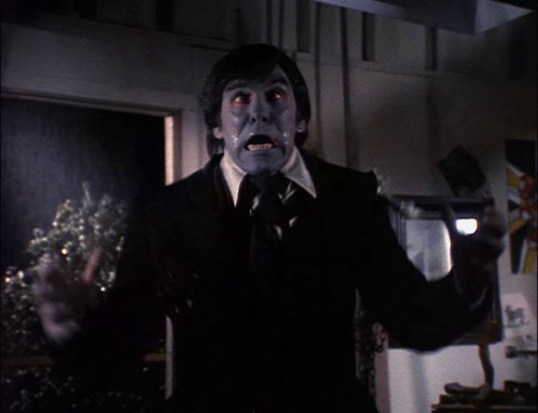
That said, the exact details for what’s going on with James Cort are almost ludicrously complicated. It turns out that James Cort is not only trying to cheat death but he’s also helping an ancient Egyptian deity invade our world. It’s best to ignore the nonsense about the Egyptian Gods and instead just focus on how creepy the undead James Cort is. With his hulking frame, his gray skin, and his nearly glowing eyes, Cort is a truly frightening monster and he’s certainly the most impressive thing about this movie. What makes Cort such an effective villain is how angry he seems to be. Whenever he’s on screen, he’s either bursting through a door or chasing someone. He’s pure nightmare fuel.
TheNorlissTapes never became a series but it did do well in Europe, where it was released in theaters. The Norliss Tapes still has a cult following, not bad for a failed pilot. Who knows what other adventures David Norliss could have had?
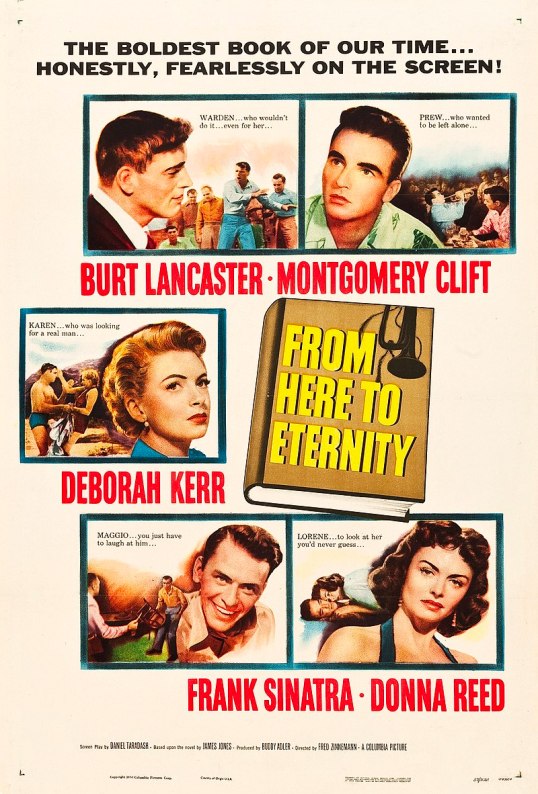
“The boldest book of our time,” shouts the poster art for 1953’s From Here To Eternity, “honestly, fearlessly brought to the screen!”
And indeed, James Jones’s novel was brought to the screen about as boldly as a studio film could be brought in 1953. The book told the story of several soldiers in the days immediately before the attack on Pearl Harbor. The Production Code was still in effect and, as a result, a few changes were made to the film’s plot. Donna Reed played Lorene, a character who is described as being a “hostess” at social club but who, in the book, worked at a brothel that was popular with the soldiers from a nearby army base. In the book, an unfaithful husband gives his wife a venereal disease that leads to her getting a hysterectomy. In the movie, Karen’s (Deborah Kerr) hysterectomy was the result of a miscarriage that occurred after she discovered her husband was being unfaithful. The book was critical of the Army and featured officers who faced no consequences for their actions. The movie definitely presents the enlisted men as being at the mercy of officers but the worst of the officers is ultimately disciplined. The movie was made with the cooperation of the U.S. Army and, as a result, the film’s villains — like Captain Holmes (Philip Ober) and the monstrous Fatso Judson (Ernest Borgnine) — were portrayed as being aberrations who did not represent the Army as a whole. That said, the film version of From Here To Eternity is still a powerful, moving, and daring film. What couldn’t be shown on screen is still suggested. One might not see the specifics of what Fatso Judson does to Maggio (Frank Sinatra) in the stockade but it’s not difficult to figure out.
The film follows one company of soldiers as they laugh, fight, and fall in love while stationed in Hawaii. They spend time training for a war that most of them think will never come. Captain Holmes is more concerned with his regimental boxing team than the prospect of going to war and is confused when Private Prewitt (Montgomery Clift) refuses to stop back into the ring. Prewitt, who takes pride in his ability as a bugler, quit boxing after he blinded an opponent in the ring but Holmes doesn’t care. Holmes wants another trophy for his office. He orders Sgt. Warden (Burt Lancaster) to make life Hell for Prewitt until Prewitt agrees to box. Warden, who has seen a lot of officers come and go and who has been tempted to become an non-commissioned officer himself, is having an affair with Holmes’s wife, Karen. Meanwhile, Prewitt and his friend Maggio spend their time looking forward to the weekends they’re allowed to spend off the base. Prewitt has fallen in love with Lenore but, as with all the men in From Here To Eternity, Prewitt’s true love is for the army. Even with Holmes pressuring him to box, Prewitt’s loyalty is to the men with whom he serves. There’s a lot of drama, a lot of death, and a lot of romance. This is the film in which Burt Lancaster and Deborah Kerr make out on the beach while the tide rolls in. But, when Pearl Harbor is attacked, all of the drama and all of the romance is forgotten as America goes to war.
From Here To Eternity is one of the best films of the 1950s and certainly one of the more worthy winners for Best Picture. Intelligently directed, wonderfully acted, deliriously romantic, and finally rather sad, it’s a film that embraces the melodrama without ever hitting a false note. Burt Lancaster’s rugged weariness, Montgomery Clift’s method sensitivity, Frank Sinatra’s naturalism, Ernest Borgnine’s crudeness, Deborah Kerr’s classiness, and Donna Reed’s earnestness all come together to create a film in which the characters feel real and alive. Warden, Prewitt, Lenore, Karen, and Maggio are all interesting, multi-faceted people, trying to find some sort of happiness in the shadow of an inevitable war. The viewer may sometimes have mixed feelings about their actions (and Borgnine’s Judson is one of the most loathsome roles that the normally likable Borgnine ever played) but you never cease to care about them and their stories. With all of the characters and the affairs and the secrets, From Here To Eternity can feel like a soap opera but it’s also a portrait of a world that is on the verge of changing forever.
A few years ago, I attended a screening of From Here To Eternity at the Dallas Angelika. This is a film that definitely deserves to be seen on the big screen. From the famous scene on the beach to the attack on Pearl Harbor to the tragic final moments, this is a big movie that deals with big emotions and big moments. It’s one of the best.
For today’s horror on the lens, we have a real treat! (We’ll get to the tricks later…)
Long before he achieved holiday immortality by playing the father in A Christmas Story, Darren McGavin played journalist Carl Kolchak in the 1972 made-for-TV movie, The Night Stalker. Kolchak is investigating a series of murders in Las Vegas, all of which involve victims being drained of their blood. Kolchak thinks that the murderer might be a vampire. Everyone else thinks that he’s crazy.
When this movie first aired, it was the highest rated made-for-TV movie of all time. Eventually, it led to a weekly TV series in which Kolchak investigated various paranormal happenings. Though the TV series did not last long, it’s still regularly cited as one of the most influential shows ever made.
The Night Stalker is an effective little vampire movie and Darren McGavin gives a great performance as Carl Kolchak.
Today’s Horror on the Lens is The Norliss Tapes, a 1973 made-for-TV movie that was also a pilot for a television series that, unfortunately, was never put into production.
Reporter David Norliss (Roy Thinnes) has disappeared. His friend and publisher, Stanford Evans (Don Porter), listens to the tapes that Norliss recorded before vanishing. (Stanford Evans, it must be said, is a great name for an editor.) Each tape details yet another paranormal investigation. (Presumably, had the series been picked up, each tape would have been a different episode.) The first tape tells how Norliss investigated the mysterious death of an artist who apparently returned from the grave.
For a made-for-TV movie, The Norliss Tapes is pretty good. It’s full of atmosphere and features a genuinely menaching yellow-eyed zombie monster. The film was directed by Dan Curtis, who was responsible for several made-for-TV horror films and who also created the deathless TV show, Dark Shadows. Curtis also directed a few feature films. Burnt Offerings,for instance, will be forever beloved for its scene of annoying little Lee Montgomery getting crushed by a chimney. If you ever get a chance to listen to the director’s commentary that Dan Curtis recorded for the Burnt Offerings DVD release, you must do so. Curtis comes across as the crankiest man on the planet and it’s actually kind of fascinating to listen to. His irritation when Karen Black keeps asking him if he knows the name of the actor who played the ghostly chauffeur is truly an amazing thing to here. (For the record, the actor’s name was Anthony James, he also had important supporting roles in two best picture winners — In The Heat of the Night and Unforgiven — and yes, he was one of the best things about Burnt Offerings. Karen Black knew what she was talking about.)
But back to The Norliss Tapes!
Admittedly, this is not the first Halloween in which I’ve shared The Norliss Tapes with our readers. Back in both 2015 and 2021, The Norliss Tapes was one of our “horrors on the lens.” Unfortunately, there’s only so many good quality, public domain horror films available on YouTube so, occasionally, a movie is going to show up more than once over the years. But, as long as it’s good film, who cares?
Welcome to Retro Television Reviews, a feature where we review some of our favorite and least favorite shows of the past! On Tuesdays, I will be reviewing the original Fantasy Island, which ran on ABC from 1977 to 1984. Unfortunately, the show has been removed from most streaming sites. Fortunately, I’ve got nearly every episode on my DVR.
Episode 5.8 “Lillian Russell/The Lagoon”
(Dir by Don Weis, originally aired on November 28th, 1981)
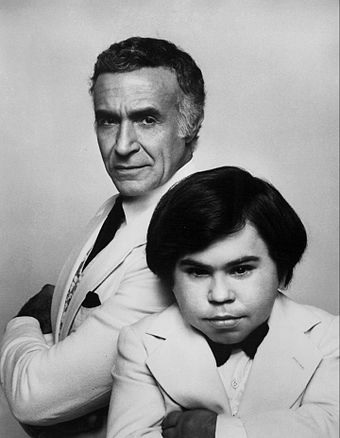
Tattoo is in this episode, which means that Julie only appears long enough to tell Mr. Roarke that she’s going to busy exploring the island with a bunch of hunky professors. (It says a lot about how poorly the Julie character has been developed that I couldn’t tell if Julie was supposed to be naive or clever when it came to going off with the men.)
At this point, it’s obvious that Julie was only added to the show to act as insurance in case Herve Villechaize walked off the set. Early on in the season, when Herve was apparently negotiating for a better contract, Julie had a few episodes where she was Roarke’s main assistant while Tattoo was described as being elsewhere on the island. But in the episodes where Tattoo is present, Julie always has to go do something else for the weekend. Ironically, Julie is such a bland and unnecessary character that it actually proves Herve Villechaize’s point about how important Tattoo was to the success of the show. By having Julie always leave whenever Tattoo is present, the show really only reminds the viewer that Roarke only needs on assistant and it’s Tattoo.
As for this week’s fantasies, they both have to do with the past.
Calvin Pearson (Claude Akin) has just spent years in prison for a crime that he didn’t commit. He’s finally been released and, understandably, he really doesn’t want to have much to do with the rest of the world. When he was a child, he spent a summer on a nearby island with his father. His father was fisherman and Calvin claims that he once caught a fish that could sing. Calvin wants to spend the weekend on the Island and he wants to catch the same serenading fish.
Sound like a pretty simple fantasy, right? Well, Calvin is not happy to discover that the he’s not alone on “my island.” There’s now a trading post, run by Jake Dutton (Broderick Crawford) and his daughter, Mira (Pamela Susan Shoop). Even worse, there are some recently escaped convicts (led by Glenn Corbett) who want to kidnap Mira! At first, Calvin refuses to get involved. He just wants to fish. But, in the end, he finally does the right thing and saves the Duttons.
What about the “serenading fish?” Calvin may not have caught a fish but he did capture the heart of Mira, who hums a tune that she says she once heard out on the lagoon. Calvin leaves the Island alone but he tells Roarke that he plans to return so that he can work at the trading post with the Duttons.
This fantasy was a bit predictable and you really do have to wonder why Roarke insists on nearly getting his guests killed every week. It seems like that would lead to a lawsuit. But the fantasy does feature a good performance from Claude Akin as a man who manages to conquer his own bitterness.
As for the other fantasy, it features Phyllis Davis as a writer named Lilly Martin who wants to write a book about the singer Lillian Russell. Roarke sends her back to 1890s New York and literally transforms Lilly into Lillian Russell, complete with singing talent and two notorious suitors, “Diamond Jim” Brady (Gene Barry) and Peter Whiting (Craig Stevens). This fantasy was enjoyable eye candy, with Lilly getting to dress up as Lillian Russell and getting to wear all sorts of jewels. Unfortunately, it’s also a fantasy that ends with a poker game. I’ve never been able to follow poker and I always groan a little whenever the plot of a show hinges on the outcome. Whenever people start talking about “bluffing” and “royal flushes,” and all that, my eyes just glaze over and that was the case here.
That said, at least Mr. Roarke got to take part in Lilly’s fantasy, popping up not once but three times to see how everything was going! In fact, Mr. Roarke and Tattoo also popped up in Calvin’s fantasy. It’s always fun when Roarke drops in.
The poker game aside, this was an enjoyable trip to the Island. Season 5 has been a bit uneven but this was one of the better episodes.
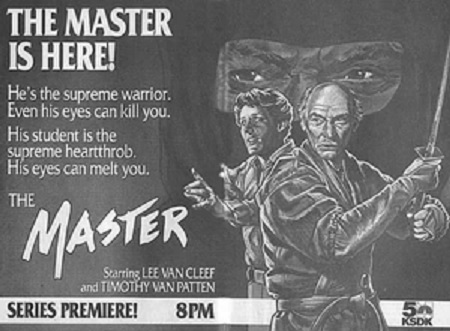
Welcome to Retro Television Reviews, a new feature where we review some of our favorite and least favorite shows of the past! On Fridays, I will be reviewing The Master, which ran on NBC from January to August of 1984. Almost all nine of the show’s episodes can be found on Tubi!
My original plan was to follow-up Half Nelson by reviewing Freddy’s Nightmares. Unfortunately, Freddy’s Nightmares has been removed from Tubi and it’s not currently streaming anywhere else. Hopefully, some other site will soon feature it or it will eventually return to Tubi and I’ll be able to review the show in the future.
While I was looking for another show to review, I came across The Master. The Master ran for 13 episodes in 1984. It featured Lee Van Cleef as John Peter McAllister, a ninja traveling across America and searching for his daughter. Helping out McAllister is Max Keller, a young drifter who owns a groovy van and who is played by Timothy Van Patten. (Van Patten, who has since become a much in-demand director, is probably best known for playing Stegman in Class of 1984.) Since The Master had a short run and everyone loves ninjas, I decided to add it to our retro television schedule!
Episode 1.1 “Max”
(Dir by Robert Clouse, originally aired on January 20th, 1984)
“My name’s Max Keller and this is how I usually leave a bar.”
So opens the first episode of The Master. The voice over is courtesy Max Keller (Timothy Van Patten), a young drifter who drives across America in a van with a pet hamster named Henry as his main companion. And the way that Max usually leaves a bar is through the front window. In this case, Max is tossed through a window by a bunch of bikers. Max responds by sabotaging all of their bikes so, when they try to chase after him as he drives off in his van, all of the bikers are thrown from their bike and onto the hard pavement of the road. I would think that this would kill most of the bikers but Max doesn’t seem to be too concerned about that. Instead, he just has a good laugh as he drives away. Oh, Max!
Meanwhile, in Japan, John Peter McAllister (Lee Van Cleef), “the man who would change my life,” (to quote Max’s voiceover) is preparing to return to America for the first time in years. McAllister moved to Japan after World War II and is the only American to have been trained in the ninja arts. (Why the ninjas would be so eager to train an American after the way World War II ended is not explained.) McAllister has just found out that he has a daughter who he has never met. (How did he find out? Again, it’s not explained.) He wants to return home so that he can find her. However, Osaka (Sho Kosugi), a former student of McAllister’s, is determined to kill him for breaking the ninja code. McAllister manages to escape Japan with only a slight wound courtesy of a throwing star. Osaka decides to follow him.
Back in America, a young woman named Holly Trumbull (a very young Demi Moore) runs out into the middle of a country highway and is nearly run over by Max. Max stops his van just in time and offers Holly a ride. It turns out that Holly is being pursued by the evil Sheriff Kyle (Bill McKinney). She explains that Sheriff Kyle tried to rape her, which is information that Max just kind of shrugs off. He manages to outrun the Sheriff and takes Holly back to the airport that is managed by her father, Mr. Trumbull (Claude Akins).
Max apparently (I say apparently because the episode’s editing is so ragged that it’s often difficult to tell how much time has passed from one scene to the next) spends a few days working at the airport and trying to date Holly. When he attempts to give Holly a kiss, she backs away from him and explains that she’s still not comfortable with being kissed after nearly being raped the town’s sheriff. “I’m sorry,” she says. Max, being a bit of a jerk, gets annoyed and says, “That makes three of us. Henry was just starting to like you.” After saying that he’s going to go somewhere to see if “my luck improves,” he goes to the local bar to unwind.
Also at the bar is John Peter McAllister! McAllister knows that his daughter came through Mr. Trumbull’s airport and he wants to show her picture to the people in the bar. For some reason, the bartender doesn’t want him to do that. When Sheriff Kyle, who is also in the bar, discovers that McAllister is carrying a samurai sword in his suitcase, the sheriff tries to arrest him. When a bar fight breaks out, Max fights alongside McAllister and they even manage to steal the sword back from the sheriff. Bonded by combat, Max and McAllister become fast friends. Before you know it, Max is agreeing to drive McAllister across the country as long as McAllister trains Max how to be a ninja.
But first, an evil developer named Mr. Christensen (Clu Gulager) is determined to run the Turnbulls off their land. After Christensen is not moved by an impassioned speech by Max and instead tries to blow up the airport, it’s time for Max and McAllister to invade Christensen’s office and fight a bunch of guards. Osaka also shows up at the office so we get a lengthy fight scene between Sho Kosugi and Lee Van Cleef’s stunt double. (McAllister dons his head-to-do ninja costume before doing any fighting, so we don’t actually see his face while he’s doing in any of his amazing ninja moves.) While Osaka and McAllister are fighting, Max defeats Christensen by throwing a ninja star at him and hitting him in the chest. I would think that would be murder but who knows. Maybe the blade narrowly missed Christensen’s heart and he was just unconscious. Or maybe Max’s just a sociopath.
Somehow, this leads to the Turnbulls getting to keep the airport. McAllister and Max drive off together, in search of America.
What a messy episode! Obviously, this episode had to get a lot done in just 48 minutes. It had to introduce Max and McAllister, it had to explain why they were traveling together, and it also had to give them an adventure. I guess I shouldn’t feel surprised that the episode felt a bit rushed but still, there were so many unanswered questions. For instance, why is Max driving across the country in a van? How did McAllister find out that he had a daughter? Why didn’t he know that he had a daughter before hand? Did McAllister’s daughter actually come through the town or not? How did Osaka track down McAllister? Where did Max learn to fight before he met McAllister? Why is McAllister so quick to agree to take Max under his wing? Why is Max so quick to drive a strange old man across the country?
As for the cast, Lee Van Cleef appears to be a bit frail in the role of McAllister. (He would died 5 years after The Master went off the air.) Timothy Van Patten comes across as being bit manic as Max. Personally, I would be worried about getting into a van with Max because he doesn’t really seem to have much impulse control. As for the guest cast, Demi Moore gives a strong performance as Holly but the character vanishes from the episode after finally giving Max a kiss. Claude Akins and Clu Gulager only get a few minutes of screentime and are both stuck with stock roles. Akin is the honest working man while Gulager is the corrupt businessman. Billl McKinny is properly hissable as the bully of a sheriff. And Sho Kosugi looks annoyed with the whole thing.
The first episode was not that promising but who knows! Maybe the show will improve as it goes along. We’ll find out next week!
For today’s horror on the lens, we have a real treat! (We’ll get to the tricks later…)
Long before he achieved holiday immortality by playing the father in A Christmas Story, Darren McGavin played journalist Carl Kolchak in the 1972 made-for-TV movie, The Night Stalker. Kolchak is investigating a series of murders in Las Vegas, all of which involve victims being drained of their blood. Kolchak thinks that the murderer might be a vampire. Everyone else thinks that he’s crazy.
When this movie first aired, it was the highest rated made-for-TV movie of all time. Eventually, it led to a weekly TV series in which Kolchak investigated various paranormal happenings. Though the TV series did not last long, it’s still regularly cited as one of the most influential shows ever made.
Anyway, The Night Stalker is an effective little vampire movie and Darren McGavin gives a great performance as Carl Kolchak.
During the final weeks of the Civil War, a group of Confederates, led by Joe Barlow (Dan Duryea,) hijacked a shipment of Union gold and buried it near Phantom Hill, Texas. Now that the war is over and Barlow is in custody, he makes an offer. He’ll lead the government to the gold in return for a pardon. Needing the money, the government agrees to Barlow’s conditions. A group of Cavalrymen, led by Matt Martin (Robert Fuller), are ordered to accompany Barlow to Phantom Hill and retrieve the gold. Because the gold itself is buried near Comanche territory, the men will be traveling undercover. If Martin and his men are captured or killed, the U.S. government will disavow any knowledge of the them. Cue the Mission Impossible theme.
It’s an eventful journey to Phantom Hill. When a local sheriff recognizes Barlow as a wanted criminal, Martin has to convince him not to kill Barlow. The sheriff agrees, on the condition that Martin and his men escort a prostitute named Memphis (Jocelyn Lane) out of town. When a group of outlaws discover that Martin and Barlow are heading for the gold, they take off after them. Meanwhile, Barlow has a few plans of his own.
Incident at Phantom Hill is a fast-moving B-western, the type that will be appreciated by fans of the genre. There are a few good shootouts. Jocelyn Lane is beautiful as Memphis, Robert Fuller is firm at Matt Martin, and Dan Duryea is dangerous as Joe Barlow. The outlaws are unusually cruel and the scene where the kill a comic relief character was probably shocking for 1966. The most interesting thing about the movie is its portrayal of Union officers working with former Confederates and the struggle to determine where everyone fits in now that the Civil War is over. Barlow is not to be trusted by the relationship between Memphis and Matt suggests that the country can come back together as long as everyone has a common enemy that needs to be defeated.
Today’s Horror on the Lens is The Norliss Tapes, a 1973 made-for-TV movie that was also a pilot for a television series that, unfortunately, was never put into production.
Reporter David Norliss (Roy Thinnes) has disappeared. His friend and publisher, Stanford Evans (Don Porter), listens to the tapes that Norliss recorded before vanishing. (Stanford Evans, it must be said, is a great name for an editor.) Each tape details yet another paranormal investigation. (Presumably, had the series been picked up, each tape would have been a different episode.) The first tape tells how Norliss investigated the mysterious death of an artist who apparently returned from the grave.
For a made-for-TV movie, The Norliss Tapes is pretty good. It’s full of atmosphere and features a genuinely menaching yellow-eyed zombie monster. The film was directed by Dan Curtis, who was responsible for several made-for-TV horror films and who also created the deathless TV show, Dark Shadows. Curtis also directed a few feature films. Burnt Offerings,for instance, will be forever beloved for its scene of annoying little Lee Montgomery getting crushed by a chimney. If you ever get a chance to listen to the director’s commentary that Dan Curtis recorded for the Burnt Offerings DVD release, you must do so. Curtis comes across as the crankiest man on the planet and it’s actually kind of fascinating to listen to. His irritation when Karen Black keeps asking him if he knows the name of the actor who played the ghostly chauffeur is truly an amazing thing to here. (For the record, the actor’s name was Anthony James, he also had important supporting roles in two best picture winners — In The Heat of the Night and Unforgiven — and yes, he was one of the best things about Burnt Offerings. Karen Black knew what she was talking about.)
But back to The Norliss Tapes!
Admittedly, this is not the first Halloween in which I’ve shared The Norliss Tapes with our readers. Back in 2015, The Norliss Tapes was one of our “horrors on the lens.” Unfortunately, there’s only so many good quality, public domain horror films available on YouTube so, occasionally, a movie is going to show up more than once over the years. But, as long as it’s good film, who cares?

 Through the Shattered Lens