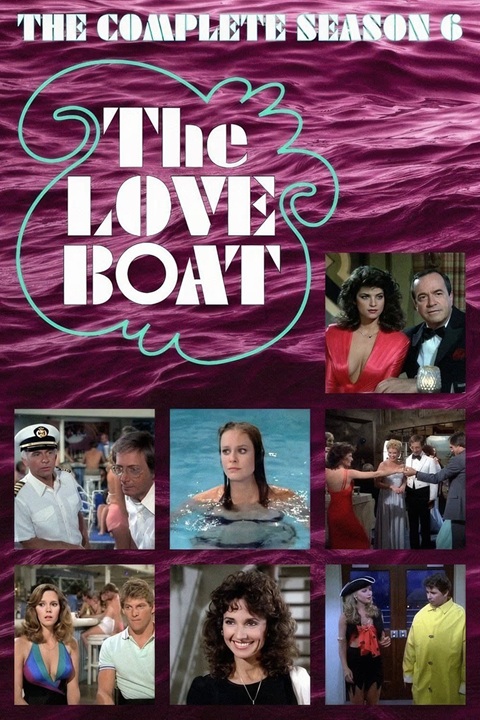
Retro Television Review: The Love Boat 6.25 “The Dog Show: Putting on the Dog/Going to the Dogs/Women’s Best Friend/Whose Dog Is It Anyway?”


Welcome to Retro Television Reviews, a feature where we review some of our favorite and least favorite shows of the past!  On Wednesdays, I will be reviewing the original Love Boat, which aired on ABC from 1977 to 1986!  The series can be streamed on Paramount Plus!

Come abroad, we’re expecting you….

Uhmm, maybe not this week, Love Boat.

Episode 6.25 “The Dog Show: Putting on the Dog/Going to the Dogs/Women’s Best Friend/Whose Dog Is It Anyway?”

(Dir by Bob Sweeney, originally aired on March 26th, 1983)

This week’s episode stressed me out.

The cruise line is co-sponsoring a dog show that is going to be held in Mexico.  The dog that wins will not only receive $10,000 but will also become the new “face” of Honeycutt Dogfood.  All the contestants bring their dogs onboard the ship and take the cruise to Mexico.

Seriously, imagine the scene.  Hundreds of dogs on cruise ship, floating in the pool and running through the passageways — YIKES!  I will admit that the majority of the dogs were cute.  There was a white Samoyed dog named Tundra who was just adorable and who could do all sorts of tricks.  But still, I spent the whole episode wondering what would happen if a dog accidentally jumped (or fell — oh my God!) overboard.  What if one of the dogs had fleas and now, everyone on the boat had them too?  Who was cleaning up after the dogs?  And what about a passenger — like me, for instance — who wasn’t really a dog person and who bought a ticket without the knowledge that the ship itself would be home to hundreds of canines?

The storylines also made me anxious, just because none of them made much sense.  (It was obvious that the main concern for this episode was getting as much cute dog footage as possible.)  So, we had Isaac and Gopher buying Tundra from $8 but not realizing that she was a brilliant dog who could do hundreds of tricks.  Isaac and Gopher sold the dog to the Captain and Vicki, just to then realize that Tundra was a sure winner in the dog show.  Isaac and Gopher tried to convince the Captain to sell the dog back but it turned out the Captain already knew Tundra was a winner.  Of course, as employees of the cruise line, neither Gopher nor Isaac nor Vicky should have been allowed to enter a dog in the show in the first place.

And then we had Isaac’s aunt Tanya (Isabel Sanford) running around with a Chihuahua while her husband (Mel Stewart) got jealous.  And we had Pamela (Catherine Bach) realizing that Gary (Dirk Benedict) was the new owner of a dog that she had lost two years before.  And then there was boozy Mrs. Honeycutt (Jo Anne Worley) boarding the ship and searching for her husband, not realizing that he wouldn’t be arriving until the ship reached Mexico.  For his part, Mr. Honeycutt (Gordon Jump) spent most of this episode in Las Vegas with his secretary.

Finally, Harold Pack (Ray Buktencia), who worked in Honeycutt’s mailroom, boarded the boat with some forms from Mr. Honeycutt and was immediately mistaken for his boss.  Pretending to be Mr. Honeycutt, Harold romanced a dog owner named Wendy (Heather Thomas).  Imagine Wendy’s surprise when she learned Mrs. Honeycutt was on the boat and looking for her husband….

Oh God, I’m getting stressed just writing about all this.

Things worked out in the end.  Mr. Honeycutt, having returned from Vegas, announced that there was a tie and all the dogs were winners!  Harold protected Honeycutt’s secret and got promoted to Vice President.  Pamela and Gary decided to own the dog together.  Vicki got Tundra!  Yay!  I was happy about that.  Tundra was adorable!

This episode was exhausting.  Too many dogs, too many half-baked stories, too much overacting on the part of Isabel Sanford, it was just too much.

Retro Television Reviews: Turn-On 1.2 “Episode Two”


Welcome to Retro Television Reviews, a feature where we review some of our favorite and least favorite shows of the past!  On Thursdays, I will be reviewing Turn-On, which aired on ABC in 1969.  The entire show is currently streaming on YouTube!
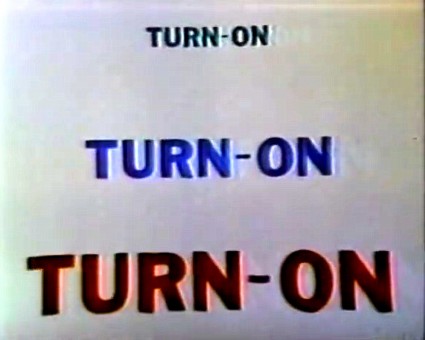
After watching and writing about the only aired episode of this show, I thought I was done with Turn-On.

However, after I published last week’s review, my friend Mark informed me that there was a second episode.  It never aired, even though it was listed in the official schedule before the pilot was so universally despised that ABC announced the show’s cancellation before the episode had even ended.  However, the second episode is available on YouTube and …. well, I am a completist.  As much as that first episode gave me a migraine, I felt an obligation to check out the second episode and see what direction that show would have followed if it hadn’t been abruptly canceled halfway through its premiere.

So, with that in mind, let’s take a look at the second episode of Turn-On!

Episode 1.2 “Episode #2”

(Dir by Mark Warren, unaired, though originally scheduled for Febraury 12th, 1969)

The second episode of Turn-On! opens much like the first.  Two computer technicians sit behind the console that will be programming the next 30 minutes.

One of them asks, “What do you think would happen if (George) Wallace had been elected president?”

“The Mason-Dixon Line would now be the Canadian border,” the other replies.

(The joke’s on him.  The Mason-Dixon line moved up to Boston, even without Wallace in the White House.)

The technician turns a key.  Robert Culp and Mel Stewart appear, standing against a white background.

“Why can’t I ever get the girl?” the black Stewart asks.

“There are some things the public isn’t ready for,” the white Culp replies before running off with a young black woman.

A few second later, Culp reappears, sitting behind an anchor desk and sign that reads, “Register communists, not firearms.”  Culp reads a news story, announcing that a man was shot by a “38 caliber communist.”

“Who knows what evil lurks in the hearts of men?” a voice asks.  “I do,” Theresa Graves replies.

A woman plays a trombone while sitting on artificial turf.  “I play even better on grass,” she says.

An astronaut attempts to enter a toilet stall, just for a voice to say, “I’m sorry, you have reached a disconnected toilet.”

A bunch of Klan members sit in a theater and look bored.

Mel Stewart plays with an abacus.

A man with a waxed mustache says that he just read Lady Chatterley’s Lover.  “I’m going right out to buy a greenhouse.”

Mel Stewart is sworn in as “the first black Justice of the Supreme Court.”  (Uhmm …. hello?  Thurgood Marshall anyone?  He’d been on the Court for two years at this point.)  After administering the oath to Stewart, a judge shakes his hand and says, “Congratulations, boy.”  Stewart does a double-take while silly sound effects play.

A cartoon tank rolls by, with a sign that reads, “Go home, everyone!”

“It’s time to Turn-On!” an old lady on a motorcycle declares.

The man with the mustache introduced tonight’s hosts, Robert Culp and France Nuyen.  Culp and Nuyen toss a bomb back and forth.

Mel Stewart paints a Campbell Soup can but is told by a Renaissance art critic that, “You are too ahead of your time.”

An executive has a tantrum at his desk.

A boss is told that his son has been bothering everyone in the office.  “Boys will be boys!” the boss.  “He’s also asking everyone why we don’t have a union!”  “Get rid of him.”

Mel Stewart appears behind a desk, announcing that you should never put “an unqualified man in office just because he’s black.”

A woman in a tattered dress complains that her detergent is hungry.

A cardboard monk carries a sign that reads, “Sanctify Fanny Hill.”

A policeman announces that muggings are down from last year and that the muggers need to try harder.

The man with the waxed mustache appears in a bridal gown and reads a letter from a woman wanting to know why men have not been molesting her like they have her friends.  “Your time will come,” he says, “Wear a tight sweater and hang out in a seedy neighborhood.”

A cardboard priest carries a sign that reads, “Candid Camera Bugs Confessionals.”

Robert Culp appears as a anchorman and says that the Commission’s Report on Civil Disorders is so shocking that another commission has been appointed.

“Money is the only that means anything you!” a wife yells at her husband, “What about love!?”  “I love money,” he replies.

(At this point, Turn-On‘s humor basically just feels like scrolling a neurotic communist’s twitter timeline.)

A blonde woman (who is introduced as being “The Body Politic”) says that she is forgiving the president.

A Southern gentleman says that “We will oppose integration by burning crosses and all other lawful means.”

Robert Culp plays a doctor who tells Mel Stewart that he’s dying and then gives him a cigarette.

“Does your wife believe in the pill?” a voice asks.  “My kids sure don’t.”

“This little piggy went to market,” a cop says as he plays with a corpse’s toes in a morgue.

A naked man (seen from behind) paints a clothed woman.

A cardboard monk carries a sign that asks us to “Pray for Rosemary’s Clooney.”

Hamilton Camp wears a straight-jacket and announces that all public assemblies have been banned in the name of free speech.

Two Depression-era bank robbers rent a car from Robert Culp.

An old woman cut-out carried a sign that reads, “Get a lot when you’re young,” which really isn’t bad advice, to be honest.

The Body Politic woman says that she’s opposed to “unilateral withdrawal.”

“Due to an oversupply, there’s a shortage!” Hamilton Camp declares.

Robert Culp, as the anchorman, says that the city council had to postpone discussion on absenteeism due to a lack of a quorum.

“I got the job!” Mel Stewart tells France Nuyen.  “I thought they didn’t hire people of your race,” Nuyen replies.  Stewart whispers, “I lied.”

“IBM plays monopoly,” reads the sign being carried by a cardboard cut-out.

A psychiatrist tells his patient that it will cost $500 for him to help her break her dependence on her father.  He suggests that she borrow the money from her father.

And it just keeps going and going.  There’s an extended sequence of people having dumb conversations while facing each other nose-to-nose.  At one point a cardboard cut-out carries a sign that announces, “The Wages of Sin Are $2.00.”

Robert Culp brags about how he cured himself of vanity.

And so it goes until eventually, the computer is turned off and the episode ends.

This unaired episode was actually a slight improvement over the episode that actually did air.  A lot of this is because Robert Culp, with his longish hair and snarky delivery, was a better fit for the show’s sensibility than the more straight-laced Tim Conway.  (Conway often seemed confused by his episode’s humor while Culp, on the other hand, comes across as being someone who appreciated a good “grass” joke.)

At the same time, for all the quick cuts and two-line skits, there was an odd blandness to this episode and one could already see the pitfalls that would have appeared if the show hadn’t been canceled.  For all of the show’s attempts to be hip and unpredictable and random, it ultimately all felt a bit formulaic.  By the end of the second episode, the abrupt cuts to people looking shocked or smiling at the camera felt just as hackneyed as the laugh tracks that appeared on other television shows.  What is shocking once is amusing twice and boring the third time.

Anyway, that’s it for Turn-On!  It’s a show that was definitely a product of its time and, as a history nerd, I appreciate it as a time capsule.  But it’s also easy to see why audiences in 1969 were not exactly turned on by Turn-On.

Next week, we’ll start in on a show that aired more than one episode!


A Cry For Help (1975, directed by Daryl Duke)


Harry Freeman (Robert Culp) is a radio talk show host in California who specializes in abusing his listeners.  They call in and they tell Harry their problems and their opinions and then Harry tells them that they’re stupid and whiny.  Despite (or maybe because of) his abrasive style, Harry is very popular.  Everyone on the California coast listens to him in the morning.

When a depressed teenage girl named Ingrid (Elayne Heilveil) calls his show and says that she’s going to kill herself, Harry doesn’t taker her seriously and tells her to go ahead and do it.  It’s only after he hangs up on her that he realizes that she might have actually been telling the truth.  When Harry calls the cops to tell them about the call, they treat him in much the same way that he treated Ingrid.  They refuse to take him or Ingrid seriously.

Not getting any help from the police, Harry turns to his listeners.  He asks them to help him track down Ingrid and to keep her from harming herself.  The film alternates between scenes of Ingrid meeting people throughout the day and then Harry in his studio, taking calls from those people.  Since Ingrid is no longer listening to Harry’s show, she has no idea that people are looking for her and it becomes a race against time to find her before she carries out her plans.

A Cry For Help is largely a showcase for Robert Culp, a talented actor whose career was often harmed by his own independence and reputation for being abrasive.  That reputation made him the perfect choice to play Harry and Culp gives a terrific performance as a not particularly nice man trying to do the right thing for once.  Interestingly, the film keeps it ambiguous as to whether Harry has really had an attack of conscience or if he’s just trying to save Ingrid for the publicity and the ratings.  Even at the end of the film, it’s hard to know if Harry was really worried about Ingrid ending her life or if he was just looking to promote himself.

Along with Culp, the film’s cast is a who’s who of 70s television actors.  Among those who Ingrid and Harry deal with during the day: Michael Lerner, Bruce Boxlietner, Ken Swofford, Chuck McCann, Julius Harris, and Gordon Jump.  Seeing Jump in the film was especially interesting since he would later star in another production about the potential power of radio, WKRP In Cincinnati.

A Cry For Help is a suspenseful made-for-TV movie from 1975.  It’s never been released on DVD but it is on YouTube.

Film Review: Guns (dir by Andy Sidaris)


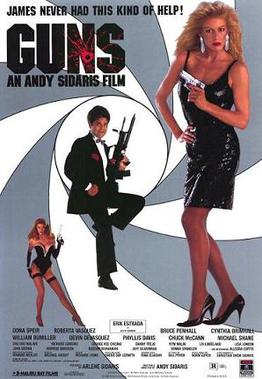
As you can probably tell by looking at the poster at the top of this review, the 1990 film Guns was Andy Sidaris’s attempt to make a Bond film.  Not only does the poster feature a man in a tuxedo and two gun-wielding women but the tag line even reads, “James Never Had This Kind of Help!”

(Of course, that’s not really true, as anyone who has seen Dr. No, Goldfinger, The Spy Who Loved Me, or For Your Eyes Only can tell you.)

Much like a Bond film, Guns features a secret agent fighting to defeat an international conspiracy.  The agent’s efforts lead her and her allies to several different cities in several different … well, really only one country.  Being a Sidaris film, it’s doubtful the Guns really had the budget to film anyplace other than the United States but still, the action does move from Lake Huvasa, Arizona to Hawaii to Las Vegas.  That’s about as close as a Sidaris film ever gets to featuring exotic locations.

(If Lake Havusa sounds familiar, that’s because Jimmy Kimmel gave away at trip to Lake Havusa during the Oscars.)

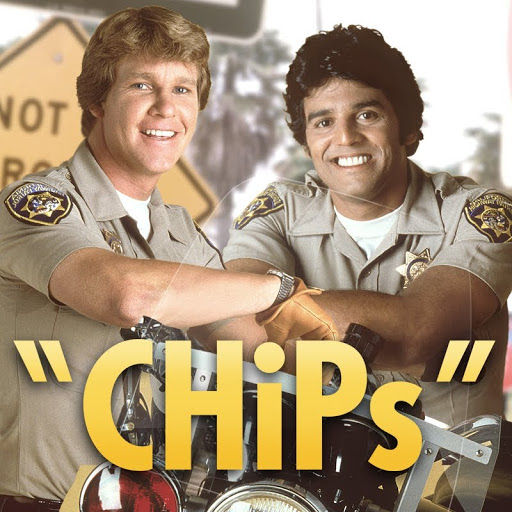
And like any good Bond film, Guns has a flamboyant and almost comically evil villain.  Juan “Jack of Diamonds” Degas (telenovela star and future reality tv mainstay Erik Estrada) is an international gun dealer and an all-around sociopath.  He’s the type who shoots someone and then smirks about it.  He’s so evil that he’s even got Danny Tejo working as his main henchman!  That’s really evil!  Estrada gives a surprisingly good performance in the role.  Especially when compared to the forgettable villains who appeared in Sidaris’s previous films, Juan Degas feels like a worthy opponent.  It’s not just that he’s evil.  It’s that he’s so damn smug about it.  You can’t wait to see him get taken down.

Degas is planning on smuggling a bunch of Chinese weapons into America through a base on Hawaii.  The only problem is that Donna (Dona Speir) and her new partner, Nicole Justin (Roberta Vasquez), are based in Hawaii!  Degas knows that he has to get rid of them if he’s going to have any hope of succeeding.  (For whatever reason, it never occurs to Degas to smuggle the weapons through Guam or American Samoa. I mean, there are other islands out there.)  When Degas sends two cross-dressing assassins to kill Nicole, they end up not only shooting the wrong woman but also killing a friend of Dona’s as well.

Now, it’s personal!

Except, it was already personal.  In a typical example of Sidaris’s make-it-up-as-you-go-along style of  plotting, it turns out that Degas previously killed Donna’s father.  And now, it appears that it might get even more personal because Degas has kidnapped the Attorney General of Nevada, who happens to be Donna’s mother!

Obviously, this means that it’s time to gather together another group of misfit agents and take down the bad guys.  That means that Savage Beach‘s Shane Abilene (Michael J. Shane) and Bruce Christian (Bruce Penhall) both show up again.  It also means that a lovable magician named Abe (Chuck McCann) gets to help out as well.  Unfortunately, one member of the team is eventually blown up by a remote control boat.

That’s right!  A remote control boat!  For some reason, remote control vehicles were a Sidaris obsession and it’s not a Sidaris film without someone getting blown by either a remote control boat or helicopter.

Anyway, there’s a lot of explosions to be found in Guns but the good thing is that it’s women blowing stuff up and it’s women who are in charge of the entire operation.  That’s the thing with a Sidaris film like this one.  For all of the nudity and the double entendre-filled dialogue, Guns was an action film where women got to shoot the guns, beat up the bad guys, and ultimately save the world from a smirking misogynist.  When Donna picked up that rocket launcher, it was both ludicrous and empowering at the same time.

Guns is one of Sidaris’s better films.  For once, despite all of the usual Sidaris red herrings, the plot can actually be followed and Estrada is an appropriately hissable villain.  While the film may not be able to compete with the best of the Bond films, it’s still more fun that SPECTRE.

A Movie A Day #256: Thrashin’ (1986, directed by David Winters)


Cory Webster (a young Josh Brolin, who looks identical to older Josh Brolin) is an amateur skateboarder from the Valley who hopes to win a downhill competition and score some sweet corporate sponsorship.  Chrissy (Pamela Gidley) is an innocent blonde from Indiana who is staying with her brother in Venice Beach.  Cory and Chrissy are in love but there is only one problem.  Chrissy’s brother is Tommy Hook (Robert Rusler), leader of The Daggers, a punk skateboard gang.  There’s no way Hook is going to let his sister go out with someone from the Valley.
Thrashin’ has a plot but it’s just an excuse for almost nonstop, kinetic skateboarding action.  The film is justly famous for the jousting scene, where Cory and Hook battle in Bronson Canyon, seeing who can knock who off his board.  Attentive viewers will be able to spot skateboard greats Tony Alva, Tony Hawk, Christian Hosoi, and Steve Caballero in the cast.  Fortunately, Gator Rogowski is nowhere to be found.

Best of all, Thrashin‘ features an early performance from Sherilyn Fenn!  She plays Hook’s girlfriend and, though her role may be small, it is easy to see the spark that would make her the breakout star of Twin Peaks.  At the time that she made Thrashin’, Fenn was dating a young actor named Johnny Depp.  The film’s director, David Winters, hoped to cast Depp in the lead role but the producers insisted on Brolin, who does a good job even if he never looks completely comfortable on a board.

With its minimal plot and threadbare character development, Thrashin‘ is dumb but legendary, a film that embodies an era.  It also has a killer soundtrack.  Keep an eye out for an early version of Red Hot Chili Peppers, performing Black-Eyed Blonde in a club scene.

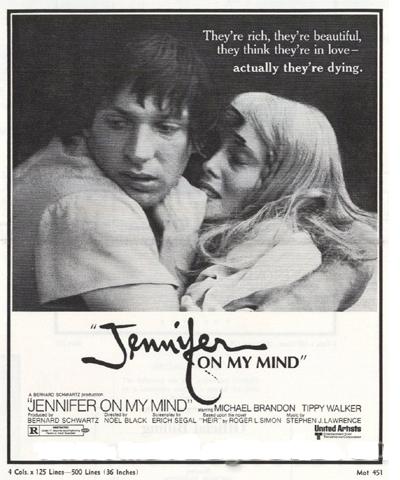
Embracing the Melodrama Part II #37: Jennifer on My Mind (dir by Noel Black)


jommThe 1971 film Jennifer On My Mind opens with a lengthy montage of black-and-white photographs of immigrants arriving at Ellis Island.  These, the film tells us, are the men and women who came to America with nothing and who fought and struggled to have something.  The film itself deals with the grandchildren of those immigrants, who, as opposed to their ancestors, now have everything and who seem to be determined to reduce it all down to nothing.

24 year-old Marcus Rottner (Michael Brandon) would appear to have everything.  Following the death of his father, Marcus has inherited the fortune that his immigrant grandfather earned.  (The ghost of his grandfather shows up at one point and smokes a joint.)  Marcus will never have to work a day in his life, owns a nice apartment, and can go to Europe whenever he feels like it.  However, Marcus does have one problem: his girlfriend Jennifer (Tally Walker) just died of a heroin overdose in his living room.  Now, Marcus has to try to dispose of the body without anyone discovering what has happened.

The film alternates between showing Marcus’s attempts to get ride of Jennifer’s body and flashbacks to his romance with her.  We see how he first met Jennifer in Venice and how he fell in love with her.  Like Marcus, Jennifer comes from a rich family.  Her parents are alive but we never see them.  (Reportedly, scenes were filmed that featured Kim Hunter as Jennifer’s mother but they were cut after a disastrous preview.)  As she leaves Venice, Jennifer tells Marcus to visit her back in the states.

Which is just what Marcus does.  Marcus and Jennifer’s relationship plays out like a romantic comedy, except for the fact that Jennifer doesn’t really seem to care that much for Marcus.  After Jennifer jumps off a roof, Marcus takes her back to Venice and tries to recreate their earlier romance.  However, Jennifer just wants to go back to New York…

About ten minutes into the film, I nearly stopped watching Jennifer On My Mind.  Both Marcus and Jennifer seemed like such unlikable characters that I couldn’t imagine spending a full 90 minutes with them.  The fact that they were both rich and spoiled didn’t help.

But I kept watching because the first part of the film was set in Venice and I love Venice!  Watching those scenes reminded me of visiting Italy the summer after I graduated from high school.  It was a great time and, despite how I felt about Marcus and Jennifer, the film still brought back some nice memories.

However, then Marcus and Jennifer returned to New York and, since I don’t really care about New York the way that I care about Venice, I again found myself tempted to stop watching.  However, it was around this time that I started to realize that Michael Brandon was actually giving a pretty good performance in the role of Marcus.  So, I decided to keep giving the film a chance.

And then the ghost of Marcus’s grandfather showed up.  And then, the film gave us a scene of Jennifer hanging out with the two traveling “minstrels.”  And I thought to myself, “This is getting unbearably cutesy…”

But then, Robert De Niro showed up!  That’s right — Jennifer On My Mind is an early De Niro movie.  When Marcus hails a cab and asks for a ride to Long Island, the taxi driver is played by none other than Robert De Niro.  And while De Niro is only in the film for a few minutes, he totally steals those few minutes.  He plays a “gypsy” cab driver in this film and, as he drives Marcus to Long Island, he rambles about his sister, his drugs, and his fear of driving Marcus to see a bunch of “squares.”  De Niro is such an eccentric and energetic presence that he brings the whole film to life.

After De Niro’s scene, there was only 30 minutes left in the film and I thought to myself, “Okay, I can give this another 30 minutes…”

Written by Love Story‘s Erich Segal and directed by Pretty Poison‘s Noel Black, Jennifer On My Mind is an uneven but oddly watchable film.  If you’re looking for quirky love story … well, I really can’t recommend Jennifer On My Mind because it never really convinces you that Marcus and Jennifer are in love.  For the most part, their relationship seems to be one of convenience.  Jennifer wants drugs and Marcus can afford them.  Marcus wants a girlfriend and Jennifer is willing to pretend.  Instead, Jennifer On My Mind is more like a parody of true romance.  Marcus spends the entire film wanting Jennifer’s body and now that he has it, he has to find a way to get rid of it.

It’s undeniably uneven; for every scene that works, there’s another one that doesn’t.  But, at the same time, it’s undeniably watchable.  Plus, you get an early performance from Robert De Niro!

Jennifer On My Mind is currently available to viewed on Netflix.