Brad’s reflections on STAND BY ME (1986), directed by Rob Reiner!


“I was twelve going on thirteen the first time I saw a dead human being.”

These are the first words spoken in director Rob Reiner’s classic coming of age film, STAND BY ME, which received its widespread theatrical release in the United States on August 22nd, 1986. Actor Richard Dreyfuss spoke words that gave an exact description of my own age in the summer of 1986 when the film was released, and I certainly felt a connection to the characters in Reiner’s film. I watched STAND BY ME many times as a teenager, and with a humble and hurting heart, I decided to watch it again last night. On its surface, it’s a pretty simple story… 

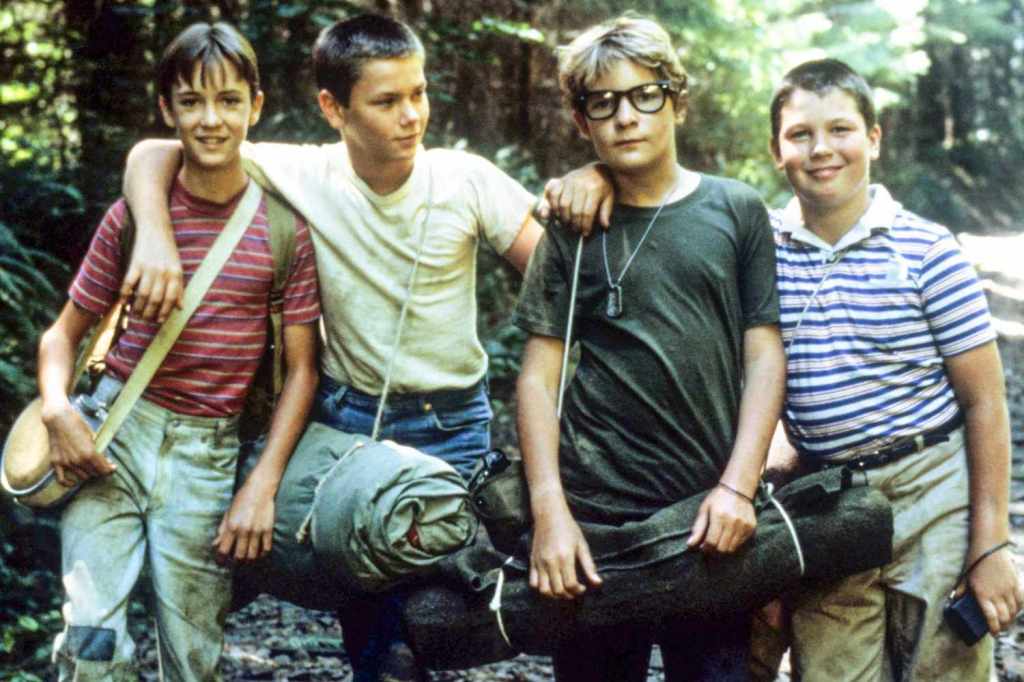
After accidentally learning of the location of the body of a local boy who’s been missing for several days, four boys (played by Wil Wheaton, River Phoenix, Corey Feldman, and Jerry O’Connell) set off on a weekend adventure to find the body in hopes of becoming local heroes. Along the way, they dodge trains, get sucked on by leeches, tell gross-out stories around a campfire, tackle traumatic personal issues, and eventually stand up to a group of older bullies (led by Kiefer Sutherland)! When the weekend is over, they move on with their own lives, lives that are never quite the same again.                   

The main reason I have a real personal connection to STAND BY ME is the fact that I recognize myself and some of my friends in its young characters. I grew up in a very small rural community in Arkansas called Toad Suck. It wasn’t even a town; it was more of just a spot in the road where a few homes built up near a dam and bridge on the Arkansas River. Often when I’d spend the night with my best friend, we’d go walking down the railroad track that ran through our community, carrying our BB guns and hanging out on the railroad bridges where we could take aim at rocks, sticks, turtles, and, at times, the dreaded water mocassin! Like the boys in the movie, we’d always have to be on the lookout for the oncoming trains. As a very naïve and sheltered kid of the mid-80’s who was raised in a strict religious household, I tended to be somewhat judgmental. STAND BY ME forced me to think deeper thoughts and try to find a more mature empathy for those kids I hung out with and saw at school every day. While none of the characters in the film are an exact replica of me or my friends, we knew of people who were probably experiencing abuse, who were looked down upon as “less than,” and who were neglected by their parents. And I think we have all experienced times when we felt insecure, lacked confidence, or were afraid and didn’t have the maturity to handle it in a positive manner. I felt compassion for these characters, which in turn helped me feel more understanding towards those around me in my real life! As a filmmaker in complete control of his craft, Rob Reiner made a movie that even affected someone like me, and I’ve never forgotten those feelings. 

My feeling of kinship with the actors who played in STAND BY ME didn’t end when the movie ended either. Wil Wheaton, River Phoenix, Corey Feldman and Jerry O’Connell were all very close to my age when they filmed the movie, and I’ve followed each of their careers fairly closely my entire life. My two favorites were River Phoenix and Corey Feldman. It was painful to me when River Phoenix died in 1993 at just 23 years of age. I remember all the issues Corey Feldman had with drug addiction. I’m so glad that he’s been able to overcome that addiction and achieve sobriety for multiple decades. I’m not a Star Trek completist, but I always got a kick out of seeing Wil Wheaton on THE BIG BANG THEORY. And then Jerry O’Connell definitely lost his baby fat and has gone on to a solid acting career! The common thread, of course, is the fact that Reiner got great performances from each of these young actors in STAND BY ME. Combine those performances with the quality of the film and the time in my own life when the film came out, and you can start to get the idea of why the film has a position of reverence in my life. You can also see why I have such respect for Rob Reiner as a filmmaker. 

Overall, STAND BY ME is simply one of my favorite films of all time. It has some of the most memorable on-screen moments of my childhood. The pie eating barf-o-rama and the crotch leeches are scenes that are burned into my psyche. Along with the great cast of boys, Kiefer Sutherland gives one of his solid, bully performances in an 80’s film. Sutherland would go on later in his career and play one of my all-time favorite TV characters, Jack Bauer, in 24. More important than all of that, though, is the fact that the coming-of-age film STAND BY ME helped 12-13 year-old me grow up a little bit myself by making me feel something. I guess the greatest compliment you can give any director is to tell them that their film made you think about things more important than yourself and made a difference in your own life. Today, I pay you that great compliment and say Rest in Peace, Mr. Reiner! 

Brad reviews BREAKING IN (1989), starring Burt Reynolds!


BREAKING IN (1989) opens with veteran safecracker Ernie Mullins (Burt Reynolds) pulling a job at a rich guy’s house, only to be surprised when a young, amateurish thief named Mike (Casey Siemaszko) turns up at the same place to raid the fridge. Immediately taking a liking to the kid, Ernie decides to offer Mike a chance to learn his trade. Thus begins a partnership, and odd-couple friendship, where the two men pull a series of jobs together, with Ernie passing on his knowledge to his young protege who seems to be enjoying the sudden influx of cash into this life. Unfortunately, the generation gap causes some problems as Mike doesn’t necessarily take heed to Ernie’s advice to never being too greedy or flashy. Soon, Mike is renting high rise apartments and buying fancy cars with cash. When they pull a big job on the 4th of July, will Mike’s less than frugal ways drag them both down?!

Written by the excellent, independent writer and director John Sayles (MATEWAN, EIGHT MEN OUT) and directed by Scottish director Bill Forsyth (LOCAL HERO), BREAKING IN is a reminder of just how great Burt Reynolds is in the right role. In his 50’s at the time this was filmed, Reynolds gives a relaxed, lived-in, character performance that comes across as effortlessly cool, and he does it without having to rely on his trademark charm and big grin. The late 80’s were a time when Burt was no longer a box office superstar, and BREAKING IN seems to be an unjustly forgotten entry in his hugely successful career. After this, Burt would find TV success on EVENING SHADE, and he’d be nominated for an Oscar for his role in BOOGIE NIGHTS (1997), but his Ernie Mullins stands out to me as one of his last great film roles. Casey Siemaszko is good as Mike, but this is Reynolds’ show and he’s overshadowed even in a solid performance. As far as the other supporting performances, Sheila Kelley stood out to me as a sharp-tongued prostitute who Siemaszko falls in lust with. The poem she shares about a man’s “balls” is a highlight of the film as far as I’m concerned, and further illustrates the quality of Sayles’ screenplay!

I like the way that BREAKING IN feels low-key, even as the characters engage in their various criminal heists. This can be credited to director Bill Forsyth who turns what could have been a standard master / apprentice crime film into something that feels somewhat realistic. The pacing is slow as Reynolds passes on his knowledge, and for some people it may be too slow, but that’s one of the things I really liked about the movie. The two men really get to know each other. That way, when they have disagreements and blow ups a couple of times, they’re still able to respect each other and patch things up. That’s how things are in the real world, as opposed to most movies where a simple disagreement will almost certainly lead to ridiculous consequences. BREAKING IN respects its characters in a way that’s unique to most crime films. 

At the end of the day, BREAKING IN is a gem that is at its best as a lighthearted character study of a professional thief whose time is passing him by. Burt Reynolds rarely got to play roles this subtle, and I think he made the most of the opportunity. As a big fan of Reynolds, I highly recommend this one. 

October True Crime: The Chase (dir by Paul Wendkos)


When he died in 1988, Phillip Hutchinson was only 24 years old.

Born in Virginia, Phillip Hutchinson served in the U.S. Marines before he was discharged for desertion.  He went on to become a career criminal and a violent one at that.  By the time he was 24, he already had a long criminal record.  In Texas, he was convicted of aggravated assault and ended up with a life sentence.  He escaped from prison by stealing a truck.  (It was his third escape attempt.)  Fleeing Texas, he eventually ended up in Denver.  He is alleged to have robbed four banks in Denver before holding up the Rio Grande Operating Credit Union.  The 18 year-old teller was able to set off a silent alarm and Hutchinson ended up leading police on a chase through Denver.  Following Hutchinson in the air was a news helicopter.  At one point, Hutchinson crashed into an unmarked police car, killing Detective Bob Wallis.

After crashing his own car, Hutchinson continued to run on foot.  Eventually, he reached a trailer park.  He took John Laurienti as a hostage and forced the 73 year-old man to drive him past the police in his pick-up truck.  When the men in the news helicopter realized that the police didn’t realize that Hutchinson was in the truck, they dived down and blocked the truck from moving forward.  The cops, realizing their mistake, surrounded the truck and opened fire, killing Hutchinson while the cameraman in the helicopter continued to film.  John Laurienti escaped from the truck, uninjured.

Phillip Hutchinson really had no one but himself to be blame.  If he hadn’t robbed the credit union, he would have had the cops chasing him to begin with.  If he hadn’t rammed into the unmarked car and killed Bob Wallis, it’s possible that the police would have been more willing to negotiate before opening fire on him.  You can wonder what led to someone, by the age of 24, becoming a hardened criminal and that is something that should always be investigated.  In the end, actions do have consequences.

Phillip Hutchinson is one of those criminals who would probably be forgotten today if not for the fact that his death was not only captured on camera but also broadcast across the television airwaves.  Hutchinson has gone on to have a significant afterlife in various “documentaries.”  Remember World’s Wildest Police Videos?  (I’ve also read that the shoot-out is a popular video on various “forbidden” and “dark” websites but I’m not going to look to find out.)

1991’s The Chase was a made-for-television movie about Phillip Hutchinson and his final ride.  Casey Siemaszko plays Phillip Hutchinson as being a psycho redneck, which is probably not the far from the truth.  Siemaszko gives a good performance as Hutchinson but the majority of the film deals with the people who came into contact with Hutchinson on the final day of his life.  Ricki Lake plays the teller who set off the silent alarm.  Ben Johnson gives a moving performance as the old man who Hutchinson took hostage.  Barry Corbin plays Bob Wallis.  Megan Follows plays a drug addict who narrowly escapes Hutchinson.  Robert Beltran plays the man in the helicopter.  They all give good performances.  At the same time, for a film called The Chase, the Chase itself doesn’t actually start until we’re 70 minutes into the movie and it’s over pretty quickly.  If you’re watching this film for the action, you’ll probably be disappointed.

This film was written by Guerdon Trueblood, who also directed one of my favorite grindhouse films, The Candy Snatchers.  Trueblood’s script follows the standard disaster formula, in that there are a lot of subplots and filler leading up to the big event.  In other words, The Chase isn’t a film for everyone.  I’ll admit, though, that I teared up a little at the end.  Phillip Hutchinson may have been a violent criminal but his death brought a community together.

#MondayMuggers presents YOUNG GUNS (1988) starring Emilio Etevez, Kiefer Sutherland, Lou Diamond Phillips, and Charlie Sheen!


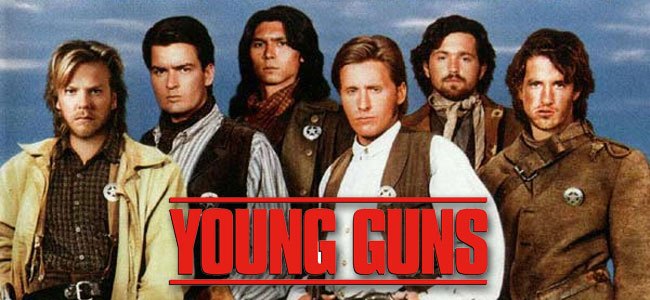
Every Monday night at 9:00 Central Time, my wife Sierra and I host a “Live Movie Tweet” event on X using the hashtag #MondayMuggers. We rotate movie picks each week, and our tastes are quite different. Tonight, Monday May 19th, we are showing YOUNG GUNS (1988) starring Emilio Estevez, Kiefer Sutherland, Lou Diamond Phillips, Charlie Sheen, Dermot Mulroney, Casey Siemaszko, Terence Stamp, Jack Palance, Terry O’Quinn, Brian Keith, and Patrick Wayne.

This movie focuses on a group of young gunmen, led by Billy the Kid (Emilio Estevez), who become deputies to avenge the murder of John Tunstall (Terence Stamp), the rancher who took them in, gave them jobs, and taught them how to read. But when Billy takes their authority too far, they soon find themselves to be the outlaws and the ones being hunted down.

Join us tonight for #MondayMuggers and watch the extremely fun YOUNG GUNS! It’s on Amazon Prime. The trailer is included below:

Film Review: Public Enemies (dir by Michael Mann)


2009’s Public Enemies is a portrait of the battle for the soul and imagination of America.

The films take place during the Great Depression.  With Americans struggling to pay their bills and many citizens out-of-work and feeling desperate, a new breed of folk hero has emerged.  Men like my distant relative Pretty Boy Floyd (Channing Tatum) and Alvin Karpis (Giovanni Ribisi) may be criminals who make their living by robbing banks but, to a nation of angry people who feel like they’ve been forgotten by the government and betrayed by the wealthy, they’re rebels who are challenging the system.  They are viewed as being modern-day Robin Hoods, even though very few of them actually bother to give the money that they steal back to the poor.

John Dillinger (Johnny Depp) is perhaps the most famous of the criminals who have been declared a “public enemy” by the FBI.  The handsome and charismatic Dillinger becomes almost a living legend, the man who cannot be captured by law enforcement.  He becomes a folk hero but with the twist that his own death seems inevitable.  Dillinger lives by his own set of rules and the press loves him even as they hungrily anticipate his violent end.

Pursuing Dillinger and the other so-called public enemies is a young FBI agent named Melvin Purvis (Christian Bale).  Purvis’s job is not only to capture or eliminate men like Dillinger.  It’s also to somehow figure out a way to replace them in the public’s imagination.  Through the use of what was then-considered to be revolutionary techniques (like fingerprinting and phone taps), Purvis tracks down one public enemy after another and soon, he’s becoming as much of a folk hero as the people that he’s pursuing.  If Dillinger and his cohorts represent the ultimate rebellion against an ineffectual system, Purvis and his success suggest that maybe the system actually can get something accomplished.  Unfortunately, for Purvis, he not only has to deal with the challenge of capturing Dillinger but also with the growing jealousy of his publicity-hungry boss, J. Edgar Hoover (Billy Crudup).  As is typical of the heroes of Michael Mann’s film, Dillinger and Purvis may be on different sides of the law but they have more in common than they realize.  Neither one can trust the people that they’re working with.

I remember that I was really excited about Public Enemies when it was first released in 2009.  I’m fascinated by the Depression-era outlaws and Dillinger’s story is certainly an interesting one.  (I’ve always enjoyed the theory that Dillinger faked his death, even though I don’t believe it for a second.)  Michael Mann seemed like the perfect director for the material and Johnny Depp seemed like ideal casting.  I have to admit that I was a little bit disappointed in the film itself, which was poorly paced and stuck so closely to the facts of the case that it led me to realize that Dillinger will always be more interesting as a legend than an actual person.  (I’ll concede that was probably the film’s point.)  There were moments of brilliance in the film.  The scene where Dillinger escaped from custody was wonderfully done.  Stephen Graham’s unhinged performance as Baby Face Nelson was excellent.  Johnny Depp had the right look for Dillinger but I have to admit that I found myself a little bit bored with Christian Bale’s Melvin Purvis.

Looking back today, though, the film feels almost prophetic.  That may seem like an odd thing to say about a film set in the past but Public Enemies portrait of an America caught between celebrating the rule of law and the excitement of rebellion feels very relevant to what’s happening today.  In retrospect, Public Enemies is a portrait of the contradiction at the heart of America, a country with a culture of both rebellion and loyal patriotism.  Public Enemies portrays a battle the continues to this day.

Public Enemies (2009, dir by Michael Mann, DP: Dante Spinotti)

Back to School Part II #22: Three O’Clock High (dir by Phil Joanou)


Three_o_clock_high_p

For the next entry in my back to school series of reviews, I want to say a few words about the 1987 comedy, Three O’Clock High.

I have no idea how Three O’Clock High did when it was originally released into theaters.  I know, I know — I could just look it up on Wikipedia or the imdb but I’m lazy and, besides, I hate that whole idea that box office success is somehow synonymous with quality.  That said, Three O’Clock High is one of those films that seems to be in a permanent cable rotation (seriously, it always seems to be playing somewhere and there’s always a few people on twitter talking about how excited they are about coming across it) and I kind of hope that it did well when it was originally released.  It’s an entertaining and genuinely funny little high school comedy.

Three O’Clock High tells the story of Jerry (Casey Siemaszko).  Jerry is a high school student, one of those kids who is a bit anonymous.  He’s kind of a nerd but so much of a nerd that he painfully sticks out of the crowd at this school.

You know who does stick out of the crowd?  Buddy Revell (Richard Tyson).  Buddy is the new kid at school.  He’s a big, hulking, and rather intimidating figure and he comes with quite a fearsome repuations.  All anyone can talk about are the stories that they’ve heard about Buddy’s dangerous past.  The one thing that the rumors all have in common is that Buddy does not like to be touched.  In fact, it appears that his aversion to being touched has made him the most dangerous high school student in the country.

The first hour of Jerry’s school day is spent working at the school newspaper and, of course, his teacher has a bright idea.  Why not welcome Buddy to the school by interviewing him!?  Sure, why not!?  Everyone loves to be interviewed!  And why not get Jerry to do the interview?

The problem is that Buddy doesn’t want to be interviewed.  And, once he realizes that Buddy not only doesn’t want to talk to him but is actually getting rather annoyed with him (this may be because Jerry chooses to approach Buddy in the boy’s bathroom), Jerry asks Buddy to forget that he even bothered him and then reaches over and punches him on the arm.

Of course, this leads to Buddy announcing that he and Jerry are going to have a fight.  At 3 pm.  In the school parking lot…

The rest of the film plays out like a surrealistic, teen-centered parody of High Noon, with Jerry desperately trying to figure out a way to avoid the fight.  He tries to frame Buddy by placing a switchblade in his locker, just to have Buddy use the knife to disable his car, effectively trapping Jerry at the school.  He tries to help Buddy cheat on a test.  He tries to get the principal to kick him out of school.  He even tries bribery!

But ultimately, three o’clock arrives and Jerry must face his destiny…

Three O’Clock High is cheerfully cartoonish and rather entertaining little film.  Director Phil Joanou pays homage to a countless number of other films, often framing the high school action like a Spaghetti western stand-off and, when the final fight arrives, it’s just as wonderfully over-the-top and silly as you could hope for.  Casey Siemaszko, who was also in Secret Admirer, is perfectly cast as Jerry and Richard Tyson is both funny and intimidating as Buddy.  Meanwhile, ineffectual adults are played by everyone from Philip Baker Hall to Jeffrey Tambor to Mitch Pileggi.  There’s a not a subtle moment to be found in Three O’Clock High but the relentless stylization definitely works to the film’s advantage.

I’d keep an eye out for the next time that Three O’Clock High shows up on Showtime.  It’s an entertaining film about teens doing what teens have to do.

Back to School Part II #20: Secret Admirer (dir by David Greenwalt)


Secret_admirer

After I finished watching Girls Just Want To Have Fun, it was time for the 1986 film, Secret Admirer!

Secret Admirer is a fairly good example of a film that is dependent upon the idiot plot.  Every plot complication could have been avoided by the characters not being idiots.  The entire storyline could have been resolved within five minutes if some of the characters had been willing to ask questions before jumping to assumptions.  Idiot plots tend to fun when they deal with teenagers, largely because, when you’re that age, you can get away with being an idiot.  That’s part of the charm of being a teenager and why nobody ever wants to grow up.  When you’re a teenager, you’re not expected to have any common sense or knowledge of the real world so you can get away with a lot more.  At the same time, idiot plots involving adults tend to be annoying because adults really should know better.  The idiot plot of Secret Admirer involves both teenagers and adults and, as a result, the film is half-charming and half-annoying.

Smart but shy Toni (Lori Loughlin) has a crush on her lifelong friend, the sweet but kinda stupid Michael (C. Thomas Howell).  So, Toni writes Michael an incredibly eloquent love note and slips it into his locker.  When Michael finds the note, he assumes that it was written by Debbie (Kelly Preston), who is pretty and popular but only dates college students.  When Michael attempts to write a response to Debbie, he is sabotaged by his limited vocabulary, lack of eloquence, and general dimness.  Luckily, Toni finds the note and, wanting to spare Michael any embarrassment, rewrites it for him.  Debbie is so touched by Toni’s note that she goes out on a date with Michael.  Toni is forced to stand in the background and watch while the boy she loves falls for a girl who is obsessed with shopping.  (Secret Admirer suggests that this obsession indicates that Debbie is shallow but seriously, who doesn’t love to shop?)  Will Toni tells Michael that she loves him or will she leave him so that she can spend a year studying abroad?  (Personally, I would leave and have fun exploring Europe but then again, I also love to shop so obviously, Toni and I have conflicting worldviews.)

But that’s not all!  Michael’s dad, George (Cliff DeYoung), also finds the note and assumes that it was written to him by Debbie’s mom, Elizabeth (Leigh Taylor-Young).  Of course, Debbie’s father, a police detective named Lou (the always gruff Fred Ward), also comes across the note and becomes convinced that George and Elizabeth are having an affair.  He somewhat forcibly recruits George’s wife, Connie (Dee Wallace Stone), to help him expose George and Elizabeth for being the cheaters that he believes them to be….

I got annoyed with the parents fairly quickly.  It’s always fun to watch Fred Ward grimace and glare at people but otherwise, all of the adults were way too stupid and their behavior reminded me of that terrible episode of Saved By The Bell where the exact same thing happens to Mr. Belding.  Secret Admirer works best when the adults are pushed to the background and the film concentrates on the relationship between Toni and Michael.  They’re a sweet couple and you really want to see them end up together.  Michael may be stupid but he’s still really cute and the film is perfectly charming whenever it concentrates on him and Toni.

Incidentally, Michael has several friends.  They all ride around in a van and look through old issues of Playboy together.  Most of the friends are interchangeable but I did like Ricardo (Geoffrey Blake), just because he was wearing a suit and a fedora for no particular reason.  Ricardo didn’t really get to do much but his fashion sense made a definite impression.

By the admittedly high standards of 80s teen films, Secret Admirer is a minor film.  It’ll never be mistaken for Sixteen Candles or Pretty In Pink.  That said, it’s still an entertaining and occasionally sweet film.  You’ll want to skip over the scenes involving the adults but the scenes involving C. Thomas Howell and Lori Loughlin are perfectly charming.

http://www.youtube.com/watch?v=iFtxW9WNs9k