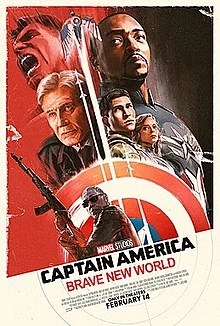
Captain America: Brave New World (dir. by Julius Onah)


Walk into a comic store, and you’ll sometimes find whole collections of comics in one large binder or book. The book that was The Infinity Saga ended with 2019’s Avengers: Endgame and that really should have been the hard stop for Marvel Studios for a while. Still, the Marvel Engine continues to run. Sometimes, we get hits, like 2021’s Shang-Chi and the Legend of the Ten Rings and 2023’s Guardians of the Galaxy, Vol. 3. On occasion, we’ve had that rare film that knocks it out of the park in 2021’s Spider-Man: No Way Home. Mostly, however, we’ve had “okay” stories, like that comic in a pile that you enjoyed reading, but wouldn’t really remember much about it after 15 minutes. These are the ones like Black Widow and Doctor Strange in the Multiverse of Madness (the latter of which I personally hated, despite it being a Raimi film).

I enjoyed Captain America: Brave New World, but the story didn’t feel as expansive as I thought it could be. It still is grounded in the political intrigue of Captain America: The Winter Soldier and Captain America: Civil War, but I felt like it lacked the same kind of weight those previous films did. There are some good fight scenes and even better flight scene thoughout.

Brave New World finds Sam Wilson (Anthony Mackie) doing very well since taking on the mantle of Captain America. Despite not having any powers, he can still handle his own, somewhat. With a suit and new Vibranium wings, compliments of Wakanda, Wilson’s quite a force to be reckoned with, though he still tends to approach certain situations with de-escalation in mind instead of brute force. He also has some help in the form of Joaquin Torres (Danny Ramirez), who has worked with Sam even before using the shield. Mackie carries this easily with the occassional joke or two. It’s also amazing to watch when you know the character isn’t enhanced and is really just one or two good punches away from a broken limb. I see in Sam Wilson a pre-super serum Steve Rogers, fending off enhanced bullies with nothing but a garbage can lid and lots of heart. That’s heroic and perhaps even Worthy, an underdog still fighting the fight (at least to me, anyway). Ramirez’ Torres is the plucky comic relief in all this. Serious when needed, but playful otherwise. His character reminded me a bit of Pablo Schreiber’s one in Michael Bay’s 13 Hours.

The political landscape has also changed since the days of Iron Man 3’s Matthew Ellis (played by William Sadler). General Thaddeus “Thunderbolt” Ross has risen through the ranks to become the President of the United States. Harrison Ford (Clear and Present Danger) takes over the role of Ross from William Hurt (Altered States), who passed away in 2022. At this stage in his career, Ford doesn’t have to do much to be effective in a scene. He’s played political characters in his Tom Clancy / Jack Ryan era, so this isn’t really new to him. His version of Ross still carries the gruff nature that Hurt had, though personally, I don’t feel either performance was as good as Sam Elliot’s in Ang Lee’s Hulk. Ford’s Ross is a man haunted by the disconnection from his family and a reputation he’d rather put behind him. The same can be said for Carl Lumbly’s Isaiah Bradley. As the forgotten Super Soldier, his character is still slowly integrating into public life after a past that left him cautious and weary.

After a successful mission, Wilson, Torres, and Bradley are invited to the White House for a special announcement. The announcement involves the discovery of the “Celestial Island”, the Continent sized remains of Tiamat from The Eternals. Even better, the entire island is made of a material that appears to be stronger than even Vibranium. The metal, dubbed “Adamantium”, causes a race between the Superpowers to acquire it. Thankfully, a treaty formed by Ross helps to keep conflict at bay.

As exciting as it sounds to hear that this particular Universe suddenly (finally!) has Adamantium in it, the announcement is as far as anyone will get to seeing it. Put away any thoughts of seeing Weapon-X plans in Canada. Japan won’t produce a Silver Samurai, and Russia won’t have Omega Red any time soon. That is not this story, and it’s an outright shame that none of that is even hinted to because the only Marvel solid references we have on Mutants to date are from Ms. Marvel at this point. At best, the Adamantium angle serves as a reason to finally include the aftermath of The Eternals into the story and possibly set up something for future films. Why is Marvel so hesitant on touching the X-Men? Ugh, that’s an argument for a different story.

An incident occurs that finds Sam and Joaquin having to exonerate Isaiah Bradley, while at the same time, trying to unravel the mystery involving a terrorist known only as Sidewinder (Giancarlo Esposito, Abigail) that puts both The President and possibly the entire nation in danger. Can Sam and Joaquin take down the Sidewinder and save the day? That is mostly the gist behind Captain America: Brave New World.

Outside of the performances, From a production standpoint, the film had 5 separate screenplay writers and a number of reshoots. It’s not terrible, but the film does feel a little like the writers were unsure of what they wanted to do from scene to scene. There was one shot involving a prison ward that made me wonder why more guards weren’t present. It’s more a nitpick than anything else. I compare it more to Nolan’s editing mistake with The Dark Knight, where the Joker crashes a party, but we never actually see him leave or learn the fates of the people there after Batman saves Rachel. There were also a number of cuts made to the film that removed scenes by actors such as Wrestling’s Seth Rollins and Alita Battle Angel’s Rosa Salazar. You won’t even notice those unless you’re actively expecting to see them in the film (I didn’t know either actor was involved, honestly).

The big showdown that all of the posters couldn’t seem to hide does happen, and the sequence itself is good, given the weaknesses of our heroes and strengths of our villains. It felt a little shorter to me than I expected it to be though it could be on par with the now classic Battle of Harlem in The Incredible Hulk. There was a time where Marvel was able to keep things like this under wraps, but given the state of the MCU and Hollywood in general, I can understand the marketing team’s fight to pull more people into cinemas.

Overall, Captain America: Brave New World is a good popcorn flick. Will you rave about it? Perhaps. Was it fun? Sure. Was it memorable? I’m not totally sure. I enjoyed where the story took me, but my expectations maybe veered to levels that the story couldn’t reach for me. That’s more a “me” problem than a movie problem. Also note that the film does have a Marvel Post-Credit moment. It doesn’t reveal much or anything specific of where the overall arc is reaching. It’s more of a “Captain America Will Return” than anything else, but of course, we all knew that.

Uneasy alliances and surprises unfold in the Captain America: Brave New World teaser!


I stumbled onto this while going through my music playlist on YouTube, and I had to figure out if this was an official teaser or was just a fan-made one. Sure enough, it appears the official teaser for Marvel Studios Captain America: Brave New World is available.

Picking up after the events of The Falcon and The Winter Soldier (or Captain America and The Winter Soldier), the film shows there are numerous changes & surprises afoot. Our long time Hulk adversary, Thaddeus Ross, shaved his mustache and changed his look with Harrison Ford taking over the role from the late William Hurt. It also looks like Isiah Bradley (Carl Lumbly) and Joaquin Torres (Danny Ramirez) have appearances.

Can the New Captain America handle these new threats? What is going on with Isiah? And will we finally get some information on that defeated celestial from The Eternals?

Captain America: Brave New World is set to hit theatres in February 2025.

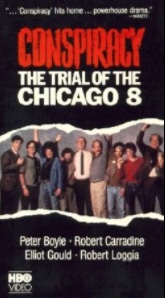
Conspiracy: The Trial of the Chicago 8 (1987, directed by Jeremy Kagan)


The year is 1969 and, in an Illinois courtroom, 8 political radicals stand accused of conspiring to disrupt the 1968 Democratic Convention.  The prosecution is putting the entire anti-war movement on trial while the defendants are determined to disrupt the system, even if it means being convicted.  The eight defendants come from all different sides of the anti-war movement.  Jerry Rubin (Barry Miller) and Abbie Hoffman (Michael Lembeck) represent the intentionally absurd Yippies.  Tom Hayden (Brian Benben) and Rennie Davis (Robert Carradine) are associated with the Students for a Democratic Society.  Bobby Seale (Carl Lumbly) is one of the founders of the Black Panthers while David Dellinger (Peter Boyle) is a longtime peace activist.  John Friones (David Kagan) and Lee Weiner (Robert Fieldsteel) represent the common activists, the people who traveled to Chicago to protest despite not being a leader of any of the various organizations.  Prosecuting  the Chicago 8 are Richard Schulz (David Clennon) and Tom Foran (Harris Yulin).  Defending the 8 are two radical lawyers, Leonard Wienglass (Elliott Gould) and William Kunstler (Robert Loggia).  Presiding over the trial is the fearsome and clearly biased Judge Julius Hoffman (David Opatoshu).

Conspiracy: The Trial of the Chicago 8 is a dramatization of the same story that inspired Aaron Sorkin’s The Trial of the Chicago 7 but, of the two films, it’s Jeremy Kagan’s The Trial of the Chicago 8 that provides a more valuable history lesson.  By setting all of the action in the courtroom and recreating only what was said during the trial, director Jeremy Kagan and his cast avoid the contrived drama that marred so much of Sorkin’s film.  Kagan trusts that the true story is interesting enough to stand on its own.  Kagan includes documentary footage from the convention protest itself and also interviews with the people who were actually there.  While Kagan may not have had the budget that Sorkin did, his film has the authenticity that Sorkin’s lacked.  Kagan also has the better cast, with Michael Lembeck and Barry Miller both making Abbie Hoffman and Jerry Rubin into something more than the mere caricatures that they are often portrayed as being.

The Trial of the Chicago 8 was a film that Jeremy Kagan spent a decade trying to make.  When he first tried to sell the idea behind the film to CBS in 1976, Kagan had Marlon Brando, Walter Matthau, George C. Scott, and Dustin Hoffman all willing to work for scale and take part in the production.  CBS still passed on the project, saying that no one was interested in reliving the 60s.  It wasn’t until 1987 that Jeremy Kagan was finally able to revive the film, this time with HBO.  It actually worked out for the best because, with HBO, there was no need to try to come up with a “clean” version for the language that was used in the courtroom or in the interviews with the actual participants.  The defendants could be themselves.

Though it has been overshadowed by Sorkin’s subsequent film, The Trial of the Chicago 8 is the definitive film about what happened in the aftermath of the the 1968 Democratic Convention.

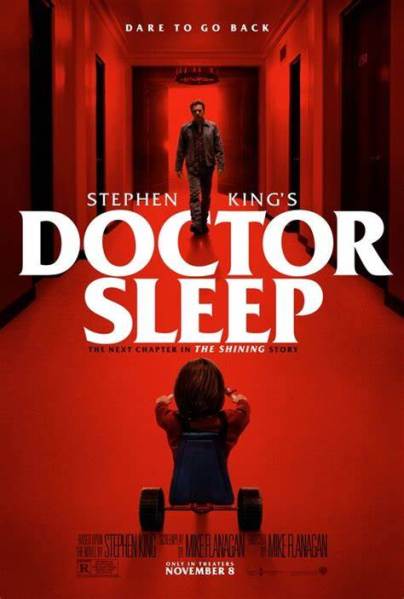
Film Review: Doctor Sleep (Dir. by Mike Flanagan)


If I asked you about Stephen King’s The Shining, would the book or the film come to mind?

DoctorSleepPosterWhen it comes to adapting Stephen King’s stories to film, it’s not an easy feat. King himself had a problem turning his own short story “Trucks” into something good when he directed Maximum Overdrive. For every great film like Stanley Kubrick’s The Shining, or It-Chapter One, we occasionally get a misstep like The Dark Tower or It-Chapter Two.  As King can sometimes get wordy in his books, I’ve felt the best adaptations were the ones where the director’s own vision came into play. Kubrick made a number or changes to King’s story, including the Grady twins and the hedge maze, which were never in the novel. The film is so widely recognized that most people recall events in the movie, rather than the book. That’s the effect Kubrick had. 
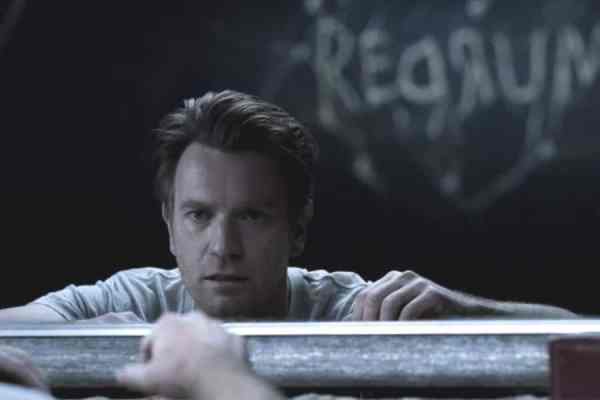
With Doctor Sleep, Mike Flanagan once again proves he’s a fantastic fit for King. The film moves at a great pace, with great performances by Rebecca Ferguson and newcomer Kyliegh Curran. In an age where audiences are typically quiet, the applause that occurred in scenes during last night’s preview screening were great to hear. The film manages to pay homage to Kubrick’s The Shining and King’s Novel of Doctor Sleep while still completely showcasing Flanagan’s vision. Of course, we already knew this from Flanagan taking on King’s own Gerald’s Game and Netflix’s The Haunting of Hill House.  One might even argue that for this film, we may in time recall Flanagan’s tale more clearly than King’s.

Doctor Sleep takes place after the events of The Shining, with Dan Torrance (Ewan McGregor) suffering from the same demons that plagued his father, Jack. Although the keeps to himself, he drinks too much, gets into brawls, and is unable to hold down decent work. Dan is also haunted by the Overlook Hotel, and the power that drew the souls to him known as The Shining. The Shining (or just the Shine) is a coveted power in King’s lore. When a group of nomads that feed on the Shine (in a way that’s reminiscent of Mick Garris’ Sleepwalkers) discover a girl with the same ability, Dan is brought out of hiding. 

Fans of the original Kubrick film will see there’s a lot of love here. You’ll be able to count some of the references to The Shining, from objects in a room to different locales. For casting, Flanagan uses a mixture of old favorites and new faces. You’ll recognize some of them right from the start, such as Bruce Greenwood and Violet McGraw. Others, like Jacob Tremblay (The Predator) are welcome additions. Rather than relying on footage from the original Shining, Flanagan recreates certain elements with new cast members, which I felt worked extremely well here. I’m not sure how others will take it.

Ewan McGregor is good in the role of Dan Torrance, which feels more like his Mark Renton character from Trainspotting than anything else to me.  This isn’t a bad thing, but it works. The film truly belongs to both Rebecca Ferguson (Mission Impossible: Fallout) and Kyliegh Curran. Ferguson’s Rose the Hat is a wicked villain, and she carries the role with a sinister, yet stylish flair. Ferguson has some of the best scenes in the film, particularly when paired with Zahn McClarnon (Midnight, Texas and Westworld), who plays Crow Daddy. Kyliegh Curran chews up the scenes she’s in, easily handling screen time with McGregor and Ferguson like a pro. Rounding out the cast are Cliff Curtis (Sunshine), Carl Lumbly (Mantis) and Emily Alyn Lind (The Babysitter). 

Doctor-Sleep-1

Dan Torrance (Ewan McGregor) can’t run from his past in Mike Flanagan’s Doctor Sleep.

As for the fear factor, there is some terror in the hunt for Abra and the way that the group interact. Doctor Sleep doesn’t have much in the way of jump scares, but makes up for it with some tense moments. I didn’t feel as scared as I did with It-Chapter One, but I cared enough about the characters to worry about how the story was going to turn out. That might be a turn off for those expecting to watch the movie from between their fingers or run out of the theatre screaming. If you enjoyed Flanagan’s other works, such as Hush or Oculus, you’ll be fine.

Speaking of Hush, Doctor Sleep lacks a Kate Siegel cameo. Flanagan is Siegel’s partner in crime (and husband). Together, they’ve been in almost every film they’d done. I’ve gotten used to going “Oh, there’s Kate!”, while watching his films. It’s not an issue at all, but it would’ve been cool to see her.

The camera work for Doctor Sleep is very even, though there are a few special effects scenes that really stand out and picked up some applause (or gasps) once they were over. The one main drawback I had with the film was that it was a little difficult to keep up with all of the locations and time periods early on. Even though everything’s clearly labeled, it took me a moment to recognize just where and when things were occurring. Not a terrible thing, though.

Overall, Doctor Sleep is an easy film to recommend. It has some great performances, and manages to be a great follow up to The Shining, while showing a lot of love for the source material.

Doctor Sleep hits cinemas on Friday, November 8th, and I’ll make a return visit.


A Movie A Day #349: The Bedroom Window (1987, directed by Curtis Hanson)


The Bedroom Window opens with quite a quandary.  Sylvia (Isabelle Huppert) has just witnessed a woman named Denise (Elizabeth McGovern) being attacked by a serial rapist/killer named Carl (Brad Greenquist).  The problem is that the window that Sylvia’s standing at is located in the bedroom of Terry Lambert (Steve Guttenberg).  Sylvia is having an extramarital affair with Terry and she knows that there’s no way to tell the police what she saw without also exposing the affair.  Terry decides that he’ll go to the police and tell them what Sylvia witnessed but he will claim to have seen it himself.
Terry does well enough with the police that Carl gets arrested but, at Carl’s trial, Terry’s testimony falls apart when he is revealed to be so near-sighted that there was no way he could have seen what happened from his bedroom window.  Carl is not only acquitted but has now figured out that Sylvia was the one who witnessed him attacking Denise.  When the killings start up again, Terry becomes the number one suspect.

An underrated and overlooked thriller, The Bedroom Window was directed by the late and missed Curtis Hanson.  It’s not a perfect film.  Terry does an excessive amount of stupid things over the course of the movie.  But Hanson did a good job creating suspense and he got good performances from his entire cast.  Steve Guttenberg may seem like a strange choice to play the lead in a Hitchcockian thriller but he actually gives a credible performance and the fact that he is not a traditional hero creates some suspense.  Brad Greenquist is chilling as the killer and keep an eye out for the great Wallace Shawn in the role of Carl’s weaselly attorney.

A Movie A Day #157: Pacific Heights (1990, directed by John Schlesinger)


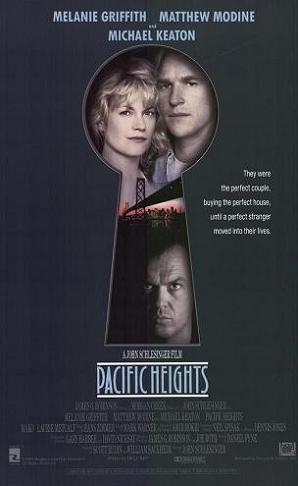
Michael Keaton is the tenant from Hell in Pacific Heights.

In San Francisco, Patty (Melanie Griffith) and Drake (Matthew Modine) have just bought an old and expensive house that they can not really afford.  In order to keep from going broke, they rent out two downstairs apartments.  One apartment is rented by a nice Japanese couple.  The other apartment is rented by Carter Hayes (Michael Keaton).  Carter convinces Patty and Drake not to check his credit by promising to pay the 6 months rent up front.  The money, he tells them, is coming via wire transfer.

The money never arrives but Carter does.  Once he moves into the apartment, Carter changes the locks so that no one but him can get in.  At all hours of the day and night, he can be heard hammering and drilling inside the apartment.  Even worse, he releases cockroaches throughout the building.  When Drake demands that Carter leave, the police back up Carter.  After goading Drake into attacking him, Carter gets a restraining order.  Drake is kicked out of his home, leaving Patty alone with their dangerous tenant.

Pacific Heights is the ultimate upper middle class nightmare: Buy a house that you can not really afford and then end up with a tenant who trashes the place to such an extent that the property value goes down.  As a thriller, Pacific Heights would be better if Drake and Patty weren’t so unlikable.  (When this movie was first made, people like Patty and Drake were known as yuppies.)  Much like Drake’s house, the entire movie is stolen by Michael Keaton’s performance as Carter Hayes.  Carter was not an easy role to play because not only did he have to be so convincingly charming that it was believable that he could rent an apartment just by promising a wire payment but he also had to be so crazy that no one would doubt that he would deliberately infest a house with cockroaches.  Michael Keaton has not played many bad guys in his career but his performance as Carter Hayes knocked it out of the park.

One final note: Keep an eye out for former Hitchcock muse (and Melanie Griffith’s mother) Tippi Hedren, playing another one of Carter’s potential victims.  Her cameo here is better than her cameo in In The Cold of the Night.