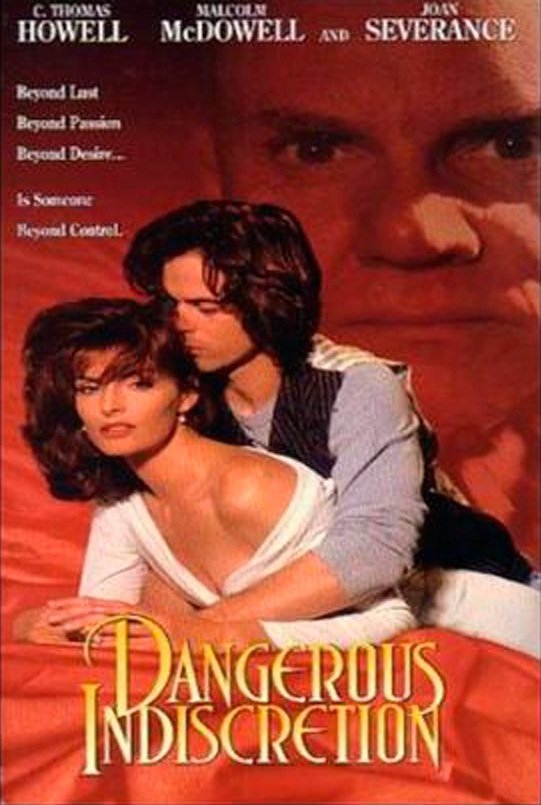
Jim Lomax (C. Thomas Howell) is an up-and-coming advertising executive who, one night, picks up the sultry Caroline Everett (Joan Severance) in a grocery store. What starts out as a one night stand between two attractive people who both buy their own groceries turns into a full-fledged affair with Caroline asking Jim, “Who are you?” after they sleep together and Jim struggling to define his own identity.
Unfortunately, Caroline is married to Roger Everett (Malcolm McDowell), a wealthy and ruthless businessmen who likes to quote the Art of War. Unlike Jim, Roger knows who he is and what he believes. He’s an evil businessman who enjoys destroying other people and who gets a kick out of fooling the world into thinking that he’s actually a compassionate philanthropist. When Roger finds out that Caroline has been cheating on him, he sets out to destroy both her and Jim. Because Roger is an arrogant bastard, he not only plots to ruin Jim’s life but he brags about it too. He tells Jim that he’s going to make his life unbearable and he also says tells him that there’s not a thing that he can do to stop him. It’s not as if Jim has ever read Suz Tzu and, largely due to the commercials that have been produced by Jim’s own firm, the public sees Roger as being a benevolent and sympathetic figure. Jim and Caroline will have to team up to figure out a way to reveal Roger for being the monster that he is.
The main problem with Dangerous Indiscretion is that it asks us to accept the idea that C. Thomas Howell could be an equal opponent to Malcolm McDowell. Howell was one of the better actors to regularly appear in straight-to-video and Skinemax films but he’s till no Malcolm McDowell. As played by McDowell, Roger comes across as someone who eats his enemies for breakfast while Jim is just a callow ad exec who looks like the star of The Outsiders. It’s Caligula vs. Soul Man and there’s not much debate about who would win that match-up in the real world. It’s unfortunate that McDowell, who played a variety of different characters at the beginning of his career, later got typecast in purely villainous roles but he’s still charismatic enough as Roger that you know there’s no way that Jim and Caroline could ever outsmart him. Whenever Jim and Caroline do pull one over him, it doesn’t feel right.
Fortunately, Dangerous Indiscretion is better directed than the average straight-to-video neo-noir and, even if they are outclassed by McDowell, both C. Thomas Howell and Joan Severance give good enough performances that you don’t get bored when they’re on-screen. (This was actually the second erotic thriller that Howell made with Severance and it’s a definite step-up from Payback.) As previously stated, McDowell’s the perfect villain. By the proud standards of late night 90s Cinemax, Dangerous Indiscretion is an entertaining film with a great bad guy.
Delfina, a precocious ten year-old, desperately needs a bone marrow transplant. Unfortunately, the only available donor is Rudy Salazar (Danny Trejo), a sociopath who is currently sitting on Death Row. (We’re told that Rudy is the only possible donor because both he and Delfina are “half-Mexican, half-Greek.” I’m not a medical expert but I imagine there’s probably more to finding a donor than just that. And, even if it was that simple, surely Rudy and Delfina are not the only two people of Mexican-Greek ancestry living in Los Angeles.) Lydia Cantrell (Sofia Shinas), who works for the governor, arranges for Rudy’s death sentence to be commuted to life in prison in return for him donating his marrow. At the hospital, Rudy stages a violent escape and soon, he and his old gang are on a rampage.
It falls to renegade Detective Quin Quinlan (C. Thomas Howell) to track down Rudy and bring his rampage to an end. The only catch is that Rudy has to be captured alive because Delfina still needs that transplant. Complicating matters is that Quinlan really enjoys shooting the bad guys.
If the plot of Dilemma sounds familiar, you may be one of the handful of people who remember an old Michael Keaton/Andy Garcia film called Desperate Measures. Desperate Measures may have had the same plot as Dilemma (along with a bigger budget and bigger stars in the cast) but it didn’t have Danny Trejo. Trejo appears without his trademark mustache and he really plays up the idea that Rudy Salazar is one evil dude. Rudy’s so evil that he even laughs at shooting people in the back. When a member of his gang is wounded in a shootout and begs, “Don’t leave me, dawg!,” Rudy takes one look at him and says, “You’re of no use to me.” Only Danny Trejo can make a line that work. With the rest of the cast not making much of an effort one way or the other, Danny Trejo is the best thing about Dilemma and one of two reasons to watch the movie. The other reason is to watch in amazement as both the police and the criminals fire thousand of bullets at each other without ever having to stop and reload their guns. Luckily, they’re all terrible shots who only have good aim when its convenient for the plot.
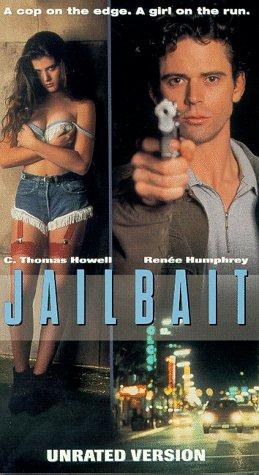
Jailbait takes place in Hollywood, the city of dreams. It opens with one of those long treks down Hollywood Boulevard that should be familiar to anyone who has seen a direct-to-video 90s film. Street performers try to cheat tourists out of their cash. Hookers look for customers. Pimps look for new girls. Vice cops look over the scene and say, “I’m too old for shit.” A Greyhound bus pulls into the station and the city’s newest inhabitant, 17 year-old Kyle Bradley (Renee Humphrey), steps off.
Kyle’s from Nebraska and she’s come to Los Angeles because she wants to be a professional dancer. By the standards of Nebraska, Kyle may be streetwise but she soon discovers that nothing is easy in Hollywood. She wants to find her half-sister, Merci (Krista Errickson) but Merci is nowhere to be found. Soon, Kyle is living on the streets, stealing food to survive and faking a heroin addiction to get a bed at the local rehab center.
What Kyle doesn’t know is that Merci is a high-class hooker. After one of her clients is murdered, Merci is framed for the crime. Merci’s on the run, though she still finds time to sing in a band. Heading up the investigation into the crime is Sergeant Lee Teffler (C. Thomas Howell). Teffler thinks that Merci’s innocent and believes that the murder is connected to a human trafficking ring that is run by his childhood friend, Roman (David Laboisa). When he meets Kyle, he takes her back to his apartment to keep her safe. Teffler swears that nothing can happen between them because she’s only seventeen. Kyle says that age shouldn’t matter and, because this is a 90s Cinemax film, he decides that she has a point.
In the late 80s and 90s, there were a countless number of films about innocent girls getting corrupted as soon as they got off the bus in Hollywood and Jailbait is certainly one of them. Jailbait, however, is one of the better examples of the genre because, from the start, Kyle is tougher than the naive, aspiring starlets who usually populated these films. Though Hollywood turns out to be an even harsher place than she was expecting, Kyle still comes across like she can take care of herself. That she’s not portrayed as being a wide-eyed or easily manipulated innocent makes Kyle’s relationship with Teffler feel less problematic than it would be otherwise. All of the characters, not just Kyle, are written and performed with more depth than you would normally expect to find in a film like this. Teffler is not just a renegade cop and Roman is not just an evil pimp. Because of their former friendship, they are portrayed as being two sides of the same coin.
It also helps that Jailbait is better acted than the standard straight-to-video film, with Renee Humphrey and Krista Errickson bringing a lot of depth to their roles. Even C. Thomas Howell, who often seemed to be sleep walking in his 90s films, is effective as the conflicted Teffler. Visually, Jailbait does a good job of capturing the glitzy grime of Hollywood. Though it may not be as well-know, Jailbait is a worthy companion to films such as Angel and Vice Squad.
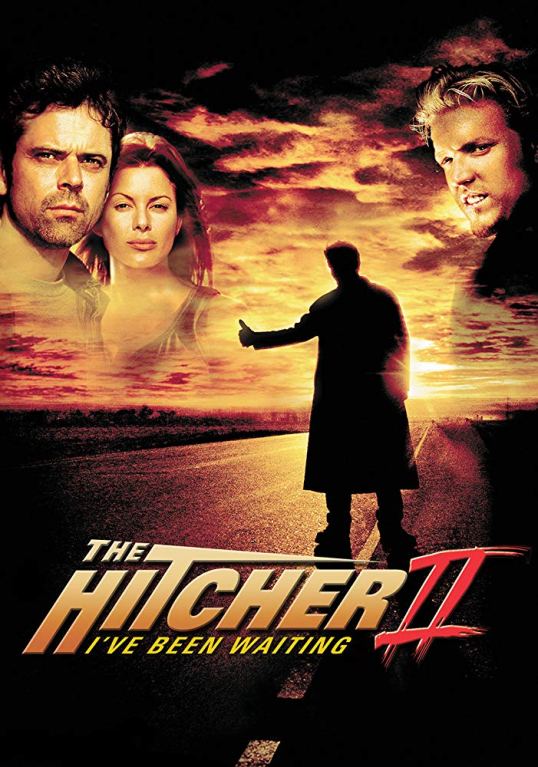
So, the 2003 film, The Hitcher II: I’ve Been Waiting, is a sequel to the original Hitcher. That’s the film where C. Thomas Howell plays a dumbass who picks up a hitchhiker played by Rutger Hauer and then kicks him out after a few miles because Hauer’s like totally insane. So, Hauer responds by murdering random people and framing Howell. The Hitcher‘s a pretty good film, largely because of the terrifying performance of Rutger Hauer as the title character.
The Hitcher came out in 1986. It got terrible reviews and didn’t do well at the box office but it found an audience when it was released on video. In fact, The Hitcher became a bit of a cult favorite, which is what it deserved to be. Then, 23 years later, a direct-to-video sequel was released and….
Seriously, this movie is so bad.
C. Thomas Howell returns, playing Jim, the same character that he played in the first movie. Jim is still haunted by what happened in the first movie. He’s a cop now but he fears that his encounter with the original Hitcher may have contributed to him using excessive force on a kidnapping suspect. Seeking some time away from the stress of it all, Jim decides to visit a friend in Texas. He and his girlfriend, Maggie (Kari Wuhrer) hit the road and, as they drive through the desert, they see a hitchhiker standing by the side of the road….
Now, I know what you’re saying. “Oh, come on!” you’re yelling. “There’s no way Jim would be make the same stupid decision twice!”
Well, you’re right. Jim doesn’t stop to pick the guy up. Instead, Maggie is the one who decides to pull over. Apparently, Jim has never bothered to tell Maggie about any of the terrible stuff that happened during the first film. Considering that Jim is apparently waking up constantly with nightmares and he’s on the verge of having a mental breakdown, you would think that all of this would be something that he would share with Maggie but no. Maggie is totally shocked when Jim later tells her that he had a bad experience picking up a hitchhiker.
Anyway, in this case, the hitchhiker is named Jack (Jake Busey) and …. wow, shock of shocks! He’s totally fucking crazy! That’s right — it’s happening again! So, Jack is chasing Jim and Maggie across the desert, murdering people and framing Jim and Maggie for the crimes. Does this sound familiar? Jim is eventually killed, giving C. Thomas Howell an excuse to never have to appear in another direct-to-video sequel. Can Maggie beat the new Hitcher at his own game?
Oh, who cares? This version of The Hitcher basically has none of the weird subtext of the first film. Unlike Rutger Hauer’s Hitcher, who seemed to be almost erotically obsessed with Jim, Jake Busey’s Hitcher doesn’t have much on his mind beyond killing people. If Rutger Hauer was all about quiet menace and charismatic intensity, Jake Busey is loud and in your face and so obviously crazy that it’s hard to have much sympathy for anyone stupid enough to pick him up.
The main problem with The Hitcher II is that it gets so damn repetitive. I lost count of the number of times that a cop showed up, refused to listen as Maggie shouted, “STOP! HE’S A KILLER,” and then got gunned down. Seriously, this film featured the stupidest cops that I’ve ever seen. The same thing keeps happening for 90 minutes or so, at which point we get a pithy one liner and then big explosion. And then the movie’s over!
If you had just moved to a small town in Georgia and your teenage son was framed for marijuana possession and sentenced to years of hard labor, what would you do?
Would you hire a good lawyer and file appeal after appeal?
Would you go to the media and let them know that the corrupt sheriff and his evil deputy are running a prostitution ring and the only reason your son is in prison is because you dared to call them out on their corruption?
Or would you get in a World War II-era Sherman tank and drive it across Georgia, becoming a folk hero in the process?
If you are Sgt. Zack Carey (James Garner), you take the third option. Sgt. Carey is only a few months from retirement but he is willing to throw that all away to break his son (C. Thomas Howell) out of prison and expose the truth about Sheriff Buelton (G.D. Spradlin) and Deputy Euclid Baker (James Cromwell, playing a redneck). Helping Sgt. Carey out are a prostitute (Jenilee Harrison), Carey’s wife (Shirley Jones), and the citizens of Georgia, who lines the road to cheer the tank as it heads for the Georgia/Kentucky border. It’s just like the O.J. Bronco chase, with James Garner in the role of A.C. Cowlings.
The main thing that Tank has going for it is that tank. Who has not fantasized about driving across the country in a tank and blowing up police cars along the way? James Garner is cool, too, even if he is playing a role that would be better suited for someone like Burt Reynolds. Tank really is Smoky and the Bandit with a tank in the place of that trans am. Personally, I would rather have the trans am but Tank is still entertaining. Dumb but entertaining.
One final note, a piece of political trivia: According to the end credits, the governor of Georgia was played by Wallace Willkinson. At first, I assumed this was the same Wallace Wilkinson who later served as governor of Kentucky. It’ not. It turns out that two men shared the same name. It’s just a coincidence that one played a governor while the other actually became a governor.
Monroe (C. Thomas Howell) is a young lawyer who moves to California and gets a job working for his Uncle Max (Terry Kiser). Max wants Monroe to concentrate on evicting beach bums. Monroe wants to play beach volleyball. Together, they solve crimes. No, actually, Max orders Monroe to evict Zack (Peter Horton), a former volleyball champion who was once “king of the beach.” Zack agrees to coach Monroe and his goofball friend, Wiley (Christopher Rydell) in a volleyball tournament. But when Zack misses a match because he is having underlit, PG-13 sex with his ex-wife (Harley Jane Kozak), uncoached Monroe accidentally breaks Wiley’s arm. Now, Zack has to step in as Monroe’s partner and reclaim his status as king of the beach!
When I was a kid, Side Out was a HBO perennial, which is not the same thing as being a good movie. There have not been many movies made about beach volleyball and Side Out shows us why. Beach volley ball is just not that exciting to watch, especially when the main competitors are two out of shape actors. All the jump cuts and close-ups in the world can’t disguise the fact that neither actor looks like he could get the ball over the net, never mind playing for over ten minutes without getting out of breath. In Side Out, beach volleyball teamwork comes down to a lot of yelling and whenever Monroe yells at either Wiley or Zack, he sounds just like the “Put him in a body bag, Johnny!” guy from The Karate Kid.
At least Kathy Ireland has a small role. Also, in the role of Zack’s friend, keep an eye out for Duke himself, the great Tony Burton!
After I finished watching Girls Just Want To Have Fun, it was time for the 1986 film, Secret Admirer!
Secret Admirer is a fairly good example of a film that is dependent upon the idiot plot. Every plot complication could have been avoided by the characters not being idiots. The entire storyline could have been resolved within five minutes if some of the characters had been willing to ask questions before jumping to assumptions. Idiot plots tend to fun when they deal with teenagers, largely because, when you’re that age, you can get away with being an idiot. That’s part of the charm of being a teenager and why nobody ever wants to grow up. When you’re a teenager, you’re not expected to have any common sense or knowledge of the real world so you can get away with a lot more. At the same time, idiot plots involving adults tend to be annoying because adults really should know better. The idiot plot of Secret Admirer involves both teenagers and adults and, as a result, the film is half-charming and half-annoying.
Smart but shy Toni (Lori Loughlin) has a crush on her lifelong friend, the sweet but kinda stupid Michael (C. Thomas Howell). So, Toni writes Michael an incredibly eloquent love note and slips it into his locker. When Michael finds the note, he assumes that it was written by Debbie (Kelly Preston), who is pretty and popular but only dates college students. When Michael attempts to write a response to Debbie, he is sabotaged by his limited vocabulary, lack of eloquence, and general dimness. Luckily, Toni finds the note and, wanting to spare Michael any embarrassment, rewrites it for him. Debbie is so touched by Toni’s note that she goes out on a date with Michael. Toni is forced to stand in the background and watch while the boy she loves falls for a girl who is obsessed with shopping. (Secret Admirer suggests that this obsession indicates that Debbie is shallow but seriously, who doesn’t love to shop?) Will Toni tells Michael that she loves him or will she leave him so that she can spend a year studying abroad? (Personally, I would leave and have fun exploring Europe but then again, I also love to shop so obviously, Toni and I have conflicting worldviews.)
But that’s not all! Michael’s dad, George (Cliff DeYoung), also finds the note and assumes that it was written to him by Debbie’s mom, Elizabeth (Leigh Taylor-Young). Of course, Debbie’s father, a police detective named Lou (the always gruff Fred Ward), also comes across the note and becomes convinced that George and Elizabeth are having an affair. He somewhat forcibly recruits George’s wife, Connie (Dee Wallace Stone), to help him expose George and Elizabeth for being the cheaters that he believes them to be….
I got annoyed with the parents fairly quickly. It’s always fun to watch Fred Ward grimace and glare at people but otherwise, all of the adults were way too stupid and their behavior reminded me of that terrible episode of Saved By The Bell where the exact same thing happens to Mr. Belding. Secret Admirer works best when the adults are pushed to the background and the film concentrates on the relationship between Toni and Michael. They’re a sweet couple and you really want to see them end up together. Michael may be stupid but he’s still really cute and the film is perfectly charming whenever it concentrates on him and Toni.
Incidentally, Michael has several friends. They all ride around in a van and look through old issues of Playboy together. Most of the friends are interchangeable but I did like Ricardo (Geoffrey Blake), just because he was wearing a suit and a fedora for no particular reason. Ricardo didn’t really get to do much but his fashion sense made a definite impression.
By the admittedly high standards of 80s teen films, Secret Admirer is a minor film. It’ll never be mistaken for Sixteen Candles or Pretty In Pink. That said, it’s still an entertaining and occasionally sweet film. You’ll want to skip over the scenes involving the adults but the scenes involving C. Thomas Howell and Lori Loughlin are perfectly charming.
It was in the summer of 2002 that the superhero film genre finally entered it’s Golden Age (or Silver Age for some). X-Menhad come out two years before to positive acclaim and, most importantly, in the box-office. It wasn’t until Sam Raimi released the first in what would be his trilogy in the Spider-Manfilm franchise that superhero comic book films became the power in Hollywood it remains to this day. The first film from Raimi easily captured the pulp and campy sensibilities of the source material and for an origin story film it was done quite well in that it introduced the titular character and what made him tick. In 2004, Raimi and company released what many consider the best comic book film with Spider-Man 2. The film brought a level of Greek tragedy to the fun of the first film and it definitely brought one of the best realized comic book villains on film with Alfred Molina as Dr. Octopus. Then the franchise hit a major bump in 2007 with Raimi third entry in the franchise with the bloated Spider-Man 3.
Sony Pictures, who owned the film rights to the Spider-Manfranchise, were so quick to churn out a fourth film, but in doing so lost the filmmaker and cast that made the trilogy happen. In the studios’ thinking they needed to get a fourth film up and running in order to keep the rights to the film from reverting back to Marvel and Disney. So, out goes Sam Raimi, Tobey Maguire and Kirsten Dunst and in comes Marc Webb, Andrew Garfield and Emma Stone. Instead of getting Spider-Man 4we get The Amazing Spider-Manwhich doesn’t continue what Raimi had established with the first three films, but reboots the franchise all the way to the beginning.
Marc Webb takes the screenplay worked on by a trio of screenwriters (James Vanderbilt, Alvin Sargent, Steve Kloves) and reboots the origin story of Peter Parker’s transformation into Spider-Man. We find Peter Parker back in high school as a student and still getting bullied by Flash Thompson while remaining awkward around girls (especially one Gwen Stacy played by Emma Stone). yet, before we even get to this part of the film we get an introductory coda where we find a preadolescent Peter Parker playing hide and seek with his scientist father. These early scenes show hints that the enhanced spider thatwill bite and give eter his abilities may have had his father’s research and work written all over it.
This intro influences much of the storyline and leaves a huge impact on the character of Peter Parker which the previous three films never explored. The rest of the film has Peter investigating the circumstances of his parent’s disappearance and his adjustment to having been given the superhuman abilities by the spider that his father may or may not have been responsible in breeding.
First off, the film does a good job in re-establishing Peter Parker as a high school student. The original film spent some time in this part of Peter Parker’s life but never truly explored it. We see Peter not just the class genius, but also one who also shows an affinity for photography (something that the original trilogy never really explained other than he needed the job and money). There’s also some added layers to the character as this version of Peter Parker is more than willing to stand up to the bullies picking on the weaker students other than himself. It’s a huge departure from the meek and geeky Peter Parker of the past. We still get a geeky and smart Peter, but one who is also a sort of a well-intentioned slacker. We also get a proper introduction for Gwen Stacy (something the third film criminally mishandled)
The film introduces once again many of the characters the first film in the series had already done. From Uncle Ben (played by Martin Sheen this time around) and Aunt May (Sally Field) right up to the robber who runs into Uncle Ben and changes Peter Parker’s outlook on his role as a hero forever. Again these were character that had already been explored by the first three films and they’re scenes that had an air of familiarity to them though Sheen performance as Uncle Ben added more layers to the character who becomes Peter Parker’s moral center.
Another thing that the film did a good job with was the design of the film. It has been ten years since the first film and the technology in CGI-effects has leapfrogged exponentially since. The look of the OsCorp Tower was a beautiful piece of architectural design. The building loomed over New York City like something dark with a hint of malice. There were changes to the suit Peter wears that really harkens back to the McFarlane years of the Spider-Man comics. Even the return of the web-shooters was a nice surprise that I had some reservations when first hearing about it.
A third good thing about the film was the extended montage when Peter Parker realizes he has gained new abilities and begins to test them out. It’s familiar territory from the first film, but Marc Webb and Andrew Garfield adds a new level of youthful exuberance to the proceedings. Even the use of parkour by Peter Parker to show his growing abilities didn’t come off as silly. Garfield’s performance as Peter Parker in this montage was pretty great. One could believe at how much fun he was having at discovering each new level of abilities. Even some of the growing pains he goes through after getting bit were some of the more hilarious moments in the film that ultimately lacked much of it in the end.
Which brings us to what made this entertaining film end up becoming a failure in the end.
I admit that the film entertained me in the end, but there were things aboutThe Amazing Spider-Manwhich nagged at me throughout and afterwards. While the film was entertaining the story self and most of the characters were inconsistently written. Once one looked past the action and some of the witty dialogue in the beginning the film’s many plot-holes and head-scratching moments become too glaring to ignore.
The character of Peter Parker does get some new layers of characterization in the beginning, but as the film played out the more the Peter Parker of this film began to stray away from not just what Raimi had created and guided through the first three films but also most of the character’s decade’s long growth in the comics. Yes, we see Peter Parker as the science-genius and even moreso than the one portrayed by Tobey Maguire, but we also don’t get the awkward teen who grows into his abilities, but most importantly, one who learns through tragedy that he has a responsibility to the people around him to protect them even if it means sacrificing his wants and dreams to do so. We don’t just see Peter Parker saving people, but also one who seemed to relish beating up and abusing those who used to do the same to him and/or others. Spider-Man in this film acts more like a bully than a reluctant hero by film’s end. Even the events that should’ve taught him the lessons of self-sacrifice and heeding the needs of the many fail to make much of an impact on the teen superhero. All one has to look at as the perfect example of this darker and more selfish turn to the character was Peter’s whisper to Gwen about promises not being kept being the best ones.
Other characters get inconsistencies in how they’re written. The other big one being Dr. Curt Connors who begins the film as a scientist so intent of not just curing his disability but also helping the world. It’s a character similar in tone to Alfred Molina as Dr. Octopus, yet where that villain remained a tragic one throughout the film and we could see the path which led him to become a villain with Dr. Connors in this fourth film there’s such a huge turnabout in the character’s motivations that whatever sympathy we may have had for Connors was squandered.
Not every character fails to impress. Martin Sheen and Denis Leary as Uncle Ben and Capt. Stacy respectively were fully realized characters who become Peter Parker’s moral centers and voice of reason. In fact, both Sheen and Leary helped anchor the scenes they appeared in and thus made their characters’ fate have the sort of emotional impact that a growing hero needs to move from being reluctant to accepting of his lot in life. It’s a shame that the writers failed to capitalize on the performances of these two character actors to help make Peter Parker more a hero and less a teenager more in love with what he can do instead of realizing that he has more to offer those who are weakest.
This is not to say that the performances by the cast was bad. From Garfield and Stone right up to Ifans, Sheen, Leary and Field, the cast did a great job with an uneven and inconsistent script that was too full of themes and ideas but no focus on any one of them. It’s a wasted opportunity to build on what the previous cast of the three films had created. Even the third film which many would agree as being a huge, bloated mess actually had a singular focus. It was a story that tried to explore Peter Parker’s darker side andhow his life as a superhero negatively impacts everyone around him he cares for. With this Marc Webb production we get a Peter Parker who at times was compassionate when it came to others being bullied and then we get one who relished on doing the same to those he now sees deserving of payback. Even Parker’s hunt for his uncle’s killer which the film spent a considerable time following just got dropped without any sort of resolution. One of the most significant events in Peter’s life gets dumped to the wayside to concentrate on finally pitting Spider-Man against the film’s Lizard.
Did The Amazing Spider-Manneed to have gotten made? The answer to that would be a yes.
Did Marc Webb, the three writers in Vanderbilt, Sargent and Kloves and the new cast get the reboot correctly? I would say no.
This was a film that spent too much time reintroducing characters both comic book and film fans already knew intimately. The storyline itself shared many similarities to the second film in the series yet none of the cohesiveness which made that first sequel such an instant classic the moment it premiered in 2004. The Amazing Spider-Manspent so much time trying to come off as a grittier and edgier version of the character (I call this the Christopher Nolan-effect) that what should’ve been coming off as a fun-loving, albeit self-sacrificing hero, came off as a dick once he finally got the full costume on. The people in charge of this reboot sacrificed what was fun about the film franchise for realism that the character and his universe were never steeped in to begin with.
Gritty, edgy and realism may work for Nolan’s take on the Batman film franchise, but for Spidey it fails and just turns what could’ve been a fresh new take on the franchise into another entertaining, but ultimately forgettable entry in the series. Maybe it’s time Sony just realize that it’s just pushing this franchise downhill and let the rights revert back to Marvel who seem to have found a balance between pulpy camp and serious realism.
Tonight saw the release throughout all NBC channels (both network and cable) of a 4-minute preview of Columbia Pictures’ entry in this summer’s blockbuster season: The Amazing Spider-Man.
The preview begins with new footage that shows Andrew Garfield saving a young boy from a dangling SUV held only by him as Spider-Man and his super-strong web. Once this sequence ends the rest of the preview is mostly a rehash of scenes from the last two trailers the studio has released.
With Marvel Studio and Walt Disney Pictures hitting the jackpot with the recently released superhero team film The Avengersthe other big films this summer, especially the superhero ones, have their work cut out for them. It’s going to be a tough going for this web-slinging reboot to capture the magic the original Raimi film was able to bottle when in came out in 2002, but from the looks of this preview and the trailers before it there’s a chance it could do so again.
The Amazing Spider-Manis set for a July 3, 2012 release date.
I will say it now that when I first heard that Sony was going to reboot the Spider-Manfilm franchise I wasn’t enthused by their decision not to mention saying bye to Sam Raimi as the franchise director. I saw this decision as Sony’s attempt to hold onto the licensing rights to the character. Without a new film coming out soon the rights were going to revert back to it’s parent company in Marvel Comics (something comic book fans probably hope would’ve happened). So, a new film was rushed, with a new director in Marc Webb and a new Peter Parker in Andrew Garfield.
This reboot will retell Spider-Man’s origin story once again and much more grittier than the more fun, pulpy Raimi trilogy. I think the fact that it was going to be another origin story is what made me hesitant to embrace this reboot. I’m still not fully committed to this film, but with each new trailer released my interest continues to rise. With this latest trailer we can see that the effects look to be much improved from the first three films which is understandable with advancement in CGI. We can also see in this new trailer the “grittier” aspect Sony was promising. I will say that I’m still not sold on Andrew Garfield as Peter Parker/Spider-Man, but maybe seeing the finished product will prove me wrong.
The Amazing Spider-Manis set for a July 3, 2012 release date.

 If you had just moved to a small town in Georgia and your teenage son was framed for marijuana possession and sentenced to years of hard labor, what would you do?
 Monroe (C. Thomas Howell) is a young lawyer who moves to California and gets a job working for his Uncle Max (Terry Kiser). Max wants Monroe to concentrate on evicting beach bums. Monroe wants to play beach volleyball. Together, they solve crimes. No, actually, Max orders Monroe to evict Zack (Peter Horton), a former volleyball champion who was once “king of the beach.” Zack agrees to coach Monroe and his goofball friend, Wiley (Christopher Rydell) in a volleyball tournament. But when Zack misses a match because he is having underlit, PG-13 sex with his ex-wife (Harley Jane Kozak), uncoached Monroe accidentally breaks Wiley’s arm. Now, Zack has to step in as Monroe’s partner and reclaim his status as king of the beach!


 Through the Shattered Lens