Film Review: Jackie Brown (dir by Quentin Tarantino)


It took me a while to really appreciated Jackie Brown.

I was nineteen and in college when I first watched the movie.  A friend rented it and we watched it with the expectation that it would be another Tarantino film that would be full of violence, fast music, and stylish characterizations.  And, of course, Jackie Brown did have all three of those.  But it was also a far more melancholy film than what we were expecting and compared to something like Kill Bill, Jackie Brown definitely moved at its own deliberate pace.  That’s a polite way of saying that, at times, the film seemed slow.  It seemed like it took forever for the story to get going and, even once it became clear that Jackie Brown (Pam Grier) and Max Cherry (Robert Forster) were going to steal from Ordell Robbie (Samuel L. Jackson), it still felt like an oddly laid back heist.  Robert de Niro, the film’s biggest star, played a guy who seemed to be brain dead.  Bridget Fonda brought an interesting chaotic energy to the film but her character was disposed of in an almost off-hand manner.  The whole thing just felt off.  I appreciated the performances.  I appreciated the music on the soundtrack.  But I felt like it was one of Tarantino’s weaker films.

As I’ve gotten older, I’ve come to better appreciate Jackie Brown.  First released in 1997 and adapted from a novel by Elmore Leonard, Jackie Brown finds Quentin Tarantino at his most contemplative.  Indeed, Tarantino wouldn’t direct anything quite as humanistic until he did Once Upon A Time In Hollywood.  If the heist seemed rather laid back, that’s because Jackie Brown really isn’t a heist film.  It’s a film about aging, starring two icons of 70s exploitation.  Robert Forster was 56 when he played bail bondman Max Cherry while Pam Grier was 48 when she was cast as Jackie Brown, the flight attendant turned smuggler.  Jackie and Max two middle-aged people faced with a world that doesn’t really make much sense to them anymore.  (Obviously, it’s easier for me to understand them now than it was when I was nineteen and I felt like the future was unlimited.)  Max bails people out of jail and it’s obvious that he still has a shred of idealism within him.  He actually does care about the people he gets out of jail and he’s disgusted by Ordell’s callous attitude towards the people who work for him.  Jackie is a flight attendant who, when we first see her, looks like she could have just stepped out of a 1970s airline commercial.  Ripping off Ordell isn’t just something that she’s doing for revenge or to protect herself, though there’s certainly an element of both those motivations in her actions.  This is also her chance to finally have something for her.  Jackie and Max are two lost souls who find each other and wonder where the time is gone.  All of those critics who have wondered, over the years, when Quentin Tarantino would make a mature movie about real people with real problems need to rewatch Jackie Brown.

Of course, it’s still a Quentin Tarantino film.  And that means we get a lot of scenes of Samuel L. Jackson talking.  This is one of Jackson’s best performances.  Ordell is definitely a bad guy and most viewers will be eager to see him get his comeuppance but, as played by Jackson, he’s also frequently very funny and definitely charismatic.  One can understand how Ordell lures people into his trap.  Jackson loves to watch video tapes of women shooting guns.  He allows De Niro’s Louis to crash at his place and the scene where Ordell realizes that Louis is thoroughly incompetent is brilliantly acted by both men.  And then you have Bridget Fonda, as a force of pure sunny chaos.  Jackson, De Niro, and Fonda are definitely a watchable trio, even if the film rightly belongs to Pam Grier and Robert Forster.

The older I get, the more I appreciate Jackie Brown.  This is the film where Tarantino revealed that there was more to his artistic vision than just movie references and comic book jokes.  This film takes Tarantino’s style and puts it in the real world.  It’s Tarantino at his most human.

Billy Bob Thornton in A SIMPLE PLAN (1998) – The great performances! 


Sam Raimi directed A SIMPLE PLAN, a movie about two brothers and a friend who find a crashed plane on a nature reserve that just happens to have a bag of cash containing $4.4 million. What starts out as the potential answer to all of their problems turns out the biggest problem they’ll ever have to deal with. 

Bill Paxton, Billy Bob Thornton & Brent Briscoe play the guys who find the money and come up with a plan to keep it. As you can imagine, it all goes to hell, with one thing leading to another thing that leads to another thing, and none of it good. The performances in this film are uniformly excellent, with Thornton as the standout. He completely disappears into his character and received an Oscar nomination for his work. It’s a great film, but it’s not exactly a fun film as we watch these characters’ lives turn into a slowly unfolding bus wreck. I watched it recently for the first time since I saw it in the theaters in 1998. Although I highly recommend it, I’m probably good for another couple of decades.

This scene with Paxton and Thornton is pretty sad and a pretty strong indicator of why money ultimately can never bring true happiness. 

IT COULD HAPPEN TO YOU (1994) – Nicolas Cage wins the lottery! Now what about that tip?!


As much as I enjoy writing about movies and talking about movies, I make a living by helping people with their annual income tax filings. That means from around January 15th through April 15th each year, almost every waking hour is spent focused on tax return preparation. While I’m working on these tax returns, I will often play movies or TV shows on one of my computer screens. These aren’t just any movies, though. These are movies or TV shows that make me feel good and help me relax while I’m working so many hours. Over the years, I’ve used movies like THE OTHER GUYS, THE HANGOVER, and ZOMBIELAND. A few years ago, THE ANDY GRIFFITH SHOW was on Prime, and I watched the entire 8 seasons through 3 times during tax season. One genre I hit hard this time of year is romantic films, both comedies and dramas. The main thing I’m looking for is happy endings. My favorite romantic films include NOTTING HILL, RETURN TO ME, HITCH, YOU’VE GOT MAIL, PERSUASION & SENSE AND SENSIBILITY. As a big fan of Nicolas Cage, IT COULD HAPPEN TO YOU, Cage’s 1994 romantic comedy with Bridget Fonda has joined that list over the years as well. Since today, January 7th, 2025, is Nicolas Cage’s 61st birthday, and tax season is coming, I thought I’d write about this charming film!

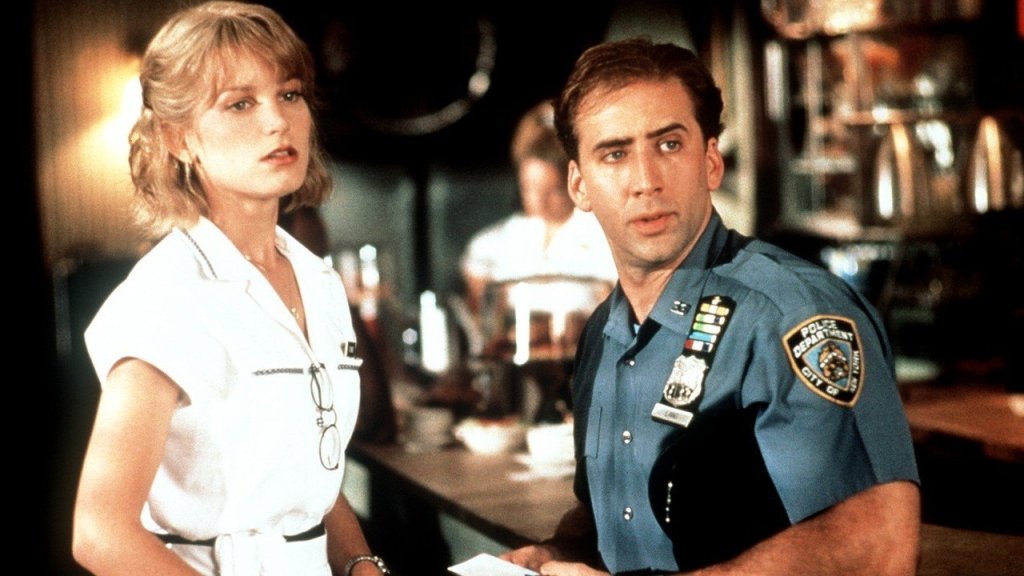
IT COULD HAPPEN TO YOU revolves around Charlie Lang (Nicolas Cage), a New York City cop who seems like an all-around good guy. One day he’s having coffee at a local diner with his partner Bo (Wendell Pierce), when they get a police call. Charlie finds himself without the money to give a proper tip to his waitress, Yvonne (Bridget Fonda), so he improvises on the spot and tells her he has a lottery ticket to be drawn on that very same night. Further, he goes on to tell her if he wins, he’ll split the winnings with her as a tip. The two cops head on out, Charlie happy that he gave her something, and Yvonne, who’s not having a good day anyway, just shakes it off knowing that it’s just another small tip she missed out on. But wouldn’t you know it, on this night the stars all align and Charlie’s number is drawn as a winner. Charlie and his wife Muriel (Rosie Perez) are ecstatic with their win, which amounts to around $4 million. In the middle of their celebration, Charlie remembers his promise to Yvonne and tells Muriel. To say she’s upset is an understatement, and she begs him to stiff the waitress. Charlie is just too honest for that, so he is able to convince Muriel that $2 Million is enough for them to live comfortably on. She begrudgingly agrees, but the fuse has been lit between Charlie and Muriel. The next day, Charlie goes back to the diner and tells Yvonne that they won. At first not believing it’s true, Charlie is able to convince Yvonne that he’s honoring his tip by giving her half of the winnings. We have found out that Yvonne is having severe financial problems, and this “tip” comes as a completely unexpected answer to her prayers. Alls well that ends well, right? As we all know, money can bring out the very best or the very worst in people and we see that play out throughout the rest of the movie. I’ll just put it this way, as Charlie and Muriel grow apart with their newfound money, Charlie and Yvonne grow closer together, bound by this amazing experience. 

It’s all a pretty crazy setup, but IT COULD HAPPEN TO YOU is a movie that I relate to idealistically. I really like Cage and Fonda in their roles. I’d love to be as honest and likable as Nicolas Cage’s character Charlie Lang. He is just a good guy, way down deep. I want to be that kind of guy. And Bridget Fonda’s character Yvonne is also very appealing. She’s presented as a lady going through a lot of personal issues, but who somehow seems to always show a kind and compassionate spirit to everyone around her, especially to others who are struggling. The scene where Charlie convinces her that he really is giving her half the money is quite an uplifting scene. Both of these characters have an honesty and attitude about life that resonates with me. Some people might argue that their characters should have more depth to make them more realistic and less one-dimensional, and they might be right, but I personally enjoy seeing them as just really honest and kind people. 

It should also be pointed out that you have to be able suspend your disbelief to enjoy IT COULD HAPPEN TO YOU. If your movies “have” to be realistic, this is not the movie for you. The entire premise is a fairytale, and the movie should be seen as such. For the movie to work, the good guys have to be really good guys, and the bad guys have to be really bad guys. I’ve mentioned earlier how kind both Charlie and Yvonne are throughout the film, with the money not changing their attitudes about life in any way. If anything, the money allows them to be even more kind and generous to others. Well, money has had the exact opposite effect on Muriel, and we soon learn that $2 Million isn’t enough for her and that the full $4 Million would not have been enough either. At this point, I’m not sure $100 Million would have been enough. In our fairytale story, she can’t be presented as a lady realistically struggling with her husband’s overly generous tip, she has to be presented as extremely selfish and cruel. I mean, how else is the story going to get Charlie and Yvonne together?!

All in all, IT COULD HAPPEN TO YOU works for me. I’ve said many times I’m a sucker for a good romance, and this film fits the bill for me. The main characters warm my heart as they are decent, kind and honest. I like a good fairytale. It’s one of the main reasons I enjoy the movies, and it doesn’t seem like we get enough good fairytales these days. 

Check out the trailer for IT COULD HAPPEN TO YOU below!

And if you’re looking for more awesome information about Nicolas Cage, check out John Rieber’s latest post where he celebrates Cage’s birthday with a movie marathon!

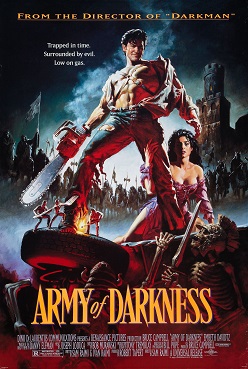
Horror Film Review: Army of Darkness (dir by Sam Raimi)


This is not going to be a traditional film review because let’s just state the obvious.  Army of Darkness is great.  Everyone knows that Army of Darkness is great.  Everyone loves Army of Darkness.  It’s not like you’re reading this review because you need to know whether or not Army of Darkness is a good film.

Now, interestingly enough, not everyone recognized just how good Army of Darkness was when it was first released.  A lot of reviewers were confused by director Sam Raimi’s mix of of horror (because the Deadites are scary under any circumstances) and slapstick comedy.  Today, we’re used to films and television shows that attempt to mix comedy and horror.  Ryan Murphy’s built an entire career out of mixing gore with camp and, as a result, he’s the favorite horror filmmaker of people who think they’re too good for horror.  In 1992, when Army of Darkness was first released, mixing horror and comedy caught critics and audiences off-guard.  What’s interesting is that 31 years later, Army of Darkness still feels fresh while many of the comedy horror films that followed feel tired.

I think one reason why the film continues to work is because it’s obvious that both Sam Raimi and Bruce Campbell were truly committed to bringing their demented vision to screen.  The film features Campbell as Ash Williams, the S-Mart clerk who, after a night of fighting the Deadites and losing his hand, has found himself in the Middle Ages, captured by Lord Arthur (Marcus Gilbert) and expected to live the life of a medieval slave.

Ash is often described as being one of the dumbest movie heroes of all time but, as this film shows, Ash’s stupidity is also his secret weapon.  While others heroes would probably get caught up trying to rationalize or understand the situation in which they’ve found themselves, Ash just accepts it.  While others heroes would strategize or try to figure out a clever way to get out of their situation, Ash simply fights back and runs straight into trouble.  “This is my boomstick!” Ash yells at one point and, while it establishes himself as being a great warrior, it’s also a case of Ash bragging on himself.  Ash is a big fan of bragging and it must be said that it usually works out for him..  When Ash is attacked by evil Ash and several miniature Ashes, the mindless delight that all of these different Ashes take in trying to destroy each other is infectious.

Of course, Ash’s stupidity can also be his biggest downfall.  For me, the best part of this film is when Ash tries to recover the Necronomicon from the haunted forest.  He is given three simple words that he needs to repeat before taking the book.  Before entering the forest, he practices by repeating the words twice but refuses to repeat them a third time because “I’ve got them!”  Of course, Ash doesn’t have them so he does what any of us would do.  He attempts to mumble the third world.  This, of course, raises an army of the dead.

(My second favorite part of the film is that the army of the dead is surprisingly talkative as they rise from their graves.  My third favorite part of the movie is Ted Raimi continually popping up as different supporting characters, occasionally even arguing with himself.  My fourth favorite part of the movie — well, I’ve got a lot of favorite parts of this movie.  Army of Darkness is one of those endlessly quotable movies about which you can spend hours saying, “Remember when….”)

“Shop smart, shop S-mart,” Ash says at one point and it’s tempting to laugh because Ash isn’t smart but he’s determined and his oddly confident and he manages to find a strange sort of joy in every situation that he finds himself.  He’s the ultimate blue collar hero and Army of Darkness is the ultimate celebration of Ash Williams, Bruce Campbell, and Sam Raimi.

Monday Live Tweet Alert: Join Us For Return of the Six Million Dollar Man and Bionic Woman and Jackie Brown!


As some of our regular readers undoubtedly know, I am involved in hosting a few weekly live tweets on twitter and occasion ally Mastodon.  I host #FridayNightFlix every Friday, I co-host #ScarySocial on Saturday, and I am one of the five hosts of Mastodon’s #MondayActionMovie!  Every week, we get together.  We watch a movie.  We snark our way through it.

Tonight, for #MondayActionMovie, the film will be 1987’s The Return of the Six Million Dollar Man and Bionic Woman!

Following #MondayActionMovie, Brad and Sierra will be hosting the #MondayMuggers live tweet!  We will be watching 1997’s Jackie Brown, starring Pam Grier, Robert Forster, Samuel L. Jackson, Robert De Niro, Bridget Fonda, Michael Keaton, and Diana Uribe!  The film is on Prime!

It should make for a night of fun viewing and I invite all of you to join in.  If you want to join the live tweets, just hop onto Mastodon, pull up Return of the Six Million Dollar Man and Bionic Woman on YouTube, start the movie at 8 pm et, and use the #MondayActionMovie hashtag!  Then, at 10 pm et, switch over to Twitter and Prime, start Jackie Brown, and use the #MondayMuggers hashtag!  The live tweet community is a friendly group and welcoming of newcomers so don’t be shy.   

Enjoy!

Spring Break On The Lens: Shag (dir by Zelda Barron)


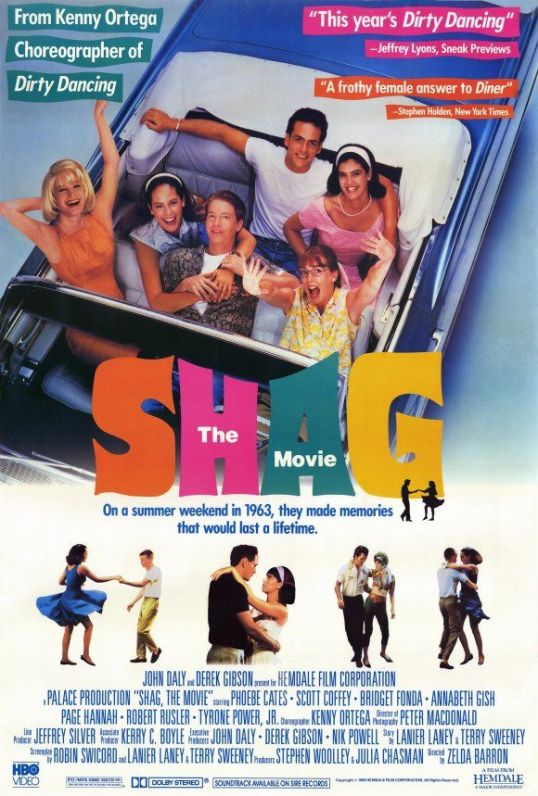
Welcome to Myrtle Beach, South Carolina, the setting of the 1989 film, Shag: The Movie!

We know that we’re in South Carolina because everyone is speaking with the type of overbaked Southern accents that you only hear in the movies.  And you know it’s the beach because of all the sand, the bathing suits, and the spring breakers.  Everyone’s listening to that rock and roll music.  Everyone’s dancing.  There’s a lot of Confederate flags around, mostly because the movie was made in the 80s and it’s taking place in the South.  If the movie were made today, it would probably take place in New Jersey and everyone would be debating whether or not Christopher Columbus was a hero or not.

Though the movie was made in 1989, it takes place in 1963.  We know that the movie takes place in 1963 because everyone in the movie keeps mentioning how it’s 1963.  One character mentions having sexual fantasies about President Kennedy, which scandalizes all of her friends.  Another character won’t stop talking about how much he enjoyed Paul Newman’s performance in The Hustler.  (The Hustler came out in 1961, though, so I think the dude needs to get with the times and watch Tom Jones.)  Everyone’s dancing the Shag.  Of course, since this is a film about how innocent the world was in 1963, there’s no talk of the growing American presence in Vietnam or anything like that.  This is the 1963 of the popular imagination, the 1963 that one visualizes after watching a hundred movies about spring break in the early 60s.

Anyway, Shag follows four friends as they have a wild week in Myrtle Beach.  They’re recent high school graduates.  Melaina (Bridget Fonda) is the wild preacher’s daughter.  Louanne (Paige Hannah) is the responsible one, who wears horn-rimmed glasses.  Pudge (Annabeth Gish) is the friend who needs better friends or, at the very least, friends who won’t give her a cruel nickname.  Carson (Phoebe Cates) is the responsible girl who is about to marry the level-headed Harley (Tyrone Power, Jr.)  After telling their parents that their going to Ft. Sumter to learn about the Civil War, they instead head down to Myrtle Beach.  Melania enters a beauty contest.  Pudge enters a shag contest with Chip (Scott Coffey).  Carson finds herself tempted by Chip’s friend, the Yale-bound Buzz (Robert Rusler).  And Louanne is tempted by Harley, who eventually comes to Myrtle Beach himself to try to understand why Carson is being so irresponsible.

There aren’t really many surprising moments to be found in Shag.  From the minute that we first see Carson trying on her wedding dress, we know that there’s no way she’s still going to be engaged by the time the movie comes to its conclusion.  By that same token, we also know that Melaina is not going to be as wild as she tries to present herself as being and that Pudge is going to find her confidence and that Louanne is eventually going to let her hair down, if just for a few minutes.  It’s a predictable movie but the cast is likable and there’s a lot of dancing, which is always a plus as far as I’m concerned.  Admittedly, Cates and Rusler are a bit bland as the main couple.  Instead, Annabeth Gish and Scott Coffey are the cast stand-outs.  I also have to say that I really liked the performance of Tyrone Power, Jr.  Harley is kind of a thankless role but Power manages to make him at least a little sympathetic.  At the very least, Carson doesn’t come across like a fool for considering him as a possible husband.

Shag is a likeable film, even if it’s not exactly groundbreaking.  And did I mention that there’s dancing?

Horror Film Review: Single White Female (dir by Barbet Schroeder)


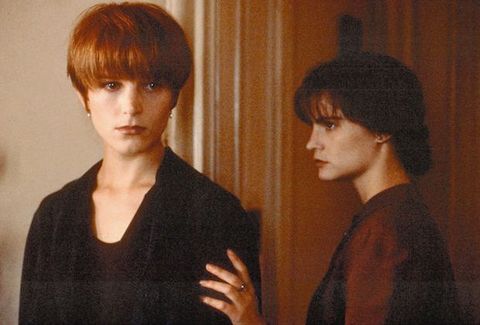
Allie Jones (Bridget Fonda) is an always fashionable software designer who is living in New York City and who has just broken up with her cheating lover, Sam (Steven Weber).  She has pretty hair, a big apartment, a closet full of nice clothes, and a totally devoted gay best friend.

Hedra Carlson (Jennifer Jason Leigh) is shy and socially awkward and in need of someone who will give her a cute nickname like “Hedy.”  She has pretty hair that’s just slightly less pretty than Allie’s, a job at a bookstore, a dead twin sister, a pair of really nice earrings, and a television that only seems to show old black-and-white movies.

Together …. THEY SOLVE CRIMES!

No, actually, they don’t.  Instead, Hedy answers an ad that Allie placed about needing a new roommate.  Even though Allie was thinking of asking another homeless woman to move in with her, Hedy impresses Allie by fixing her sink.  Seriously, how can you turn down a potential roommate who knows how to do simple plumbing?  Allie invited Hedy to live with her and, at first, everything is great.  Hedy even brings home a dog that Allie quickly falls in love with.  However, then Sam shows back up and we quickly discover just how obsessed Hedy has become with her roommate.

Single White Female was originally released way back in 1992 and, even if you’re viewing it for the very first time, you’ll probably feel a sense of deja vu while watching the movie.  This is one of those films that has been so endlessly imitated and has been unofficially remade so many times that you probably already know everything that happens in the film, regardless of whether you’ve actually sat through it or not.  A few years ago, there was a film called The Roommate that basically was Single White Female, just with a college setting and a bit less of a subversive subtext.  As well, I’ve lost count of the number of Lifetime films that have basically ripped off Single White Female‘s plot.  Any time that a new friend proves herself to be excessively clingy, chances are that she’s going to get compared to Jennifer Jason Leigh in this film.


And yet, despite all of the imitations, Single White Female still holds up surprisingly well.  A lot of that is because Single White Female was directed by Barbert Schroeder.  Schroeder started his career as a disciple of the French New Wave and, much like Paul Verhoeven, his American films tend to be genre films with just enough of a subversive subtext to stick in your mind afterwards.

For example, Single White Female is often describes as being a film about “the roommate from Hell” but what always seems to be missed is that, especially during the film’s first half, Allie is often as bad of a roommate as Hedy.  For instance, when Allie comes home late after spending two days with Sam, Hedy is pissed off and waiting for her.  On the surface, the scene is the first indication that Hedy has become obsessed with Allie.  But, at the same time, Hedy actually is making a valid point.  After repeatedly telling Hedy that she wants nothing to do with Sam, Allie runs off and spends two days with him without bothering to call home once.  Though Hedy may have been a bit too quick to yell, she still had every right to be annoyed.

In fact, Allie really is a bit of self-centered character.  She impulsively invited Hedy to live with her and then, just as impulsively, she gets back together with Sam and decides that it’s time for Hedy to move out.  Of course, then Hedy tosses a dog out of a window and you pretty much lose whatever sympathy you may have had for her.

Still, you can’t help but feel that, just as Hedy wants to be Allie, there’s a part of Allie that would like to be Hedy.  Hedy does all the things that Allie’s scared to do.  When Allie is sexually harassed and nearly raped by a client, Hedy’s the one who actually gets revenge.  While Allie tries to get over and suppress her anger at Sam, Hedy’s the one who acts on that anger.  Just Hedy seems to need Allie’s life to be happy, Allie seems to need Hedy’s anger to survive.  In short, there’s a lot more going on underneath the surface of Single White Female than its reputation might lead you to presume.

Not surprisingly, the film is dominated by Jennifer Jason Leigh’s performance.  When Hedy first appears, Leigh plays her as just being slightly off.  She has some obvious confidence issues but, at the same time, she comes across as being so innocent and naive that you can’t help but want to protect her.  You find yourself wondering how she could have possibly survived living in a city like New York.  It’s only as the film progresses that you start to discover that Hedy was never particularly naive and everything that she’s done and said has basically been about manipulating the people around her.  And yet, even after Hedy has started killing dogs and people, you can’t help but feel a strange empathy (though not necessarily sympathy) for her.  There’s an emptiness to Hedy, an emptiness that she attempts to fill by stealing the personalities of the people around her and Leigh does a great job of expressing the pain that would come from not having an identity of your own.  Plus, poor Hedy just seemed so happy with Allie said that she liked her earrings!  I mean, I just can’t imagine being that insecure but I get the feeling it would really suck.

(Fortunately, I’ve also never really had a truly bad roommate situation.  One advantage of having three older sisters is knowing that you’ll always have someone to stay with.)

Despite all of the imitations and rip-offs that have come out over the years, both Single White Female and Jennifer Jason Leigh’s performance hold up remarkably well.  I’d recommend watching it before inviting anyone to come live with you.  If nothing else, you’ll at least learn what stiletto heels are really for.


A Movie A Day #28: Scandal (1989, directed by Michael Caton-Jones)


scandal-posterLondon.  1961.  Doctor Stephen Ward (played by John Hurt) is an artist and an osteopath.  He counts among his patients some of the most distinguished men and women in British society, including the Minister of War, John Profumo (Ian McKellen).  After meeting two young dancers, Christine Keeler (Joanne Whalley) and Mandy Rice-Davies (Bridget Fonda), Stephen becomes their mentor, the Henry Higgins to their Eliza Doolittle.
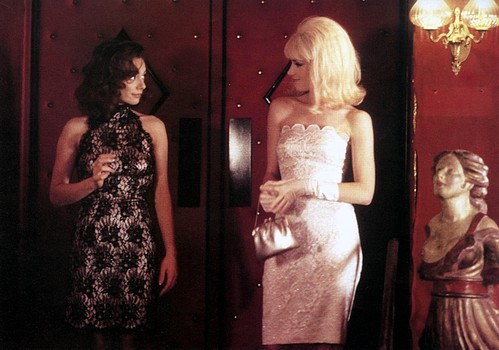
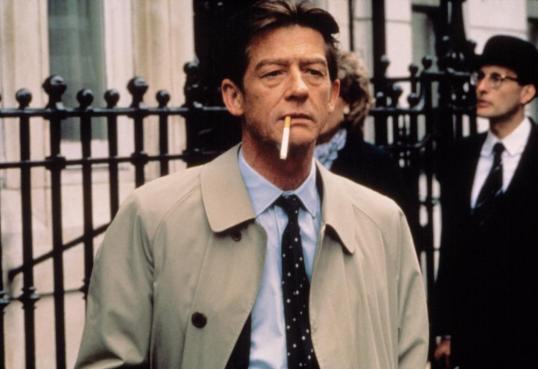
Under Stephen’s watchful eye, both Christine and Mandy are soon having affairs with some  of the most powerful members of Harold Macmillan’s Conservative government.  Christine becomes the mistress of both Profumo and KGB agent, Yevgeny Ivanov (Jeroen Krabbe), along with maintaining off-and-on relationships with drug dealer Johnny Edgecombe (played by singer Roland Gift) and musician Lucky Gordon (Leon Herbert).

When a disagreement leads to Johnny slashing Lucky’s face and then getting arrested for firing a gun at Stephen’s flat, the public learns the details of Christine’s affair with Profumo.  With the scandal rocking the British government, Stephen is a convenient scapegoat and soon finds himself on trial, charged with making a living off of “immoral earnings.”

Based on the real life scandal that led to the eventual fall of Harold Macmillan’s government, Scandal is remarkably faithful to the facts of the Profumo Affair, even if it did leave out some of the more interesting allegations.  (For instance, no mention is made of an alleged encounter between Mandy Rice-Davies and President Kennedy.)  Though it may seem tame by today’s standards, when Scandal was first released in 1989, it was considered to be something of a scandal itself and it initially got an X rating when it was released in the United States.  (The scandal over Scandal is one of the things that led to the MPAA adopting the NC-17 rating to distinguish between films for adults and “adult” films.  Of course, it didn’t work as a potential NC-17 still carries the same stigma as the X rating did.)

scandal

Scandal holds up well as both a recreation of London on the verge of the sexual revolution and a look at contrast between private and public mores.  Both Joanne Whalley and Bridget Fonda are excellent in the roles of Christine and Mandy.  Fonda gets to deliver the most famous line of the whole Profumo Affair when Mandy is told that Lord Astor has denied having had an affair with her.  “He would, wouldn’t he?” she says.  After I watched Scandal last night, I did some checking and I discovered that Bridget Fonda has not made a film since 2002.  She is missed.

Not surprisingly, Scandal‘s best performance comes from John Hurt, who plays Stephen Ward as a naive and well-meaning social butterfly who ultimately gets in over his head and pays a steep price for trusting that his friends would remain his friends.  Scandal is just one of many movies that proves what a great talent was lost when the world lost John Hurt.

RIP.

SCANDAL, John Hurt, 1989

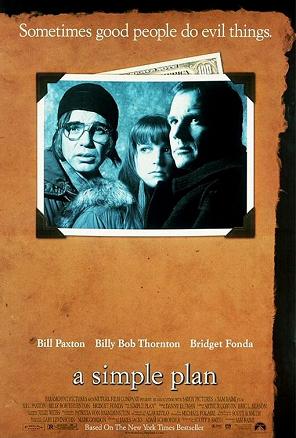
Embracing the Melodrama Part II #96: A Simple Plan (dir by Sam Raimi)


Simple_plan_poster

The 1998 film A Simple Plan reunites Bill Paxton and Billy Bob Thornton.  After previously playing adversaries in One False Move, they played brothers here.  However, it’s not just the cast that makes A Simple Plan feel like a spiritual descendant of One False Move.  Both One False Move and A Simple Plan deal with greed and violence.  Both One False Move and A Simple Plan take place in a small town where everyone thinks that they know all there is to know about each other.  Both One False Move and A Simple Plan feature Paxton as a man who turns out to be something more than what the viewer originally assumed.  Perhaps most importantly, both One False Move and A Simple Plan are meditations on guilt, greed, and community.

A Simple Plan takes place in Minnesota, in a world that seems to exist under a permanent layer of snow and ice.  While out hunting, Hank (Bill Paxton), his well-meaning but dim-witted brother Jacob (Billy Bob Thornton), and their redneck friend Lou (Brent Briscoe) stumble across an airplane that has crashed in the woods.  Inside the airplane, they find a dead pilot and a bag containing 4 million dollars.  At first, Hank says they should call the authorities and let them know what they’ve found but he rather easily allows Jacob and Lou to talk him out of it.  Instead, they agree that Hank will hide the money at his house until spring arrives.  They also agree to not tell anyone about the money but, as soon as he arrives home, Hank tells his pregnant wife Sarah (Bridget Fonda) everything that has happened.

Needless to say, this simple plan quickly get complicated.  Sarah is soon telling Hank that he should not trust Lou and Jacob.  The local sheriff (Chelcie Ross) saw Hank and Jacob leaving the woods after discovering the plane and may (or may not) be suspicious of what they found.  Alcoholic Lou starts to demand his share of the money early.  As things start to spiral, Hank finds himself doing things that he would have never thought he would ever do.  Or, as Sarah puts it, “Nobody’d ever believe that you’d be capable of doing what you’ve done.”

And then, one day, a mysterious FBI agent (Gary Cole) shows up and says that he’s looking for the plane.  Except that, according to Sarah, he’s not really with the FBI…

It’s appropriate that A Simple Plan takes place in a world that appears to be permanently covered in snow because it is a film that is both chilly and chilling.  Bill Paxton and Billy Bob Thornton are both perfectly cast.  (Thornton received an Oscar nomination for his performance.  Paxton undoubtedly deserved one.)  Bridget Fonda turns Sarah into a small town Lady MacBeth and Gary Cole, Brent Briscoe, and Chelcie Ross are all memorable in smaller roles.

(Brent Biscoe, in particular, is a redneck nightmare.)

The next time that you want to contemplate the evil that is done in the name of money, why not start off with a double feature of One False Move and A Simple Plan?


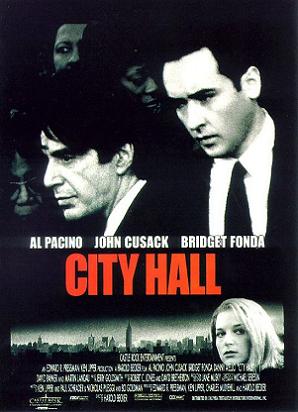
Shattered Politics #58: City Hall (dir by Harold Becker)


City_hall_ver1

Interestingly enough, New York City may be the center of wealth and politics in the United States but being Mayor of New York rarely leads to any sort of greater office.  Though the Americans Elect people tried to unsuccessfully recruit Michael Bloomberg in 2012 and there’s a few deluded souls who seem to think that Bill de Blasio could run and win in 2016, only three NYC mayors have taken the plunge and actually run for President.  Of the three of them, DeWitt Clinton was the most successful.  He not only won the Federalist nomination but he came close to beating James Madison in the election of 1812.  However, both John V. Lindsay and Rudy Giuliani were forced to end their campaigns when their electoral success in New York failed to translate into votes outside of the Northeast.

And that’s the thing really.  Everyone in America knows that New York is an important city, perhaps the most important city in the United States.  And they resent the Hell out of it.  It’s kinda like how the rest of country hates my home state of Texas because they need our oil more than we need … well, whatever the Hell it is that the rest of the country brings to the table.

I mean, let’s face it.  There’s a lot of resentment out there.  And that resentment will probably keep anyone from going from Gracie Mansion to the White House.

That’s one of the problems that I had with the 1996 film City Hall.  In order for City Hall to work, you have to believe that Mayor John Pappas has a legitimate chance to not only be nominated for President but to win the election as well.  At the start of the film, we’re informed by Deputy Mayor Kevin Calhoun (John Cusack, speaking in one of the worst attempts at a Louisiana accent that I’ve ever heard) that Pappas is the greatest mayor that New York City has ever had.  I guess that might be true, even though we really don’t see any evidence of that fact.  (Pappas does get to deliver a few monologues about how much he loves New York but if love is all it took, I’d be a really kick ass Prime Minister of Canada.)  However, it’s because Mayor Pappas is such a product of New York City that he’d probably never be able to actually win a primary in Vermont and capture Iowa’s electoral votes.  That’s one reason why it’s difficult to buy Mayor Pappas as a future President.

The other reason is that Mayor Pappas is played by Al Pacino.  And we’re not talking about Godfather or Dog Day Afternoon Al Pacino here.  Instead, we’re talking about raspy voiced, constantly bellowing, thousand-yard state Al Pacino.  As played by Al Pancino, it takes only one look at Mayor Pappas to imagine thousands a middle American voters running in terror away from the voting booths.

(One gets the feeling that if a large group of police officers ever turned their back on Mayor Pappas, he would immediately start jumping up and down while yelling, “YOU ARE TURNIN’ YOUR BACKS ON DA MAYOR HERE!  WHAT DA FUCK IS GOIN’ ON WITH THIS SHIT HERE!?”)

That said, there’s another reason why Mayor Pappas may never be President.  There’s been a shooting.  An undercover cop and a drug dealer shot each other.  A little boy was hit by a stray bullet.  The little boy is black but, oddly enough, nobody in the film ever suggests that there was any sort of racial element involved.  Instead, Mayor Pappas goes to the boy’s funeral and is enthusiastically applauded by the entirely African-American congregation.

It turns out that the drug dealer is the nephew of a mafia don.  He should have been in prison at the time of the shooting but instead, he was given an early release by a seemingly incompetent judge (Martin Landau).  As Calhoun and a lawyer named Marybeth Cogan (Bridget Fonda, giving a good performance in a generically written role) investigate how the dealer came to be released, they discover that local politician Frank Anselmo (Danny Aiello) may have had something to do with it.  Calhoun also discovers that his idol, Mayor Pappas, may know more than he’s saying as well…

If you do happen to watch City Hall, be sure to compare Danny Aiello’s performance with Al Pacino’s.  Both Aiello and Pacino are playing larger-than-life characters.  And both Aiello and Pacino have a tendency to bellow and to play big.  But, whereas Pacino’s performance feels forced and oddly empty, Aiello’s performance feels totally natural.  You actually believe that Aiello could be elected to a citywide office whereas Pacino — or at least the version of Al Pacino that shows up for City Hall — seems like he’d have a hard time getting elected to a student council, much less Mayor of America’s largest city.

Anyway, City Hall is currently making the rounds on cable, which is how I saw it.  It had the potential to be an interesting look at urban politics but, ultimately, it just doesn’t work.  To a certain extent, I hate to be negative about any film that, like City Hall, has its heart in the right place but the movie just doesn’t work.