The 2017 film, A Very Merry Toy Store, asks the age-old question: “Could any couple possibly be more adorable than Melissa Joan Hart and Mario Lopez?”
Melissa Joan Hart (Sabrina!) and Mario Lopez (Slater!) play rival toy store owners. (Their fathers once owned one big toy store but that didn’t work out.) Hart’s idealistic toy store is struggling. Lopez’s more commercial toy store is thriving. But they’re going to have to set aside their differences (and accept that they’re totally in love) because a big chain store is coming to town!
It’s a cute movie, one that works because the leads are so likable. (Brian Dennehy and Beth Broderick are both well-cast in supporting roles.) What can I say? I like this movie! Maybe I just always wanted to own a toy store.
(If I had a toy store, I would so a “Buy a Toy, Get A Free Book” promotion.)
In 1977’s Looking for Mr. Goodbar, Diane Keaton plays Theresa Dunn.
A neurotic and single woman who has never emotionally recovered from her childhood struggle with scoliosis, Theresa is trying to find herself in the wild and promiscuous world of the 1970s. After losing her virginity to a condescending college professor (Alan Feinstein), Diane goes on to have relationships with a needy social worker (William Atherton) and an hyperactive petty criminal (Richard Gere). During the day, she teaches deaf children and she’s good at her job. She even manages to win over the distrustful brother (Levar Burton) of one of her students. At night, she hits the bars. She buys drugs from the neighborhood dealer (Julius Harris). She tries to read the book that she always carries with her. (Some nights, it’s The Godfather and other nights, it’s something else.) She picks up strange men and takes them to her roach-infested apartment. One of those men, Gary (Tom Berenger), turns out to both be a bit insecure about his masculinity and also totally insane….
Looking for Mr. Goodbar is an adaptation of a novel that was inspired by the real-life murder of a New York school teacher named Roseann Quinn. The book was best seller and, just as he had with a previous best-selling true crime novel, director Richard Brooks bought the rights and both wrote and directed the film. Diane Keaton, who at that point was best-known for playing Kay Adams in The Godfather and for appearing in Woody Allen’s comedies, took on the demanding role of Theresa and, whatever one may think of the film itself, it can’t be denied that Keaton gives a brave performance as the self-destructive Theresa. In fact, I would say it’s one of Keaton’s best performances, outside of her work with Woody Allen and The Godfather Part II. If she had been played by a lesser actress, Roseann could have been unbearable. As played by Diane Keaton, though, she’s everyone’s best friend who just need some time to find herself. The viewer worries about her and wants to protect her as soon as they see her, making her ultimate fate all the more tragic.
As for film itself, I’ve watched Looking For Mr. Goodbar a few times and I’m always a little bit surprised by how bad the movie actually is. The film actually gets off to a strong start. The scenes between Theresa and the professor make for a sensitive portrait of a repressed young woman finally getting in touch with her sexuality and, in the process, discovering that she deserves better than the man she’s with. But once Theresa moves into her apartment and starts hitting the bars at night, the film takes on a hectoring and moralistic tone that leaves the viewer feeling as if the film is blaming Theresa for the tragedy that’s waiting for her at the end of the story. Diane Keaton and Tuesday Weld (who plays her sister) both give excellent performances but everyone else in the film either does too much or too little. This is especially true of Richard Gere, who is very hyperactive but still strangely insubstantial in his role. (Whenever Richard Gere appears on screen, one gets the feeling that they could just walk right through him.) A scene where Gere jumps around the apartment is meant to be disturbing but it’s more likely to inspire laughter than chills.
It’s an overly long film and the moments in which Theresa has dark, sexually-charged fantasies are never quite as powerful as the film obviously meant for them to be. (Brian Dennehy makes his film debut as a doctor who kisses Theresa’s breast during one of her fantasies.) As opposed to the empathy that he brought to In Cold Blood, one gets the feeling that director Richard Brooks didn’t like anyone in this movie and that he was more interested in Theresa as a cautionary tale than as a human being. With this film, Brooks seemed to be standing athwart the Sexual Revolution and shouting, “Stop!” That said, the film’s final moments are genuinely disturbing and difficult to watch. It’s the one moment where Brooks’s lack of subtlety pays off. Those last minutes are about as horrific as anything you could expect to see.
As for Roseann Quinn, her killer was eventually arrested. John Wayne Wilson hung himself in prison, 5 months after murdering her.
On July 10th, 1981, Kenneth Rex McElroy was gunned down in Skidmore, Oklahoma. He was shot while sitting in his truck. Over 40 bullets were fired into the truck but only two actually hit McElroy. His fourth wife, Trena (who Kenneth first met when she was 12 and he was 35), was sitting beside him at the time but was not hit by any bullets. McElroy was 47 years old when he was gunned down in broad daylight. There were reportedly 46 witnesses who saw the shooting occurred. When interrogated by the police, not a single one said that they saw anything. Quite a few did mention that Ken McElroy had gotten exactly what he deserved.
Ken McElroy was a high dropout, a barely literate career criminal who rustled cattle, burned down houses, raped his fourth wife when she was just 12, and then killed her family’s dogs in order to intimidate them into not pressing charges against him. He was known as the town bully, a surly man who had 17 children with 6 different women and who would shoot anyone who disagreed with him. Whenever he was charged with a crime, he would intimidate the witnesses into not testifying against him. In 1980. he got angry at a store owner after one of his kids was accused of shoplifting candy. McElroy shot the man and was put on trial for attempted murder. For once, he was convicted but he was freed on bail while awaiting appeal. When it become apparent that McElroy would not be going to prison for a while, the citizens of Skidmore….
Well, I should probably chose my words carefully. The truth of the matter is that no one has even been charged with or convicted of killing Ken McElroy. It is known that several citizens did have a meeting a few night before McElroy’s death and that they discussed what they could best do to keep McElroy from hurting anyone else. It’s also knoqn that, a week before he was shot, McElroy walked into the local bar with his rifle and dared anyone who wanted him dead to come get him. Does that mean that a group of concerned citizens took it upon themselves to dispense vigilante justice? That’s what Trena always claimed but again, no one was every charged, indicted, or convicted. The death of Ken McElroy remains officially unsolved.
Perhaps that’s why the names were changed for the 1991 made-for-television movie InBroadDaylight. Brian Denney may be playing a character named Len Rowan but, for anyone familiar with the case, it’s obvious that he’s playing Ken McElroy just as Marcia Gay Harden is obviously playing Tena McElroy, even if her character is called Adina. The film doesn’t change the name of the town and it doesn’t change the circumstances that led to McElroy’s death. W watch as McElroy intimidates the owners of a grocery store (played by Cloris Leachman and John Anderson) and even attempts to bully the local police (represented here by Chris Cooper). The film features a gun-toting crowd surrounding Len Rowan’s vehicle but it’s shot in such a way that their faces are blurry.
InBroadDaylight was filmed in Texas and it definitely captures both the beauty and the potential danger that comes with living in a rural community. Everyone in town knows everyone else. There’s a strong sense of community but, because the community is so small and isolated, it’s easy for a man like Len Rowan to bully the entire town. Some of the actors lean a bit too hard into their country accents. (Lord protect us from Yankees trying to sound Southern.) But the main members of the supporting cast — Cloris Leachman, John Anderson, Chris Cooper, Marcia Gay Harden — all give convincing performances. As for Brian Dennehy, he’s absolutely horrifying as the astoundingly cruel Len Rowan. Dennehy plays Len as being a man who might not exactly intelligent (the real Ken McElroy dropped out of school early) but who is positively brilliant at intimidating people. Dennehy plays Rowan as if he has a death wish. All of his threats and his speeches make it clear that he’s just daring someone to shoot him. Even when he realizes he’s about to get shot while sitting in his truck, he sit there and accepts the inevitable. Perhaps even he was getting sick of dealing with himself.
After watching In Broad Daylight, it’s easy to understand why no one came forward as a witness. By his own actions, Ken McErloy was destined to die violently. A few people just decided to speed things up a little. Who knows who?
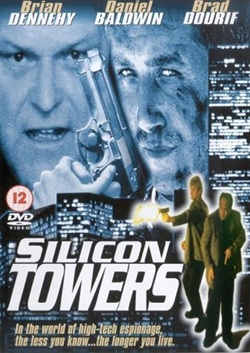
Charlie (Jonathan Quint) gets a promotion to an executive job at Silicon Towers. After his promotion, he is sent an encrypted email that reveals that the company is manufacturing computer chips that it can use to drain money from the banks and to control the world. Charlie goes on the run, jumping from roof to roof as he tries to avoid the company’s security team and reveal the truth. Brian Dennehy plays the evil CEO. Daniel Baldwin plays another executive. Brad Dourif plays a paranoid tech expert and steals the movie. Robert Guillaume is the police detective who is investigating the strange things that are happening around the company. Be sure to hum the Benson theme song while watching.
There was a lot of movies like SiliconTowers in the late 90s. The internet was still exotic and people were still convinced that technology was going to destroy us all on Y2K. SiliconTowers was not the only paranoid tech thriller to come out in 1999 but it might have been the most inept. Serge Rodnunsky made a lot of movies back in the day and never let a lack of a budget stand in his way but he also never seemed to understand the importance of being able to hear dialogue or smooth editing. There are some good actors in Silicon Towers. Good luck understanding what any of them are saying.
This film is mostly memorable for the scenes of Charlie “hacking.” Charlie writes his hacking code in HTML. That’s pretty much all you need to know.
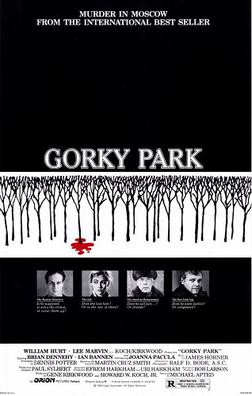
Earlier today, I saw that the writer Martin Cruz Smith has died. He was 82 years old and was best known for a series of detective novels about Arkady Renko, a Russian police detective. Starting with 1981’s GorkyPark, Smith’s novels not only dealt with Renko’s adventures but also provided a look at contemporary Russia, as it went from being controlled by the communists to being controlled by Putin. Renko was a cynical observer whose cases often exposed the corruption of the Russian elite, regardless of who was in charge.
The first of Smith’s Renko novels was turned into a movie in 1983. GorkyPark stars William Hurt as Renko. Renko investigates the discovery of three dead bodies at a ice skating rink in Moscow. One of the victims in an American whose brother (Brian Dennehy) is a tough New York cop who has come to Russia to investigate his disappearance. Renko’s investigation leads him to an American businessman (Lee Marvin) who is smuggling sables out of Russia and who is also a KGB asset. Joanna Pacula plays a woman whose hope to escape from Russia leads to her getting caught up in the murders and the subsequent investigation.
Gorky Park‘s mystery is easily solved. Just by casting Lee Marvin in the role, it is automatically clear who is responsible for the murders and it doesn’t take long for Renko to figure it out either. Instead, the movie is about how Renko’s investigation exposes the corruption of the Russian state, with the KGB first protecting Lee Marvin’s businessman when he’s considered to be an asset and then expecting Renko to assassinate him once it becomes obvious that his activities are becoming a liability. The subdued William Hurt and the brash Brian Dennehy make for an compelling investigative team while the underappreciated Joanna Pacula gives an outstanding performance as a woman who is so desperate to escape the oppression of the Soviet Union that she’ll risk everything. (Even though the murderer is an American businessman, the Soviet Union still banned Gorky Park as both a book and a film.) GorkyPark’s snowy cinematography and Michael Apted’s measured direction captures the chilly paranoia of Smith’s story and the bleak depiction of a society where national pride mixes with healthy a dose of fear.
Upon release, GorkyPark was a box office disappointment, which meant that there would be no further adventures of William Hurt’s Renko on the big screen. Martin Cruz Smith continued to write, ultimately publishing ten novels about his unconventional hero.
Brian Dennehy directed, co-wrote and starred in this made-for-TV movie about Chicago homicide detective Jack Reed. This is the third TV movie based on Reed’s exploits, following 1992’s DEADLY MATRIMONY, and 1993’s BADGE OF HONOR. In A SEARCH FOR JUSTICE, Jack Reed (Brian Dennehy) investigates the murder of pregnant stripper Lorelei Bradley (Marjorie Monaghan), who also happens to love children, even running a daycare center in the trailer park she lives in. Reed’s investigation quickly identifies the politically connected businessman and strip club owner, Win Carter (Miguel Ferrer), as the prime suspect. As if trying to solve the murder isn’t tough enough, Reed must also deal with corrupt superiors within his own department and train his new boss Charles Silvera (Charles S. Dutton), the latest in a long line of men to be promoted over him. No matter what obstacles Reed encounters, he remains determined to bring the killer to justice!
JACK REED: A SEARCH FOR JUSTICE, is my first “Jack Reed” film, and I enjoyed it. The character of Jack Reed is based on real life Cook County, Illinois Sheriff John “Jack” Reed, with each of the different movies loosely based on cases that Reed investigated throughout his career. As you might imagine, Brian Dennehy is excellent in the lead role as the tough, principled cop who will stop at nothing to catch criminals. The Chicago backdrop adds a nice wrinkle to the proceedings with its strong reputation for corruption, something that plays strongly into this installment and makes Reed’s job that much harder. I also really like Charles S. Dutton’s character, Lieutenant Charles Silvera. Initially promoted due to the color of his skin, and as a way to stick it to Reed, Silvera turns out to be an incorruptible lawman who develops a great working relationship with Reed. I’ve always been a fan of Dutton as an actor, mainly because of his ability to project decency and integrity on screen, and I’m looking forward to seeing them work together in future installments. Miguel Ferrer is also a good villain. He doesn’t go over the top here, rather he plays the part as low key, politically connected, amoral, and ultimately, very dangerous. It’s a good choice.
The fact that JACK REED: A SEARCH FOR JUSTICE is based on real life cases helps bring a little more realism than you might get in most TV movie cop movies of the time. As an example, our cops are more concerned about putting together solid evidence and getting a conviction over anything else. There is some action, but after watching this installment, I realize that these movies are just as likely to end with lawyers cutting a deal than with a big shootout. On the flip side, there are elements of the story that don’t seem realistic at all, such as Reed’s wife Arlene (Susan Ruttan) doing her own undercover work at one point, and our victim’s unlikely dual life as a stripper and daycare operator. What can I say, it’s not a perfect movie, but if you enjoy 90’s TV cop dramas like I do, you should enjoy this film and this series. The cast is good, and the characters are men of integrity trying to bring justice to a corrupt world. That’s a recipe for enjoyment as far as I’m concerned, and I’m looking forward to watching the rest of the film series!
I’m a big fan of tough guy actor, Brian Dennehy. I especially liked it when he teamed up with James Woods in the badass cop/hitman flick, BEST SELLER! In honor of Dennehy’s 87th birthday in cinema heaven, I thought I’d share him pummeling a very deserving Woods in one of the film’s many standout scenes!
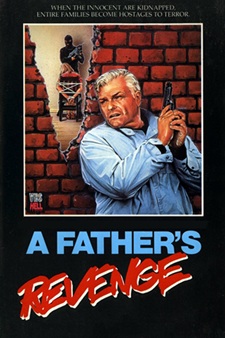
After his flight attendant daughter is taken hostage by a group of German terrorists, basketball coach Paul Hobart (Brian Dennehy) grows frustrated with government red tape and heads to Germany to track her down and save her himself. Realizing that he doesn’t have the experience necessary to do it all on his own, Paul hires Vickers (Anthony Valentine), a shady and ruthless former SAS man who will do whatever is necessary to get the job done. Joanna Cassidy plays Paul’s wife. Ron Silver plays the journalist who sees the opportunity to break a great story as Paul searches for his daughter.
AFather’sRevenge is a slow-moving thriller. I was surprised to discover that it was actually given a theatrical release because everything about it feels like a made-for-television movie. It’s a predictable movie. At first, Paul is reluctant to embrace Vickers’s more extreme methods but then he sees that those methods are the only ones that work when dealing with terrorists. As usual, Dennehy is ideally cast as a beer-drinking, blue collar American and the underused Joanna Cassidy has a few good emotional scenes as his wife. The movie is stolen by Anthony Valentine, who brings a note of ambiguity to Vickers’s motivations. The main problem with the movie is that it spends too much time on scenes of people debating what they should do and not enough time showing them actually doing it. The finale is exciting but it takes too long to get there.
Welcome to Retro Television Reviews, a feature where we review some of our favorite and least favorite shows of the past! On Mondays, I will be reviewing Miami Vice, which ran on NBC from 1984 to 1989. The entire show can be purchased on Prime!
This week, MiamiVice takes an unwelcome detour.
Episode 4.2 “Amen …. Send Money”
(Dir by James Quinn, originally aired on October 2nd, 1987)
This was pretty dumb.
Tubbs, working undercover, busts Leona Proverb (Anita Morris), who just happens to be the wife of Billy Bob Proverb (Brian Dennehy). Billy Bob is a television preacher who continually asks his followers to send him cash so he can live the lifestyle that he says God wants him to live. On paper, this sounds like a great role for Brian Dennehy but this episode’s script lets him (and, for that matter, everyone else in the cast) down. Somehow, the fact that the guy is named Billy Bob Proverb is the least heavy-handed aspect of this episode.
Faye Nell (Jo Anderson), who is one of Billy Bob’s followers, calls Tubbs to the studio and says she has information on what the Proverbs are doing. As soon as Tubbs shows up, Faye tosses herself on him, rips her dress, and starts to yell, “Rape!” Tubbs finds himself being investigated by Internal Affairs while Faye claims that God told her to call Tubbs down to the studio and she even passes a lie detector test.
“I’m being set up by a preacher!” an angered Tubbs says but it turns out that Billy Bob Proverb is not the one behind all of Tubbs’s problems. In fact, Billy Bob is actually sincere, in his own strange way. Instead, the villain turns out to be another television preacher, Mason Mather (James Tolkan). Mather has the ability to make himself go into a coma, which makes it difficult to arrest him.
Before I started watching this season, I read online that season 4 featured some of Miami Vice‘s worst episodes. Amen …. Send Money feels almost like a parody of MiamiVice. The episode itself is meant to be largely comedic and perhaps if this episode had centered on Switek and Zito instead of Crockett and Tubbs, it would have worked. Unfortunately, the show killed off Zito last season so instead, it’s Crockett and Tubbs making odd jokes and rolling their eyes in shock. The thing is, MiamiVice has — up until this episode — been a show about ruthless dealers and the futility of the War on the Drugs. The thing that set MiamiVice apart from other 80s cop shows was that it was thematically dark, the endings were frequently unhappy, and Crockett and Tubbs were always the epitome of cool, no matter what happened. This episode features cartoonish villains and a silly plot and both Crockett and Tubbs come across as being a little …. well, dorky.
(On the plus side, the show does continue its tradition of featuring future stars by giving Ben Stiller a small role as a con artist.)
Oh well. Not every episode can be a great one. Hopefully, next week will be an improvement.
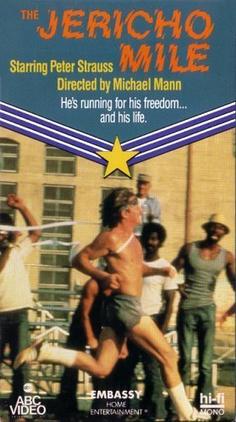
1979’s The Jericho Mile tells the story of Larry Murphy (Peter Strauss).
Larry is serving a life sentence at Folsom Prison, convicted a crime that he admits to having committed. Larry murdered his father, specifically to protect his stepsister from being raped. Larry feels no guilt for his crime and, at the same time, he’s willing to quietly serve his sentence. He’s a loner, avoiding the rival racial factions in the prison. (Brian Dennehy leads the Aryans while Roger E. Moseley leads the black prisoners and Miguel Pinero is the head of the Mexican Mafia.) Larry just wants to spend his time running around the prison yard.
When Dr. Bill Janowski (Geoffrey Lewis) sees how fast Larry can run, he arranges for a local track coach, Jerry Beloit (Ed Lauter), to come up to the prison with a few potential Olympians so that they can race Larry. Larry manages to outrun all of them. Jerry becomes convinced that Larry could qualify for the Olympics, if only he had a regulation track to run on. The Warden, knowing good publicity when he sees it, assigns the inmates to build the track but doing so means dealing with Folsom’s highly charged racial politics. No matter how fast Larry can run and no matter how inspiring it would be for Larry to go from serving a life sentence to competing in the Olympics, Folsom is still a prison and Larry is still a prisoner. And while the guards may have the guns and may be the only ones who are allowed to go home at the end of the game, it’s the prison gangs who have all the power. When the Aryans go on strike and refuse to work on the track, it puts Larry’s chances in jeopardy.
Of course, Larry’s chances are already in jeopardy just because of who he is. Larry is a prisoner who refuses to show remorse. While other prisoners embrace religion or politics and try to convince outsiders that they’ve either reformed or been wrongly convicted, Larry just wants to run. Running is when he’s free. (The film’s title refers to the Walls of Jericho coming down.) And, for the other inmates, watching Larry run is a reminder that there are many ways once can escape from the drudgery of being locked away.
The Jericho Mile is a tough and rather cynical prison film, one that manages to combine downbeat social drama with a uplifting sports story. You’ll want to cheer Larry while he’s running, even if you secretly suspect that he’s ultimately chasing something that will never happen. Making his directorial debut, Michael Mann shot the film on location at Folsom and the cast is full of actual prisoners, all of whom bring some much need authenticity to the film’s story. Mann never lets us forget that this is a film about people in a very dangerous situation and, even at its most inspiring, the film leaves you feeling as if violence could break out at any moment. Peter Strauss, who usually played somewhat more refined characters, is totally believable as the taciturn Larry and character actors like Dennehy and Mosely skillfully blend in with the actual prisoners in the cast. The Jericho Mile is a portrait of crime, punishment, and dreams. It’s a movie that will stay with you.




 Through the Shattered Lens