Retro Television Review: The Love Boat 5.29 “Mothers Don’t Do That/Marrying For Money/Substitute Lover”


Welcome to Retro Television Reviews, a feature where we review some of our favorite and least favorite shows of the past!  On Wednesdays, I will be reviewing the original Love Boat, which aired on ABC from 1977 to 1986!  The series can be streamed on Paramount Plus!
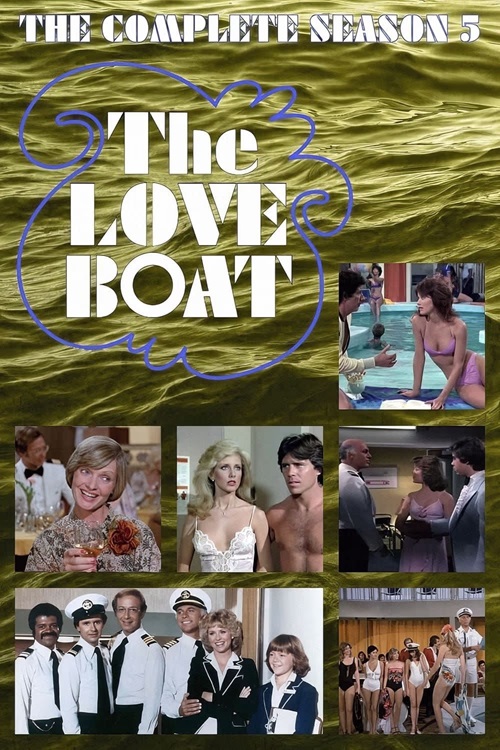
This week, season 5 comes to a close!

Episode 5.29 “Mothers Don’t Do That/Marrying for Money/Substitute Lover”

(Dir by Jerome Courtland, originally aired on May 15th, 1982)

Glamorous Marian Healy (Eva Gabor) boards the boat and is reunited with the son that she barely knows, Danny (Brad Savage).  Danny, however, reads Marian’s diary and declares, “Mother don’t do that!”  Hey, you little brat, how do you think you came into existence?

Meanwhile, yet another old high friend of Julie’s board the boat and proceeds to lie to a passenger.  It seems like this happened every week.  This time, it’s Bert (Eddie Mekka) who pretends to be the pen pal of Marla Bennett (Audrey Landers).  Don’t worry, Marla forgives Bert when she learns the truth.  If there’s anything I’ve learned from watching The Love Boat, it’s that romantic relationships that start off with some horrible lie always work out for the best.

Finally, Gopher and Isaac are worried that Lola Trout (Caren Kaye) is trying to kill her new husband, Orville (Arte Johnson), by forcing him to exercise.  They can’t think of any other reason why Lola would marry Arte, other than to murder him and take his money.  If they spent more time watching Fantasy Island, they would know that there are simpler ways to kill your husband than by making him exercise.  You could challenge him to a pentathlon for instance….

This was the final episode of the fifth season and everyone seemed to be a little bit tired.  None of the three stories is particularly developed and you can really tell that everyone’s eager to get off the boat and spend some time on dry land.  That’s fine.  Season 5 was a pretty good season, even with that terrible musical episode.  Everyone deserves a break and if that means the finale is a bit underwhelming, so be it!

Next week, we start Season 6!  I have a feeling I will never finish reviewing this series and that’s okay.  The Love Boat is a show that I could happily watch forever!
 

Late Night Retro Television Review: CHiPs 3.18 “Kidnap”


Welcome to Late Night Retro Television Reviews, a feature where we review some of our favorite and least favorite shows of the past!  On Mondays, I will be reviewing CHiPs, which ran on NBC from 1977 to 1983.  The entire show is currently streaming on Prime!

This week, two dumbs kids case a lot of trouble.

Episode 3.18 “Kidnap”

(Dir by Gordon Hessler, originally aired on January 26th, 1980)

Ponch and Baker have been assigned to escort to stupid kids — Pete (Brad Savage) and his weirdo friend Ray (Christopher Holloway) — to the country courthouse so that they can receive some sort of an award for an essay that they wrote about traffic safety.  I don’t know, it sound pretty dumb.  For some reason, local news reporter Pat Blake (Jayne Kennedy) is there to cover the story.  Ponch gets busy flirting with Pat and Baker’s busy hitting on Pete’s older sister (Judy Strangis) and nobody notices Pete and Ray getting into an unlocked limo and starting the engine.

Meanwhile, two crooks named Solkin (played by legendary character actor Timothy Carey) and Bickel (Warren Berlinger) escape from custody, run down to the parking garage, and hop in the limo.  Because those dumb kids turned on the engine, Solkin and Bickel steal the car with the two stupid kids in the backseat!

Even though this is entirely the fault of Pete and Ray, the entire Highway Patrol mobilizes to rescue them.  This episode is one long chase scene.  Solkin and Bickel want to drive up to Canada.  (Draft dodgers!)  Pete and Ray are trying to figure out a way to escape.  Ponch and Baker are trying to discreetly follow without letting the crooks know that they’ve been spotted.  Unfortunately, two stoners in a van try to help and almost give away the entire operation.

Of course, the kids are rescued and, of course, it’s all because of Ponch.  Ponch dresses like an auto mechanic and then borrows a banged-up Cadillac that has fuzzy pink seat covers.  Ponch follows the men and continually plays La Cucaracha by honking the car’s horn.  While Baker and the other members of the Highway Patrol struggle to keep track of the kidnappers and continually screw up, Ponch solves this case almost single-handedly!

Okay, that’s a little unfair on my part.  This is one of those episodes where the emphasis really is on team work.  Everyone — from Grossie to Getraer to Bear to Ponch and Jon — does their part to follow the limo and to come up with a plan to save the kids.  Still, it’s hard not to notice that, when it comes time to save the kids, it’s pretty much Ponch doing it on his own.  We’re closing in on the end of the third season and it’s pretty much undeniable that CHiPs has become The Ponch Show.

This episode was kind of annoying, despite the presence of the always entertaining Timothy Carey.  The main problem was that the two kids were jerks who had no one to blame but themselves for getting into that bad situation.  I hope they were grounded for the rest of their lives!

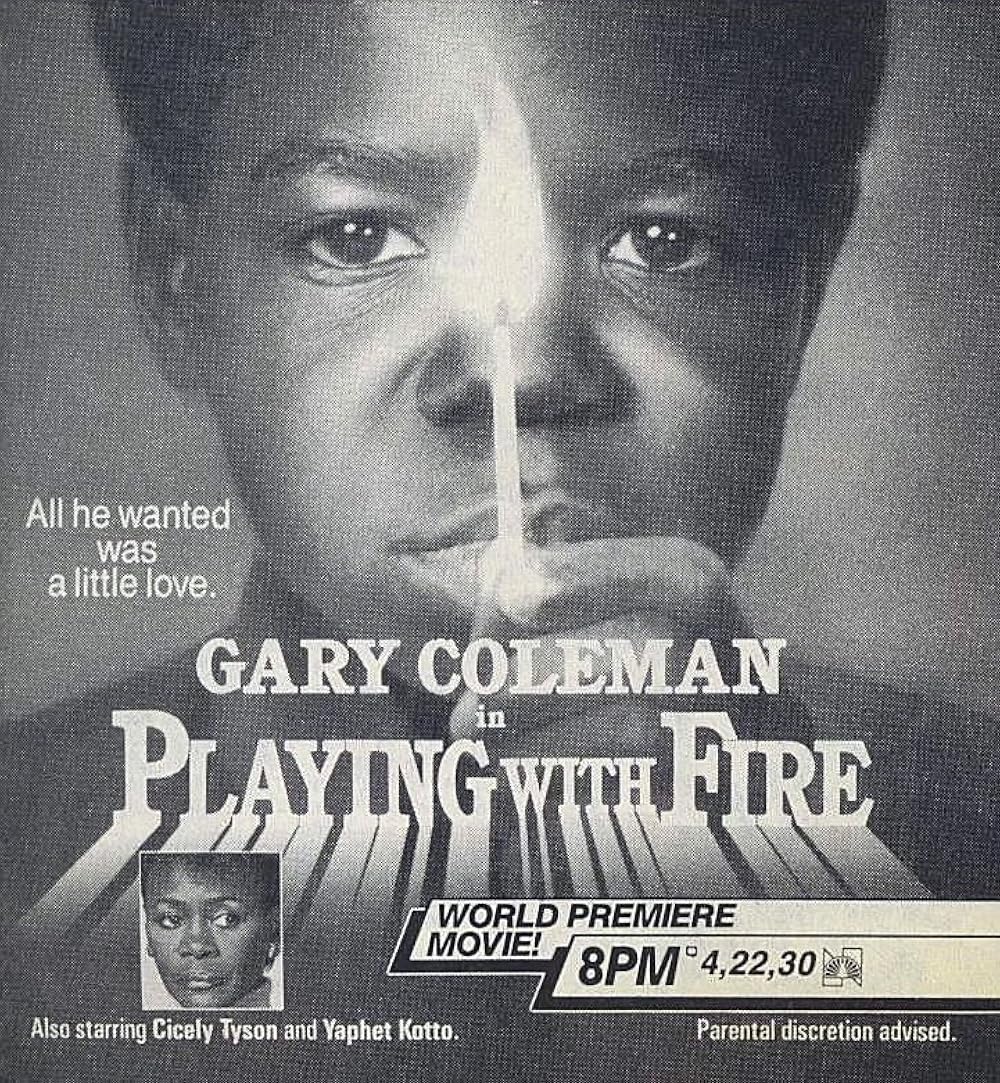
Playing With Fire (1985, directed by Ivan Nagy)


David Phillips (Gary Coleman) is a teenager who sets fires when he gets upset.  He has many reasons to be upset.  His parents (Ron O’Neal and Cicely Tyson) are getting divorced and are constantly fighting.  His teachers at school are always getting on his back.  He has to take care of his younger siblings and his dog.  He can’t even get the bigger kids in school to let him play basketball with them.  At first, David just plays with his lighter but, after he accidentally sets his mother’s coat on fire, David discovers that he likes to watch things burn.  David and his mother both claim it’s just coincidence that David is always nearby whenever a fire breaks out but Fire Chief Walker (Yaphet Kotto) knows what’s really going on.  After David nearly burns down his house, Walker tries to reach him before it’s too late.

This isn’t really meant to be a horror film  but it’s shot like one, with plenty of scenes of Gary Coleman staring at a burning fire with a possessed-look in his eyes.  The movie tries to make David sympathetic but the scene where he threatens his own dog with a lighter suggests that David has more problems than just his parents splitting up.  This was Gary Coleman’s first dramatic role.  I think it may have also been his only dramatic role.  It’s not that he’s not convincing as a really angry kid.  It’s just that he’s Gary Coleman so, no matter how much the movie tries, it still comes across as being a special episode of Diff’rent Strokes where Arnold becomes a pyromaniac.  Coleman tries to play up the drama of the situation but it’s hard not to laugh whenever he looks shocked at one of the fires that he has just started.  Every scene seems like it should end with Conrad Bain showing up with the cops.

For years, this movie was next to impossible to find but finally, someone found an old VHS tape in their garage and uploaded the movie to both YouTube and the Internet Archive, ensuring the world will never forget the time that Gary Coleman played with fire.

One final note: the director is better known for eventually becoming business partners with notorious Hollywood madam, Heidi Fleiss.

Retro Television Reviews: The Bait (dir by Leonard J. Horn)


Welcome to Retro Television Reviews, a feature where we review some of our favorite and least favorite shows of the past!  On Sundays, I will be reviewing the made-for-television movies that used to be a primetime mainstay.  Today’s film is 1973’s The Bait!  It  can be viewed on YouTube!

Tracey Fleming (Donna Mills) is the widow of a cop and an undercover detective herself.  Unfortunately, her superior, Captain Maryk (Michael Constantine), is not convinced that Tracey has what it takes to be in a dangerous situation and, as a result, Tracey spends most of her time riding the bus and busting perverts and low-level drug dealers.  When four woman are raped and murdered by the same serial killer, Tracey writes up a report on what she thinks is motivating the killer.  Captain Maryk is, at first, skeptical about Tracey’s claim that the killer is fueled by a puritanical rage but, when it turns out that the killer has been wiping off his victims’s lipstick (just as Tracey speculated that he was), Maryk starts to think that Tracey might have something to offer the investigation.

Tracey becomes the bait in an operation to lure out the killer.  Leaving behind her son and her mother, Tracey moves into an apartment in the neighborhood that is believed to be the center of the killer’s activities.  Tracey is given a job as a survey taker and soon, she’s walking around the neighborhood and asking random men for their opinions on current events and women’s liberation.  A local waitress (Arlene Golonka) recognizes Tracey as a detective but Tracey lies and say that she’s no longer with the force.  When the killer makes the waitress his next victim, Tracey becomes even more determined to capture him but will she able to get Marsyk and the rest of the force to give her the room to investigate the murders?

This may sound like an intriguing whodunit but, for some reason, The Bait reveals early on that the murderer is a bus driver named Earl Stokely (played, in a very early performance, by William Devane).  There’s really nothing to be gained by revealing the killer’s identity as early as the film does.  Perhaps if the film was split between scenes of Tracey investigating the neighborhood and Earl stalking Tracey, that would have generated some sort of suspense but, with the exception of one bus ride, Tracey and Earl barely even interact before he comes after her at the film’s end.  Devane does give a good performance as a homicidal lunatic but, when viewed today, it’s impossible to watch him in this film without spending most of the time thinking, “Hey, that’s the usually Kennedyesque William Devane, playing a killer bus driver!”

I was not surprised to learn that The Bait was intended to be a pilot for a weekly television series that would have followed the future investigations of Tracey Fleming.  Donna Mills was likable in the lead role and she had a good chemistry with the other actors playing her colleagues so it’s easy to imagine a series in which Tracey solved a new case every week while Marsyk continually underestimated her.  Ultimately, though, that series never happened and The Bait would be the sole televised adventure of Detective Tracey Fleming.

Retro Television Reviews: Fantasy Island 1.14 “Call Me Lucky/Torch Song”


Welcome to Retro Television Reviews, a feature where we review some of our favorite and least favorite shows of the past!  On Tuesdays, I will be reviewing the original Fantasy Island, which ran on ABC from 1977 to 1986.  The entire show is currently streaming on Tubi!

This week, the first season of Fantasy Island comes to a close!

Episode 1.14 “Call Me Lucky/Torch Song”

(Dir by Cliff Bole, originally aired on May 20th, 1978)

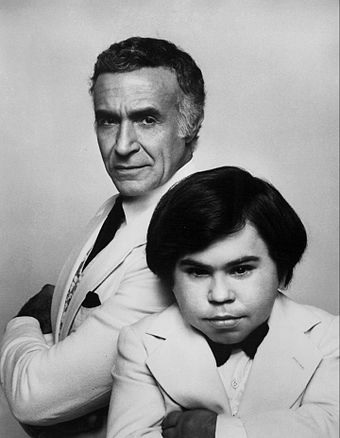
As always, this week’s episode of Fantasy Island brings us a collection of guest stars who have all flown to the island to have their fantasies granted.  However, none of these fantasies are quite as interesting as the rather bizarre relationship of Mr. Roarke and Tattoo.

I’ve often commented on the fact that, during the first season of this show, Mr. Roarke and Tattoo seemed to harbor a strong dislike for each other.  Tattoo was always complaining that Mr. Roarke wasn’t charging enough for the fantasies.  Mr. Roarke often chastised Tattoo for his attempts to hit on the guests.  Even though they were supposed to be good friends and business partners, nearly every episode seemed to end with Mr. Roarke getting rather exasperated with Tattoo.  Reportedly, Ricardo Montalban and Herve Villechaize did not get along off-screen and, as I’ve said before, it often seems like that dislike bled into their performances on the show.

This episode begins with Tattoo smoking a pipe and wearing a monocle.  As he explains to Mr. Roarke, he’s trying to be appear sophisticated so he can “get all the broads.”  He also says that he’s specifically trying to act like Mr. Roarke.  Now, I know enough about passive-aggressive behavior that I immediately realized that Tattoo’s compliment was basically his way of accusing Mr. Roarke of being a pompous jackass.  Mr. Roarke obviously figured it out as well because, a few scenes later, he takes a twenty dollar bill away from Tattoo and gives it to a guest on the island.  When Tattoo objects, Mr. Roarke suavely replies, “Finders keepers, losers weepers.”  At the end of the episode, when Tattoo gets his twenty back, Roarke promptly snatches it away from him.  It’s hard not to notice that, even with two fantasies to keep an eye on, Mr. Roarke’s main concern seems to be making sure that Tattoo doesn’t get anything that he wants.

As for the fantasies, the first one deals with Harry Beamish (Richard Dawson), a degenerate gambler who has lost his family due to his need to make bets and risk his cash.  Harry’s fantasy to be the luckiest guy in the world and, for a day or so, he is.  Every bet that he makes pays off.  Tattoo even starts to follow Harry around at the race track so that he can too can make money.  (Fantasy Island has a racetrack?)  But then Harry’s ten year-old son, Joey (Brad Savage), shows up.  It turns out that Joey’s fantasy is for his father and his mother to get back together.  (Mr, Roarke mentions that he only charged Joey $5 for the fantasy so Tattoo does have a point about Roarke not charging enough.)  When Harry realizes that Joey idolizes him and is planning on following in his footsteps, Harry realizes that it’s time to stop gambling and be a father.  Awwwwww!

The other fantasy deals with Edith Garvey (Kathryn Holcomb), whose fantasy is to go back to the 20s and become a torch singer.  Under the name of Kitty Abilene, she finds a good deal of success.  She also falls in love with her piano player, Neil (Edd Byrnes).  Unfortunately, two rival gangsters go to war over who owns her contract.  Edith’s fantasy ends at the exact moment that the local speakeasy is attacked by crime boss Big Al.  Fortunately, it turns out that Neil is also a guest on the island and that he was having a fantasy of his own.  Edith and Neil leave the island together.  Awwwwww!

The fantasies weren’t bad and, being the 20s loving history nerd that I am, I enjoyed the gangster action.  But, ultimately, it was the passive aggressive hostility between Mr. Roarke and Tattoo that made this episode memorable.  The first season ended with Roarke rolling his eyes at Tattoo.  Will their relationship improve during the second season?  We’ll find out next week!

Horror Scenes I Love: Salem’s Lot (Part 2)


sddefault

“Look at me teacher.”

Those were some of the most terrifying words I’ve ever heard growing up. It’s all because of one scene from the tv mini-series which adapted Stephen King’s vampire novel, Salem’s Lot. It was a scene in the novel that terrified me as a young boy reading King for the first time.

I’ve always been gifted (or I sometimes say cursed) with having a very overactive imagination. This is why horror has always been such a fascinating genre for me. Even where the horror is all up in one’s face with it’s gore and messy aftermath my mind’s eye would make things worst or just constantly play it on repeat in my head days after the film has ended. It’s even worst when the horror comes across less through gore and more through atmosphere and built-up dread moving towards a jump-scare or something more insidious.

This particular scene is my second favorite from the Salem’s Lot mini-series. The first one I had posted a couple years back which just barely lags behind this one for third. What made this scene so effective despite it’s tv-style production was Tobe Hooper’s direction. Despite working with the censorship inherent in broadcast tv, Hooper was able to create a palpable sense of dread as the old English teacher Matt Burke senses a presence up in one of his house’s rooms. It was the same room where one of his former students had passed away in his sleep.

As the audience we already have an idea who or what is in that second floor room. Matt Burke has an idea as well, but his morbid curiosity wins out as he decides to investigate. Yet, despite such a lack in judgement he does come armed with a crucifix in hand. The way the scene builds and builds as Burke climbs the stairs and hesitating before opening the door to the room was almost too much to bear.

The reveal of his former student, Mike Ryerson, back in the room sitting in the rocking chair as one of the undead only increases the horror of the scene. His snake-like mannerisms was a new take on the vampire behavior. It’s not the usual silk and lace bloodsucker we grew up watching. This was a vampire that behaved like a predator beguiling it’s next prey. From the way Ryerson (played by Geoffrey Lewis) hissed his words and undulated his body as he stood to face his former teacher was disturbing at the very least.

Just writing about it and seeing the scene for the umpteenth time still gives me the shakes.

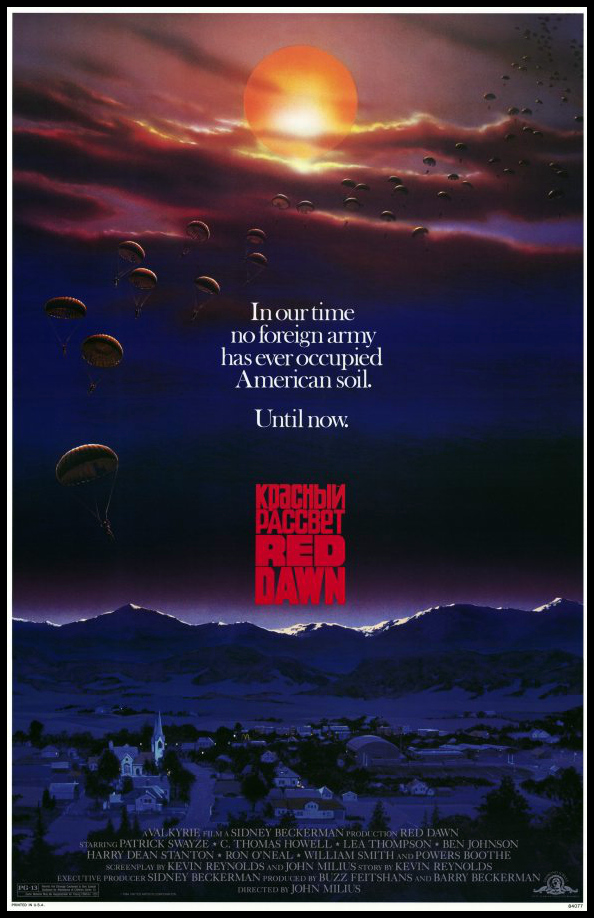
Review: Red Dawn (dir. by John Milius)


“I don’t know. Two toughest kids on the block I guess. Sooner or later they’re going to fight.”

[guilty pleasure]

Anyone who grew up during the 1980’s would say that some of the best action films were made and release during this decade. I won’t disagree with them and probably would agree to a certain point. This was the decade when action films evolved from the realism of the 70’s to the excess and ultra-violence of the 80’s. This was the decade which ushered in such action heroes as Schwarzenegger, Stallone and Willis. It was also the decade which released one of the most violent films ever released by a major motion picture studio. It’s a film that has been remembered through the prism of nostalgia. I speak of the 1984 war film by John Milius simply titled Red Dawn.

John Milius is one of those filmmakers who never conformed to the stereotype of liberal Hollywood. He was an unabashed Republican (though he considers himself more of a Zen anarchist) in a liberal studio system who happened to have written some of the most revered films of the 1970’s (Jeremiah Johnson, Apocalypse Now, Dirty Harry). He came up with a follow-up to his hugely successful Conan the Barbarian in the form of a war film set in current times (mid-80’s) America that he called Red Dawn. It was a story which takes an alternate history of the Cold War where Soviet forces and it’s allies launch a successful preemptive invasion of the United States. Before people think that this was the idea born of a conservative, warmongering mind it’s been documented that Milius’ inspiration for this film was a real Pentagon hypothetical exercise of what would happen if the Soviet Union conducted a conventional invasion of the United States and how the government and it’s population would react and resist such an occupying force. The  story would finally get it’s final treatment with major input from screenwrtier Kevin Reynolds’ own story which added a certain Lord of the Flies vibe to the group of teenagers who form the bulk of the film’s cast.

The film actually starts off with an impressive sequence of your typical Midwestern high school day with students seated in their classrooms. One moment this Rockwellian image gets a surprise from soldiers parachuting in the field outside the school. Thus we have the beginning of the Soviet invasion with one of the teachers being gunned down for trying to peacefully interact with the airborne troopers. The rest of the film is about a group of highschoolers led by senior Jed Eckert (Patrick Swayze) and his younger brother Matt (Charlie Sheen) as they flee with a handful of their classmates the massacre at their school and soon their whole town as well.

Red Dawn uses the first half of the film to show the confusion and chaos created by the sudden appearance of foreign soldiers on America soil attacking civilians and, soon enough, whatever American military response that manages to react in the area. We’re put in the shoes of Jed and his band of teenagers as they try to survive the roving bands of Soviet and Cuban soldiers patrolling the plains and countryside surrounding their hometown of Calumet, Colorado. We see American civilians packed into re-education camps and rumors of KGB secret police making certain troublemakers disappear and worst. It’s the America Cold War nightmare scenario where the Soviet Evil Empire has taken a foothold on US soil and the government and military nowhere in sight to help it’s population.

The second half of the film solves this scenario by arming the teenagers led by Jed into a sort of teen guerrila force using their school’s mascot as their rallying cry. It’s the shouts of “Wolverines!” which has become part of American pop-culture as we get to see these teenagers conduct hit-and-run strikes on enemy patrols and forward bases while at the same time arming those they free from camps. It’s during this part of the film where the violence gets ramped up to an almost ridiculous level. It’s no wonder that for almost two decades this film would be considered by Guinness World Records as the most violent film ever put on the big-screen. Milius and his filmmaking crew do not skimp on the use of blood squibs as Jed and his ragtag band of teen fighters gun down Soviets, Nicaraguans and Cuban soldiers by the score every minute during a long montage in the middle of the film.

Red Dawn in terms of storytelling is actually quite good in the grand scheme of the narrative being told, but even through the prism of nostalgia and rose-tinted glasses the characters in the film get the short-end of the stick. With the exception of Swayze’s eldest teen Jed as leader of the Wolverines the rest of the band’s teenage characters look like your typical casting call stereotypes who fill in the required roles in any ensemble cast. There’s Darren Dalton as the high school class president jealous of the group’s leader Jed, but unable to act on it. We have C. Thomas Howell as Robert the mousy one when the film begins who becomes a hardened and cold-hearted killer as the film goes on. Everyone fits in neatly to their assigned role and noen of the young actors (at the time) bring much to their characters.

This film continues to be remembered fondly by it’s fans both new and old because of the “what-if” scenario being played out on the screen. I would say that if there ever was a pure American film I would think Red Dawn manages to fit the bill. It’s a film which highlights the so-called individualism and can-do attitude Americans see for themselves. How it’s up to each individual to fight to protect their loved ones and for what is theirs. Some have called this film as a conservative’s wet-dream, but I rather think it’s a film that should appeal more to Libertarians as it focuses on individual liberties and self-preservation when the government and military tasked to protect them have failed.

John Milius has always been a maverick in Hollywood and his unpopular political beliefs have kept him from doing more work in the film industry, but one cannot deny the fact that he made one of the most iconic films of the 1980’s. Whether one agreed with the film’s politics and thought it to be a good film or not was irrelevent. Red Dawn has become part of American pop-culture and will continue to be a major example of the excess of 80’s action filmmaking for good or ill. Plus, even the most liberal people I know find the basic story of fighting to protect the nation from invaders something that feeds their innermost fantasy of playing the good guys fighting the good fight. Red Dawn is a great example of the underdog film that just happens to have teenagers kicking Soviet military ass.

Scenes I Love: Salem’s Lot (Part 1)


Stephen King’s novels and short stories were mined relentlessly during the late 70’s and through the 80’s and the early 90’s. For the most part the film and tv adaptations of his work were adequate and passable. Some were downright awful and made one wonder if King was just trying to cash as many of his work for licensing paychecks or if he really thought the studios who purchased the rights would actually do a good job adapting them. One such studio which seemed to have done a very good job adapting one of King’s greatest works, Salem’s Lot, was Warner Brothers who adapted the classic vampire novel to become a mini-series for CBS.

I never saw the mini-series when it first aired in 1979, but I did see it a few years later when it re-aired on TV and then many more times on VHS and then on DVD. Tobe Hooper directed the hell out of this mini-series and turned what was a very complex modern retelling of Bram Stoker’s Dracula into a 3-hour mini-series that was both gothic and downright terrifying despite the restraints of TV.

While the mini-series does seem dated now it still retains that creepiness, foreboding atmosphere and scares which made Hooper’s Salem’s Lot one of the better King adaptations. The scene which will always stick with me and still gives me the chills whenever I watch it is when Danny Glick’s younger brother visits him in the hospital. This scene is just downright scary whether watching it as a 9 year-old or one in their 30’s.