Retro Television Review: Miami Vice 3.2 “Stone’s War”


Welcome to Retro Television Reviews, a feature where we review some of our favorite and least favorite shows of the past!  On Mondays, I will be reviewing Miami Vice, which ran on NBC from 1984 to 1989.  The entire show can be purchased on Prime!

This week, another friend of Sonny’s gets killed.

Episode 3.2 “Stone’s War”

(Dir by David Jackson, originally aired on October 3rd, 1986)

Sonny Crockett’s old friend, journalist Ira Stone (Bob Balaban), returns to Miami and he’s in trouble once again.

The last time we saw Stone, he appeared to be dying as the result of being severely wounded by Col. William Maynard (G. Gordon Liddy).  I guess Stone survived because this episode opens with him and a cameraman in Nicaragua, filming anti-Communist rebels opening fire on a village.  They even gun down a priest!  However, it turns out that the rebels have got some help from some men who appear to be American.  Stone’s cameraman is shot.  Apparently leaving him to die, Stone grabs the tape of the attack and then flees to Miami.

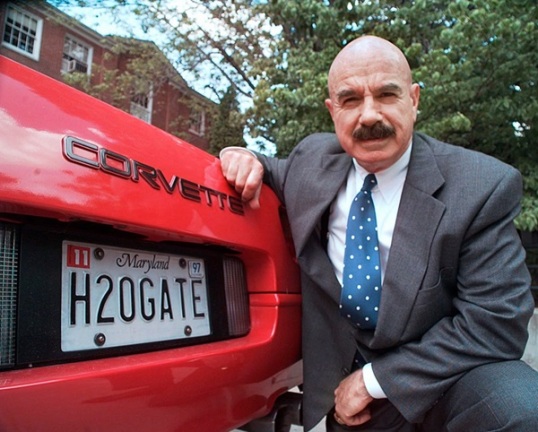
In Miami, Stone tracks down Sonny, who is reluctant to get involved with Stone.  However, when it becomes obvious that some agents of the government are not only following Stone but also trying to assassinate him, Crockett changes his mind.  It turns out that the men in Nicaragua do indeed work for Col. Maynard.  Maynard makes a return appearance, showing off a necklace of ears that have been chopped off of communists in an attempt to get businessmen to invest in his army.  This episode drops some very obvious hints that Maynard is now working for the U.S. government.

In their efforts to help Stone get his tape to the public, Crockett and Tubbs get a few people killed.  Local reporter Alica Mena (Lonette McKee) is murdered after Maynard’s men break into her office to search for the tape.  In the end, Stone himself is once again wounded by Maynard’s man and this time, he actually dies on-camera.  As for Maynard, he once again boards a private plane and escapes.  The episode ends on a properly cynical note, with Crockett listening to reports blaming the death of the priest on the Nicaraguan government.

Actually, this whole episode feels a bit cynical.  On the one hand, this episode criticizes the American government for being so anti-communist that it tries to overthrow the governments of other counties.  On the other hand, a good deal of the episode’s running time is devoted to showing off Sonny’s new car, a 1986 Ferrari Testarossa.  There’s even an extended chase scene that seems to exist largely so the show can work in as many close-ups of Sonny changing gears as possible.  It’s a cool car but just try to get one in Nicaragua, Venezuela, or Cuba.  (Or, I should say, try to get one without being related to someone who is in power.)

Ira Stone was a bit more compelling in his previous appearance on the show.  In this episode, Balaban’s performance is almost too low-key.  It lacks the manic instability of his first appearance, in which Stone was portrayed as being almost as mad as Maynard.  This time out, he’s just another independent journalist who is convinced the government is out to get him.  Fortunately, G. Gordon Liddy returns to Maynard and takes so much obvious joy in the role that he’s fun to watch.  As I mentioned when Liddy last appeared on this episode, my father had a “G. Gordon Liddy for President” bumper sticker.  As far as Watergate felons are concerned, Liddy was certainly less annoyingly self-righteous and more honest about his amorality than John Dean has turned out to be.

As a whole, this wasn’t a bad episode.  Like last week’s episode, it was serviceable but it still seemed to be lacking the spark that distinguished the show’s first two seasons.  For the second week in a row, Miami Vice puts more emphasis on its guest stars than the main cast and, perhaps as a result, the main cast seems to largely be going through the motions.  (Zito and Gina don’t even appear in this episode.  Castillo is barely present, which is interesting considering that the character is supposed to have connections in U.S. intelligence that would have perhaps been a bit helpful this time around.)  Still, it was good to see both Stone and Maynard return to the show and remind the viewers that the vice in Miami is often the result of conflicts happening elsewhere.

Late Night Retro Television Review: Monsters 2.6 “The Farmer’s Daughter”


Welcome to Late Night Retro Television Reviews, a feature where we review some of our favorite and least favorite shows of the past! On Wednesdays, I will be reviewing Monsters, which aired in syndication from 1988 to 1991. The entire series is streaming on YouTube.

Say, have you heard the joke about the traveling Bible salesman and the farmer’s daughter?  How about the one about the Man from Nantucket….

Episode 2.6 “The Farmer’s Daughter”

(Dir by Michael Warren Powell, originally aired on November 5th, 1989)

On a rainy night, traveling salesman Howard Filby (Soupy Sales) has an accident in front of the farmhouse owned by …. well, the show just calls them Ma (Bobo Lewis) and Pa (George Hall).  Ma and Pa seem like good country folks.  (That said, just their names brought to mind the owners of the Ma & Pa General Store on King of the Hill.  “I guess your Pa because you’re PA-thetic!”  “And you’re Ma because you’re always ridin’ mah ass!”)  Ma and Pa are willing to let Howard spend the night at the farmhouse, out of the rain.  He can just sleep up in the attic.  They’ll have to put up a privacy sheet, of course.  Their daughter Lucy (Stephanie Phillips) also stays up in the attic.

That privacy sheet doesn’t stay up for long.  Howard becomes intrigued by Lucy’s silhouette and her sultry voice.  When the sheet comes down, Howard is relieved to discover that Lucy is just as attractive as she sounded.  Lucy asks Howard for his undying love and Howard’s willing to give it.  Lucy talks about heading downstairs to let Ma and Pa know that they’ll be getting married.  Howard’s a little bit surprised to hear that….

Howard’s even more surprised when he accidentally pulls off a chunk of Lucy’s skin.  It turns out that Lucy is not quite who Howard thought she was and that Howard is hardly the first salesman to be brought to the farmhouse and sent up to the attic.  Even as Howard struggles in the attic, Ma and Pa sit in their living room and smile at the sound of another fender bender outside….

This was a nicely atmospheric episode.  Having heard all the various stories and jokes about traveling salesman and farmer’s daughters, I can’t say that I was particularly surprised by the direction that the story took but the episode still works as an example of American folk horror.  Soupy Sales was a comedian and a children’s show host and, according to Wikipedia, his trademark was getting a pie slammed in his face.  (Ouch!)  With that in mind, I guess it’s not a surprise that Sales’s performance occasionally leans a bit too much towards the goofy side.  (There’s a difference between playing the role with humor and just mugging for the camera.)  However, Stephanie Phillips, George Hall, and Bobo Lewis are all effectively creepy as the faux friendly farmhouse inhabitants.

Interestingly enough, this episode was co-written by character actor Bob Balaban.  As a director, Balaban was responsible for Parents, another film about a seemingly perfect married couple with a secret.

Retro Television Review: Miami Vice 2.11 “Back In The World”


Welcome to Retro Television Reviews, a feature where we review some of our favorite and least favorite shows of the past!  On Mondays, I will be reviewing Miami Vice, which ran on NBC from 1984 to 1989.  The entire show can be purchased on Prime!

This week, an old friend of Sonny’s comes to Miami.

Episode 2.11 “Back In The World”

(Dir by Don Johnson, originally aired on December 6th, 1985)

Directed by Don Johnson himself, Back In The World opens in the closing days of the Vietnam War.  A war correspondent named Ira Stone (played by Bob Balaban) has discovered that the bodies of American soldiers are being packed with heroin before being shipped back to the United States.  He shares the discovery with his best friend, a young Marine named Sonny Crockett.

Ten years later, Sonny is a member of Miami Vice and laughing as he watches the DEA go all out to arrest two rich kids who have a few pounds on weed on them.  Meanwhile, Ira Stone is still a journalist but it’s been a while since he’s had a major byline.  Stone has become known for being erratic and paranoid.  His own wife (played by Patti D’Arbanville, who was Johnson’s girlfriend at the time this episode was filmed) describes Stone as being a crazed junkie who spends his time chasing imaginary enemies.  Sonny discovers just how paranoid Stone has become when Stone approaches him and asks for help in exposing the truth about the heroin trade.

Stone has a lot of theories, the majority of which involve rogue elements of the CIA.  Sonny agrees to help Stone investigate a lead but he’s skeptical of Stone’s theories.  But then someone launches a mortar attack on Sonny and Stone while they’re talking on a motorboat.  “INCOMING!” Stone yells as Sonny steers the boat through a shower of explosions.  As out there as Ira Stone may be, he’s obviously made someone uncomfortable.

Could that someone be William Maynard (G. Gordon Liddy, who was one of the Watergate burglars)?  Maynard is a former (and maybe current) CIA agent who, in Vietnam, was renowned for his ability to track down and destroy the enemy.  Now, Maynard lives in a Miami mansion with his wife (Susan Hatfield) and a mute servant who has a tendency to show up whenever someone needs to be killed.   While Crockett and Stone investigate Maynard, Tubbs and Switek (who is dressed as a leather-clad biker for some reason) investigate an exotic drug currier named Dakotah (Iman).

It’s an intriguing story but it ends on a rather conventional note, with Crockett and Tubbs launching an assault on one of Maynard’s mansions in the Everglades.  It’s probably not a coincidence that the Everglades are filmed to resemble a Vietnamese jungle.  At one point, Crockett nearly shoots in Tubbs by mistake, a stark reminder of the confusion that comes with combat.  In the end, Maynard escapes, Stone is seriously wounded, and the heroin trade continues.  There aren’t many happy endings to be found in Miami.

This was an uneven but entertaining episode.  The use of The Doors on the soundtrack was occasionally effective and occasionally heavy-handed.  The opening Vietnam montage was done well but it fell apart as soon as middle-aged and gravelly-voiced Don Johnson showed up as a fresh-faced Marine in his 20s.  That said, once the action moved to Miami and the present day, Don Johnson was never less than convincing as a battle-scarred veteran still trying to come to terms with what happened in Vietnam.  G. Gordon Liddy was entertaining as Maynard, even if it was obvious that acting was not his main thing.  Bob Balaban’s manic intensity (“INCOMING!”  “MEDIC!”) made Ira Stone into a fascinating character.  A visit by Crockett and Stone to a VA hospital not only leads to an important lead but it also allows the show to discuss the shameful way that America treated (and treats) veterans of unpopular wars.  Johnson did a good job directing the episode but it still never quite escaped the shadow of the thematically-similar Bushido.

Incidentally, my father used to have a “G. Gordon Liddy For President” bumper sticker.  And I’ve got a beat-up copy of Liddy’s autobiography, one that I purchased from Recycled Books in Denton a few years ago.  After watching this week’s episode, I think I’ll give it a read.

Film Review: Asteroid City (dir by Wes Anderson)


Asteroid City opens with black-and-white footage of Bryan Cranston, wearing a suit and speaking in the authoritative tones of someone who has made his living on television.  Cranston informs us that we are about to see a televised production of a play by the famed but enigmatic playwright named Conrad Earp (Edward Norton).

The play, which is seen in stylized color, opens with Augie Steeback (Jason Schwartzman) driving his family through the desert.  He is taking his son, Woodrow (Jake Ryan), to a Junior Stargazers convention that is being held at Asteroid City, a tiny town that is best-known for being the location of an impact crater.  Along for the ride are Augie’s three daughters, who are all pretending to be witches.  What Augie hasn’t told his children is that their mother has died, her cremated remains are in a Tupperware container, and that they will be moving in with their wealthy grandfather (Tom Hanks).

There’s not much to the town of Asteroid City.  There’s a motel that’s managed by a man (Steve Carell) who sells land deeds out of a refurbished Coke machine.  There’s a diner.  There’s a group of helpful cowboys, led by the polite and helpful Montana (Rupert Friend).  There’s a mechanic (Matt Dillon) who is called into duty when Augie’s car breaks down.  The Junior Stargazer convention is the event of the year for Asteroid City.  Young geniuses from all around the country have descended on the town and have brought their parents.  One of them, Dinah (Grace Edwards), is the daughter of actress, Midge Campbell (Scarlett Johansson).  When an alien (played, at one point in the film, by Jeff Goldblum) shows up and steals the town’s meteorite, General Gibson (Jeffrey Wright) declares a quarantine.  Some people handle the lockdowns better than others.  Augie takes pictures and thinks about his wife.  Midge rehearses for her next role, one that is centered around her character dying.  The genius children play a memory game that they realize will never end because they’re all geniuses.  A teacher (Maya Hawke) tries to teach her students about the Milky Way, just to discover that the kids only want to talk about the alien.  One of the fathers (Liev Schreiber) ends up with a useless plot of desert land and the death ray that his son recently invented.

Throughout it all, Bryan Cranston appears in black-and-white footage that gives us a look into what went on behind the scenes during the production of Asteroid City.  The director (Adrien Brody) was a lech.  The actor playing Augie struggled to understand what the play was about and who his character was meant to be while the actress (Margot Robie) hired to play his wife ended up in another play after her scenes were cut from Asteroid City.  Only once does Bryan Cranston’s host appear in the color sections of Asteroid City, just to sheepishly admit that he’s not supposed to be there before ducking off camera.

Even if his name wasn’t in the opening credits, the viewer could probably easily guess that this is a Wes Anderson film.  It features all of Anderson’s trademarks, all of the things that viewers will automatically love or hate depending on how they feel about Anderson’s quirky aesthetic.  It’s a visually impressive, pop art-flavored, all-star comedy with an undercurrent of profound melancholy, one in which the fanciful strangeness of the alien’s “invasion” is compared and contrasted with the very real-life strangeness of how humans deal with life, loss, death, and uncertainty.  Scenes of clever wordplay are mixed with scenes in which we see Augie still very much struggling to come to terms with the death of his wife and the actor Augie very much struggling to understand what is actually going on in his character’s head.  As far as recent Anderson films go, Asteroid City is not quite as humanistic as Rushmore or Grand Budapest Hotel but, at the same time, it’s still more accessible than The French Dispatch.

If you’re not a fan of Anderson’s style, this film won’t convert you.  That said, I am a fan of Anderson’s style and I absolutely loved Asteroid City.  As with so many of Anderson’s films, the main focus is on how we try to deal with the uncertainties of life by trying to maintain an illusion of control over every aspect of our lives.  Playwright Conrad Earp writes because that way he can have a world that follows his own rules.  The actors follow a script that tells them how to react to everything that happens around them.  In the play, the Junior Stargazers fall back on science while Augie’s father-in-law falls back on religion and Augie’s daughter convince themselves that spells will bring back or, at least, protect their mother.  Even General Gibson falls back on his belief in the government and the military to deal with the sudden appearance by the alien.  The alien is the unknowable and his arrival reminds everyone that life is unpredictable, regardless of how much you try to control your own story.  Indeed, while the film takes place in the 50s and is full of comments about the Red Scare and atomic bomb testing, it’s hard not to see Asteroid City as being a commentary on the recent COVID lockdowns and the debate over whether people could ever go back to living the way that they did before the pandemic.  Much as with the Coen Brothers’s similarly stylized A Serious Man, the ultimate message seems to be that the only way to deal with the unpredictability of life is to embrace it.

It’s also a very funny film, one that is full of small details that reward repeat viewing.  If one focuses on the background characters, it quickly becomes apparent that there are actually several stories unfolding in the film and, much as with life, the viewer just has to be willing to look for them.  (I particularly enjoyed the romance between The Teacher and Montana.)  Jason Schwartzman is compelling as both Augie and the actor playing Augie and Scarlett Johansson plays both Midge and the actress playing Midge with the perfect amount of cool detachment.  To the film’s credit, none of the character’s become caricatures.  They remain individuals, regardless of how bizarre the film’s story may sometimes seem.  Everyone gets a moment to reveal a little depth, from Jeffrey Wright’s sincere (if misplaced) faith in the lockdown policy to the moment when Tom Hanks’s previously unsympathetic father-in-law reveals that he’s as much in mourning as Augie.  The all-star cast also includes Tilda Swinton, Liev Schrieber, Stephen Park, Willem DaFoe, Hong Chau, and Margot Robbie and all of them add to the film’s portrait of quirky but ultimately relatable humanity.

Again, with this film, it undoubtedly helps to already be familiar with and to like Wes Anderson’s way of doing things.  If  you’re not a fan of his film, this one probably won’t change your mind.  That said, for those of us who do enjoy his style, this is Anderson at his best.

The TSL’s Grindhouse: Parents (dir by Bob Balaban)


An odd little film, 1989’s Parents is.

It takes place in the 50s of the pop cultural imagination, with neatly laid out suburban neighborhoods and perfectly mowed lawns and big cars driving down the street.  Nick (Randy Quaid) and Lily (Mary Beth Hurt) seem like the perfect couple.  Lily stays at home and spends a lot of time in the kitchen.  Nick is an engineer who works for a company called Toxico and who is helping to develop what will become known, during the Vietnam War, as Agent Orange.  Nick and Lily are friendly, well-mannered, and they love to eat meat.  Lily explains, at one point, that she didn’t really love to eat meat until she married Nick and he showed her how wonderful it could be.

Their son, ten year-old Michael (Bryan Madorsky), is a bit less conventional.  He’s a quiet boy who never smiles and who, when asked to draw a picture of his family, freaks out his school’s guidance counselor (played by Sandy Dennis).  Michael has frequent nightmares.  Michael doesn’t like to eat meat and, in fact, it’s hard to think of a single scene in the movie where Michael is seen eating anything.  Michael is haunted by the sight of his parents making love in the living room.  He’s also haunted by a growing suspicion that his parents are cannibals.

Are they?  Perhaps.  It’s hard to say.  The first time you watch the movie, it seems deceptively obvious that Nick and Lily are exactly what Michael says they are.  The second time, you start to notice a few odd things.  For one thing, we never see Michael actually going from one location to another.  Instead, he just seems to magically show up wherever he needs to be to hear something that will confirm his suspicions.  When his teacher and his guidance counselor discuss his home life, Michael just happens to be in a nearby closet.  When his mother is preparing something that looks like it might be a human organ, Michael just happens to be standing in the pantry.  Are we seeing reality or are we just seeing what Michael thinks is reality?  When Nick starts to threaten Michael and later claims that there’s no way Michael is his son, is he really saying that or is Michael just imagining his fatherr confirming all of Michael’s insecurities?  How much of the film is real and how much of it is in Michael’s head?

It’s an odd film, Parents.  It’s also the directorial debut of character actor Bob Balaban.  Balaban has spent the majority of his career playing shy, slightly repressed characters.  Parents, with the withdrawn Michael as the main character, is a film that feels autobiographical.  That’s not to say that Balaban’s parents were cannibals but the scenes where Nick goes from being a loving father to an abusive monster are too intense and suffused with too much pain for them to be anything other than personal.  Balaban’s direction is heavily stylized.  At times, it’s a bit too stylized but ultimately, it works.  The final 30 minutes of the film feel like a nightmare that has somehow been filmed.

A satire of conformity and suburbia, Parents is also a portrait of an alienated child struggling to figure out where he fits into his family.  He’s given the choice of either indulging in his family’s sins or living life alone.  Except, of course, it really isn’t a choice.  Nick expects Michael to do what he’s been told, no matter what.  Randy Quaid and Mary Beth Hurt are both terrifying as the parents but, at the same time, Balaban makes good use of the fact that both of those performers — at least at the time this movie was made — were naturally likable.  You want Nick to be the perfect father that he pretends to be and you share Michael’s anger and disillusionment when he turns out to be something very different.

Parents may be a strange film but it’s not one that you’re going to forget.

The Late Shift (1996, directed by Betty Thomas)


Want to relive the public battle over whether David Letterman or Jay Leno would be Johnny Carson’s successor?

Then The Late Shift is the film for you!

Though it pales when compared to the subsequent battle between Leno and Conan O’Brien, the competition between Letterman and Leno to succeed Johnny Carson as host of The Tonight Show riveted America in the early 90s.  Most media critics (and, reportedly, Carson himself) felt that Letterman had not only earned the right to host The Tonight Show but that he represented the future of late night comedy.  The NBC network execs, however, preferred Leno, who had served for years as Carson’s permanent guest host and who was viewed as being more of a team player than Letterman.  The end result, of course, was that Leno got The Tonight Show, Letterman switched networks, and for years the country was separated into Leno people and Letterman people.  (Letterman got the critical acclaim but Leno got the ratings.)

The Late Shift opens with the unexpected retirement of Johnny Carson (played, as an enigma, by Rich Little) and then follows Letterman (John Michael Higgins) and Leno (Daniel Roebuck) as they maneuver their way to become his successor.  Unfortunately, neither Higgins nor Roebuck are particularly believable in their roles, though Roebuck does get to wear a truly impressive fake chin.  Far more impressive are Kathy Bates as Leno’s manager and Treat Williams as Mike Ovitz.  Bates rips through her scenes, destroying anyone standing in the way of Jay Leno while Williams is cool, calm, and menacing as the agent who was, at the time the film was made, the most powerful man in Hollywood.

The main problem with The Late Shift is that, when it went into production, Letterman was ahead in the ratings and the film is clearly sympathetic to him.  Leno comes across as a weasel while Letterman is portrayed as being neurotic but brilliant.  But, shortly before the film made its debut on HBO, Leno landed the first interview with Hugh Grant after the latter’s arrest with a prostitute.  Leno not only won that night in the ratings but he won every subsequent night and soon, Letterman was the one who was forever stuck in second place.  A title card was added to the end of  The Late Shift, admitting that Leno was now winning the war for the late night.  Since every minute of the film was designed to make Letterman appear to the winner, it’s hard not to be let down by the ending.

Despite the disappointing ending, The Late Shift is an entertaining look at network politics.  (Seinfeld fans will note that, after playing a version of Warren Littlefield during the show’s 4th season, Bob Balaban was cast as the real thing in The Late Shift.)  After watching the movie, be sure to read the Bill Carter book on which it’s based.

Horror Film Review: Altered States (dir by Ken Russell)


You gotta watch out when it comes to those sensory deprivation tanks.  They may look like fun and it might seem like a pleasant idea to spend a while floating in and out of a state of consciousness but those tanks will mess you up.  Especially if you’ve got unresolved issues with your family and religion.

Also, if you’re going to go to Mexico to try a powerful hallucinogenic, make sure you’re not appearing in a Ken Russell film because again, those drugs will mess you up.  It’s like you’ll close your eyes and, when you reopen them, you’ll be in an 80s music video or something.

Now, to be honest, Altered States came out in 1980 so it’s a bit unfair to complain that it looks like a music video from the 80s or, for that matter, the 90s.  Instead, it’s more fair to say that a lot of the music videos from those two decades looked like Altered States.  That shouldn’t be particularly surprising since this film was directed by Ken Russell and Russell was a director who specialized in combining music with wild imagery.

Altered States may have been directed by Ken Russell but it was written by Paddy Chayefsky.  Chayefsky, of course, is best known for writing the script for Network.  (He also wrote the script for the Oscar-winning film, Marty.)  Chayefsky is one of those writers who is always cited as an inspiration by writers who are trying justify being heavy-handed.  For instance, when Aaron Sorkin was criticized for both Studio 60 On The Sunset Strip and The Newsroom, his supporters started talking about how he was just carrying on the proud tradition of Paddy Chayefsky.  In his autobiography, A British Picture, Ken Russell portrays Chayefsky as being a pompous control freak who refused to allow any changes to his dialogue-heavy script.  Russell responded by directing his actors to speak the dialogue as quickly as possible, rendering much of it incoherent.  In a few scenes, he even specifically had the actors eating so that their mouths would be full as they spoke.  Chayefsky was not amused and eventually demanded to be credited under his real name, Sidney Aaron.

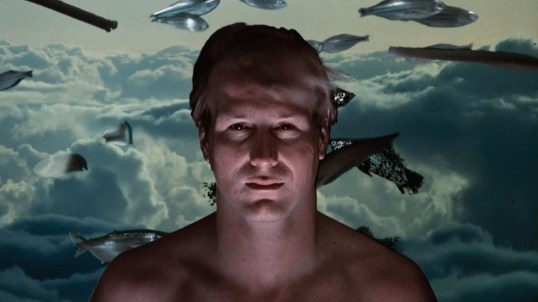
As for the film itself, it tells the story of Dr. Eddie Jessup (William Hurt, in his film debut), who is convinced that he can cure schizophrenia by exploring states of altered consciousness.  As mentioned above, this leads to him floating in a tank and taking hallucinogenics in Mexico.  Somehow, this leads to him turning briefly into a caveman and then into some sort of primordial energy creature.  His wife (Blair Brown) is not happy that Eddie appears to be determined to reverse evolution and return to mankind’s original form.  For that matter, Eddie’s bearded colleagues (Charles Haid and Bob Balaban) all think that he’s playing a dangerous game as well.  Eddie’s daughter (Drew Barrymore, making her film debut) isn’t particularly concerned but that’s just because she’s like five and probably thinks it would be fun to have a primordial energy monster to play with.  Anyway, it all becomes a question of whether or not all questions need to be answered and whether love can defeat science.

Anyway, this is a deeply silly movie but it’s also kind of compelling, mostly because the uneasy mix of Chayefsky’s pompous, serious-as-Hell script and Ken Russell’s aggressive and semi-satiric directorial style.  Chayefsky obviously meant for the story to be taken very seriously whereas Russell takes it not seriously at all.  Though Chayesfky and Russell ended up hating each other, Russell keeps the film from becoming the cinematic equivalent of Neil DeGrasse Tyson’s twitter account.  Chayefsky’s greatest objection was that Russell directed the actors to not only speak quickly but to also speak over each other but this actually works to the film’s advantage.  Eddie and his colleagues are young, arrogant, and determined to make their mark.  Of course, they’re going to speak quickly.  They’re excited and there’s no time to lose.  The film’s best moments are the early ones, where it’s hard not to get swept up in Eddie’s enthusiasm.  Of course, once Eddie turns into a caveman, it pretty much becomes impossible to take anything that follows seriously.

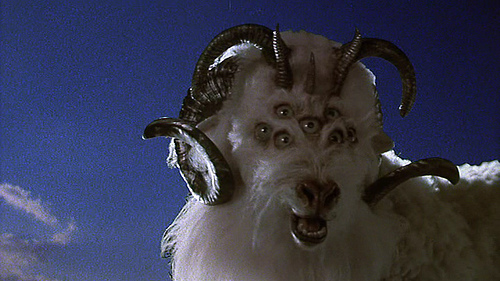
For all the talk about the origins of mankind and whether or not love can save the day, the main appeal of this film is to watch William Hurt totally freak out.  Jessup’s hallucinations allow Russell to do what he did best and they’re the highlight of the film.  Despite Chayefsky’s ambitions, you don’t watch this film for the science.  You watch it for the seven-eyed ram and the scenes of Eddie walking into a mushroom cloud.  Ken Russell was smart enough to know that audiences would take one look at William Hurt, with his WASP bearing, and totally want to see just how fucked up Eddie Jessup actually was.  On that front, Russell totally delivers.

This film is a mess but at least it’s a Ken Russell mess.


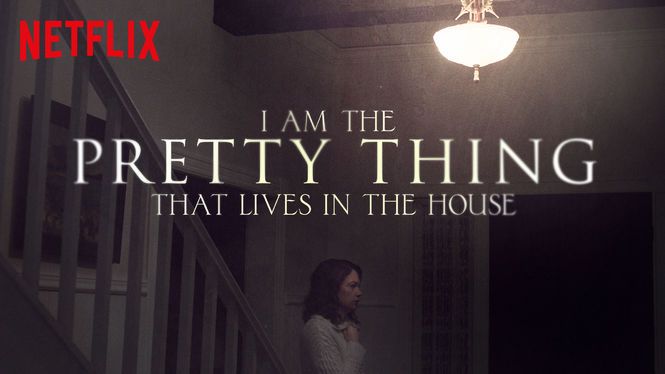
I Am The Pretty Thing That Lives In The House- Review By Case Wright


IAM IAM

Welcome to the second day of October!!! Woohoo! There are a lot of great horror movies to watch and this is not one of them!  HERE WE GO!  I will only refer to this movie as I AM because the above is too much to write unless I create some shortcut key and I am NOT doing that….EVER!

This film is a sloooooow paced artsy haunted house film directed by Oz Perkins the son of Anthony Perkins of Psycho.  The concept is that people die in homes and if they don’t have any outdoorsy interests, they remain in the domicile for eternity and mope about and not do much.  Therefore, if you’re an introvert like a political activist on twitter who always takes offense, your spirit will NEVER leave your home and your wifi service will be cancelled….BWAHAHAHAHA!

The story revolves around Lily who is a scaredy cat hospice nurse who is assigned to take care of the dying formerly famous author Iris Blum.  Iris calls Lily by the name of Polly throughout the film?  Why?  Because she was a terrible author. All she ever did was listen to this weird murder victim ghost name Polly and type out what she told her.  I couldn’t live with myself if everyone thought I was a great writer, when I was actually just a stenographer.

In any case, Polly was murdered and put in the wall of the house back in the 1800s and ever since she kinda hangs out for no particular reason except to give hack-writers storylines.  Why does Polly do this? I’m guessing because she lacked hobbies.  There’s a lesson here…get outside! If you’re going to haunt something, do the Appalachian Trail or a library at least; otherwise, you have a very boring eternity ahead of you!  Lily continues to take care of this dying author and she just doesn’t want to die.  Iris does chit-chat A LOT and Lily is introvert enough to quietly listen.  Honestly, Lily going into the great hereafter will likely not be a huge transition except for no copays for dental.

I would put this film in the elliptical watching category except it’s so quiet that you might need really good headphones.  It does have Bob Balaban in the film who must’ve believed that he was auditioning to play a lamppost, but with less feeling.  Of course, it’s hard to say if boredom wasn’t intentional! Maybe this was a brave choice on the part of Oz Perkins?  For far too long, we, the viewer, have expected to be entertained or even have our attention captured.  I would find some pharmaceutical or extra coffee to focus you while watching this or you’ll be looking up possible deductions for 2018 and miss some critical scene with an actor wandering around aimlessly.

I hope you are having a wonderful October.  Stay Spooky, My Friends!

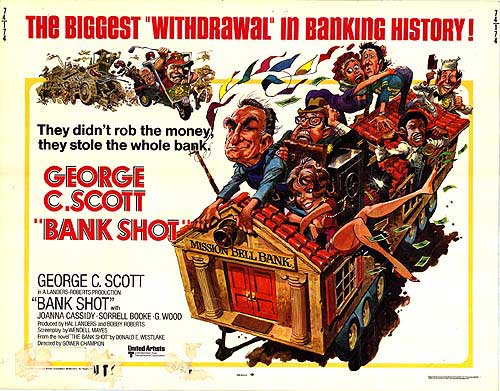
Criminally Underrated: George C. Scott in BANK SHOT (United Artists 1974)


gary loggins's avatarcracked rear viewer

I’m a big fan of the novels and short stories of Edgar Award-winning writer Donald E. Westlake , named a Grand Master by the Mystery Writers of America. His comic-laced crime capers featuring master planner Dortmunder were well suited for films and the first book in the series, THE HOT ROCK, was filmed by Peter Yates in 1972 with Robert Redford as the mastermind. Two years later came BANK SHOT, the second Dortmunder novel, starring George C. Scott but changing the character’s name to Walter Ballentine due to legal issues. Dortmunder or Ballentine, BANK SHOT is a zany film with a fine cast of actors that deserves another look.

Ballentine is doing life in Warden “Bulldog” Streiger’s maximum security prison, but when his shady “lawyer” and confidant Al G. Karp visits with an idea for a new “shot”, the hardened criminal makes his escape. Karp needs Ballentine’s expertise to plan the robbery of Mission Bell…

View original post 334 more words

Lisa Reviews An Oscar Nominee: Capote (dir by Bennett Miller)


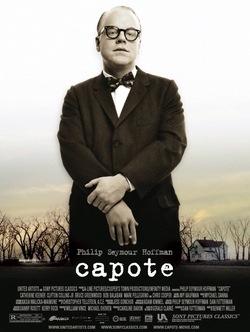
capote_poster

The first time I ever saw the 2005’s Capote, I thought it was a great film.

I guess that shouldn’t be a surprise.  I love movies about writers and I love biopics and, as the title indicates, Capote was both.  I’m also fascinated by true crime and Capote told the story of how Truman Capote came to write the first true crime book, In Cold Blood.  Add to that, I was (and am) a Philip Seymour Hoffman fan and Capote provided Hoffman with not only a rare starring role but it also won him an overdue Academy Award.  Finally, to top it all off, Capote also dealt with Truman’s friendship with Harper Lee (Catherine Keener), the author of To Kill A Mockingbird.  Seriously, a film that dealt with the writing of both In Cold Blood and To Kill A Mockingbird!?  How couldn’t I love that?  While everyone else was outraged that Crash beat Brokeback Mountain, I was upset that it beat Capote.

Needless to say, I was really looking forward to rewatching Capote for this review.  But when I actually did sit down and watched it, I was shocked to discover that Capote wasn’t actually the masterpiece that I remembered it being.

Oh, don’t get me wrong.  It’s still a good film.  At times, it’s even a great film.  I still think it would have been a more worthy Best Picture winner than Crash.  But still, there seemed to be something missing.  Much as with director Bennett Miller’s most recent film, Foxcatcher, there’s a coldness at the heart of Capote.  One can’t deny its success on a technical level but, at the same time, it keeps the audience at a distance.  In the end, we remains detached observers, admiring the skill of the film without ever getting emotionally invested in it.

Interestingly, the film suggests that the exact opposite happened to Truman Capote while he wrote In Cold Blood.  The film suggests that Capote got so invested in one of the killers at the center of In Cold Blood that the process of writing the book nearly destroyed him.  When we first see Capote, he’s at some social event in New York and he’s amusing his rich friends with charmingly risqué anecdotes about his other rich and famous friends.  As played by Hoffman, Capote is someone who is almost always performing.  It only with his friend Harper Lee and his partner Jack Dunphy (Bruce Greenwood) that he ever lets down his guard long enough to reveal who he actually is, a gay man from the deep South who was fortunate enough to escape.

That’s one reason why Capote grows close to Perry Smith (Clifton Collin, Jr.).  The subjects of In Cold Blood, Smith and Dick Hickcock (Mark Pellegrino) killed the Clutter family in Holcomb, Kansas.  Capote, who followed the case from their arrest to their eventual execution, becomes obsessed with Smith precisely because he sees Smith, with his dysfunctional background and his overly sensitive nature, as being who Capote could have been if things had gone just a little bit differently in his life.  Miller further makes this point by skillfully juxtaposing scenes of Truman dropping names and telling jokes at New York parties with the grim reality of life and death in Kansas.

Truman finds himself serving as a mentor to Perry.  (Hickcock is neglected by both Capote and the film.)  Of course, Truman’s also a writer and he knows that he needs an ending for his story.  As his editor (played by Bob Balaban, who seems to be destined to play everyone’s editor at some point or another) points out, Smith and Hickcock have to be executed if the book is ever to be completed.  Truman also has to get Perry to finally talk about what happened in the Clutter family farm.  As much as Capote seems to care about Perry, he’s ruthless when it comes to getting material for his book.  The film suggests that Truman Capote got his greatest success at the cost of his soul.

It’s a rather dark movie, which might explain why I was initially so impressed with it.  (I went through a period of time where I thought any movie with a sad ending was a masterpiece.)  Rewatching it, I saw that the film’s triumph was mostly one of casting.  Miller gets some seriously brilliant performances from the cast of Capote.  Yes, Hoffman is great in Capote but so is the entire cast.  Keener and Greenwood are well-cast as the only two people who have the guts to call Truman on his bullshit.  Chris Cooper gives a very Chris Cooperish performance as Alvin Dewey, the no-nonsense lawman who views Capote with a mix of amusement and distrust.  Clifton Collins, Jr. and Mark Pellegrino are both excellent as Smith and Hickcock.  In fact, Pellegrino makes such an impression that you regret the both Capote and the film didn’t spend more time with his character.

As previously stated, Hoffman won Best Actor but Capote lost best picture to Crash.  How Crash beat not just Brokeback Mountain but Capote as well is a mystery that Oscar historians are still trying to unravel.