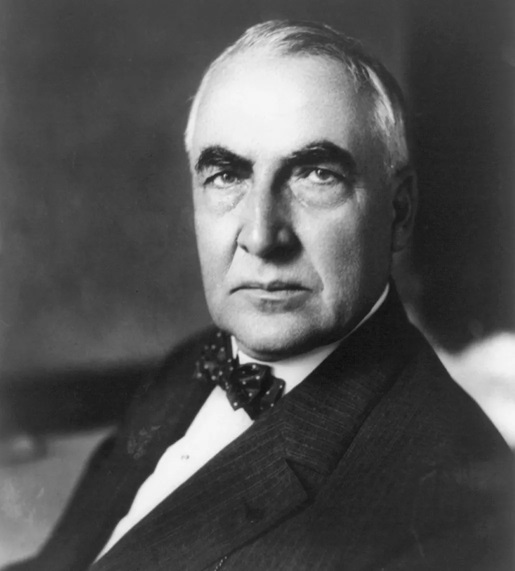
Since today is Presidents Day, I wanted to take a moment to acknowledge and honor my favorite president, Warren G. Harding of Ohio. The former newspaper editor-turned-Senator was elected in 1920, by one of the largest landslides in American history. (Interestingly enough, his opponent was another newspaper man from Ohio, James Cox.) Harding was elected on a platform that promised a “return to normalcy” after the authoritarian excesses of Woodrow Wilson. He was the first president to be elected in a national election in which all states allowed women to vote and he overwhelmingly won their vote. A politician who remembered his friends and who had little trouble entertaining his constituents in his office, Warren Harding epitomized everything that was fun about the early 1920s.
And we have actual newsreel footage of Warren Harding’s inauguration! For today’s blast of the past, here is newsreel footage of my favorite President renewing America’s greatness. This footage is over 100 years old and, in all seriousness, it shows why film is so important. The video below is not just a short movie of someone taking the oath of office in Washington, D.C. Instead, it’s a portal into the past. At a time when history itself is often altered to fit whatever the current narrative may be, it’s good that we can still see things for ourselves.
Filmed in 1957 for a television program called Westinghouse Studio One, The Night America Trembled is a dramatization of the night in 1938 when Orson Welles’s adaptation of H.G. Wells’s The War of the Worlds reportedly caused a panic amongst listeners.
For legal reasons, Orson Welles is not portrayed nor is his name mentioned. Instead, the focus is mostly on the people listening to the broadcast and getting the wrong idea. That may sound like a comedy but The Night America Trembled takes itself fairly seriously, complete with Edward R. Murrow narrating and taking drags off of a cigarette.
Clocking in at a brisk 60 minutes, The Night America Trembled is an interesting recreation of that October 30th. Among the people panicking are a large collection of future stars and character actors. Ed Asner, James Coburn, John Astin, Warren Oates, and Warren Beatty all make early appearances.
It’s an interesting historical document and you can watch it below!
On October 30th, 1938, Orson Welles and the Mercury Theater On The Air broadcast an adaptation of H.G. Wells’s War of the Worlds and, legend has it, they scared the ever-loving heck out of America.
Actually, there’s some debate as to just how panicked America got when they heard the Mercury Theater On The Air’s adaptation of War of the Worlds. There was definitely some panic but there are differing reports on just how wide spread it was. For our purposes, let’s assume that the entire country was terrified at the same time and that everyone was loading up a shotgun and planning to go out and look for aliens. One thing is for sure. With his adaptation of War of the Worlds, Orson Welles managed to invent the whole found footage genre that would later come to dominate horror cinema in the late 90s and the aughts. Every found footage horror film owes a debt to what Orson Welles accomplished with War of the Worlds. We won’t hold that against Orson. Instead, it’s just another example of how far ahead of his time Orson Welles was.
H.G. Wells, the original author of War of the Worlds, and Orson Welles only met once, while they were both in San Antonio, Texas in 1940. (Orson Welles and H.G. Wells hanging out in San Antonio? To be honest, that sounds like it would make a good movie.) They were interviewed for a local radio station. H.G. Wells expressed some skepticism about the reports of Americans panicking while Welles compared the radio broadcast to someone dressing up like a ghost and shouting “Boo!” during Halloween. Both Wells and Welles then encouraged Americans to worry less about Martians and more about the growing threat of Hitler and the war in Europe.
I’ve shared this before but this just seems like the time to share it again. Here, for Halloween, is the 1938 Mercury Theater On The Air production of The War of the Worlds!
First broadcast in 1981, The Wave stars Bruce Davison as Ben Ross, a high school social studies teacher who conducts a social experiment.
Frustrated by the fact that he can’t answer his students questions of how the German people could have allowed the Holocaust to occur, Ben decides to teach his students a lesson. He starts by introducing a bunch of seemingly arbitrary rules to his classroom, concerning the proper way for students to sit at their desks and to address the teacher. Ben is somewhat surprised to see how quickly his students adapt to the new rules, even taking pleasure in showing how quickly and efficiently they can follow orders. The next day, Ben tells his students that they are now members of The Wave, a national youth organization with membership cards and a secret salute.
And that is when all Hell breaks loose. Ben only meant to show his students what it’s like to be a member of a mass movement but the students take The Wave far more seriously than Ben was expecting. Soon, other students are joining The Wave. When the popular football players announce that they are a part of The Wave, others are quick to flock to the organization. The formerly likable David turns into a fanatic about bringing people into the organization. Robert, a formerly unpopular student, revels in his new job of reporting anyone who deviates from the rules of The Wave. When a student reporter writes an article that is critical of the organization, she and the school paper are targeted. Has Ben’s social experiment spiraled out of control?
42 years after it was originally produced, The Wave remains a powerful and sobering look at how people can be manipulated into doing things as a mob that they would never do as an individual. If anything, the film feels more relevant today than it probably did in 1981. The character of Robert, in particular, is a familiar one. He’s someone with no self-esteem who latches onto a movement and finds his identity by taking down others and accusing them of failing to follow the rules. One can find people like Robert all over social media, searching through old posts for any example of wrongthink that they can broadcast all through their social world. It’s tempting to smirk at how quickly the members of The Wave sacrificed their freedom and their ability to think for themselves but it’s no different from what we see happening in the real world every day. (Indeed, if the film had been made just two or three years ago, The Wave would probably be the people policing whether or not the rest of us were observing quarantine and wearing our facemasks correctly.) People like to feel that they belong to something, even if that means sacrificing their humanity in the process.
Featuring a good performance from Bruce Davison as the well-meaning teacher who is both fascinated and terrified by the experiment that he’s set in motion, The Wave can be viewed below:
In 1986’s The Drug Knot, Dermot Mulroney plays a high school student.
At the time this show aired, Dermot Mulroney was 25 years-old and he looked like he was 30 but, looks aside, he actually gives a pretty convincing performance as Doug Dawson. Doug is a smart and musically-gifted high school senior. He’s talented enough to make beautiful music with a saxophone and rebellious enough to skip class so that he can play the sax in the school locker room. His girlfriend, Kim (Meryl Streep look-alike Kim Myers), is totally in love with Doug but she also worries that he’s getting too heavily into dugs. He’s gone from smoking weed to snorting cocaine. He hides his drugs in his bedroom. His mother (Mary Ellen Trainor) has no idea that Doug is a drug addict while Doug’s little brother (David Faustino) wants to be just like him.
Can you see where this is heading?
In order to combat the school’s growing drug problem, the school has invited a speaker named David Toma to give a speech at a school assembly. Toma is a former cop who struggled with addiction himself. He inspired not one but two television shows, one called Toma and the other called Baretta. He goes from school to school and he gives speeches about all of the teenagers that he knows who have died as a result of doing drugs. As we see throughout the episode, Toma is a confrontational speaker, one who is not afraid to yell at his audience. Doug shows up for the assembly but his bad attitude leads to Toma kicking him out.
Personally, I’ve always had mixed feelings about the idea of trying to change people’s behavior by yelling at them. I know that it’s a popular technique and there’s been a lot of television shows (Intervention and Beyond Scared Straight come to mind) that are all about getting in people’s faces and screaming at them. My feeling, though, has always been that this approach is more about making other people feel good than actually changing behavior. Everyone wants to see the people who have caused them stress get yelled at. On talk shows, audiences would applaud whenever a disrespectful teen got sent to boot camp but it’s rare that you ever heard about whether or not the approach actually worked. I mean, I assume the approach works for some people but I know that if someone yells at me not to do something, my usual reaction is to go ahead do it just because I resent authority. David Toma’s approach would not have worked with me.
(One interesting thing about The Drug Knot is that David Toma is a real person and he plays himself. Apparently, he’s still out there and still at it, even though he’s in his 90s now. I should note that, on YouTube, there’s a lot of comments from people who say that getting yelled at by David Toma saved their lives so maybe the yelling approach does work for more people than I assumed.)
Anyway, as always when it comes to these made-for-TV anti-drug programs, the drugs lead to tragedy and The Drug Knot ends on a particular dark note. For once, there is no redemption.
Here is The Drug Knot, complete with an anti-drug message from Michael Jordan:
In 1980’s Stoned, Scott Baio plays Jack Melon, a teenager with a problem.
Jack is shy, awkward, and can’t escape the shadow of his older brother, Mike (Vincent Bufano). Mike is champion swimmer. Jack is someone who can barely walk down a hallway without walking into a wall. But then Teddy (Jack Finch) gets Teddy hooked on marijuana, the so-called weed with roots in Hell! Soon, Jack is acting weird, making strange jokes, and getting all of the attention in the world. Unfortunately, Jack is also alienating those closest to him and his newfound habit leads to a near-tragedy.
Stoned was aired as an ABC Afterschool Special and, while it’s not quite Reefer Madness, it does adhere to the general anti-drug formula. In record time, Jack goes from being shy and dorky to being goofy and potentially dangerous. We get all the expected scenes of Jack devouring ice cream, Jack wandering around in a daze, Jack realizing that the girl he likes what’s nothing to do with the new Jack, Jack’s well-meaning teacher (played by the show’s writer and director, John Herzfeld) confronting his students about their drug use, and Jack accidentally hitting his brother with an oar. Jack thinks that marijuana is opening his brain because, while stoned, he suddenly realizes that a tree looks like “Old Man Eber.” Stoned goes on to show Jack ruining his life but I have to admit that I spent most of the running time wondering who Old Man Eber was. (Seriously, Old Man Eber sounds like some sort of Lovecraftian ghoul, waiting in the shadows to drag one to an Arkham cemetery.) Of course, someone nearly dies as a result of Jack’s marijuana use. What’s interesting is Jack is able to save the person’s life, even though he’s stoned. Would non-stoned Jack have been able to do it?
From the fashion choices to the cast to the message that marijuana is the most dangerous thing on the planet, Stoned is one of those TV specials that epitomizes its time. This was a film that was made at a time when it was inconceivable that there would some day be commercials for edible gummies and it shows. Watching Stoned is like stepping into a time machine.
Today, of course, Scott Baio is better known for his politics than his acting. Whenever I see a headline that reads, “This veteran Hollywood star is calling out his industry for not understanding America,” I know the story is inevitably going to be about Scott Baio complaining about his taxes. That said, Scott Baio is convincing when he’s playing Jack as being awkward and insecure but he definitely goes a bit overboard once Jack starts smoking. While that probably dilutes the effectiveness of the film’s message (because, let’s be honest, real stoners are going to watch this and easily recognize the fact that Jack is trying way too hard to convince everyone that he’s stoned), it does give this film a certain entertainment value.
Here is Stoned, complete with the commercials that aired when the show was original broadcast on November 12th, 1980:
Today’s Blast From The Past comes to us from 1990 and it’s a scary one.
In The Fourth Man, Peter Billingsley (yes, the kid from A Christmas Story) plays Joey Martelli, an insecure high schooler who thinks that he’ll be more attractive to girls if he becomes more like his best friend, friendly jock Steve Guarino (Vince Vaughn, making his film debut and already physically towering over everyone else in the cast). With Steve’s encouragement, Joey tries out for the track team and, to everyone’s surprise, he makes it!
Joey is now an athlete. He finally has friends. Girls (including Nicole Eggert) are talking to him. His father (Tim Rossovich) is finally proud of him. But Joey soon discovers that staying on the track team is not an easy task. His coach tells Joey that he has to pick up his speed. Feeling desperate, Joey does what so many other television teenagers before him have done. He starts taking steroids! (Dramatic music cue!) Soon, the kid from A Christmas Story is breaking out in pimples, throwing temper tantrums, and becoming a rage-fueled monster! Joey only took the steroids because he wanted to be as cool as Steve but, unfortunatey, Joey learns too late that Steve’s success and popularity are not due to how big and strong he is but to the fact that he is played by a young Vince Vaughn.
(Myself, I was fortunate enough to go to a high school where the emphasis was placed more on the arts and intellectual pursuits than athletic success. My school didn’t even have its own football field. We had to share with the high school down the street! Anyway, as a result, I don’t think knew anyone in high school who was abusing steroids and I never had to deal with anyone suddenly flying into a rage and punching a hole in a wall or any of the other stuff that always happens whenever anyone abuses steroids on television.)
The Fourth Man was written and directed by Joanna Lee, who is perhaps best known for playing Tanna the Alien in Ed Wood’s Plan Nine From Outer Space. (Lee, it should be noted, had a very long and respected career as a writer and director of television dramas. In many ways, she had the career that Ed Wood imagined that he would someday have.) Along with Billingsley and Vaughn, the cast includes horror mainstay Adrienne Barbeau as Joey’s mother and football player-turned-horror-actor Lyle Alzado as a man who has his own history with steroids. The film has good intentions and a good message about not taking shortcuts and being happy with who you are but I imagine that most people will just want to watch it to see Peter Billingsley descend into roid rage. And I will say that, for all the film’s melodrama, there is something a little bit disturbing about watching fresh-faced Peter Billingsley turn into a physically aggressive bully.
From October of 1990 (and complete with the commercials than ran during the program’s first broadcast), here is The Fourth Man.
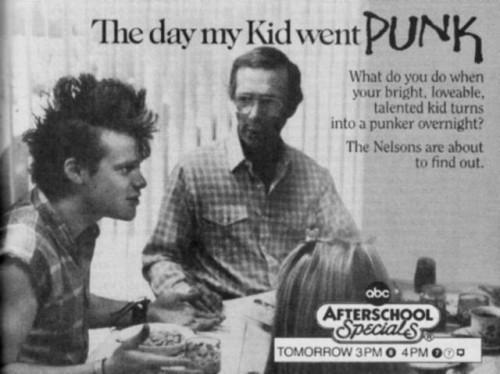
First produced in 1987, the short film The Day My Kid Went Punk tells the story of Terry Warner (Jay Underwood), a clean-cut teenager and aspiring violinist who lands a summer job working as a daycare counselor at a luxury hotel.
Feeling that he’s been neglected in favor of his high achieving older brother and his younger sister, Terry acts like a typical middle child and decides to change his image right after leaving home for his job. (It worked for Jan Brady!) He decides to become a punk. (Jan Brady never went that far.) Could this have something to do with his mother (Christine Belford) being the nation’s leading expert on the “Punk Syndrome,” that is terrifying parents everywhere? Or could it just be because Terry knows that he’ll never be as cool as his father (Bernie Kopell), who might claim to be named Tom Warner but who is obviously just Adam Bricker living in the suburbs? Every time Tom looks at his “punk” son, you can just see him dreading the thought of word of this getting back to Captain Stubing.
(Incidentally, the family in film is clearly named Warner but, in all of the advertisements that I’ve seen for this special, including the one at the top of the post, they’re identified as being the Nelson family.)
Needless to say, Terry Warner is, in no way, a convincing punk and judging from the film’s dialogue and plot, it would appear that the film doesn’t really know the difference between punk, goth, and heavy metal. Everyone at the hotel is a bit taken aback by Terry’s appearance but he proves himself to be a good worker and the kids absolutely love riding horses with him. I guess the message is that you shouldn’t judge someone based solely on how he looks. That’s a good message except that it’s ultimately undercut by Terry himself and his decision abandon his punk look as soon as it inconveniences him at school. So, I guess the message is that teens should dress the way they want unless it keeps them from winning first chair in the school band and parents shouldn’t worry because teenagers are so shallow that they’ll abandon anything after a month or two. The film suggests that Punk is less of a syndrome and more of a fad that whiny middle children go through during the summer.
(Myself, I’m not a middle child. I’m the youngest of four and I’ve never felt particularly ignored, even if there were times when it seemed like being left alone would be a nice change of pace. That said, I definitely went through some phases while I was growing up. During my junior and senior years of high school, I always made sure that I was wearing at least one black garment and I wrote emo poetry under the name Pandora DeSaad.)
Anyway, Halloween’s approaching and this very (and I do mean very) campy short film feels like a good way to welcome a month that encourages everyone, young and old, to think about putting on costumes. Here is The Day My Kid Went Punk!
Today’s blast from the past comes to use from 1982.
In A Very Delicate Matter, teenager Kristin Sorenson (Lori-Nan Engler) spends the summer working at a camp. After her nominal boyfriend, Greg Pscharapolus (Zach Galligan), fails to call her even once, Kirstin ends up dating her superhot co-worker, Larry (future daytime drama star Grant Aleksander, making his television debut). Once summer ends, Kristin returns home where Greg apologizes for not calling her. Kristin takes Greg back and decides not to tell him about Larry. But then Kristin gets a call from Larry. Larry tells her that she might want to go by the free clinic and get some penicillin because Larry’s got gonorrhea and there’s a good chance to Kristin now has it as well. And, since Kristin and Greg previously spent a day making up, Greg might have it too!
The plot description probably makes A Very Delicate Matter sound considerably campier than it is. For the most part, this is a sensitive and nonjudgmental film, one in which no one is portrayed as being a villain. (As one doctor points out, even Larry showed more courage than most by immediately calling Kristin and letting her know what was going on.) While the two leads both give good performances (with Galligan just two years away from starring in Gremlins), the film is stolen by Marta Kober and John Didrichsen, who play the best friends of Kristen and Greg and who have a nice flirtatious chemistry with each other. Just because your friend has a social disease, the film seems to be saying, don’t give up on love. Marta Kober is probably best known for Friday the 13th Part 2, which featured its own warning about having unprotected sex at a summer camp.
Made in 1985 for CBS, Ace Hits The Big Time is a seriously strange little film.
It tells the story of Horace Hobart (Rob Stone, a likable actor), a 16 year-old kid from New Jersey who has just transferred to a new high school in New York. He’s paranoid about going to his new school because it’s supposedly populated by gang members. The school is so notorious for gang activity that the members of the gang even make an appearance on the front page of the paper of record, The New York Freaking Times! Looking at the newspaper makes Horace Hobart so paranoid that he has musical fantasies in which the members of a gang known as the Purple Falcons surround him, start singing, and then beat him up while doing an interpretive dance.
Horace does eventually find the courage to go to his new high school but he insists on calling himself “Ace,” he wears a jacket with a fearsome dragon embroidered on the back of it, and he wears an eye patch because he’s got …. ewwww …. pink eye. (Remember when Bob Costas got pink eye at the Olympics and traumatized thousands of viewers by insisting on going on the air every night and talking about snowboarding while struggling to keep his eye from popping out of its socket? Those were crazy times!) Ace looks so tough that the real Purple Falcons mistake him for being an associate of a notorious New Jersey gang (no, not the Sopranos) and they recruit him to be a member of their gang. Ace is so convincing as a tough guy that a film crew decides to use him and his friends as extras in a movie! (Interestingly, the director is really involved in picking and working with the extras. There’ll be no second unit crap for Ace and the Purple Falcons!) Unfortunately, another gang insists on trying to make the Purple Falcons look bad. Fortunately, Ace is able to defuse the tension by baking a cake. What?
This is like the dorkiest version of West Side Story ever made and I can’t really figure out what the message is supposed to be. On the one hand, Ace is totally paranoid about any sort of gang violence and goes out of his way to try to prevent a gang war. On the other hand, even before Ace shows up and starts quoting John Lennon, neither one of the show’s gangs are particularly violent or even intimidating. The Purple Falcons are pretty much impossible to take seriously because they’re called “the Purple Falcons.” (They all wear purple, as well. I guess some other gang had already claimed all the cool falcon colors.) They really don’t do any sort of “gang” stuff. Instead, they eat a lot of pizza and appear in a movie. That sounds like a pretty good deal, actually. With its mix of dorky humor, random dance numbers, and “tough” gang talk, this is one of those old time capsules that simply has to be seen to be believed.

 Through the Shattered Lens