Decade of last.fm scrobbling countdown:
26. Summoning (1,154 plays)
Top track (86 plays): Menegroth, from Oath Bound (2006)
Featured track: Ashen Cold, from Let Mortal Heroes Sing Your Fame (2001)
Blind Guardian’s Nightfall in Middle-Earth might be the most inspired musical retelling of any of J.R.R. Tolkien’s works to date, but no band has crafted an atmospheric sound to capture that world quite so convincingly as Summoning. With a sound that would just as soon excite fans of video game music or “new age” artists like David Arkenstone as their orginal black metal fan base, Summoning have forged a truly unique musical path. While their first studio album, Lugburz (1995), was relatively standard for the synth-laden black metal of its day, they nearly finalized the sound that made them famous on Minas Morgul, released later that same year. Since then, the only perceptible change has been a slow decline in the use of tremolo guitar; the quality of the songwriting and the imaginative world it invokes has remained pretty consistently superb.
For me at least, Summoning and Tolkien’s fantasy world have become nearly inseparable. The echoing, tribal drums paint vast landscapes cast dark by distorted vocals and guitar. The synth speckles the scene in a light that, never breaching the world of full orchestration, retains a fantasy aspect through its unnatural sound. The lyrics enliven the music with the spirit of an epic tale–whether it be the dramatic narrated loop on on “South Away”–“By the crowns of the seven kings and the rods of the five wizards!”–the water god Ulmo’s bold proclamations on “Farewell”–Who can tell you the age of the moon? But I can! Who can call the fish from the depths of the sea? Yes, I can! Who can change the shapes of the hills and the headlands? I can!–or the spirit of perseverance on the track here featured–“Though his body is not tall and his courage seems small, his fame will take long to fade.”
Tolkien’s greatest achievement was to craft a fantasy world so vast that imaginative minds ever since have managed to forge a place within it. Summoning have done so with a level of excellence nearly unrivaled, and they continue to today. There might have been a seven year gap between Oath Bound (2006) and Old Mornings Dawn (2013), but their new release is in every way on par with the rest. It’s a bit of a wonder that they’re only ranked 26th on my decade-spanning last.fm charts. I suspect that, another ten years from now, they’ll be much nearer the top, because their music takes me to a place that is eternal.
Decade of last.fm scrobbling countdown:
27. Alcest (1,127 plays)
Top track (154 plays): Souvenirs d’un autre monde, from Souvenirs d’un autre monde (2007)
Featured track: Là Où Naissent Les Couleurs Nouvelles, from Les Voyages De L’Âme (2012)
About two years ago I passed up a rare opportunity to strike up a one on one conversation with a musician I admire to no end. Alcest had just finished opening for Enslaved on their 2011 U.S. tour, and I stumbled upon Neige idling in the outdoor smoking lounge, standing exposed in the middle without a pesky fan in sight. I’m not the sort to pester someone over a stupid autograph, and I couldn’t think of a question worth asking on the spur of the moment, so I let the opportunity pass. But if I could have it back again, I would ask him what bands he’d been listening to when he recorded Le Secret (2005). Influence has been a hot topic for Alcest interviews ever since Neige denied any knowledge of shoegaze music at the release of Souvenirs d’un autre monde (2007). He responded to the comparisons by actively engaging a lot of relevant 80s and early 1990s bands, such that the perceived similarities lead to real influence down the road. I don’t think that is as apparent in his more recent works as some fans would like to believe; in Alcest, Neige produces the sort of uniqueness and quality that transcends genres. Nevertheless, my fascination with the history of music begs the question. Le Secret delivered what I wanted with a unique innocence that could only ever succeed once, and it certainly wasn’t “shoegaze” that paved the way for it.
Le Secret rather felt to me like something the black metal scene was destined to produce sooner or later. I’d been craving it since I first heard Ulver’s “Of Wolf and Passion”. If black metal had always been more about De Mysteriis than Dom Sathanas, “Le Secret” was the final incantation–the first real invocation in a world of petty summoners. Le Secret battered down the stereotyped walls, presenting a glorious first glimpse at what dwelt beyond that meditative barrier of blast beats and tremolo. On Souvenirs d’un autre monde and beyond, Neige gave us a beautiful vision of just how that world appeared to him, and he continues to improve on it with each new release. “Là Où Naissent Les Couleurs Nouvelles”, the 2012 track here featured, might be his most encompassing song to date.
Don’t get me wrong. Neige was certainly not the first black metal artist to think outside the box. The Ukrainian black metal scene especially had been doing it for years. But I feel like Neige’s artistic accomplishment and subsequent popularity really paved the way towards a widespread abandonment of black metal’s pseudo-machismo persona in exchange for the artistry necessary to accomplish a more sublime beauty and brutality alike. If we are ever going to speak of “post-black metal” or some “third wave” supplanting the early 1990s establishment, it began in 2005 and 2006 with the likes of Alcest and Agalloch. It is only an odd coincidence that the term “shoegaze” has regained popularity outside of metal and adopted new definitions. I look at Alcest not as a merging of two styles, but as a change in mindset which has empowered countless bands over the last few years to let their novel ideas be heard and widely distributed.
Le Secret will always be my favorite Alcest recording because of its timeliness and audible obliviousness to this transition which was slowly gaining ground. But perhaps I’ve beat that horse to death over the past few years. When I listen to Les Voyages De L’Âme (2012), I hear a musician in his prime, undeterred by the expectations of any particular genre, who has successfully improved with every new album. Alcest’s sixth major release, Shelter, should be coming out some time later this year, and I have really high hopes.
Decade of last.fm scrobbling countdown:
37. Drudkh (841 plays)
Top track (67 plays): Fate, from The Swan Road (2005)
Ukraine was my gateway into black metal. My earliest exposure to bm in general was met with a closed mind; I remember picking up IX Equilibrium not long after it came out, hearing nothing but distortion and blast beats, and wondering what all the fuss was about, as if its brilliant classical component was non-existent. But somehow Nokturnal Mortum’s Goat Horns blew my mind on first exposure, when I was still a teenager rocking out to In Flames, Opeth, Iced Earth and the like. That pagan spirit screaming murder beneath a wall of chaos struck me with more force than “satanic” or “progressive” bm ever would, then or now. I spent a substantial chunk of my paychecks at The End Records in the years that followed, and I was not searching for “black metal” so much as “Ukraine”. The consequence was that I got to enjoy bands like Drudkh, Hate Forest, and Astrofaes before it was “cool” to do so. (Let’s face it, hype always influences our perspective on a band in one way or another, whether we like to admit it or not.)
Drudkh quickly became my second favorite band in that scene after Nokturnal Mortum, and what I have heard in them over the years is nothing like the steady degradation from Forgotten Legends downward that supposedly “old school” fans are inclined to proclaim. I don’t know why so many people see Drudkh as a one-track band. Perhaps it is because the rate at which they release new material softens perception of the major shifts in their evolution as artists. Handful of Stars (2010) was the only album on which fans actually had to stop and go “wait, is this still Drudkh?”, and the band answered that question decisively with the Slavonic Chronicles EP. But if you listen to Drudkh as a band who played the same solid thing for four or five albums and then got too successful and lost their touch, you’re fairly misguided. It’s true that their first three albums have a lot of similarities. I sort of feel as though their vision on all three was roughly the same, with Swan Road (2005) marking the point at which they had enough recording experience to really make their sound fully capture that vision. The band has rarely repeated the same sound since. Blood in Our Wells (2006), my personal favorite, was a tremendous shift in favor of their pagan undertones, with songs like “Solitude” and “Eternity” crushing the listener through anthems more than atmospherics. Songs of Grief and Solitude (2006) was perhaps the best folk interlude album in black metal since Ulver famously did it, and Estrangement (2007) completely revisioned their sound, replacing characteristic deep plods with rabid, shrill blast beats and grittier production. Microcosmos (2009) was a significant change in production towards the other end of the spectrum, and I rather doubt the gut-wrenching quality of “Ars Poetica” (a song I still think has an almost screamo vibe to it at the climax) would have hit home so forcefully otherwise.
Drudkh’s trip to France on Handful of Stars (2010) may have left some fans disgusted, but it would be frankly stupid to call a band so consistently open to change “sell-outs” the moment their vision failed to reflect stereotypical expectations of aggression, masculinity, whatever the fuck tr00 cvlt dandies demand. And anyone who thinks Eternal Turn of the Wheel (2012) was some grand return to the good old days is in stark denial of the (I think quite intentional) persistent French influence underlining this newest chapter in their discography.
If I seem to be taking a defensive stance here, it might be in part because I’m arguing against my own initial inclinations. I’ve made the shallow mistake of blowing off Drudkh as washed up many times before, and I never fail to regret it once I’ve given the album in question substantially more time to grow on me. (My initial review here of Eternal Turn of the Wheel was cautiously negative. Today I would say it’s great.) I think over the years I’ve developed some boneheaded stereotype of Ukraine as a third world nation–an opinion based mainly on Ukrainian Americans whose pseudo-heritage reeks of self-debasing Cold War propaganda and “world music” zines. (“Only my American non-profit organization can preserve the endangered culture of our pathetic, eternally oppressed, utopianly pacifistic Slavic ancestors! I’ll give you a cultural awareness award and my new Carpathian-Caribbean fusion cd! Buy my shitty handicrafts! Send money!”) I try to forget about it and remind myself that these people are the ultimate American idiots with no actual connection to the people they pretend to represent, but I still find it hard at times to give Slavic musicians the intellectual credit they deserve. Roman Saenko and co are actually among the most intelligent musicians of our generation, and when I remind myself of that and revisit their discography, I realize again that it has been consistently solid from start to finish.
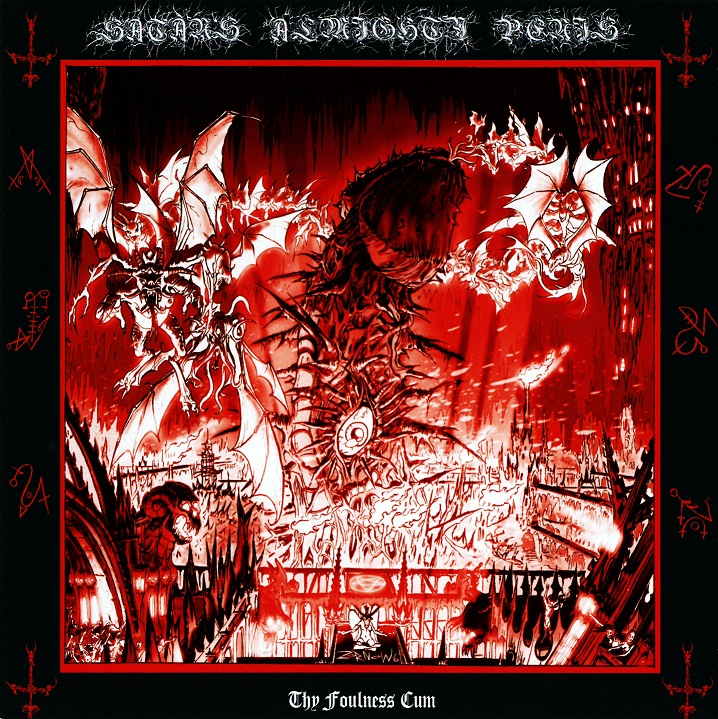
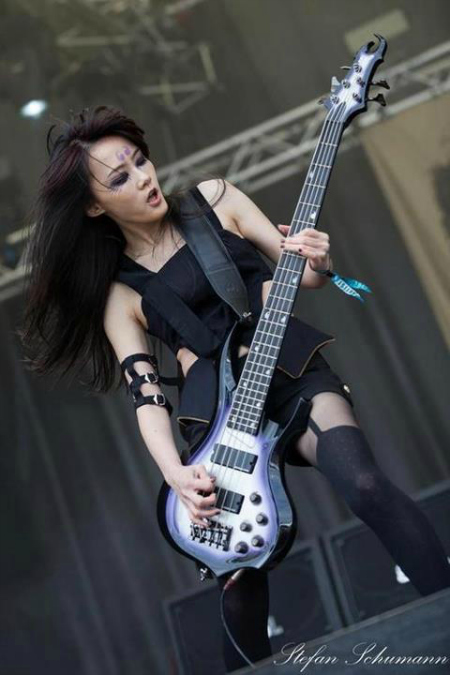
I had only the most honest of intentions when I stumbled upon Ms. Yeh. I was sampling the new album by Taiwanese black metallers 閃靈 (Chthonic), and I casually plugged them into Google image search. Grim frostbitten glamor shots immediately bombarded me with all the force of Satan’s Almighty Penis thrust into my lusting goatholes of blasphemy. Doris Yeh has been playing bass for the band since 1999. On top of being a great musician, she has effectively employed her phenomenal body to both market the band and garner attention towards their political activism. Chthonic are actively involved in promoting human rights in Taiwan and throughout Asia, speaking out against Chinese imperialism in Tibet and their home country and advocating a greater awareness of women’s rights. Visually, Doris Yeh stuns me most in more traditional black metal attire and on stage (the last two pictures in this compilation), but she’s just as gorgeous in her modeling and goth photo shoots.
Musically, Chthonic are better than most at what they play. I give them props for incorporating that delightful and underrepresented world of Asian folk into metal, but their glossy, high production, symphonic brand of black, melodic death, and folk metal isn’t really my style. Here is a sample track from their new album, 武徳 (Bú-Tik), if you’re curious:
Decade of last.fm scrobbling countdown:
42. Burzum (756 plays)
Top track (42 plays): Key to the Gate, from Det Som Engang Var (1993)
I remember watching some comedy in the early 90s where a cave man frozen in ice gets thawed out and has to adapt to life in modern Los Angeles. I don’t really remember any details about it, except that it was bad. This has pretty much been Varg Vikernes’s fate since being released from prison in 2009, and no one ought to feel the least bit sorry for him. Varg ultimately made his name known through his crimes, not his music, but he used to deliver a sound to match. There is a tinge of the deranged in classic Burzum. Albums like Det Som Engang Var carry such a lasting appeal because they simultaneously capture the pagan spirit of early 1990s black metal and the air of madness that overtook the scene, landing many of its participants in coffins or jail. Varg’s first new recording after his release, Belus, was sufficiently better than anyone expected to open the door for a potential second chance at a successful musical career. But after more than a decade with no means to record, Varg let his longing for creative expression take him, pumping out five new albums in the four years that followed with little quality control, coupled with an endless sea of writings. The overwhelming majority of this material was ho-hum, and for any other aging artist this would be fine. Plenty of other later-career heavy metallers have earned sufficient respect in their younger years to maintain a fan base as their capacity for greatness dwindled. Plenty of revolutionary thinkers have maintained a right to social commentary extending beyond their original mode of expression. But no one respects Varg Vikernes nor views him as a revolutionary, and no one really should. In spite of the quality of his early albums, he remained rightly subject to criticism, leaving prison to run head first into a sea of high expectations and further demands for proof of talent. He failed to rise to the occasion, and now no one cares. He is busy writing treatises and filming documentaries that no one will ever grant the time of day. He is chugging out album after album that most of us will never bother listening to. Sorry Count Grishnackh. It is too late for your opinions to ever matter.
We can certainly continue to derive enjoyment from select Burzum material while rolling our eyes at any mention of its creator, but for me Varg is a bit of a disappointment. Black metal is something of the thinking man’s sledgehammer–a genre which oddly entangles disgust for intellectualism with ideas which require a great deal of formal dialogue to express in other-than-artistic ways. But if the fault lines of egotism render my favorite forms of music necessarily esoteric, I have always preserved the hope that some musician might have something intelligent to say about it. Varg runs his mouth ceaselessly, and I think it a shame that nothing substantive has ever come out of it. No one has ever been in a greater position to serve as the spokesman for the genre than Varg Vikernes, granted for all of the wrong reasons. The murder of Euronymous and Varg’s outrageous, self-incriminating comments which followed propelled him to a level of stardom that his music alone could have never achieved. Sure, he was entirely at odds with the genre; he could never, unlike artists such as Ihsahn, point to unlawful actions in the early 90s scene as an immature expression of an entirely justifiable state of mind. But he had the one thing no other black metal artist could hope to achieve: extensive public attention beyond his niche genre.
I guess I hoped that more than 15 years in prison would have given him the opportunity to grow up a little. I thought maybe he would fess up to having been a dumb-shit teenager who ruined the Norwegian scene by letting his emo jealousy of Euronymous get in the way of his commitment to its values. I thought he might very carefully and very professionally take his time crafting an outstanding album as proof that he was moving on to bigger and better things. Belus succeeded in buying time, but Fallen and the works that followed proved beyond a doubt that the dumb-shit teenager was nothing more than an educated, bearded, dumb-shit adult. He never acknowledged his debt to metal–and his potential for adding a substantial new flame to a musical movement that has since rapidly left him in the dust. In short, it irks me that a man of so many words, once returned to the spotlight in 2009, had so little to say and show for it. Nevertheless, classic Burzum has stood the test of time and remains a quintessential example of the sound that swept Scandinavia in the early 1990s and continues to influence countless bands today.
Decade of last.fm scrobbling countdown:
44. Peste Noire (721 plays)
Top track (65 plays): Ballade cuntre les anemis de la France, from Ballade cuntre lo Anemi francor (2009)
Peste Noire is probably the most French thing to ever happen to metal. Famine has frankly stated, if the interview excerpts I saw were properly translated, that he intentionally aims to make his music as terrible and possible. This is something quite successfully achieved in the nearly unlistenable L’Ordure à l’état Pur, released two years ago. That album seems to me a big “fuck you” to everyone who failed to give Ballade cuntre lo Anemi francor an abysmal rating on Encyclopaedia Metallum. Its unprecedented levels of tastelessness successfully mock modern consumerism through an acute awareness of that about popular culture which inclines us to lose all faith in humanity. (Famine even traded in his traditional black metal/skinhead garb for a nu metal image in the packaging.) Maybe Ballade cuntre lo Anemi francor, released in 2009, was intended to be a parody too, but in that instance Famine let his actually incredible song-writing abilities and aesthetic awareness get in the way of producing anything which can honestly be regarded as terrible. I am rather inclined to call it one of my favorite albums of all time.
One of the most interesting people I have ever had the pleasure of knowing was a highly educated skinhead obsessed with extremely racist, nationalistic bands in the punk/skinhead/RAC sphere. He didn’t share any of their ideologies in the slightest, but he was able to set aside disgust in what they stood for and tap into the sort of raw emotion that drove average working-class individuals to proclaim such extreme views. Ballade cuntre lo Anemi francor might be said to mock this sort of music by maintaining the emotional appeal while deflating the fictionalized history typically necessary for its evocation. It embraces French nationalism as a parody, presumably. At least, it presents a raw, ugly image of the past that hardly meets the standard conditions for pride or beauty. Yet Famine’s vulgar vocals and lo-fi, distorted, “black and roll” instrumentation come coupled with an intense feeling of nostalgia that persists throughout the album. The parody, if it can be called a parody, stems from the presentation of nostalgia for something grotesque, but towards this end Famine committed his artistic talents without restraint. It is a nostalgic ode to a sick, sinister past, juxtaposing musical representations of unjustifiable violence and intolerance to a feeling of warmth and comfort. On the one hand it is deliciously dark, and on the other it is a legitimate embrace of nationalism in its most honest clothes. Ballade cuntre lo Anemi francor is an album that has always fucked with my head, and I love it dearly.
Decade of last.fm scrobbling countdown:
46. Agalloch (653 plays)
Top track (147 plays): Odal (Demo), from The End Records Sampler: At the End of Infinity [Echoes & Thoughts of Wonder] (2002)
Featured track: Limbs, from Ashes Against the Grain (2006)
Throughout the first decade of this century, Agalloch stood at the forefront of some of the most progressive movements in metal. They were the product of a new generation of musicians exceptionally well informed on musical trends happening outside of their own genre. Citing such diverse influences as Katatonia, Ulver, and Godspeed You! Black Emperor, they endowed their first major release, Pale Folklore in 1999, with an entirely unique sound. Bleak neofolk guitar and piano merged with black metal as the two most dominant styles to paint a beautiful and desolate snowy landscape that demands the listener’s full attention from start to finish. The folk felt, to me at least, just as influenced by neofolk artists far beyond the metal spectrum like Current 93 and Death in June as by Ulver’s Kveldssanger.
The Mantle in 2002 took this diversity a step further, incorporating post-rock proper as a central structural theme for most of the album. But it was Ashes Against the Grain, in 2006, that really solidified their place as one of the most significant metal bands of the era. It got back to the heavier influences that The Mantle had left behind, offering a seamless fusion of folk, post-rock, and metal that would inspire dozens of bands in the years to follow. As a band first born of black metal, their developed sound helped pave the way for a new era in experimental bm that broke the restraints of the 1990s. These restraints, of course, had long been shattered by Ulver, with Enslaved and ex-Emperor frontman Ihsahn following close behind, but these artists’ credentials as legendary musicians were well established while formulaic black metal was still the norm. Agalloch, alongside Alcest, appeared to me as the next generation, born into a much broader gene pool of music and taking full advantage of their situations. As the seven years since Ashes Against the Grain have shown, progressive and post-black metal was the new wave–and perhaps one of the most outstanding waves in the history of metal in general. I can’t tell you whether Agalloch directly influenced the bands that followed them or not, but their open-minded ability to appreciate black metal for its unique sensory qualities without giving in to the corpse-paint drenched exclusiveness of its accompanying culture drastically expanded the genre’s exposure.
I would say today that Pale Folklore is my favorite Agalloch album, though Ashes struck me the most when I first heard it. The version of the song I’ve played the most in Agalloch’s library though does not appear on any of their albums. It was the first track I ever heard by the band–an edited pre-release version of Odal from The Mantle that The End Records had featured on a free sampler cd. The song is not appreciably different from its studio album variant, but it cuts out sizable chunks of the intro and outro to create a much more repeatable track. Odal immediately struck me as deliciously similar in atmosphere to Matt Uelmen’s Tristram from the Diablo series, and I am often inclined to put the two on repeat together. I’ll leave you with a video of the finalized cd version of the song:
This is embarrassing. Here it is 2013, and my 2012 collection consists of only 38 albums, the majority of which I’ve listened to twice at best. I never heard the new Neurosis. I never heard the new High On Fire. Hell, forget metal, I didn’t even listen to the new Shins and Godspeed albums. I can’t offer an experienced, informed opinion now the way I could at the end of 2011. But I’ve been posting up some sort of album of the year list somewhere for over a decade now, and I’ll be damned if I let the fact that I didn’t really listen to any albums in 2012 stand in my way.
Or something like that. Here we go.
10. Dawnbringer – Into the Lair of the Sun God (track: IV)
It’s not often I get into a standard heavy metal album, but Dawnbringer did everything right in 2012. The songs rock along with a bit of an Iron Maiden drive to them, the power and black metal tendencies are tastefully incorporated to enhance the drive without altering the vibe, and the vocals know their limit. If it sounds a bit generic, don’t let that fool you. Not too many bands can pull this off without giving into the temptation to be more “epic” or “extreme” than they really are. Dawnbringer pull it off without the flare–without ever going over the top–and their accessibility places Into the Lair of the Sun God among the best of the year.
9. Korpiklaani – Manala
I wouldn’t say Hittavainen was the heart and soul of Korpiklaani, but he was an essential component. The band would be at a total loss without Jonne Järvelä, and their consistent line-up over the years has contributed enormously to their success, but Juho Kauppinen’s accordion aside, the folk instrumentation was almost all a product of Hittavainen. When he left due to health issues after Ukon Wacka in 2011, I feared it was the end of an era. Korpiklaani never missed a beat recovering from the loss in 2012. In addition to picking up the highly qualified Tuomas Rounakari as their new violinist, Jonne Järvelä stepped up to fill in the void by recording the mandolin, flute, and whistle tracks. I think I can hear some nuance differences between his and Hittavainen’s playing style, but it might just as well be in my head; Manala sounds like a Korpiklaani album through and through. I don’t like it as much as Karkelo and Ukon Wacka–it’s a bit heavier, too much so for my taste in folk metal–but in the greater sphere of Korpiklaani’s discography it is certainly composed and performed to par.
8. Ensiferum – Unsung Heroes
Ensiferum took a lot of slack for this album. I think a lot of people wanted to hear the over-the-top bombast that worked so effectively on Victory Songs, but in my opinion that was already growing stale on From Afar. Unsung Heroes is down to earth in a way they haven’t been since the 2001 self-titled debut, and I love it. They’re heading in exactly the direction I’d hoped for, and with the exception of the ugly mistake that is the album’s 17 minute closing track, Power Proof Passion, Unsung Heroes does not sound at all like a band past their prime. If they continue to push in the direction of tracks like Pohjola, they’re in position to trump Victory Songs and follow up Unsung Heroes with their best album to date.
7. Wodensthrone – Curse
I wish I’d taken the time to review this album earlier in the year, because I haven’t listened to it since the summer, and their flavor of epic black metal isn’t the sort of thing you can fully absorb in a quick last-minute listen. This is an album that can move nowhere but up in my charts over the months to follow, but for the time being I am content to place it somewhere in the middle. While busting out black metal that’s just as grim and unforgiving as the 1990s greats, Wodensthrone manage to infuse a tremendous amount of emotion that speaks of something beautiful hidden beneath the chaos. It’s buried a bit deeper than say, Femundsmarka by Waldgeflüster last year, but the feeling is similar.
6. Vattnet Viskar – Vattnet Viskar EP (song: Weakness)
If someone were to ask me what black metal sounded like in 2012, I might hand them this EP. It’s kind of cool getting to say that, because one of their members is a regular at the music forum where I get most of my recommendations. I wouldn’t have guessed back in March that they would be signed to Century Media by the end of the year, but I’m stoked to hear it. The whole notion of post-black metal has taken on a number of different flavors in these formative years, and Vattnet Viskar expand the genre by incorporating a lot of the all-encompassing guitar tones I associate with post-rock acts like Mono and This Will Destroy You. Top-notch stuff that’s really at the forefront of an emergent genre I’ve been anticipating for years.
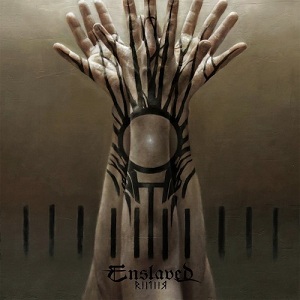
5. Enslaved – RIITIIR
How Enslaved have aged so well is beyond me, but their last three albums have been their best three albums, and 22 years after the formation of this band they remain at the forefront of metal. Their viking-infused progressive black sound of late has done as much to shape the future of the genre as any new-found participant in the current popular trend towards black metal that has been taking shape over the past four years. RIITIIR is another outstanding output by the one classic early 90s black metal band that has managed to weather the ages unscathed.
4. Blut aus Nord – 777: Cosmosophy
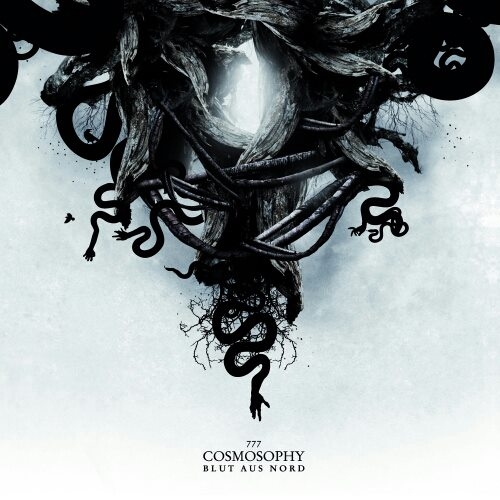
The review I wrote of 777: Cosmosophy last month was one of the most thorough I’ve done all year, and there is nothing I care to say about the album that I haven’t said already. It is outstanding in its own right, but it does not feel like an entirely complete finale to their already classic 777 series. The first and third tracks, breathtaking though they may be, don’t seem to sufficiently progress from where the second album in the trilogy, The Desanctification, left off. The second track moreover, Epitome XV, is the weakest link on all three albums. The last two tracks compensate greatly by concluding in proper form, and I certainly think Cosmosophy is excellent. It can only be said to have “shortcomings” in so far as I expected it to be the best album of 2012. Fourth place isn’t too bad.
3. Torche – Harmonicraft (song: Reverse Inverted)
Calling Torche metal at this point is really pushing the limits of the definition. Since their early days writing crushing stoner anthems, they have evolved into a bizarre amalgamation equal parts metal and pop. But it’s not just the uniqueness of the happy, smiley-face hammers Harmonicraft beats you down with that makes it so appealing. Torche have become by all rights the heirs of the 1990s. These guys have more in common with the Smashing Pumpkins than they do with any of their stoner metal contemporaries. This is the sort of thing that 15 years ago we could have just labeled “alternative rock” and gone on enjoying without any need for classifications. While forging an entirely unique, original sound of their own, Torche have managed to capture a song-writing ethos that has been dead for a generation, and Harmonicraft is the cleanest breath of fresh air I’ve inhaled in years.
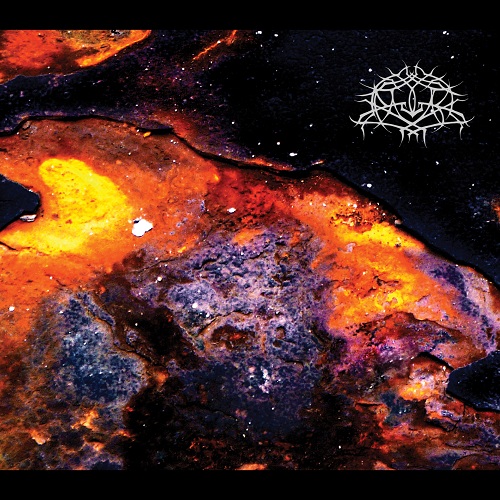
2. Krallice – Years Past Matter (song: Track 2)
Krallice is my favorite band making music today, and I dare say last year’s Diotoma might be my favorite album by any band ever. Seldom if ever has a band followed up such a masterpiece with something of equal worth, and I was shocked that Krallice had the energy left to release anything at all this year. Years Past Matter is an outstanding post-black metal outing in the vein of Dimensional Bleedthrough. The tracks took longer than usual to grow on me, and usual for Krallice entails dozens of listens, but the payout is always worth the time, and the slow process of appreciation is enjoyable in its own right. Mick Barr and Colin Marston’s dual tremolo is the grand ultimate ear-candy, and so long as they never compromise their commitment to that they will probably remain my favorite band. (Track 3 is my favorite song on Years Past Matter so far, but it was not available on youtube. Track 2 is a worthy substitute.)
1. Panopticon – Kentucky (song: Killing the Giants as They Sleep)
The fact that I didn’t review this album is almost embarrassing, because much like Aesthethica by Liturgy last year, it is an album that absolutely demands a thorough investigation to properly appreciate. I can’t easily tell you why I placed it this high, because frankly I don’t know yet myself. When I first read that a Louisville, Kentucky-based band called Panopticon had released a bluegrass black metal album, all sorts of thoughts ran through my head. Kentucky sounds like none of them. Do ignore the cliche “blackgrass” labels; while Austin Lunn listened to plenty of bluegrass in the process of recording this, he does not actually incorporate the genre as we might think of it. Instead he interweaves traditional Appalachian folk–not bluegrass particularly–as distinct tracks separated from the black metal. What folk does emerge in the bm is more akin to Waylander, and certainly far from “bluegrass”. That’s not a bad thing, just an–I think–important distinction to be made, because otherwise we might be left searching for genre stereotypes which simply aren’t present here. What Kentucky really accomplishes is a merging of a musical themes which perfectly juxtapose a beautiful landscape and a totally destitute human condition. The first half of “Killing the Giants as They Sleep” for instance generates landscape imagery with a degree of effectiveness similar to Femundsmarka by Waldgeflüster. (Have I referenced that album twice now? I think it’s time I paid it another visit.). You take a look around, take a deep breath, and really appreciate the natural beauty that surrounds you. About half way through the dialogue begins, and the explosion around 9:15 serves to draw you fully into the atrocities taking place here, both in the exploitation of workers and the desecration of the environment.
I don’t think Austin Lunn intended to make any sort of political statement here, but in succeeding so comprehensively to depict elements of Appalachia and its outskirts, he effectively did so. At a time when the working class of America is inexplicably becoming staunch supporters of big capital, this album hits a bulls-eye on all of the thoughts that have been forefront on my mind of late. His bleak renditions of union anthems like “Which Side Are You On?”, recently covered with such optimism by the likes of Dropkick Murphys, strike me as a painfully realistic reminder that the entire notion of equality as an American ideal is becoming antiquated.
But that might be seen as secondary. Wherever our ideas may lead us, Kentucky is the sort of album that inclines us to form them. It’s an album that makes me think. Like Aesthethica by Liturgy and Diotima by Krallice last year, it forces me to set aside my mundane daily routines and really engage the human experience. That alone, all other considerations aside, suffices to render it my favorite album of 2012.
I was pretty shocked when Krallice released Years Past Matter this August. If I remember an interview with the band I watched correctly, their first three albums–Krallice, Dimensional Bleedthrough, and Diotima–had all been written by Mick Barr and Colin Marston at roughly the same time. A very clear progression distinguished each, and by Diotima significant influence by drummer Lev Weinstein and bassist Nick McMaster was apparent, but the foundation had been there all along. I expected a rather lengthy break between Diotima and their next release, as I figured the band would be working more from scratch at that point. Instead, Years Past Matter appeared on the scene just a little over a year later.
The surprise worked out rather nicely, because I didn’t have time to build up unrealistically high expectations. Diotima was the best new album I’d heard in a decade, and I really doubted Krallice would be able to top it any time soon. They didn’t, and that’s just fine, because Years Past Matter is still outstanding.
I feel like it is a somewhat subdued work in comparison, far less explosive and dynamic than Diotima. Almost every Diotima track had a total mind-fuck moment or two: The intro track, Inhume at the beginning and at 5:25, Diotima at 5:35 and 8:50, Telluric Rings at 2:55, 6:40 and 10:35, Dust and Light at 4:45. I’ve yet to find any moment on this album where the music slaps me upside the head with a brick and makes me stair wide-eyed mouthing “holy fucking shit”. That being said, last.fm claims I’ve listened to Diotima over a hundred times. Krallice isn’t the sort of band you can fully appreciate on short notice.
It also seems like the drumming and bass have reverted to the secondary roles they had on Krallice and Dimensional Bleedthrough, not function as equal players in the manner of Diotima. There were a lot of instances on Diotima, especially on Inhume, where I think the drumming actually managed to trump the guitars in delivery. That might not be a matter of performance so much as production, and it’s worth noting towards this end that my dear, beloved cd player in my 2005 Nissan Sentra finally passed away this summer. I swear its stock model had better sound quality than any high-end sound system I have ever heard. It might just be the case that these elements on Years Past Matter feel slightly less overwhelming because my shoddy computer headset fails to do them justice.
But in light of the lofty and exclusive pedestal I place Diotima upon, these are modest complaints. Over all Years Past Matter feels a lot like Dimensional Bleedthrough to me. That was an album which, unlike their 2008 debut, I completely failed to appreciate initially. It wasn’t until Diotima had raised my opinion of the band through the roof that I began to revisit Dimensional Bleedthrough and really recognize its quality. I’m not going to make the same mistake with Years Past Matter, but it’s going to take more than the few dozen listens I’ve given it so far to really grasp its full worth. The myriad subtle complexities only become apparent bit by bit over time, and in the absence of Diotima’s explosiveness there is little to immediate grasp hold of. Like Dimensional Bleedthrough, the songs progress slowly and require a substantial attention span to fully engage. What works so well for both that album and Years Past Matter is that the atmosphere they generate makes for ideal background music. You can let it play all evening without ever growing tired, and when you do temporarily tune in what you encounter is always outstanding. My experience with these albums has been one of a gradual piecing together of the parts I happen to engage, building up over countless rewarding listens into a big picture that I know by heart from start to finish.
The physical presentation of the album actually adds a lot too. Along with one of the most compelling album covers I’ve seen in a while, Years Past Matter offers no printed lyrics or meaningful track titles. I haven’t gotten a chance to try and decipher any of the lyrics as sung, but I don’t think they are meant to play an essential role in the songs the way they do on Diotima. The feeling is more of some abstract, dehumanized vision of outer space. This isn’t so much a change in the sound–the vibe I get from it is essentially the same as on Dimensional Bleedthrough–but it places the music in a slightly different context from the outset.
If you don’t care for what you’re hearing on first listen, this band probably isn’t for you. Their unique take on black metal has remained fairly consistent throughout the years. But if you do appreciate the technical precision and the overall atmosphere, don’t be too quick to write off their song-writing. What may sound meandering at first will in time coalesce into a brilliantly crafted song. The big picture is a lot more accessible on Krallice and especially Diotima, but it was there to be had on Dimensional Bleedthrough too; I just tried too hard at that time to extract it. Years Past Matter has been a great experience for me this year because I’m not trying at all. I’m enjoying the ride and letting the full vision of their songs emerge naturally over time.
Blut aus Nord generated a lot of waves in the metal scene last April when they released Sect(s), the first installment in their 777 trilogy. The album was a gripping ride through a vivid musical nightmare, merging industrial music and a particularly demented take on black metal to paint its demon-ridden post-apocalyptic landscapes. The Desanctification, released in last November, flew much lower under the radar. Lacking all of Sect(s)’s shock value, it was a more contemplative plod which capitalized on the industrial side of their 777 sound and presented the devastation inflicted first-hand on Sect(s) from a less intimate angle. If the listener was the victim on Sect(s), Desanctification offered the role of witness.
Cosmosophy, the final installment in the 777 trilogy, was released this September, and a lot hinged on it. Sect(s) and The Desanctification were drastically different and yet inseparable, the second naturally flowing from the first. How did Blut aus Nord intend to bring it all to an end?
In the very last way anyone could have ever expected: They repeated the exact same thing they did on The Desanctification. It’s a brooding, visually stunning bird’s-eye view of a cyberpunk holocaust, and as such it’s just as outstanding as its predecessor. But where is it going?
If Blut aus Nord released two albums like this every year they might well become my favorite band. I’ve been dying for this kind of material, and The Desanctification and Cosmosophy both fill that niche with a degree of excellence that surpasses all other attempts I have heard. But I guess for me the 777 series was telling a story, vague though it need necessarily be, and Cosmosophy just kind of waves that off. It’s an outstanding album in its own right, but it does not feel appropriate in the context of the trilogy.
Epitome XVII and XVIII are somewhat of an exception,and they’re the tracks I’ll be sampling here. XVII has a definite sense of conclusion about it. It’s not an optimistic one, especially given the lyrics–“How many seasons beyond this sacred life? How many treasons beyond this clever lie?” But the feeling is one of profound revelation, as if the listener in this nearly wordless narrative has finally come to see the grand vision we were all hoping Cosmosophy would offer. The transition that spans from about 4:20 to 6:20 is pensive, serving to reintroduce the darkness that resolution has by no means abated. As this fades and we reach the final track in the trilogy, you can definitely see the story coming to an end:
Epitome XVIII is one of the finest of those bird’s-eye perspectives on the greater 777 landscape, and in its context it offers something of a new, esoteric light on the devastation below. The outro that begins to fade in after the 7 minute mark is the perfect conclusion and perhaps the darkest moment in the entire trilogy, epic in its silence. Of Cosmosophy’s two concluding tracks I have no complaints. It’s the first three that get us there that leave a lot to be desired.
If you care to revisit The Desanctification, it ends on a completely twisted industrial groove that offers all of the madness of Sect(s) without any of the fear–a sense that the subject (the listener) is breaking down into utter insanity, becoming a part of the surrounding chaos. I desperately wanted Cosmosophy to pick up on this note. I wanted to hear a merging of Sect(s)’s black metal and Desanctification’s industrial that, if you’ll humor my manner of description, merged the victim and the witness into one. I expected a juxtaposition of the sweeping landscapes and the frantic madness that could, in the context of the trilogy, depict a sort of out of body experience in the subject/listener. Epitome XIV and XVI instead feel like unused (though equal) tracks from Desanctification, while XV offers three minutes of obnoxiously spoken French which quite frankly fails to invoke anything but annoyance before plunging into an outstanding but compromised semi-operatic sweep that could have found a place on the album but lacks appropriate context as presented.
Epitome XV is the only track I dislike in the trilogy, while XIV and XVI seem out of order. In the meantime, I feel like an essential step between Desanctification’s XIII and Cosmosophy’s XVII is missing. In short, Cosmosophy does not live up to my ridiculously high expectations. If Blut aus Nord were to come out with a surprise Part 4, I certainly would not deem it overkill. But if we view Cosmosophy as just another 2012 metal album there is hardly room to complain. It is only in light of the standard set by Sect(s) and The Desanctification, and in expectation that the conclusion ought to be the 777 trilogy’s finest hour, that it slightly disappoints.











 Through the Shattered Lens