We just received word that the Texas Branch is still currently down. It’s been six full days without power. I can’t even begin to imagine the impact, but we’re hoping that they back up and running soon. Case and I are keeping the fires lit here, but it also reminds us of Lisa Marie’s John Wick levels of legendary speed, sheer will, creative output and literary fortitude. We miss the Bowmans, and are rooting for their quick return.
In the meantime, we’re sharing some of our favorite scenes and films. It seems fitting that the Lighting of the Beacons sequence of The Return of the King is our focus here. With the city of Gondor under attack, the steward Denathor (John Noble) doesn’t wish to call for any help. With Pippin’s (Billy Boyd) help, Gandalf (Ian McKellan) gets word out to Rohan in a most spectactular fashion. Howard Shore’s score amplifies the sequence to epic levels.
It’s been 13 years since the first film in what will ultimately become Peter Jackson’s Middle-Earth Saga and now we’re in the stretch run. The Hobbit: The Battle of the Five Armies is set to arrive in North America this December 17. The film premiered in London on December 1, 2014.
Kids who first saw The Fellowship of the Ring in 2001 are now young adults. For adults who have returned time and time again to the world Peter Jackson built for over a decade of limitless imagination and hard work of thousands this final film will be the culmination of watching what many in years past have called unfilmable.
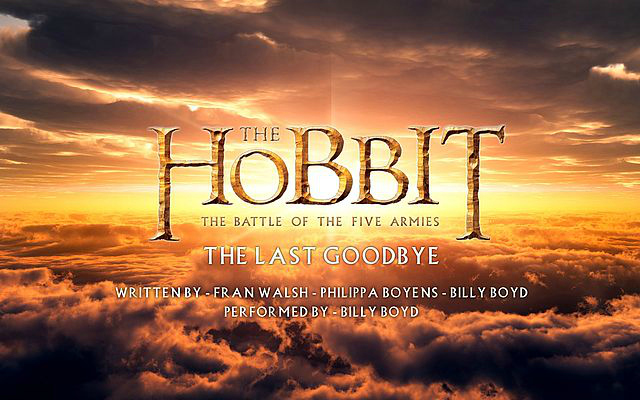
So, it’s with both joy and sadness that the book finally closes on Peter Jackson’s Middle-Earth journey and what better way than the final end credits song “The Last Goodbye” written and recorded by Peregrin Took himself, Billy Boyd.
The video itself mixes in scenes from both The Battle of the Five Armies and the previous five films. We also get some behind-the-scenes footage of the cast making their final farewells as filming closes to an end.
Damn people cutting onions.
The Last Goodbye
I saw the light fade from the sky On the wind I heard a sigh As the snowflakes cover my fallen brothers I will say this last goodbye
Night is now falling So ends this day The road is now calling And I must away Over hill and under tree Through lands where never light has shone By silver streams that run down to the sea
Under cloud, beneath the stars Over snow one winter’s morn I turn at last to paths that lead home And though where the road then takes me I cannot tell We came all this way But now comes the day To bid you farewell Many places I have been Many sorrows I have seen But I don’t regret Nor will I forget All who took the road with me
Night is now falling So ends this day The road is now calling And I must away Over hill and under tree Through lands where never light has shone By silver streams that run down to the sea
To these memories I will hold With your blessing I will go To turn at last to paths that lead home And though where the road then takes me I cannot tell We came all this way But now comes the day To bid you farewell
“Arise, arise Riders of Théoden (Riders of Rohan)! Fell deeds awake: fire and slaughter! Spear shall be shaken, shield be splintered, a sword-day, a red day, ere the sun rises! Ride now, ride now! Ride for ruin… and the world’s ending! Death! Death! Forth Eorlingas!” – Theoden, King of Rohan
This marks the final “Scenes I Love” series from Peter Jackson’s fantasy epic, The Lord of the Rings. The last couple days have seen a favorite scene picked from the first two film. Today’s pick was a tie between two scenes. One a third of the way into The Return of the King with the second being two-thirds in and a logical consequence of the first scene picked. I could’ve easily picked one over the other, but I’ve always seen the two as connected in some way. I also didn’t want to pick one over the other so we have two scenes instead of one. I say that’s a bonus for everyone.
The first scene was (continues to be one of my most favorite scenes ever put on film) the lighting of the beacons which signals Gondor’s call for aid to it’s far neighboring kingdom of Rohan. This scene just builds and builds until the rousing “Gondor theme” reaches it’s peak and shows each beacon lighting up one right after the other until it reaches the mountain peaks outside Rohan. No matter how often I see this scene (especially now on blu-ray) I can’t help but still feel a sense of awe at what Peter Jackson and his crew pulled off. One buys into the scene and just marvels at the sequence. A film which, up until the lighting of the beacons, had such a hopeless tone to it suddenly had hope appear.
The second scene finally sees the culmination of the lighting of the beacons. Rohan has responded in force as every able-bodied man and his horse have gathered on a rise above Pelennor Fields. With Theoden knowing the forces of Sauron arrayed and besieging Mina Tirith dwarfs even his own cavalry force he nonetheless orders his men to charge the Mordor lines to help break the siege. His speech in this scene trumps even Aragorn’s own rousing speech later on in the film which is saying much. The charge of the Rohirrim down into the Mordor lines gets a nice assist from Howard Shore’s score which begins with the “Rohan theme” signalling the arrival of the Rohirrim to the battle then transitioning to the “Nature theme” which is heard for the first time in full orchestral mode before returning to the “Rohan theme” as the Rohirrim charge finally crashes into the Mordor lines.
The charge itself looked great when I saw it on the big-screen and still the best way to see it. Barring not seeing it on the big-screen the best option would be to see it on blu-ray and on a large HDTV screen. The wide, overhead shot of the massed cavalry gradually gaining speed with Theoden at the elongating tip in the middle makes for great, epic filmmaking. The scene sells itself as Jackson used hundreds of extras in real armor and on charging horses (with CGI copies expanding their numbers into the thousands) to show true weight to the scene. I recommend to those who want to revisit this scene to watch it again but using their surround sound system on high and feel the thundering hooves of the charging Rohirrim until they crash into the Mordor lines. It’s the only way to see and experience the scene.
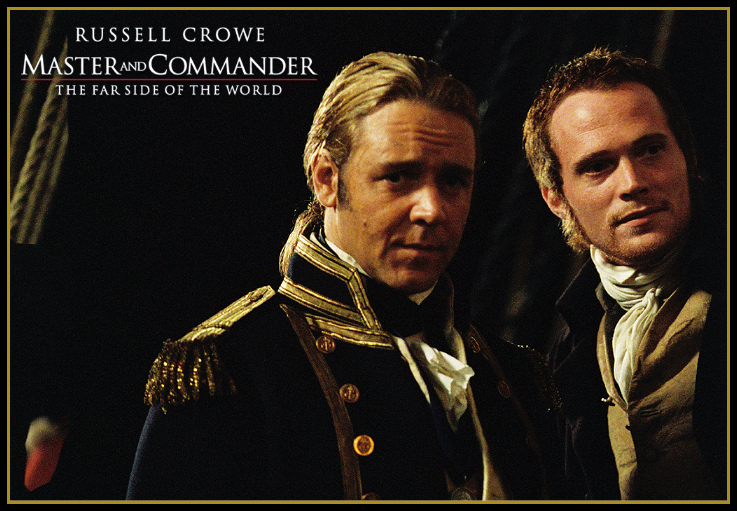
If there was a film which deserved better when it first came out in 2003 it would be Peter Weir’s epic adaptation of the Patrick O’Brian seafaring novels starring the character of Capt. Jack Aubrey. It was just bad luck on the part of Weir’s film that it came out the same year and month as the juggernaut that would sweep through not just the box-office for the 2003 holiday season, but all through the award-season. If Master and Commander: The Far Side of the World had only come out a year later there’s a great chance it would’ve been the frontrunner for 2005 Academy Awards for Best Picture, Best Director, Best Adapted Screenplay and many more. But the juggernaut that was Peter Jackson’s Lord of the Rings: The Return of the King would not be denied after two previous years when Jackson and his magnum opus were passed over.
To say that Peter Weir was at the top of his game with Master and Commander would be an understatement. Working from a script written by Weir himself and John Collee, the film would take several episodes from the Patrick O’Brian Aubrey-Maturin novels and combine them to make a coherent and thrilling period piece that rarely ever get made anymore. This was epic filmmaking at its finest with Weir’s direction keeping the long-running time of the film from becoming too tedious. Yet, he was also able to keep the film from becoming one battle setpiece following another. There was enough of a balance between the quiet storytelling, especially between the characters of Capt. “Lucky” Jack Aubrey (played by Russell Crowe in what had to be his best role ever) and his close friend and ship’s doctor Stephen Maturin (Paul Bettany matching Crowe scene for scene) to keep the film grounded in reality.
Master and Commander is set during the Napoleonic Wars when France and England battle it out on land and in the high seas. On one side is the HMS Surprize captained by Jack Aubrey which patrols the sea lanes from French privateers looking to attack and loot the rich English whaling ships to help fund Napoleon’s ambitions. The film is actually a cat-and-mouse thriller wrapped around a character piece as Aubrey’s ship and crew, outgunned and less armored than the French frigate Acheron it has come across during its patrol, must not just try and survive but find a way to beat it’s larger opponent. It’s during the quiter scenes in-between sea engagements that the film actually becomes stronger. We see life onboard the HMS Surprize as being quite harsh and primitive and not so glamourous as past films about sailing life would have audiences believe. The film shows how this harsh life for volunteers and press-ganged crew ratings creates a strong bond of fellowship amongst the crew members that when they believe someone is jeopardizing their lives they quickly turn on that individual. But it’s through the near-dictatorial handling of his crew which keeps both ship and crew from devolving into mutiny. Crowe does a great job of giving Jack Aubrey that balance of ruthless taskmaster whose word is law onboard, but also gives his captain that bon vivant flair which when used accordingly makes Aubrey a hero to the very men he has to lord over.
This benevolent dictator was balanced out by Bettany’s Dr. Maturin who acts not just as the scientific counter to Aubrey’s militaristic personality, but also as the conscience of the ship who looks first to the crew’s well-being. This dynamic between Crowe and Bettany kept the film anchored and stabilized as we see the long-standing friendship between these two get tested not just by the crisis they find themselves in but also the vast ideological differences between the military man and the scientist. Yet, despite all their problems and difference when things became rough the two would settle it amicably and concentrate on their shared task with their bond of friendship intact and much stronger after.
The film doesn’t shirk it’s thrills as Master and Commander provides audiences with some of the most thrilling and accurate portrayal of naval combat during the Napoleonic era. There are no steel-hulls or rapid-fire guns. The engagements between the HMS Surprize and the Acheron were all brutal affairs from the first time the latter ambushes Aubrey’s ship early in the film to the final battle which sees not just ship-to-ship fighting but boarding actions as the crew of the Surprize attempt a desperate gamble to take the fight to the bigger French privateer. It’s a testament to Weir’s direction that even through the chaotic nature of each battle he’s able to keep each scene easy to follow and allow for main characters to stand out for audiences to recognize.
It’s a shame that the film didn’t succeed in the box-office more than it did. Master and Commander: The Far Side of the World showed that there was still old-school epic filmmaking left in Hollywood with filmmakers willing to tell a grand story with bigger-than-life characters on a broad canvas. The fact that it took an even more epic film to surpass Peter Weir’s film shouldn’t detract from this film’s accomplishments.
 Through the Shattered Lens