Retro Television Reviews: International Airport (dir by Don Chaffey and Charles S. Dubin)


Welcome to Retro Television Reviews, a feature where we review some of our favorite and least favorite shows of the past!  On Sundays, I will be reviewing the made-for-television movies that used to be a primetime mainstay.  Today’s film is 1985’s International Airport!  It  can be viewed on YouTube!

It’s not easy working at an international airport!

At least, that’s the message of this made-for-television film.  Produced by Aaron Spelling and obviously designed to be a pilot for a weekly television series, International Airport details one day in the life of airport manager David Montgomery (Gil Gerard).  Everyone respects and admires David, from the recently graduated flight attendants who can’t wait for their first day on the job to the hard-working members of the airport security team.  The only person who really has a problem with David is Harvey Jameson (Bill Bixby), the old school flight controller who throws a fit when he learns that a woman, Dana Fredricks (Connie Sellecca), has been assigned to work in the tower.  Harvey claims that women can’t handle the pressure of working the tower and not having a personal life.  He demands to know what Dana’s going to do during that “one week of the month when you’re not feeling well!”  Harvey’s a jerk but, fortunately, he has a nervous breakdown early on in the film and Dana gets to take over the tower.

Meanwhile, David is trying to figure out why an old friend of his, Carl Roberts (played by Retro Television mainstay Robert Reed, with his bad perm and his retired porn star mustache), is at the airport without his wife (Susan Blakely).  David takes it upon himself to save Carl’s troubled marriage because it’s all in a day’s work for the world’s greatest airport manager!

While Carl is dealing with his mid-life crisis, someone else is sending threatening letters to the airport.  One of the letters declares that there’s a bomb on a flight that’s heading for Honolulu.  David and Dana must decide whether to allow Captain Powell (Robert Vaughn) to fly to Hawaii or to order him to return to California.  And Captain Powell must figure out which one of his passengers is the bomber.  Is it Martin Harris (George Grizzard), the sweaty alcoholic who want shut up about losing all of his friends in the war?  Or is it the woman sitting next to Martin Harris, the cool and aloof Elaine Corey (Vera Miles)?

Of course, there are other passengers on the plane.  Rudy (George Kennedy) is a veteran airline mechanic.  Rudy is hoping that he can talk his wife (Susan Oliver) into adopting Pepe (Danny Ponce), an orphan who secretly lives at the airport.  Unfortunately, when Pepe hears that Rudy’s plane might have a bomb on it, he spends so much time praying that he doesn’t realize he’s been spotted by airport security.  Pepe manages to outrun the security forces but he ends up hiding out in a meat freezer and, when the door is slammed shut, it appears that Pepe may no longer be available for adoption.  Will someone hear Pepe praying in time to let him out?  Or, like Frankie Carbone, will he end up frozen stiff?

International Airport was an attempt to reboot the Airport films for television, with the opening credits even mentioning that the film was inspired by the Arthur Hailey novel that started it all.  As well, Gil Gerard, Susan Blakely, and George Kennedy were all veterans of the original Airport franchise.  George Kennedy may be called Rudy in International Airport but it’s easy to see that he’s still supposed to be dependable old Joe Patroni.  Unfortunately, despite the familiar faces in the cast, International Airport itself is a bit bland.  It’s a disaster film on a budget.  While the viewers gets all of the expected melodrama, they don’t get anything as entertaining or amusing as Karen Black flying the plane in Airport 1975 or the scene in Concorde: Airport ’79 where George Kennedy leaned out the cockpit window (while in flight) and fired a gun at an enemy aircraft.  Probably the only thing that was really amusing (either intentionally or unintentionally) about International Airport was the character of Pepe and that was just because young Danny Ponce gave perhaps the worst performance in the history of television.

International Airport did not lead to a television series.  Watching it today, it’s a bit on the dull side but, at the same time, it is kind of nice to see what an airport was like in the days before the TSA.  If nothing else, it’s a time capsule that serves as a record of the days when the world was a bit more innocent.

Retro Television Review: The Love Boat 1.4 “Message for Maureen / Gotcha / Acapulco Connection”


Welcome to Retro Television Reviews, a feature where we review some of our favorite and least favorite shows of the past!  On Wednesdays, I will be reviewing the original Love Boat, which aired on ABC from 1977 to 1986!  The series can be streamed on Paramount Plus!

Welcome aboard, it’s love!

Episode 1.4 “Message for Maureen / Gotcha / Acapulco Connection”

(Directed by Stuart Margolin, Richard Kinon, and Peter Baldwin, originally aired on October 15th, 1977)

Oh no!  It’s a stowaway!  I guess any television show that took place on a cruise ship would have to feature at least one storyline featuring a stowaway.  It’s a bit disconcerting that The Love Boat couldn’t make it for more than four episodes before using the most obvious plotline but then again, the show ended up running for 9 seasons and a movie.  So, apparently, audiences didn’t mind and I have a feeling that there will probably be many more stowaway stories to come.

The stowaway in this episode is April Lopez (played by Charo).  Apparently, April became a recurring character, one who appeared in almost every season.  In this, her first appearance, she sneaks onto the boat in Acapulco.  The captain is not happy when she’s discovered hiding in a laundry hamper but everyone else is charmed by just how loud and talkative she is.  Because there’s no available rooms, April is housed with Doc Bricker until she can be dropped off at the next port.  Of course, Doc falls in love because Doc fell in love with everyone who came into his exam room.  Seriously, Doc was an HR nightmare waiting to happen.

Of course, April is not the only exhausting person to be on the ship.  There’s also Cyril Wolfe (Milton Berle), a nonstop practical joker whose wife (Audra Lindley) is getting sick of dealing with him and really, who can blame her?  Cyril greets a total stranger with a joy buzzer.  He carries around a fake, detachable hand so that he can freak people out.  Cyril can’t even give it a rest during their vacation!  Pretty soon, not only his wife but the crew are pretty sick of him.  (Most of the people watching the show will be sick of him, too.)  Do they conspire to toss Cyril overboard?  They could probably get away with it, seeing as how all of the ship’s nominal authority figures are busy dealing with a stowaway who loves to sing.  Somehow, Cyril survives his trip and he and his wife end up more in love than ever.

Finally, Maureen Mitchell (Brenda Benet) is a former tennis player who is now in a wheelchair.  All she wants is a few days of vacation before she meets with a surgeon who might be able to help her walk again.  Unfortunately, she discovers that an arrogant sportswriter named John (Bill Bixby) is also on the cruise!  At first, she wants nothing to do with him but when John injures his knee and has to use a wheelchair for the rest of the cruise, the two of them fall in love….

Hold on.  You know what just occurred to me?  Last week’s episode featured Robert Reed and Loretta Swit as two people who don’t like each other but just happen to end up on the same cruise.  This episode featured Brenda Benet and Bill Bixby as two people who don’t like each other but just happen to end up on the same cruise …. how long did The Love Boat writers last before they said, “Okay, we’re out of stories.  Let’s start repeating ourselves?”

Anyway, this episode was a mixed bag.  Charo and Milton Berle were not particularly subtle performers and their storylines felt as if they were designed to invite them to indulge in their worst impulses as performers.  But Bill Bixby and Brenda Benet had a lot of chemistry as John and Maureen and their story actually worked as a result.  (Bixby and Benet were married at the time they appeared in this episode.)  Plus, the ship looked lovely.  So did the ocean.  That’s what really matters.

Retro Television Review: Fantasy Island (dir by Richard Lang)


Welcome to Retro Television Reviews, a feature where we review some of our favorite and least favorite shows of the past!  On Tuesdays, I will be reviewing the original Fantasy Island, which ran on ABC from 1977 to 1996.  The entire show is currently streaming on Tubi!

Ah, Fantasy Island!

There have been several versions of Fantasy Island.  In the late 90s, there was a version that featured Malcolm McDowell as the somewhat aloof owner of the island.  More recently, there was a movie that featured Michael Pena as the owner of the Island and which tried to turn the whole thing into a horror franchise.  It wasn’t very good.  And right now, there’s a show on Fox that features Roselyn Sanchez as the grand niece of the island’s original owner.  The Fox series is about to start its second season.  It’s a bit silly, which is why I kind of love it.

And then there’s the Fantasy Island that started it all, the Aaron Spelling-produced series that ran from 1977 to 1984 on ABC and which has lived on in reruns and on streaming platforms like Tubi.  Both the original series and all of its subsequent spin-offs took place on a mysterious tropical island where people would pay to live out their fantasies.  In the original series, the island was run by Mr. Roarke (Ricardo Montalban), who wore a white suit and encouraged everyone to smile whenever the guests arrived.  Serving as Mr. Roarke’s second-in-command was Tattoo (Herve Villechaize), who was 3’11, always wore a matching white suit, and announced the arrival of the plane by ringing a bell and shouting, “The plane, the plane!”  Of course, each week would bring in a different group of guest stars.  They would come to the island with a fantasy and, hopefully, they would learn that reality was the only fantasy that they needed.

All seven seasons of the original Fantasy Island are currently streaming on Tubi.  However, if you want to see the 1977 pilot film that started it all, you have to go to YouTube.

In many ways, the 90-minute pilot film feels like a typical episode of Fantasy Island.  It’s interesting to see that the show’s basic premise and format was already set in stone when the pilot was filmed.  (Pilots are notorious for often being dramatically different from the shows that they were created to sell.)  The pilot opens with the plane arriving (and yes, from the start, Tattoo rings the bell and shouts, “The plane!”) and three guests meeting Mr. Roarke.  Our three guest stars are Bill Bixby, Hugh O’Brian, and Eleanor Parker.  Bixby plays Arnold Greenwood, a former war correspondent who wants to be reunited with Francesca (Sandra Dee), the woman with whom he fell in love during World War II.  O’Brian is Paul, a famous big game hunter who wants to be hunted for once.  Eleanor Parker is Eunice Hollander Barnes, one of the world’s richest women.  She wants to fake her death so she can see who, from her life, would actually mourn her and who would just try to steal her fortune.

If the pilot’s format is the same as the series that followed, the general tone is somewhat different.  Mr. Roarke is an almost sinister figure, one who doesn’t really seem to think much of his guests and who is quick to point out that no one gets a fantasy until they’ve paid him the required $50,000.  (That’s $50,000 in 1970s money.  I have to admit that when Mr. Roarke first mentioned how much the fantasies cost, I was like, “Hey, I could afford this place!”)

Consider the story of the hunter.  Paul wants to be hunted because he’s suicidal.  His real fantasy is to die.  The night before Paul’s fantasy is to begin, Michelle (Victoria Principal) shows up at Paul’s room.  Michelle explains that Mr. Roarke has hired her to provide Paul with companionship during the night.  Unfortunately, Michelle ends up handcuffed to Paul and, as a result, she’s hunted along with him!  Now, you could argue that Mr. Roarke did this to teach Paul to think about someone other than himself.  But what if Paul hadn’t learned the lesson?  Then Michelle would be dead too!  What would Mr. Roarke do then?  Just have Tattoo dump the bodies in the lagoon?  “To hell with you, Roarke!” Paul yells and who can blame him?

And then there’s our war correspondent, Arnold.  Arnold’s fantasy seems simple enough but then it turns out that the reason he lost contact with Francesca is because he murdered her!  As a result of his fantasy, Arnold not only relives the first time he met Francesca but also how their relationship ended.  The entire experience leaves Arnold laughing like a madman as his sanity slips away.

As for Eunice’s story, it’s pretty stupid.  She dresses up like a maid so that she can listen to what people have to say about her once they think she’s dead.  It’s like an episode of Undercover Boss.  At least former Kennedy in-law Peter Lawford makes an appearance as Eunice’s husband.  Eunice ends up far less traumatized than either Paul or Arnold but she still had to fake her death to come to peace with her life.

The pilot is entertaining.  One can understand why it would lead to a series.  The island is lovely to look at.  Even with the somewhat sinister tone of two of the stories, it’s still impossible to watch the pilot without wondering what type of fantasy you would pursue if you went to the Island.  For me, that’s always been the main appeal of all of the various versions of Fantasy Island.  Still, it’s interesting that the fantasies themselves are less comforting than what I think many would expect on account of the show’s reputation.  For all the criticism that Blumhouse received for their reinterpretation of Fantasy Island, they were not the first to imagine Mr. Roarke as being somewhat less than benevolent.  Of course, when the actual series started, Mr. Roarke was a far friendlier host.

Next week, the series begins and hopefully, no further guests are traumatized to the point of catatonia.

The Death of the Incredible Hulk (1990, directed by Bill Bixby)


David Banner (Bill Bixby), still hoping to find a cure for the condition that causes him to turn into the Hulk (Lou Ferrigno) whenever he gets injured or stressed out, heads up to Portland.  Pretending to be a simple-minded janitor named David Bellamy, Banner gets a job working in the lab of Dr. Ronald Pratt (Philip Sterling).  Banner hopes that Dr. Pratt’s research holds the secret that can release him from being the Hulk.  When Dr. Pratt learns Banner’s secret, he and his wife (Barbara Tarbock) work with Banner to try to cure him and to understand the Hulk.

David Banner is not the only person who has infiltrated the lab.  KGB agent Jasmin (Elizabeth Gracen) has also been sent to the lab with orders to steal Pratt’s research.  Jasmin hates working for the KGB but she’s been told that her sister will be killed unless she complete one final mission.  When Jasmin meets and falls in love with David, she starts to reconsider her loyalties.  When the KGB finally makes their movies, Jasmin is going to have to decide who to help and the Hulk is going to have to come through and save the day one final time.

David Banner’s saga finally comes to a close in The Death of the Incredible Hulk, the third and last of the Incredible Hulk television movies.  It’s also the best of the three, though that might not by saying much when you consider the quality of the first two.  While the other two movies both served as backdoor pilots for other heroes and the Hulk was barely even present in the 2nd movie, The Death of the Incredible Hulk keeps the focus squarely on David Banner and the Hulk.  (Though Jasmin does seem like she could be a version of the Black Widow, I think the similarities between the two characters are a coincidence.  Beautiful and conflicted KGB agents were a popular trope in the 80s and early 90s.)  Both Bixby and Ferrigno get to show off what they can do in their signature roles.  Bixby is especially good at capturing Banner’s tortured and lonely existence and his performance helps to make The Death of the Incredible Hulk something more than just another cheap sci-fi TV movie.

Though the film stays true to its title and ends with a mortally wounded Banner saying that he’s finally free, it was not intended to be the final Hulk film.  There were plans to bring David Banner back to life and presumably, the Hulk would have come back with him.  Unfortunately, Bill Bixby himself died in 1993, before shooting could begin on The Return of the Incredible Hulk.


The Trial of the Incredible Hulk (1989, directed by Bill Bixby)


Still on the run and hoping to find a cure for the condition that causes him to transform into the Incredible Hulk, David Banner (Bill Bixby) is now in New York and using the name David Belson.  He’s grown a beard to keep himself from being recognized.  I guess it’s like when Superman used to put on his glasses.  When David sees a woman being harassed on the subway by two thugs, it’s too much stress for him and he transforms into the Hulk (Lou Ferrigno).  When the Hulk turns back into David, he is arrested and charged with being a mugger.  (No one believes the witness’s account of seeing a huge green man on the subway.)

Despite the title, the Hulk never goes on trial, though there’s a dream sequence where David turns into the Hulk in a courtroom.  (Stan Lee plays the jury foreman.)  Just having a nightmare about turning into the Hulk is enough to cause the transformation for real.  No New York jail can hold the Hulk.

David’s lawyer is blind and yes, his name is Matthew Murdock (played by Rex Smith).  Murdock thinks that the attack on the subway was somehow linked to a crime lord named … yes, Wilson Fisk.  Fisk (John Rhys-Davies) wants to set up a national crime syndicate, as if Lucky Luciano didn’t already do that.  Using the name Daredevil, Murdock tries to prevent that.  David eventually ends up helping.

The Trial of the Incredible Hulk is a huge tease.  It promises the Hulk on trial but, instead, it’s just a backdoor pilot for a Daredevil TV series.  Just like in The Incredible Hulk Returns, the Hulk is forced to make room for a new hero.  But at least The Incredible Hulk Returns actually featured the Hulk working with Thor.  In Trial of the Incredible Hulk, the Hulk is hardly present at all.  Banner encourages Murdock not to give up, even after he’s badly beaten by Fisk’s men, and he works with Matt to help him prepare for a rematch.  But the final battle is almost all Daredevil.  Once he escape from prison, Banner doesn’t turn into the Hulk once.

Rex Smith isn’t bad as Daredevil.  While he’s not as good as Charlie Cox, he’s still better than Ben Affleck.  While the movie does not feature the classic Daredevil costume, it does at least get Daredevil’s origins and powers correct.  John Rhys-Davies hams it up as Wilson Fisk.  One of Marvel’s most intriguing villains is turned into just another generic bad guy in an office.  It’s disappointing.

The Trial of the Incredible Hulk ends with Murdock pledging to protecting the city and Banner again hitchhiking away.  Daredevil would have to wait for another 25 years before getting his own series.  Banner would return in The Death of the Incredible Hulk.


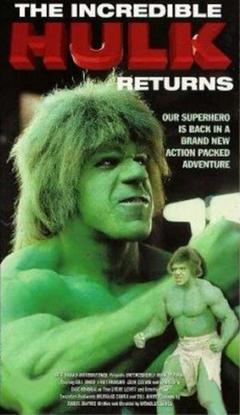
The Incredible Hulk Returns (1988, directed by Nicholas Corea)


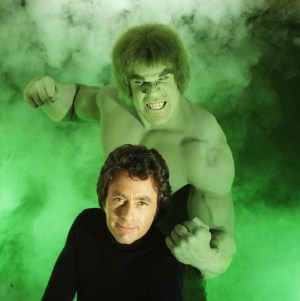
Scientist David Banyon (Bill Bixby) has a secret.  His real name is David Banner and he has spent the last ten years in hiding, traveling up and down the highway and searching for a cure to a very strange condition.  As the result of getting dosed with gamma rays, David Banner sometimes transforms into an angry green monster known as the Hulk (Lou Ferrigno).  The world believes that David Banner is dead and Banner must let them continue to believe that until he can find a cure for the monster within.

The Incredible Hulk Returns is a continuation of the old Incredible Hulk television series, which was the first (and, until the MCU came along, only) successful attempt to build a live action show around a Marvel super hero.  Premiering in 1978, The Incredible Hulk ran for 5 seasons and got good ratings and, for a comic book series, surprisingly decent reviews.  However, it was also expensive to produce and it was abruptly cancelled in 1982, before the show got a chance to wrap up David’s story.  When The Incredible Hulk ended, David Banner was still alone and hitchhiking from town to town.  Six years later, The Incredible Hulk Returns caught up with David and tried to sell viewers on a “new” Marvel hero as well.

David “Banyon” is now living in California and working at the Joshua-Lambert Research Institute.  It’s been two years since he last turned into the Hulk.  He controls his rage by being careful not to get involved in any dangerous situations.  He also has a girlfriend, Dr. Maggie Shaw (Lee Purcell).  David is designing the Gamma Transponder, which he thinks will cure him of his condition.  Life’s good until Donald Blake (Steve Levitt) shows up.

A student of Banner’s, Blake recognizes his former teacher and approaches him with a crazy story.  When Blake was in Norway, he stumbled across a tomb that contained a hammer that contained the spirit of Thor, a Viking warrior who was banished to Earth by Odin.  To prove that he’s telling the truth, Blake commands Thor to emerge from the hammer.  When Thor (played by Eric Kramer) does, he makes such a mess in the laboratory that David transforms into the Hulk.

Thor is not Banner’s only problem.  Jack LeBeau (Tim Thomerson!) and Mike Fouche (Charles Napier!!) want to steal the Gamma Transponder and turn it into a weapon.  Also, reporter Jack McGee (Jack Colvin) s back in town and still obsessed with proving that the Hulk exists.

The Incredible Hulk Returns may be a continuation of David Banner’s story but the main reason it was filmed was so it could serve as a backdoor pilot for a Thor television series.  The Thor TV series never happened and, for those who are used to Chris Hemsworth’s comedic take on Thor, it’s jarring to see Eric Kramer playing the role like a third-tier professional wrestler.  For fans of The Incredible Hulk TV series, it’s even more jarring to see the Hulk fighting alongside a viking.  Unlike the comic book, the TV series usually tried to ground its stories in reality, with Banner’s transformations into the Hulk serving as the show’s only concession to its comic book origins.  The villains played by Thomerson and Napier both seem like typical bad guys from the show’s heyday but Thor just doesn’t belong.  Fans of the show will resent Thor taking the spotlight away from David Banner and the Hulk while fans of Thor will notice that this version of Thor is apparently not the god of thunder but instead just an egotistical viking who got on Odin’s nerves.

Bill Bixby was always The Incredible Hulk‘s not-so-secret weapon, taking and playing his role very seriously.  He continues to do that in The Incredible Hulk Returns but how seriously can anyone come across when they’re speaking to Thor?  By the end of the movie, Thor and Blake head off on their own adventures while Banner resumes hitchhiking.  Thor and Blake would not be seen again but David Banner’s adventures would continue in The Trial of the Incredible Hulk.

A Movie A Day #145: The Incredible Hulk: A Death In The Family (1977, directed by Alan J. Levi)


Following the events of The Incredible Hulk and with the world convinced that he is dead, Dr. David Banner (Bill Bixby) is hitchhiking his way across California, hoping to reach a hospital where research is being done on the effects of gamma radiation.  When he stops off in an orange grove, he spots a young, crippled woman named Julie (Laurie Prange).  When Julie faints, David carries her back to her mansion.  It turns out that, after the mysterious death of her father, Julie stands to inherit millions.  David suspects that her doctor (played by William Daniels) may be poisoning her and he gets a job working on the grounds of her mansion.  At first, David thinks that his biggest problem is going to be the head groundskeeper (Gerald McRaney), who is jealous of David’s relationship with Julie.  But, actually, it’s Julie’s stepmother (Dorothy Tristan) that David has to watch out for.  When David tries to protect Julie and a bitter hermit (John McLiam) from the stepmother’s evil plans, he soon finds himself being pursued through the swampland by both men with guns and tabloid journalist Jack McGee (Jack Colvin).  They are all making David Banner angry and they’re about to discover that they wouldn’t like David Banner when he’s angry.

This was the second pilot for The Incredible Hulk.  It aired a week after the first pilot and, like that one, it was also given a theatrical release in Europe.  While the first movie established David Banner’s backstory and explained why he transformed into the Hulk whenever he bumped his head on a door frame or twisted his ankle, A Death in The Family is more typical of the series that would follow.  Like every subsequent episode, A Death In The Family opens with David Banner finding an odd job and ended with him walking down the road with his thumb stuck out.  In between, Banner helps a special guest star.

Watching the second pilot, it’s easy to see why CBS took a chance on The Incredible Hulk even though, at the time, comic book adaptations were considered to be a risk.  Both Bill Bixby and Lou Ferrigno really throw themselves into playing Banner and his alter ego and the show takes the idea seriously.

There’s nothing special about the pilot’s story.  The stepmother and the doctor are obviously guilty from the start.  But the plot (and the 90 minute running time) does allow for four appearances by the Hulk.  David Banner even gets attacked by a grizzly bear, which brings the Hulk right out.  David Banner always had the worst luck with wild animals and barbed wire.  The Hulk, though, just throws the grizzly bear over into the next pond.  The bear is not harmed.  The Hulk may have been angry but he was never really dangerous.

Finally, for the record, Death In the Family featured the first of many aliases that David Banner would assume over the next four years.  This time, he’s David Benton.

A Movie A Day #144: The Incredible Hulk (1977, directed by Kenneth Johnson)


It may seem hard to believe now but there was a time when comic book adaptations were considered to be a risky bet at best.  In 1977, Marvel Comics sold the television rights for four of their characters to Universal Productions. This led to three unsuccessful pilots (one for Dr. Strange and two for Captain America), a Spider-Man series that lasted for two seasons, and The Incredible Hulk.  As opposed to the other Marvel adaptations, The Incredible Hulk series was popular with fans and (some) critics and ultimately lasted for four seasons.

It all started with a 90 minute pilot that aired in 1977.  Haunted by the car accident that caused the death of his wife and his inability to rescue her, Dr. David Banner (Bill Bixby) is researching why, in times of extreme stress, ordinary people can suddenly experience moments of super human strength.  What he theorizes is that it is a combination of body chemistry and gamma radiation caused by sun spots.  Eager to test his theory, David straps himself into a chair and zaps himself with gamma radiation.  At first, it seems as if nothing has changed.  But when David’s driving home, he gets a flat tire.  When he struggles to change the tire, in the middle of a hurricane nonetheless, David gets mad.  Suddenly, his eyes turn green and soon so does the rest of him as David Banner is transformed into the Incredible Hulk (Lou Ferrigno, except for one shot where the Hulk is played by Richard Kiel).  The Hulk runs through the woods, accidentally scaring a girl and getting shot by a hunter.  When the Hulk falls asleep, he transforms back into David, who has no memories of what he did while he was the Hulk.  While David and his colleague, Elaina Marks (Susan Sullivan), investigate what happened to him, tabloid reporter Jack McGee (Jack Colvin) tries to uncover the results of David and Elaina’s research.

Other than introducing the Hulk and giving Banner a backstory, the pilot didn’t have much in common with the series that followed.  Along with being a comic book adaptation, the series was also a remake of The Fugitive.  With everyone convinced that the Hulk had murdered both him and Elaina, David was always on the run and trying to find a way to cure his condition.  Every episode would begin with David working a new odd job and getting involved in a new situation and almost every episode ended with David hitchhiking while the show’s famous piano theme played over the final credits.  Because David was always either getting beaten up or tangled in barbed wire, the Hulk would show up twice an episode.  David Banner just couldn’t catch a break.

The pilot seems to take forever to get going, devoting a lot of time to David and Elaina doing research.  In those days before the success of The Dark Knight and the MCU legitimized comic books as a cultural force, The Incredible Hulk was determined to show that it was not just a show for kids.  Today, the pilot is too slow-paced and self-consciously serious but still contains the elements that made the show itself became a success.  Bill Bixby takes his role seriously and Lou Ferrigno is the perfect choice for the Hulk.  Decades after they first aired, the Hulk-transformation scenes are still undeniably cool.  It was also during the pilot that Dr. Banner uttered those famous and oft-parodied words: “Mr. McGee, don’t make me angry.  You wouldn’t like me when I’m angry.”

As of this week, reruns of The Incredible Hulk are now being shown, daily, on both H&I and the El Rey network.  I will be watching.