October True Crime: The Chase (dir by Paul Wendkos)


When he died in 1988, Phillip Hutchinson was only 24 years old.

Born in Virginia, Phillip Hutchinson served in the U.S. Marines before he was discharged for desertion.  He went on to become a career criminal and a violent one at that.  By the time he was 24, he already had a long criminal record.  In Texas, he was convicted of aggravated assault and ended up with a life sentence.  He escaped from prison by stealing a truck.  (It was his third escape attempt.)  Fleeing Texas, he eventually ended up in Denver.  He is alleged to have robbed four banks in Denver before holding up the Rio Grande Operating Credit Union.  The 18 year-old teller was able to set off a silent alarm and Hutchinson ended up leading police on a chase through Denver.  Following Hutchinson in the air was a news helicopter.  At one point, Hutchinson crashed into an unmarked police car, killing Detective Bob Wallis.

After crashing his own car, Hutchinson continued to run on foot.  Eventually, he reached a trailer park.  He took John Laurienti as a hostage and forced the 73 year-old man to drive him past the police in his pick-up truck.  When the men in the news helicopter realized that the police didn’t realize that Hutchinson was in the truck, they dived down and blocked the truck from moving forward.  The cops, realizing their mistake, surrounded the truck and opened fire, killing Hutchinson while the cameraman in the helicopter continued to film.  John Laurienti escaped from the truck, uninjured.

Phillip Hutchinson really had no one but himself to be blame.  If he hadn’t robbed the credit union, he would have had the cops chasing him to begin with.  If he hadn’t rammed into the unmarked car and killed Bob Wallis, it’s possible that the police would have been more willing to negotiate before opening fire on him.  You can wonder what led to someone, by the age of 24, becoming a hardened criminal and that is something that should always be investigated.  In the end, actions do have consequences.

Phillip Hutchinson is one of those criminals who would probably be forgotten today if not for the fact that his death was not only captured on camera but also broadcast across the television airwaves.  Hutchinson has gone on to have a significant afterlife in various “documentaries.”  Remember World’s Wildest Police Videos?  (I’ve also read that the shoot-out is a popular video on various “forbidden” and “dark” websites but I’m not going to look to find out.)

1991’s The Chase was a made-for-television movie about Phillip Hutchinson and his final ride.  Casey Siemaszko plays Phillip Hutchinson as being a psycho redneck, which is probably not the far from the truth.  Siemaszko gives a good performance as Hutchinson but the majority of the film deals with the people who came into contact with Hutchinson on the final day of his life.  Ricki Lake plays the teller who set off the silent alarm.  Ben Johnson gives a moving performance as the old man who Hutchinson took hostage.  Barry Corbin plays Bob Wallis.  Megan Follows plays a drug addict who narrowly escapes Hutchinson.  Robert Beltran plays the man in the helicopter.  They all give good performances.  At the same time, for a film called The Chase, the Chase itself doesn’t actually start until we’re 70 minutes into the movie and it’s over pretty quickly.  If you’re watching this film for the action, you’ll probably be disappointed.

This film was written by Guerdon Trueblood, who also directed one of my favorite grindhouse films, The Candy Snatchers.  Trueblood’s script follows the standard disaster formula, in that there are a lot of subplots and filler leading up to the big event.  In other words, The Chase isn’t a film for everyone.  I’ll admit, though, that I teared up a little at the end.  Phillip Hutchinson may have been a violent criminal but his death brought a community together.
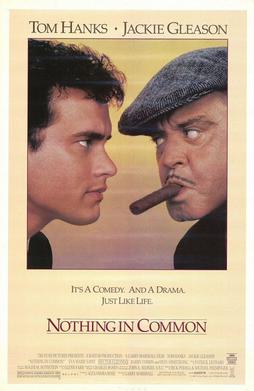
Nothing In Common (1986, directed by Garry Marshall)


Tom Hanks plays David Basner (Tom Hanks), an advertising executive whose immature lifestyle gives him insight into what sells but has also left him totally unprepared to deal with the fallout when his mother (Eva Marie Saint) leaves his father, Max (Jackie Gleason).  David, who is struggling to come up with the perfect commercial for a demanding client (Hector Elizondo), has to come to terms with both his father’s bad health and his history of infidelity.

This isn’t my favorite Tom Hanks movie.  It comes from that awkward period when Hanks was trying to make the transition from comedy to drama and its attempt to mix the two genres is not always successful.  The scenes of Hanks at the ad agency are often so cartoonish that they don’t seem like they belong in a movie where Jackie Gleason loses a foot to diabetes and realizes that he spent his entire marriage emotionally abusing his wife.  The movie, though, is worth watching for the teaming of Hanks and Gleason, two comedic actors who eventually proved themselves to equally as skilled at playing it serious.  Gleason, especially, gives a strong performance.  This was his final film and Garry Marshall convinced him to take it by asking, “Do you really want to go out on Smokey and the Bandit 3?”  Gleason would die a little over a year after the release of Nothing In Common and this film, even if it wasn’t perfect, gave the world a chance to see what a good actor he really was.

This film is often cited as the the movie that started Hanks on the way to becoming a dramatic actor.  Like Punchline, Nothing In Common played a role in Hanks becoming more than just a comedian but  I think Big was ultimately the better showcase for Hanks’s ability to mix pathos with laughs.  Nothing In Common was directed by Garry Marshall and, as was usually the case with Marshall, he often doesn’t trust the audience to figure things out for themselves.  He goes overboard trying to force an emotional response instead of just trusting the material.  Tom Hanks still does a good enough job in Nothing In Common.  Hanks is as likable as always and you can see the dramatic actor emerging in Hanks’s performance even if Hanks still wasn’t totally comfortable with it.

Nothing In Common is flawed but it was definitely a better swan song for Jackie Gleason than Smokey and the Bandit 3.

The Unnominated #17: Honkytonk Man (dir by Clint Eastwood)


Though the Academy of Motion Picture Arts and Sciences claim that the Oscars honor the best of the year, we all know that there are always worthy films and performances that end up getting overlooked.  Sometimes, it’s because the competition too fierce.  Sometimes, it’s because the film itself was too controversial.  Often, it’s just a case of a film’s quality not being fully recognized until years after its initial released.  This series of reviews takes a look at the films and performances that should have been nominated but were, for whatever reason, overlooked.  These are the Unnominated.

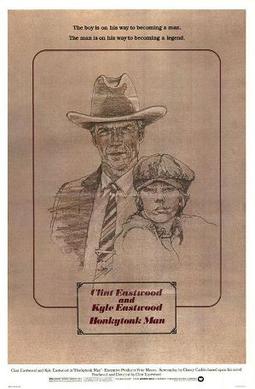
1982’s Honkytonk Man was a Clint Eastwood film that I had never heard of, until I came across it on Prime.  I decided to take a chance and I rented it.  I’m glad that I did because it turned out to be one of Eastwood’s best films.

Clint stars as Red Stovall, a country singer turned farmer during the Great Depression.  Kyle Eastwood stars as Red’s nephew, 14 year-old Whit “Hoss” Wagoneer.  When Red gets an opportunity to perform at the Grand Old Opry, he decides to head for Tennessee.  Since Red is dying of tuberculosis and barely knows how to drive a car, he is accompanied by Grandpa Wagoneer (John McIntire) and Whit.  Whit may be young but he knows how to drive and soon, he’s driving Red and Grandpa across the country.  When a highway patrolman (Tim Thomerson) stops them, he says that Whit is too young to drive.  After watching a speeding Red struggle to keep the car in the right lane, the patrolman pulls up beside them and says, “Let the kid drive.”

Honkytonk Man features an unexpected performance from Eastwood.  Typically, we think of Eastwood’s characters as being the epitome of cool.  Red is definitely not that.  Red is a screw-up, someone who gets arrested while trying to steal chickens and who frequently gets conned by those that he meets during his journey.  When the car breaks down in Arkansas, Red is too busy drinking to remember to catch the bus to Tennessee.  He spends the night with a hitchhiker named Marlene (Alexa Kernin).  The next morning, Whit wakes Red up and informs him that he only has a few minutes before the next bus leaves.  Marlene announces that she’s pregnant.  “HOLD THE BUS!” Red yells as he hastily puts on his clothes.

That said, Whit loves his uncle and the two Eastwoods, Clint and Kyle, both give excellent performances in Honkytonk Man.  In fact, his performance here is probably the best that Clint Eastwood has ever given.  Clint plays with his own image here.  Initially, the film almost feels like a satire of Clint’s hypermasculine persona.  (There is one scene where Eastwood handles a gun but it doesn’t play out the way that you might expect it to.)  But, as the film progresses and Red’s illness grows worse, we start to understand Red and his way of looking at the world.  Red is flawed but he loves his nephew and he loves music and, in the end, what’s important is not whether or not his song were recorded but instead that he spent his final days with Whit.  The film may start out as a comedy but it ultimately becomes a meditation on aging and how one faces the inevitability of death.

As a director, Eastwood takes his time.  He lets the movie play out slowly, with the casual pace of country story.  It’s a film full of wonderful performance and beautiful visuals and it more than earns our patience.  Wisely, Eastwood the director realizes that this story really isn’t about Red.  The story is about Whit (or Hoss, as he asks to be known) and his experiences with his uncle.  Whit worships his uncle but he also comes to learn that the most important thing is to be able to respect yourself.  In this film, Clint Eastwood knows the story that he’s telling and he knows exactly how to tell it.

Honkytonk Man went unnominated as far as the Oscars are concerned.  In the year when the well-intentioned but dramatically inert Gandhi dominated the awards and the nominations, Honkytonk Man was forgotten.  That’s a shame.

Previous Entries In The Unnominated:

  1. Auto Focus 
  2. Star 80
  3. Monty Python and The Holy Grail
  4. Johnny Got His Gun
  5. Saint Jack
  6. Office Space
  7. Play Misty For Me
  8. The Long Riders
  9. Mean Streets
  10. The Long Goodbye
  11. The General
  12. Tombstone
  13. Heat
  14. Kansas City Bomber
  15. Touch of Evil
  16. The Mortal Storm

Film Review: Any Which Way You Can (dir by Buddy Van Horn)


In this 1980 sequel to Every Which Way But Loose, Philo and his orangutan Clyde are still living next door to Orville (Geoffrey Lewis) and his mother (Ruth Gordon).  Philo is still working as a truck driver but he’s becoming far better known as a bare-knuckles brawler.  In fact, when another famous fighter named Jack Wilson (William Smith), moves to the area, everyone assumes that Jack wants to challenge Philo.  It turns out that Jack’s actually a pretty nice guy.  He and Philo become jogging buddies.

Remember Lynn Halsey-Taylor (Sondra Locke), the extremely self-centered singer who broke Philo’s heart in the first film?  Well, she’s back and she’s changed her ways.  When she and Philo meet in a bar, Lynn apologizes to him for her past behavior and soon, she and Philo are a couple again.  Booo!  Seriously, Eastwood and Locke somehow have even less chemistry here than they did in the first film.  (Again, Locke and Eastwood were in a relationship at the time, which makes their total lack of chemistry even more interesting to consider.)  Everyone in the film is surprisingly forgiving of Lynn, considering that she was portrayed as being nearly sociopathic in the previous film.  Even Clyde seems to be happy to have her back.  Of course, Clyde gets to have a romance of his own, with another orangutan.  Clyde has sex with his partner while Philo and Lynne fool around in the room next door.  It’s …. kind of weird.

Anyway, the Mafia really wants Philo and Jack to fight so they decide to kidnap Lynn in order to force the fight to happen.  Instead, Jack and Philo team up to rescue Lynn and to put those gangsters in their place.  That might sound dramatic but this film is very much a redneck comedy so these are probably the least intimidating mafia soldier that I’ve ever seen.  Just as the previous film’s outlaw bikers (and they also make a return appearance in this film) were too buffoonish to be truly menacing, the same is true of the Mafia in this film.

In the end, Philo and Jack do have a fight but it’s under their own terms and, afterwards, they accompany each other to the hospital.  It’s kind of a nice moment, really.  Even after beating the hell out of each other and causing more than a few broken bones, Philo and Jack are still friends.  It’s a nice touch that Jack was played by William Smith, who was a bit of a low-budget version of Clint Eastwood.

Indeed, with Geoffrey Lewis relegated to a supporting role and Sondra Locke abducted by the mafia, the friendship between Philo and Jack becomes the heart of the film and if there is really anything that makes this film memorable, it’s the scenes that Eastwood shares with William Smith.  These two tough guys actors seem to have a natural understanding of each other and their friendship and mutual respect feels real.  They may fight but it’s only out respect for each other.  It’s a shame that Eastwood and Smith didn’t team up for more films.

Any Which Way You Can is an amiable comedy.  It’s not as much fun as Every Which Way But Loose.  Beverly D’Angelo’s Echo is missed but she was presumably busy filming Coal Miner’s Daughter at the time.  The film works best as a buddy movie.  Clint Eastwood, William Smith, Geoffrey Lewis, and an orangutan.  What a team!

Horror Film Review: Dead & Buried (by Gary Sherman)


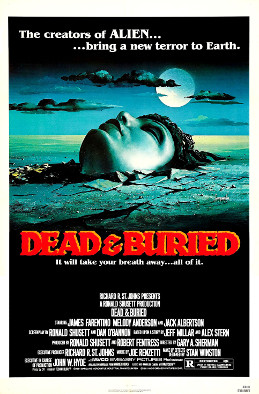
The 1981 horror film, Dead & Buried, takes place in the small town of Potters Bluff.  It seems like it should be a nice place to live.  The people are friendly.  The scenery is lovely.  The town is right on the coast of the ocean so the view is great.  It’s a bit of an artist’s colony, the type of place where you would expect to find Elizabeth Taylor painting the sunset while Richard Burton battles a hangover in the beach house.  It’s the type of small town that used to by very popular on television.  It’s just one Gilmore girl away from being an old CW show.

It’s such a nice town.  So, why are so many people dying?

That’s the mystery that Sheriff Dan Gillis (James Farentino) has to solve.  Actually, it’s one of the many mysteries that Dan has to solve.  There’s also the mystery of why his wife, Janet (Melody Anderson), has been acting so strangely.  And then there’s the mystery of what happened to the person who, one night, Dan ran into with his car.  The person ran away but he left behind his arm.  When Dan gets some skin from the arm analyzed, he’s told that the arm belongs to someone who has been dead for at least four months!

Who can explain all of this?  How about William G. Dobbs (Jack Albertson), the folksy coroner who seems to enjoy his work just a little bit too much.  In fact, Dr. Dobbs seems to be a bit more than just a tad eccentric.  One would necessarily expect a coroner to have a somewhat macabre view of life but Dr. Dobbs seems to take things to extreme.  Is it possible that Dr. Dobbs knows more than he’s letting on?

Dead & Buried has a reputation for being something of a sleeper, a deliberately-paced and often darky humorous horror film that had the misfortune to be released at a time when most horror audiences were more interested in watching a masked man with a machete kill half-naked teenagers.  Because the studio wasn’t sure how exactly to market Dead & Buried, it failed at the box office and it was only years later, after it was released on home video, that people watched the film and realized that it was actually pretty good.  And make no mistake about it, Dead & Buried is a fairly clever horror film, one that is full of effective moments and which does a good job of creating a creepy atmosphere.  If I’m not quite as enthused about this film as others, that’s because I do think that it’s occasionally a bit too slow and the film’s twist ending, while well-executed, didn’t particularly take me by surprise.  This is one of those films that you enjoy despite the fact that you can see the surprise conclusion coming from a mile away.

In the end, Dead & Buried fills like a particularly twisted, extra-long episode of one of those old horror anthology shows, like Night Gallery, Twilight Zone, or maybe even Ghost Story.  It’s a nicely done slice of small town horror, featuring a study lead performance from James Farentino and an enjoyably weird one from Jack Albertson.  Though the film is not heavy on gore, Stan Winston’s special effects are appropriate macabre.  Even if it’s not quite up there with Gary Sherman’s other films (like Vice Squad and Death Line, to name two), Dead & Buried is an entertainingly eccentric offering for Halloween.

Cleaning Out The DVR: Urban Cowboy (dir by James Bridges)


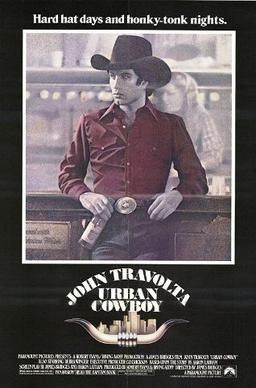
Last night, I watched the 1980 film, Urban Cowboy.  This was a film that had been sitting on my DVR for over a year.  For some reason, I had never actually gotten around to watching it.  There were many times when I started to watch it but I always ended up stopping after a few minutes.  I was never quite sure why as everything that I had heard about the film was positive.  Having finally watched it last night, I think I hesitated because I instinctively knew that John Travolta would look silly wearing a cowboy hat.

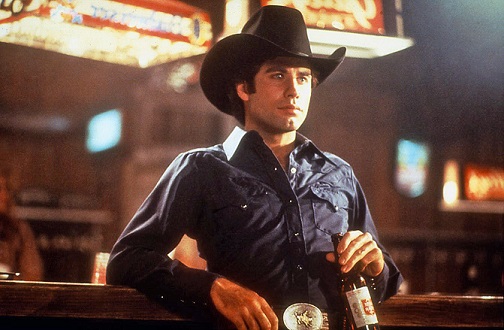
And let’s just be honest.  He does.  I mean, Travolta actually gives a fairly good performance in Urban Cowboy.  He plays Bud, a kid from West Texas who moves to Houston so that he can work on an oil rig with his uncle, Bob (Barry Corbin).  At first, he only wants to stay in Houston long enough to raise the money to buy some land back home.  But, he soon falls in love with the Houston nightlife and the local country-western bar.  (He’s Travolta so, of course, he can dance.)  He also falls in love with and eventually marries Sissy (Debra Winger).

Travolta is believable as an impulsive young adult who might not be particularly smart but who makes up for it with a lot of determination.  And he even does an okay job when it comes to capturing the country accent of West Texas.  But that said, whenever he puts on that cowboy hat, the viewer is immediately reminded that Travolta is actually from New Jersey and probably never even attended a rodeo until he was cast in Urban Cowboy.  The hat feels like an affectation, an attempt by a city boy to be more country as opposed to a country boy trying to hold onto his identity in the city.  Ironically, the term “urban cowboy” has come to mean someone who, despite having never left the city, dresses like they’re heading out to herd the cattle and rope some steers.  However, in the film itself, the hat is meant to be a natural part of Bud’s persona but it never quite feels that way.

Far more credible as a cowboy is a youngish Scott Glenn, who plays Wes Hightower.  After Bud’s chauvinistic and abusive behavior drives Sissy away, she ends up with Wes.  Wes teaches Sissy how to ride a mechanical bull, which is something Bud tried to forbid her from doing.  Wes is confident and dangerously sexy and he can even make the fact that he lives in a run-down trailer work for him.  Unfortunately, Wes also turns out to be even more controlling and abusive than Bud.  Even though Bud still loves Sissy and Sissy still loves him, Bud soon hooks up with Pam (Madolyn Smith), the daughter of a wealthy oilman.

Many more complications follow and, of course, there’s one big tragedy that causes Bud to reexamine his life.  Not surprisingly, the film’s conclusion all comes down to who can stay on that mechanical bull for the longest….

The best thing that Urban Cowboy has going for it is not Travolta or Glenn but instead, it’s Debra Winger, who gives a believable and relatable performance as Sissy, playing her as someone who may not have much but who refuses to surrender her pride.  She knows that she deserves better than both Bud and Wes, even if she is hopelessly in love with one of them.  Winger has chemistry with both Travolta and Scott Glenn, which makes the film’s love triangle feel like something more than just a typical story about a girl who can’t resist a bad boy.  She grounds the film in reality and, as such, there are real stakes to the film’s story.  Thanks to Winger, Urban Cowboy becomes about something more than just a fight over a mechanical bull.

The second best thing that Urban Cowboy has going for it is that it does manage to capture the atmosphere of a good country-and-western bar.  It’s place where people go to relax after a hard day’s work.  Unlike the discotheques  that Travolta frequented in Saturday Night Fever, the bars in Urban Cowboy eschew glamour and artifice.  Instead, they’re all about proving yourself not on the dance floor but on the back of a mechanical bull.  For Sissy, the bull symbolizes freedom.  For men like Bud and Wes, it symbolizes survival.  Myself, I’m not a drinker so my bar experience is limited.  And, though I may be from Texas and I spent a lot of time in the country while I was growing up, I’ve never been a fan of country music.  That said, I’ve danced to a few country songs and I’ve certainly stopped by a few bars, even if I was usually the one who annoyed my family and friends by just asking for a glass of water.  I’ve been to the rodeo and I’ve seen people get trampled.  I’ve also seen a few people get tossed off a mechanical bull.  I’ve never been on a mechanical bull myself but I did buy one for my Sims.  (They loved it but, sadly, I had to get rid of it because they spent so much time riding it, they kept missing work and getting fired.)  From my limited experience, I can say that Urban Cowboy got most of the details right.  Even though it was made 42 years ago, it still feels authentic.

That said, Travolta still looks odd wearing a cowboy hat.

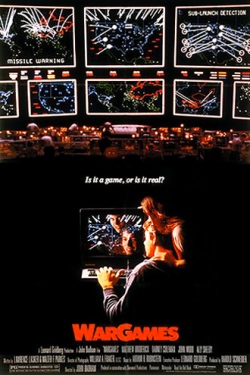
Film Review: Wargames (dir by John Badham)


If you thought Tom Cruise nearly started a war in Top Gun, you should see what Matthew Broderick did three years earlier in Wargames!

In Wargames, Broderick plays David Lighter, a dorky but likable teenager who loves to play video games and who spends his spare time hacking into other computer systems.  (Of course, since this movie was made in 1983, all the computers are these gigantic, boxy monstrosities.)  Sometimes, he puts his skills to good use.  For instance, when both he and Jennifer (Ally Sheedy) are running the risk of failing their biology class, he hacks into the school and changes their grades.  (At first, Jennifer demands that he change her grade back but then, a day later, she asks him to change it again.  It’s kind of a sweet moment and it’s also probably the way I would have reacted if someone had done that for me in high school.)  Sometime, David’s skills get him into trouble.  For instance, he nearly destroys the world.

Now, keep in mind, David really didn’t know what he was doing.  He was just looking for games to play online.  He didn’t realize that he had hacked into NORAD and that Global Thermonuclear War was actually a program set up to allow a gigantic computer named WOPR to figure out how to properly wage a thermonuclear war.  David also doesn’t know that, because humans have proven themselves to be too hesitant to launch nuclear missiles, WOPR has, more or less, been given complete control over America’s nuclear arsenal.

(Wargames actually starts out with a chilling little mini-movie, in which John Spencer and Michael Madsen play two missile technicians who go from joking around to pulling guns on each other during a drill.  Of course, Madsen’s the one ready to destroy the world.)

Of course, the military folks at NORAD freak out when it suddenly appears as if the Russians have launched a nuclear strike against Las Vegas and Seattle.  (Not Vegas!  Though really, who could blame anyone for wanting to nuke Seattle?)  In fact, the only thing that prevents them from launching a retaliatory strike is David’s father demanding that David turn off his computer and take out the trash.  However, WOPR is determined to play through its simulation, which pushes the world closer and closer to war.  (One of the more clever — and disturbing — aspects of the film is that, even after the military learns that the Russians aren’t planning the attack them, they still can’t go off alert because the Russians themselves are now on alert.   Once the war starts, it can’t be stopped even if everyone knows that the whole thing was the result of a mistake.)

With the FBI looking for him, David tries to track down the man who created WOPR, Dr. Stephen Falken (John Wood).  However, Falken is not easy to find and not as enthusiastic about saving the world as one might hope….

Watching Wargames was an interesting experience.  On the one hand, it’s definitely a dated film.  (Again, just look at the computers.)  At the same time, its story still feels relevant.  In Wargames, the problem really isn’t that WOPR wants to play a game.  It’s that men like Dr. John McKittrick (well-played by Dabney Coleman) have attempted to remove the human element and have instead put all of their faith in machines.  The appeal of a machine like WOPR is that it has no self-doubt and does whatever needs to be done without worrying about the cost.  But that’s also the reason why human beings are necessary because the world cannot be run on just algorithms and cold logic.  That’s a theme that’s probably even more relevant today than it was in 1983.

Wargames is also an exceptionally likable film.  In fact, it’s probably about as likable as any film about nuclear war could be.  On the one hand, you’ve got everyone at NORAD panicking about incoming missiles and then, on the other hand, you’ve got David and Jennifer having fun on his computer and trading flirty and silly quips.  Matthew Broderick and Ally Sheedy are both likable in the two main roles.  Broderick brings a lot of vulnerability to the role of David.  (David Lightner is a far more believable teenager than Ferris Bueller.)  He handles the comedic scenes well but he’s even better as David grows increasingly desperate in his attempts to get the stubborn adults around him to actually listen to what he has to say.  When it appears the only way to save the world is to swim across a bay, David is forced to admit that he’s never learned how to swim because he always figured there would be time in the future.  Yes, it’s a funny scene but the way Broderick delivers the line, you understand that David has finally figured out that there’s probably not going to be a future.  It’s not that he doesn’t know how to swim.  It’s that he’ll never get the chance to learn or do anything else for that matter.

Wargames is definitely a film of its time but its themes are universal enough that it’s a film of our time as well.

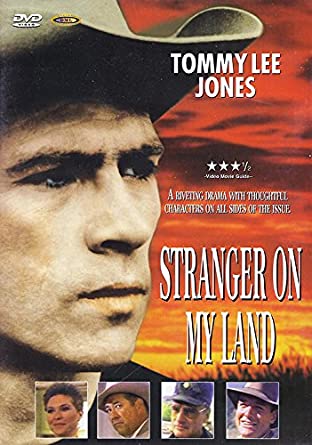
Stranger On My Land (1988, directed by Larry Elikann)


The Air Force wants to build a new air base in Utah but the Whitman family refuses to sell their ranch.  Bud Whitman (Tommy Lee Jones) served in Vietnam and he disapproved just as much of forcing Vietnamese villagers to move as he now disapproves of the idea of allowing the government to force American citizens to move.  When a judge rules that the Air Force can force the Whitmans to vacate their property under the rule of eminent domain, Bud announces that he still will not be moving.  With several of Bud’s old combat buddies showing up to support Bud, the villainous county surveyor, Connie Priest (Terry O’Quinn), prepares to take matters in his own hands.

Tommy Lee Jones vs. Terry O’Quinn?  That sounds like it should have the makings of a classic but Stranger On My Land is a largely forgettable made-for-TV movie.  A huge part of the problem is that O’Quinn’s character doesn’t have any real motivation beyond just being a prick and that seems like a waste when you consider the number of interesting villains that Terry O’Quinn has played over the years.  This is the actor who, in The Stepfather, actually made a multiple murderer seem a little bit likable.  Connie Priest seems like a villain that O’Quinn could have done a lot with if only the film’s script hadn’t been so simplistic.  Tommy Lee Jones is always well-cast as a modern day western hero but again, the script doesn’t do much with his character.  He’s just Tommy Lee Jones yelling at people to get off his property.  You could probably go to Tommy Lee Jones’s own ranch and have the exact same experience without having to sit through the rest of this movie.  Even Bud’s ethical objections to the Vietnam War feel like something that was just tossed in to assure the people watching at home that he’s not meant to be some sort of gun-toting militiaman.  The best performance in the movie comes from Ben Johnson, who is plays Tommy Lee Jones’s father.  That’s prefect casting.  If Ben Johnson wasn’t actually Tommy Lee Jones’s father, he probably should have been.

The main problem with Stranger On My Land is that it was made for television and it had to operate within the limits of what was acceptable for television in 1988.  The entire movie seems to be building up to a fierce battle between Bud and law enforcement but instead, it settles for a personal fight between Bud and Connie.  The film’s sudden ending doesn’t feel authentic but it does feel like what you’d expect to find on ABC in the late 80s.

Film Review: The Hot Spot (dir by Dennis Hopper)


As befits the title, the 1990 film, The Hot Spot, is all about heat.

There’s the figurative heat that comes from a cast of characters who are obsessed with sex, lies, and murder.  There’s the literal heat that comes from a fire that the film’s “hero” sets in order to distract everyone long enough so that he can get away with robbing a bank.  And, of course, there’s the fact that the film is set in a small Texas town that appears to be the hottest place on Earth.  Every scene in the film appears to be drenched by the sun and, if the characters often seem to take their time from getting from one point to another, that’s because everyone knows better than to rush around when it’s over a hundred degrees in the shade.  As someone who has spent most of her life in Texas, I can tell you that, if nothing else, The Hot Spot captures the feel of what summer is usually like down here.   I’ve often felt that stepping outside during a Texas summer is like stepping into a wall of pure heat.  The Hot Spot takes place on the other side of that wall.

The Hot Spot is a heavily stylized film noir, one in which the the traditional fog and shadows have been replaced by clouds of dust and blinding sunlight.  Harry (Don Johnson) is a drifter who has just rolled into a small Texas town.  Harry’s not too bright but he’s handsome and cocky and who needs to be smart when you’ve got charm?  Harry gets a job selling used cars, though he actually aspires to be a bank robber.  Harry finds himself falling in love with Gloria (Jennifer Connelly), a seemingly innocent accountant who is being blackmailed by the brutish Frank Sutton (William Sadler).  Meanwhile, Harry is also being pursued by his boss’s wife, Dolly (Virginia Madsen), an over-the-top femme fatale who is just as amoral as Harry but who might be a little bit smarter.  Complicating matters is that, while Harry’s trying to rob a bank, he also ends up saving a man’s life.  Only Dolly knows that Harry isn’t the hero that the rest of the town thinks he is.  She tells him that she’ll keep his secret if he does her just one little favor….

The Hot Spot was directed by Dennis Hopper (yes, that Dennis Hopper) and, from the start, it quickly becomes apparent that he’s not really that interested in the film’s story.  Instead, he’s more interested in exploring the increasingly surreal world in which Harry has found himself.  The Hot Spot plays out at a languid pace, which allows Hopper to focus on his cast of small-town eccentrics.  (My particular favorite was Jack Nance as the alcoholic bank president who also doubles as the town’s volunteer fire marshal.)  The film is so hyper stylized that it’s hard not to suspect that every character — with the possible exception of Harry — understands that they’re only characters in a film noir.  For instance, is Dolly really the over-the-top femme fatale that she presents herself as being or is she just a frustrated housewife playing a role?  Is Gloria really an innocent caught up in a blackmail scheme or is she just smart enough to realize that the rules of noir requires her to appear to be Dolly’s opposite?  And is Harry being manipulated or is he allowing himself to be manipulated because, deep down, he understands that’s his destiny as a handsome but dumb drifter in a small town?  Do any of the characters really have any control over their choices and their actions or has everyone’s fate been predetermined by virtue of them being characters in a film noir?  In the end, The Hot Spot is more than just a traditional noir.  It’s also a study of why the genre has endured.

It’s a long and, at times, slow movie, one that plays out at its own peculiar pace.  As a result, some people will be bored out of their mind.  But if you can tap into the film surreal worldview and adjust to the languid style, The Hot Spot is a frequently entertaining and, at times, rather sardonic slice of Texas noir.

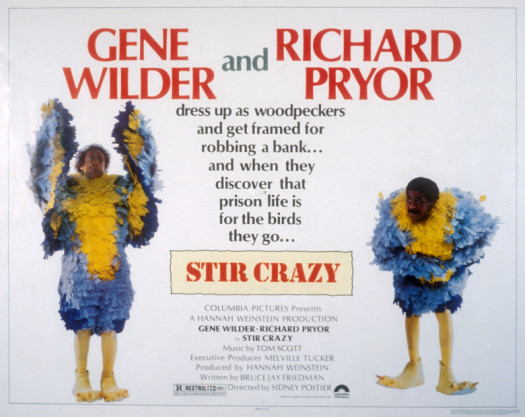
Brute Farce: Wilder & Pryor Go STIR CRAZY (Columbia 1980)


gary loggins's avatarcracked rear viewer

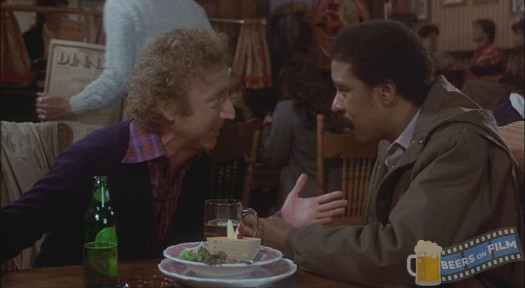
Gene Wilder  and Richard Pryor weren’t really a comedy team at all, just two incredibly funny comic actors who happened to work well together.  Both were stars in their own right, first appearing together in the 1976 comedy-thriller SILVER STREAK, with Pryor in the pivotal supporting role as a thief who aides the in-danger Wilder. Audiences loved the chemistry between the two, and of course Hollywood took notice. STIR CRAZY is not a sequel, but a funny film of its own allowing Gene and Richard to be their loveably loony selves.

New Yorkers Skip Donahue (Wilder) and Harry Monroe (Pryor) are a couple of buds who’ve both lost their jobs. Playwright Skip’s a dreamer, while aspiring actor Harry’s a realist, but somehow Skip talks his pal into leaving The Big Apple to seek fame and fortune in Hollywood. Their cross-country trek ends when Harry’s decrepit Dodge van breaks down in…

View original post 530 more words