RUTHLESS PEOPLE (1986) – In remembrance of Jim Abrahams


It made me sad when I saw that writer/director Jim Abrahams had passed away on November 26, 2024 at 80 years of age. Growing up in the 1980’s, Mr. Abrahams is responsible for some of my favorite comedies. AIRPLANE, TOP SECRET, and THE NAKED GUN would not exist without Jim Abrahams. As much as I love all of those movies, my personal favorite film that Jim Abrahams co-directed is RUTHLESS PEOPLE. I remember when our family rented this film and watched it in the ‘80’s. We thought it was so funny. I specifically remember my mom laughing out loud on multiple occasions as the ridiculous scenario played out. That was a fun movie night in the Crain household. 

RUTHLESS PEOPLE is about a rich businessman named Sam Stone (Danny DeVito) who truly hates his wife Barbara (Bette Midler), and hatches a plan to kill her so he can inherit her money. Unfortunately he runs into a couple of problems. First, his mistress Carol (Anita Morris) knows about the plan, so she and her dimwitted boy toy Earl (Bill Pullman) want to film Sam dumping his wife’s body so they can blackmail him for millions. Second, before Sam can execute his plan, Barbara is kidnapped and held for a ransom of $500,000 by Ken and Sandy Kressler (Judge Reinhold and Helen Slater). It seems that Sam stole Sandy’s idea for the spandex miniskirt, screwed them out of millions with a handshake deal, and then kept the money for himself. This seems like an answer to prayer at first for Sam because they threaten to kill Barbara if he doesn’t meet their needs or if he calls the police or the media. After saying no to their demands, and then immediately calling the police and the news, Sam realizes that they don’t want to kill her when they keep coming back with lower demands. Sandy tells Barbara that Sam refuses to pay even $10,000 for her safe return. Eventually the kidnappers and Barbara join together to try to take the unfaithful and unethical Sam for everything he’s worth!! 

RUTHLESS PEOPLE is one of my favorite comedies of the 1980’s. It has such a great cast. Danny DeVito and Bill Pullman are especially hilarious and have some of the film’s best lines. At the time the movie came out in 1986, DeVito was already established as a master of comedy, so Pullman’s performance as Earl, the dumbass Sonny Crockett wannabe, was the real revelation to me. Pullman made his film debut in RUTHLESS PEOPLE, and I never see him to this day that I don’t think of his character Earl’s excitement over the prospect of his newfound blackmail money:

“And then we’re off, to Haiti!”

“It’s Tahiti, you moron!”

One of the most interesting things about RUTHLESS PEOPLE is just how different it is from the directing trio’s (Zucker / Abrahams / Zucker) other popular films like THE KENTUCKY FRIED MOVIE and AIRPLANE. Those films are based on non-stop visual and verbal gags. I love those films, but this is quite different. The comedy of RUTHLESS PEOPLE is based on the story itself, which is a comedy of confusion, coincidence, and character. I know it’s awesome because I still think of the film often. “Give the bag to bozo” and “a little poke in the whiskers” are phrases I’ll remember up to the point I go to my grave. 

Even though the film is almost 40 years old, if you’re looking for a laugh, I don’t think you can do much better than RUTHLESS PEOPLE. 
Holiday Film Review: Die Hard 2: Die Harder (dir by Renny Harlin)


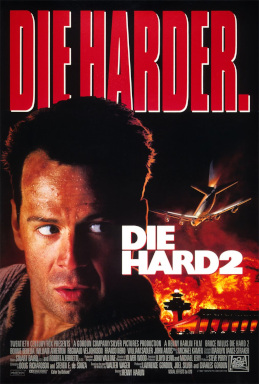
During 1990’s Die Hard 2, John McClane (Bruce Willis) asks himself, “How can the same shit happen to the same person twice?” and he does have a point.

I mean, consider the situation.  In 1988, McClane spent his Christmas sneaking around a skyscraper and saving his wife from a group of sadistic mercenaries.  Two years later, John McClane spends his Christmas sneaking around an airport and saving his wife from a group of sadistic mercenaries.

There are a few differences of course.  In 1988, the mercenaries were only interested in stealing as much money as they could and each mercenary had his own properly ghoulish personality.  In 1990, the mercenaries are really more of a cult, led by the fanatical Col. Stuart (William Sadler).  And, along with trying to make some money, they are also trying to free General Ramon Esperanza (Franco Nero), a Central American drug lord and former CIA asset.  Despite the fact that the mercenaries are played by familiar actors (like Robert Patrick, John Leguizamo, Tony Ganois, and Vondie Curtis-Hall), none of them are quite as memorable as the henchmen that Alan Rickman commanded in the first film.  And while Sadler has charisma and makes a big impression during his first scene, his character is nowhere near as interesting or entertaining as Hans Gruber.  Franco Nero, it must be said, is as dashing as ever.  He really seems to be having fun in this movie.

A lot more people die in Die Hard 2 than died in the first Die Hard and the majority of them are innocent bystanders.  This isn’t like the first film, where Harry Ellis died because his coke-addled mind led him to believe that he could outsmart Gruber.  The victims in Die Hard 2 include a friendly church caretaker and over 200 passengers of an airplane that Stuart tricks into crashing on an airport runway.  The scene where the plane crashes remains disturbing no matter how many times that you see it and it truly makes you hate Colonel Stuart.  When the plane crashes, despite McClane’s futile efforts to warn the pilots, McClane sobs and it’s a powerful scene because it’s the first scene in which McClane has not had a quip or a one-liner ready to go.  In this scene, McClane fails to save the day and, for a few minutes, he’s helpless.  I usually end up crying with McClane.  Today, those tears are also a reminder of what a good actor Bruce Willis truly could be whenever he let down his defenses and allowed himself to be vulnerable on screen.

Die Hard 2 is usually dismissed as not being as good as the first movie and …. well, that’s correct.  It’s not as good but then again, few actions films are.  There’s a reason why Die Hard continues to be held in such high regard.  That said, Die Hard 2 is not bad.  The stakes are a bit higher and the action scenes a bit more elaborate, as you would expect from a film directed by Renny Harlin.  Bruce Willis plays McClane with the blue collar swagger that made his such an awesome hero in the first film.  Bonnie Bedelia and William Atherton also return from the first film and Atherton once again gets his comeuppance in a crowd-pleasing moment.  The cast is full of character actors, all of whom get a chance to make an impression.  Dennis Franz is the profane head of security who eventually turns out to be not such a bad guy.  John Amos is the major who eventually turns out to be not such a good guy.  Colm Meaney has a few heart-breaking moments as the pilot of the doomed airplane.  My favorite supporting performance is given by Fred Thompson, bringing his quiet authority to the role of tough but fair-minded Air Traffic Control director.  Watching Die Hard 2, it does feel as if the viewer has been dropped in the middle of these people’s lives.  Everyone seems real.  No one seems like a mere plot device.

Is Die Hard a Christmas movie?  You bet it is!  But so is Die Hard 2 and it’s not a bad one.

Lisa Reviews An Oscar Nominee: A Soldier’s Story (dir by Norman Jewison)


http://www.youtube.com/watch?v=SG1mF1jtul0

Set during World War II, 1984’s A Soldier’s Story opens with a murder.

On a rural road outside of a segregated army base in Louisiana, someone has gunned down Sergeant Vernon Walters (Adolph Caesar).  At the time, Walters was staggering back to the base after a night of heavy drinking.  Both the local authorities and Watlers’s fellow soldiers assume that the murder was the work of the Ku Klux Klan.  Captain Richard Davenport (Howard Rollins) isn’t so sure.

Captain Davenport is the officer who has been assigned to investigate the murder.  From the minute that he arrives at the base, the soldiers stare at him.  As Cpl. Ellis (Robert Townsend) explains it, the enlisted men are shocked because they’ve never seen a black officer before.  Some of the soldiers admire Davenport while other view him with suspicion, wondering what Davenport must have done or who he must have sold out to earn his commission.

Meanwhile, the other officers (who are all white) view Davenport with a combination of condescension and hostility.  Col. Nivens (Trey Wilson) only allows Davenport three days to wrap up his investigation and assigns the polite but skeptical Capt. Taylor (Dennis Lipscomb) to work with him.  Taylor suspects that Walters may have been murdered by the openly racist Lt. Byrd (Wings Hauser!).  Davenport, however, isn’t so sure.  Even though the official story is that Walters was a tough but fair sergeant who was respected by his company, Davenport suspects that one of them may have killed him.

Davenport and Taylor start to interview the soldiers who actually had to deal with Walters on a daily basis.  Through the use of flashbacks, Walters is revealed to be a far more complex man than anyone knew.  We see that Walters was a man who was bitterly aware of the fact that, even after a lifetime of military service, he was destined to always be treated as a second-class citizen by the nation that he served.  Unable to strike out at the men who the army and society had placed over him, Walters instead struck at the men serving underneath him.  While the man in Walters’s company wait for word on whether or not they’ll be allowed to serve overseas, Davenport tries to determine if one or more of them is a murderer.

A Soldier’s Story was adapted from a play but director Norman Jewison is careful to prevent the material from becoming stagey.  Effortlessly transitioning from the film’s present to flashbacks of the events that led to Walters’s murder, Jewison crafts both an incendiary look at race relations and a compelling murder mystery.  He’s helped by a strong cast of predominately African-American actors.  In one of his earliest roles, Denzel Washington plays Pfc. Peterson with a smoldering intensity.  David Alan Grier and Robert Townsend, two actors known for their comedic skills, impress in dramatic roles.  Seen primarily in flashbacks, Adolph Caesar turns Walters into a complex monster.

And yet, with all the talent on display, it is Howard Rollins who ultimately steals the movie.  As  a character, Captain Davenport has the potential to be a rather thankless role.  He spends most of the movie listening to other people talk and, because of his status as both an officer and a black man in the rural south, he’s rarely allowed to show much anger or, for that matter, any other emotion.  However, Rollins gives a performance of such quiet intelligence that Davenport becomes the most interesting character in the movie.  He’s the ultimate outsider.  Because of his higher rank and his role as an investigator, he can’t fraternize with the enlisted men but, as an African-American, he’s still expected to remain separate from and differential to his fellow officers.  As the only black officer on a segregated base, Davenport is assigned to stay in an empty barrack.  One of the best scenes in the film is Davenport standing alone and surveying the stark layout of his temporary quarters.  The expression on his face tells you everything you need to know.

(Towards the end of the film, when Davenport finally gets a chance to drop his rigid facade and, if just for one line, be himself, you want to cheer for him.)

A Soldier’s Story was nominated for best picture but it lost to another theatrical adaptation, Milos Forman’s Amadeus.


A Movie A Day #262: Downtown (1990, directed by Richard Benjamin)


Alex (Anthony Edwards) is a patrolman assigned to the nicest neighborhood in Philadelphia but, after he gets in trouble for pulling over a wealthy businessman (David Clennon), he is told that he can either be suspended or he can take a transfer downtown, to the Diamond Street precinct.  Alex takes the transfer, even though everyone on the force says that “not even the Terminator would go to Diamond Street.”  Alex gets assigned to work with seasoned Sgt. Dennis Curren (Forest Whitaker), who is still emotionally scarred by the death of his former partner and does not want to have to babysit a naive white cop from the suburbs, especially one who is obsessed with the Beach Boys.  At first, Alex struggles with his new assignment and his new partner but, when an old friend is murdered by a notorious hitman (Joe Pantoliano), Alex is determined to crack the case and bring the killer to justice.
Downtown is a combination of other, better cop films: Alex’s situation is Beverly Hills Cop in reverse and his partnership with Dennis is lifted straight from Lethal Weapon.  Art Evans is the captain who is always yelling at Alex and Dennis and telling them to drop the case and the character is so familiar that I had to check to make sure that Evans had not played the same role in Lethal Weapon.  As the bad guys, Clennon and Pantoliano could just have easily been replaced by Beverly Hills Cop‘s Steven Berkoff and Jonathan Banks and no one would have noticed.  The only real difference is that Downtown is neither as exciting nor as funny as those two films.  Downtown was directed by Richard Benjamin, who will never be known as a particularly versatile filmmaker and who struggles to balance the fish-out-of-water comedy with some surprisingly brutal violence.  Beverly Hills Cops had Eddie Murphy and Lethal Weapon had Mel Gibson and Danny Glover.  Downtown has Anthony Edwards and Forest Whitaker, who are both good actors but who both seem to be woefully miscast here.  (If Downtown were made today, Whitaker could play Dennis but, in 1990, he was too young to be the cop who was “too old for this shit.”)    Of the many Lethal Weapon ripoffs that came out in late 80s and early 90s, Downtown is one of the most forgettable.


A Movie A Day #81: The Great White Hype (1996, directed by Reginald Hudlin)


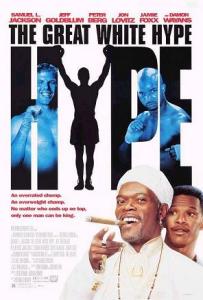
The Rev. Fred Sultan (Samuel L. Jackson) has a problem.  He is the richest and the best known fight promoter in America but the current (and undefeated) heavyweight champion is just too good.  No one is paying to watch James “The Grim Reaper” Roper (Damon Wayans) fight because Roper always wins.  Sultan has a plan, though.  Before Roper turned professional, he lost a fight to Terry Conklin (Peter Berg).  Conklin has long since retired from boxing and is now a heavy metal, progressive musician.  Sultan convinces Conklin to come out of retirement and face Roper in a rematch.  Since Conklin is white and Roper is black, Sultan stands to make a killing as white boxing fans get swept up in all the hype about Conklin being the latest “great white hope.”

In the days leading up to the fight, crusading journalist Mitchell Kane (Jeff Goldblum) attempts to expose the crooked Sultan before getting seduced into his inner circle.  Meanwhile, boxer Marvin Shabazz (Michael Jace) and his manager, Hassan El Rukk’n (Jamie Foxx), unsuccessfully pursue a match with Roper.  Conklin gets back into shape while Roper eats ice cream and watches Dolemite.

In its attempt to satirize boxing, The Great White Hype runs into a huge problem.  The fight game is already so shady that it is beyond satire.  This was especially true in the 90s, when the The Great White Hype was first released.  (Even more than the famous Larry Holmes/Gerry Cooney title fight, The Great White Hype’s obvious inspiration was the heavily promoted, two-minute fight between Mike Tyson and Peter McNeeley.)  The Great White Hype is a very busy film but nothing in it can match Oliver McCall’s mental breakdown in the middle of his fight with Lennox Lewis, Andrew Golota twice fighting Riddick Bowe and twice getting disqualified for low blows, or Mike Tyson biting off Evander Holyfield’s ear.

The Great White Hype has an only in the 90s supporting cast, featuring everyone from Jon Lovitz to Cheech Marin to, for some reason, Corbin Bernsen.  Damon Wayans is the least convincing heavyweight champion since Tommy Morrison essentially played himself in Rocky V.  The Rev. Sultan was meant to be a take on Don King and Samuel L. Jackson was a good pick for the role but the real Don King is so openly corrupt and flamboyant that he’s almost immune to parody.

When it comes to trying to take down Don King, I think Duke puts it best.