
Norman Bates, now there’s someone who probably made a big deal out of every Mother’s Day. Today’s scene that I love comes from 1960’s Psycho and features Hitchcock, Janet Leigh, and Anthony Perkins at their absolute best,
Norman Bates, now there’s someone who probably made a big deal out of every Mother’s Day. Today’s scene that I love comes from 1960’s Psycho and features Hitchcock, Janet Leigh, and Anthony Perkins at their absolute best,
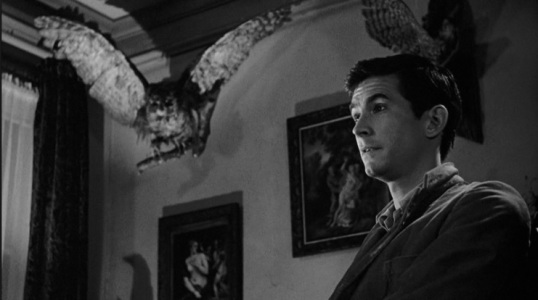
You have to feel a bit bad for Anthony Perkins, who was an Oscar-nominated star of film and Broadway and something of a teen idol before he was cast as Norman Bates in Alfred Hitchcock’s 1960 masterpiece, Psycho. Perkins was so convincing in the role that he pretty much spent the majority of his career either playing variations of the character or appearing in small roles where his macabre screen image would not be too much of a problem. Perkins gave one of the best film performances of all time and his career never really recovered from it.
Unfortunately, there’s a tendency to overlook just how good Anthony Perkins was in this first Psycho. People look at his later, less-compelling performances and they make the mistake of thinking those performance were the best that Perkins was capable of giving. Perkins was a fine actor and never better than when he played Norman. The scene below highlight how Perkins managed to make Norman Bates both poignant and creepy at the same time.
The 1984 film, Crimes of Passion, tells the story of three people and their adventures on the fringes of society. One is just visiting the fringes. One chooses to work there while living elsewhere. And the other is a viscous demon of repressed sexuality.
Bobby Grady (John Laughlin) has what would appear to be an ideal life. He has a nice house in the suburbs. He appears to have a good job. He has a lovely wife (Annie Potts) and he has friends who all remember what a wild guy Bobby used to be when he was younger. Bobby’s grown up and it appears that he’s matured into a life of comfort. In reality, though, Bobby is frustrated. He worries that he’s become a boring old suburbanite. He and his wife rarely have sex. The commercials on television, all inviting him to dive into the life of middle class ennui, seem to taunt him. In order to help pay the bills, he has a second job as a surveillance expert.
He’s hired to follow Joanna Crane (Kathleen Turner), an employee at a fashion house who is suspected of stealing her employer’s designs and selling them. Joanna is describe to Bobby as being cool, ambitious, and always professional. At work, she always keep her emotions to herself and no one seems to know anything about what she does outside of the office. There’s no real evidence that Joanna is stealing designs. Her employer just suspects her because Joanna always seem to be keeping a secret.
Bobby follows Joanna and he discovers that she’s not stealing designs. Instead, she’s leading a secret life as Chyna Blue, a high-priced prostitute who wears a platinum wig and who tends to talk to like a cynical femme fatale in a film noir. Bobby becomes obsessed with Chyna, following her as she deals with different johns, the majority of whom are middle class and respected members of society. Chyna has the ability to know exactly what the men who come to her are secretly looking for. A cop wants to be humiliated. A dying man needs someone to care about him. And one persistent and sweaty customer is obsessed with saving her.
The Reverend Peter Shayne (Anthony Perkins, in twitchy Psycho mode) hangs out on Sunset Strip and tries to save souls. Those who he can’t save, he kills. He carries the tools of his trade with him, a bible, a sex doll, and a sharpened dildo. After Chyna tells him that she doesn’t want anything to do with him or his money or his religion, Shayne grows increasingly more and more obsessed and unbalanced.
The plot is actually pretty simple and not that much different from what one might find in a straight-to-video neo-noir. What sets Crimes of Passion apart from other films of the genre is the fearless performance of Kathleen Turner and the over-the-top direction of Ken Russell. Never one to shy away from confusing and potentially offending his audience, Russell fills the film with shocking and frequently surreal imagery. Grady’s wife would rather watch insanely crass commercials than have sex with him. (“We just got the cable,” she explains.) When Shayne first approaches Chyna, the scene plays out in black-and-white and at a pace that would seem more appropriate for a screwball comedy than a graphic horror film. When Shayne commits one of his first murders, his victim is temporarily transformed into a blow-up doll. The sex-obsessed dialogue alternates between lines of surprising honesty and moments that are so crudely explicit that it’s clear they were meant to parody what Russell viewed as being America’s puritanical culture.
It’s not a film for everyone, which won’t shock anyone who has ever seen a Ken Russell film. The film works best when it focuses of Kathleen Turner and her performances as Chyna and Joanna. John Laughlin is a bit bland as the film’s male lead but that blandness actually provides some grounding for Russell’s more over-the-top impulses. As for Anthony Perkins, he was reportedly struggling with his own addictions when he appeared in this film and he plays Peter Shayne as being a junkie looking for his next fix. There’s nothing subtle about Perkins’s performance but then again, there’s nothing subtle about Ken Russell’s vision.
Crimes of Passion has some major pacing issues and, for all of Russell’s flamboyance, his visuals here are not as consistently interesting as they were in films like Altered States and The Devils. Still, Crimes of Passion is worth seeing for Kathleen Turner’s performance and as a portrait of life on the fringes. Even a minor Ken Russell film is worth watching at least once.
Poor Anthony Perkins!
Anthony Perkins did not start his career as a horror icon. A talented young actor, Perkins started his career on Broadway and eventually, he started to appear in films. From the start, he was usually cast as nervous young men, the type who awkwardly smiled and struggled to talk to people. Perkins was promoted as a romantic lead, with the Studios and his agents making sure that Perkins was regularly photographed dating Hollywood starlets like Natalie Wood. As witty off-screen as he was nervous on-screen, Perkins was a popular figure in Hollywood. He received his only Oscar nomination for his performance as a young Quaker in 1956’s Friendly Persuasion.
Perkins’s entire career changed when Alfred Hitchcock cast him as the seemingly timid motel owner in 1960’s Psycho. Perkins was reportedly Hitchcock’s first choice for the role, with Hitchcock saying that he felt only Perkins or Dean Stockwell was capable of bringing Norman to life. Perkins was not nominated for Best Actor but the role pretty much defined him in the eyes of many. Perkins spent the rest of his career trying to first escape the shadow of Psycho and then eventually embracing his status as an icon of horror.
Perkins’s performance has been imitated so many times that there’s a tendency to forget just how good he is in the role. In this episode, Perkins-as-Norman discusses his mother with Janet Leigh.
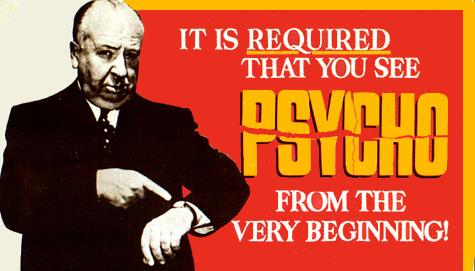
For Hitchcock’s birthday, today’s scene that I love is the final scene of 1960’s Psycho! Do I really have to give a spoiler warning for this?
Ah, the 60s. Both the studio system and the production code collapsed as Hollywood struggled to remain relevant during a time of great social upheaval. The Academy alternated between nominating films that took chances and nominating films that cost a lot of money. It led to some odd best picture lineups and some notable snubs!
1960: Psycho Is Not Nominated For Best Picture and Anthony Perkins Is Not Nominated For Best Actor
To be honest, considering that the Academy has never really embraced horror as a genre and spent most of the 60s nominating big budget prestige pictures, it’s a bit surprising that Psycho was actually nominated for four Oscars. Along with being nominated for its production design and its cinematography, Psycho also won nominations for Alfred Hitchcock and Janet Leigh. However, Anthony Perkins was not nominated for Best Actor, despite giving one of the most memorable performances of all time. The film literally would not work without Perkins’s performance and, considering that Perkins pretty much spent the rest of his career in the shadow of Norman Bates, it’s a shame that he didn’t at least get a nomination for his trouble. Psycho was also not nominated for Best Picture, despite being better remembered and certainly more influential than most of the films that were.
1962: The Man Who Shot Liberty Valance Is Almost Totally Snubbed
The Man Who Shot Liberty Valance was not totally snubbed by the Academy. It received a nomination for Best Costume Design. But still, it deserved so much more! John Ford, James Stewart, John Wayne, Lee Marvin, Vera Miles, and the picture itself were all worthy of nominations. Admittedly, 1962 was a year full of great American films and there was a lot of competition when it came to the Oscars. Still, The Man Who Shot Liberty Valance definitely deserved a best picture nomination over the bloated remake of Mutiny on the Bounty. Today, if the first Mutiny on the Bounty remake is known for anything, it’s for Marlon Brando being difficult on the set. But The Man Who Shot Liberty Valance is still remembered for telling us to always print the legend.
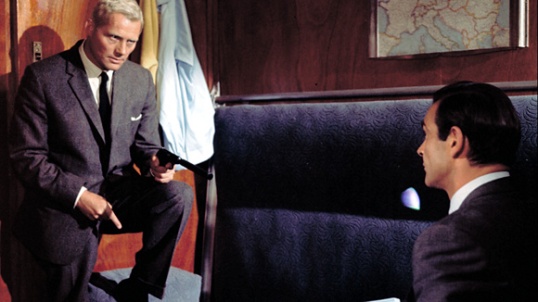
1964: From Russia With Love Is Totally Snubbed
The same year that the Academy honored George Cukor’s creaky adaptation of My Fair Lady, it totally ignored my favorite James Bond film. From Russia With Love is a Bond film that works wonderfully as both a love story and a thriller. Sean Connery, Lotte Lenya, Robert Shaw, and Terence Young all deserved some award consideration. From Russia With Love was released in the UK in 1963. In a perfect world, it would have also been released concurrently in the U.S., allowing From Russia With Love to be the film that gave the the Academy the chance to recognize the British invasion. Instead, Tom Jones was named the Best Picture of 1963 and From Russia With Love had to wait until 1964 to premiere in the U.S. It was snubbed in favor of one of old Hollywood’s last grasps at relevance.
1964: Slim Pickens Is Not Nominated For Best Supporting Actor
Playing three separate roles, Peter Sellers dominates Dr. Strangelove: Or How I Learned To Stop Worrying And Love The Bomb. But, as good as Sellers is, the film’s most memorable image is definitely Slim Pickens whooping it up as he rides the bomb down to Earth. George C. Scott and Sterling Hyaden also undoubtedly deserved some award consideration but, in the end, Pickens is the one who brings the film to life even as he helps to bring society to an end.
1967: In Cold Blood Is Not Nominated For Best Picture
In Cold Blood, though not a perfect film, certainly deserved a nomination over Dr. Doolittle. In Cold Blood is a film that still has the power to disturb and haunt viewers today. Dr. Doolittle was a box office debacle that was nominated in an attempt to help 20th Century Fox make back some of their money.

1967: Sidney Poitier Is Not Nominated For Best Actor For In The Heat Of The Night
In 1967, Sidney Poitier starred in two of the films that were nominated for Best Picture but somehow, he did not pick up a nomination himself. His restrained but fiercely intelligent performance in In The Heat Of The Night provided a powerful contrast to Rod Steiger’s more blustery turn. That Poitier was not nominated for his performance as Virgil Tibbs truly is one of the stranger snubs in Academy history. (If I had to guess, I’d say that the Actors Branch was split on whether to honor him for In The Heat of the Night or Guess Who’s Coming To Dinner or even for To Sir With Love and, as a result, he ended up getting nominated for none of them.)
1968: 2001: A Space Odyssey and Planet of the Apes Are Not Nominated For Best Picture
Neither one of these classic science fiction films were nominated for Best Picture, despite the fact that both of them are far superior and far more influential than Oliver!, the film that won that year.
1968: The Good, The Bad, and the Ugly Is Totally Ignored
Not even Ennio Morricone’s score received a nomination!
1968: Petulia Is Totally Snubbed
Seriously, I don’t know what was going on with the Academy in 1968 but it seems they went out of their way to ignore the best films of the year. Richard Lester’s Petulia is usually cited as one of the definitive films of the 60s but it received not a single Oscar nomination. Not only did the film fail to receive a nomination for Best Picture but Richard Lester, George C. Scott, Julie Christie, Shirley Knight, Richard Chamberlain, and the film’s screenwriters were snubbed as well.
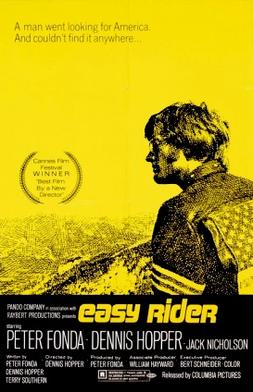
1969: Easy Rider Is Not Nominated For Best Picture
Yes, I know. Easy Rider is a flawed film and there are certain moments that are just incredibly pretentious. That said, Easy Rider defined an era and it also presented a portrait of everything that was and is good, bad, and timeless about America. The film may have been produced, directed, and acted in a drug-razed haze but it’s also an important historical document and it was also a film whose success permanently changed Hollywood. Certainly, Easy Rider’s legacy is superior to that of Hello, Dolly!
Agree? Disagree? Do you have an Oscar snub that you think is even worse than the 10 listed here? Let us know in the comments!
Up next: It’s the 70s!
 During the lawless day of the old west, a drifter named Roy Bean (Paul Newman) wanders into the desolate town of Vinegaroon, Texas. When he enters the local saloon, he meets the vagrants who run the town. They beat him, they rob him, and they tie him to the back of his horse and leave him to die.
Bean, however, does not die. Instead, he’s nursed back to health by a beautiful young woman named Maria Elena (Victoria Principal). Carrying a gun, Bean reenters the saloon and promptly kills nearly everyone who previously attacked him. (“I’m not done killing you yet!” Bean yells at one fleeing woman.) Bean sits down in front of the saloon and waits for justice. Instead, he’s visited by a lecherous traveling preacher (Anthony Perkins), who buries the dead and gives Bean absolution. Bean declares that he is now the “law of the West Pecos.” As the preacher leaves, he looks at the audience and says that he never visited Bean again and later died of dysentery in Mexico. He hasn’t seen Bean since dying so the preacher is sure that, wherever Bean went, it wasn’t Heaven.
Judge Roy Bean dispenses rough and hard justice from his saloon and renames the town Langtry, after the actress Lillie Langtry. Bean has never met Langtry or even seen her perform but he writes to her regularly and pictures of her decorate the walls of his saloon. Bean hires outlaws to serve as his town marshals and sentences prostitutes to remain in town and marry the citizens. Lawbreakers are left hanging outside of the saloon. Bean enters into a common law marriage with Maria and, for a while, they even own a bear, who drinks beer and helps Bean maintain order in the court. Bean may be crazy but his methods clean up the town and Langtry starts to grow. As Langtry becomes more civilized and an attorney named Arthur Gass (Roddy McDowall) grows more powerful, it starts to become apparent that there may no longer be a place for a man like Judge Roy Bean.

The real-life Judge Roy Bean did hold court in a saloon and he did name the town after Lilly Langtry. It’s debatable whether or not he was really a hanging judge. Because he didn’t have a jail, the maximum punishment that he could hand out was a fine and usually that fine was the same amount of however much money the accused had on him at the time of his arrest. Because of his eccentricities and his reputation for being the “only law west of the Pecos,” Roy Bean became a legendary figure. The Life and Times of Judge Roy Bean acknowledges from the start that it’s not a historically accurate, with a title card that reads, “Maybe this isn’t the way it was… it’s the way it should have been.”
Based on a script by John Milius and directed by Hollywood veteran John Huston, The Life and Times of Judge Roy Bean is one of the strangest westerns to ever be released by a major studio. Featuring multiple narrators who occasionally speak directly to the camera, The Life and Times of Judge Roy Bean is an episodic mix of low comedy, graphic violence, and syrupy romance. (The film’s sole Oscar nomination was for the song that played over scenes of Bean and Maria going on a romantic picnic with their pet bear.) Familiar faces show up in small roles. Along with Perkins and McDowall, Tab Hunter, Ned Beatty, Jacqueline Bissett, Ava Gardner, and Anthony Zerbe all play supporting roles. Even a heavily made-up Stacy Keach makes an appearance as an albino outlaw named Bad Bob.

Jacqueline Bisset in The Life and Times of Judge Roy Bean
Milius has gone on the record as calling The Life and Times of Judge Roy Bean a “Beverly Hills western” and he has a point. He envisioned the script as starring Warren Oates as a less likable and much more morally ambiguous version of Judge Roy Bean and he was not happy that his original ending was replaced by a more showy pyrotechnic spectacle. Milius envisioned the film as a low-budget spaghetti western but Huston instead made a Hollywood epic, complete with celebrity cameos and a theme song from Maurice Jarre and Marilyn Bergman. Milius said that his experience with The Life and Times of Judge Roy Bean is what led to him deciding to direct his own films.
Again, Milius has a point but John Huston’s version of The Life and Times of Judge Roy Bean has its strengths as well. Though he may not be the madman that Milius originally envisioned, Paul Newman gives a good, grizzled performance as Roy Bean and the role served as a precursor for the type of aging but determined characters that Newman would specialize in during the final phase of his career. Due to its episodic structure, the film is uneven but it works more often than it doesn’t. The chaotic early scenes reflect a time when the west was actually wild while the later scenes are more cohesive, as society moves into Langtry and threatens to make formerly indispensable men like Roy Ban obsolete. Even the cameo performances fit in well with the film’s overall scheme, with Anthony Perkins standing out as the odd preacher. Finally, the young Victoria Principal is perfectly cast as the only woman that Roy Bean loved as much as Lily Langtry.
Though it’s impossible not to wonder what Warren Oates would have done with the title role, The Life and Times of Judge Roy Bean is a good end-of-the-west western.

There’s been a murder on the Orient Express!
In the middle of the night, a shady American businessman (Richard Widmark) was stabbed to death. Now, with the train momentarily stalled due to a blizzard, its up to the world’s greatest detective, Hercule Poirot (Albert Finney), to solve the crime. With only hours to go before the snow is cleared off the tracks and the case is handed over to the local authorities, Hercule must work with Bianchi (Martin Balsam) and Dr. Constantine (George Coulouris) to figure out who among the all-star cast is a murderer.
Is it the neurotic missionary played by Ingrid Bergman? Is it the diplomat played by Michael York or his wife, played by Jacqueline Bisset? Is it the military man played by Sean Connery? How about Anthony Perkins or John Gielgud? Maybe it’s Lauren Bacall or could it be Wendy Hiller or Rachel Roberts or even Vanessa Redgrave? Who could it be and how are they linked to a previous kidnapping, one that led to the murder of an infant and the subsequent death of everyone else in the household?
Well, the obvious answer, of course, is that it had to be Sean Connery, right? I mean, we’ve all seen From Russia With Love. We know what that man is capable of doing on a train. Or what about Dr. No? Connery shot a man in cold blood in that one and then he smirked about it. Now, obviously, Connery was playing James Bond in those films but still, from the minute we see him in Murder on the Orient Express, we know that he’s a potential killer. At the height of his career, Connery had the look of a killer. A sexy killer, but a killer nonetheless….
Actually, the solution to the mystery is a bit more complicated but you already knew that. One of the more challenging things about watching the 1974 version of Murder on the Orient Express is that, in all probability, the viewer will already know how the victim came to be dead. As convoluted as the plot may be, the solution is also famous enough that even those who haven’t seen the 1974 film, the remake, or read Agatha Christie’s original novel will probably already know what Poirot is going to discover.
That was something that director Sidney Lumet obviously understood. Hence, instead of focusing on the mystery, he focuses on the performers. His version of Murder on the Orient Express is full of character actors who, along with being talented, were also theatrical in the best possible way. The film is essentially a series of monologues, with each actor getting a few minutes to show off before Poirot stepped up to explain what had happened. None of the performances are exactly subtle but it doesn’t matter because everyone appears to be having a good time. (Finney, in particular, seems to fall in love with his occasionally indecipherable accent.) Any film that has Anthony Perkins, John Gielgud, Lauren Bacall, Sean Connery, Ingrid Bergman, and Albert Finney all acting up a storm is going to be entertaining to watch.
Though it’s been a bit overshadowed by the Kenneth Branagh version, the original Murder on the Orient Express holds up well. I have to admit that Sidney Lumet always seems like he would have been a bit of an odd choice to direct this film. I mean, just consider that he made this film in-between directing Serpico and Dog Day Afternoon. However, Lumet pulls it off, largely by staying out of the way of his amazing cast and letting them act up a storm. It looks like it was a fun movie to shoot. It’s certainly a fun movie to watch, even if we do already know the solution.

Despite making some inroads as of late, horror films still never quite get the respect that they deserve when it comes Oscar time. That’s especially true of the performers who regularly appear in horror films. If it’s rare for a horror movie to receive a best picture nomination, it’s even rarer for someone to get nominated for appearing in one of them.
And yet, it takes as much skill to make a monster compelling as it does a historical figure or a literary character. In fact, it may take even more skill. After all, everyone knows that Queen Elizabeth I actually ruled over England and that Atticus Finch was an attorney in the South. However, everyone also knows that there’s no such things as vampires and that the dead cannot be reanimated or raised as a zombie. It takes a lot of skill to make a monster seem human.
With that in mind, here are 6 horror performances that deserved, at the very least, an Oscar nomination:

1. Boris Karloff as The Monster in Frankenstein (1931) and The Bride of Frankenstein(1935)
The great Boris Karloff is perhaps the most egregious example of a deserving actor who was consistently ignored by the Academy because of the type of films in which he appeared. In the role of Monster, Karloff was never less than brilliant and he set the standard by which all future monsters are judged.

Dracula (1931, directed by Tod Browning)
2. Bela Lugosi in Dracula (1931)
When viewed today, it’s perhaps a little bit too easy to be dismissive of Lugosi’s grandly theatrical interpretation of Dracula. But, if you can ignore all of the bad imitations that you’ve seen and heard over the years, you’ll discover that Lugosi’s performance is perfect for the film in which he’s appearing. Indeed, Lugosi’s best moments are the silent ones, when he goes from being a courtly (if vaguely sinister) nobleman to a hungry animal. In those moments, you see why Lugosi’s performance endures.
3. Anthony Perkins as Norman Bates in Psycho (1960)
Ah, poor Anthony Perkins. Before he played Norman Bates, he was considered to be something an up-and-coming star and even something of a neurotic romantic lead. As with Lugosi’s Dracula, we’ve seen so many bad imitations of Perkins’s performance that it’s easy to overlook just how good he is in the role. He was so perfect as Norman that spent the rest of his career typecast. And, sadly enough, he didn’t even get a much-deserved Oscar nomination out of it.
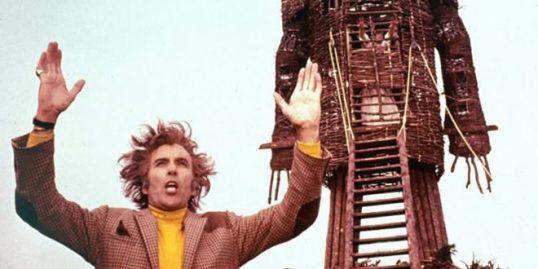
4. Christopher Lee as Lord Summerisle in The Wicker Man (1973)
Christopher Lee was one of the great actors and, though he may be best remembered for his horror work, he actually appeared in almost every genre of film imaginable. Lee was often dismissive of the Dracula films that he made for Hammer so, as much as I’d love to argue that he deserved a nomination for The Horror of Dracula, I’m instead going to suggest that Lee deserved one for the role that he often cited as his favorite, the pagan Lord Summerisle in The Wicker Man. Lee brings the perfect mix of wit and menace to the role and, in the process, shows that not all monsters have to be undead.

5. Donald Pleasence as Dr. Sam Loomis in Halloween (1978) and Halloween II (1981)
Much as with Lugosi and Anthony Perkins, it’s important (and perhaps a little bit difficult) to separate Pleasence’s performances in these two slasher films with all of the imitations that have followed. In both films, Pleasence does a great job of playing a man who has been driven to the verge of madness as a result of having spent too much time in the presence of evil. As potentially dangerous as Sam Loomis sometimes appears to be, there’s no way not to sympathize with him as he continually tries to get people to understand that he wasn’t the one who left Michael escape. If nothing else, Pleasence deserved a nomination just for his delivery of the line, “As a matter of fact, it was.”

6. Betsy Palmer as Pamela Voorhees in Friday the 13th (1980)
“I’m an old friend of the Christys.” AGCK! RUN!
Norman Bates is back!
Released in 1986 and directed by Anthony Perkins himself, Psycho III picks up a few months after Psycho II ended. Norman (Anthony Perkins, of course) is still free. He’s still got his motel. He’s still talking to his dead mother. Of course, at the end of Psycho II, Norman was told that the woman who Norman thought was his mother actually wasn’t his mother. Instead, Emma Spool told Norman that she was his mother, which led to Norman promptly hitting her with a shovel and then keeping her preserved body hidden away in the motel. Got all that? Great, let’s move on….
In Psycho III, business suddenly starts booming at the Bates Motel! All sorts of people come by to visit.
For instance, there’s the obnoxious tourists who show up at the motel so they can watch a football game and get drunk. Future director Katt Shea plays one of the unfortunate tourists, who ends up suffering perhaps the most undignified death in the history of the Psycho franchise. Shea later ends up being stored in the motel’s ice chest. At one point, the local sheriff grabs a piece of ice and tosses it in his mouth without noticing that it’s covered in blood.
And then there’s Duane Duke (a young Jeff Fahey!), who is superhot but also super sleazy. For reasons that are never quite clear, Norman hires Duke to be the assistant manager at the motel. Duke turns out to be thoroughly untrustworthy but he’s Jeff Fahey so he remains strangely appealing even when he shouldn’t be.
Red (Juliette Cummins) shows up at the motel so that she can have sex with Duke and then get stabbed to death while taking off her top in a phone booth. That, I guess, is Psycho III‘s equivalent of the first film’s shower scene. Later, Duke comes across Norman mopping up all the blood in the phone booth but he doesn’t say anything about it. Duke knows better than to ask why there’s blood in the phone booth.
Tracy Venable (Roberta Maxwell) is a journalist whose sole purpose in life is to prove that Norman murdered Emma Spool. Tracy’s main function in this film is to explain just why exactly so many different women have claimed to be Norman’s mother. It’s a rather complicated story and you’ll get a migraine if you think about it for too long.
And finally, there’s Maureen (Diana Scarwid), the former nun who has lost her faith and her sanity. She shows up at the motel and stays in Marion Crane’s old room. She takes a bath instead of a shower and slits her wrists. When Norman storms into the room to kill her, the barely lucid Maureen mistakes him for the Virgin Mary and sees his knife as being a crucifix. Maureen survives and Norman is hailed as a hero for rescuing her. Later, Norman and Maureen fall in love. You can guess how that goes.
When compared to the first sequel, Psycho III is much more of a standard slasher film and there’s certainly never any doubt over who is doing the killing. However, Perkins again does a great job in the role of Norman, making him both sympathetic and creepy. Fahey, Scarwid, Maxwell, and Hugh Gillin (as the hilariously clueless sheriff) all provide good support. There’s really not a single character in this film who doesn’t have at least one odd or memorable quirk. Duane Duke, for instance, is one of the most amazingly sleazy characters in the history of American cinema. Just when you think that the character can’t get any worse, he proves you wrong.
As mentioned above, Perkins directed this film. It was one of two movies that Perkins would direct before his death. As a director, Perkins had a good visual sense, even if he did allow the narrative to meander a bit. There’s nothing particularly subtle about Perkins’s direction and several of the scenes — like the sex scene between Duke and Red — are so over the top that they become rather fascinating to watch. That said, there was really no longer any need to be subtle when it came to Norman Bates and his story.
With the exception of the weird Gus Van Sant remake with Vince Vaughn, Psycho III would be the last Psycho film to be released into theaters. It would also be Perkins’s second-to-last time to play Norman. (The last time would be in a 1990 made-for-TV sequel, Psycho IV: The Beginning. Despite it’s title, Psycho IV pretty much ignored everything that happened in the previous two sequels.) Perkins passed away in 1992, at the age of 60 but the character of Norman Bates would live on, both in his own performances and in the later work of Freddie Highmore in Bates Motel.

 Through the Shattered Lens