Horror Film Review: The Corpse Vanishes (dir by Wallace Fox)


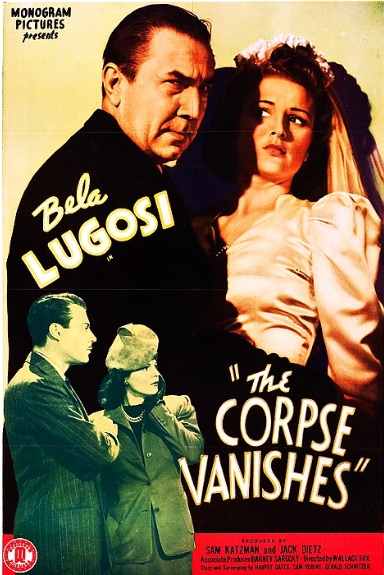
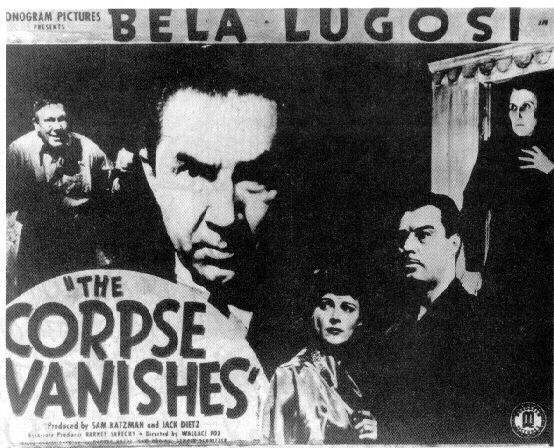
1942’s The Corpse Vanishes opens with a young bride collapsing at her wedding.  A doctor runs over to her and says that she’s died.  A hearse — or a “stiff wagon,” as one witness puts it — pulls up and takes the body.  However, the body never reaches the morgue!

It turns out that this is not the first time this has happened.  In fact, there’s an epidemic of brides dying on their wedding day and their bodies disappearing.  One would think that this would cause a citywide panic or, at the very least, it would cause some people to maybe get married out-of-town.  Considering that the most recent victim was the daughter of one of the richest families in the community, you would think solving this mystery would be the police’s number one priority.

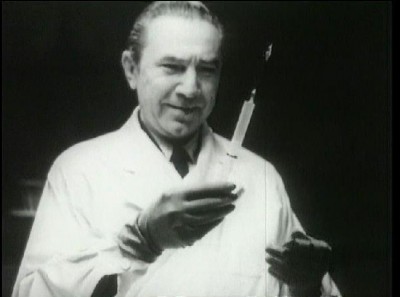
However, the police are useless.  And when the police can’t get the job done, it falls to journalists.  At least, that’s the way it worked in movies from the 1930s and the 40s.  While the cops were busy saying, “Scram!” and “Beat it, buster!,” it fell to the cynical and quick-witted journalist to find out what was going on.  In this case, Patricia Hunter (Luana Walters) investigates and discovers that all of the brides received an orchid on their wedding day.  (How the police didn’t notice this, I don’t know.)  Patricia tracks down the eccentric Dr. Lorenz (Bela Lugosi), who was once quite renowned for his orchids.

Dr. Lorenz now lives in a secluded mansion.  He’s polite when Patricia comes to speak to him but it’s obvious that he’s hiding something.  A sudden thunderstorm leads to Patricia and Dr. Foster (Tristram Coffin) getting stranded at Lorenz’s mansion.  Foster was visiting the mansion to examine Lorenz’s wife, the Countess (Elizabeth Russell).

Lorenz, as you probably already guessed, is behind the corpse abductions.  Except, of course, the brides aren’t dead.  Instead, the orchid has put them into a state of suspended animation.  Lorenz is extracting their blood and using it to keep his wife young.  Helping him out are his servants, a dwarf named Toby (Angelo Rossitto), Toby’s hulking half-brother, Angel (Frank Moran), and their mother, Fagah (Minerva Urecal).  Patricia figures out what is going on but will she be able to convince anyone else!?

From what I read about the film online, it would appear that The Corpse Vanishes has got a terrible reputation but, when I watched it, I actually found it to be entertaining when taken on its own Poverty Row terms.  No, the plot doesn’t make any sense.  But Bela Lugosi’s smile manages to be both sinister and inviting and Toby and Angel make for good henchmen.  The movie only has a 64-minute runtime and, as a result, the plot has to keep moving fairly quickly.  The film also features a lot of snappy “newsroom” dialogue between Patricia and her easily-annoyed editor (Kenneth Harlan), all delivered at a fast pace and with the the casually cynical outlook that makes 1940s newspaper movies so entertaining.  The Corpse Vanishes is a thoroughly ludicrous film that epitomizes an era and, as such, it’s far more diverting than one might otherwise expect.
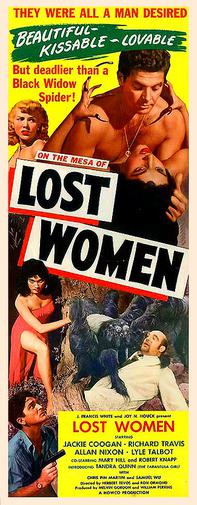
Horror Film Review: Mesa of Lost Women (dir by Herbert Tevos and Ron Ormond)


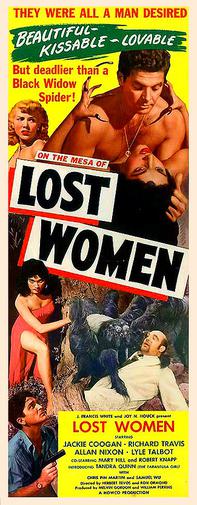
“Have you ever been kissed by a girl like this?” a disembodied voice asks at the start of 1953’s Mesa For Lost Women as a pair hands with claw-like fingernails caresses the face of someone who is later identified as being “Doc” Tucker (Allan Nixon).

Things get stranger from there.  A couple is found lost and dehydrated in the Mexican desert.  Grant Phillips (Robert Knapp) rambles about “super bugs” out in the desert and how they have to be destroyed.  American land surveyor Frank (John Martin) assumes that Grant must be delirious but Frank’s assistant, Pepe (Chris Pin Martin), knows differently.  We know that Pepe knows differently because the narrator tells us that Pepe had heard all about the monsters in the desert but Pepe keeps that information to himself….

Who is this narrator and why is he so condescending?  (For the record, he’s actor Lyle Talbot, who split his career between major, Oscar-winning productions and stuff like this.)  Have you ever noticed that a narrator usually just leaves you feeling even more confused by what you just watched?  There’s a trailer playing right now for a film called Ella McCay that opens with Julie Kavner saying, “Hi, I’m the narrator!” and whenever I hear that line, I’m just like, “Oh, this film is going to be so bad!”

I think it’s because most narrators are added after the fact, in an attempt to give some sort of uniformity to a badly constructed movie.  The narrator is there to tell us stuff that a good movie would be able to show us.  For instance, in the trailer for Ella McCay, Julie Kavner tells us that “I’m nuts about her,” as a way to assure us that Ella McCay is someone worth making a movie about.  Now, ideally, you wouldn’t have to have someone tell you that.  You would just watch the movie and say, “Hey, Ella McCay!  She deserves all the happiness in the world!”  But when your trailer is a bunch of scenes of Ella McCay acting a bit immature for someone who is destined to become “governor of the state you were born and raised in,” you need that narrator to say, “No, she’s likable, I promise!”

By that same logic, Mesa of Lost Women was apparently a mash-up of several different films, none of which had a complete script.  Narrator Lyle Talbot is here to tell us that, despite what we’re seeing, Mesa of Lost Women is an actual movie with an actual story as opposed to just a bunch of random scenes that were haphazardly crammed together.  We get a flashback of a scientist named Masterson (Harmon Stevens) traveling to the laboratory of Dr. Aranya (Jackie Coogan) and discovering that Aranya is creating giant tarantulas and transforming human women into mind-controlled slaves with the instincts of a spider.  Masterson doesn’t think that’s ethical so Aranya’s assistant, Tarantella (Tandra Quinn), gives him an injection that turns him into a simpleton.  Masterson ends up in a mental hospital, though he later escapes.  Meanwhile, an American businessman and his girlfriend (Mary Hill) come to Mexico and witness Tarantella dancing in a bar.  Masterson shows up and shoots Tarantella and then takes everyone hostage so that he can force Grant, who we now discover is a pilot, to fly him to the mesa of lost women …. or something.

Despite the best efforts of the narrator, the film is impossible to follow.  A big problem is that Dr. Aarnya’s plan never makes much sense.  How is creating a giant spider and a bunch of women who think that they’re spiders going to help him conquer the world?  The other problem is that the film had two directors, one of whom was an enigmatic German named Herbert Tevos who got the job by claiming to have directed Josef von Sternberg’s The Blue Angel.  Tevos’s footage of Dr. Aranya, the giant tarantula, and the “lost women” was not enough to secure the film distribution so a second director, Ron Ormond, was brought in to shoot a bunch of new footage to make the film more commercial.  Tevos’s film became an extended flashback in the middle of Ormond’s film and the whole thing is a big mess.

In fact, the film is such a mess that some people insist Ed Wood must have been involved.  It is true that narrator Lyle Talbot also appeared in Plan 9 From Outer Space and Glen or GlendaPlan 9‘s Mona McKinnon appears as a spider woman.  So does Dolores Fuller, who was Wood’s girlfriend at the time.  Wood later “borrowed” Mesa of Lost Women‘s score for Jail BaitMesa of Lost Women was definitely Wood-adjacent but, by all accounts, Wood didn’t actually do any work on the film.  This mess of a film belongs to Tevos and Ormond.

And it is a mess.  It’s a watchable mess, in much the same way that a nuclear meltdown would probably be watchable.  But, nonetheless, it’s still a mess and the incoherence of the plot really does get on one’s nerves, despite the best efforts of Lyle Talbot.  Talbot can’t sell the viewer on Mesa of Lost Women.  Maybe he would have had better luck with Ella McCay.

Horror on the Lens: Dementia (dir by John Parker)


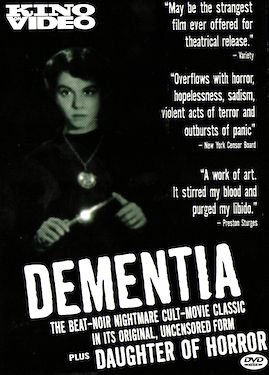
Today’s Horror on the Len is 1955’s Dementia, an experimental horror film without dialogue.  The film follows a young woman (Adrienne Barrett) over the course of one surreal and nightmarish night on Los Angeles’s skid row.

Despite an opening endorsement from no less a Hollywood luminary as Preston Sturges, audiences in 1955 were not sure what to make of this dream-like film.  However, it has since been rediscovered and reappreciated by audiences who appreciate the film’s surreal vision.

Horror on the Lens: Mesa of Lost Women (dir by Herbert Tevos and Ron Ormond)


Today’s Horror on the Lens is the infamous 1953 film, Mesa of Lost Women.  Off in the middle of the desert, Dr. Aranya (Jackie Coogan) is conducting dangerous experiments that are resulting not only in giant spiders but also a master race of superwomen who Aranya is planning to use to conquer the world or something.

Mesa of Lost Women is a bit of a disjointed film.  It was originally filmed by a German director named Herbert Tevos, who claimed to be an associate of Erich Von Stroheim’s and a former collaborator of Marlene Dietrich’s.  However, despite his claims of being well-connected, no one was particularly impressed with Tevos’s first cut of the film so Ron Ormond was brought in to film additional scenes, the majority of them featuring Jackie Coogan as the insane Dr. Aranya.  Jackie Coogan was, at the time, still best-known for playing The Kid in the Charlie Chaplin film of the same name.  After Mesa, he would go on to play Uncle Fester on the original Addams Family.

Anyway, Mesa of Lost Women is one of those B-movies that simply has to be seen and heard to be believed.  (Lyle Talbot provides the narration, which is judgmental even by the standards of the 1950s.)  Enjoy Mesa of Lost Women!

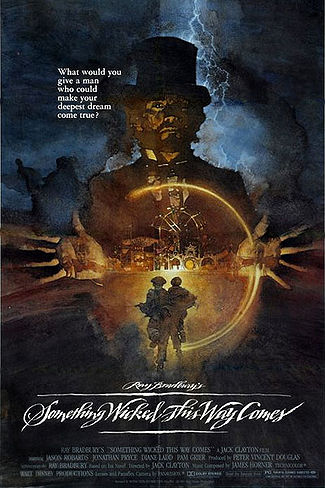
A Movie A Day #296: Something Wicked This Way Comes (1983, directed by Jack Clayton)


Something Wicked This Way Comes is one of my favorite films.
The place is Green Town, Illinois.  The time is the 1920s.  The carnival has come to town but this is no normal carnival.  Led by the sinister, Mr. Dark (Jonathan Pryce), this carnival promises to fulfill everyone’s dreams but at what cost?  Double amputee Ed (James Stacy) gets his arm and his leg back.  The lonely teacher, Miss Foley (Mary Grace Canfield), is young and beautiful once again.  Mr. Dark may bring people what they want but he gives nothing away for free.  Only two young boys, Will (Vidal Peterson) and Jim (Shawn Carson), realize the truth about the carnival but no one in town will listen to them.  Mr. Dark wants Jim to be his successor and Will’s only ally is his elderly father, the town librarian (Jason Robards).

As much a coming of age story as a horror film, Something Wicked This Way Comes takes the time to establish Green Town and to make it feel like a real place and its inhabitants seem like real people.  When Mr. Dark shows up, he is not just a supernatural trickster.  He is not just stealing the souls of Green Town.  He is also destroying the innocence of childhood.  Jonathan Pryce is both charismatic and menacing as Mr. Dark while Jason Robards matches him as the infirm librarian who must find the strength to save his son.  The confrontation between Pryce and Robards, where Pryce tears flaming pages out of a book, is the best part of the movie.  Along with Robards and Pryce, the entire cast is excellent.  Be sure to keep an eye out for familiar faces like Royal Dano, Jack Dodson, Angelo Rossitto, and especially Pam Grier, playing the “Dust Witch,” the most beautiful woman in the world.

Based on a classic novel by Ray Bradbury, Something Wicked This Way Comes is one of the only Bradbury adaptations to do justice to its source material.

Horror on the Lens: Dracula vs. Frankenstein (dir by Al Adamson)


Zandor Vorkov is Dracula!

John Blood is Frankenstein’s monster!

Together … THEY SOLVE CRIMES!

No, actually, they don’t.  If anything, they cause crimes to happen.

First released in 1971 and directed by Al Adamson, Dracula vs. Frankenstein may not be a good film but it’s definitely an unforgettable film.  Yes, it may be thoroughly inept but it’s also perhaps the strangest take on the Dracula/Frankenstein rivalry that you’ll ever see.

Plus, it’s one of the final films of Lon Chaney, Jr.  Unfortunately, Lon doesn’t exactly look his best in Dracula vs Frankenstein...

Speaking of slumming celebrities, long before he played Dr. Jacoby and inspired America to shout, “Dig yourself out of the shit!,” Russ Tamblyn played a biker named Rico in this movie.

Also, like every other exploitation film made in 1971, Dracula vs. Frankenstein features hippies, leading to the age old question: who needs the supernatural when you’ve got LSD-crazed hippies running around?

Another age old question: Is Dracula vs. Frankenstein merely inept or is it a classic of bad filmmaking?

Watch below and decide for yourself.

Enjoy!

Halloween Havoc!: Bela Lugosi in THE CORPSE VANISHES (Monogram 1943)


gary loggins's avatarcracked rear viewer

cv1

A little over a week ago I wrote about Bela Lugosi’s pairing with The East Side Kids , and mentioned what’s been come to know as “The Monogram Nine”. These Poverty Row horrors were ultra-low-budget schlockfests made quickly for wartime audiences, and though the films weren’t very good, they gave Bela a chance to once again have his name above the titles. From 1941 to 1944, the Hungarian cranked out the rubbish: THE INVISIBLE GHOST, BLACK DRAGONS, THE CORPSE VANISHES, BOWERY AT MIDNIGHT, THE APE MAN, VOODOO MAN, RETURN OF THE APE MAN, and the two East Side Kids entries. Let’s take a look at a typical Lugosi vehicle, 1943’s THE CORPSE VANISHES.

cv2

Our story concerns young, virginal society brides who keep dying at the altar, their corpses hijacked by mysterious Dr. Lorenz (Bela, of course). The brides receive an “unusual orchid” whose “peculiar sweet odor” causes them to go into a…

View original post 602 more words

Halloween Havoc!: Bela Lugosi Meets The East Side Kids… Twice!


gary loggins's avatarcracked rear viewer

spooks1

Ten years after making horror history as DRACULA,   Bela Lugosi signed a contract with Monogram Studios producer Sam Katzman   to star in a series of low-budget shockers. The films have been affectionately dubbed by fans “The Monogram Nine” and for the most part are really terrible, redeemed only by the presence of our favorite Hungarian. Two of the films were with the East Side Kids, SPOOKS RUN WILD and GHOSTS ON THE LOOSE, making them sort of Poverty Row All-Star Productions for wartime audiences.

I won’t go too deeply into all the Dead End Kids/East Side Kids/Bowery Boys variations here. Suffice it to say original Dead Enders Leo Gorcey   (Muggs), Huntz Hall (Glimpy), and Bobby Jordan (Danny) landed at Monogram after their Warner Brothers contracts expired, much to Jack Warner’s relief. The young actors were a rowdy bunch, and Jack was probably glad to be rid of them! Anyway, the trio were popular with the masses, and…

View original post 621 more words

Insomnia File #1: The Story of Mankind (dir by Irwin Allen)


Story of Mankind

What’s an Insomnia File?  You know how some times you just can’t get any sleep and, at about three in the morning, you’ll find yourself watching whatever you can find on cable?  This feature is all about those insomnia-inspired discoveries!

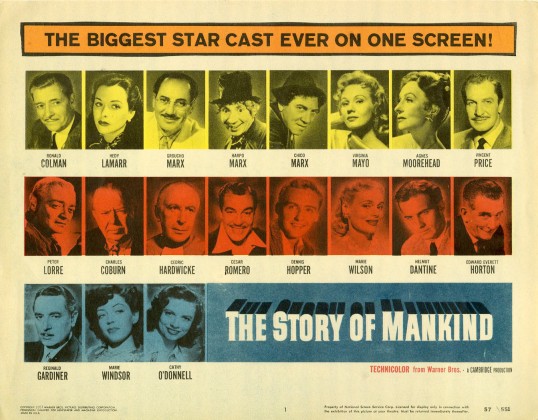
If, last night, you were suffering from insomnia at 3 in the morning, you could have turned on TCM and watched the 1957 faux epic, The Story of Mankind.

I call The Story of Mankind a faux epic because it’s an outwardly big film that turns out to be remarkably small on closer inspection.  First off, it claims to the tell the story of Mankind but it only has a running time of 100 minutes so, as you can imagine, a lot of the story gets left out.  (I was annoyed that neither my favorite social reformer, Victoria C. Woodhull, nor my favorite president, Rutherford B. Hayes, made an appearance.)  It’s a film that follow Vincent Price and Ronald Colman as they stroll through history but it turns out that “history” is largely made up of stock footage taken from other movies.  The film’s cast is full of actors who will be familiar to lovers of classic cinema and yet, few of them really have more than a few minutes of screen time.  In fact, it only takes a little bit of research on the imdb to discover that most of the film’s cast was made up of performers who were on the verge of ending their careers.

The Story of Mankind opens with two angels noticing that mankind has apparently invented the “Super H-Bomb,” ten years ahead of schedule.  It appears that mankind is on the verge of destroying itself and soon, both Heaven and Hell will be full of new arrivals.  One of the angels exclaims that there’s already a housing shortage!

A celestial court, overseen by a stern judge (Cedric Hardwicke) is convened in outer space.  The court must decide whether to intervene and prevent mankind from destroying itself.  Speaking on behalf on humanity is the Spirit of Man.  The Spirit of Man is played by Ronald Colman.  This was Colman’s final film.  In his heyday, he was such a popular star that he was Margaret Mitchell’s first choice to play Rhett Butler in Gone With The Wind.  However, in The Story of Mankind, Colman comes across as being a bit bored with it all and you start to get worried that he might not be the best attorney that mankind could have hired.

Even more worrisome, as  far as the future of mankind is concerned, is that the prosecutor, Mr. Scratch, is being played by Vincent Price.  Making his case with his trademark theatrics and delivering every snaky line with a self-satisfied yet likable smirk on his face, Vincent Price is so much fun to watch that it was impossible not to agree with him.  Destroy mankind, Mr. Scratch?  Sure, why not?  Mankind had a good run, after all…

In order to make their cases, Mr. Scratch and the Spirit of Man take a tour through history.  Mr. Scratch reminds us of villains like the Egyptian pharaoh Khufu (John Carradine) and the Roman Emperor Nero (Peter Lorre, of course).  He shows how Joan of Arc (Hedy Lamarr) was burned at the stake.  The Spirit of Man argues that, despite all of that, man is still capable of doing good things, like inventing the printing press.

And really, the whole point of the film is to see who is playing which historical figure.  The film features a huge cast of classic film actors.  If you watch TCM on a semi-regular basis, you’ll recognize a good deal of the cast.  The fun comes from seeing who tried to give a memorable performance and who just showed up to collect a paycheck.  For instance, a very young Dennis Hopper gives a bizarre method interpretation of Napoleon and it’s one of those things that simply has to be seen.

And then the Marx Brothers show up!

They don’t share any scenes together, unfortunately.  But three of them are present!  (No, Zeppo does not make an appearance but I imagine that’s just because Jim Ameche was already cast in the role of Alexander Graham Bell.)  Chico is a monk who tells Christopher Columbus not to waste his time looking for a quicker way to reach India.  Harpo Marx is Sir Isaac Newton, who plays a harp and discovers gravity when a hundred apples smash down on his head.  And Groucho Marx plays Peter Miniut, tricking a Native American chief into selling Manhattan Island while leering at the chief’s daughter.

And the good thing about the Marx Brothers is that their presence makes a strong argument that humanity deserves another chance.  A world that produced the Marx Brothers can’t be all bad, right?

Anyway, Story of Mankind is one of those films that seems like it would be a good cure for insomnia but then you start watching it and it’s just such a weird movie that you simply have to watch it all the way to the end.  It’s not a good movie but it is flamboyantly bad and, as a result, everyone should see it at least once.


Embracing the Melodrama Part II #11: Child Bride (dir by Harry Revier)


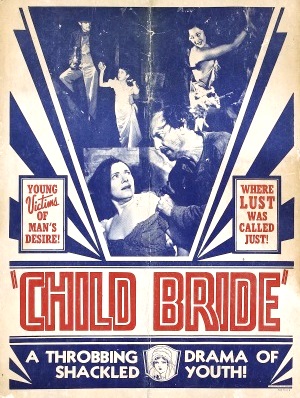
Child_Bride“Child marriage must go!”

— Miss Carol (Diana Durrell) in Child Bride (1938)

Oh my God!

Listen, I have never made a secret about the fact that I love low-budget exploitation films but watching the 1938 film Child Bride was seriously one of the ickiest experiences of my life.  This is one of those films that, after you watch it, you have to take a long shower to try to wash it off of you.  This is the type of film that will inspire you to lock your door and sit in a corner with a long kitchen knife for protection.  The film’s poster describes it as being a “throbbing drama of shackled youth” but I would be scared of anyone who came out of Child Bride throbbing.

Child Bride claims to take place in Ozarks but, from the minute you see all of the Eucalyptus trees and hear all the bad accents, you know that this film is about as Californian as a film can be.  Miss Carol (Diana Durrell) grew up in the backwoods and now she’s returned so she can serve as the teacher in a tiny, one-room schoolhouse.  Upon her arrival, Miss Carol is viewed by suspicion by the townspeople.  They distrust her refined ways and, even worse, she keeps saying how she’s going to get the state to pass a law banning underage marriage.  There won’t be any more child brides!

So, of course, the townspeople decide to tar and feather her.  Fortunately, Miss Carol is saved by moonshiner Ira (George Humphreys) and his partner in crime, Angelo the Dwarf (Angelo Rossitto).  However, one of the townspeople — the demonic Jake Bolby (Warner Richmond) — has decided that he wants to marry Ira’s 12 year-old daughter, Jennie (Shirley Mills) and he’s not above committing murder to get what he wants.

What makes the film so icky is that Jennie was played by an actual 12 year-old and there’s a length scene where Jennie goes skinny dipping while Jake watches from the bushes.  As you watch, you find yourself wondering whether Child Bride was actually made to appeal to the Jake Bolbys of the world.

(It doesn’t help that Richmond, one of the few professional actors to appear in this film, gives a totally convincing performance.  Kevin Bacon in The Woodsman has got nothing on Warner Richmond…)

That said, as icky as it is, Child Bride is still definitely watchable.  It’s hard not to laugh at the film’s extreme version of the Ozarks.  I’ve never seen so many shacks, overalls, and toothless grins in my life.  Since I have family that lives in that part of the country, it was hard for me not to be amused by the film’s version of country living.  (If you want to know about life in the so-called “backwoods,” see Winter’s Bone.)

Ultimately, Child Bride is so weird that it’s understandable if you want to see it once but just make sure to take a shower afterward.