April True Crime: Our Guys by Bernard Lefkowitz and Our Guys (dir by Guy Ferland)


If there’s any true crime book that I recommend without hesitation, it’s Our Guys by Bernard Lefkowitz.

First published in 1997, Our Guys deals with a terrible crime that occurred in the leafy suburban community of Glen Ridge, New Jersey.  In 1989, it was an affluent community that loved its high school football team and where conformity and financial success were the most valued qualities the someone could have.  On March 1st, a 17 year-old girl was invited to a house party where, after she was convinced to head down to the basement, she was raped with a broomstick and a baseball bat by several members of the football team.  The girl was intellectually disabled and was later determined to have an IQ of 64.  Her name has never been revealed to the public.  In his book, Lefkowitz assigned her the pseudonym of Leslie Faber.

The crime was terrible.  So was the aftermath.  When one of the witnesses went to a teacher with what he saw happen in the basement, the town responded by rallying around the accused.  Initially, Leslie was accused of lying.  Then, as it became clear that something actually had happened in that basement, Leslie was accused of bringing it on herself.  Leslie, who was desperate to have friends and who was later determined to be psychologically incapable of saying “no” or even understanding what consent meant, was cast as a wanton seductress who led the members of the football team astray.  A girl who went to school with Leslie even tape recorded a conversation with Leslie in which Leslie was manipulated into saying that she had made the entire thing up.  It also undoubtedly didn’t help that some of the accused boys had fathers who were on Glen Ridge’s police force.

It’s a book that will leave you outraged.  Lefkowitz not only examined the crime itself but also the culture of the town and its general attitude that “boys will be boys.”  Despite the fact that they had a losing record and the fact that one of them was infamous for exposing himself every chance that he got, the football team was viewed as being made up as winners.  They were allowed to party every weekend with their parties becoming so legendary that they bragged about them in their yearbook quotes.  With a group of supportive girlfriends doing their homework for them, the football team was free to do whatever they wanted and, by the time they were seniors, they were infamous for being voyeurs.  While one football player would have sex, all the others would hide in a closet and watch.  When one of the football players stole $600 from one of his classmates, his father paid back the money and no one was ever punished.  In a town that valued material success above all else and viewed being different as a sign of weakness, Leslie and her family were treated as being outcasts.  In the end, three of the football players were sentenced to prison.  One was sentenced to probation.  A few others accepted plea deals and had their arrests expunged from the record.  Years later, one of the guys who was in the basement but not charged would murder his wife while home on leave from the military.
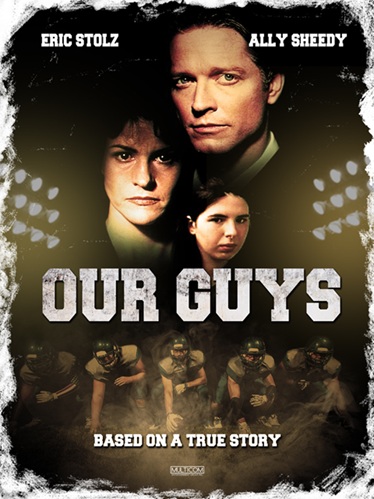
In 1999, Our Guys was adapted into a made-for-television movie.  Featuring Heather Matarazzo as Leslie, Ally Sheedy as the detective who investigated her rape, Eric Stoltz as the lawyer who prosecuted the case, and Lochlyn Munro as a cop who starts out on the side of the football team before realizing the truth, Our Guys simplifies the story a bit.  While the book focused on Glen Ridge and the culture of celebrating winners no matter what, the film focuses on Sheedy as the detective and her disgust with the suburbs in general.  Unfortunately, by not focusing on the culture of the town, the film presents the rape as being the bad actions of a group of dumb jocks as opposed to an expression of Glen Ridge’s contempt for anyone who was viewed as being on the outside.  What Lefkowitz showed through a precise examination of the town and its citizens, the film quickly dispenses by having Stoltz and Sheedy make a few pithy comments about how much the town loves it football team.  The story will still leave you outraged and Heather Matarazzo gives a heart-breaking performance as Leslie.  But, for those wanting the full story of  not only what happened in Glen Ridge but also how it happened, the book is the place to find it.

Back to School: I Think I’m Having A Baby (dir by Arthur Allan Seidelman)


Poor Jennifer Jason Leigh!

Seriously, whenever you watch any of the movies that Leigh made early in her career, your heart just goes out for.  She was always either getting stalked or getting abused or getting lost or struggling through a pregnancy scare.  In Fast Times At Ridgemont High, she actually did get pregnant and had to go to the abortion clinic on her own after Mike Damone failed to keep his promise to be there for her.  It doesn’t get quite as bad as that for her in 1981’s I Think I’m Having A Baby but she still has to put up with a lot.

In I Think I’m Having A Baby, Jennifer Jason Leigh plays 15 year-old Laurie, who is not only socially awkward but also has the worst haircut that has even been inflected on an otherwise attractive person.  Laurie idolizes her older cousin, Phoebe (Helen Hunt).  Phoebe is dating a lunkhead jock named Peter (Shawn Stevens).  Phoebe does Peter’s homework for him and Peter complains that Phoebe won’t go beyond some mild making out in his car.  That’s the kind of relationship that they have.  On the night of his birthday, Peter and Phoebe have an argument at the outdoor party that Phoebe went out of her way to set up.  Peter drives off in his car, little realizing that the shy Laurie is hiding in the backseat.  When Peter notices Laurie there, he pulls over and starts talking about how difficult (cue a massive eye roll from me) his life is.  By the end of the night, Peter has revealed himself to be a whiny jerk and Laurie is no longer a virgin.

Soon afterwards, Laurie starts to feel ill.  Her nerdy best friend, Marsha (Samantha Paris), thinks that Laurie might have the flu.  Laurie, however, fears that it’s definitely not the flu.  When Laurie tells Peter that she thinks she might be pregnant, Peter freaks out.  He tells her to take care of it and makes it clear that he has no interest in being a father.  Marsha says that she can’t understand why anyone would want to have a baby.  She announces that she’s never going to have one.  Instead, she’ll just adopt a dog.  That really doesn’t help out Laurie, though.  Eventually, Marsha and Laurie head to the clinic to discover whether or not Laurie is actually pregnant.

Meanwhile, Laurie’s little sister, Carrie (Tracey Gold), makes the mistake of letting her pet rabbits all socialize with each other.  Carrie learns a lesson about the importance of keeping a safety barrier between male and female rabbits.  At school, the students smirk as Mr. Fenning (David Birney) ties to teach a sexual education class.  One of the students is played by future Breakfast Club member Ally Sheedy, making her television acting debut by uttering a handful of lines.  The ultimate message is that no one knows anything and all of the education that they’ve gotten so far has been inadequate.

It’s pretty heavy-handed and some of the acting is a bit less than award-worthy.  (Samantha Paris shouts nearly every line that she has.)  But Jennifer Jason Leigh gives a good performance as Laurie, perfectly capturing not only Laurie’s fear of being pregnant but also the sadness that comes from being painfully shy.  Your heart breaks for her when you watch this film.  If nothing else, hopefully Laurie realizes, by the time the end credits roll, that she can do far better than Peter.  For that matter, so can Phoebe.  While everyone has a bright future ahead of them, Peter is destined to spend the rest of his life wondering why he peaked at 17.

And that’s the way it should be.

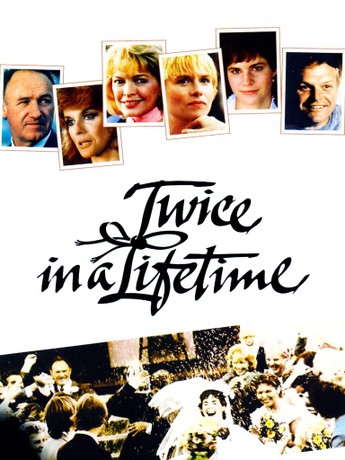
Twice In A Lifetime (1985, dir by Bud Yorkin)


Today, for obvious and tragic reasons, people everywhere have been thinking about their favorite Gene Hackman performances.  Hackman was an actor who always brought his all, even when he was appearing in a lesser film.  I think you could ask five different people for their five favorite Hackman performances and they would all give five different answers.  His performance as Lex Luthor in Superman and Superman II has always been one of my favorites.  Others will undoubtedly cite his award-winning performance as Popeye Doyle in The French Connection or his great work as Norman Dale in Hoosiers or his work in classic neo-noirs like The Conversation and Night Moves.  Let’s not forget his most unexpectedly great turn, as the blind man in Young Frankenstein.  Hackman gave so many great performances that some of them were for films that are not even remembered today.

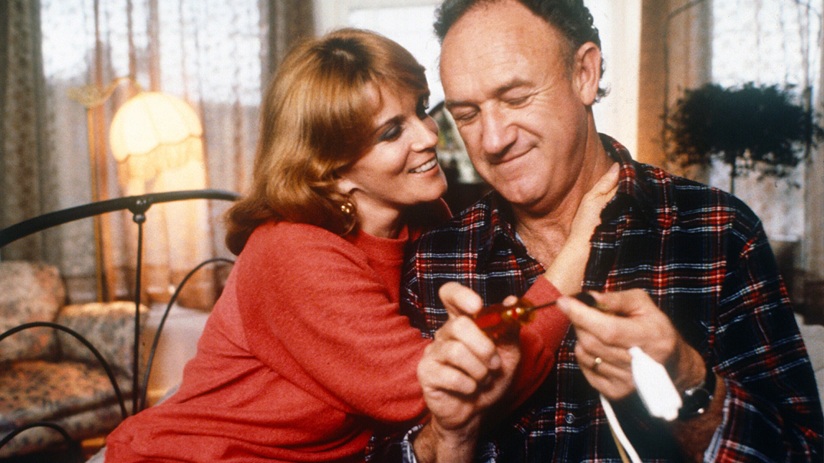
Twice In A Lifetime is one of those forgotten films but I think it features one of Hackman’s best performances.  He plays Harry Mackenzie, a steelworker who is married to Kate (Ellen Burstyn, made up to look frumpy) and who has two daughters (Amy Madigan and Ally Sheedy).  Harry is the type of everyman that Hackman excelled at playing.  He’s a hard worker, a good family man, and a good friend.  What no one, not even Harry realizes, is that he’s also having a midlife crisis.  On his 50th birthday, he goes out to the neighborhood bar with his buddies and falls for the new barmaid, Audrey (Ann-Margaret).  Harry ends up leaving his wife for Audrey, pursuing the spark that his marriage no longer gives him.  The movie follows Harry and Kate and their daughters as they adjust to their new lives and they plan for the younger daughter’s wedding.

Twice In A Lifetime was one of many 80s films that dealt with divorce and it has the same flaws that afflicted many of them.  These films, which were often made by middle-aged directors who had just gone through their own divorces, rarely played fair when it came to depicting why the marriage failed.  Twice In A Lifetime stacks the odds in Harry’s favor just by suggesting that Ann-Margaret would end up working at a bar frequented by steelworkers.  Harry has to choose between his plain and boring wife and Ann-Margaret.  That’s going to be a difficult choice!  The twist that Harry’s decision was ultimately the right thing for Kate doesn’t feel earned.

But damn if Gene Hackman isn’t great in this film.  Even though he was one of the most recognizable actors in the movie, Hackman is totally believable as both a steelworker and a man who worries that he’s destroyed his family.  It’s not just one moment or scene that makes this a great performance.  It’s the entire performance as a whole, with Hackman portraying all of Harry’s conflicted emotions both before and after leaving his family.  Hackman gives a performance that is more honest than the film’s script or direction.  The movie believes Harry did the right thing but Hackman shows us that Harry himself isn’t so sure.  Hackman captures the middle-aged malaise of a man wondering if his life is as good as it gets.  When the movie works, it is almost totally due to the emotional authenticity of Hackman’s performance.  Twice in a Lifetime may be a forgotten film but it’s also proof of how great an actor Gene Hackman really was.  There will never be another one like him.

Retro Television Review: St. Elsewhere 1.5 “Samuels and the Kid”


Welcome to Retro Television Reviews, a feature where we review some of our favorite and least favorite shows of the past! On Fridays, I will be reviewing St. Elsewhere, a medical show which ran on NBC from 1982 to 1988.  The show can be found on Hulu!

This week’s episode of St. Elsewhere featured Dr. Craig winning an award.  Good for him!

Episode 1.5 “Samuels and the Kid”

(Dir by Thomas Carter, originally aired on November 30th, 1982)

This week’s episode of St. Elsewhere was kind of boring,  It wasn’t a bad episode because the show was well-acted and even the boring subplots felt as is they were part of a bigger whole but, especially when compared to last week’s episode, Samuels and the Kid just wasn’t as compelling.

The Kid of the title is Robbie Durant (Jeremy Licht), a young patient who needs to have some minor surgery done on his ankle.  Dr. Samuels take a really intense interest in the kid, bonding with him and even offering him tickets to a Patriots football game.  At first, it seems like Samuels is just trying to be nice to a kid who is in a scary situation.  (When I was growing up, I spent a few nights in the hospital because of my asthma and it always scared me to death.)  But, at the end of the episode, it is revealed that Samuels had a son who was Robbie’s age who died in a freak accident.  As for Robbie, the operation is a success but he still dies as the result of an embolism.  It was sad but, at the same time, I knew Robbie was going to die as soon as he showed up in the hospital.  I’ve seen enough medical shows to know.

Dr. Cavanero was at a bed-and-breakfast when she learned that one of her patients had gone into labor and was at her apartment alone.  Cavenro had to beg people for change so that she could use a pay phone to call the patient’s neighbors so that she could talk them through delivering the baby.  Seen today, the most interesting thing about this storyline is that it takes place at a time when people had to carry around quarters so that they could call each other in case of an emergency.  (There is a very dusty old payphone a few blocks away from my house.  I assume it doesn’t work and I don’t think it’s been touched by human hands since the 90s — and I’m certainly not going to touch it! — but it’s always interesting to see it sitting there like some haunted beacon of the past.)

Dr. Fiscus continued to have sex with Kathy Martin.  Good for them but I really don’t know that I need to spend a good deal of time listening to Howie Mandel talk about his sex life.

Dr. Chandler (Denzel Washington) accused a nurse of being incompetent.  Nurse Rosenthal (Christina Pickles) got mad at him for yelling at the nurse in the hospital hallway.  Dr. Westphall mediated and agreed to move the nurse to another floor.  Denzel Washington is always fun when he’s yelling at people.

There was one very funny scene.  Dr. Craig won an award for surgeon of the year and gave an extremely long, pompous, and rather bitter acceptance speech.  (The award was a plaster cast of his own hands.)  William Daniels played the scene perfectly and I have a feeling that Dr. Craig is going to end up becoming my favorite character.  As a bonus, Daniels’s wife, Bonnie Bartlett, appeared as Craig’s wife.  By the middle of Craig’s speech, even she had stoppled listening and lit a cigarette.

As I said, this was a little bit of a boring episode.   Still, I look forward to the future of the show!

Speaking of the future, this is my last St. Elsewhere review of 2024.  My next review of this show will post on January 3rd!


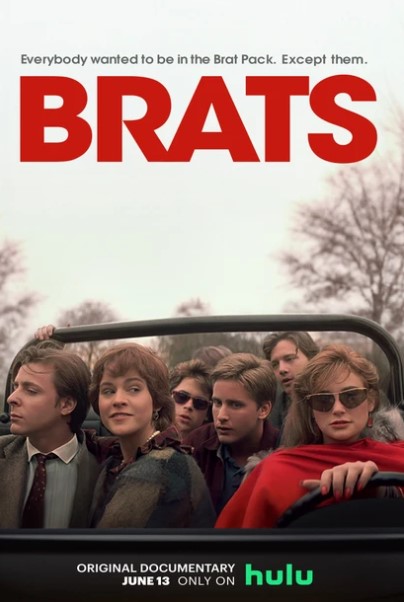
Documentary Review: Brats (dir by Andrew McCarthy)


The documentary Brats opens with actor and travel writer Andrew McCarthy in New York City.

He’s obsessing over his film career, which featured him starring in several classic 80s films, like Pretty In Pink, Class, and Less Than Zero.  If you love those films as much as I do, you’ll be happy to know that, physically, McCarthy has aged well.  If he was adorably cute during his teen idol days, Andrew McCarthy now looks like a distinguished and handsome creative writing teacher.  McCarthy talks about how he was briefly a star and now, he has a busy career as a writer.  To be honest, it seems like everything should be going pretty well for Andrew McCarthy.

The only problem is that Andrew McCarthy has spent the last 30 years obsessed with an article that he feels led to him being labeled as one of the “Brat Pack,” along with Emilio Estevez, Rob Lowe, Judd Nelson, Molly Ringwald, Demi Moore, and Ally Sheedy.  Interestingly enough, McCarthy is only mentioned once in the article, when Nelson dismissively describes him as playing every role “with the same intensity.”  Still, McCarthy feels that the article led to him being unfairly labeled “a brat,” and it also led to his film career fizzling.

Over the course of the documentary, McCarthy travels to California and tracks down some of his co-stars (with both Ringwald and Nelson being notable for their absence) and he also talks to the author of the article.  He talks about what it means to be identified with the Brat Pack and how the label still haunts him.

Seriously, this is one of the most depressing documentaries I’ve ever seen.

It’s not just that McCarthy, who really does seem like he should be enjoying his second act as a successful and respected travel writer, is still obsessed with an article that came out 30 years ago.  It’s also the fact that, judging from the scenes in which he drops in on Estevez, Lowe, Moore, and Sheedy, it doesn’t appear that anyone has wanted to talk to McCarthy since they all did St. Elmo’s Fire.  Emilio Estevez, especially, seems to be uncomfortable with having McCarthy in his kitchen.  As for the others, Ally Sheedy is polite, Demi Moore comes across as if she’s visiting from another planet, and Rob Lowe is once again the most likable and laid back person in the room.  Everyone that McCarthy interviews has dealt with the Brat Pack legacy in their own different way.  The thing they all have in common is that they’ve all dealt with it better than McCarthy.

The saddest part of the film is that Molly Ringwald never returns Andrew McCarthy’s call.  Seriously, the main reason I watched this documentary was because I wanted to see Andie and Blane reunited.  Instead, I had to settle for Blane and Duckie having an awkward conversation.  It’s nice to see that McCarthy and Jon Cryer are apparently now on friendly terms (which apparently they weren’t during the filming of Pretty in Pink), but seriously, Molly is the one that most viewers will probably want to see reunited with Andrew.  That it doesn’t happen is kind of heart-breaking.

I hope someone gives Andrew McCarthy a good hug and tells him that we’re all Team Blane.  He deserves it.

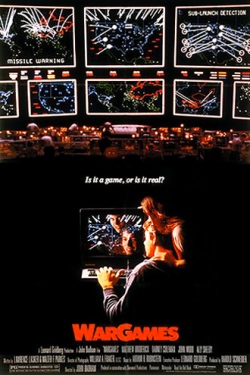
Film Review: Wargames (dir by John Badham)


If you thought Tom Cruise nearly started a war in Top Gun, you should see what Matthew Broderick did three years earlier in Wargames!

In Wargames, Broderick plays David Lighter, a dorky but likable teenager who loves to play video games and who spends his spare time hacking into other computer systems.  (Of course, since this movie was made in 1983, all the computers are these gigantic, boxy monstrosities.)  Sometimes, he puts his skills to good use.  For instance, when both he and Jennifer (Ally Sheedy) are running the risk of failing their biology class, he hacks into the school and changes their grades.  (At first, Jennifer demands that he change her grade back but then, a day later, she asks him to change it again.  It’s kind of a sweet moment and it’s also probably the way I would have reacted if someone had done that for me in high school.)  Sometime, David’s skills get him into trouble.  For instance, he nearly destroys the world.

Now, keep in mind, David really didn’t know what he was doing.  He was just looking for games to play online.  He didn’t realize that he had hacked into NORAD and that Global Thermonuclear War was actually a program set up to allow a gigantic computer named WOPR to figure out how to properly wage a thermonuclear war.  David also doesn’t know that, because humans have proven themselves to be too hesitant to launch nuclear missiles, WOPR has, more or less, been given complete control over America’s nuclear arsenal.

(Wargames actually starts out with a chilling little mini-movie, in which John Spencer and Michael Madsen play two missile technicians who go from joking around to pulling guns on each other during a drill.  Of course, Madsen’s the one ready to destroy the world.)

Of course, the military folks at NORAD freak out when it suddenly appears as if the Russians have launched a nuclear strike against Las Vegas and Seattle.  (Not Vegas!  Though really, who could blame anyone for wanting to nuke Seattle?)  In fact, the only thing that prevents them from launching a retaliatory strike is David’s father demanding that David turn off his computer and take out the trash.  However, WOPR is determined to play through its simulation, which pushes the world closer and closer to war.  (One of the more clever — and disturbing — aspects of the film is that, even after the military learns that the Russians aren’t planning the attack them, they still can’t go off alert because the Russians themselves are now on alert.   Once the war starts, it can’t be stopped even if everyone knows that the whole thing was the result of a mistake.)

With the FBI looking for him, David tries to track down the man who created WOPR, Dr. Stephen Falken (John Wood).  However, Falken is not easy to find and not as enthusiastic about saving the world as one might hope….

Watching Wargames was an interesting experience.  On the one hand, it’s definitely a dated film.  (Again, just look at the computers.)  At the same time, its story still feels relevant.  In Wargames, the problem really isn’t that WOPR wants to play a game.  It’s that men like Dr. John McKittrick (well-played by Dabney Coleman) have attempted to remove the human element and have instead put all of their faith in machines.  The appeal of a machine like WOPR is that it has no self-doubt and does whatever needs to be done without worrying about the cost.  But that’s also the reason why human beings are necessary because the world cannot be run on just algorithms and cold logic.  That’s a theme that’s probably even more relevant today than it was in 1983.

Wargames is also an exceptionally likable film.  In fact, it’s probably about as likable as any film about nuclear war could be.  On the one hand, you’ve got everyone at NORAD panicking about incoming missiles and then, on the other hand, you’ve got David and Jennifer having fun on his computer and trading flirty and silly quips.  Matthew Broderick and Ally Sheedy are both likable in the two main roles.  Broderick brings a lot of vulnerability to the role of David.  (David Lightner is a far more believable teenager than Ferris Bueller.)  He handles the comedic scenes well but he’s even better as David grows increasingly desperate in his attempts to get the stubborn adults around him to actually listen to what he has to say.  When it appears the only way to save the world is to swim across a bay, David is forced to admit that he’s never learned how to swim because he always figured there would be time in the future.  Yes, it’s a funny scene but the way Broderick delivers the line, you understand that David has finally figured out that there’s probably not going to be a future.  It’s not that he doesn’t know how to swim.  It’s that he’ll never get the chance to learn or do anything else for that matter.

Wargames is definitely a film of its time but its themes are universal enough that it’s a film of our time as well.

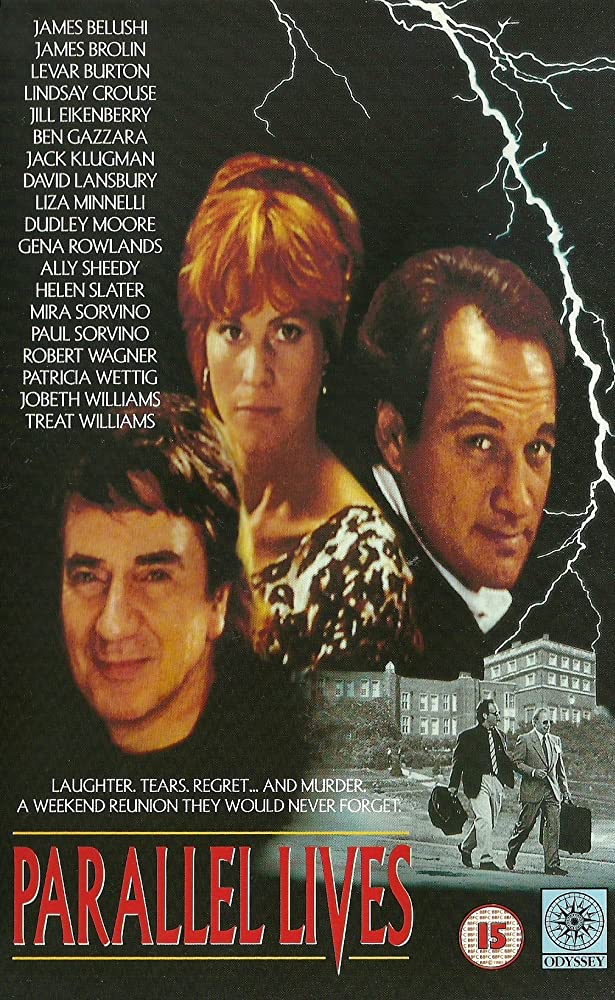
Parallel Lives (1994, directed by Linda Yellen)


A large group of people gather together one weekend for a fraternity/sorority reunion.  Since college, some of them have become rich and powerful.  Some of them are now famous.  Some of them are now seedy and disreputable.  They all have college memories, though there’s such a wide variety of age groups represented that it’s hard to believe that any of them actually went to college together.  After the men spend the day playing practical jokes and touch football and the women spend the night talking about their hopes and dreams, they wake up the next morning to discover the someone has murdered Treat Williams.  A pony-tailed sheriff (Robert Wagner) shows up to question everyone.

Parallel Lives was made for Showtime with the help of the Sundance Institute.  Today, it’s a forgotten film but, for some reason, it was very popular with American Airlines during the summer of 1997.  That summer, when I flew to the UK, Parallel Lives was one of the movies that we were shown.  (It was the second feature.  The first feature was Down Periscope, a submarine comedy starring Kelsey Grammar.  Fourteen year-old me enjoyed Down Periscope but, in retrospect, it wasn’t much of a flight.)  A month and a half later, when I flew back to the U.S., Parallel Lives was again one of the films shown on the flight!  For that reason, I may be the only person on the planet who has not forgotten that a film called Parallel Lives exists.

Parallel Lives, I later learned, was an entirely improvised film.  The huge cast were all given their characters and a brief outline of the film’s story and they were then allowed to come up with their own dialogue.  Unfortunately, no one did a very good job of it and the men were reduced to bro-ing it up while the women spent most of the movie having extended group therapy.  The story doesn’t add up too much and, even when I rewatched it from an adult’s perspective, I wasn’t sure what I was supposed to get out of everyone talking about how different the real world was from college.  Technically, the film’s a murder mystery but you can’t improvise a successful murder mystery.  This film proves that point.

Of course, it doesn’t help that there are 26 characters, all trying to get a word in at the same time.  Some of the roles don’t make much sense.  Dudley Moore shows up, playing an imaginary friend.  (How do you improvise being a figment of someone’s imagination?)  James Brolin introduces himself to everyone as being, “Professor Doctor Spencer Jones” and that appears to be as far as he got with his improv.  Ben Gazzara is a gambler and Mira Sorvino is the prostitute that he brings to the reunion while Mira’s father, Paul Sorvino, moons the camera several times.  Jack Klugman is a senator with Alzheimer’s and Patricia Wettig is his daughter.  The majority of the movie centers around Jim Belushi, playing a reporter and falling in love with JoBeth Williams.  Liza Minnelli, Helen Slater, Levar Burton, Lindsay Crouse, Matthew Perry, Ally Sheedy, and Gena Rowlands all have small roles.  How did so many talented people come together to make such a forgettable movie and why did American Airlines decide it was the movie to show people on their way to another country?  That’s the true mystery of Parallel Lives.

A Movie A Day #191: Blue City (1986, directed by Michelle Manning)


Billy Turner (Judd Nelson) has always been the bad boy but now he just wants to return to his Florida hometown and reconnect with his estranged father.  As soon as he rolls into town, Billy gets into a bar brawl and is arrested.  The chief of police (Paul Winfield) informs Billy that his father has been murdered and that his stepmother has since married the local gangster, Perry Kerch (Scott Wilson).  Everyone knows that Perry murdered Billy’s father but no one can prove it.  He is told to get out-of-town but Billy’s not going out like that.  Instead, he gets together with his childhood friends, gimpy legged Joey (David Caruso) and Annie (Ally Sheedy), and seeks his revenge.

No, it’s not a picture of Judd Nelson hanging out with the a member of the Heaven’s Gate cult.  It’s the DVD cover for Blue City.

An infamous flop, Blue City was meant to show that the members of the infamous Brat Pack could play serious, adult roles.  Unfortunately, Blue City was released right at a time when everyone was starting to get sick of the Brat Pack.  (Even John Hughes had moved on, casting Matthew Broderick as Ferris Bueller, instead of Anthony Michael Hall.)  After countless magazine covers and the monster success of The Breakfast Club and St. Elmo’s Fire, a backlash was brewing and Blue City walked (or, in Joey’s case, limped) straight into it.

It also did not help the film’s prospects that it matched up the least interesting Brat Packer, Judd Nelson, with the member of the Brat Pack most likely to take herself too seriously, Ally Sheedy.  Playing roles that would have been played by Alan Ladd an Veronica Lake in the 40s, both Nelson and Sheedy are miscast and, strangely considering this was their third film together, have no chemistry.  Nelson, in particular, gives one of the most annoying performances in film history.  He never stops smirking, even when there is no reason for Billy Turner to be smirking.  With his wide-eyed stare and his attempts to speak like a tough guy, Nelson comes across like John Bender auditioning for West Side Story.  The scene where he manages to floor Tiny Lister with one punch is simply beyond belief.

When Judd Nelson can beat you up, there is only one thing left to do:

Thanks, Duke.

On a more positive note, David Caruso, long before he could usher in the Who by simply putting on his sunglasses, is better cast as Joey but there is nothing surprising about what eventually happens to him.  The best performance is from Scott Wilson, showing why he used to always play villains before reinventing himself as Herschel on The Walking Dead.  Wilson was so good that I realized, halfway through Blue City, that I actually would not have minded if he succeeded in killing Billy.

The most disappointing thing about Blue City is that it is a Florida noir from the 80s that somehow does not feature even a cameo appearance by Burt Reynolds.  Couldn’t Judd have taken just a few seconds during the filming of Shattered: If Your Kid’s On Drugs to convince Burt to drop by Blue City?

They could have used the help.

A Movie A Day #122: The Lost Capone (1990, directed by John Gray)


Chicago.  1915.  Up-and-coming gangster Al Capone (Eric Roberts) berates his younger brother, Jimmy (Adrian Pasdar), for not being aggressive enough in a street fight.  Not wanting to follow his brothers into a life of organized crime, Jimmy runs away from home and eventually finds himself in Harmony, Nebraska.  Claiming to be a World War I vet named Richard Hart, Jimmy impresses everyone with both his marksmanship and his incorruptible nature.  Soon, the new Richard Hart has been named town marshal.  While Al Capone is taking over the Chicago rackets, Richard is keeping the town safe with his Native American deputy, Joseph Littlecloud (Jimmie F. Skaggs), and starting a family with the local school teacher, Kathleen (Ally Sheedy).  When illegal liquor from Chicago starts to show up on a nearby Indian reservation, Richard Hart comes into conflict with the Chicago Outfit and his secret is finally revealed.

There is a sliver of truth to this made-for-TV movie.  Al Capone really did have a brother named James, who ended up changing his name to Richard Hart and working as a prohibition agent in Nebraska.  Otherwise, the movie changes so many facts that it is hard to know where to begin.  In real life, Al and James Capone grew up in New York.  James, who was actually several years older than Al, ran away from home not to escape Al’s bullying but because he wanted to join the circus.  (Al was only 9 when James ran away.)  James changed his name to Richard Hart not to keep people from realizing that he was related to Al but because he admired silent screen cowboy William S. Hart.  Though James did work in law enforcement, he never came into conflict with Al Capone’s organization and, in fact, regularly visited Chicago.

The Lost Capone is a forgettable mix of western and gangster clichés, featuring a notably stiff performance from Adrian Pasdar in the lead role.  It does feature two of the strangest performances that I have ever seen.  Eric Roberts, complete with a phony scar, playing Al Capone is just as weird as it sounds, while Ally Sheedy plays a wholesome and always smiling teacher but delivers her lines in the same halting tone of voice that she used as the “basket case” in The Breakfast Club.

There is probably a good movie that could be made about the life of James Capone/Richard Hart but The Lost Capone is not it.

Val’s Movie Roundup #15: Hallmark Edition


MV5BMTEyNzg4MTIzNDZeQTJeQWpwZ15BbWU4MDc1NzcyMTIx._V1_SY317_CR15,0,214,317_AL_

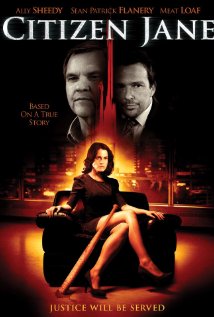
Citizen Jane (2009) – I was quite surprised that this was actually a Hallmark movie. The acting was strong. The story stayed focused. They actually bothered shooting in San Francisco. This almost could have been a small time B-Movie or something I would expect from Lifetime.

It begins with Jane Alexander’s (Ally Sheedy) aunt being murdered. Jane lives with a man named Tom O’Donnell (Sean Patrick Flanery) and it’s never really a mystery that he did it. The film is about how they prove it. Jane has assistance from Detective Jack Morris (Meat Loaf). I think Meat Loaf did a great job and so does Sheedy. We care, we follow, we get a decent movie. The only problem I found is the same one that was in the Lifetime movie Cleveland Abduction (2015). That movie was also based on real events. Even not knowing the true story behind it, you could tell that the film was a superficial treatment that needed much more time to properly tell the story. The same is true here. At times things will feel like they just jumped from one gear to another. Otherwise, it’s one of the most well made of the Hallmark mystery type movies. Even if there isn’t much of a mystery to it. More like mystery in the Columbo sense of the word where we know exactly what happened, but find out how the person is going to be caught.

9d1f26c4b9f94aed872c7522a258077b

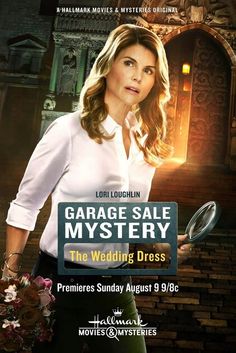
Garage Sale Mystery: The Wedding Dress (2015) – Again, it’s time for Jennifer (Lori Loughlin) to get involved in a mystery. This time she is at an estate sale and when she returns to her shop she discovers that among the things she has purchased is a vintage 1970’s wedding dress. Great! Except there are blood stains in a pocket. And thank god there are. I say that because this establishes a good reason for her to be investigating while the cops don’t. That’s really nice when it comes to the recent deluge of these murder mystery movies that Hallmark is producing. Usually the woman just comes across as a busybody who should just mind her own business. Here she has something that should spark her interest and the further she looks into it, the more she has a reason to bring her police officer friend into the case. It’s still heavily sanitized in the way you expect from these movies. However, for this series, I think it’s the best one I have seen so far.

LoveUnderTheStarsPoster

Love Under the Stars (2015) – When you boil it down to the basic plot, this is like the Hallmark movie Class (2010). Except it’s much better. It’s about a college girl played by Ashley Newbrough who needs to come up with her thesis in child psychology. Her college advisor played by Barry Bostwick has a niece that teaches a fourth grade class and has Newbrough go there for inspiration. She meets a guy played by Wes Brown who is raising a daughter as a single parent because the mother/wife has passed away. It plays out the way you expect it to and the way Class did, but it’s just better the whole way through. Especially Wes Brown. We can easily understand why she is attracted to him, but he also comes across well as a loving father who appears happy, but also has an underground river of fear and concern for his daughter constantly flowing through him. He is the real reason the film works as well as it does. Newbrough is pretty good too, but she basically walks around the film like she’s hot and horny, to put it bluntly, all the time she’s with him. It makes it difficult to take her character seriously as a real person the way we do with him. In particular, when it comes to her backstory of also losing her mother and the development of the relationship with the daughter. They should have had her dial it back a bit and act less like an infatuated teenager.

Also, the daughter (Jaeda Lily Miller) is a little annoying. I don’t think it’s the actresses fault so much as it is the way her character is written. I don’t think they give her enough credit and let her be more like a real kid with problems, then a cardboard cut out of a troubled child. A little tweaking of her character would have helped.

I really did like the use of the counting thing. When the father leaves her off at school or somewhere else, he counts down a few seconds because he knows she will turn around, usually opening a door, in order to wave to him one more time. She’s afraid he might be gone like her mother is forever. It’s a really nice touch that of course pays off in the end.

All around, this is one of the top tier Hallmark movies I have seen so far.

OperationCupcake-ADLg

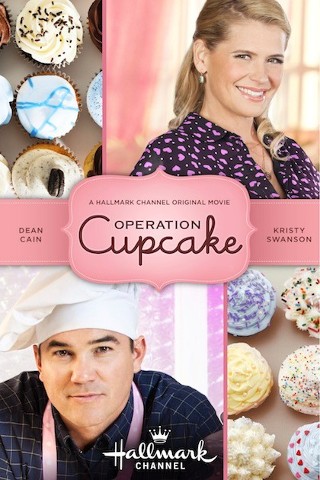
Operation Cupcake (2012) – I mentioned not giving the character of the daughter enough credit in Love Under The Stars and the problem is in this film too. This is about Army Colonel Griff Carson (Dean Cain) who comes home on leave to his wife Janet (Kristy Swanson) who runs a cupcake shop. The whole thing is about Griff adjusting to civilian life while also awaiting a possible promotion to General. The problem is they don’t give this guy enough credit. Instead, they drag out his adjustment way too long. It shouldn’t have taken him so long and the change should have been more gradual rather than played for laughs as long as it could. He works at the shop with his wife, and there was at least one scene where you wonder if he actually comes from the Army. He is mobbed by a ton of people at the cupcake store that he suddenly has to service. He doesn’t really attempt to put some of his training to use in order take a bunch of unruly people and get them to act in a civilized manner. The scene doesn’t work and the movie just doesn’t really work either. I think they should have had Cain’s character transition more gradually rather than having him be essentially a brick wall that only comes down in the end. Hallmark avoided that with Recipe For Love and that’s why it is one of my favorites. I also think that Dean Cain was miscast. I have difficultly buying any kind of machismo from his character. He just doesn’t fit the part. This is one that’s fine if you wind up catching it by chance, but don’t put your lure out into the Hallmark waters explicitly to see it.

Final note: I didn’t even notice till I was looking at the credits, but Donna Pescow is in this. She was a baker at the store who has some back and forth with Cain. Of course for most people she is from Saturday Night Fever (1977), but I will always remember her as the mom on the TV Show Out Of This World. Makes me want to break out my bootleg copies of that show. To the best of my knowledge, they still haven’t released that show on DVD.