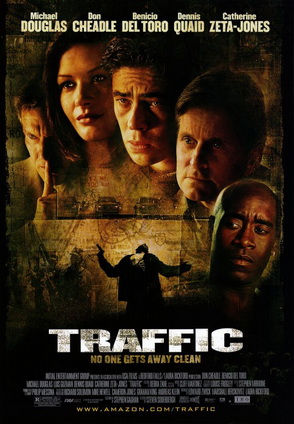
Shattered Politics #69: Traffic (dir by Steven Soderbergh)


Traffic2000Poster

I have mixed feelings about Steven Soderbergh.  On the one hand, his talent cannot be denied and you have to respect the fact that he’s willing to take chances and make films like The Girlfriend Experience and The Informant.  On the other hand, he’s also the director who has been responsible for overrated messes like Contagion and utter pretentious disasters like Haywire.  And it doesn’t help that Soderbergh’s fanbase seems to be largely made up of the type of hipsters who end up leaving comments under the articles at The A.V. Club.  Some people mourned Soderbergh’s retirement.  Personally, I think he made the right decision.  He retired before his misfires ended up outnumbering all of his masterpieces.

The thing about Soderbergh is that his good films are so good that it makes it all the more frustrating to watch his failures.  If Soderbergh was just your typical bad director than a film like Contagion wouldn’t be as annoying.  But this is the man who also gave us Traffic!

And Traffic is a very good film.

First released in 2000, Traffic attempted to deal with the American war on drugs, a war that the film suggests might not even be worth fighting.  (Full disclosure: I support the legalization of drugs and, for that matter, just about everything else.  And yes, I am biased towards films that agree with me.  So is every other film critic out there.  The difference is that I’m willing to admit it.)  Traffic won four Oscars, including Best Director and Best Supporting Actor for Benicio Del Toro.  It was also nominated for best picture but lost to Gladiator.

Traffic tells three, barely connected stories.  Each story is given its own distinct look, feel, and color scheme.  And while it takes a few minutes to get used to film’s visual scheme, it ultimately works quite well.  Though all of the film’s characters share the same general existence, they live in different worlds.  The only thing linking them together is drugs.

Judge Andrew Wakefield (Michael Douglas) is a judge on the Ohio Supreme Court who has recently been named as the new drug czar.  However, while Judge Wakefield is going around the country and talking to politicians (Harry Reid shows up playing himself and is just as creepy as always), his daughter Caroline (Erika Christensen) is dating Seth (Topher Grace) and getting addicted to cocaine and heroin.  When Caroline run away, Judge Wakefield recruits Seth and, using him as a guide, searches the ghetto for his daughter.

The Wakefield scenes are bathed in cold and somber blues.  They’re beautiful to look at but, in some ways, they’re also some of the weakest in the film.  The whole plotline of Caroline going from being an innocent honor’s student to being a prostitute who sells her body for heroin feels a lot like the notorious anti-drug film Go Ask Alice.  At the same time, it’s interesting and a little fun to see Topher Grace playing such a little jerk.  Grace gets some of the best lines in the film, especially when he attacks Wakefield’s feelings of smug superiority.

In the film’s second storyline, two DEA Agents (Don Cheadle and Luis Guzman) arrest drug trafficker Eddie Ruiz (Miguel Ferrer).  Eddie works for the Ayala syndicate and, once he’s arrested, he turns informant.  Drug lord Carlos Ayala (Steven Bauer) is arrested.  While Carlos sits on trial, his pregnant wife (Catherine Zeta-Jones) and his sleazy business associate (Dennis Quaid) struggle to hold together the business and find a way to kill Ruiz before he can testify.

This storyline is filmed in bright and vibrant colors and why not?  The Ayalas are rich and, unlike the Wakefields, they don’t feel the need to hide their material wealth.  This is actually probably my favorite storyline, largely because it’s the best acted and the most entertaining.  Miguel Ferrer, in particular, steals every scene that he’s in.  The scene where he explains the economics of being a drug trafficker is fascinating to watch.

The Ayala storyline may be my favorite but the film’s most thought-provoking storyline is the third one.  Taking place in Mexico, it stars Benicio Del Toro as Javier Rodriguez, a casually corrupt police officer who gets recruited to work for General Salazar (Tomas Milian), who is heading up Mexico’s war on the cartels.  Following the orders of Salazar, Javier captures assassin Frankie Flowers (Clifton Collins, Jr.) who is then savagely tortured by Salazar until he turns informer.  Javier comes to realize that Salazar is actually working for one of Mexico’s cartels.  When he decides to inform on Salazar, he puts his own life at risk.

The Mexico storyline is also the harshest and visually, it reflects that fact.  The heat literally seems to be rising up from the desert and the streets of Tijuana.  It takes a few minutes to adjust to the look of the Mexico scenes but, once you do, they become enthralling.

And Traffic, as a film, is undeniably enthralling as well.  Soderbergh deftly juggles the multiple storylines and brings them together to create a portrait of a society that’s being destroyed by the efforts to save it.  Hopefully, if Soderbergh ever does come out of retirement, he’ll give us more films like Traffic and less films like Contagion.

 

James Bond Review: Skyfall (dir. by Sam Mendes)


For almost a month, starting in mid-October and almost two weeks into November, we here at Through the Shattered Lens have watched and shared our reviews and thoughts on the 25 James Bond films (22 official EON productions with 3 non-official ones) which preceded this week’s release of the latest James Bond entry with Skyfall. We’ve shared which were our personal favorites of the series. Some preferred the Connery-era of the Bond franchise while some were in the Moore-era. What we here have all come to realize is just how timeless this franchise has become despite it having celebrated it’s 50th anniversary just last month.

The James Bond film franchise has gone beyond what Ian Fleming had imagined when he first came up with a literary character that would become a global pop icon and remain one of cinemas most successful franchises in history. There have been low points in the franchise (usually when the actor whohas been performing the role has outlived their stay) but then there have been some great highs. In the end, there’s always been one constant and that’s the character of James Bond — British secret agent 007 with a license to kill.

A franchise which began with on Sean Connery in the title role has now seen a return to prominence with the role now in the care of British actor Daniel Craig. The Craig-era began with the critically-acclaimed Casino Royalewhich also became popular with the mass audience. The sequel to this reboot would set the franchise back a step or two, but still became the second highest grossing Bond film in the franchise. We now come to the third Bond film in the Craig-era with 2012’s Skyfall and the question of whether the James Bond franchise can still remain relevant in this age of hyper-kinetic and ultra-violent action films remain to be answered.

Skyfall begins with Bond already in the middle of a mission to recover a computer hard-drive which stores the names of hundreds of NATO agents deep undercover within the many terrorist organizations around the world. Things are not going well for Bond and his fellow MI6 agents. He finds many of them already dead or dying and it’s up to him and another agent named Eve (played by Naomie Harris) to chase after the mercenary who has taken off with the hard-drive.

One thing we’ve come to expect with the more recent James Bond films (especially the Daniel Craig ones) are the action sequences which make up the opening section of the film. Even before we get to the recognizable Bond opening credit sequence this opening of the film using a very thrilling and elaborate action sequence tend to set the tone for the rest of the film. Skyfall was no different as Bond chases the mercenary Patrice through the rooftops of Istanbul’s Grand Bazaar right up to a one-on-one fight on top of a moving train. Through an unfortunate stroke of luck and a command decision by “M” back in MI6 headquarters in London we segue ito the always popular opening credits sequence with Bond having been shot by accident and left for dead.

The plot of Skyfall was somewhat similar to Goldeneye which saw Pierce Brosnan introduced as the new James Bond. James Bond finds himself racing against time and a former MI6 agent who feels betrayed not just by the country and organization he loyally served but by “M” herself. Raoul Silva (played with a sociopathic flair and panache by Javier Bardem) knows the in’s and out’s of MI6 and this allows him to penetrate both their physical and cyber defenses which puts the entire national security of Great Britain and the Commonwealth in extreme peril. It also puts “M” on the proverbial political hot seat as civilian oversight committees look to find a scapegoat for dead MI6 agents and Silva’s continuing assault on Britain’s intelligence apparatus.

To say anymore about the plot of Skyfall would ruin the biggest joy about this film. Mendes would’ve been one of the last people I saw being picked to direct a James Bond film, but he proves himself more than just capable, but also brings his own character-driven narrative sensibilities to raise the bar for future James Bond film. His handling of the quieter moments during the film shows that particular skill of his that has made him an Academy Award-winning filmmaker. It was on the action scenes that Mendes’ skill as a filmmaker would remain in doubt, but with the help of second unit director Alexander Witt, Skyfall manages to create action scenes that weren’t created for the sake of putting action on the screen but to move the story forward.

In the past, James Bond films rarely moved into introspection on it’s main character’s personal and professional motivations. This began to change when Daniel Craig was picked to help reboot the franchise. The first two films with Craig as Bond showed a much grittier and emotionally complex 007 than in years past. We also got a Bond who was still new to the role of being a 00-agent so we saw the character grow into the role. With Casino Royale and Quantum of Solace we got a Bond who moved from newly minted secret agent then to an agent going off the reservation and following his emotions to finish a mission (both official and personal). The one thing those two films didn’t do was give us a Bond that was fully capable and confident in his abilities to get the job done through the biggest odds. But before we finally get that Bond in Skyfall we see him go through personal doubts about whether he still has the skill to be 007 in a world that sees him and his kind of espionage a relic of the Cold War. By the time the film finishes to a close we find ourselves seeing this new modern, complex Bond finally meeting the old-school traditional Bond who delighted our parents and grandparents in the past.

There’s so much more to be said about this film which brings to the table the best of 50 years this franchise has been on the silver screen. The film pays homage to it’s cinematic history, but not so much that the film becomes a “Can you spot a past Bond reference” exercise. Each and every reference seemed to flow naturally into every scene it showed up in and some even got a nice ovation and reaction (classic Aston Martin DB for example). We even got to see the film poke a bit of cheeky fun at some of the franchises more over-the-top plot devices and all of it in good fun.

Then even with a strong story, great performances from the film’s principal cast members there’s still the question that always get asked whenever a new Bond film hits the screen. That question being how were the latest new Bond Girls.

While Naomie Harris’ Eve was a nice partner to Craig’s Bond their chemistry just didn’t flare up like most of the classic pairings in the franchise. That honor goes to Bond’s short, brief time with the character Severine (played by the ridiculously beautiful Bérénice Lim Marlohe). The scenes the two share in the Macau gambling house was one of the highlights of the film with Marlohe conveying both the femme fatale and damsel in distress in the same scene with the most subtle of acting touches. There’s a good chance that whenever “best of…” lists about Bond girls get made each and every year Marlohe as Severine would be on the top of most lists.

It took two films and six years of exploring, deconstructing and analyzing the character of James Bond through the performance of Daniel Craig. Through that time we’ve gotten to see a new side to James Bond without dismissing and forgetting about the character’s suave and deadly efficiency of past Bond films. While I still lean towards Sean Connery as the gold standard of all James Bond performances after seeing Craig as Bond for the third time in Skyfall the gap has shrunk considerably and I wouldn’t argue if some have Craig matching and/or surpassing Connery in the role. It’s a title that would be well-earned and with how the film ends a chance to see how Craig moves forward as Bond not just in the updated modern sense but the traditional that has made the character one of the most iconic figures in cinema history.

A last note, we get a return to old-school James Bond songs with Adele performing the film’s song which actually has the film’s title in it. The song also harkens back to the days of Shirley Bassey and If I had a choice in the matter I would just let Adele sing all future Bond songs for as long as she wants to.

Thus end Through the Shattered Lens’ retrospective on the James Bond franchise both past and present. It’s been a great ride and all thanks to the drive and organization of co-founder Lisa Marie Bowman who styles herself as the site’s resident Bond Girl.

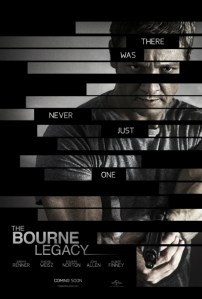
Quick Review: The Bourne Legacy (dir. by Tony Gilroy)


After completing The Bourne Ultimatum, Director Paul Greengrass and Actor Matt Damon were probably asked if they’d ever come back to do another. When you look at the overall story, Bourne’s journey was pretty complete, and Damon voiced that he’d only consider doing another if Greengrass did. After Greengrass bowed out, the notion of another chapter in the Bourne saga was dead in the water.

Universal had other ideas, deciding on moving forward and having the trilogy’s screenwriter, Tony Gilroy direct The Bourne Legacy. No stranger to making films, Gilroy is more known for making “slow burn” features like Duplicity and one of my favorites, Michael Clayton. If he were working on a remake to “All the President’s Men”, I’d be certain it was a perfect fit. For Bourne, however, we get something of a different result. Not a terrible one, but possibly not the one that everyone was hoping for. This almost makes sense, considering that even the Bourne novels themselves were taken over by Eric Van Lustbader after Robert Ludlum’s death.

The Bourne Legacy takes place during the same time period as The Bourne Ultimatum. The story expands not on what happened to Bourne post Ultimatum, but what happened to the programs in place in the aftermath of Bourne’s visit to New York. We find Aaron Cross (Jeremy Renner), part of a separate program that goes beyond Treadstone and Blackbriar, making his way through a snowy Alaskan wilderness. The new breed of agents (assets, as they’re referred to in the Bourne Universe) are genetically augmented by way of meds they call “Chems”. The Chems give the assets the edge they need to do what they do.

This bothered me a little, because Jason Bourne got by with none of that for years, but I chalk that part of the storyline to the notion that Gilroy has this thing for Pharmaceuticals and Chemicals. Michael Clayton’s antagonist worked for a Chemical Company. Duplicity’s spies were trying to steal secrets from a pair of what seemed like pharmaceutical companies. The reasoning behind Cross’ need for the Chems is made clear through the story, but it was a strange angle to go on, I felt.

During the course of Aaron’s trip, the Powers That Be, played by, Stacy Keach, Donna Murphy and an underused Edward Norton decide that Bourne’s actions (along with Joan Allen’s Pamela Landy) are going to cause all of their programs some serious trouble and decide to wipe the slate clean. Cross needs to both escape this while still finding a way to get a hold of the Chems he needs to stay at peak performance. That’s the idea behind the Bourne Legacy in a nutshell.

On a casting level, The Bourne Legacy is actually very good. Both Renner and Rachel Weisz handle their parts well, I thought (for what they were given). A few of the cast members return from the previous Bourne films, but their appearances are so brief that it may leave you feeling as if they were just a piece of leftover film from the Original Trilogy. If there’s anyone who feels out of place, it would have to be Edward Norton. He comes across in this movie like he wasn’t sure what he wanted to take on and decided to just do this to pass the time.

The action in the Bourne Legacy is on par with the other films, but this being Gilroy, there’s more of a distance between the action and the drama.  When I really think about it, there’s about the same amount of it as there was in The Bourne Identity or Supremacy – neither one of those were die hard action films – but the potential to wish for more is greater with Legacy. This is especially true with the way it was advertised. Just about every action scene in the film is in the trailer. That said, Gilroy has gotten better at being able to handle these scenes. A few more films like this and he should do really well in the future.

Just like Michael Clayton, however, the movie ends so abruptly that you may blink a few times in protest. Gilroy needs to work on that part.

So overall, The Bourne Legacy wasn’t a story that was needed, nor does it really add too much more to the Bourne Universe over all, but it’s nice to return to the espionage that surrounds it. Here’s hoping that this could give something more for Renner, Gilroy and the rest of the team.

Trailer: The Bourne Legacy


When Paul Greengrass completed The Bourne Ultimatum it looked like a perfect ending to the Bourne Series. Despite an ending that could be seen as a way to leave the door open to continue the series most people were content with the series ending as trilogy. That sort of thinking never enters the mind of studio executives who saw the success of this particular trilogy as still bankable even if it meant the filmmaker (Greengrass) and the series’ lead star (Matt Damon) weren’t going to participate.

What we ended up getting was a new lead in Jeremy Renner as another Treadstone-like agent, but one who didn’t have all the glitches that Jason Bourne had. Let’s just say that Renner’s character Aaron Cross would be Jason Bourne 2.0. I wasn’t convinced that a Bourne film minus Greengrass and Damon would work, but after seeing this latest official trailer from Universal Pictures I’m quite excited about this latest film.

With the success of The Avengers and Mission Impossible: Ghost Protocol where Renner had substantial roles in it looks like this latest film in the series could get a nice uptick in the amount of interest it gets from the public. The sort of action Renner’s character goes through in this film one could easily call this Hawkeye: The Early Years. All his character would need would be a nice hi-tech bow.

The Bourne Legacy is set for an August 17, 2012 release date.

Trailer: Skyfall (dir. by Sam Mendes)


We finally get the return of Britain’s deadliest and world-renowend “Double-O” agent with Sam Mendes’ Skyfall.

It’s been quite a long time since Marc Foster’s underwhelming Quantum of Solace with MGM’s subsequent bankruptcy being one of the major causes for the delay of this film being made. With the MGM bit now out of the way James Bond finally returns to the big screen with Daniel Craig once again donning the Walther and the tuxedo to play the debonair and ruthless killer agent that Ian Fleming made famous through his spy novels.

This teaser doesn’t show much other than some bits of action (one of which looks like it might’ve been lifted out of a level of Modern Warfare 3) and Bond being coldly ominous about people coming to get him and “M”. I’ve always been a huge fan of the Bond films and even when they don’t go over so well I still enjoy myself. They also tend to have a different director with each and every film which gives each film a different take on the character of Bond. This time around we have Sam Mendes in the director’s chair and it’ll be interesting to see how well he handles the thriller genre and action.

Skyfall is set for an October 26, 2012 release date.

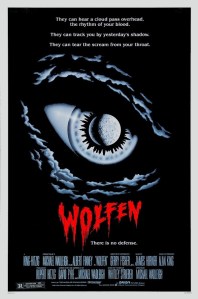
Quick Horror Review: Wolfen (dir. by Michael Wadleigh)


Michael Wadleigh’s Wolfen (1981) remains one of my favorite stories with wolves, though there are no actual werewolves in the movie. It’s a great and underrated film, though I’m not quite sure if it really can be considered Horror. There’s bloodshed, yes, but not a lot when compared to the more superior The Howling, which came out in the same year.

The film in a nutshell is that you have the Bronx. Back in the late 70’s and early 80’s, the Bronx was a warzone, and there were a number of films showcasing the decay of the area (Nighthawks and Fort Apache: The Bronx are two good ones). When a real estate mogul who’s developing buildings in the area and his wife are brutally murdered, Detective Dewey Wilson (Albert Finney) is partnered with a terrorism expert (Diane Venora) to solve the crime.

Through the film, Dewey discovers that the murders are being done not by people, but the spirits of ancient indians in the form of Wolves – or better to say that they were hunters from an older time. The Wolfen, as they’re called, are scavengers of the city’s decay, feeding off of those who won’t be missed – derelicts and the like.

While Finney and Venora carry the film, Gregory Hines has some fun lines as the local NYPD mortician and Tom Noonan’s Wolf Expert was interesting, though a little strange. The best person in the supporting cast (who doesn’t have as much time to work with) is Edward James Olmos, in a surprising turn as Eddie, who is believed to have something to do with the murders, but later helps put Dewey in the right direction.

Supposedly, the movie was a little heavy handed with all of the anti-terror angle they tried to use. From what I’ve read, it wasn’t a major part of Whitley Streiber’s novel of the same name and it tends to steer the audience away from the actual problem. I mean, the audience is seeing wolves do this (or at least are seeing something animalistic do it), so to bring in the notion that there’s a terrorist plot involved kind of went over my head. The movie would have been tighter without it, I believe anyway.

One of the cooler elements of the movie is that you are able to see things through the eyes of the Wolfen themselves in an infrared vision style. While this was done with movies after it like Predator, and films before it like Westworld, Wolfen was my first experience with the effect. That, coupled with James Horner’s score (a mixture of themes you’d later find in Star Trek II: The Wrath of Khan and Aliens), lend to some of the style. Unfortunately, Wolfen is a somewhat difficult film to find in terms of obtaining the DVD for it, but the film has been on Netflix. If you have a chance to catch it, it’s an interesting watch.

Quickie Review: Wolfen (dir. by Michael Wadleigh)


1981 was a great year for wolf movies. There was the excellent An American Werewolf in London by John Landis and Joe Dante’s equally creepy The Howling. To finish off the trifecta of werewolf films for the year there’s Michael Wadleigh’s Wolfen. Wadleigh’s film was a very good werewolf tale that added a bit of Native American folklore to the typical lycanthrope story, but it’s slightly overlong running time keeps it from being as great as Landis’ and Dante’ contributions.

Wolfen takes place in the city of New York and its growing urban jungle of decaying and condemned buildings in the city’s ghettos. One has to remember that the late 70’s and through on the mid-80’s the inner-cities of most of the major metropolitan cities in the US have turned into rundown ghettos rife with drug problems, high-crime rates and unemployment. It is in this setting that Wolfen takes place in. The film used the screenplay co-written by horror veteran novelist Whitley Strieber and his quirky style heavily influences this werewolf story. Strieber’s screenplay mixes together a police procedural, political intrigue, business corruption, race and class relations, Native American lycanthrope folklore and horror. Wolfen tries to combine all these different elements together as well as possible and it mostly succeeds, but there’s times when the film gets dragged down a bit trying to accomplish this.

The cast was made up of mostly new actors (well young and new at that time) with a few veteran actors holding things together. Albert Finney gets the choice role of NYPD Detective Dewey Wilson who begins investigating a series of brutal murders of three individuals whose race, class and personal status brings no discernible clues that ties them together. Joining him in his investigation — which Wilson gradually suspects has some sort of supernatural angle to it — were the very young Diane Venora and Gregory Hines. Edward James Olmos plays a Native American whose knowledge ties to who or what was involved in the killings might be closer than everyone thinks. The performances from all involved were pretty good though Hines comic relief performance was a bit too blackface in its tone and execution. 1981 Hollywood was still not ready to discount such racial stereotypes and it gives Wolfen a certain sense of creepiness and insensitivity. Maybe the screenplay was written just that way to highlight one of the film’s themes of racial and class inequality. If it was then Strieber sure did an excellent job of hammering home the point.

There’s a point in the film where we find out the nature of these wolfen and it does stretch the usual definition of the typical werewolf story. But looking back on it now this version told by Strieber and Wadleigh does lend credence to native folklore about wolves who were cunning as men and who preyed not just on the animals in their territory but hunted men as well. Whether they’re wolves or men in the shape of wolves really is left to the audience’s imagination even after the brief explanation of the wolfen and it’s role in the legends and myths of Native Americans.

The film had very creepy moments whenever the story switches over to be told through the viewpoint of the wolfen. The skewed perspective the camera takes on to signify that we were seeing things through the eyes of the wolfen was disorienting and creepily well-done. Wolfen never really has pure horror moments in the film though in the hands of a director like Carpenter these sequences definitely would’ve raised the level of dread and horror. Wadleigh does a good enough job, but it seemed like he was treating the horror aspect of the story with less attention than it was its due.

Wolfen marks the weakest of the werewolf trilogy of 1981, but thats not to say that it was a bad film. The finished product was a well-done film and its attempt to be very ambitious in its storytelling has to be commended. The fact that the filmmakers and all involved were able to keep all the different themes and genres together without having the film spiral into utter confusion makes it a worthwhile werewolf film. It may have been the weakest of the three films mentioned but it wasn’t by much.