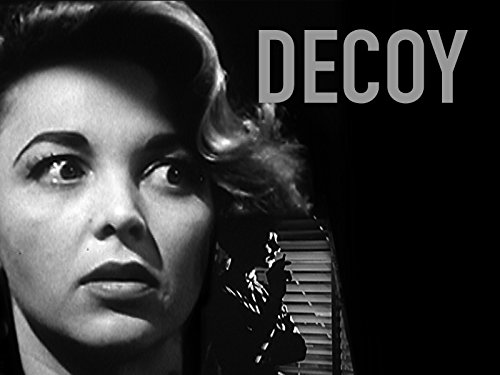
Welcome to Retro Television Reviews, a feature where we review some of our favorite and least favorite shows of the past! On Thursdays, I will be reviewing Decoy, which aired in Syndication in 1957 and 1958. The show can be viewed on Tubi!
This week, Casey investigates an elderly crime lord.
Episode 1.25 “High Swing”
(Dir by David Alexander, originally aired on March 31st, 1958)
Casey rides to the hospital with a young woman named Anne (Zohra Lampert). Anne has overdosed on heroin. Before she dies, Anne tells that Casey that she was poisoned by an old man named Otto Flagler (Albert Dekker). After learning that Anne was a pickpocket, Casey goes undercover as a thief until Otto Flagler approaches her and invites her to come live and work with him and his wife, Lily (Edith Atwater).
Casey is shocked to discover that Lily is in a wheelchair, the result of an accident that occurred when Lily was a trapeze artist. Otto is a mugger because he needs the money to take care of his wife. Casey even starts to feel sorry for Oto and Lily. That said, Casey is still a cop and she has a job to do. When Otto realizes that he and his wife are about to be arrested, he slips heroin into their coffee. By the time the police arrive, both Otto and Lily are dead.
Casey is upset. One of the other cops offers to buy her a cup of coffee. Casey says that she won’t be drinking coffee for a while.
This was a sad episode. Casey didn’t really have to do much to solve the mystery. The whole point of the episode was that Otto and Lily were not master criminals. They were two people who loved each other and found themselves in a desperate situation. That said, Otto did murder Anne so let’s not feel too sorry for him.
Albert Dekker and Edith Atwater both gave good performances and, as always, Beverly Garland was excellent in the role of Casey. This was a good episode.
“We’ve got to start thinking beyond our guns. Those days are closin’ fast.” — Pike Bishop
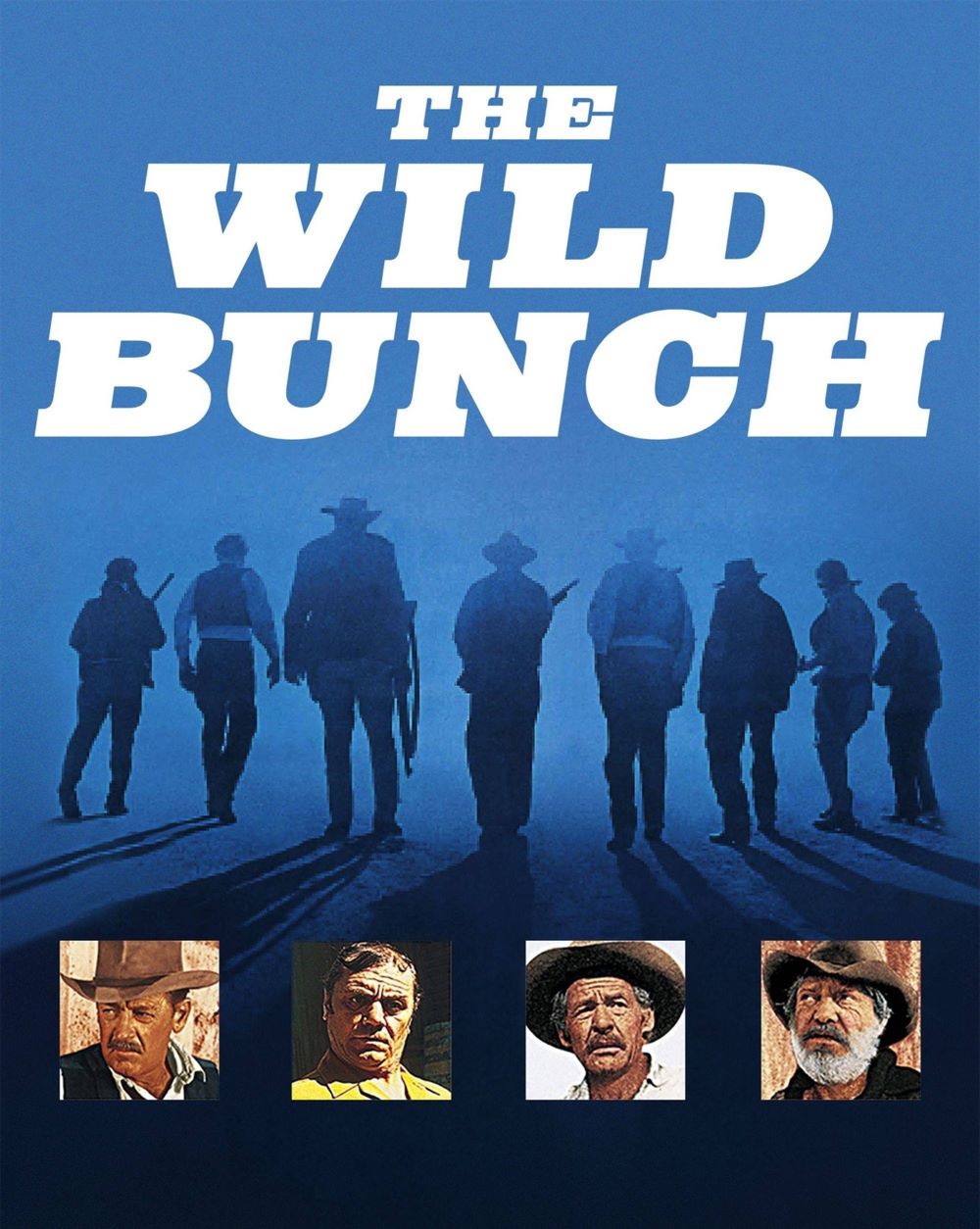
Sam Peckinpah’s The Wild Bunch stands out as a landmark in the Western genre, famous for its daringly harsh depiction of both violence and the fading mythos of the American West. Rather than following the traditions of earlier Westerns, the film presents a gritty portrait of aging outlaws on the edge of extinction, wrestling with a society that has evolved past them. It’s a movie that’s difficult to shake, both for its unapologetic style and the unresolved feelings it leaves long after the final shots ring out.
At its core, the story centers on Pike Bishop and his band—a crew of seasoned criminals aiming for one last grand heist as modernity encroaches on their world. Hoping to pull off a train robbery, they end up entangled in deeper complications after being betrayed and soon are thrust into the turbulence of the Mexican Revolution. Peckinpah builds a narrative where clear-cut morality falls away. The criminals and those pursuing them, supposed bringers of justice, are equally compromised and dangerous. This balancing act challenges the audience to reassess their sympathies, since the characters rarely line up as traditional heroes or villains.
The film’s notoriety is inseparable from its treatment of violence. In an era when Westerns often depicted gunfights as almost bloodless, The Wild Bunch arrived blazing with slow-motion fatalities, realistic wounds, and chaos that feels nearly documentary. Peckinpah didn’t intend to sugarcoat death; the film’s fight scenes are designed to unsettle rather than thrill, making viewers register the true cost of violence on screen. The movie’s most infamous sequences, particularly the opening and closing shootouts, still provoke debate over whether their artistry justifies their brutality. Peckinpah reportedly wanted to expose the real consequences of violence, not celebrate them, and the resulting imagery remains both striking and disturbing decades later.
Beyond its bloodshed, the film is packed with melancholy, exploring the futility and obsolescence of its central figures. The Wild Bunch themselves—Pike, Dutch, Lyle, Angel, and others—all feel the weight of their era’s end. They are not just outdated in terms of time; their entire way of life has been mechanized and modernized beyond their grasp. The film depicts this through powerful imagery, from horses being supplanted by cars and trucks to rifles giving way to machine guns. This mechanization highlights that Pike and his men live in a world that has moved on, leaving them behind. Their code of honor and rough camaraderie are relics in a brutal, mechanized landscape that favors efficiency and merciless violence. The emergence of rapid-fire weaponry and vehicles is more than a backdrop; it symbolizes their growing irrelevance and the passing of a wild, untamed frontier.
Technically speaking, The Wild Bunch is as impressive as it is influential. The cinematography captures wide Mexican landscapes with dust and sunlight, conveying both beauty and bleakness. The editing—particularly in the action scenes—was ahead of its time, with its expressive use of multiple camera angles and slow-motion adding an almost ballet-like rhythm to chaotic violence. The music, a mix of Jerry Fielding’s score and traditional Mexican songs, deepens the film’s sense of place and loss. All of this technical prowess merges in set pieces that are still studied by action directors today.
One of the film’s most enduring legacies is its profound influence on a slew of filmmakers in the years following its release. Directors like Martin Scorsese, Quentin Tarantino, and John Woo have all cited The Wild Bunch as a key inspiration, particularly in how it reshaped the depiction of violence and complex characters onscreen. Peckinpah’s innovative use of slow motion during action scenes transformed gunfights into sequences that feel almost balletic, bringing an eerie beauty to brutality. This technique became a hallmark of John Woo’s work, where slow-motion shootouts are choreographed with a dance-like precision, making the violence stylized yet emotionally impactful. Meanwhile, Scorsese and Tarantino embraced the moral ambiguity and character complexity Peckinpah championed, pushing their own stories beyond clear-cut good and evil. Through these directors and many others, The Wild Bunch continues to resonate and shape modern cinema.
The performances in The Wild Bunch are integral to its powerful impact, with its ensemble cast bringing layered humanity to otherwise rough, sometimes brutal characters. William Holden leads as Pike Bishop with a mix of weary charisma and existential urgency, embodying a man caught between the fading wild past and a ruthless present. Holden’s Pike is not just a leader of outlaws, but a man wrestling with his own moral contradictions—as loyal and protective as he is capable of cold violence. This complexity allows the character to stay compelling rather than becoming a cliché tough guy.
Ernest Borgnine as Dutch Engstrom offers a grizzled, weary presence, conveying the toll that years of violence have taken on his spirit, while Warren Oates imbues Lyle Gorch with a volatile and rebellious energy that adds tension within the gang. His brother, Tector Gorch, played by Ben Johnson, brings a contrasting steadiness, portraying a man caught between loyalty and survival. Robert Ryan’s portrayal of Deke Thornton, the relentless bounty hunter, stands out as a tragic figure torn between his past friendship with Pike and his duty. This character conflict gives the story a deeper emotional layer and adds weight to the relentless pursuit central to the plot.
Supporting performances by Edmond O’Brien as Freddie Sykes and Jaime Sánchez as Angel enrich the group dynamic, each adding distinct personality traits that feel authentic and lived-in. The chemistry between the cast helps ground the film’s heavy themes in real human experience, making the characters’ struggles with obsolescence and loyalty resonate beyond the screen.
However, despite the strong male performances, the film’s treatment of female characters is notably sparse and limiting. Women in the film often fall into marginal roles, lacking development or agency, which reflects the gender dynamics of many Westerns from the era but feels particularly dated today.
For viewers seeking straightforward heroism or moral clarity, The Wild Bunch can be a challenging experience. Its bleak, nihilistic worldview and refusal to deliver easy answers may leave some feeling drained. The story culminates in a violent, unresolved climax with no tidy resolution, emphasizing loss and the end of an era. But it is precisely this rawness and technical mastery that keep the film compelling and worthy of close viewing.
The Wild Bunch demands you shed simple notions of good versus evil and prepare for a rough, often brutal ride. It’s a story about men fighting not just other men but inevitability—caught between their own fading values and the relentless march of modernization and change. Peckinpah doesn’t offer comfort; instead, he forces the viewer to reckon with violence’s cost and the price of nostalgia. Even with all its grit and flaws, the film’s artistry and influence remain undeniable, securing its status as a masterwork that redefined Westerns and action cinema alike. It’s a wild ride that continues to inspire and provoke long after the credits roll.
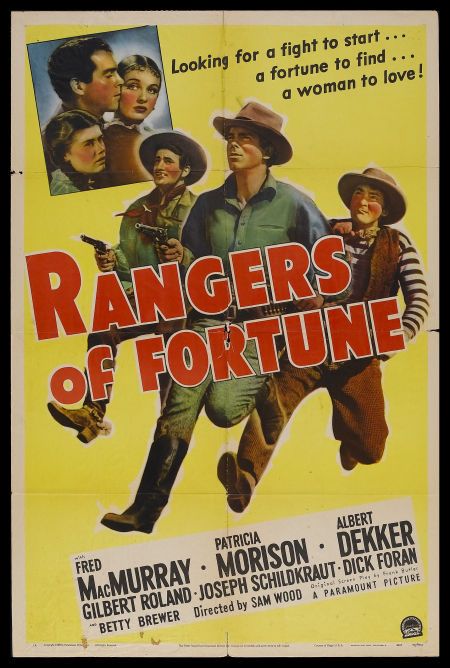
After narrowly avoiding execution by a firing squad in Mexico, three good natured outlaws head back to Texas. Gil (Fred MacMurray) is their leader, a former army officer. Antonio (GIlbert Roland) is the charming caballero. George (Albert Dekker!) is the punch-drunk former prizefighter who provides comedic relief. When they reach Texas, they meet and become involved in the efforts of a newspaper publisher (Brandon Tynan) and his daughter (Betty Brewer) to free their hometown from the control of an aristocratic landowner named Col. Rebstock (Joseph Schildkraut), who rules the town with the help of a sadistic group of cowboys. It turns out that the three outlaws aren’t so bad while the respectable and wealthy Col. Rebstock is as bad as they come.
Rangers of Fortune is a standard 1940’s western programmer, though it’s distinguished by a better than usual cast and the quick-paced direction of Sam Wood. It starts out almost as a comedy, with MacMurray, Roland, and Dekker cracking jokes and getting the better of almost anyone that they come across. The screenwriter of Rangers of Fortune, Frank Butler, also wrote some of Bing Crosby and Bob Hope’s road films and he’s just as good as coming up with comedic dialogue for the team of MacMurray, Roland, and Dekker as he was for Hope and Crosby.
But the movie takes a serious turn once MacMurray, Roland, and Dekker cross the Texas border and they discover that Col. Rebstock will do almost anything and kill just about anyone to keep his hold on the town. Even a successful scheme to install Gil as sheriff just leads to more innocent people dying. When Rangers of Fortune turns dark, it turns very dark, with characters, who we usually don’t expect to die in a film like this, meeting a violent end. Though it won’t convert any skeptics, it’s an interesting film for those who are already fans of old Hollywood westerns.
Rangers of Fortune has never gotten a proper video release but it is on YouTube. Unfortunately, the copy uploaded to YouTube was in terrible condition so it’s difficult to fairly judge the film’s production values. However, even on a damaged print, the natural authority of Fred MacMurray’s lead performance comes through and Joseph Schildkraut is as good a villain as always. Patricia Morrison plays the prettiest girl in town and, even on YouTube, it’s easy to see why every man in town is competing for her attentions. Seeing Albert Dekker, usually cast as intelligent and often conniving character, playing dumb is also an interesting experience, even on a bad print. Hopefully, someday, Rangers of Fortune will get a decent restoration.
Okay, I’ll be the first to admit that 1966’s Gammera The Invincible is not really a horror film. Maybe there was a time when people found the idea of a giant, fire-breathing turtle to be scary but I kind of doubt it.
But let’s think about this! What better time is there to watch a movie about giant, fire-breathing turtle than in October?
Seriously, this is a fun movie and if you’ve got some time to kill this morning, I guarantee this movie will make you smile.
Earlier today, as I was watching the 1947 film, Gentleman’s Agreement, I found myself thinking about a conversation that I had in 2006.
This was when I was in college. I was having lunch with some friends from one of my classes. As we were eating, the conversation turned to the war in Iraq. That, in itself, was not surprising because, in 2006, it seemed like every conversation somehow turned to what was happening in the Middle East.
One of the people with whom I was having lunch was Olivia, self-styled intellectual who fancied herself as the most knowledgeable person on campus. To be honest, I can’t think of anyone who liked her that much but she had a skill for subtly weaseling her way into almost every conversation. She was one of those incredibly pretentious types who started every sentence with “Actually….” and who had embraced Marxism with the shallow vapidness of someone who had grown up in Highland Park and who would never have to struggle to pay a bill.
On that day, Olivia announced to us all that the only reason we were in Iraq was because we were doing the bidding of Israeli lobbyists and then she went on to talk about how 9-11 was an inside job. She repeated the old lie about Jews calling in sick on 9-11 and claimed that five MOSSAD agents were arrested in New York for celebrating after the collapse of the Twin Towers.
After Olivia said this, there was the briefest silence as everyone else tried to figure out how to react. Finally, someone tried to change the subject by making a joke about our professor. Realizing the no one was going to openly disagree with Olivia and risk an argument, I said, “That’s not true.”
“What’s not true?” Olivia asked.
“About Jewish people calling in sick on 9-11 and celebrating after the Towers fell. That’s not true.”
Olivia looked a little bit surprised that she was being openly challenged. Finally, she said, in a surprisingly sincere tone of voice, “I’m sorry. I didn’t realize you were Jewish.”
I’m not Jewish. I’m Irish-Italian-Spanish and pretty much all of my immediate ancestors were Catholic. But, as far as Olivia was concerned, I had to be Jewish because why else would I object to her repeating an anti-Semitic conspiracy theory? When she apologized (and, make no mistake, there was not a hint of sarcasm in her tone when she said she was sorry), it wasn’t for being a bigot. Instead, it was for being a bigot in front of the “wrong” person. It didn’t occur to her that I was upset because what she said was bullshit.
Anyway, I wish I could say that I threw a drink in Olivia’s face or that I stood up on the table and delivered an impassioned speech but, once again, the other people at the table hastily changed the subject. Anything to avoid a conflict, I suppose. That was the last time I ever had a conversation with Olivia. For the rest of the semester, I ignored her and I felt pretty proud of myself for shunning her. It’s only been recently that I realized that Olivia also didn’t really make any effort to really talk to me after that conversation. I shunned her because of her bigotry and I can only assume that she shunned me because of her misconception about my ancestry.
Gentleman’s Agreement is about a Gentile reporter named Phillip Green (Gregory Peck) who, while researching a story about anti-Semitism, poses as a Jew and discovers that the world is full of people like Olivia. His own fiancee, a self-declared liberal named Kathy (Dorothy McGuire), reacts to Phil’s plan by asking him, “But you’re not really Jewish …. are you?” By the simple act of telling everyone that his last name is actually “Greenberg,” Phil discovers that he suddenly can’t get a hotel reservation. People stop returning his calls. When he and Kathy have an engagement party in a wealthy community in Connecticut, many of Kathy’s friends stay away. (Kathy, meanwhile, begs Phil to let her tell her family that she’s not actually engaged to a Jew.) When Phil’s son, Tommy (Dean Stockwell), is harassed at school, Phil is shocked to hear Kathy tell Tommy that he shouldn’t listen to the bullies not because they’re a bunch of bigots but because “you’re not actually Jewish.”
Meanwhile, Phil’s friend, Dave Goldman (John Garfield), has returned from serving in World War II, just to discover that he can’t even rent a home for his family because many landlords refuse to rent to Jews. When Phil learns that Katy owns a vacant cottage, he suggests that she rent it out to Dave. Despite her sympathy for Dave, Kathy is shocked at the suggestion. What will the neighbors think?
Gentleman’s Agreement was produced by Darryl F. Zanuck, who took on the project after he was refused membership in the Los Angeles Country Club because the membership committee assumed that Zanuck was Jewish. It was considered to be quite a controversial film in 1947, as it not only dealt with American prejudice but it also called out two prominent elected anti-Semites — Sen. Theodore Bilbo and Rep. John E. Rankin — by name. Zanuck often claimed that the other studio moguls asked him to abandon the project, saying that a film would only inspire more of what it was trying to condemn. Still, Zanuck stuck with the project and it was not only a box office hit but it also won the Oscar for Best Picture.
Seen today, Gentleman’s Agreement has its flaws. In the lead role, Gregory Peck is a bit of a stiff and Elia Kazan’s directs in an efficient but bland manner. Because this film was made in 1947 and a happy ending was a must, Kathy is given a rather convenient opportunity at redemption. The film’s most compelling performers — John Garfield, Celeste Holm, and June Havoc (playing Phil’s Jewish secretary, who had to change her last name before anyone would even consider hiring her) — are often underused.
And yet, with all that in mind, Gentleman’s Agreement is still a very effective film. Gentleman’s Agreement understand that there’s more to prejudice than just the morons who go to rallies or the degenerates who shout slurs across the street. Gentleman’s Agreement understands that, for prejudice to thrive, it also needs people like Kathy or Olivia, people who have that prejudice so ingrained in their system that they don’t even think twice about it and Dorothy McGuire does a very good job of playing a self-satisfied liberal who is blind to her own prejudice. Gentleman’s Agreement understands that bigotry isn’t just about the openly hateful. It’s also about the people who silently tolerate it and who refuse to stand up against it. It’s about the people who respond to prejudice not with outrage but who instead attempt to change the subject.
In the UK, one of the two major political parties has basically surrendered itself to anti-Semitism. Here in the US, Congress can’t even bring itself to condemn the frequently anti-Semitic comments of two of its members. Elected leaders and pundits only offer up the weakest of condemnation when Jewish people are viciously attacked in the streets. When a man attacked a group of Jews on Hanukkah, many excused the man’s attack by trying to say that he was just upset about gentrification. For many reasons, Gentleman’s Agreement is still relevant and important today.
We’re way overdue for a Cleaning Out the DVR post – haven’t done one since back in April! – so let’s jump right in with 4 capsule reviews of 4 classic crime films:
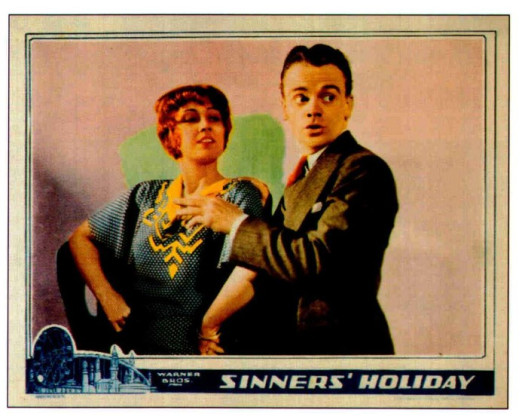
SINNERS’ HOLIDAY (Warner Brothers 1930; D: John Adolfi) – Early talkie interesting as the screen debut of James Cagney , mixed up in “the booze racket”, who shoots bootlegger Warren Hymer, and who’s penny arcade owner maw Lucille LaVerne covers up by pinning the murder on daughter Evalyn Knapp’s ex-con boyfriend Grant Withers. Some pretty racy Pre-Code elements include Joan Blondell as Cagney’s “gutter floozie” main squeeze. Film’s 60 minute running time makes it speed by, aided by some fluid for the era camerawork. Fun Fact: Cagney and Blondell appeared in the original Broadway play “Penny Arcade”; when superstar entertainer Al Jolson bought the rights, he insisted Jimmy and Joan be cast in the film version, and…
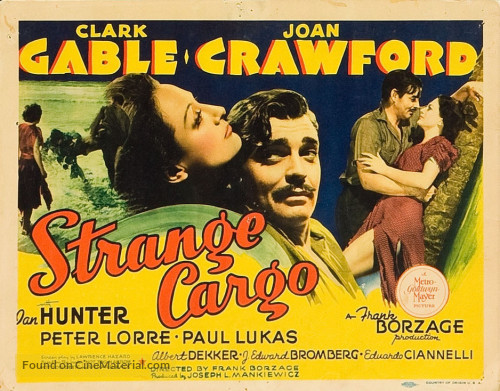
Any film condemned by the Catholic Legion of Decency can’t be all bad! STRANGE CARGO depicts a bunch of hardened, unrepentant criminals escaping a brutal French Guiana prison, with a prostitute in tow to boot, and is laced with plenty of lascivious sex and brutal violence. But that wasn’t all the self-appointed guardians of morality objected to… there was the character of Cambreau who, though the film doesn’t come right out and say it, supposedly represents none other than Jesus Christ himself!
One more time: Clark & Joan
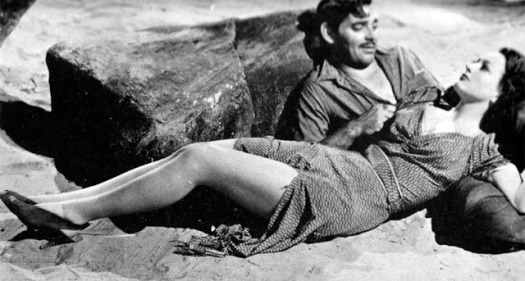
Clark Gable and Joan Crawford , in their eighth and final film together, lead this pack of sinners through a sweltering jungle of lust, murder, and ultimately redemption. He’s a con named Verne, “a thief by profession”, whose several attempts at escape have proved unsuccessful. She’s Julie, a two-bit hooker plying her trade on the island. The pair, as always, crackle like…
Okay, I’ll be the first to admit that 1966’s Gammera The Invincible is not really a horror film. Maybe there was a time when people found the idea of a giant, fire-breathing turtle to be scary but I kind of doubt it.
But let’s think about this! What better time is there to watch a movie about giant, fire-breathing turtle than in October?
Seriously, this is a fun movie and if you’ve got some time to kill this morning, I guarantee this movie will make you smile.
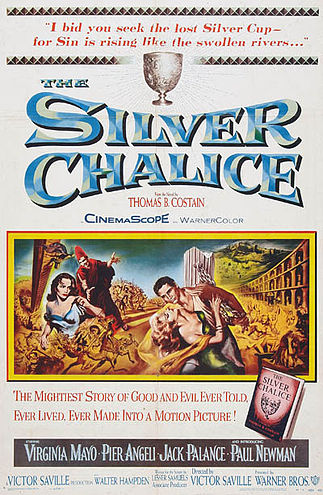
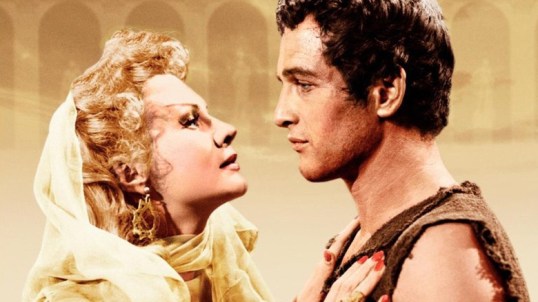
If you ever needed proof that everyone has to start somewhere, look no further than the 1954 biblical epic, The Silver Chalice.
The Silver Chalice features the film debut of Paul Newman, who later proved himself to be a legitimately great actor. It’s true that, unlike a lot of actors, Newman made his debut in a starring role. He never had to humiliate himself with any one-line roles or walk-on bits. No, Paul got to humiliate himself with a starring role.
Paul Newman was 29 years old when he played Basil, a former slave turned sculptor. Not only did Newman bear a disconcerting resemblance to Ben Savage (of Boy Meets World fame) but he gave a performance that was so bad that it’s kind of a shock that he ever worked again. Basil is a passionate artist, one who survived being betrayed by his adopted family and slavery. Newman comes across like a nice, young man from Iowa. Usually, Newman looks miserable but occasionally, he flashes a somewhat weak smile. When Basil gets mad, Newman speaks in a squeaky voice. When Basil is feeling reverent, Newman furrows his brow like a hungover Russell Brand staring straight into the sun.
“But me and Topanga are soul mates…”
Then again, I’m not sure that any actor could have given a good performance as Basil. The Silver Chalice has a terrible script, one that was written by Lesser Samuels. (I’ll avoid the obvious joke about whether or not The Silver Chalice would have been better if written by Greater Samuels.) Apparently, before Newman was cast, the producers pursued James Dean for the role. I’m sure we all would have enjoyed seeing Dean slouch his way through the film but I doubt that even he could have done much with The Silver Chalice.
The Silver Chalice is based on a novel, which perhaps explains why there’s so many characters and so many unnecessary subplots. Basil follows a path that will be familiar to anyone who has seen a 1950s biblical epic. He’s a young Greek who is adopted into a noble Roman family. When his kindly stepfather dies, Basil’s stepsiblings sell him into slavery. It’s not an easy life but Basil is a talented sculptor so Joseph of Arimathea commissions him to make a silver chalice for the Holy Grail. Basil goes from poor to rich to poor again to rich again to ultimately saved by grace. He even gets to do the same walking towards Heaven thing that Richard Burton did at the end of The Robe.
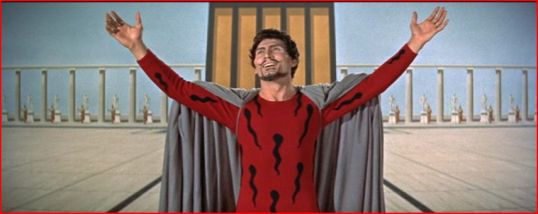
Meanwhile, Simon Magus (Jack Palance) is wowing the citizenry with his magic tricks and claiming to be the risen Messiah. Simon’s assistant just happens to be Helena, who knew Basil when he was younger. Young Helena is played by dark-haired Natalie Wood. Grown-up Helena is played by blonde Virgina Mayo. They were both good actresses but there’s seriously no way that Natalie Wood would have ever grown up to be Virginia Mayo.
Jack Palance pretty much steals the movie, mostly because he gets to wear the silliest costumes:
Poor Paul Newman has to settle for a tunic and a miniskirt, while Jack Palance gets to wear this:
Personally, I’ve always enjoyed the story of Simon Magus. He tried to show off by flying over the Roman Forum so St. Peter said a prayer and Simon promptly plunged to his death. Take that, you Gnostic!
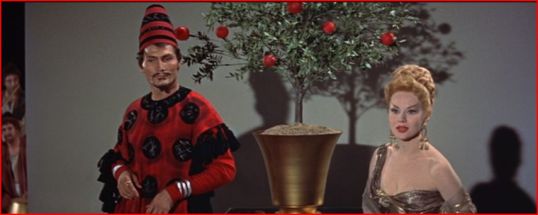
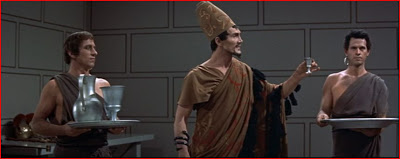
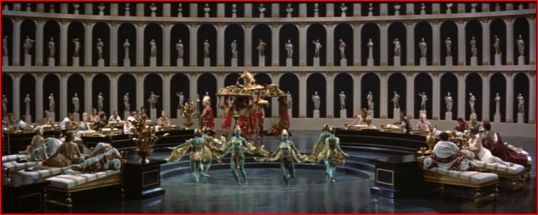
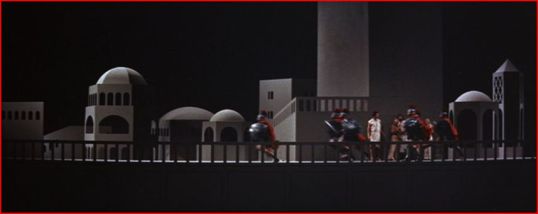
Another interesting thing about The Silver Chalice is that the sets are very deliberately fake. I don’t mean that they look cheap. I mean, much as in the style of German Expressionism, the sets are specifically designed to remind you that you’re watching a movie.
For instance, look at the wall behind Palance:
Look at this pleasure palace:
Look at Rome at night:
The sets are extremely dream-like and yet everything else about the film is extremely slow and conventional. One wonders if director Victor Saville was trying to make an art film, though there’s nothing else in his long filmography that would suggest that Saville was anything other than a workmanlike director. In fact, most biblical epics of the time took a lot of pride in looking as expensive and “accurate” as possible. Major studios in the 1950s were not known for artistic experimentation, especially when it came to Biblical epics. It’s hard to know what to make of The Silver Chalice‘s artistic flourishes, which is why it’s easier to just focus on what a terrible performance Paul Newman gives.
That’s certainly what Paul did! In 1966, when The Silver Chalice finally premiered on TV, Newman took out a newspaper ad in which he apologized for his performance and then asked people not watch. Apparently, he also used to show the movie during parties on the condition that his guests mock the film while watching it.
I don’t really blame him. It’s an amazingly dull film and Newman looks absolutely miserable in nearly every other scene. However, because it did star Paul Newman, The Silver Chalice will always have a life on TCM.
Speaking of TCM, they last broadcast this film on February 24th as part of their 31 Days of Oscar. (It was nominated for both its sets and its score.) That is when I recorded it. And, after watching it yesterday, I was more than happy to erase it.
Mickey Spillane’s Mike Hammer novels have long been one of my favorite Guilty Pleasures. Spillane’s books were the literary equivalent of knocking back shots of Jack Daniels with no chaser. The misanthropic Mike Hammer’s Sex & Violence filled adventures are rapid paced, testosterone fueled trips through a definitely un-PC world where men are men, women are sex objects, and blood and bullets flow freely through a dark, corrupt post-war world. Spillane turned the conventional detective yarn on its ear and, though critics hated his simplistic writing, the public ate up his books by the millions.
The film version of Spillane’s KISS ME DEADLY turns film noir on its ear from its opening shot of Christine Bailey (a young Cloris Leachman) running down a lonely highway, almost getting run over by Mike Hammer. The PI picks her up and the opening credits roll backwards to the strains of Nat King Cole crooning “Rather Have The Blues”. This beginning set-up lets…




 Through the Shattered Lens