Review: Westworld (dir. by Michael Crichton)


“There’s no way to get hurt in here, just enjoy yourself.” — John Blane

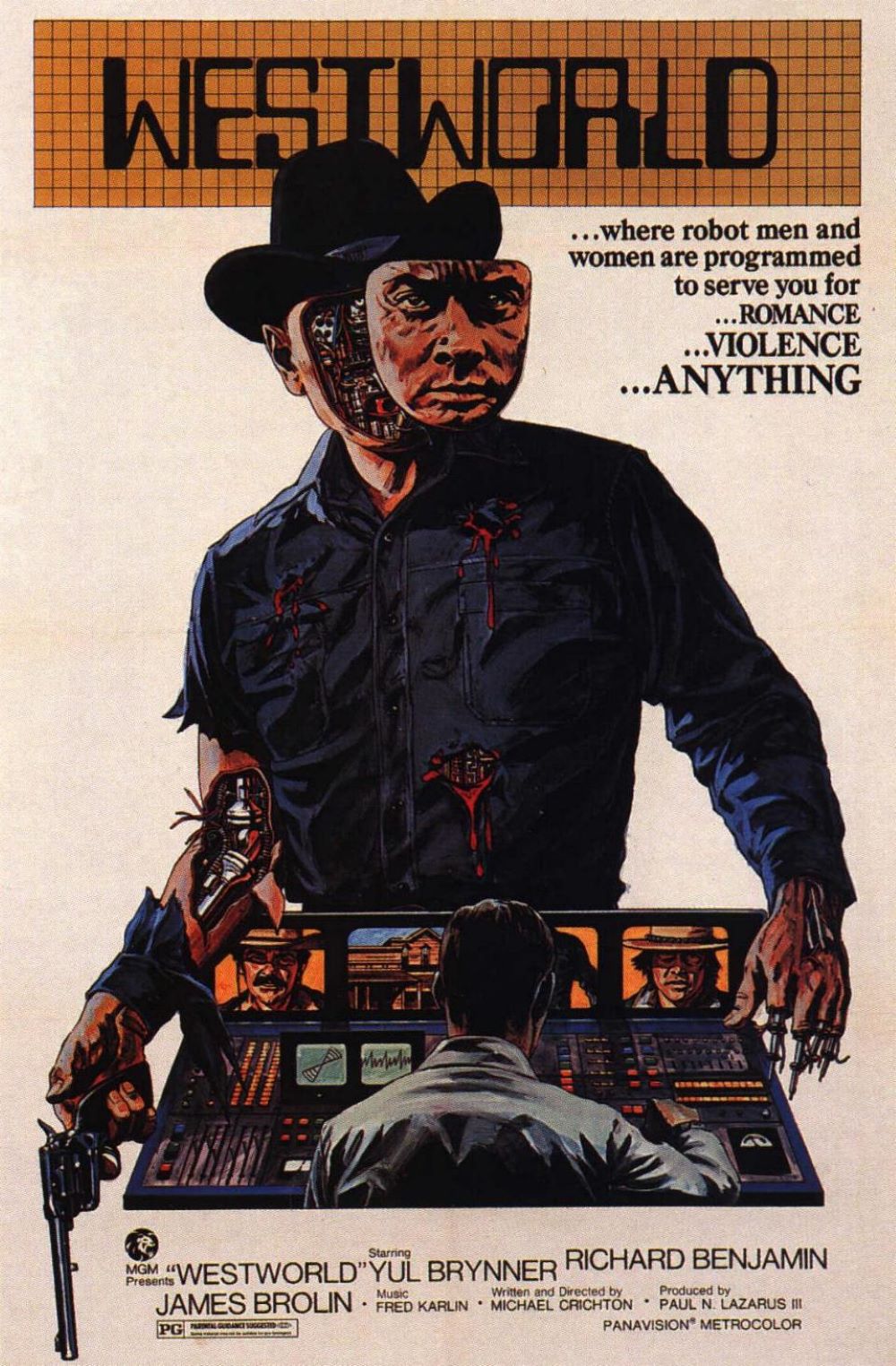
Michael Crichton’s Westworld (1973) is a pioneering sci-fi thriller that uniquely melds futuristic technology with classic Western motifs to explore the dark side of immersive fantasy. The film is set in Delos, a high-tech amusement park divided into three themed worlds—Roman, Medieval, and Western—where guests can live out their fantasies with lifelike androids programmed to serve them. The story focuses on friends Peter Martin (Richard Benjamin) and John Blaine (James Brolin), who embark on a vacation to Westworld, only to find the androids malfunctioning with deadly consequences.

One of Westworld’s greatest strengths lies in its compelling premise. The concept of a theme park filled with near-human robots designed for guests’ amusement feels both visionary and deeply relevant even decades later. It touches on early concerns about the dangers of AI, the ethics of escapism, and how technology could spiral out of control. The film’s gradual shift from playful adventure to tense horror keeps the viewer engaged, illustrating how quickly paradise can turn into a nightmare. Yul Brynner’s portrayal of the robotic Gunslinger is especially memorable, embodying a calm yet unstoppable menace that has echoed through decades of genre cinema. His near-silent, mechanical stalking of the protagonists in the film’s thrilling climax defines the archetype of the relentless android assassin.

Technologically, Westworld was groundbreaking for its era. It featured some of the first uses of computer-generated imagery to simulate the Gunslinger’s “robot vision,” providing a novel and eerie perspective that laid the groundwork for the visual language of future sci-fi films. The movie’s restrained approach to horror and suspense—which leans heavily on atmosphere and tension rather than gore—remains effective. The juxtaposition of idyllic fantasy and mechanical terror gives Westworld a unique texture that feels both nostalgic and fresh.

However, the film is not without flaws. Its pacing is uneven—while the first half indulges in leisurely world-building and character interactions, it can feel slow and unfocused, weighing down the narrative momentum. The characters, particularly Peter and John, are somewhat archetypal and underdeveloped, serving more as audience surrogates than fully fleshed-out individuals. This limits emotional investment in their plight, which could have deepened the film’s impact. Some dialogue and scenes feel dated or clichéd, something Crichton himself acknowledged by deliberately shooting certain sequences as cinematic clichés to evoke a stylized old-movie atmosphere.

The tonal shift from lighthearted theme-park romp to suspenseful thriller, while intriguing, feels abrupt and uneven in spots. The horror elements emerge forcefully in the second half but are preceded by a comparatively slow start that may test some viewers’ patience. The film’s logic around the park’s safety and the androids’ malfunctioning is also inconsistent—what begins as programmed fantasy behavior suddenly becomes lethal with little explanation or foreshadowing. These plot holes can detract from the immersion if one is seeking tightly reasoned sci-fi.

World-building is another area where Westworld shows its age; the other park zones like Romanworld and Medievalworld are barely touched on, serving more as exotic backdrops than dynamic settings. The film lightly explores AI ethics and humanity’s hubris but refrains from delving deeply into philosophical questions, which later adaptations and works inspired by the film would expand upon more thoroughly. The 1970s social attitudes reflected in the cast and scenarios can also feel outmoded to modern sensibilities.

Despite these issues, Westworld remains a cult classic and a fascinating artifact of sci-fi cinema history. Its influence is enormous, seeding ideas that blossomed into franchises like The TerminatorJurassic Park, and the HBO Westworld series. It stands as Michael Crichton’s directorial debut and an early example of a film grappling with human-machine interaction and the consequences of technological spectacle.

Westworld is a smart, ambitious blend of sci-fi, Western, and horror that captivates with its high-concept premise, pioneering visuals, and iconic villainy. While its uneven pacing, thin character development, and occasional logical gaps reveal its age, these flaws do little to diminish its charm and significance. For genre fans, it’s an essential watch—both as a suspenseful thriller and a creative blueprint for many modern tales of technology run amok. It’s a film that showcases the thrilling promise and lurking threat of immersive fantasy, wrapped in the dust and desolation of the Wild West.

Retro Television Review: St. Elsehwere 1.18 “Dog Day Hospital”


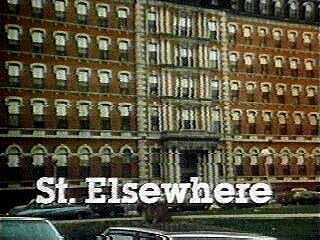
Welcome to Retro Television Reviews, a feature where we review some of our favorite and least favorite shows of the past! On Fridays, I will be reviewing St. Elsewhere, a medical show which ran on NBC from 1982 to 1988.  The show can be found on Hulu and, for purchase, on Prime!

This week, Judith Light has got a gun!

Episode 1.18 “Dog Day Hospital”

(Dir by Victor Lobl, originally aired on March 22nd, 1983)

Finally, Dr. Ehrlich is performing his first solo operation.  Dr. Craig is assisting but Ehrlich is in charge.  He gets to play his music in the OR.  He gets to decide what type of retractor to use.  It’s a simple hernia operation.  The patient (Sam Anderson) is awake and babbling through the whole operation.

Unfortunately, there’s also an angry woman in the OR and she has a gun.  Barbara Lonnicker (Judith Light) is eight months pregnant, despite her husband claiming that he got a vasectomy at St. Eligius.  As she already has several children to deal with, she wants to see the doctor who screwed up the vasectomy but she’s just as willing to shoot any other doctor to get her revenge.  The operation continues while Dr. Craig and Dr. Westphall negotiate with her.

I have to admit that I did find a lot of this episode to be amusing.  Ehrlich’s excitement over getting to do his first operation, Dr. Craig’s stuffy annoyance with being interrupted by a woman with a gun, and the patient’s nonstop rambling all made me smile more than once.  And Judith Light, not surprisingly, was great as the woman with the gun.  I loved the her husband was played by Tom Atkins.  You never know who you might see at St. Eligius!  That said, after the episode ended, I couldn’t help but think about how dumb the whole thing actually was.  How are people always managing to get guns into St. Eligius?  How did Barbara manage to get into an operating room without being stopped beforehand?  (Luther does tell her that she can’t be back there but he’s the only one who seems to notice her before she bursts into the OR.)  How come no one in the hospital seems to be more upset about the fact that there’s a woman waving a gun around an operating room?  At one point, Barbara shoots Ehrlich’s radio and hardly anyone seems to react.  The plot is played for laughs and that’s fine.  But, in this case, the story was a bit too implausible for its own good.

Meanwhile, Nurse Rosenthal returned to work after her mastectomy and struggled to get back into her routine.  Carolyn Pickles did a great job portraying Rosenthal in this episode.  And Fiscus and Shirley Daniels visited an old woman in a nursing home.  The subplots were handled well but, for the most part, this episode still felt as if it was trying a bit too hard.

Retro Television Review: St. Elsewhere 1.17 “Brothers”


Welcome to Retro Television Reviews, a feature where we review some of our favorite and least favorite shows of the past! On Fridays, I will be reviewing St. Elsewhere, a medical show which ran on NBC from 1982 to 1988.  The show can be found on Hulu and, for purchase, on Prime!

Another day, another death in Boston.

Episode 1.17 “Brothers”

(Dir by Mark Tinker, originally aired on March 15th, 1983)

I swear, St. Eligius must have the worst security guards in Boston.

In this episode, Walter Schaefer (Pat Hingle), a blue collar fisherman, manages to smuggle a freaking hunting rifle into the hospital so that he can use it to kill his brother, Arthur (Richard Hamilton).  Arthur was dying of cancer and didn’t have much time left.  Walter had previously begged Dr. Westphall to cease giving Arthur chemotherapy and to just let his misery come to an end.  Westphall declined to do so so Walter killed his brother.  The episode was designed to make the viewer feel that Walter had no choice but …. eh, I don’t know.  I’m not a fan of euthanasia and I find the enthusiasm for it in television and film to be a bit icky.  This episode’s treatment of the issue was about as heavy-handed as they come.  And seriously, couldn’t Walter have just smothered Arthur with a pillow or something?  Shooting a man is dramatic but now I’m wondering about who had to clean up the room afterwards.  Plus. Arthur was hooked up to a bunch of medical equipment that was probably ruined as well.

(I don’t know, it’s hard for me to judge this storyline.  My Dad died in hospice care and I had to sign a DNR order before he could start it.  The aggressiveness that those people showed in demanding that I sign the order still haunts me.)

On a lighter note, Ehrlich managed to get another date with Shirley, despite the fact that their previous date ended with Ehrlich drunk and making a fool of himself.  Fiscus recommended a nice romantic restaurant.  Of course, when Ehrlich couldn’t make the date due to his work as a doctor, Fiscus took Shirley to the restaurant.  The end result is that Shirley has a crush on Fiscus and Fiscus needs to find a new place to stay because Ehrlich responded by kicking him out of the apartment.

Speaking of relationships, Dr. White is such a sleaze!  He’s separated from his wife so he’s now involved with a nurse.  While talking to that nurse on the phone, White was flirting with another nurse.  But then, Dr. White happened to see his wife out with another man and decided he had the right to get all jealous.  Ugh!  What a jerk!

Finally, the episode ended with Nurse Rosenthal on the operating table, about to undergo a mastectomy.  This was the subplot that actually got to me, not all of the stuff about Walter murdering his brother.  Christina Pickles, who has been such a steady presence during the first season, gave a wonderful performance as Rosenthal tried to keep it together as the day of her surgery approached.  This storyline brought tears to my eyes and that’s really all I have to say about it.

This was an uneven episode.  The stuff with the brothers didn’t do much for me but, when the episode just focused on the doctors and the nurses, it shined.

Retro Television Reviews: Death Sentence (dir by E.W. Swackhamer)


Welcome to Retro Television Reviews, a feature where we review some of our favorite and least favorite shows of the past!  On Sundays, I will be reviewing the made-for-television movies that used to be a primetime mainstay.  Today’s film is 1974’s Death Sentence!  It  can be viewed on YouTube!

There’s been a murder!

A young woman has been strangled in her own home.  The nosy neighbor (Hope Summers) testifies that the woman often argued with her woman and that she heard the woman yelling on the night of the murder.  The husband, John Healy (Nick Nolte), is found in a neighborhood bar and, when he’s brought back to his house, his drunken reaction to seeing his dead wife doesn’t do much to keep him from looking totally guilty.

However, the viewer knows that John is innocent because the viewer has already seen that the woman was murdered by Don Davies (Laurence Luckinbill), the man with whom she was having an affair.  She demanded that he leave his wife for her and Don, realizing that his cheating was about to revealed, responded by strangling her.

Don’s wife is Susan Davies (Cloris Leachman), who knows that she and Don have been going through a rough patch but who certainly had no idea that Don was cheating on her.  Shortly after the murder, Susan is called up for jury duty.  She’s placed on the jury and told that she will be an important part of a major trial.  As a result, she and the other jurors will be sequestered in a hotel….

And who is the defendant in this trial?  John, of course!

As opposed to the other members of the jury, who are ready to convict John even before the first bit of testimony is heard, Susan pays attention to what is said in the courtroom.  She listens to Lubell (Alan Oppenheimer), the prosecutor.  She listens to Tanner (William Schallert), the defense attorney.  She comes to believe that John is innocent but will she be able to hold her own against the rest of the jury?  And will she ever figure out that the murder was actually committed by her husband?

It’s an intriguing premise, even if it is a bit far-fetched.  I mean, it really is an amazing coincidence that Susan just happened to end up on the jury for a case involving a murder that was actually committed by her husband.  However, this is a made-for-television movie and, as soon as “Produced by Aaron Spelling” appears on the screen, most viewers should be savvy enough to know what they’re getting into.  Instead, the main problem with the film is that it opens by showing us who the murderer is.  Therefore, there’s really zero suspense as to who actually committed the crime.  Instead, the viewer spends the entire movie waiting for Susan to catch up.  Since the majority of the film takes place in court, it’s a very talky film but there’s no joy to be found in paying close attention to every word said and picking up on the details that will allow you to solve the crime for yourself.  This is a case where the film spoils its biggest twist and, despite good performances from Leachman and Luckinbill, it’s a bit dull.

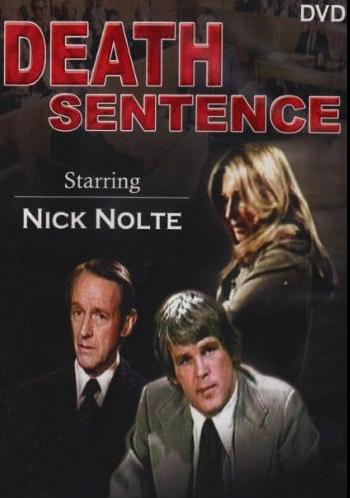
(Nick Nolte, for his part, spends most of the movie silently sitting in the courtroom.  He’s not bad and his look of anguish is believable but it’s hardly a starring role, regardless of what the film’s video packaging might otherwise claim.)

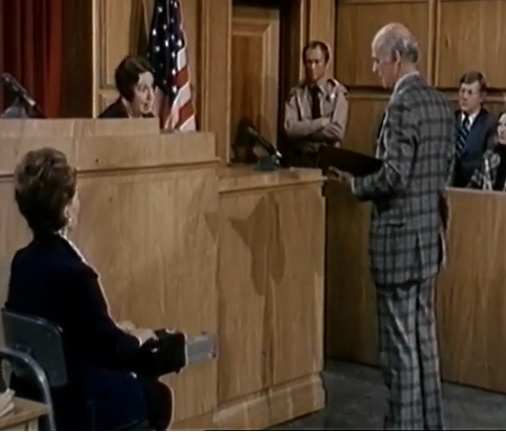
In the end, what I’ll mostly remember about Death Sentence were the atrocious fashion choices made by the prosecutor.  Seriously, would you trust a man wearing this suit?

Film Review: Westworld (dir by Michael Crichton)


“Draw,” says Yul Brynner.

“Whatever,” says a tourist who has spent a lot of money to spend their vacation at the Delos amusement park.

BANG!  Down goes the tourist, as the robot revolution of 1983 begins.

Recently, TCM broadcast the 1973 science fiction thriller, Westworld.  Since I am absolutely obsessed with the more recent HBO revival, there was no way I could resist watching the original film.  It was an interesting experience.  While the film is far more simpler and straight-forward than the television series, they both essentially tell the same story.  A bunch of rich humans pay a lot of money to pretend to be either cowboys or knights or Roman citizens for a week.  Everyone has a great time until, eventually, the robots stop doing what they were supposed to do and instead, begin to fight back.

One thing that the movie and the series definitely shared is a less-than-positive view of humanity.  The movie focuses on two businessmen.  Peter (Richard Benjamin) is the nerdy one.  John (James Brolin) is the hypermasculine one.  Peter is visiting Westworld for the first time.  John is a frequent guest who loves gunning down any robots who looks at him the wrong way.  Neither one of these characters is particularly likable.  Peter starts out as a self-righteous hypocrite who ends up sleeping with a sexbot, despite being married.  John brags about how easy it is to kill the robots, mostly because the robot’s are programmed to not fight back.

Meanwhile, the human engineers who work behind-the-scenes and keep Delos running are all blandly incompetent.  When the robots start to malfunction, the engineers can only shrug and wonder why.  They’re so ineffective that, halfway through the movie, they get sealed up in their own control room, slowly suffocating to death while the park collapses around them.

As opposed to the TV series, the robots in Westworld never achieve any sort of real consciousness.  Even when they malfunction, it doesn’t lead to a true rebellion as much as it just causes them to ignore any previous directives about killing the guests.  When the Gunslinger (Yul Brynner) starts stalking Peter and John across the park, it’s not an act of ideology or, for that matter, even revenge.  It’s simply that the Gunslinger has been programmed to be a killer and this is what a killer does.

It all leads to an extended chase sequence involving the Gunslinger and Peter and, despite the fact that it doesn’t have much of a personality, it’s hard not to be on The Gunslinger’s side.  If nothing else, the Gunslinger is at least good at what it does.  Peter, on the other hand, is perhaps one of the most incompetent heroes to ever show up in a movie.  After spending the first half of the movie being smug and dealing with robots programmed not to fight back, Peter now has to try to win on an even playing field.

Westworld was the directorial debut of writer Michael Crichton.  The film’s flaws are largely the flaws that you would expect from a first-time director.  Occasionally, the pacing falters and the first half of the film sometimes moves a bit too slowly.  (There’s one saloon fight that seems to go on forever.)  During the first half of the film, there’s several scenes involving another tourist (played by Dick Van Patten) who seems like he’s going to play a major role in the film but, after the first hour, the character literally vanishes from the film.

Despite those flaws, Westworld remains an exciting mix of suspense and science fiction.  Though his actual screentime is rather limited, Yul Brynner easily dominates the entire film.  In the role of the Gunslinger, Brynner is a relentless killing machine.  What makes the character especially disturbing is that Brynner plays him without a hint of emotion or expression.  The Gunslinger gets no pleasure out of killing nor does he seek to accomplish any sort of identifiable goal.  The Gunslinger simply kills because that’s what he was programmed to do.

While I prefer the HBO series, the original Westworld is still an exciting and entertaining film, one that probably seems a lot more plausible today than when it was first released 46 years ago.  Watch it the next time your home robot gets bored.

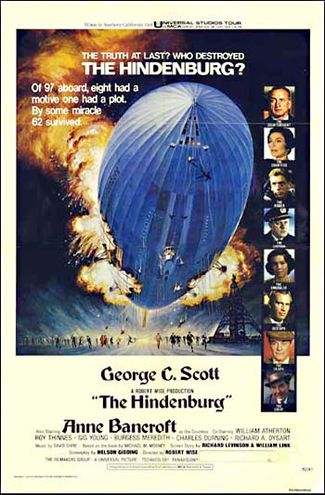
Film Review: The Hindenburg (dir by Robert Wise)


80 years ago, on May 6th, 1937, the Hindenburg, a German airship, exploded in the air over New Jersey.  The disaster was not only covered live by radio reporter Herbert Morrison (whose cry of “Oh the humanity!” continues to be parodied to this day) but it was also one of the first disasters to be recorded on film.  Looking at the footage of the Hindenburg exploding into flame and sinking to the ground, a mere skeleton of what it once was, it’s hard to believe that only 36 people died in the disaster.  The majority of those who died were crew members, most of whom lost their lives while helping passengers off of the airship.  (Fortunately, the Hindenburg was close enough to the ground that many of the passengers were able to escape by simply jumping.)

Not surprisingly, there was a lot of speculation about what led to the Hindenburg (which has successfully completed 63 flights before the disaster) exploding.  The most commonly accepted explanation was that it was simply an act of God, the result of either lightning or improperly stored helium.  Apparently, there was no official evidence found to suggest that sabotage was involved but, even back in 1937, people loved conspiracy theories.

And really, it’s not totally implausible to think that the Hindenburg was sabotaged.  The Hindenburg was making its first trans-Atlantic flight and it was viewed as being a symbol of Nazi Germany.  One of the ship’s passengers, Captain Ernest Lehman, was coming to the U.S. in order to lobby Congress to give Germany helium for their airships.  With Hitler regularly bragging about the superiority of German industry, the theory was that an anti-Nazi crewman or passengers planted a bomb on the Hindenburg.  Since no individual or group ever stepped forward to claim responsibility, the theory continues that the saboteur must have perished in the disaster.

At the very least, that’s the theory put forward by a film that I watched earlier today, the 1975 disaster movie, The Hindenburg.

A mix of historical speculation and disaster film melodrama, The Hindenburg stars George C. Scott as Col. Franz Ritter, a veteran of the German air force who is assigned to travel on the Hindenburg and protect it from saboteurs.  Ritter is a Nazi but, the film argues, he’s a reluctant and disillusioned Nazi.  Just a few weeks before the launch of the airship, his teenage son was killed while vandalizing a synagogue.  Ritter is a patriot who no longer recognizes his country and George C. Scott actually does a pretty good job portraying him.  (You do have to wonder why a seasoned veteran of the German air force would have a gruff, slightly mid-Atlantic accent but oh well.  It’s a 70s disaster film.  These things happen.)

Ritter is assigned to work with Martin Vogel (Roy Thinnes), a member of the Gestapo who is working undercover as the Hindenburg’s photographer.  Tt soon becomes obvious that he is as much a fanatic as Ritter is reluctant.  Vogel is a sadist, convinced that every Jewish passenger is secretly a saboteur.  Thinnes is chilling in the role.  What makes him especially frightening is not just his prejudice but his casual assumption that everyone feels the same way that he does.

And yet, as good as Scott and Thinnes are, the rest of the cast is rather disappointing.  The Hindenburg features a large ensemble of actors, all playing characters who are dealing with their own privates dramas while hoping not to burn to death during the final 15 minutes of the film.  Unfortunately, even by the standards of a typical 70s disaster film, the passengers are thinly drawn.  I liked Burgess Meredith and Rene Auberjonois as two con artists but that was mostly because Meredith and Auberjonois are so charming that they’re fun to watch even if they don’t have anything to do.  Anne Bancroft has one or two good scenes as a German baroness and Robert Clary does well as a vaudeville performer who comes under suspicion because of his anti-Nazi leanings.  Otherwise, the passengers are forgettable.  Whether they die in the inferno and manage to make it to the ground, your main reaction will probably be to look at them and say, “Who was that again?”

Anyway, despite all of Ritter and Vogel’s sleuthing, it’s not much of mystery because it’s pretty easy to figure out that the saboteur is a crewman named Boerth (William Atherton).  Having seen Real GeniusDie Hard and the original Ghostbusters, I found it odd to see William Atherton playing a sympathetic character.  Atherton did okay in the role but his attempt at a German accent mostly served to remind me that absolutely no one else in the film was trying to sound German.

Anyway, the main problem with The Hindenburg is that it takes forever for the airship to actually explode.  The film tries to create some suspense over whether Ritter will keep the bomb from exploding but we already know that he’s not going to.  (Let’s be honest.  If you didn’t already know about the Hindenburg disaster, you probably wouldn’t be watching the movie in the first place.)  The film probably would have worked better if it had started with the Hindenburg exploding and then had an investigator working backwards, trying to figure out who the saboteur was.

However, the scenes of the explosion almost make up for everything that came before.  When that bomb goes off, the entire film suddenly switches to black-and-white.  That may sound like a cheap or even sensationalistic trick but it actually works quite well.  It also allows the scenes of passengers and crewmen trying to escape to be seamlessly integrated with actual footage of the Hindenburg bursting into flame and crashing to the ground.  The real-life footage is still shocking, especially if you’re scared of fire.  Watching the real-life inferno, I was again shocked to realize that only 36 people died in the disaster.

In the end, The Hindenburg is flawed but watchable.  George C. Scott was always at his most watchable when playing a character disappointed with humanity and the real-life footage of the Hindenburg disaster is morbidly fascinating.

Oh, the humanity indeed!