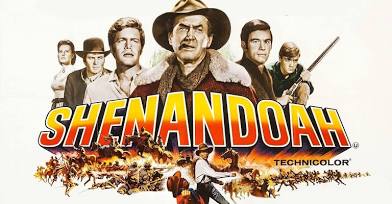
I review SHENANDOAH (1965), starring James Stewart! 


Jimmy Stewart plays Charlie Anderson, the patriarch of a large farming family in Virginia during the time of the Civil War. His family doesn’t own slaves, so he doesn’t figure it’s any of their business what all the fighting is about. He wants to keep working the land in hopes that the war will pass them by. Besides, he has six sons, a daughter, and a daughter in law that he wants to keep safe. He’s trying to keep the family together on his own as his beloved Martha had passed away sixteen years earlier giving birth to their youngest son, who we only know as Boy (Phillip Alford). Aside from the war that’s going on all around them, things seem pretty good for the Anderson’s. They all sit down for a big delicious meal every night. They attend Church every Sunday where they’re usually late and given the side-eye by Pastor Bjoerling (Denver Pyle). One of the sons, James Anderson (Patrick Wayne) and his wife Ann (Katharine Ross), have a precious newborn baby to take care of. The beautiful daughter Jennie (Rosemary Forsyth) is being courted by, and eventually marries, a lovestruck confederate officer named Sam (Doug McClure). Unfortunately the war won’t just go away, and when Boy is taken prisoner by Union soldiers, Charlie can’t stand idly by any longer. They head out to find him and bring him home. 

In the guise of an entertaining semi-western, SHENANDOAH does a great job of illustrating how futile and randomly tragic war can be. The movie starts out lighthearted and fun as the family goes about its normal life, with Jimmy Stewart’s Charlie Anderson giving his homespun advice and rolling his cigars. This is a self-sufficient family that loves, respects and enjoys each other even if they don’t agree on everything. But the war keeps inching its way into their lives. First in the form of small group of confederate soldiers who come by to get some water and try to convince the boys to join up. None of the boys will join up, but they do help bury the soldiers when they’re ambushed and killed just down the road. Next a group of men come to the ranch to try to confiscate their horses for the Union army. Of course, Charlie Anderson isn’t going to let that happen and this turns into the type of brawl that seems to come right out of John Wayne western comedy like MCLINTOCK. Everybody joins in with the participants punching and being punched repeatedly, while Boy keeps getting knocked into the horse trough. This shouldn’t be a surprise because Director Andrew V. McLaglen directed MCLINTOCK and many other John Wayne films. Finally, Boy is taken prisoner because he is wearing a confederate cap that he found floating down the steam while he was out fishing one day. Once Charlie and most of his family head out to search for Boy, the movie begins a turn into tragedy. I won’t give the specifics away, but some members of the family will die, and not a single one of their deaths will be based on the actual fighting of a war. Rather, their deaths will be based on the chaos and depravity that surrounds the war. It’s tough to see, especially when they were all so happy just a little bit earlier. For me, the movie’s changes in tone make the tragedy more powerful and really drive home its message about the futility of war. But the Anderson family, like the United States of America after the Civil War, is made up of tough, resilient folks, and the movie ends on a hopeful note that definitely brought some extra moisture to my eyes. 

Jimmy Stewart commands the screen in SHENANDOAH. You simply can’t take your eyes off of him, and his performance alone would make the movie worth watching. But with its powerful message, excellent cast, and solid direction, the movie is much more than just Stewart’s strong performance. I highly recommend it. 
Live Tweet Alert: Join #ScarySocial for When A Stranger Calls Back!


As some of our regular readers undoubtedly know, I am involved in a few weekly live tweets on twitter.  I host #FridayNightFlix every Friday, I co-host #ScarySocial on Saturday, and I am one of the five hosts of #MondayActionMovie!  Every week, we get together.  We watch a movie.  We tweet our way through it.

Tonight, at 9 pm et, Deanna Dawn will be hosting #ScarySocial!  The movie?  1993‘s When A Stranger Calls Back!  

If you want to join us this Friday, just hop onto twitter, start the movie at 9 pm et, and use the #ScarySocial hashtag!  I’ll be there tweeting and I imagine some other members of the TSL Crew will be there as well.  It’s a friendly group and welcoming of newcomers so don’t be shy.

When A Stranger Calls Back is available on Prime!

See you there!

Song of the Day: My My, Hey Hey (Out of the Blue) by Neil Young


This is the song that gave it’s title to one of Dennis Hopper’s best films.

My my, hey hey
Rock and roll is here to stay
It’s better to burn out
Than to fade away
My my, hey hey.

Out of the blue
and into the black
They give you this,
but you pay for that
And once you’re gone,
you can never come back
When you’re out of the blue
and into the black.

The king is gone
but he’s not forgotten
This is the story
of a Johnny Rotten
It’s better to burn out
than it is to rust
The king is gone
but he’s not forgotten.

Hey hey, my my
Rock and roll can never die
There’s more to the picture
Than meets the eye.
Hey hey, my my.

Songwriters: Neil Young and Jeff Blackburn


Scenes I Love: Bill Paxton and Helen Hunt In Twister


Bill Paxton would have been 70 years old today.

Today’s scene that I love comes from Twister and it features Bill Paxton showing off some wonderful chemistry with Helen Hunt.  One of the great things about Bill Paxton is that he was equally at home in both big blockbusters like Twister and Titanic and low-budget indies like Near Dark.  He was an artist who also happened to be a star.  As a lover of both films and eccentric Texans, I will always miss Bill Paxton.

4 Shots From 4 Films: Special Dennis Hopper Edition


Dennis Hopper (1936–2010)

4 (or more) Shots From 4 (or more) Films is just what it says it is, 4 (or more) shots from 4 (or more) of our favorite films. As opposed to the reviews and recaps that we usually post, 4 (or more) Shots From 4 (or more) Films lets the visuals do the talking.

89 years ago, Dennis Hopper was born in Dodge City, Kansas.

It seems rather appropriate that one of America’s greatest cinematic outlaws was born in a town that will be forever associated with the old west. Dennis Hopper was a rebel, back when there were actual consequences for being one. He started out acting in the 50s, appearing in films like Rebel Without A Cause and Giant and developing a reputation for being a disciple of James Dean. He also developed a reputation for eccentricity and for being difficult on set and he probably would have gotten completely kicked out of Hollywood if not for a somewhat improbable friendship with John Wayne. (Wayne thought Hopper was a communist but he liked him anyways. Interestingly enough, Hopper later became a Republican.) Somehow, Hopper managed to survive both a raging drug addiction and an obsession with guns and, after a mid-80s trip to rehab, he eventually became an almost universally beloved and busy character actor.

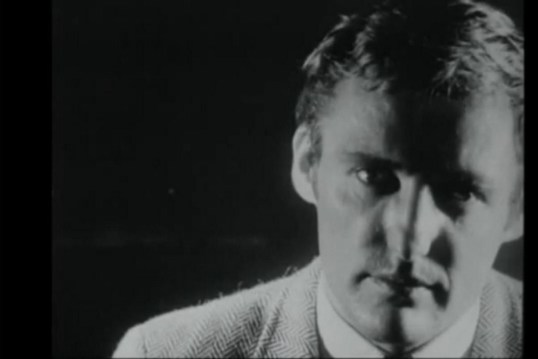
Hopper, however, always wanted to direct. He made his directorial debut with 1969’s Easy Rider, a film that became a huge success despite being an infamously chaotic shoot. The success of Easy Rider led to the Hollywood studios briefly trying to produce counter-culture films of their own. Hopper was given several million dollars and sent to Peru to make one of them, the somewhat dangerously titled The Last Movie. Unfortunately, The Last Movie, was such a bomb that it not only temporarily derailed Hopper’s career but it also turned Hollywood off of financing counter culture films. Hopper spent a decade in the Hollywood wilderness, giving acclaimed performances in independent films like Tracks and The American Friend, even while continuing to increase his reputation for drug-fueled instability. Hopper would eventually return to directing with his masterpiece, 1980’s Out of the Blue. (Out of the Blue was so controversial that, when it played at Cannes, Canada refused to acknowledge that it was a Canadian production. It played as a film without a country. Out of the Blue, however, is a film that has stood the test of time.) Unfortunately, even after a newly cleaned-up Hopper was re-embraced by the mainstream, his directorial career never really took off. He directed 7 films, of which only Easy Rider and Colors were financially successful. Contemporary critics often didn’t seem to know what to make of Dennis Hopper as a director. In recent years, however, Hopper’s directorial efforts have been reevaluated. Even The Last Movie has won over some new fans.

Today, on his birthday, we honor Dennis Hopper’s directorial career with….

4 Shots From 4 Dennis Hopper Films

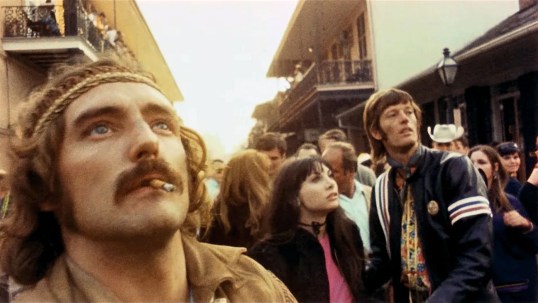
Easy Rider (1969, dir by Dennis Hopper, DP: Laszlo Kovacs)
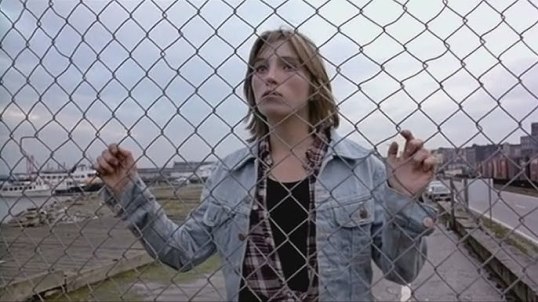
The Last Movie (1971, dir by Dennis Hopper, DP: Laszlo Kovacs)
Out of the Blue (1980, dir by Dennis Hopper, DP: Marc Champion)
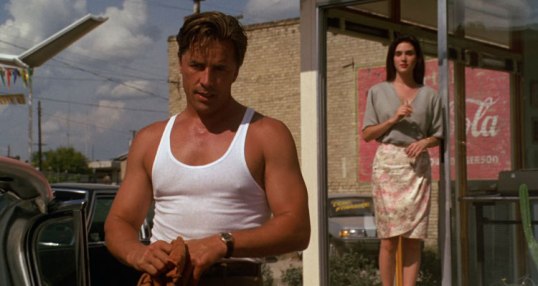
The Hot Spot (1990, dir by Dennis Hopper, DP: Ueli Steiger)

Late Night Retro Television Review: Friday the 13th: The Series 3.13 “Midnight Riders”


Welcome to Late Night Retro Television Reviews, a feature where we review some of our favorite and least favorite shows of the past! On Fridays, I will be reviewing Friday the 13th: The Series, a show which ran in syndication from 1987 to 1990. The entire series can be found on YouTube!

This week, the show attempts a change of pace!

Episode 3.13 “Midnight Riders”

(Dir by Allan Eastman, originally aired on January 29th, 1990)

An odd episode, this one.

Jack, Micki, and Johnny head out to a small town so that Jack can look up into the night sky and see a once-in-a-lifetime convergence of the stars.  However, possibly as a result of the convergence (it’s never really made clear), a bunch of dead motorcycle riders are resurrected and they rumble into town, seeking vengeance on everyone who took part in the death of their leader.  If the bikers can kill every one of them, their leader will be resurrected.  Finally, the ghost of Jack’s father (Dennis Thatcher) shows up and works with Jack to stop the bikers.  It turns out that Jack and his father had a difficult relationship.  Ryan had a difficult relationship with his father.  Johnny was falsely accused of murdering his father.  We’ve never met Micki’s father but he’s probably a jerk too.

The weird thing about this episode is that it didn’t feature a cursed antique.  Instead, Jack and the crew went to a small town and supernatural stuff started happening shortly after they arrived.  That’s okay, I guess.  In theory, there’s nothing wrong with trying something new.  But, at the same time, the cursed antiques were what set this show apart from all of the other supernaturally-themed television series out there.  Personally, even when the antique’s curse makes no sense, I still enjoy seeing what the show comes up with.

This episode had a lot of atmosphere and a typically good performance from Chris Wiggins.  The ghost bikers were never quite as intimidating as they should have been, despite all of the murders.  If anything, they reminded me a bit too much of Sometime They Come Back.  This episode was a change of pace and, as if often the case with things like this, it didn’t quite work.  Here’s hoping next week will have a cursed antique!

Brad’s “Scene of the Day” – Chow Yun-Fat dances with Jodie Foster!


Chow Yun-Fat is one of the most charismatic men on earth. I’ve always enjoyed his performance in ANNA AND THE KING (1999) with Jodie Foster. He’s wonderful in this big budget American film, and he doesn’t even have to fire two guns! I know several women here in Arkansas who don’t know the first thing about Hong Kong movies, but they still love Chow based on this one film. On a side note, ANNA AND THE KING made over $113 Million at the worldwide box office, which means quite a few people in this world appreciate a more romantic Chow.

Enjoy this scene where the King of Siam surprises Foster’s English schoolteacher, and breaks all kinds of cultural norms, when he asks her to dance. It’s quite a charmer.

Wild Rovers (1971, directed by Blake Edwards)


In Montana, Walter Buckman (Karl Malden) runs his ranch with an iron hand, warning his neighbor, Hansen (Sam Gilman) not to even think of allowing his sheep to graze on his land.  Walter has two sons, hot-headed John (Tom Skerritt) and the laid back and good-natured Paul (Joe Don Baker).  When Walter learns that two of his ranch hands — aging Ross Bodine (William Holden) and young Frank Post (Ryan O’Neal) — have robbed a bank and are heading down to Mexico, he sends John and Paul to bring them back.  Walter is a big believer in the law and he’s not going to allow any of his people to get away with breaking it.

Ross is a veteran cowboy, who only robbed the bank after Walter withheld his pay to cover the damage of a saloon fight between Ross and Hansen’s men.  Frank is the wilder of the two.  He looks up to Ross and Ross is protective of Frank, even if he has a hard time admitting it.  Ross and Frank are heading down to Mexico so Ross can retire in peace.  Instead of going straight to Mexico, though, they make the mistake of stopping by a small town so Frank can play a little poker and visit the town’s brothel.

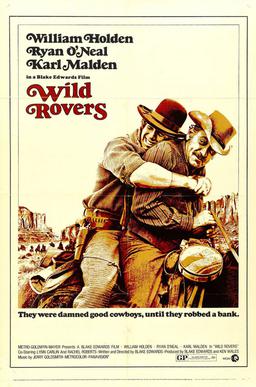
Wild Rovers was Blake Edwards’s attempt to make an epic, revisionist western and he includes plenty of shots of the sun setting over the mountains as well as several violent shoot-outs that are shot in Peckinpah-style slow motion.  Unfortunately, the story itself isn’t really strong enough to support Edwards’s ambitions and all of the shots of the countryside, while nice to look at, don’t really add up too much.  Wild Rovers was also a troubled production, with MGM slashing Edwards’s original three-hour film down to 106 minutes and advertising it with a poster featuring O’Neal hugging Edwards from behind, making the film look like a buddy comedy in the style of Butch Cassidy and the Sundance Kid (or an early version of Brokeback Mountain) as opposed to a violent and elegiac western.  (In 1986, a director’s cut was released, which ran for 136 minutes.)  If you only know Blake Edwards from his Pink Panther movies, the grim and tragedy-filled Wild Rovers will come as a surprise.

One thing that Wild Rovers does have going for it is a good cast.  William Holden and an energetic Ryan O’Neal are a solid team and Karl Malden, Tom Skerritt, Rachel Roberts, James Olson, and Moses Gunn all give good performances too.  This movie also provides Joe Don Baker with a sympathetic role and he’s very likable as the laid back Paul Buckman.  It’s not the type of role that Baker often got to play and it’s obvious that a lot of scenes between John and Paul were cut from the film but, in the truncated version, Joe Don Baker’s Paul Buckman becomes the moral center of the film’s story.

Wild Rovers was a disappointment at the box office, one of many that Edwards suffered in the 70s before he and Peter Sellers brought back Inspector Clouseau.