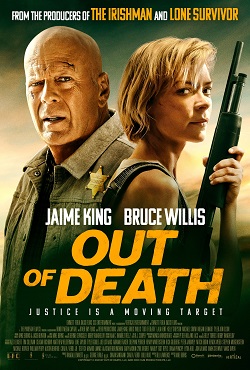
The first question that one might want to ask about 2021’s Out of Death is what is going on with that title.
Out of Death? Did they run out? Is there an issue with the warehouse? Is it a nationwide outage or just a regional problem? How exactly does someone find themselves out of death? I mean, there are plenty of shortages in the world. There are people who can’t get clean drinking water or tasty food. I had to wait an extra day to get my new scanner because of a supply chain issue. These things happen. But people never seem to run out of death. Death is the one thing that we will always in large quantities.
As for the film itself, it is rather death-obsessed. Shannon (Jaime King) is a photojournalist who has recently lost her father. All she wants to do is spread his ashes in the woods. However, when she witnesses a murder in the woods, she finds herself being pursued by a compromised deputy (Lala Kent). Meanwhile, Jack Harris (Bruce Willis) is a retired detective who has recently lost his wife. He wants to spend some time alone in his niece’s cabin but instead, he finds himself mixed up in Shannon’s problems. The corrupt sheriff (Michael Sirow) wants to be mayor and he’s not going to let Shannon and Jack stand in his way, even if it means killing every possible witness.
Even though Bruce Willis gets top-billing along with Jaime King, he’s not in much of Out of Death. Out of Death was one of the many film productions to be delayed by the COVID lockdowns. When production finally did begin, Bruce Willis shot all of his scenes in one day. (The entire film took 9 days to shoot. Roger Corman, if he was still with us, would want to know why the production took 9 days when it could just as easily been done in two.) Sadly, this is one of the films that Bruce Willis made after it became apparent that he was having serious issues with his health. Willis delivers his lines in a halting manner, which technically works for his emotionally shattered character but which is still hard to watch now that we know that Willis was suffering from frontotemporal dementia at the time. Producer Randall Emmett made his career by convincing big stars to appear in B-movies and he shouldn’t be faulted for that. However, the later films he made with Willis not always easy to watch. Say what you will about the films that Sylvester Stallone and Robert De Niro have made with Emmett, they all knew what they were getting into. It’s hard to say whether the same was true with Bruce Willis.
As for Out of Death, it’s a fairly dull cat-and-mouse game but I will give it some credit for capturing the atmosphere that goes along with being isolated in the Southern wilderness. This is a film where you could feel the humidity rising from the screen. And Jaime King, who deserves better, gave a strong performance as Shannon. Otherwise, the most interesting thing about Out of Death is the mystery as to what exactly the title means.
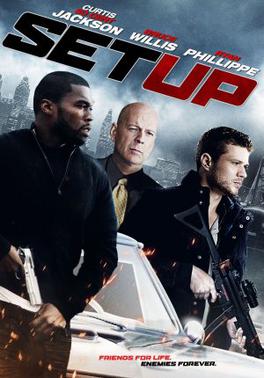
Well, anyway, Sonny (5o Cent) is a career criminal who also happens to be a really nice guy. When his partner-in-crime, Vincent (Ryan Phillippe), worries about the survival of his imprisoned father (James Remar), Sonny is sympathetic. When his other partner-in-crime, Dave (Brent Granstaff), won’t shut up about how much he loves his wife and his life in the suburbs, Sonny is genuinely happy for him. Sonny may be a criminal but he’s not violent. He’s not a killer.
Understandably, Sonny is upset when Vincent kills a guard during their latest diamond heist. However, that’s nothing compared to how angry Sonny becomes when Vincent betrays both him and Dave, shooting them and leaving them for dead. Dave dies but Sonny survives. Seeking revenge, Sonny teams up with a gangster named Biggs (Bruce Willis). Biggs demands that Sonny retrieve some money for him. It really shouldn’t be that difficult except for the fact that every criminal in Detroit is soon revealed to be an absolute idiot.
At this point, I’ll admit that 2011’s Setup has more than a little in common with Gun. Like that film, it takes place in Detroit and it centers on the drama that takes place in the shadows of the underworld. 50 Cent plays a criminal in both films. James Remar has a small role in both films. Both films feature multiple betrayals and both of them contrast the criminals on the street with the bosses behind-the-scenes. Both films were also produced by Randall Emmett. Indeed, this was one of the first films that Bruce Willis did with Emmett. Emmett would go on to produce several of Willis’s final films and there’s definitely some controversy as to whether or not those films exploited Willis at a time when he was particularly vulnerable.
That said, I actually kind of liked Setup. It’s definitely a low-budget B-flick but it still has its ambitions and it actually achieves some of them. 50 Cent is far more convincing as the well-intentioned but somewhat dumb Sonny in Setup than he was in Gun and he actually does pretty well as the film progresses and Sonny becomes more conflicted about whether or not he actually wants his legacy to be one of vengeance. Ryan Phillippe is well-cast as Vincent and I liked the performances of Jay Karnes and Jenna Dewan, both playing low-level criminals who find themselves in over their heads. The film did a good job of examining all of the different levels of crime in Detroit, from the wealthy Biggs all the way down to the idiots who continually screw up the simplest of plans. Randy Courtere does an especially good job as Petey, the moron who thinks playing with a loaded gun is a good idea.
As for Bruce Willis, his role here is small and it’s a role that probably could have been played by any tough guy actor of a certain age. But, Willis still brings his cocky charm to the role. (Seeing Willis here really drives home just how different he was in the final films that he did for Emmett.) Willis plays Biggs with a sense of humor and it’s just what the movie needed.
To say a movie is better than expected can sound like a backhanded compliment but it’s a compliment nonetheless. Setup was definitely better than I expected.
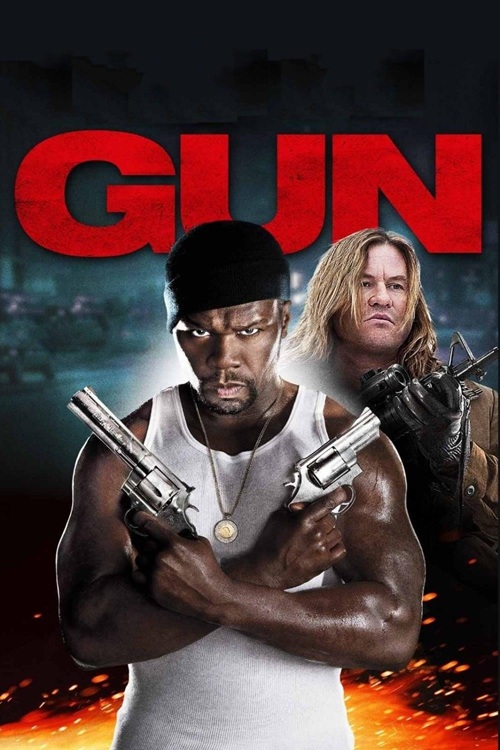
Angel (Val Kilmer) has just been released from prison and he’s returned to the hard streets of Detroit. Hooking up with his old friend Rich (50 Cent), Angel gets involved in a gun-running operation.
Unfortunately, it’s no longer easy or safe to sell guns in Detroit. The police are cracking down. Rival gun dealers are trying to take out a competition. A raid at a club leaves a dealer dead and a huge power void in Detroit’s criminal underworld. When it becomes obvious that the police have a snitch in Rich’s crew, Rich’s girlfriend (AnnaLynne McCord) suspects that it’s Angel. Can Rich find the snitch without having to betray his best friend? And does Angel have secrets of his own?
First released in 201o, Gun was the third film that Val Kilmer made with 50 Cent and it’s apparently their only collaboration that Kilmer didn’t mention in his autobiography. It probably should be noted that Val Kilmer doesn’t look particularly happy in the movie but that actually works for his character. Angel has just gotten out of prison, he’s mourning his wife, and he’s found himself right in the middle of the type of violent situation that could lead to him going back to prison. In many ways, Angel feels like he could be a version of Heat’s Chris Shiherlis. It’d easy to imagine that maybe Chris changed his name after escaping Los Angeles. He became Angel and he found a new partner in the form of Rich. Unfortunately, Detroit is a lot uglier than Los Angeles, Rich is no Neil McCauley, and Michael Mann’s not directing. Kilmer’s performance is not bad. Even in a low-budget movie like this, he still did his best.
That said, the film is centered around 50 Cent. 50 Cent plays Rich. 50 Cent provides the music. 50 Cent produced the film, along with Randall Emmett, a producer who largely made a career out of getting faded stars to appear in B-movies. (He’s best-known for producing the many of Bruce Willis’s final films.) As Rich, 50 Cent gives a rather stiff performance. It’s not so much that he’s not convincing as a street smart gun dealer as he’s just not very interesting to watch. There’s a predictability to his performance, one that is reflected in the songs that appear on the film’s soundtrack. How many rap songs about making money and shooting people can one listen to before admitting that it all gets boring after a while?
In the end, the most interesting thing about Gun is the number of familiar faces who appear in small roles. James Remar plays a cop. Paul Calderon, the bartender from Pulp Fiction and the traitor from King of New York, plays a detective. John Larroquette and, somewhat inevitably, Danny Trejo both make appearances. Perhaps most oddly, Mike “Boogie” Malin, the winner of Big Brother All-Stars, plays an ATF agent. I should mention that, in real life, Boogie Mike and Dr. Will Kirby (winner of Big Brother 2) had a friendship that widely mirrored the friendship between Rich and Angel. I doubt that factored into his casting. That would be giving Gun to much credit.
Gun was not a particularly compelling film, though it did win some authenticity points by actually being shot on location in Michigan. That said, Val Kilmer gave a better performance than perhaps the material deserved. Val is definitely missed.
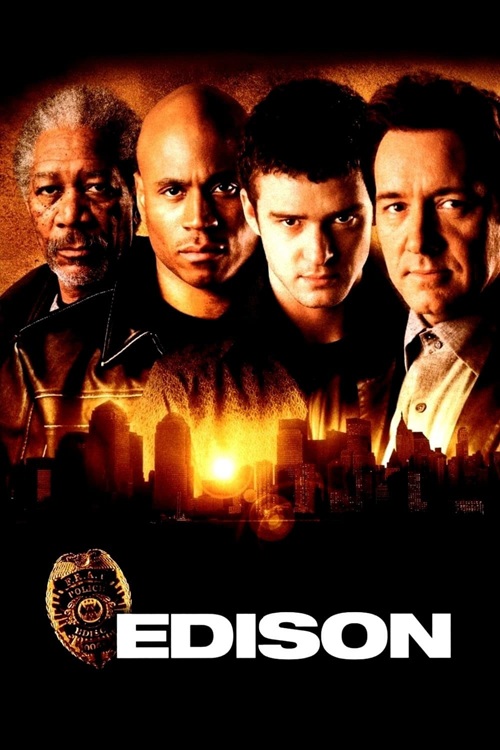
In the town of Edison, a reporter named Pollack (Justin Timberlake) is convinced that he’s uncovered evidence of massive police corruption. His editor, Moses Ashford (Morgan Freeman), responds by firing Pollack but then rehires him on the condition that he actually do the work and interview everyone involved. Pollack is confused until he sees that Ashford has a Pulitzer Prize in his Edison bachelor pad.
FRAT stands for First Response Assault and Tactical. Led by Captian Tilman (John Heard) and protected by duplicitous politician Jack Reigert (Cary Elwes), FRAT has made Edison safe but at what cost? The constitution is regularly trampled. Drug dealers are summarily executed. Sgt. Lazaerov (Dylan McDermott) confiscates and uses the drugs himself while the newest recruit, Detective Deeds (LL Cool J), worries that he’ll be executed when he declines to lie in court. Deeds has reason to be worried because he witnesses the attempted assassination of both Pollack and his girlfriend (Piper Perabo).
Teaming up with Detective Leon Wallace (Kevin Spacey), Pollack and Ashford try to get Deeds to turn on FRAT and expose the trouble in Edison.
First released in 2005, Edison was produced by Randall Emmett, who is today best-known for producing (and occasionally directing) Bruce Willis’s final films. Emmett specializes in getting name actors to play small roles in what are otherwise B-movies. In an Emmett film, De Niro, Stallone, Travolta, or Nicolas Cage might get top billing but usually, they only have a few minutes of screentime. Edison is unique in that Morgan Freeman and Kevin Spacey (who was still considered to be a big name back in 2005) both actually have fairly large roles. Though LL Cool J and Justin Timberlake are the stars of the film, it still appears that it probably took Freeman and Spacey longer than a day to shoot their scenes and that truly does set this film apart from other Emmett productions. I should also note that Spacey wears an incredibly tacky hairpiece while Freeman gets an extended dance scene set to Time Has Come Today by The Chambers Brothers.
Is the film itself any good? Eh, not really. It’s a bit disjointed. John Heard was a good actor but this movie was made when he was at the height of his “9-11 was an inside job” nuttiness and he gives a cartoonish performance as the main bad guy. Cary Elwes is entertaining as the crooked politician but it’s hard not to feel that the film would have been more interesting if he and Kevin Spacey had switched roles. LL Cool J is not particularly convincing as a cop so naive that he’s shocked to discover that there’s corruption on the force. As for Justin Timberlake, this was actually his debut as an actor. Timberlake is always at his best playing morally shady characters, like in Alpha Dog or The Social Network. In this film, he has to play earnest and outraged and he’s never particularly convincing. If anything, he comes across as being a little whiny.
That said, the idea behind Edison is at least interesting. FRAT — like countless other special police units in the country — has become untouchable by actually doing its job. The streets are safer, as long as you don’t get on FRAT’s bad side. Who watches the watchmen? Edison asked this now common question in 2005, when America was still embracing the survelliance state. Flaws and all, Edison was ahead of its time.
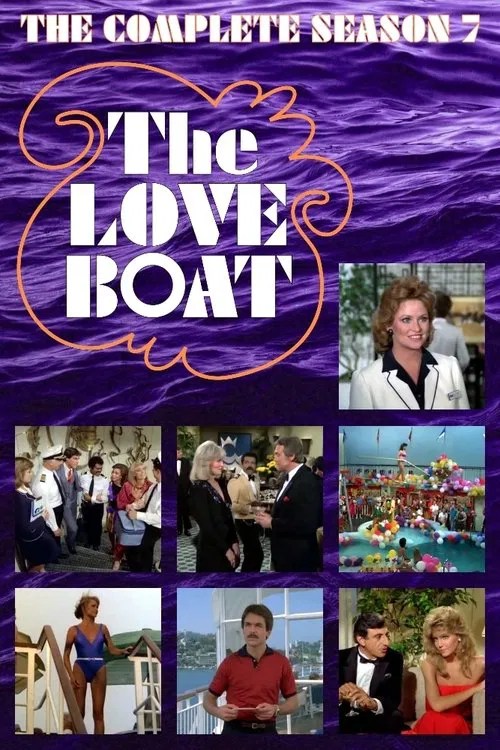
Welcome to Retro Television Reviews, a feature where we review some of our favorite and least favorite shows of the past! On Wednesdays, I will be reviewing the original Love Boat, which aired on ABC from 1977 to 1986! The series can be streamed on Paramount Plus!
(Dir by Richard Kinon, originally aired on December 3rd, 1983)
A detective (Don Gordon) tells Isaac and Gopher that he suspects a woman named Doris will be boarding the boat. She’s supposed to testify in a high-profile divorce case and she’s been dodging the process servers. The detective mentions that there’s a reward for turning Doris in. That definitely get Gopher and Isaac’s attention.
And Doris (Markie Post) is on the boat! Except she is pretending to be a teenager named Dee Dee and she’s speaking in an annoying squeaky voice. Jerry Howard (Clark Brandon) meets Dee Dee and develops a crush on her. Meanwhile, Jerry’s father, Phil (Geoffrey Scott), meets Doris and develops a crush of his own! In the end, Doris falls in love with Phil and Jerry …. well, Jerry gets his heart broken but he claims not to care. Phil is amused. As for the divorce case, it’s settled so Doris doesn’t have to testify after all!
(And no, there’s no reward for Isaac and Gopher. In fact, Stubing threatens to fire them.)
While that’s going on, author Daniel Baker (Tom Poston) wants to enjoy a romantic cruise with his wife (Abby Dalton) but he’s being blackmailed by his assistant, Wendy (Leslie Easterbrook). Wendy knows that Daniel plagiarized sections of his book and she threatens to reveal the truth unless Daniel has an affair with her. This is one of those storylines that would have worked better if some different casting choices had been made. As it is, noted sex symbol Tom Poston feels miscast.
Finally, Julie has a blind date boarding the boat. He turns out to be a nerdy, overweight guy named Leonard Gluck (Walter Olkewicz). Julie has nothing in common with Leonard and is planning on dumping him. But then Leonard dumps her first and Julie has a crisis of confidence. This story had the potential to reveal a new side of Julie but, in the end, Leonard revealed that he only dumped Julie to make her like him and Julie’s confidence was restored, along with her rule about not dating fat guys.
This was not a great cruise. It took me two minutes to get sick of Dee Dee’s voice. Oh well — not every trip can be a winner!
“A man dies when he is forgotten… as long as someone remembers you, you never truly die,” — Dr. Hiriluk
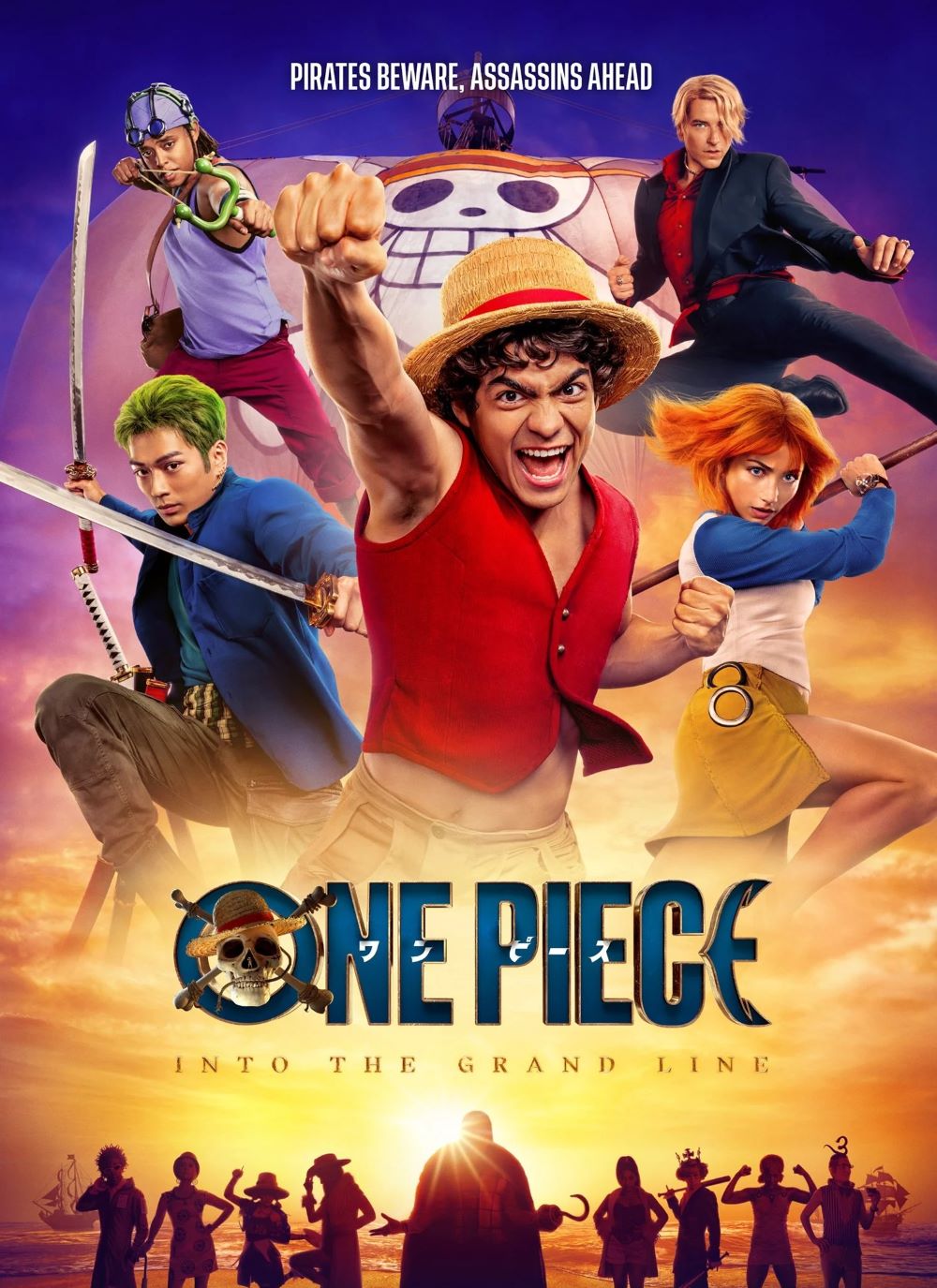
Netflix’s One Piece live-action sails into its second season with a lot more swagger, a lot more snow, and just enough rough edges to keep the debate interesting instead of purely celebratory. Season 2, subtitled Into the Grand Line, takes the Straw Hats from Loguetown through Reverse Mountain, Whisky Peak, Little Garden, and finally Drum Island, and you can feel the creative team leaning into the idea that season 1’s success wasn’t a fluke. It’s bigger, louder, more emotionally direct, and also a bit more overstuffed, but the core mix of sincerity, goofiness, and found-family melodrama still mostly works in live action.
The early stretch, especially episode 1, comes out swinging like the writers have a checklist of “stuff we have to set up before the Grand Line” and they’re determined to cram it all into a single opening salvo. Loguetown gets positioned as both a victory lap for the season 1 crew and a promise that the stakes are rising; you’ve got the looming execution platform, the legacy of Gol D. Roger, and the Marines closing in from multiple angles. Smoker and Tashigi are introduced as new Marine threats, and while they’re not as absurdly overpowered as their manga counterparts, their presence immediately shifts the atmosphere from “wacky pirate road trip” to “you’re on borrowed time, kids.” The result is an opener that’s busy to the point of clutter, but rarely boring, and it reassures you that the show still understands the scrappy, earnest energy that made season 1 feel like a minor miracle.
Once the Going Merry officially commits to the Grand Line, the season loosens up and starts having fun with its new sandbox. Reverse Mountain and Laboon give you that classic One Piece blend of absurdity and heartache: a giant whale with abandonment issues, a sea route that wants to kill you on the way in, and a protagonist who treats impossible odds like minor inconveniences. The adaptation trims and rearranges details from the manga, but the emotional throughline—Luffy refusing to dismiss someone else’s pain as a joke—still lands. Visually, the show takes advantage of wild weather and vertical ship movement to signal that Netflix has clearly opened the purse strings a bit.
The midseason arcs on Whisky Peak and Little Garden are where the season’s strengths and weaknesses sit side by side. On the plus side, the show feels far more confident staging ensemble scenes now; the Baroque Works intrigue in Whisky Peak gives everyone a small moment to shine, from Zoro’s stoic overkill to Usopp’s anxious resourcefulness. At the same time, you can tell the writers are racing a clock. Baroque Works as a threat sometimes plays like “sassy assassins of the week” rather than a deeply rooted conspiracy, and certain reveals hit faster than they probably should just to keep the plot on schedule. There’s a similar push-pull in the Little Garden episodes: the prehistoric island, giant warriors, and dinosaur mayhem are inherently goofy in a way that fits the franchise, but the story occasionally feels like it’s checking off “cool arc landmarks” rather than letting the weirdness breathe.
What keeps that middle section from sagging is how much better the show has gotten at tying action beats to character beats. Sanji and Zoro’s rivalry plays as casual, lived-in banter rather than forced comic relief, and Nami’s role as the crew’s unofficial grown-up becomes more prominent now that they’re in genuinely lethal territory. Usopp’s arc quietly levels up too; by the time we reach the Drum arc, he’s shifted from pure punchline to someone whose lies and bravado hide a growing sense of responsibility to the crew. The series still loves its shonen clichés, but it’s more careful now about using them as punctuation for character moments instead of the entire sentence.
The season really finds its footing once Nami falls ill and the plot veers into Drum Island. Episode 6 uses a simple hook—crew member in medical danger—to justify a full tonal pivot into survival mode, and it pays off. Nami’s fever forces Luffy and Sanji into a desperate climb toward a supposedly witch-haunted castle, and suddenly the story is about how far these idiots will go for each other, framed against a harsh, snowy landscape that looks genuinely inhospitable rather than just “TV cold.” The direction leans into long, wind-whipped shots of the mountainside and the rickety pathways up to Drum Castle so the physical effort feels real, even while we’re still dealing with rubber limbs and talking reindeer.
Visually, Drum Island is where the production team flexes the hardest. Drum Castle plays like a kind of “Winterfell of the Grand Line”: a looming, half-mythic fortress on a cliff that feels grounded enough to stand alongside the more heightened CG work. The snowstorms, the avalanche sequence, the torchlit interiors of Kureha’s domain—all of it sells the idea that the crew has wandered into a different kind of danger than the sunny East Blue of season 1. The score shifts accordingly, mixing sweeping orchestral swells with more intimate piano lines during the quieter medical scenes, and it does a lot of work underscoring the “we might actually lose someone this time” tension.
Episodes 7 and 8 are easily among the strongest hours the live-action has produced. The first of the two slows the pace to focus almost entirely on Tony Tony Chopper’s backstory, and it does that classic One Piece thing of luring you in with a silly premise—a talking reindeer in a tiny hat—and then punching you in the throat with abandonment, discrimination, and grief. The flashbacks to Chopper’s exile from his herd and rescue by Dr. Hiriluk are played surprisingly straight; Hiriluk becomes a ridiculous, heartbreaking figure whose speeches about miracles and cherry blossoms somehow dodge corniness through sheer conviction. Chopper’s performance has a gruff vulnerability that makes his early defensiveness around humans feel earned instead of cute schtick, and the combination of prosthetics, motion capture, and restrained CG works well enough that he reads as a real presence in the room, not a cartoon pasted in after the fact.
That said, the Chopper flashback episode isn’t flawless. Some of the emotional beats linger a bit too long, clearly honoring manga moments that don’t fully translate to live-action pacing, and a few of his transformation gags resort to quick cuts that blunt the imaginative body-horror silliness you get in animation. Still, the emotional spine is strong: Hiruluk’s doomed confrontation with Wapol, punctuated by illusory sakura petals and a speech about when a person truly dies, is staged with an almost theatrical sincerity that the cast actually pulls off. In the present, the B-plot with Zoro and Usopp anxiously waiting in the village for word about Nami is simple but effective, reinforcing how helpless it feels when your role in the crew doesn’t let you directly fix what’s wrong.
In the finale, the action splits cleanly between the village and the castle on the mountaintop, and that structure helps the chaos feel coherent instead of just noisy. Zoro and Usopp are down in Drum Village, hacking their way through the grotesque monster-soldier constructs that Wapol literally spits out as disposable shock troops, giving the ground battle a messy, creature-feature energy. Meanwhile, Sanji and Chopper are up in Drum Castle on top of Drum Mountain, clashing with Wapol’s advisors in tighter, more personal skirmishes that double as a test of Chopper’s resolve to stand with the Straw Hats. Wapol himself returns juiced up on his Baku Baku no Mi powers, and the episode leans hard into the grotesque humor of a villain who eats anything—including his own men—to spit out living weapons and fleshy blob minions.
The blend of practical creature work and CG in that finale isn’t flawless, especially in a few slow-motion shots where the animation looks more rubbery than Luffy, but it’s inventive enough that the absurdity never completely breaks immersion. The action is staged with a nice sense of geography: the snowy streets and rooftops of Drum Village, the cramped interior corridors of the castle, and the exposed battlements all feel distinct, so you always know where you are in the fight. The editing gives each Straw Hat a clear lane—Zoro as the unstoppable blade, Usopp as the desperate tactician, Sanji as the stylish brawler, Chopper as the rookie trying to prove he belongs—without turning the climax into a series of disconnected hero shots.
What really elevates the finale is how it uses the big battle to crystallize character arcs. Vivi, who’s been threaded into the season as a wavering princess-turned-co-conspirator, finally gets a proper leadership moment confronting Wapol and calling out his idea of kingship, and it feels earned instead of “we needed a speech here.” Dalton’s evolution from dutiful soldier to rebel champion hits a satisfying crescendo when he throws himself into the fight in a way that echoes his beastly manga counterpart, giving the non-Straw Hat side of the conflict some emotional heft. Luffy’s most telling moment isn’t about defending his own crew’s banner, but about protecting Dr. Hiriluk and Chopper’s sakura-painted Jolly Roger flag, making it clear that, to him, it isn’t just the Straw Hat symbol he respects but the very idea of a pirate flag as someone’s dream, no matter whose it is.
Chopper’s actual recruitment is peak One Piece cheese in the best way. After an episode and a half of backstory and reluctance, Luffy’s straightforward “You’re our doctor now” carries the weight of everything we’ve seen without turning into a speech, and Usopp’s outsider-to-outsider encouragement seals the emotional deal. The sleigh escape from Drum Castle, complete with impossible cherry blossoms blooming in a blizzard as Kureha salutes them with artillery, should be ridiculous, and it is—but it’s also exactly the kind of heightened, tear-jerking nonsense this series lives on. The show even sneaks in a small but potent Sanji beat, linking his obsession with feeding people to a sickly mother in his past, which adds a layer of vulnerability to his usual horny-cook routine without hijacking Chopper’s spotlight.
To keep things fair, the season does have some recurring issues. The pacing is uneven; cramming five arcs into eight episodes means some side characters and worldbuilding details flash by as cameos rather than lived-in pieces of a larger world. Wapol, while fun, sometimes leans too far into hammy buffoonery, undercutting his menace just when the show wants you to take Drum’s past trauma seriously. A few CG shots—particularly around Wapol’s more exaggerated transformations and some of the blob soldiers—don’t quite match the otherwise solid stunt work and practical sets, which can be jarring when the show is trying to sell you on grounded emotion. Nami spends a big chunk of the Drum arc sidelined by illness, and even though the narrative logic is sound, fans of her more active role in season 1 may feel shortchanged.
On the flip side, the main cast continues to carry the whole enterprise. Iñaki Godoy’s Luffy still walks that fine line between live-action goofball and shonen hero, radiating a kind of unfiltered optimism that makes his big declarations—about friendship, dreams, pirate kings—feel less like memes and more like core character. Mackenyu’s Zoro leans even further into deadpan exasperation, Taz Skylar’s Sanji gets both action hero and quietly wounded pretty boy notes, and Emily Rudd’s Nami remains the emotional anchor even when she’s stuck in a sickbed. Jacob Romero, meanwhile, gets a massive upgrade this season, with Usopp’s arc quietly becoming one of the highlights; he evolves from a running gag and anxious sniper into the Straw Hat who undergoes the most visible growth, fumbling his way toward that dream of being a “brave warrior of the sea” in a way that feels messy, vulnerable, and genuinely human. Add in strong turns from the Drum Island newcomers—Hiriluk’s big-hearted foolishness, Chopper’s skittish warmth, Kureha’s boozy tough love, Dalton’s stoic decency—and you end up with a season that feels richer in performance even when the story is sprinting.
Taken as a whole, One Piece: Into the Grand Line isn’t a flawless second voyage, but it is a confident one. It respects Eiichiro Oda’s world without trying to copy the manga panel-for-panel, it isn’t afraid to tweak pacing and emphasis for live action, and it continues to bet hard on earnest emotion over ironic distance. The rushed arcs, occasional CG wobble, and tonal whiplash won’t work for everyone, especially if you wanted a slower, more atmospheric take on the Grand Line. But if you were on board with season 1’s big-hearted cosplay-epic vibe, season 2 doubles down on that spirit, nails the Drum Island climax, and ends with the crew stronger, weirder, and more ready than ever to take on Alabasta.
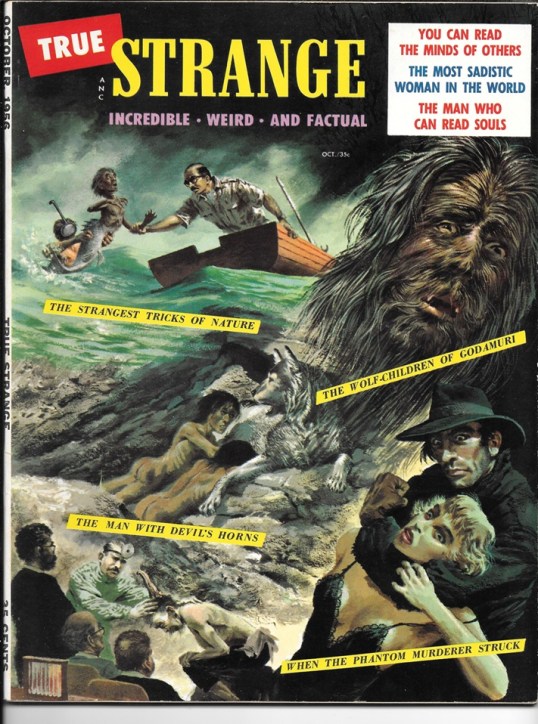
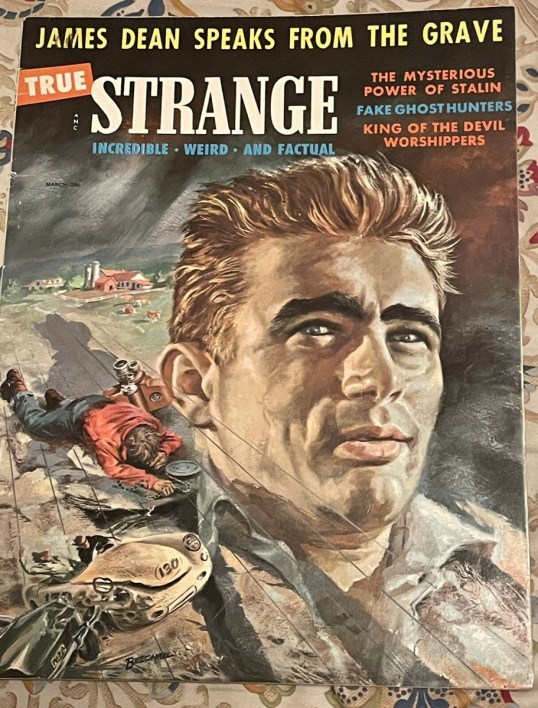
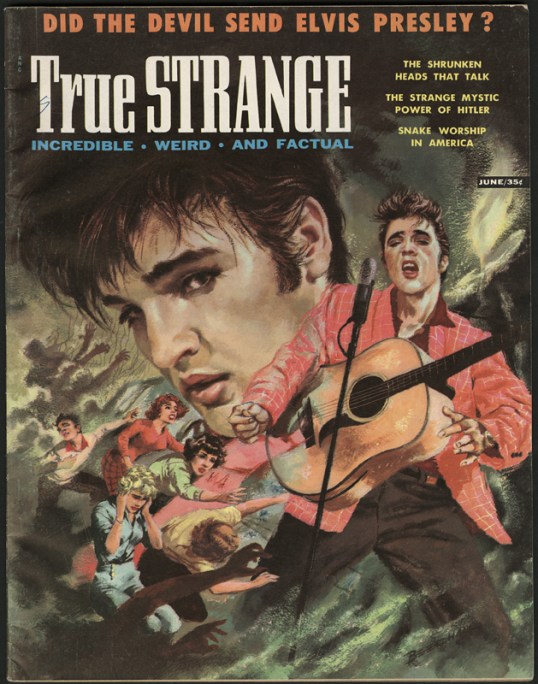
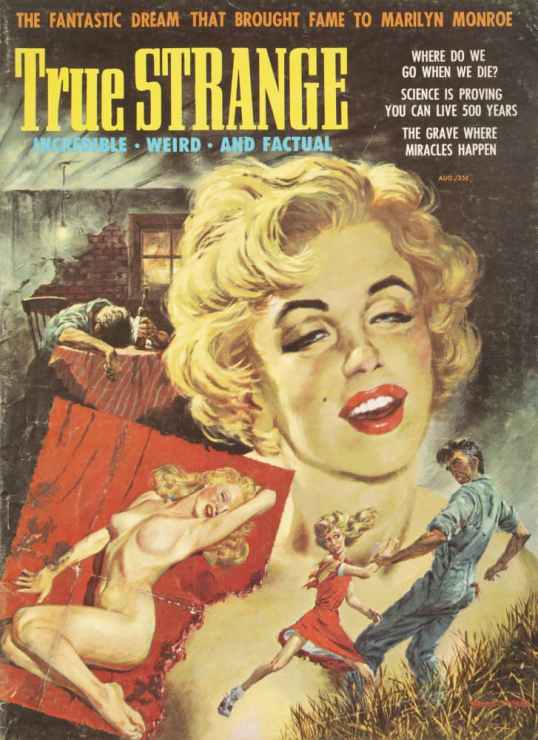
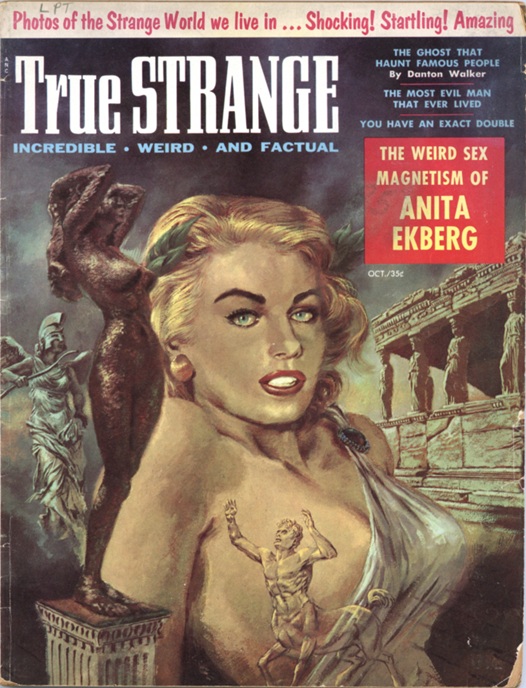
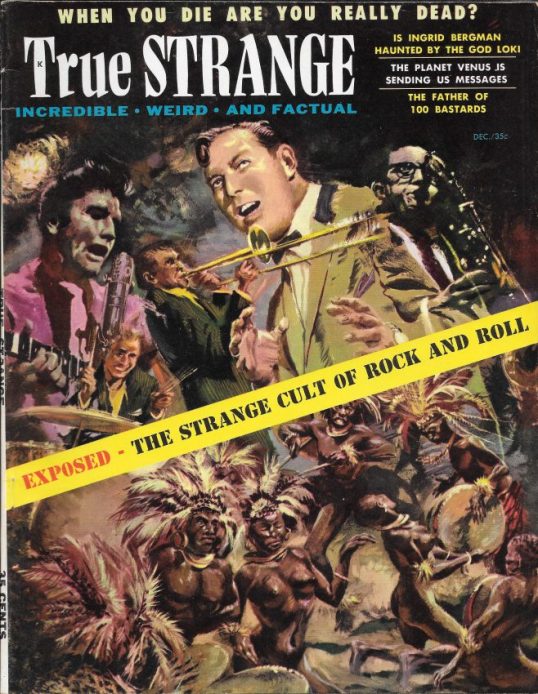
In 1957, seven issues of True Strange Magazine were published. True Strange claimed to feature stories about incidents that were true but strange! Or strange but true. Whichever, the magazine is today eagerly sought after by collectors for its beautiful, celebrity-filled covers, all of which were done by Thomas Beecham.
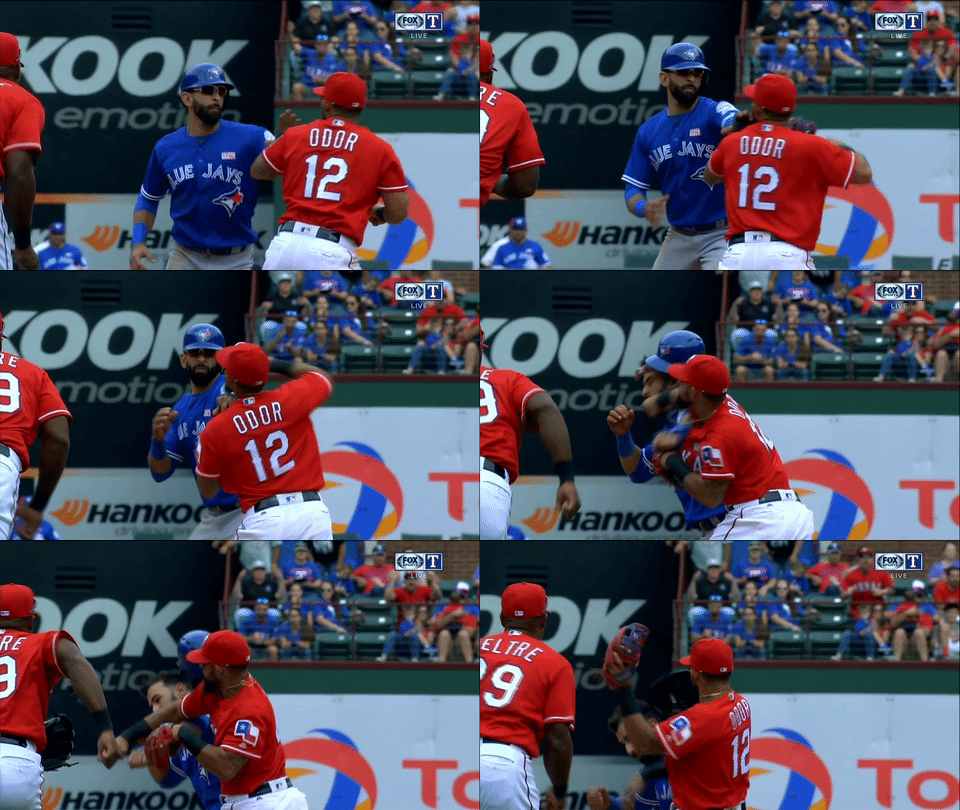
I’m so excited that I’m going to share one of my favorite moments as a Rangers fan, the day that Rougned Odor punched out Jose Bautista. This happened nearly 10 years ago and I still remember it like yesterday. Watch Bautista’s glasses fly! It couldn’t have happened to a nicer guy.
In Dallas, that moment was preserved in a mural. Some people didn’t like this mural but baseball fans understood.
by Juan Velasquez
Here’s hoping for more classic baseball moments this season!
Since today is David Lean’s birthday, it only seems appropriate that today’s song of the day should come from the film that is regularly acknowledged as being Lean’s masterpiece, 1962’s Lawrence of Arabia. Composed by Maurice Jarre, here is one of the greatest film scores of all times.
The great British director David Lean was born 118 years ago today.
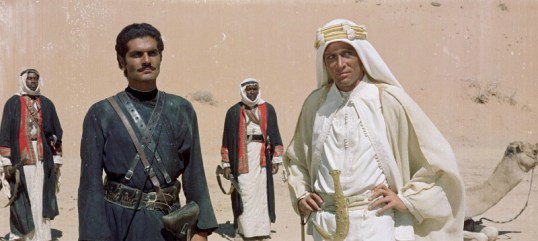
In honor of his films and his legacy, here is a scene that I love from Lawrence of Arabia. In this scene, Peter O’Toole blowing out a flame transports us straight to a sunrise in the desert. Though Lean started out his career directing small-scale but emotionally rich films like Brief Encounter and Great Expectations, he ultimately became best-known for directing historical epics and cinematic spectacles. This scene shows us why. Even to this day, it seems as if any epic film is destined to be compared to the work of David Lean.


 Through the Shattered Lens