It’s true, they don’t!
Today, as we celebrate America’s success in the Winter Games and as we get ready for what will hopefully be a big 250th birthday celebration in July, a song about trucks just feels appropriate.
Enjoy!
It’s true, they don’t!
Today, as we celebrate America’s success in the Winter Games and as we get ready for what will hopefully be a big 250th birthday celebration in July, a song about trucks just feels appropriate.
Enjoy!
After sharing a scene from Manhunter, there was no way I couldn’t pick this for today’s song of the day.
Today, the Shattered Lens wishes a happy birthday to Texas’s own Jennifer Love Hewitt!
Enjoy!

Since today would have been Robert Altman’s 101st birthday, it only seems right that today’s song of the day should come from his best film. In this scene from 1975’s Nashville, Keith Carradine sings I’m Easy as Altman’s camera finds each of his lovers in the audience, all convinced that Carradine is singing expressly to them.
This song won Nashville it’s only Oscar. It also made Keith, who wrote the song, the only Oscar winner amongst the fabled Carradine family.
Here’s a classic music video from X.
When I was looking for a music video to share today, I discovered that the majority of the music videos had recently been uploaded to YouTube were AI. It wasn’t just that the videos were made with AI. It was that the singers and the songs were often AI as well! That was disturbing, especially since most of the AI artists didn’t sound that different from their autotuned real-life counterparts.
Needless to say, I was happy to find this from Exene and X.
Enjoy!
Today’s song of the day is from Crystal Method. Though Keep Hope Alive was featured in the film The Replacement Killers, it was actually inspired by a 1992 speech from Jesse Jackson, which is heard throughout the song.
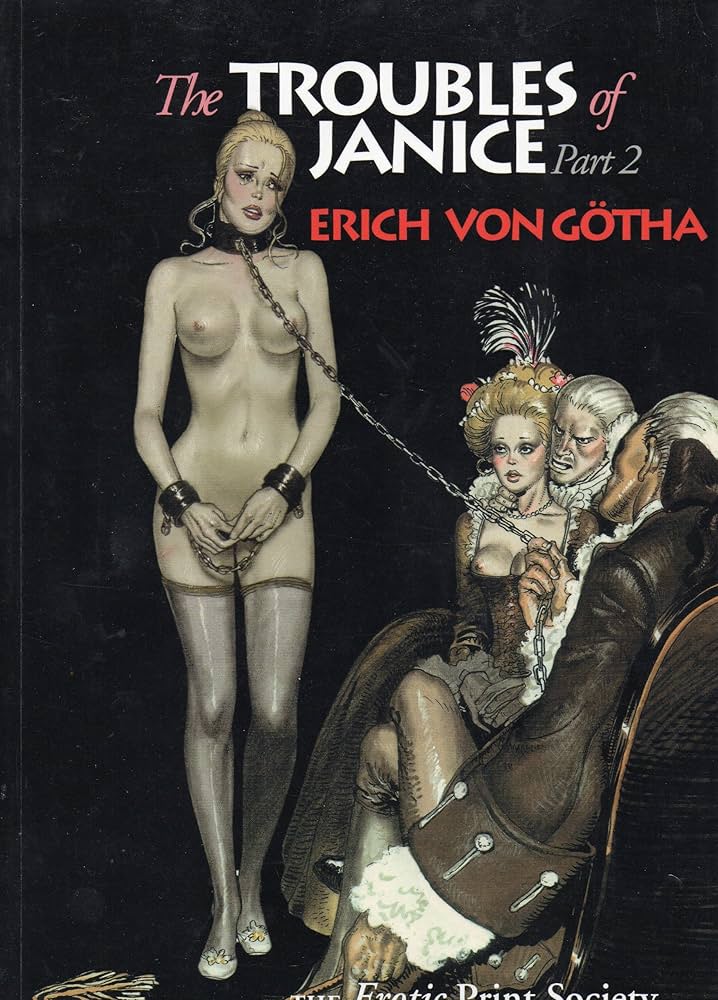
The Troubles of Janice by Erich von Götha remains one of the most infamous works in erotic comics, a multi-volume series spanning 1987 to 1996 that draws readers into a vivid world of sadomasochistic intrigue amid the lavish decay of 18th-century England. Janice McCormick, a curvaceous young woman released from Newgate Prison, soon finds herself ensnared by the sadistic Duke Viscount Vauxhall of Nether Wallop, whose experiments in female discipline propel her through a cascade of blackmail, assassinations, and sensual escapades—from the clandestine Hellfire Club to the shimmering waterways of Venice. Serialized initially in French magazines and later compiled into albums such as Parts 1 through 4, the narrative echoes the spirit of the Marquis de Sade’s Philosophy in the Bedroom, pitting innocence against unbridled authority in panels brimming with exaggerated forms and explicit encounters that straddle the edge of terror and desire.
This series thrives squarely in guilty pleasure territory, offering a procession of BDSM scenarios tailored for indulgent, after-hours reading—Janice bound and enduring floggings, group violations, and ceremonial degradations at the hands of depraved aristocrats, clergy, and a imposing black servant named Horace, whose prominence marks the early chapters. The artwork begins with a raw, straightforward style, its stark lines accentuating phallic prominence and voluptuous contours, but evolves across the run into more refined techniques, incorporating nuanced shading, occasional full-color pages, and fluid compositions that convey genuine motion. Under the pseudonym of British artist Robin Ray, von Götha refined his craft from earlier projects like the sporadic Torrid comic of the 1980s, achieving here a theatrical intensity that elevates rote erotica into something akin to a decadent opera. Janice’s subjugation under Vauxhall builds to extravagant bacchanals, her figure a stage for boundless transgression, sustained by slender plotlines: a doomed union with Lord Mitchcombe, clerical extortion of her fortune, and a desperate flight to Venice. It delivers unvarnished pornographic fantasy, where non-consent heightens the illicit allure, interwoven with dated racism, sexism, and brutality that clash with contemporary standards.
Nevertheless, amid its sensationalism, The Troubles of Janice carries a sly undercurrent that resonates as guilty pleasure, while dedicated admirers in specialized erotica and Sadean circles regard it as elevated art for its bold dissection of dominance and moral corruption. Enthusiasts praise von Götha’s fidelity to historical particulars—powdered periwigs, flickering chambers, and rigid social strata—which grounds the excess in authenticity, recasting Janice’s sufferings as a pictorial meditation on control and yielding. The work’s longevity, evidenced by deluxe reprints into 2008 via publishers like Dynamite and Priaprism/Last Gasp, underscores this devoted following, as initial stark visuals mature into polished depictions of perspiration, anguish, and rapture rendered with technical finesse. Partnership with writer Bernard Joubert lends philosophical weight reminiscent of Sade’s justifications for indulgence, complemented by von Götha’s advertising and design heritage, which infuses each frame with compelling, voyeuristic magnetism.
The episodic structure fosters escalating drama without pause: Janice’s journey from captive to bereaved inheritor to elusive temptress parallels gothic archetypes, her physique weathering not only corporal trials but subtle emotional fissures that suggest deeper psyche amid the torment. Venetian interludes in subsequent volumes add worldly elegance, with Janice alluring period luminaries amid carnivalesque revels and canal rendezvous, a momentary reprieve prior to recapture. Visually, the shift from monochrome austerity to vivid palettes enlivens flesh tones and intensifies ominous depths. Fair assessment reveals shortcomings, however: proportions veer toward the grotesque, recurring motifs dull the initial impact, and pervasive misogyny, though fitting the fantastical milieu, borders on excess even for 1980s sensibilities. Stereotypes such as Horace’s portrayal jar in modern light, affirming its roots in London’s pre-PC erotic underbelly.
Within insular communities, such elements paradoxically enhance its stature—collectors and forums acclaim von Götha as a virtuoso of restraint, his standalone prints and mythic illustrations perpetuating the legacy, bolstered by exhibitions in Bologna and Paris that confer artistic validity. To the broader audience, it embodies quintessential guilty pleasure—discreetly concealed material that fulfills taboo yearnings sans apology. The Troubles of Janice persists by unflinchingly engaging the subconscious, compelling confrontation with shadowed impulses through line and shade. Whether approached for its carnality or its Sadean resonances, The Troubles of Janice endures as a divisive masterpiece, ideally encountered with caution.
Previous Guilty Pleasures
Today, we wish a happy birthday to the one and only Victoria Justice!
Enjoy!

Given the fact that today is the birthday of both John Hughes and Molly Ringwald, it seems obvious what today’s song of the day should be.
Hey, hey, hey, hey
Ooh, woah
Won’t you come see about me?
I’ll be alone, dancing, you know it, baby
Tell me your troubles and doubts
Giving everything inside and out and
Love’s strange, so real in the dark
Think of the tender things that we were working on
Slow change may pull us apart
When the light gets into your heart, baby
Don’t you, forget about me
Don’t, don’t, don’t, don’t
Don’t you, forget about me
Will you stand above me?
Look my way, never love me
Rain keeps falling, rain keeps falling
Down, down, down
Will you recognize me?
Call my name or walk on by
Rain keeps falling, rain keeps falling
Down, down, down, down
Hey, hey, hey, hey
Ooh, woah
Don’t you try and pretend
It’s my feeling we’ll win in the end
I won’t harm you or touch your defenses
Vanity and security, ah
Don’t you forget about me
I’ll be alone, dancing, you know it, baby
Going to take you apart
I’ll put us back together at heart, baby
Don’t you, forget about me
Don’t, don’t, don’t, don’t
Don’t you, forget about me
As you walk on by
Will you call my name?
As you walk on by
Will you call my name?
When you walk away
Or will you walk away?
Will you walk on by?
Come on, call my name
Will you call my name?
I say
La, la-la-la-la, la-la-la-la
La-la-la-la-la-la-la-la-la-la
La-la-la-la, la-la-la-la
La-la-la-la-la-la-la-la-la-la
La-la-la-la, la-la-la-la
La-la-la-la-la-la-la-la-la-la
When you walk on by
And you call my name
When you walk on by
It’s Ash Wednesday! Sharing this song by David Bowie is a bit of an Ash Wednesday tradition and I’m going to keep it going this year. (Yes, I understand the song isn’t actually about Ash Wednesday but, for me, it is.)
This is from a 2000 performance in London.
Enjoy!
 Through the Shattered Lens