Insomnia File No. 15: George Wallace (dir by John Frankenheimer)


What’s an Insomnia File? You know how some times you just can’t get any sleep and, at about three in the morning, you’ll find yourself watching whatever you can find on cable? This feature is all about those insomnia-inspired discoveries!

George Wallace

If, after watching Promise last night, you discovered that you were still suffering from insomnia, you could have watched the very next film that premiered on TCM.  That film was the 1997 biopic, George Wallace.

Like PromiseGeorge Wallace was originally made for television.  Also, much like Promise, George Wallace is a character study of a conflicted man who makes many people uncomfortable and it’s also well-acted by a cast of veteran performers.  That, however, is where the similarities end.  Whereas Promise was ultimately a rather low-key and human drama, George Wallace is an epic.  Clocking in at nearly 3 hours and telling a story that spans decades, George Wallace attempts to use one man’s life story as a way to tell the entire story of the civil rights movement.

That’s a tremendously ambitious undertaking, especially for a film that had to conform to the demands of 1990s television.  Therefore, it’s probably not surprising that the movie, as a whole, is uneven.  It’s not a bad movie but, at the same time, it doesn’t quite work.

First off, we need to talk about who the historical George Wallace was.

(Here’s where I get to show off my amazing history nerd powers.  Yay!)

George Wallace served a total of four terms as governor of Alabama.  A protegé of a populist known as “Big Jim” Folsom, Wallace first ran for governor in 1958.  He campaigned as a moderate who supported integration and, as a result, he was defeated by the KKK’s endorsed candidate, John Patterson.  (Oddly enough, a fictionalized version of Patterson was the hero of the classic and racially progressive 1955 film, The Phenix City Story.)  When Wallace ran again in 1962, he ran as an outspoken segregationist and defeated his former mentor, Jim Folsom.  Infamously, Wallace is the governor who stood in the schoolhouse door and announced that Alabama would never accept integration.  Unable to succeed himself, Wallace arranged for his wife, Lurleen, to be elected as governor.  Lurleen subsequently died in office, succumbing to cancer while Wallace was running for President as the candidate of the American Independent Party.  (As of this writing, Wallace is the last third party presidential candidate to carry any states.)  Reelected governor in 1970, Wallace married Folsom’s niece and made another presidential run.  However, after a string of primary victories, that campaign was cut short when Wallace was shot and crippled by Arthur Bremer.  (Bremer would serve as the inspiration for Robert De Niro’s Travis Bickle in Taxi Driver.)  Confined to a wheelchair, Wallace served as governor until 1978 and, in 1976, ran for President one final time.  After being out of office for four years, he was elected Governor for one final term in 1982.  Late in life (and, it should be pointed out, long after integration had been generally accepted as the law of the land), Wallace renounced his segregationist past and publicly apologized for standing in the schoolhouse door.  During his final campaign for governor, he won a majority of the black vote and he proceeded to appoint more blacks to state positions than any governor before him.

George Wallace lived a long, dramatic, and interesting life and he’s still a very controversial figure.  Who was the real George Wallace?  Was he a political opportunist who used racism to further his career?  Was he truly a racist who saw the error of his ways and repented or did he only pretend to renounce his former beliefs once they were no longer popular?  And, even if Wallace was sincere in his regret, did he deserve to be forgiven or should he always be remembered as the villainous caricature that Tim Roth portrayed in Selma?  If we forgive or make excuses for the actions of a George Wallace, do we run the risk of diminishing the success and importance of the civil rights movement?

And I, honestly, have no answers to those questions.  Unfortunately, neither does George Wallace.  But before we get into that, let’s consider what does work about this film.

George Wallace opens in 1972 with Wallace campaigning in Maryland.  Wallace is played by Gary Sinise and his second wife, Cornelia, is played by a very young Angelina Jolie.  Sinise and Jolie both give brilliant performances, perhaps the best of their respective careers.  Sinise plays Wallace as a calculating and charismatic politician who is also a very angry man.  Throughout every second of his performance, we are aware of Wallace’s resentment that his political success in Alabama has potentially made him unelectable in the rest of the country.  Watching Sinise as Wallace, you see a man who believes in himself but doesn’t necessarily like the person that he’s become.  Meanwhile, Jolie plays Cornelia like a Southern Lady MacBeth and watching her, I remembered how, at one time, Angelina Jolie really did seem like a force of nature.  The Angelina Jolie of George Wallace is the wild and uninhibited Jolie of the past (the one who once said, “You’re in bed, you’ve got a knife, shit happens.”), as opposed to the safe and conventional Jolie of the present, the one who is currently directing rather stodgy movies like Unbroken and By The Sea.

After Wallace is shot, the film goes into flashback mode.  We watch as Wallace goes from being a liberal judge to being the segregationist governor of Alabama.  Mare Winningham plays Lurleen Wallace while Joe Don Baker plays Big Jim Folsom.  They all do a pretty good job but the flashback structure is so conventional (and so typical of a made-for-tv biopic) that it makes the film a bit less interesting.

There’s also a character named Archie.  Played by Clarence Williams III, Archie is literally the only major black character in the entire film.  He is portrayed as being a former convict who has been hired to serve as Wallace’s valet.  While Wallace plots to thwart the civil rights movement, Archie stands in the background glowering.  At one point, he’s even tempted to kill Wallace.  However, after Wallace is shot, Archie helps to take care of him.  The film suggests that being shot and subsequently cared for by Archie is what led to Wallace renouncing his racist views.  (The film also suggests that Wallace was never that much of a racist to begin with and, instead, was just so seduced by power that he would say whatever he had to say to win an election in Alabama.)

At the end of the film, we’re informed that almost everyone in the film was real but that Archie was fictional.  The problem, of course, is that the film is suggesting that the fictional Archie is responsible for the real-life Wallace both rejecting racism and apologizing for the all-too real consequences of racism.  The film ends with the realization that the filmmakers were so convinced that audiences would not be able to accept an ambiguous portrait of a public figure that they created a fictional character so that Wallace could have a moment of redemption.

(It also doesn’t help that a film about civil rights only features one major black character and that character is a fictional valet who doesn’t get to say much.)

In the end, the film doesn’t seem to be certain what it’s trying to say about Wallace and the meaning of his dramatic life.  That said, I enjoyed watching George Wallace because of the acting and because, as a history nerd, I always enjoy seeing historical figures portrayed on-screen, even if the filmmakers don’t seem to be quite sure what they’re tying to say about them.

George Wallace was directed by John Frankenheimer, a good director who, it appears, was constrained by the demands of 1990s television.  If George Wallace were made today, it would probably air on HBO and would probably be allowed to take more of a firm stand one way or the other on Wallace’s character.  That said, it would probably also be directed by Jay Roach who, to put it lightly, is no John Frankenheimer.

Anyway, George Wallace doesn’t quite work but it’s definitely interesting.  Watch it for Gary and Angelina!

Previous Insomnia Files:
  1. Story of Mankind
  2. Stag
  3. Love Is A Gun
  4. Nina Takes A Lover
  5. Black Ice
  6. Frogs For Snakes
  7. Fair Game
  8. From The Hip
  9. Born Killers
  10. Eye For An Eye
  11. Summer Catch
  12. Beyond the Law
  13. Spring Broke
  14. Promise

Insomnia File No. 14: Promise (dir by Glenn Jordan)


What’s an Insomnia File? You know how some times you just can’t get any sleep and, at about three in the morning, you’ll find yourself watching whatever you can find on cable? This feature is all about those insomnia-inspired discoveries!

woods-james-jim-garner-1986-photo-promises-signed-autograph-with-byline-21

If you were awake at midnight last night and if you were watching TCM, you would have seen a 1986 film called Promise.

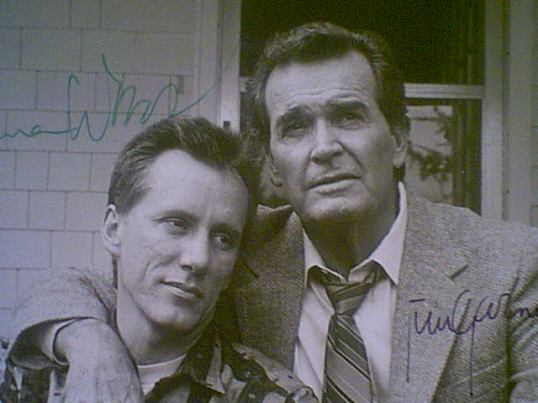
Promise stars James Garner as Bob Beuhler, who is one of those deceptively confident men who seems to have his entire life together.  He’s made a nice little life for himself, buying and selling houses and he lives in a small town where everyone appears to know and respect him.  If Promise were made today, Bob is the type of person who could probably have his own A&E reality show.

But then Bob’s mother dies and we learn of a promise that Bob made forty years ago.  It turns out that Bob has a younger brother, named D.J. (James Woods).  D.J. suffers from schizophrenia and he’s spent all of his life living with his mother.  It quickly becomes apparent that the main driving force behind Bob’s success has been the need to prove that he’s nothing like D.J.  When he doesn’t take his medication, D.J. is unpredictable and suffers from violent mood swings.  Bob loves his brother but he’s also scared of him.

However, Bob made a promise and he’s going to try to honor it.

It turns out to be even more difficult than he expected.  Sometimes, D.J. is calm and sweetly shy.  Other times, he becomes violent.  The rest of the town starts to gossip about Bob’s “crazy” brother.  After one fight, Bob discovers that D.J. has become catatonic.  When Bob calls an ambulance, everyone in the neighborhood lines up on Bob’s lawn to watch as D.J. is taken away.

Even though D.J. is eventually released from the hospital and returns home, Bob still is unsure of whether or not he can properly care for his brother.  When they go on a trip to a cabin that they often visited as children, Bob is surprised to see how “normal” D.J. is acting.  But how long will it last?

When I looked up Promise on the imdb, I was not surprised to discover that it was originally made for television.  The fact that nobody in the film ever curses was a dead giveaway and the script occasionally threatens to turn into a PSA.  But, with all that in mind, Promise is still a wonderfully effective and rather heartbreaking little movie.  James Woods has the more showy role and does a great job with it’s the far more low-key James Garner who keeps the film grounded.  Watching a film like Promise, you see that Garner was really a great actor.

Promise is a sad film but it’s definitely one worth watching.

Previous Insomnia Files:

  1. Story of Mankind
  2. Stag
  3. Love Is A Gun
  4. Nina Takes A Lover
  5. Black Ice
  6. Frogs For Snakes
  7. Fair Game
  8. From The Hip
  9. Born Killers
  10. Eye For An Eye
  11. Summer Catch
  12. Beyond the Law
  13. Spring Broke

Insomnia File #12: Beyond The Law (dir by Larry Ferguson)


What’s an Insomnia File? You know how some times you just can’t get any sleep and, at about three in the morning, you’ll find yourself watching whatever you can find on cable? This feature is all about those insomnia-inspired discoveries!

Beyond_the_Law_(1992_film)_poster

Last night, if you were awake at one in the morning, you could have turned on FLIX and watched the 1993 film Beyond The Law.

Now, you may look at the title and think to yourself, “That movie sounds way too generic for anyone to watch.”  And, to a certain extent, you’re right.  Based, so the narrated epilogue insists, on a true story, Beyond The Law is about a troubled cop who goes undercover and joins a biker gang.  After gaining the trust and friendship of the gang’s ruthless leader, the cop struggles to maintain a between order and chaos.  Sometimes, he succeeds.  Sometimes, he doesn’t.  Largely, his success is dependent on whatever the narrative requires at the moment.

It’s totally predictable but, at the same time, it’s hard not to watch.  When a film starts with an Indian shaman telling Charlie Sheen that his dark side is going to destroy him, how can you not keep watching?

That’s right … the undercover cop is played by Charlie Sheen.  Fortunately, since Beyond the Law was made in 1993, we’re talking about the sexy and dangerous Charlie Sheen who showed up at the end of Ferris Bueller’s Day Off and not the sad and bloated Charlie Sheen who co-starred on Two And A Half Men.

Charlie’s a deputy in Arizona who, as a result of his traumatic childhood, has a violent temper.  After he gets into a fist fight with another deputy (played by Rip Torn), he is told that he can either quit the force or he can go undercover.  He chooses to go undercover.  Fortunately, he knows an informant (Leon Rippy) who can teach him how to pass for a biker.  The informant’s nickname is Dildo (no, really) but later, we find out that his given name is Virgil.  And he’s Charlie’s guide through the Hell of the Arizona underworld, just as another Virgil led Dante through another Hell…

Yes, it’s totally heavy-handed but somehow, it’s appropriate.  The title may be generic but, within the first 30 minutes of the film, Beyond the Law gives us Indian wisdom, strange flashbacks, references to Dante, a guy named Dildo, and Charlie Sheen.  But that’s not all!  Beyond the Law also has Michael Madsen!

Michael Madsen plays Blood, the leader of the biker gang that Charlie has to infiltrate. And he gives a classic Michael Madsen performance, full of random squints, arched eyebrows, menacing pauses in the middle of dialogue, and that famous Michael Madsen half-smirk.  Predictable as its plot may be, Beyond The Law is your only chance to see Charlie Sheen and Michael Madsen compete to see who can chew the most scenery.  Charlie does his crazy eyes.  Madsen does his half-smirk.  In the end, I would say that Madsen wins.

Charlie also ends up having a relationship with an photojournalist (Linda Fiorentino).  Before going undercover, he gave her a speeding ticket and, when they later meet at a biker gathering, she immediately recognizes him but keeps his secret.  She doesn’t really get to do much in the film but I still liked the character because she was tough and she was the only person in the film who could outsmirk Michael Madsen.

Beyond The Law is nothing special but it’s worth watching just for the chance to see Michael Madsen and Charlie Sheen acting opposite each other.

Previous Insomnia Files:

  1. Story of Mankind
  2. Stag
  3. Love Is A Gun
  4. Nina Takes A Lover
  5. Black Ice
  6. Frogs For Snakes
  7. Fair Game
  8. From The Hip
  9. Born Killers
  10. Eye For An Eye
  11. Summer Catch


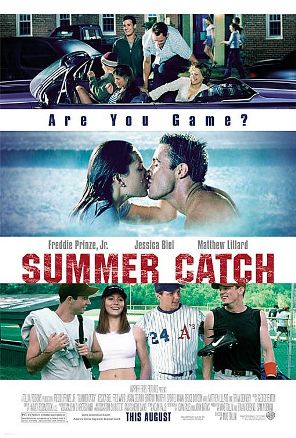
Insomnia File #11: Summer Catch (dir by Mike Tollin)


What’s an Insomnia File? You know how some times you just can’t get any sleep and, at about three in the morning, you’ll find yourself watching whatever you can find on cable? This feature is all about those insomnia-inspired discoveries!

Summer_catch

Whenever I look at my cable guide, I always notice that channel 834 is listed as being “MorMax.”  For some reason, I always assume that MorMax stands for Morman Max and I’m always expecting that it’s going to show movies about Joseph Smith and Brigham Young.  But actually, MorMax stands for More Cinemax.

Anyway, last night, if you were having a hard time sleeping around midnight (though why anyone would ever try to go to sleep before midnight is beyond me), you could have turned on MorMax and watched the 2001 romantic comedy Summer Catch!

Though it may be hard to believe today, there was a time when Freddie Prinze, Jr. was a pretty big deal.  From 1997 to 2001, Prinze appeared in 179 movies.  Well, actually, he only appeared in 10 but since they were all aimed at teenage girls and played on cable constantly, it felt like 179.  (Seriously, there was a time when I could not get through an entire day without seeing at least a few minutes of She’s All That.)  For the most part, all of these films were pretty much the same.  Freddie Prinze, Jr. plays a kind of dumb guy who falls in love with a girl.  Prinze’s character was usually from a working class family and had at least one wacky friend.  The girl was usually from a rich family and had one bitchy friend who would be an ex-friend by the end of the movie.  There was usually at least one scene set on the beach or at a swimming pool, the better for Freddie to remove his shirt and his costar to chastely strip down to her underwear.  There was usually a falling in love montage and at least one big misunderstanding.  Freddie would always flash the same goofy smile whenever the misunderstanding was cleared up.  Even at the time that the films were being released, nobody was ever under the impression that Freddie Prinze, Jr. was a particularly good actor.  But he was likable, unthreatening, and hot in an oddly bland sort of way.

(Speaking of oddly bland, check out the titles of some of Prinze’s films: She’s All That, Down To You, Boys and Girls, Head over Heels, and, of course, Summer Catch.)

Summer Catch opens with Ryan Dunne (Freddie!) explaining that he’s just a working class kid from Massachusetts but this summer, he’s going to be playing amateur baseball in Cap Cod and hopefully, he’ll get signed to a professional contract as result.  (Freddie adopts an inconsistent “pahk ya cah by the bah” accent and its kind of endearing to see him trying so hard.)  Ryan, of course, is just a local guy who mows lawns for a living but he’s determined to succeed.  He just has to stay focused.

However, that’s going to be difficult because he’s just met Tenley Parrish (Jessica Biel).  The Parrishes own a vacation home on Cape Cod and they are so rich that they can afford to name their oldest daughter Tenley.  Soon, Tenley and Ryan are a couple but Tenley’s father wants Tenley to marry a rich boy and Ryan’s father is too busy being all surly and working class to appreciate Ryan’s dreams.

(Tenley’s father, incidentally, is played by Bruce Davison because all snobbish WASPs of a certain age are played by Bruce Davison.  Ryan’s father is played by Fred Ward because Summer Catch was made in 2001.)

Because every Freddie Prinze, Jr. movie needs a hyperactive and wacky sidekick, Ryan’s best friend on the team is a catcher named Billy Brubaker (Matthew Lillard.)  Billy is known as “Bru.”  There’s a lot of scenes of people saying stuff like “Yo, Bru,” and “Come on, Bru!”  After a while, I found myself hoping for a scene where Bru went crazy and started shouting, “My name is Billy, dammit!  BILLY!  DAMN YOU ALL TO HELL!”  Instead, however, we get a subplot about how Billy can’t get any hits until he has sex with and wears the thong underwear of a local baseball fan.

Anyway, Summer Catch is an extremely predictable film.  It’s not surprising that this was one of Freddie’s final star vehicles because, other than his heroic effort to maintain a Massachusetts accent, even he seems to be bored with it all.  Perhaps the most remarkable thing about Summer Catch is that there’s next to no actual conflict in the film.  Oh sure, Ryan and Tenley have a few misunderstandings but it’s never anything serious.

If there’s an unheralded hero to Summer Catch, it’s the uncredited guy who we hear providing commentary during the games.  Seriously, I would have been so lost if not for him constantly saying stuff like, “This is Ryan Dunne’s chance to show what he can do,” and “Billy Brubaker needs to get a hit here…”  They should have made the entire movie about him and his efforts to remain up-to-date on all the players.

Because Summer Catch was a baseball film, I begged my sister Erin to watch it with me so that she could explain all the baseball stuff to me.  For the record, Erin says that the game scenes were okay (and I personally liked all of the totally gratuitous slow motion) but that the film wasn’t really a deep examination of baseball.  To be honest, I really wasn’t expecting that it would be.  I just wanted to make my sister stay up late and watch a movie with me.

Previous Insomnia Files:

  1. Story of Mankind
  2. Stag
  3. Love Is A Gun
  4. Nina Takes A Lover
  5. Black Ice
  6. Frogs For Snakes
  7. Fair Game
  8. From The Hip
  9. Born Killers
  10. Eye For An Eye


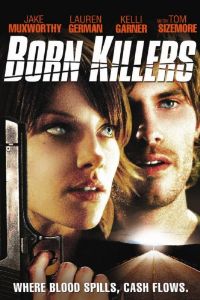
Insomnia File #9: Born Killers (dir by Morgan J. Freeman)


What’s an Insomnia File? You know how some times you just can’t get any sleep and, at about three in the morning, you’ll find yourself watching whatever you can find on cable? This feature is all about those insomnia-inspired discoveries!

Born Killers 2

If you were suffering insomnia at around 2:30 this morning, you could have turned over to ActionMax and watched the 2005 film Born Killers.

Now, probably the first thing that you noticed about this film is that the director is named Morgan J. Freeman.  That J is there for a reason.  In no way is Morgan J. Freeman the director related to Morgan Freeman the actor.  Instead, Morgan J. Freeman is a director who has done a few indie films and who will probably never live down the fact that he directed American Psycho II: All-American Girl.  According to the imdb, Freeman is also an executive producer on Teen Mom.

In other words, Morgan J. Freeman has been involved with a lot of crap.

However, Born Killers is actually a fairly good film.  It’s certainly far better than anything you would expect to see from the director of American Psycho II.

Born Killers tells the story of two brothers, John (Jake Muxworthy) and Michael (Gabriel Mann).  John and Michael are both killers.  They call other human beings “piggy banks” and they spend all of their time murdering innocent people and then robbing them.  For the wild and unpredictable Michael, it’s fun.  For the coolly calculating John, it’s strictly business.  They’re both sociopaths but, as quickly becomes apparent, Michael is the only one who is having any fun.

Through flashbacks, we discover that Michael and John never really had a chance to be anything other than what they eventually became.  From an early age, their father (Tom Sizemore, who is absolutely chilling) taught them how to kill and steal.  After their father’s violent death, John and Michael go on their own killing spree.

And everything seems to be going well for them, until John ends up shooting Michael.  Why did John kill him?  Even though John is narrating the story, he doesn’t seem to be sure.  He admits that his memory may be fooling him.  He thinks that it might have something to do with a woman named Archer (Kelli Garner), who the brothers reluctantly murdered.

With his brother now dead, John tracks down his half-sister, Gertle (Lauren German).  John hasn’t seen Gertle in years and, when he first approaches her, he pretends to be a Mormon missionary.  Gertle responds by leading him into her house and, after they have sex, she tells him that she knows that he is her half-brother.

Though John was originally planning on murdering her, he instead finds himself falling in love with her and even feeling that maybe his love for her would redeem him for all of his past crimes.  When she tries to warn him that she has issues of her own, John replies that he knows they are meant to be together.  He begs her to take a chance on him.

But Gertle, as you’ve probably guessed, has secrets of her own…

At first, I wasn’t expecting much from Born Killers.  And, for the first 30 minutes or so, it plays out like your typical serial killer road film.  I kept watching because of the performances but I didn’t think much of the story.  However, as soon as John tracks down his sister, the entire movie changes direction and it actually starts to catch you off guard.  Suddenly, you’re no longer sure just what exactly is going to happen or how it’s going to end.  During the final half of the film, Lauren German and Jake Muxworthy give such good and compelling performances that you forget about the shaky first half.  Even if the film’s ending is a little bit too twisted for its own good, it’s still an interesting journey.

All in all, Born Killers is not at all bad for a low-budget serial killer film airing on Cinemax at two in the morning!

born killers

Previous Insomnia Files:

  1. Story of Mankind
  2. Stag
  3. Love Is A Gun
  4. Nina Takes A Lover
  5. Black Ice
  6. Frogs For Snakes
  7. Fair Game
  8. From The Hip

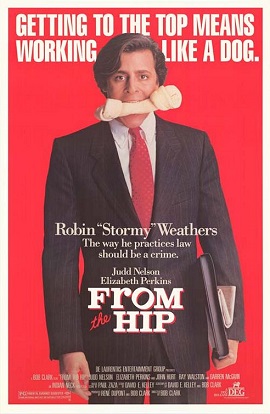
Insomnia File No. 8: From the Hip (dir by Bob Clark)


What’s an Insomnia File? You know how some times you just can’t get any sleep and, at about three in the morning, you’ll find yourself watching whatever you can find on cable? This feature is all about those insomnia-inspired discoveries!

From_the_Hip_(film)

Last night, if you discovered that you couldn’t get any sleep around two in the morning, you could have turned to Showtime and watched the 1987 film, From The Hip.

In From the Hip, Judd Nelson plays a character named Robin Weathers.  Of course, his nickname is Stormy.  Robin has just graduated from law school and is working at a prestigious law firm.  He’s ambitious, he’s outspoken, and he’s totally frustrated.  As his co-workers (played, quite well, by David Alan Grier and Dan Monahan) continually remind him, nobody gets to try a case during their first year out of law school.  They advise him to be patient and to wait his turn.

However, a man who is capable of being patient would not be nicknamed Stormy.  It just wouldn’t make any sense.  So, Stormy Weathers schemes his way into the courtroom.  One morning, he intentionally withholds information from the senior partners, going out of his way to keep them from realizing that a trial is scheduled to begin that afternoon.  When senior partner Craig Duncan (Darren McGavin) discovers what Stormy has done, he fires him and makes sure that he never get hired at another law firm … oh wait.  No, he doesn’t because that would make too much sense.  Instead, he allows Stormy to try the case because, at this point, Stormy is the only one who knows anything about it.

The case is a simple assault case that involves two bankers and should be resolved easily but Stormy manages to drag it out for several days and his flamboyant style catches the attention of the media.  The other partners in the law firm — who are all old and boring — want to fire Stormy but Stormy’s client says that, if Stormy is fired, he’ll take his business and his money elsewhere.  Stormy becomes a minor celebrity but — in a rather clever little twist — it turns out that he and the prosecuting attorney are old friends from law school and they conspired to make each other look good.

Anyway, Stormy is now so famous that he gets assigned to defend a college professor, named Benoit (John Hurt), who has been accused of murder.  When it quickly becomes obvious that Benoit is not only guilty but will probably murder again, Stormy is forced to choose between ambition and morality…

When my friend Evelyn and I first started to watch From the Hip last night, I really thought I was going to hate it.  The hot pink neon credits screamed, “Bad 80s movie!” and, because I happen to know quite a few lawyers, I tend to be a 100 times more critical of movies about lawyers than I am when it comes to movies about, say, homicidal fishermen.

And, honestly, From The Hip is a heavily flawed film.  Judd Nelson is miscast and the scenes with his politically conscious girlfriend (Elizabeth Perkins) are painfully shallow and reek of limousine liberalism.  But, if you can get through the weak opening, the film itself is watchable and enjoyable in a dumb sort of way.  John Hurt does a great job as a sociopath and, miscast as he may be, it’s still fun to watch Nelson go insane in court.

From The Hip is not a great film but, in its way, it’s an enjoyable little time capsule.  Believe it or not, there was a time when Judd Nelson starred in a movies that were actually released in theaters.

Previous Insomnia Files:

  1. Story of Mankind
  2. Stag
  3. Love Is A Gun
  4. Nina Takes A Lover
  5. Black Ice
  6. Frogs For Snakes
  7. Fair Game


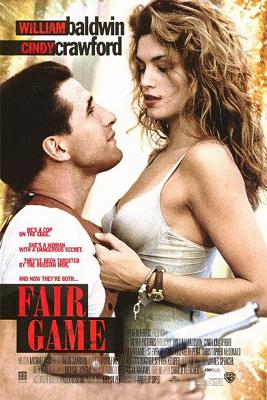
Insomnia File No. 7: Fair Game (dir by Andrew Sipes)


What’s an Insomnia File? You know how some times you just can’t get any sleep and, at about three in the morning, you’ll find yourself watching whatever you can find on cable? This feature is all about those insomnia-inspired discoveries!

Fair_game

On Tuesday night, if you were suffering from insomnia at midnight, you could have turned over to HBO Signature (commonly listed as HBOSIG) and watched Fair Game, a remarkably mindless action film from 1995.

Originally, my plan was to start this review of Fair Game by telling you, in quite a bit of detail, just how sick I am of the Russian Mafia.  Seriously, Russian mobsters have become the default villain for lazy crime films everywhere.  And, quite frankly, I’m getting bored with them.  I’m bored with how the head Russian mobster is always described as being “former KGB” and is always found sitting in the back room of restaurant, wearing an overcoat and smoking filterless cigarettes.  I am bored with how his main henchman is always some big guy with a crew cut and that guy always has a thin sidekick who wears his hair in a pony tail and has a bad mustache.  I’m sick of the overexaggerated accents of American and British accents trying to sound Russian and the way they’re always listening to EDM while driving.  It’s all so predictable and tedious.

But then I considered that Fair Game was made 20 years ago.  Even if the villains are Russian mobsters and even if they are some of the least interesting Russian mobsters in cinema history, it’s totally possible that, when Fair Game, was made, there was still some sort of novelty about the Russian Mafia.

However, even if we give Fair Game a pass on using the cliché of the Russian mob, the villains still weren’t particularly interesting.  Kazak (Steven Berkoff) is … well, the film isn’t really that clear on what Kazak’s big plan is but he has a lot of henchmen and they certainly do end up killing a lot of people.  Kazak runs his operations off of a yacht that belongs to a Cuban criminal named Emilio (Miguel Sandoval).  Emilio is in the process of getting divorced and attorney Kate McQuean (model Cindy Crawford, who made her film debut here and has never played a leading role since) is determined to repossess his boat.  So, Kazak decides that the perfect solution would be to murder Kate…

Which makes absolutely no sense.  Kazak doesn’t want anyone to discover his operation so he decides to blow up a good portion of Miami, all in pursuit of one person.  Wouldn’t it make more sense for Kazak to just blow up the boat and buy a new one?

Anyway, as the film opens, Kate is out jogging when suddenly someone driving by in a car opens fire on her.  She ends up getting grazed in the arm, not that it seems to bother her.  She wears a bandage for a few scenes but it soon vanishes.  Kate is all business so, even after getting shot, she still goes into the office and starts to make plans to repossess that yacht.  Personally, if anyone ever shot at me, I would probably be so freaked out that I would never leave the house again.

Now, you may be thinking that Kate was shot because of Kazak but actually, it turns out that the shooting was just a random thing that happened.  Apparently, the shooter was trying to shoot someone else and Kate just happened to be in the wrong place at the wrong time.  So, we never find out who actually shot Kate and that really bothered me, as that seems to be kind of a huge plot point to bring up and then refuse to resolve.

Anyway, Kate meets a detective named Max Kirkpatrick (William Baldwin) and, soon, they’re on the run from Kazak’s assassins.  The majority of the film is made up of Max and Kate running from one location to another.  One thing that really bothered me was that literally everyone that Max and Kate talked to ended up getting killed just a few minutes later.  At one point, Kate flirts with a computer service expert to get him to help them out.  The scene is played for laughs but then, five minutes later, that same innocent technician guy is being brutally tortured by a bunch of Russians and, though we don’t see it happen, it’s safe to assume that he was eventually murdered by them.  And no point do Max or Kate appear to feel any guilt or concern about the number of innocent people who are killed just for associating with them.

Anyway, Fair Game is a completely mindless film that has a rather nasty streak of sadism to it.  (I imagine, when this film was released, it probably set a record for close-ups of people getting shot and stabbed in the crotch.)  William Baldwin and Cindy Crawford both have perfect bodies and give totally wooden performances, which leads to them having a dimly-lit sex scene that is both physically hot and emotionally cold at the same time.

(I have no idea what entropy at absolute zero means but it sounds like a pretty good description of the chemistry between Cindy Crawford and William Baldwin in Fair Game.)

One good note: Salma Hayek has a small role as Max’s ex-girlfriend.  Whenever she shows up in the movie, she starts screaming at everyone.  I don’t blame her.

Fair Game

Previous Insomnia Files:

  1. Story of Mankind
  2. Stag
  3. Love Is A Gun
  4. Nina Takes A Lover
  5. Black Ice
  6. Frogs For Snakes


Insomnia File No. 6: Frogs For Snakes (dir by Amos Poe)


What’s an Insomnia File? You know how some times you just can’t get any sleep and, at about three in the morning, you’ll find yourself watching whatever you can find on cable? This feature is all about those insomnia-inspired discoveries!

220px-Frogs_for_Snakes

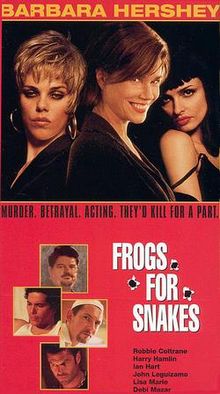
If you were suffering from insomnia last night, at around two a.m., you could have turned over to Flix and watched the 1998 film Frogs For Snakes.

And if you were suffering from insomnia, watching Frogs For Snakes would probably have been a good idea because this film is amazingly dull.  In fact, I am not sure that I have the words to express to you just how tedious Frogs For Snakes truly was.  It may be necessary for me to go back to school and learn how to speak in a dead language in order for me to express the boredom that I felt while watching Frogs For Snakes.

And yes, I realize that I’m talking about an obscure film that was released nearly 20 years ago and it might seem kind of petty to, at this late date, make a big deal about how terrible this film was.

But seriously, Frogs For Snakes was really, really bad.  In fact, it was disturbing to think that a film this bad could have actually been made.  It was even more disturbing to consider that this film was apparently given a theatrical release and, all these years later, still pops up on cable so that it can proudly display its overwhelming mediocrity.

Now, I’m going to tell you what Frogs For Snakes is about and you’re going to think, “That actually sounds like it might be kind of interesting.”  Don’t be fooled!  The film may sound interesting but it’s not.

Frogs for Snakes takes place in a stylized, neo-noir version of New York City.  Eva Santana (Barbara Hershey) is an aging actress who claims to have quit the business, though it’s clear that it’s more a case of the business quitting her.  She talks about leaving New York and raising her son in a better environment.  However, until she gets around to leaving, she’s making ends meet by working as a waitress at a diner owned by the kind-hearted Quint (Ian Hart).  And, of course, when she’s not waitressing, she’s working as a debt collector for her ex-husband, a loan shark named Al Santana (Robbie Coltrane).

That’s right, this actress has a gun and she uses it frequently.  However, because Eva is good at heart, she rarely kills anyone.  Instead, she just shoots them in the foot and tells them to pay back their loans while they lay on the floor and scream in agony.  (All that agonized screaming got pretty old after a while.)

As for Al, he’s not just a loan shark.  He’s a theatrical impressario.  He’s planning on putting on a production of David Mamet’s American Buffalo.  He promises his driver a role in American Buffalo on the condition that the driver assassinate Eva’s new boyfriend (John Leguizamo, of course).

Soon, actors all over New York are literally killing to get a role in Al’s play.  Meanwhile, Eva just wants to retire and get out of New York but first, she has to do one last job for Al…

In between all the killing, the characters frequently launch into monologues that have been lifted from other films.  John Leguizamo does a Brando imitation.  Lisa Marie (Tim Burton’s ex, not yours truly) delivers the cuckoo clock speech from The Third Man.  A suggestion for aspiring filmmakers: if you’re going to make a bad film, don’t remind your audience that they could be watching The Third Man instead.

Anyway, the plot sounds interesting but none of the potentially intriguing ideas are explored.  I imagine that the film was meant to be a satire of Off-Broadway ruthlessness but ultimately, the film is just another tediously violent indie film from the 90s.  This is one of those movies where nobody can do anything without spending an excessive amount of time talking about it beforehand and, when things do turn violent, it’s the worst type of quirky, sadistic, drawn-out, “look how crazy we are” violence.

There’s a scene towards the end of the film where Al shoots a group of people in a bar.  This is intercut with clips from the Odessa Steps sequence from Battleship Potemkin.  As Al leave, he shoots the TV showing Battleship Potemkin and, I have to say, that really annoyed me.  Seriously, just as a bad filmmaker should not remind people that they could be watching The Third Man, he shouldn’t invite them to compare his film to Battleship Potemkin unless he’s willing to back up the comparison.  When Al shot the TV, I found myself hoping that Sergei Eisenstein would pop up and shoot him.

Frogs for Snakes is one of the worst films that I’ve ever seen.  It may, in fact, be the worst but I would need to rewatch Ted 2 before I said that for sure.  But, if you have insomnia, Frogs For Snakes will at least put you to sleep.

Previous Insomnia Files:

  1. Story of Mankind
  2. Stag
  3. Love Is A Gun
  4. Nina Takes A Lover
  5. Black Ice


Insomnia File No. 5: Black Ice (dir by Neill Fearnley)


What’s an Insomnia File? You know how some times you just can’t get any sleep and, at about three in the morning, you’ll find yourself watching whatever you can find on cable? This feature is all about those insomnia-inspired discoveries!

Black Ice 2

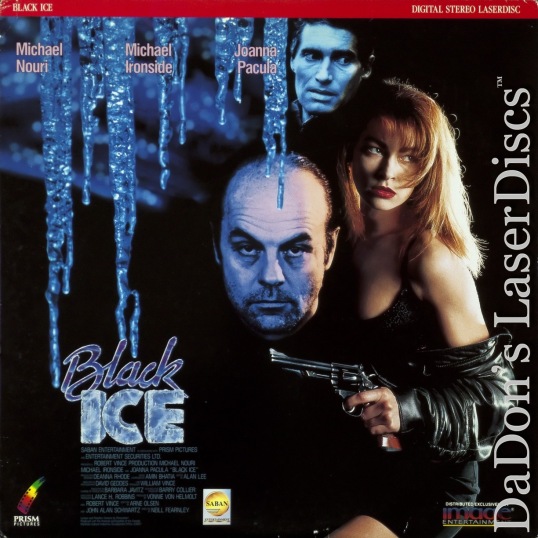
If you were having trouble getting to sleep last night at 2 a.m., you could have turned over to Indieplex and watched Black Ice, a Canadian thriller from 1992.

Why is the film called Black Ice?  Well, that’s a good question.  There’s a lot of snow and ice to be seen in the film but absolutely none of it is black.  According to the imdb, this film was also released under the title A Passion for Murder.  I have to admit that I kind of like A Passion For Murder as a title, simply because it’s so generic and empty that it becomes oddly brilliant.  If you were making a parody of the type of movies that Netflix usually lists in the “steamy thriller” category,  A Passion For Murder is probably the title that you would come up with.

But, as for this film, it opens as all thrillers from the early 90s must, with a man in a suit meeting his clad-in-black-lingerie mistress in a hotel room.  The man in the suit is an up-and-coming senator.  His mistress is the mysterious Vanessa (Joanna Pacula).  When Vanessa pressures him to leave his wife, the senator gets mad and leaves.  Vanessa goes back to her apartment, where she is soon visited by the senator.  She and the senator get into a fight.  She shoves the senator into a window, which shatters and promptly kills the senator.

Meanwhile, Ben Shorr (Michael Nouri) is barely making a living as a taxi driver.  He’s an aspiring writer and, just in case we had any doubts about his intellectual bona fides, he has a pony tail and talks almost nonstop.  (Ben also owns a goldfish that he’s named Travis, as in Taxi Driver‘s Travis Bickle.)  Ben is pretty annoying and when he picks up Vanessa, you’re kind of hoping that she’ll end up killing him like she killed the senator.

But no, it turns out that Ben is supposed to be our hero.  Vanessa asks Ben to drive her from Detroit to Seattle.  And, of course, Ben agrees because … well, there wouldn’t be a movie otherwise.

It turns out that Vanessa is actually a secret agent.  She was supposed to seduce and eventually marry the senator.  Now that she’s accidentally killed him, her supervisor, Quinn, is determined to kill her.  Because this movie was made in Canada, the villainous Quinn is played by Michael Ironside.

The rest of the film is basically Quinn chasing Ben and Vanessa across the northwest.  Along the way, Vanessa and Ben fall in love.  One huge problem with Black Ice is that the audience knows everything about Vanessa before Ben does.  There are a lot of scenes of Ben trying to figure out why Quinn is pursuing Vanessa but, since we already know why, those scenes mostly feel like filler.  If  Vanessa had been as much of a mystery to the audience as she was to Ben for most of the film’s running time, Black Ice probably would have been a bit more intriguing.

As it is, Black Ice is pretty much a standard, low-budget chase film.  Michael Nouri is pretty annoying but Joanna Pacula and Michael Ironside both give good performances.  It snows throughout the entire film and there’s a few genuinely impressive shots of the three main characters running across the icy landscape.  Otherwise, Black Ice is pretty forgettable but it also doesn’t require much thought, which might make it an appropriate film to watch if you’ve got insomnia.

Black Ice

Previous Insomnia Files:

  1. Story of Mankind
  2. Stag
  3. Love Is A Gun
  4. Nina Takes A Lover

Insomnia File No. 4: Nina Takes A Lover (dir by Alan Jacobs)


What’s an Insomnia File? You know how some times you just can’t get any sleep and, at about three in the morning, you’ll find yourself watching whatever you can find on cable? This feature is all about those insomnia-inspired discoveries!

nina-poster1

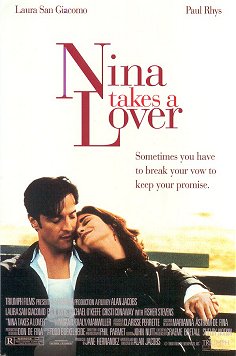
Last night, if you were having trouble getting to sleep at 2 in the morning, you could have turned over to Starz and watched Nina Takes A Lover, a movie from 1994.

Nina Takes A Lover is such a typical 90s Sundance film that it could have just as easily been called Independent Movie From 1994.  Everything that we tend to associate with American independent cinema is present in this film.  It’s a relationship drama with moments of quirky comedy.  It’s set in the city and no, it doesn’t matter which city.  It could be New York or it could be Seattle or it could be Los Angeles or San Francisco.  The important thing is that it’s a city on one of the coasts, the type of city where people engage in witty banter while sharing an apple in the park or over cups of coffee at a cozy cafe that was probably replaced by a Starbucks after this film was released.  This is the type of film where the characters tell their stories in flashback while being interviewed by a bespectacled journalist.  Characters alternate between artificial small talk and sudden statements of portentous wisdom.  Of course, all of quirky drama leads up to a sudden twist.  I figured out the twist after watching about 10 minutes of the film.  Maybe audiences in 1994 were a bit more surprised.

About the only thing that keeps Nina Takes A Lover from being the most stereotypical indie film ever made is the fact that there’s no quirky criminals and nobody spends any time talking about their favorite childhood TV shows.  If Nina had only shot someone while taking a lover, this would have been the most indie film ever.

I imagine that I’ve probably made the film sound totally unbearable but I actually enjoyed Nina Takes A Lover.  Once I realized and accepted that Nina Takes A Lover wasn’t exactly going to reinvent cinema, I discovered that it was actually a very likable film.

Nina is played by Laura San Giacomo, who owns a shoe store.  Nina meets a man in the park.  The man (Paul Rhys) has no name and is merely identified as being “Photographer.” (And, of course, he’s British because this is an independent film and, in the world of indie cinema, all ideal lovers are British.)  Soon, Nina and Photographer are having a passionate and very physical affair.  However, Nina explains that she’s married and her husband will be home in three weeks.  Photographer says that he has a wife as well.  As Nina and the Photographer talk about love, marriage, and sex, they also try to figure out what they should do when the three weeks are up.

And, of course, it all leads to a twist that you’ve probably already figured out but you know what?  It doesn’t matter if the film is predictable because it’s just so likable.  Laura San Giacomo and Paul Rhys both give likable performances, they have a lot of chemistry, and the sex scenes are well-done and genuinely erotic.  The film may tell a familiar story but it tells it well.

Nina Takes A Lover is a good film to watch when you’ve got insomnia.  It won’t put you to sleep but it will definitely make the hours of darkness a little more pleasant.

Previous Insomnia Files:

  1. Story of Mankind
  2. Stag
  3. Love Is A Gun