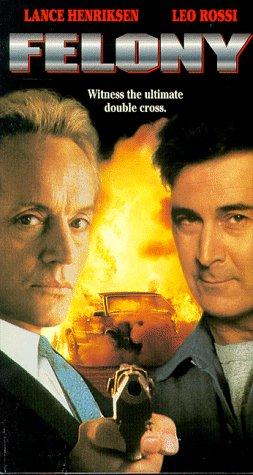
In New Orleans, a drug raid gone wrong leads to eleven cops being gunned down and then blown up. The disastrous raid was being filmed for a Cops-like reality show The show’s producer, Bill Knight (Jeffrey Combs) finds himself being pursued through New Orleans by a collection of rogue intelligence agents, cops, and gangsters, all of whom want the tape of the massacre.
It’s a simple direct-to-video premise and the film’s plot hits every chase film cliche, while keeping the action moving at a decent pace. Bill Knight is not supposed to be a typical action hero. He’s just a television producer who was in the wrong place at the wrong time. Yet Knight proves himself to be as indestructible as any Arnold Schwarzenegger hero. He gets shot, twice. He falls from a great height. He crashes through a window. He repeatedly gets hit over the head. And yet, his injuries never seem to really slow him down or even hurt that much. He does hook up with a nurse (Ashley Laurence) but still, it’s hard to believe anyone could take that much punishment and keep running. Jeffrey Combs, the brilliant star of films like Re-Animator, is miscast as Knight but he’s still always entertaining to watch.
In fact, the cast is the main thing that Felony has going for it. David Prior was able to assemble a true group of B-movie all-stars. Lance Henriksen and David Warner are the evil intelligence agents who are determined to kill Knight. (Warner finally gets to handle a grenade launcher and we’re all the better for it.) Leo Rossi and Charles Napier are the two New Orleans cops who are investigating the drug raid. Joe Don Baker is the rogue intelligence agent who dresses like a cowboy and who is trying to clean up everyone else’s mess. The cast keeps the action moving and there are enough eccentric personalities in this film that it’s always watchable. I think this might be the only film to feature Joe Don Baker and Lance Henriksen performing opposite each other. If nothing else, it deserves to be watched for that!
(The cover for Felony features Lance Henriksen and Leo Rossi but not Jeffrey Combs, even though Combs is the lead in the film and Rossi’s role is actually pretty small. Henriksen also doesn’t have blonde hair in the movie. There are plenty of double crosses in the movie but I can’t think of any that really qualify as the “ultimate double cross.”)
Even with its miscast lead and its cliche-heavy plot, Felony is what direct-to-video action movies should be all about, fact-paced action and a cast unlike any other,
When infielder Bill Riley (Patrick Wayne) makes an error that costs his team the game, sports columnist Rex Short (Carleton Young) claims that he witnessed Bill being paid off by Slim Conway (James Stewart). Slim is a former player who was banned from Major League Baseball after he was accused of taking a bribe from a gambler.
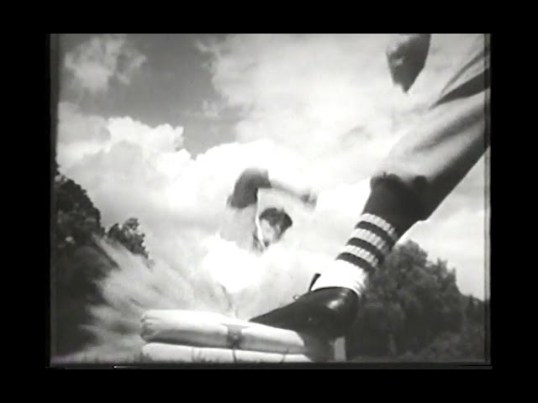
Most the movie is a flashback, showing how Bill first met Slim when Slim was playing for a barnstorming team of former major leaguers. That was my favorite part of the movie. Slim and a collection of old, worn-out men stumble out of their bus and even though they might move a little slower and they might need to stretch a little more before swinging a bat, they still show up a cocky team made up of young local players. Even after the crowd nearly riots when they realize that Slim is one of the players, the old players keep their cool and their eye on the game. After Bill spikes Slim while sliding into home plate, Bill apologizes. Slim remembers the young man’s humility and, working with one of the few friends that he has left in the game, Slim helps Bill get his chance in the Majors.
Usually, when my sister yells at me to come watch something because “it’s got baseball!,” I’m prepared for it turn out to just be a movie with one scene of someone holding a bat. I’m glad that she called me to come watch FlashingSpikes with her because it really is a good and loving celebration of my favorite game. Even after Slim is treated so unfairly by the press, the League, and even some of the fans, he never stops loving the crack of the bats and the cheers of the crowd. FlashingSpikes is unabashedly pro-baseball and Slim stands in for every player who was ever unfairly railroaded out of the game by scandal mongers like Rex Short.
First released in 1953, The Naked Spur is one of the most cynical and downbeat movies that I’ve ever seen.
It’s also one of the most visually beautiful. Filmed in the Rockies and presented in glorious Technicolor, The Naked Spur is a western that is full of amazing scenery, from green forests to snow-capped mountains to a river that, under different circumstances, would probably be a wonderful place to just sit down and think for a spell. Director Anthony Mann crafts an image of the American frontier that makes it easy to understand why anyone would want to explore it and build a new life there. Mann contrasts the beauty of nature with the ugliness of the people who trample across it.
Jesse Tate (Millard Mitchell) is a grizzled and somewhat sickly prospector who runs into a stranger named Howard Kemp (James Stewart). Kemp is, at first, antagonistic and paranoid but soon, he offers to pay Tate $20 if Tate will help him track down an outlaw named Ben Vandergroat. Vandergroat, wanted for the murder of a U.S. marshal, is believed to be hiding in the mountains. In need of the money, Jesse agrees. Soon, he and Kemp are joined by another wanderer, a recently discharged soldier named Roy Anderson (Ralph Meeker). From the minute that Roy shows up, it’s obvious that he’s not being totally honest about why he’s wandering around the Rockies.
As for Ben Vandergroat (Robert Ryan), he is indeed hiding in the mountains. He’s accompanied by Lina Patrch (Janet Leigh), a naive young woman whose late father was one of Ben’s partners-in-crime. Lina looks up to Ben as a father figure and refuses to believe that he could possibly be guilty of any of the things that he’s been accused of doing. Ben, meanwhile, manipulates Lina into doing his bidding.
After being captured by Kemp, Jesse, and Roy, Ben proves himself to be far more clever than he initially seems. After revealing that Kemp isn’t who Jesse assumed him to be, Ben works to try to turn the three men against each other. There’s a reward on Ben’s head and, after Kemp reluctantly agrees to share the money with Jesse and Roy, Ben mentions that there will be a lot more money if its split two ways instead of three. Soon, Ben has the three men distrusting each other even more than they already did. However, Lina finds herself falling in love with Kemp.
TheNakedSpur is a great film. Featuring only five-speaking parts, it plays out like a particularly intense play and every single member of the cast does a great job of bringing the film’s characters to life. Robert Ryan is coolly manipulative as the cocky Ben while Ralph Meeker is crudely menacing as the untrustworthy Roy Anderson. Millard Mitchell is, at times, heart-breaking as the sickly prospector. Janet Leigh reveals the strength underneath Lina’s naive persona. Of course, the film is stolen by James Stewart, who is convincingly bitter and ultimately rather poignant as Howard Kemp. Kemp feels like a continuation of the character that Stewart played in BrokenArrow. He’s seen the worst that humanity has to offer. Even in the beautiful Rockies, Stewart’s character cannot escape the ugliness that he’s witnessed firsthand. Stewart’s performance as that haunted and angry Howard Kemp is one of his best.
TheNakedSpur is an intelligent and well-acted western and one of eight movies that Stewart made with director Anthony Mann. It’s psychological complexity, beautiful scenery, compelling script, and brilliant cast make it a true classic.
Though the Academy of Motion Picture Arts and Sciences claim that the Oscars honor the best of the year, we all know that there are always worthy films and performances that end up getting overlooked. Sometimes, it’s because the competition too fierce. Sometimes, it’s because the film itself was too controversial. Often, it’s just a case of a film’s quality not being fully recognized until years after its initial released. This series of reviews takes a look at the films and performances that should have been nominated but were, for whatever reason, overlooked. These are the Unnominated.
Oh, how this movie made me cry!
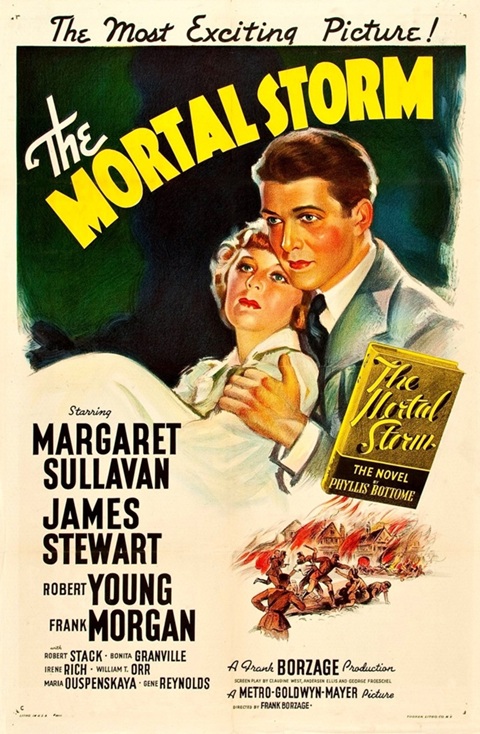
Released in 1940, at a time when war was spreading across Europe, Asia, and Africa but the United States was still officially neutral, The Mortal Storm opens on January 30th, 1933. In the mountains of Germany, near the Austrian border, Professor Viktor Roth (Frank Morgan) is celebrating his 60th birthday. He starts the day being applauded by his students at the local college. In the evening, he returns home for a celebration with his family, including wife (Irene Rich), his daughter Freya (Margaret Sullivan), his son Rudi (Gene Reynolds), and his two stepsons, Otto (Robert Stack) and Erich von Rohn (William T. Orr). Also present are Freya’s fiancé, Fritz (Robert Young) and one of Roth’s students, a pacifist named Martin Breitner (James Stewart). It’s a joyous occasion and the film takes its time introducing us to Prof. Roth and his extended family. At first, everyone seems very kind. They seem like people who most viewers would want to spend time with or live next to….
But then, the family’s maid excitedly enters the room and announces that it’s just been announced that Adolf Hitler is the new chancellor of Germany. Otto and Erich are overjoyed and head out to celebrate with the other members of the Nazi Youth Leage. Martin is less happy and excuses himself to return home. Roth and his wife worry about what this means for people who do not agree with Hitler’s beliefs. Freya says that they shouldn’t talk politics. It is jokingly mentioned that Hitler has taken away Roth’s special day but Roth’s young son Rudi says that he’s learned in school that the needs of the individual will never be more important than the needs of the state. If Hitler wants to take away your day, it’s your duty to give it up or face the consequences.
Based on a 1937 novel, The Mortal Storm was not the first Hollywood production to take a stand against Hitler and the Nazis but it was one of the best. I say this despite the fact that the film only hints at the fact that Prof. Roth is Jewish, something that was made very clear in the book. (In the movie, Roth and his wife worry what will happen to “Non-Aryans” and “freethinkers.”) That said, the film perfectly captures how quickly and insidiously the authoritarian impulse can spread. The town, which once seemed so friendly, becomes a very dark place as the students at the university put on their swastika armbands and start to hunt down anyone who dissents from the party line. When Roth says that, as a scientist, he does not believe one race can be genetically superior to another, his students walk out on him. A local teacher is beaten when he fails to return to the Nazi salute. When Martin refuses to join the Party, Otto and Erich turn against him despite being lifelong friends. When Martina and Freya flee for the border, Fritz pursues them. And even after Prof. Roth is sent to a concentration camp, Otto and Erich continue to follow the orders of Hull (Dan Dailey), the sinister Youth Party Leader.
It’s a powerful film, one that remains just as relevant today as it was when it was first released. Hull and Erich’s fanaticism would, today, find a welcome home on social media. The scenes in which the townspeople eagerly threaten to report their former friends and neighbors for failing to salute or show proper enthusiasm for the government have far too many modern day equivalents for me to even begin to list them all. This film was also the last the James Stewart made with frequent co-star Margaret Sullivan and they both give great performances. (All-American Jimmy Stewart might seem a strange choice to play a German farmer but he is never less that convincing as Martin, one of the few people in the town not to surrender his principles and beliefs to the crowd.) The film’s final moments, with the camera panning around the empty Roth home, brought very real tears to my eyes.
Despite being a powerful film, TheMortalStorm was not nominated for a single Oscar. (Jimmy Stewart did win his only Oscar that year but it was for The Philadelphia Story.) It’s temping to assume that, at a time when America was still divided about how to react to the war in Europe and when many Americans still remembered the trauma of the first World War, TheMortalStorm was too explicitly political and anti-Nazi to get a nomination but, the same year, The Great Dictatorwas nominated for Best Picture. It seems more likely that, in those days when the studios ruled supreme, MGM decided to puts it weight behind The Philadelphia Story rather than The Mortal Storm.
That said, The Mortal Storm was definitely worthy of being nominated, for Picture, Director, Screenplay, Actress (Margaret Sullivan), Actor (Stewart), Supporting Actor (Frank Morgan and Robert Stack), and Supporting Actress (Irene Rich and, in the role of Stewart’s mother, Maria Ouspenskaya). The film may not have been nominated but it remains a powerful and important work of art.
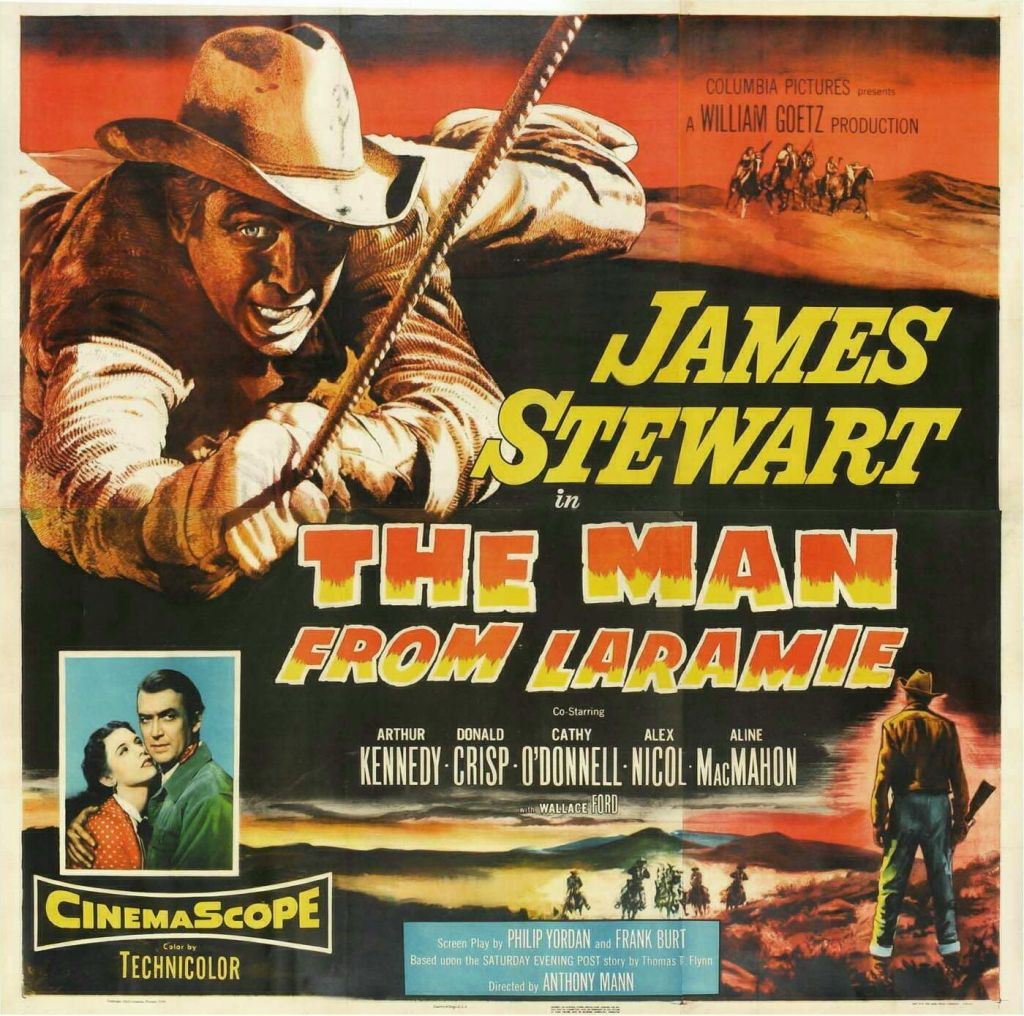
I’m celebrating Jimmy Stewart’s birthday by watching his western THE MAN FROM LARAMIE! Stewart plays Will Lockhart, a man who has run into some bad luck. His brother, a U.S. cavalryman, was recently killed in an attack by Apaches using repeating rifles outside of the town of Coronado, New Mexico. In an attempt to track down the man who sold the rifles to the Indians, Lockhart has come to Coronado from Laramie, WY, to snoop around. He’s welcomed to town by Dave Waggoman (Alex Nicol), we’ll call him “Crazy Dave,” the son of powerful local rancher Alec Waggoman (Donald Crisp). Accusing Lockhart of stealing salt off of their land, Crazy Dave proceeds to drag him with a rope, burn his wagons and shoot his mules. Before he can do even more damage to Lockhart, the foreman of the Waggoman ranch Vic Hansbro (Arthur Kennedy) comes along and stops him. Vic seems like a reasonable man, but he does ask Lockhart to move on down the trail before there’s any more trouble. Lockhart isn’t leaving until he finds out more about those rifles so he politely declines by going back into town, finding Crazy Dave, and kicking his ass. He then goes to see Alec and asks to be paid back for the wagons and mules that crazy Dave destroyed. Alec pays Lockhart back and then calls Vic in to come see him. Here’s where we start to get a feel for Waggoman family dynamics. You see, Alec loves his son no matter how crazy he is, and he expects Vic to keep him out of trouble. He even takes the cost of the destroyed wagons and dead mules out of Vic’s pay instead of Crazy Dave’s. We find out that Crazy Dave is jealous of Vic, and that Vic feels underappreciated by a man he has treated like a father for many years. Against this backdrop of family jealousy and insanity, Lockhart will continue to dig around until he finds out who sold the rifles that killed his brother. Could it be Vic or Crazy Dave?
THE MAN FROM LARAMIE is the last of five westerns that Stewart worked on under the direction of Anthony Mann. Their work is legendary, including the western classics WINCHESTER ‘73 (1950), BEND OF THE RIVER (1952), THE NAKED SPUR (1953), and THE FAR COUNTRY (1954). In my opinion, they may have saved their best for last. Jimmy Stewart gives a masterful performance in the role of Will Lockhart. Stewart was very smart in the way he played his parts in westerns. Tall and gangly, he would never have been a believable western star if he had played his roles more like a John Wayne or Gary Cooper. Rather, his character here is driven by an uncontrollable desire for revenge, so no matter what happens to him, outside of being killed, he’s going to keep on coming. In this movie, he’s dragged, beaten and even has his hand shot from point blank range, but that doesn’t stop him. And every so often he flashes that Jimmy Stewart smile and you can’t help but have complete sympathy for him. The supporting performances are good as well, especially from Donald Crisp as Alec Waggoman and Arthur Kennedy as Vic Hansbro. Neither are completely bad men, but they make bad decisions based on emotions that most of us can completely understand. They’re so good in the roles that we can’t help but kinda like them in spite of those bad decisions. One of the things I love about old westerns is the way they deal with honest emotions and universal truths. At one point in the film, after discovering that Vic has lied to him about something, Alec tells him, “Once you start lying, there’s no way to stop!” If you’ve ever lied about something before, you know that one lie always leads to another, and then to another. The drama in THE MAN FROM LARAMIE centers around what happens to the characters when the truth finally comes to light. In my opinion it’s great stuff, and produces one of my very favorite westerns!
On a side note, I love this movie so much that I demanded that my wife and I stop and eat in Laramie a couple of years ago when we were visiting family in Wyoming. Here’s a pic from that wonderful day. I wanted to make sure we got the sign in the back that said Laramie!
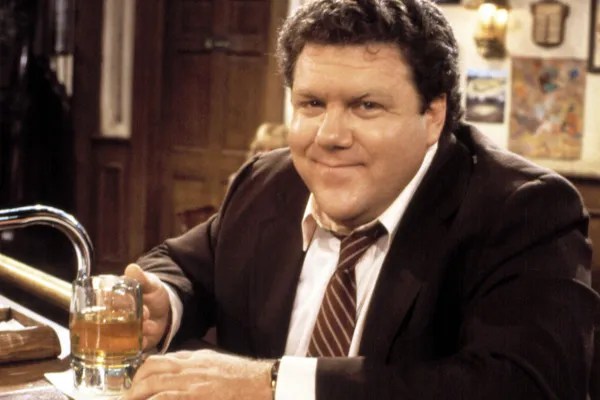
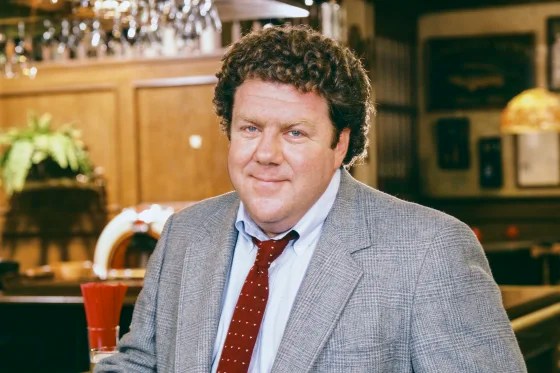
George Wendt passed away in his sleep earlier today. He was 76 years old.
If you’re old enough to have watched Cheers when it originally aired or to have caught it in reruns, George Wendt will always be Norm Peterson, the beer-drinking accountant who spent all of his time at the show’s titular bar. One of the show’s trademarks was that, whenever he entered the bar, everyone greeted him by shouting, “Norm!” “How’s the world treating you?” a bartender would ask. “It’s a dog eat world and I’m wearing milkbone underwear,” Norm once replied.
(One of my favorite joke from the series was when Norm went into a steakhouse and everyone inside was heard to yell, “Norm!” as the door closed behind him.)
If we’re going to be really honest, Norm was probably a high-functioning alcoholic and terrible husband. (Wife Vera was often-mentioned but never seen.) Wendt was so likable in the role and was so good at delivering those one-liners that it didn’t matter. Watching the show, you never wondered why Norm was in the bar. You were just glad he was.
George Wendt was also an accomplished stage actor. (I saw him on stage when he was co-starring with Richard Thomas in 12AngryMen.) He appeared in several movies, usually playing the comedic sidekick or the hero’s best friend. His film roles often didn’t ask him to do much other than be likable but one exception was his performance in 1991’s GuiltyBySuspicion.
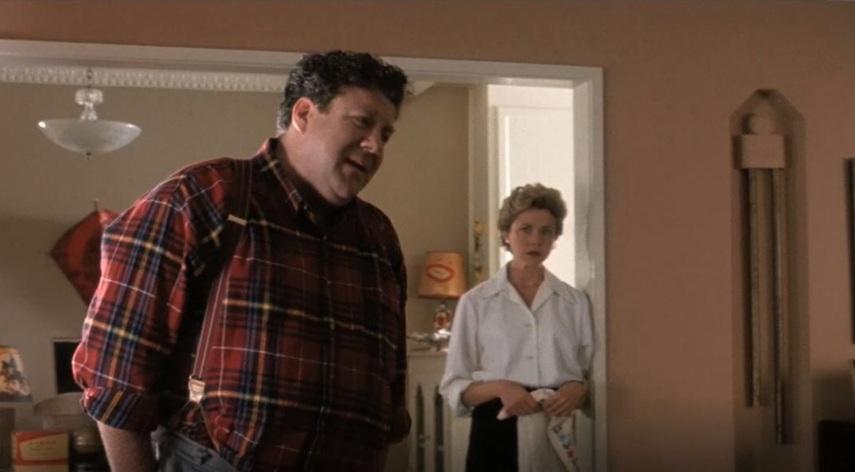
GuiltyBySuspicion is a film about the McCarthy era, starring Robert De Niro as film director David Merrill, who is threatened with being blacklisted unless he names four of his colleagues as being communists. George Wendt plays screenwriter Bunny Baxter, a childhood friend of David’s who attended a few communist rallies when he was younger, failed to mention it to the FBI, and who is now being investigated as a subversive. The studio argues that David should name Baxter because his name is already out there. When David refuses, he finds himself blacklisted and unable to make a living. Bunny Baxter, meanwhile, is offered a similar deal. Baxter can save his own career but only if he names David as a communist. Unlike David, Baxter considers betraying his friend because it’s the only way that he can ever hope to work again. “Your dead anyway,” Baxter says to David.
GuiltyBySuspicion suffers from Irwin Winkler’s plodding direction but De Niro gives a good performance, as does Martin Scorsese who is cast as a director based on Joseph Losey. The film is full of actors who would later become better-known, like Chris Cooper, Tom Sizemore, and Annette Bening. Wendt, however, gives the film’s best performance as the screenwriter who is torn between protecting his career and maintaining his integrity. The scene where he asks permission to name Merrill as a communist is powerful and it shows how good an actor George Wendt could be. Bunny Baxter is asking his best friend to allow himself to be stabbed in the back. Baxter is that desperate. That he’s played by George Wendt, an actor who was everyone’s favorite likable barfly in the 80s, makes the scene all the more powerful.
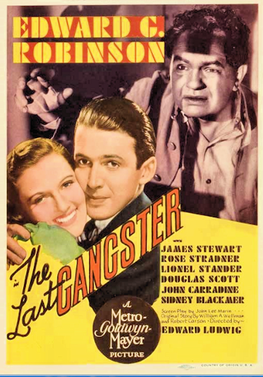
In 1937’s TheLastGangster, Edward G. Robinson plays Al Capone.
Well, actually, that’s not technically true. The character he’s playing is named Joe Krozac. However, Joe is a ruthless killer and gangster. He’s made his fortune through smuggling alcohol during prohibition. Despite his fearsome reputation, Joe is a family man who loves his wife Tayla (Rose Stradner) and who is overjoyed when he learns that she’s pregnant. To top it all off, Joe is eventually arrested for and convicted of tax evasion. He gets sent to Alcatraz, where he finds himself being bullied by another inmate (John Carradine) and waiting for his chance to regain his freedom.
In other words, Edward G. Robinson is playing Al Capone.
Krozac does eventually get out of prison but, by that point, Tayla has moved on. She’s married Paul North (James Stewart), a former tabloid reporter who was so outraged by how his newspaper exploited Tayla’s grief that he resigned his position. Joe Krozac’s son has grown up with the name Paul North, Jr. and he has no idea that his father is actually a notorious gangster.
Krozac wants to get his son back but his gang, now led by Curly (Lionel Stander), has other ideas. They want Krozac to reveal where he hid the money that he made during his gangster days. As well, an old rival (Alan Bazter) not only wants to get revenge on Krovac but also on Krovac’s son. Joe Krovac, fresh out of prison, finds himself torn between getting his revenge on his wife and protecting his son. This being a 30s gangster film, it leads to shoot-outs, car chases, and plenty of hardboiled dialogue.
Edward G. Robinson and Jimmy Stewart in the same movie, how could I n0t watch this!? I was actually a bit disappointed to discover that, even though both Robinson and Stewart give their customarily fine performances, they don’t spend much time acting opposite each other. Indeed, it sometimes seem like the two men are appearing in different pictures.
Robinson is appearing in one of the gangster films that made him famous. (Indeed, the film’s opening credits feature footage that was lifted from some of Robinson’s previous films.) He gives a tough and snarling performance but also one that suggests that, as bad as he is, he’s nowhere near as bad as the other gangsters that are working against him. His gangster is ultimately redeemed by his love for his son, though the Production Code still insists that Joe Krozac has to pay for his life of crime.
Stewart, meanwhile, plays his typical romantic part, portraying Paul as being an incurable optimist, a happy go-getter who still has a sense of right-and-wrong and a conscience. Stewart isn’t in much of the film. This is definitely Robinson’s movie. But still, there’s a genuine charm to the scenes in which Paul romances the distrustful Tayla. Not even being forced to wear a silly mustache (which is the film’s way of letting us know that time has passed) can diminish Stewart’s natural charm.
If you like 30s gangster films, like I do, you should enjoy TheLastGangster. I would have liked it a bit more if Robinson and Stewart had shared more scenes but regardless, this film features these two men doing what they did best. This is an offer that you can’t refuse.
1936’s Speed takes place in Detroit, at the home of Emery Motors.
When Joan Mitchell (Wendy Barrie) shows up to start her new job in the PR department, one of the first things she sees is a car being driven around a race track at a high speed until eventually it crashes. Automotive engineer Frank Lawson (Weldon Heybourn) explains that it’s all a part of making sure the car is safe. At Emery Motors, they crash cars on a daily basis to make sure that both the car and the driver will survive.
Terry Martin (James Stewart), the driver of the crashed car, proceeds to give Joan a tour of the factory. There’s an obvious attraction between the two of them but Joan also seems to have feelings for Frank. Terry and Frank are rivals. Terry may not have Frank’s education but he has instincts and he has common sense. He and his friend, Gadget Haggerty (Ted Healy), have an instinctive understanding of cars. They know how to drive them. They know how to fix them. They know how to make them go really fast.
In fact, Terry is working on a new carburetor, one that he says will increase the speed of Emery’s cars. Frank is skeptical but Terry knows that, if he can enter his car into the Indianapolis 500, he’ll be able to prove that he knows what he’s talking about. Joan comes to believe in Terry and his carburetor. And, fortunately, Joan has a secret of her own that will be very helpful to Terry’s ambitions.
Speed was not Jimmy Stewart’s first feature role but it was his first starring role. 28 years old when he starred in Speed, Stewart is tall, a little bit gawky, and unbelievably adorable. From the minute that Terry climbs out of that wrecked car and introduces himself to Joan, Stewart’s a true movie star. He and Wendy Barrie have a lot of chemistry and are a truly cute couple but Stewart is the one who dominates the film with his straight-forward charisma. Terry may not be the best educated engineer at Emery Motors but he is determined to prove himself and Stewart does a great job of portraying that determination.
As for the film itself, it’s low-budget and it’s short. Automotive enthusiasts might enjoy seeing all of the old cars and getting a chance to see what a car race was about in the days when cars themselves were still a relatively new invention. The film itself starts out as almost a documentary, with Stewart (as Terry) explaining how each car is manufactured on the assembly line. He points out all the machinery that goes into making the car in an almost-awed tone of voice. If the information is a bit dry, it doesn’t matter because it’s impossible not to enjoy listening to Jimmy Stewart speak. In his pre-WWII films, Stewart was the voice of American optimism and that’s certainly the case with Speed.
Speed was not a huge box office success but, in just two years, Stewart would be working with Frank Capra on You Can’t Take It With You, the first Stewart film to be nominated for (and to win) the Oscar for Best Picture of the year.
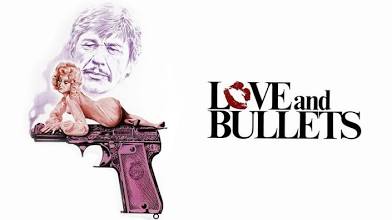
Charles Bronson is an Arizona cop who goes to Switzerland to bring back a gangster’s girlfriend (Jill Ireland). The gangster (Rod Steiger) sends a hitman (Henry Silva) to kill her so she can’t tell his crime secrets to the authorities.
This isn’t one of Bronson’s best films, but it’s still a fun movie to watch on a chilly, rainy day. There are some good action scenes set in various cold & snowy European locations. This is Bronson in “Bond” mode which is kind of fun and different. And what can you say about a stuttering Rod Steiger screaming at his advisors about the meaning of “love.” It’s fun stuff when you like Steiger as much as I do. I do deduct half a star because Steiger gets so mad at one point that he turns over a table with some of the biggest, most scrumptious looking shrimp I’ve ever seen. That was completely uncalled for and wasteful, but not quite as wasteful as Bronson and Henry Silva in the same movie without an epic battle of some sort. The fact that they didn’t fight it out on the Matterhorn itself can only be described as a missed opportunity.
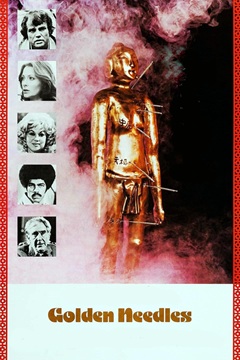
An ancient Chinese statue contains several acupuncture needles that, when placed correctly, can grant a man unstoppable vim and vigor. It can also grant amazing sexual prowess, which is why every elderly crime boss in the world wants it. In Hong Kong, a group of flamethrower-toting thugs steal the statue so that their boss, Lin Tao (Roy Chiao), can sell the statue to a Los Angeles mobster named Winters (Burgess Meredith!). Winters’s agent in Hong Kong, Felicity (Elizabeth Ashley), decides to hire Vietnam vet Dan Mason (Joe Don Baker) to steal the statue from her so that she can not only take Winters’s money but also sell the statue herself. Mason agrees, in return for money and sex.
Eventually, the action does move from Hong Kong to Los Angeles. That allows Jim Kelly to make an appearance as Jeff, a buddy of Mason’s who helps him look for the statue and who takes part in one lousy fight scene. It’s really a glorified cameo. Robert Clouse previous directed EnterTheDragon, in which Kelly played the member of the heroic trio who didn’t survive. There are actually a handful of EntertheDragon cast members scattered throughout GoldenNeedles but, unfortunately, Bruce Lee was dead and John Saxon was apparently unavailable.
There are a few good action sequences in this film, though if you’re hoping to see Joe Don Baker lay down some sweet kung fu moves, you’re going to be disappointed. Baker’s character throws people through windows but there’s not much finesse in his fighting style. I still appreciated Baker’s performance in GoldenNeedles. Clouse makes good use of Baker’s lumbering form, showing how out of place he is in Hong Kong. Baker and Elizabeth Ashley make a good team and Burgess Meredith gives a performance that’s only slightly less subtle than his turn as the Penguin on Batman. The film’s PG-rating keeps the violence from getting too extreme but it also probably made GoldenNeedles perfect for a Saturday matinee.
Golden Needles is an enjoyable oddity. See it if you’re a Joe Don Baker fan.
 In New Orleans, a drug raid gone wrong leads to eleven cops being gunned down and then blown up. The disastrous raid was being filmed for a Cops-like reality show The show’s producer, Bill Knight (Jeffrey Combs) finds himself being pursued through New Orleans by a collection of rogue intelligence agents, cops, and gangsters, all of whom want the tape of the massacre.


 Through the Shattered Lens