The TSL Horror Grindhouse: The Last House On The Left (dir by Wes Craven)


The year is 1972 and the news is grim.  The fighting continues in Vietnam.  The protests continue at home.  Crime is rising.  The economy is struggling.  Groups like the Weathermen and the SLA are talking about taking the revolution to the streets.  In New York, the notorious murderers Krug Stillo (David Hess) and Fred “Weasel” Podowksi (Fred Lincoln) have broken out of prison and are one the run.  They are believed to be traveling with Krug’s drug-addicted son, Junior (Marc Sheffler), and a woman named Sadie (Jeramie Rain), who is said to be feral and bloodthirsty.

However, Mari Collingwood (Sandra Cassel) doesn’t care about any of that.  She’s just turned seventeen and she can’t wait to go to her first concert with her best friend, Phyllis (Lucy Grantham).  Mari is naive, optimistic, and comes from from a comfortably middle-class family.  Phyllis is a bit more worldly and tougher.  As she explains it, her family works in “iron and steel.”  “My mother irons, my father steals.”

While Mari’s parents (Richard Towers and Eleanor Shaw, though they were credited as Gaylord St. James and Cynthia Carr) bake a cake and prepare for Mari’s birthday party, Mari heads into the city with Phyllis.  Before they go to the concert, they want to buy some weed.  When they see Junior Stillo hanging out on a street corner, they assume he must be a dealer and they approach him.  Junior takes them to an apartment, where they are grabbed by Weasel and Krug.

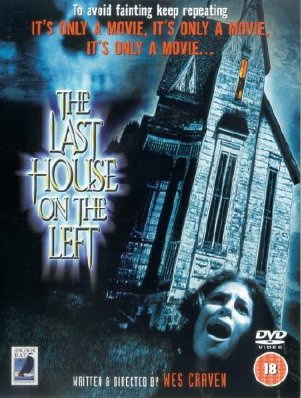
1972’s The Last House On The Left was advertised with the classic (and much-repeated line), “To avoid fainting, keep repeating, ‘It’s only a movie …. it’s only a movie…. it’s only a movie….”  That advice is easy to remember during the first part of the film because, up until Mari and Phyllis approach Junior, the movie is fairly cartoonish, with Richard Towers giving an incredibly bad performance as Mari’s father.  This film was Wes Craven’s debut as both a director and a writer.  By his own admission, Craven had no idea what teenage girls would talk about and, as such, he just wrote a lot of dialogue in which Mari talked about her breasts and Mari’s mother complaining that young women no longer wore bras.  (On the commentary that he recorded for the film’s DVD release, Craven succinctly explained, “I guess I was obsessed with breasts.”)  This part of the film plays out like a weird counter-culture comedy.  Even when we first meet Krug, he’s using his cigar to pop a little kid’s balloon.
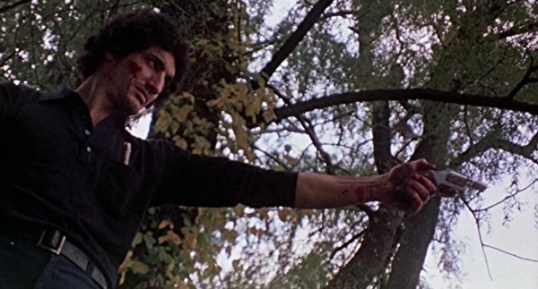
The Last House On The Left (1972, dir by Wes Craven, DP: Victor Hurwitz)

The tone of the film jarringly shifts the minute that Mari and Phyllis step into that apartment.  That’s largely due to the performances of David Hess and Fred Lincoln, who are both so convincing in their roles that it can be difficult to watch them.  In real life, Fred Lincoln was a stuntman (he’s in The French Connection) and an adult film actor.  David Hess, meanwhile, was a songwriter who was looking to break into acting.  (Hess’s songs — some of which are beautifully sad and some of which are disturbingly jaunty — are heard throughout the movie.)  Hess, in particular, is so frightening as Krug that he spent the rest of his career typecast as sociopathic murderers.  The middle part of the film alternates between disturbingly realistic scenes of Mari and Phyllis being tortured and humiliated and cartoonish scenes involving two incompetent cops (one whom is played by Martin Kove) and Mari’s parents.  Phyllis is murdered and dismembered in a graveyard and the gore effects remains disturbingly realistic even when seen today.  Mari, after being raped by Krug, recites a prayer, and then wades into a nearby lake.  Krug shoots her three times.  Afterwards, Krug, Weasel, and Sadie try to wash the blood off of themselves, the expression on their faces indicating that even they understand that they’ve gone too far.

Eventually, Krug, Weasel, Sadie, and Junior stop off at a nearby house, claiming to be salespeople who just had a little car trouble.  What they don’t realize is that the people who are generously welcoming them to spend the night are also the parents of Mari Collingwood….

Basing his script on Ingmar Bergman’s The Virgin Spring, Wes Craven has often said that The Last House On The Left was meant to be a commentary on the Vietnam War and the way that other films had glamourized violence.  That may or may not be true.  (Craven has also said that, at the time, he was so desperate to direct a movie that he would have filmed almost anything.)  What is true is that the violence in Last House On The Left is not easy to watch.  Once it starts, it’s relentless and, at no point, is the audience given an escape.  David Hess is so committed to playing a sadist that he never takes a moment to wink at the audience and say, “Hey, we’re just playacting here!”  Craven shot the film in a guerilla style and the shaky camera, the natural light, and the grainy images leave you feeling as if you’re watching some sicko’s home movies.  At the end of the movie, when Mari’s parents take the same joy in attacking her killers as Krug took in attacking their daughter, it’s hard not to feel that Mari has been forgotten.  Everyone has been consumed by the violence that has erupted around them.  Even though Richard Towers’s nearly blows the ending with a few hammy line readings, the film still leaves you exhausted.
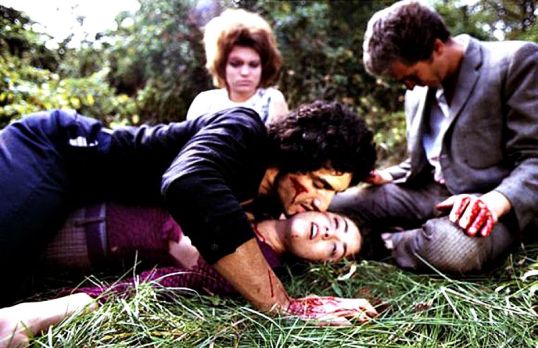
The Last House on the Left (1972, dir. by Wes Craven, DP: Victor Hurwitz)

Not surprisingly, The Last House On The Left was attacked by most reviewers when it was originally released.  The movie played the drive-in and grindhouse circuit for three years, with producer Sean Cunningham often taking out advertisements in local newspapers that read: “You will hate the people who perpetrate these outrages—and you should! But if a movie—and it is only a movie—can arouse you to such extreme emotion then the film director has succeeded … The movie makes a plea for an end to all the senseless violence and inhuman cruelty that has become so much a part of the times in which we live.”  The film’s advertisements also contained a warning that no one under 30 should see the movie.  Needless to say, The Last House On The Left was a huge hit, especially with viewers under 30.

(One of the great ironies of film criticism is that one of the few critics to defend Last House On The Left was Roger Ebert.  Ebert, who would later be one of the slasher genre’s biggest attackers, gave Last House On The Left a very complimentary review and praised it for its political subtext.)

Seen today, The Last House On The Left still packs a punch.  It’s a shocking and shamelessly sordid film, one that shows hints of the talent that would make Wes Craven one of the most important directors to work in the horror genre.  It’s flawed, it’s exploitive, it’s thoroughly unpleasant, and yet it’s also a film that sticks with you.  It’s powerful almost despite itself.  It’s not a movie that I would necessarily chose to watch on a regular basis but, at the same time, I can recognize it as being a historically important film.  For better or worse, much of modern American horror owes a debt to Wes Craven’s Last House On The Left.  Even today, when one is regularly bombarded with horrific images, Last House On The Left still has the power to shock.
The Eric Roberts Horror Collection: Sorority Slaughterhouse (dir by David DeCoteau)


At a college that appears to be located on a beach in Hawaii, Dean Whitman (Eric Roberts) is about to lose his job.  He’s been accused of taking advantage of his female students, something that he admits is true.  Somewhat drunk and disillusioned with the world, Whitman has a conversation with a creepy clown doll.  (The doll comes out a box that specifically says that it was made by voodoo priestess.)   Whitman decides to play with a gun and — whoops! — shoots himself in the head.  Whitman’s mind is transferred into the doll’s body.  In the form of the clown doll, Whitman goes after the sorority that he blames for his downfall.

Eric Roberts is only onscreen for a handful of minutes in 2015’s Sorority Slaughterhouse but we hear his voice throughout the film.  It turns out that doll is a total pervert!  What’s odd is that the doll is also really small and it moves somewhat stiffly, leading me to wonder just how exactly it manages to effortlessly kill so many people.  Admittedly, most of the deaths are edited in such a way that we never actually see the doll and the victim in the same shot but it’s still hard to look at that doll and imagine it as a killer.  Of course, the victims are all just dumb enough to fall victims to a killer doll.  One girl uses the doll as a vibrator.  A guy is suffocated with a balloon animal.  Someone else is murdered by having Drain-O poured over her.  I can’t imagine that product placement was appreciated.

This is a David DeCoteau film and I’m pretty sure that the sorority house was the same house that DeCoteau used in Bigfoot vs D.B. Cooper.  It’s hard not to appreciate DeCoteau’s determination to make mockbusters for next to no money.  This film obviously owed a lot to Child’s Play and the DeCoteau-directed Puppet Master films  and DeCoteau wasn’t going to let a lack of special effects get in the way of the particular killer doll movie.  That said, the action moves very slowly and the doll is in no way intimidating, even if it does sound like Eric Roberts reading dirty DMs.  Personally, when it comes to collaborations between Eric Roberts and David DeCoteau, I prefer A Talking Cat!?!

Previous Eric Roberts Films That We Have Reviewed:

  1. Paul’s Case (1980)
  2. Star 80 (1983)
  3. Runaway Train (1985)
  4. To Heal A Nation (1988)
  5. Best of the Best (1989)
  6. Blood Red (1989)
  7. The Ambulance (1990)
  8. The Lost Capone (1990)
  9. Best of the Best II (1993)
  10. Love, Cheat, & Steal (1993)
  11. Voyage (1993)
  12. Love Is A Gun (1994)
  13. Sensation (1994)
  14. Dark Angel (1996)
  15. Doctor Who (1996)
  16. Most Wanted (1997)
  17. Mercy Streets (2000)
  18. Raptor (2001)
  19. Rough Air: Danger on Flight 534 (2001)
  20. Strange Frequency (2001)
  21. Wolves of Wall Street (2002)
  22. Border Blues (2004)
  23. Mr. Brightside (2004)
  24. Six: The Mark Unleased (2004)
  25. We Belong Together (2005)
  26. Hey You (2006)
  27. Depth Charge (2008)
  28. Amazing Racer (2009)
  29. The Chaos Experiment (2009)
  30. In The Blink of an Eye (2009)
  31. Bed & Breakfast (2010)
  32. Enemies Among Us (2010)
  33. The Expendables (2010) 
  34. Sharktopus (2010)
  35. Beyond The Trophy (2012)
  36. The Dead Want Women (2012)
  37. Deadline (2012)
  38. The Mark (2012)
  39. Miss Atomic Bomb (2012)
  40. Assault on Wall Street (2013)
  41. Bonnie And Clyde: Justified (2013)
  42. Lovelace (2013)
  43. The Mark: Redemption (2013)
  44. The Perfect Summer (2013)
  45. Self-Storage (2013)
  46. Sink Hole (2013)
  47. A Talking Cat!?! (2013)
  48. This Is Our Time (2013)
  49. Bigfoot vs DB Cooper (2014)
  50. Doc Holliday’s Revenge (2014)
  51. Inherent Vice (2014)
  52. Road to the Open (2014)
  53. Rumors of War (2014)
  54. Amityville Death House (2015)
  55. Deadly Sanctuary (2015)
  56. A Fatal Obsession (2015)
  57. Las Vegas Story (2015)
  58. Stalked By My Doctor (2015)
  59. Enemy Within (2016)
  60. Hunting Season (2016)
  61. Joker’s Poltergeist (2016)
  62. Prayer Never Fails (2016)
  63. Stalked By My Doctor: The Return (2016)
  64. The Wrong Roommate (2016)
  65. Dark Image (2017)
  66. The Demonic Dead (2017)
  67. Black Wake (2018)
  68. Frank and Ava (2018)
  69. Stalked By My Doctor: Patient’s Revenge (2018)
  70. Clinton Island (2019)
  71. Monster Island (2019)
  72. The Reliant (2019)
  73. The Savant (2019)
  74. Seven Deadly Sins (2019)
  75. Stalked By My Doctor: A Sleepwalker’s Nightmare (2019)
  76. The Wrong Mommy (2019)
  77. Exodus of a Prodigal Son (2020)
  78. Free Lunch Express (2020)
  79. Her Deadly Groom (2020)
  80. Top Gunner (2020)
  81. Deadly Nightshade (2021)
  82. The Elevator (2021)
  83. Just What The Doctor Ordered (2021)
  84. Killer Advice (2021)
  85. Megaboa (2021)
  86. Night Night (2021)
  87. The Poltergeist Diaries (2021)
  88. The Rebels of PT-218 (2021)
  89. Red Prophecies (2021)
  90. A Town Called Parable (2021)
  91. Bleach (2022)
  92. Dawn (2022)
  93. My Dinner With Eric (2022)
  94. 69 Parts (2022)
  95. The Rideshare Killer (2022)
  96. D.C. Down (2023)
  97. Aftermath (2024)
  98. Bad Substitute (2024)
  99. Devil’s Knight (2024)
  100. The Wrong Life Coach (2024)
  101. When It Rains In L.A. (2025

Masters of the Universe (1987, directed by Gary Goddard)


On the distant planet Eternia, the evil Skeletor (Frank Langella) has finally taken over Castle Grayskull and imprisoned the Sorceress (Christina Pickles).  When He-Man (Dolph Lundgren) and his allies Teela (Chelsea Field), Man-At-Arms (Jon Cypher), and Gwildor (Billy Barty) launch a rescue mission, they find themselves overwhelmed by Skeletor’s forces and are forced to use an interdimensional key to escape.

He-Man and his friends end up in 1980s California.  The key is lost in the process and discovered by two teenagers, one of whom is played by a pre-Friends Courteney Cox.  Skeletor sends Evil-Lyn (Meg Foster), Beast Man (Tony Carroll), and a host of other henchmen after the key.

The first (and, as of this writing, only) live action film to be based on the famous Mattel action figures, Masters of the Universe was produced by Cannon and it should have been a lot better than it actually was.  The idea of He-Man and Skeletor in modern-day California was a good one and it’s easy to imagine scenes of He-Man and Skeletor wandering around downtown Los Angeles and being as shocked by the locals as the locals are by them.  Big, blonde Dolph Lundgren seemed like the ideal pick for the role of He-Man.  Best of all, from the perspective of many, is that there was no Orko.  The most annoying member of the He-Man ensemble was left out of the film.  (Billy Barty’s Gwildor may have sometimes been annoying but he was still better than Orko.)

Unfortunately, the movie did not live up to anyone’s expectations.  Taking more inspiration for Star Wars and Conan than from any of the He-Man mythology, Cannon’s version of Masters of the Universe is a generic action movie in which He-Man is reduced to being just another forthright hero with a sword.  (He’s not Prince Adam in this movie.  He’s just He-Man.)   Teela doesn’t even wear her famous costume.  The main problem with Masters of the Universe is that so few of the Masters actually appear in the movie.  This was a Cannon/Mattel co-production but apparently, Mattel was stingy when it came to delivering their half of the budget.  There wasn’t enough money to bring He-Man’s rogue’s gallery (not to mention the majority of his allies) to life.  The means no Trap-Jaw and no Mer-Man.  Not even Ram Man makes the cut and this movie could have really used Ram Man.

Fortunately, Skeletor and Evil-Lyn are present to pick up the slack.  (When it came to the Masters of the Universe franchise as a whole, the villains were always more entertaining than the heroes.)  With the help of a surprisingly convincing makeup job that give him a skull face, Frank Langella appears to be having the time of his life as the evil Skeletor and I wasn’t surprised to recently read that this was one of Langella’s favorite roles.  Langella seems to having a blast playing such a thoroughly evil and cartoonish character and his scenes have a playful energy that the rest of the film is lacking.  Meg Foster, she of the piercing eyes, is the perfect choice for Evil-Lyn and is magnetically evil.  They provide some of the most entertaining villainy since Max von Sydow announced, “Klytus, I’m bored,” at the start of Flash Gordon.

Masters of the Universe was a critical failure when it was released in 1987, which isn’t a surprise.  A film based on a toy line and a children’s cartoon?  Maybe that would be an Oscar nominee today but, in 1987, there was no way the critics were going to go for it.  But Masters of the Universe was also a box office failure, one of many high-profile Cannon films that failed to score when it was first released.  (It did find a cult following when it was released on video.)  A proposed sequel — in which Lundgren would be replaced as He-Man by surfer Laird Hamilton — was abandoned.  The sets that had been built for Masters of the Universe 2 were instead used for Cyborg, starring Jean-Claude Van Damme.

A new live action Masters of the Universe film is scheduled to be released in 2026.  Jared Leto will be playing Skeletor.  That is probably all that needs to be said.


October True Crime: In Cold Blood (dir by Richard Brooks)


In 1959, the Clutter Family was murdered in Holcomb, Kansas.

Herbert Clutter was a farmer and was considered to be prosperous by the standards of small-town Holcomb.  Neither he nor his wife nor his teenage son and daughter were known to have any enemies.  The brutality of their deaths took not just the town but the entire state by surprise.  People like the Clutters were not supposed to be brutally murdered.  They certainly weren’t supposed to be brutally murdered in a tight-knit community like Holcomb or in a state like Kansas.

The Clutters

The author Truman Capote traveled to Holcomb with his friend Harper Lee, looking to write a story about how the heartland was dealing with such a brutal crime.  Six weeks after the murders, while Capote and Lee were still conducting their interviews, two small-time criminals named Dick Hickock and Perry Smith were arrested for the crime.  Capote’s proposed article about Holcomb instead became the basis for his best-known book, In Cold Blood.  Capote followed the case from the initial investigation to the eventual execution of both Hickok and Smith.  He examined the backgrounds of the two criminals, especially Perry Smith’s.  (Indeed, there were some who felt that Capote saw something of himself in the mentally-fragile Smith.)  In Cold Blood was Capote’s most successful book and it also launched the entire “true crime” genre.  It also may have been Capote’s downfall as Capote reportedly spent the rest of his life haunted by the feeling that he would never top the book and that he had potentially exploited Perry Smith while writing it.  In Cold Blood may be critical of the death penalty but, if Smith and Hickok hadn’t gone to the gallows, Capote would never have had an ending for the book.

(The writing of In Cold Blood and Capote’s subsequent struggles are dramatized in the excellent Capote.)

When it was published in 1965, In Cold Blood shot up the best seller lists.  A film version was an inevitability.  Otto Preminger —  who had already made films out of Anatomy of a Murder, Exodus, Advice and Consent, and The Cardinal — was eager to turn the book into a film and one can imagine him churning out some epic version with his usual all-star cast.  (Sal Mineo as Perry Smith?  Peter Lawford as Dick Hickok?  With Preminger, anything was possible.)  However, Capote sold the rights to Richard Brooks, an independent-minded director who was also an old friend.  Brooks decided to duplicate Capote’s “non-fiction novel” approach by actually shooting his film in Holcomb and having several residents of the town play themselves.  He also rejected Columbia’s suggestion that Smith and Hickok should be played by Paul Newman and Steve McQueen.  Instead, he cast former child actor Robert Blake as Perry Smith and an up-and-coming character actor named Scott Wilson as Dick Hickok.  The only “star” who appeared in the film was television actor John Forsythe, who played the Kansas detective who was placed in charge of the investigation.

The story plays out in deliberately harsh black-and-white.  (Legendary cinematographer Conrad Hall made his debut with this film.)  The opening contrasts scenes of Smith and Hickok, both recently released from prison, meeting up in Kansas with scenes of the Clutter family innocently going about their day.  Perry Smith is neurotic and quick to anger, a wannabe tough guy who wears a leather jacket and whose greasy hair makes him look less like a cunning criminal and more like an understudy in a regional production of West Side Story.  Dick Hickok is friendly and slick, a compulsive shoplifter who claims that his smile can get him out of anything.  In jail, Hickok heard a story that suggested that Mr. Clutter kept a lot of money hidden away in a safe on his farm.  Hickok’s plan is to tie up and rob a family of strangers, with the assumption being that, by the time the Clutters get loose and call the police, he and Smith will already be far out of town.  Neither he nor Smith seem like natural-born murderers.  Smith seems to be too sensitive.  Hickok seems like the epitome of someone who brags but doesn’t follow through.  And yet, the morning after the robbery, four of the Clutters are discovered murdered in their own home.

The film delves quite a bit into Perry Smith’s background.  Throughout the film, he has flashbacks to his abusive father and his promiscuous mother.  When Alvin Dewey (played by John Forsythe) investigates Smith’s family, the recurring theme is that Perry never really had much of a chance to become anything more than a criminal.  We learn less about Dick Hickok’s background, beyond the fact that he was a popular high school jock who turned mean after a car accident.  And yet, despite the fact that the film is clearly more interested in Perry Smith than Dick Hickok, it’s Scott Wilson who dominates the film.  It’s not that Robert Blake gives a bad performance.  It’s just that Perry is such a neurotic mess and Blake gives a performance that is so method-y that occasionally, you’re reminded that you’re just watching a movie.  Scott Wilson, on the other hand, gives a very natural performance as Dick Hickok.  There’s nothing particularly showy about his performance and that makes Hickok all the more disturbing as a criminal and a potential murderer.  If you’ve spent any time in the country, you’ve met someone like Dick Hickok.  He’s the friendly guy who always knows that right thing to say but there’s something just a little bit off about him.  He’s likable without being trustworthy.

A few years ago, when I saw that In Cold Blood was going to be airing on TCM, I told my aunt that I was going to watch the film.  She replied that I shouldn’t.  She saw the film when it was originally released and she described it as being incredibly disturbing.  Despite her warning, I watched the film and I have to admit that she was right.  Even though it’s nearly 60 years old and not particularly explicit when compared to the true crime films of today, In Cold Blood is still a disturbing viewing experience.  Towards the end of the film, we finally see the murders in flashback and the image of Smith and Hickok emerging from the darkness of the farmhouse will haunt you.  There’s not a lot of blood.  The camera often cuts away whenever the actual murders occur (we hear more gunshots than we see) but the Clutters themselves are sympathetic and innocent victims and their deaths definitely hurt.  Indeed, considering that the film falls on the more liberal side of the question of root causes, In Cold Blood deserves a lot of credit for not shying away from the brutality of the crimes.  After spending 90 minutes emphasizing Perry Smith’s terrible childhood, it was important to remind the audiences of what he and Dick Hickok actually did.

The murder scene is so nightmarish that it actually makes it a bit difficult to buy into the film’s anti-death penalty argument.  The film may end with Smith remorseful and a reporter (Paul Stewart) talking about how revenge is never the answer but the film’s liberal talking points feel hollow after witnessing the murder of four innocent people.  (Ironically, it turned out there was no safe so those four people died so Smith and Hickok could steal about forty dollars.)  A few years ago, I probably would have been very moved by the film’s anti-death penalty message.  While I’m still opposed to the death penalty because I think there’s too much of a risk of a wrongly convicted person being executed, I’m long past having much personal sympathy for the Perry Smiths of the world.

Overall, In Cold Blood remains a powerful and disturbing movie. It was a film that was nominated for several Oscars, though it missed out on Best Picture due to 20th Century Fox’s huge campaign for Dr. Dolittle.  Neither Blake nor Wilson were nominated, which is evidence that they were perhaps too convincing as Smith and Hickok for the Academy’s taste.  While Robert Blake would go on to have the more storied career, Scott Wilson was a dependable character actor up until his death in 2018.  A whole new generation of fans knew him not as Dick Hickok but instead as The Walking Dead‘s beloved Herschel Greene.

One final note: Both the book and the film present the murders as being an aberration, something that neither Smith nor Hickok originally planned.  In 2013, new evidence was released that revealed the Smith and Hickok were the number one suspects in the murder of Christine and Cliff Walker and their two children, a crime that occurred in Florida shortly after they fled Kansas.  The two of them were questioned at the time and given a polygraph test, which they both passed.  The bodies of Smith and Hickok were exhumed for DNA testing,  The tests came back inconclusive.

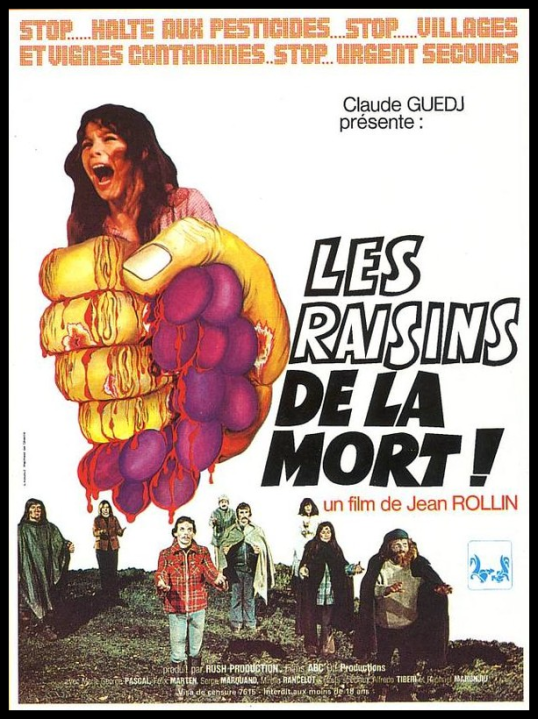
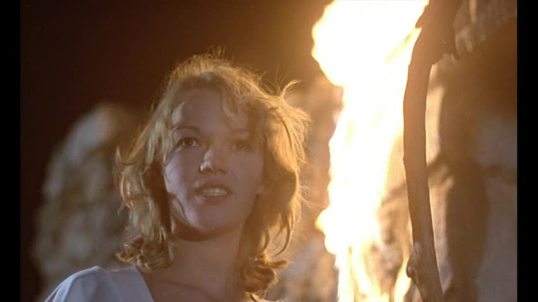
Horror Film Review: The Grapes of Death (dir by Jean Rollin)


1978’s The Grapes of Death is a zombie film that moves at a relentless place, combining effective body horror with an ominous atmosphere that leaves you feeling as if anyone could be the next victim of the zombie horde.

At a vineyard, a worker complains about the new pesticides that are being used and is told, by his smug manager, not to worry so much.  Later, when that worker stumbles aboard a train, his face is pulsing with hideous ulcers.  He kills one woman and chases another, Elizabeth (Marie-Georges Pascal), off the train.  Elizabeth, who is just trying to visit her boyfriend in a nearby village, makes her way across the French countryside, meeting men and women who have been infected by something and who are now going mad.  They may not technically be the undead but, with their nonstop pursuit and their obsession with killing everyone that they come across, they are definitely zombies.

The Grapes of Death is also one of the most French films ever made.  In this film, the zombies are not the creation of a voodoo curse or outer space radiation or even there no longer being room in Hell.  (In fact, it becomes fairly obvious that The Grapes of Death takes place in a world in which there is no Heaven or Hell.)  Instead, this film features people who are transformed into zombies because they drank contaminated wine at an annual festival.  When Elizabeth does eventually meet two men who have not been turned into zombies, they are both revealed to be beer drinkers.  One could actually argue that, despite the film’s grim atmosphere and all of the violence committed and the blood shed and the philosophical discussions that occur, The Grapes of Death is ultimately a satire of French culture.  Only in France could a bad crop of wine lead to the zombie apocalypse.

The Grapes of Death was one of the more commercially successful films to be directed by the great Jean Rollin.  Rollin is best-known for his surreal and dream-like vampire films.  In an interview, he stated that The Grapes of Death was his attempt to make a commercial horror film and that, when he was writing the script, he closely studied the structure of Night of the Living Dead.  While the film does have its similarities to Romero’s classic zombie film, The Grapes of Death is still definitely the work of Jean Rollin.  The lingering shots of the fog-shrouded French countryside and the ancient French villages, with blood staining the cobblestone streets, could have come from any of Rollin’s vampire films.  The film also uses the same serial structure that Rollin used in many of his film, with Elizabeth going from one adventure to another and almost always managing to narrowly escape danger.  Elizabeth goes from fleeing the infected man on the train to finding herself a near prisoner in an isolated house to protecting a blind girl (Mirella Rancelot) for her crazed boyfriend to being menaced by the mysterious Blonde Woman (played by frequent Rollin collaborator Brigitte Lahaie).  There’s a new cliffhanger every fifteen minutes or so.

(Rollin said that he originally envisioned contaminated tobacco as being the cause of the zombie outbreak but he ultimately went with wine instead.  Not everyone smokes but, in France, just about everyone drinks wine.)

First released as Les raisins de la mort, The Grapes of Death has been described as being “France’s first zombie film.”  I don’t know if it was the first but it’s certainly one of the best, a relentless chase through the French countryside that ends on a proper note of downbeat horror.  This film made me happy that I’m not a wine drinker.

(Be sure to read Arleigh’s thoughts here!)

Horror Film Review: The Shining (dir by Stanley Kubrick)


The Shining is one of the few horror movies that still scares me.

I say this despite the fact that I’ve lost track of the number of times that I’ve watched Stanley Kubrick’s 1980 adaptation of Stephen King’s third novel.  It’s a film that I watch nearly every October and it’s a film that I’ve pretty much memorized.  Whenever I watch the film, I do so with the knowledge that Jack Torrance (Jack Nicholson), the caretaker of the Overlook Hotel, is eventually going to start talking to ghosts and he’s going to try to kill his wife Wendy (Shelley Duvall) and his son, Danny (Danny Lloyd).  Whenever I watch this film, I know what Jack is going to find Room 237.  I know about the blood pouring out the elevator like the Tampax commercial from Hell.  I know what Danny means when he says, “Redrum….”  I know about the twins and their request of “Come play with us, Danny.”  And, of course, I know about the film’s famous ending.

Whenever I start watching this film, I know everything that is going to happen.  And yet, as soon as I hear the booming beat of of Wendy Carlos’s theme music and I see the overhead shot of the mountain roads leading to the Overlook Hotel, I start to feel uneasy.  Whenever Barry Nelson (played the hotel’s general manager) starts to blandly explain that a previous caretaker got cabin fever and chopped up his twin daughters, I smile because Nelson delivers the lines so casually.  But I also get nervous because I know Charles (or is it Delbert) Grady is going to show up later.

(Incidentally, Barry Nelson never gets enough credit for his brilliant cameo as the friendly but guarded hotel manager.  In Stephen King’s original novel, the character was a stereotypically unsympathetic middle manager, a martinet who existed largely to be told off.  In Kubrick’s film, the manager is one of the most fascinating of the supporting characters.)

I still get nervous when I see Wendy and Danny, sitting in their disturbingly sterile Colorado home while Jack interviews for the caretaker job.  Wendy smokes and Danny talks about how his imaginary friend, Tony, doesn’t want to go to the hotel.  With her unwashed her and her tentative voice, Shelley Duvall is a far cry from the book’s version of Wendy.  However, Duvall’s Wendy is also a far more compelling character, an abused woman who finds her strength when her son is put in danger.  Duvall is the perfect choice for Wendy because she seems like someone who you might see in the parking lot of your local grocery store, trying to load the bags in her car and keep an eye on her young child at the same time.  She seems real and her reactions remind us of how we would probably react if we found ourselves in the same situation.  Wendy makes the mistakes that we would all probably make but she refuses to surrender to her fear.

Why does The Shining remain so powerful and so frightening, even after repeated viewings?  Most of the credit has to go to Stanley Kubrick.  Stephen King has been very vocal about his dislike of the film, claiming that The Shining was more Kubrick’s version than his.  King has a point.  Film is a director’s medium and few directors were as brilliant as Stanley Kubrick.  (Along with The Shining, Kubrick also directed Paths of Glory, 2001, Barry Lyndon, Dr, Strangelove, Spartacus, Lolita, The Killing, A Clockwork Orange, Eyes Wife Shut, and Full Metal Jacket.  Stephen King directed Maximum Overdrive.)  From the minute we see the tracking shots that wind their way through the desolate mountains and the empty hallways of the Overlook, we know that we’re watching a Kubrick film.  Those tracking shots also put us in the same role as the spirits in the Overlook.  We’re watching and following the characters, observing and reacting to their actions without being able to interact with them.  King has complained that Kubrick’s version of The Shining offers up no hope.  But, honestly, what kind of hope can one have after discovering that ghosts are real and they want to kill you?  Once Jack Torrance finally accepts that drink from Joe Turkel’s Lloyd and meets Phillip Stone’s Grady, there is no more room for hope.  King’s book ends with the Overlook destroyed and Jack Torrance perhaps redeeming himself in his last moments.  Kubrick’s film suggests that Jack Torrance never cared enough about his family to be worthy of redemption and that the evil that infected the Overlook is never going to be destroyed.  In the end, not even the kindly presence of Scatman Crothers in the role of Dick Halloran can bring any real hope to the Overlook.

The Shining is unsettling because, more than being a ghost story, it’s a film about being tapped.  Physically, the Torrances are trapped by the blizzard.  Mentally, Jack is trapped by his addictions and his resentments.  One gets the feeling that he’s deeply jealous of Danny, viewing him as someone who came along and took away all of Wendy’s attention.  Wendy is trapped in a bad and abusive marriage and there’s something very poignant about the way Duvall both captures Wendy’s yearning for outside contact (like when she uses the radio to communicate with the local rangers station) and her hope that, if she’s just supportive enough, Jack will get his life together.  Danny’s trapped by his psychic visions and his knowledge of what’s to come.  The victims of the Overlook appear to be trapped as well.  Grady’s daughters are fated to always roam the hallways, looking for someone to play with them.  The Woman in 237 will always wait in her bathtub.  Were these spirits evil before they died or were the twisted by the Overlook?  It’s an unanswered question that sticks with you.

As I mentioned earlier, Stephen King has been very vocal about his dislike of both The Shining and its director.  (King once boasted about outliving Kubrick, a comment that showed a definite lack of class on the part of America’s most commercially successful writer.)  Why does King hate the Kubrick film with such a passion?

I have a theory.  Both King’s second novel, Salem’s Lot, and The Shining feature a writer as the man character.  In both cases, King obviously related to the main character.  Ben Mears in Salem’s Lot is charming, confident, articulate, and successful.  He’s a writer that everyone respects and he’s even well-known enough to have a file with the FBI.  Jack Torrance, on the other hand, is a struggling writer who has a drinking problem, resents authority figures (like the hotel manager), and has issues with his father.  Torrance is a much more interesting character than Ben Mears, precisely because Torrance is so flawed.  (King, and I give him full credit for this, has been open about his own struggles with substance abuse and how he brought his own experiences to the character of Jack Torrance.)  I’ve always suspected that, at the time that King wrote Salem’s Lot and The Shining, Ben Mears was King’s idealized version of himself while Jack Torrance, with all of his struggles and flaws, reflected how King actually felt about himself.  (That the Wendy Torrance of the novel is a beautiful blonde who sticks with her husband despite his drinking problem feels like a bit of wish fulfillment on the part of King.)  When Stanley Kubrick made his version of The Shining and presented Jack Torrance as essentially being a self-centered jerk who, even before arriving at the hotel, had a history of abusing his wife and son, it’s possible King took it a bit personally.  Since King had poured so much of himself into Jack Torrance, it was probably difficult to see Kubrick present the character an abusive narcissist whose great novel turned out to be literally a joke.  And so, Stephen King has spent the last 45 years talking about how much he hates Kubrick’s film.

King’s opinion aside, Kubrick’s The Shining is probably the most effective Stephen King adaptation ever made, precisely because Kubrick knew which parts of the book would work cinematically and which parts were best excised from the plot.  As opposed to later directors who often seem intimidated by King’s fame, Kubrick was able to bring his own signature style to the story.  Stanley Kubrick’s The Shining is a masterpiece and one that I look forward to revisiting this October.

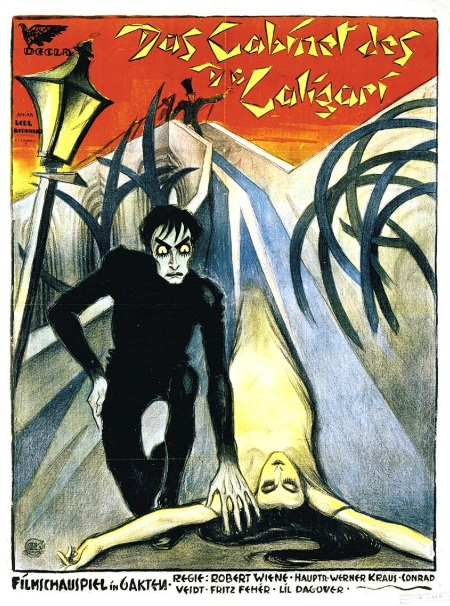
Silent Horror Review: The Cabinet of Dr. Caligari (dir by Robert Wiene)


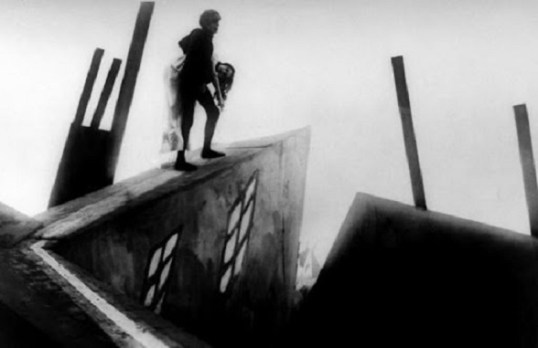
The Cabinet of Dr. Caligari (1920, dir by Robert Wiene, DP: Willy Hameister)

Sitting on a bench, a man named Franzis (Friedrich Feher) tells a story of how he and his fiancée Jane (Lil Dagover) suffered at the hands of Dr. Caligari (Werner Krauss), the owner of a traveling carnival who used an apparent sleepwalker named Cesare (Conrad Veidt) to commit murders for him.  Franzis’s story takes place in an odd village, one that is full of crooked streets, ominous buildings, and dark shadows.  It’s a bizarre story that gets even stranger as we start to suspect that Franzis himself is not quite who he claims to be.

Released in 1920, the silent German film The Cabinet of Dr. Caligari is one of those films that we’ve all heard about but far too few of us have actually seen.  Like most silent films, it requires some patience and a willingness to adapt to the narrative convictions of an earlier time.  However, for those of us who love horror cinema, The Cabinet of Dr. Caligari remains required viewing.  Not only did it introduce the concept of the twist ending but it also helped to introduce German expressionism to the cinematic world.  The film’s images of twisted roads and ominous structures that seem to be reaching out to capture the people walking past them would go on to influence a countless number of directors and other artists.  The film captures not only the logic and intensity of a nightmare but the look of one as well.

It also captures something very true about human nature.  Running through the story is a theme of authoritarianism.  Before Caligari can bring his carnival to the show, he has to deal with a rude town clerk who seems to take a certain delight in making even the simplest of request difficult.  Caligari keeps Cesare in a coffin-like box and only brings him out when he’s needed to do something.  The sleepwalking Cesare does whatever he is ordered to do, without protest.  Even the film’s twist ending leaves you wondering how much you can trust the people in charge.  When the film was released, Germany was still struggling to recover from World War I, a war that was fought by people who had been trained not to question the orders of those who were sending them to die.  Caligari, like a general, sends Cesare into danger and Cesare, being asleep, never questions a thing.

(Of course, thirteen years after The Cabinet of Dr. Caligari was released, Germany would once again embrace authoritarianism.  Director Robert Wiene left Germany after the rise of Hitler and died in France in 1938.  Co-writer Carl Mayer and star Conrad Veidt also fled Germany, with Veidt landing in Hollywood and playing the villainous Nazi in Casablanca.  Meanwhile, Werner Krauss was reportedly a virulent anti-Semite who supported the Nazi Party and who became one of Joseph Goebbels’s favorite actors.  Lil Dagover also remained in Germany and continued to make films.  She was known to be Hitler’s favorite actress though Dagover always claimed that she didn’t share Hitler’s views.)

Needless to say, it takes some adjustment to watch a silent film.  That’s certainly true in the case of a The Cabinet of Dr. Caligari, though the twisted sets and the bizarre story actually help the mind to make the adjustment.  Dr. Caligari takes place in a world so strange that it actually seems appropriate that the dialogue is not heard but only read on title cards.  (If I could imagine a soundtrack to The Cabinet of Dr. Caligari, it would probably involve a lot of industrial noise in the background, in the manner of David Lynch’s Eraserhead.  Lynch, incidentally, is a filmmaker who was clearly influenced by Caligari.)  For modern audiences, watching The Cabinet of Dr. Caligari also means accepting that there was a time when CGI was not a thing and films had to make due with practical effects.  But Conard Veidt’s performance is all the more impressive when you realize that it was one that he performed without any of the filmmaking tricks that we now take for granted.

Ever since I first watched it on a dark and rainy night, The Cabinet of Dr. Caligari has stayed with me.  The night after I watched it, I even had a nightmare in which Dr. Caligari was trying to break into my apartment.  Yes, Dr. Caligari looked a little bit silly staring through my bedroom window but it still caused me to wake up with my heart about to explode out of my chest.

In short, The Cabinet of Dr. Caligari passes the most important test that a horror film can pass and one that most modern film fail.  It sticks with you even after it’s over.

Horror Film Review: The Vampire’s Ghost (dir by Lesley Selander)


1945’s The Vampire’s Ghost takes place in the African port of Bakunda.  It’s the colonial period and the port is full of not just adventurers and local plantation owners but also all sorts of disreputable people who are looking to disappear from civilization for a while.  A series of murders have recently rocked the port.  Victims, almost all of them women, have been discovered drained of blood.  The natives claim that it is the work of vampire but the colonialists dismiss that as superstition.  Plantation owner Thomas Vance (Emmett Vogan) says that there is no such things are vampires.  Thomas’s daughter, Julie (Peggy Stewart), says that there is no such things as vampires.  Julie’s boyfriend, Roy (Charles Gordon), says that there is no such thing as vampires.  Mysterious casino owner Webb Fallon (John Abbott) says that …. well, actually, Webb’s thoughts on the subject are a bit less certain.

Webb Fallon is known to be an expert on the occult and voodoo.  The natives consider him to be a vampire and it turns out that they’re right!  After he is wounded in an assassination attempt, Fallon is forced to reveal the truth of his existence to Roy.  He also puts Roy under his psychic command, forcing him to serve as Fallon’s servant while Fallon proceeds to kill several people.  Can Father Gilchrest (Grant Withers) save Roy from Fallon’s control and also prevent Fallon from turning Julie into his eternal vampire bride?  And why exactly did Thomas think it was a good idea to buy a plantation next to the infamous Temple of Death in the first place?

It may not sound like it from the plot description but The Vampire’s Ghost is actually a fairly interesting take on the traditional vampire story.  The film was made by Republic Studios and, as was so often the case with Republic, the budget was noticeably low and the film’s African locations were obviously just sets on a Hollywood soundstage.  The film was apparently shot in ten days, which was considered to be a long shoot by Republic standards.  And yet, despite the low budget, director Lesley Selander does a good job of creating a properly eerie atmosphere, opening with a POV shot of the vampire stalking a native woman and filling the soundtrack with the sound of beating drums in the distance.  The beautiful Adela Mara appears as a dancer in Abbott’s casino and her dance scene is definitely one of the film’s highlights, a sudden burst of energy that fills the screen with life.  With his somewhat wan appearance, John Abbott may not immediately strike most viewers as the most intimidating of vampires but, as the film progresses, Abbott’s performance win us over.  He plays Webb Fallon as being a calculating villain who suffers from just a touch of ennui.  He’s grown weary of his existence but he’s still driven by his vampiric urges.

This film was an early credit for screenwriter Leigh Brackett.  Apparently, Howard Hawks hired her to adapt The Big Sleep after seeing this film.  Brackett would go on to work on the scripts for Rio Lobo, El Dorado, The Long Goodbye, and The Empire Strikes Back.  And it all started with a vampire named Webb.

Horror On The Lens: Mazes and Monsters (dir by Steven Hilliard Stern)


Hi there and welcome to October!  This is our favorite time of the year here at the Shattered Lens because October is our annual horrorthon!  For the past several years (seriously, we’ve been doing this for a while), we have celebrated every October by reviewing and showing some of our favorite horror movies, shows, books, and music.  That’s a tradition that I’m looking forward to helping to continue this year!

Let’s get things started with 1982’s Mazes and Monsters!

Based on a best-seller by Rona Jaffe, Mazes and Monsters tell the story of some college students who enjoy playing a game called Mazes and Monsters.  Now, I realize that Mazes and Monsters may sound a lot like Dungeons and Dragons but they are actually two separate games.  One game takes place in a dungeon.  The other takes place in maze, got it?

When the players decide to play the game in some nearby caves, it causes the newest member of the group (Tom Hanks — yes, Tom Hanks) to snap and become his character.  Convinced that he’s living in a world full of monsters and wizard, Hanks runs away to New York.  How does that go?  During a moment of clarity, Hanks calls his friends and wails, “There’s blood on my knife!”

It’s all fairly silly.  There was a moral panic going on about role playing games when this film was made and this film definitely leans into the panic.  But, in its own over-the-top way, it works.  If you’ve ever wanted to see Tom Hanks battle a big green lizard, this is the film for you.  And I defy anyone not to tear up a little during the final scene!

From 1982, here is Mazes and Monsters!  Happy Horrorthon!

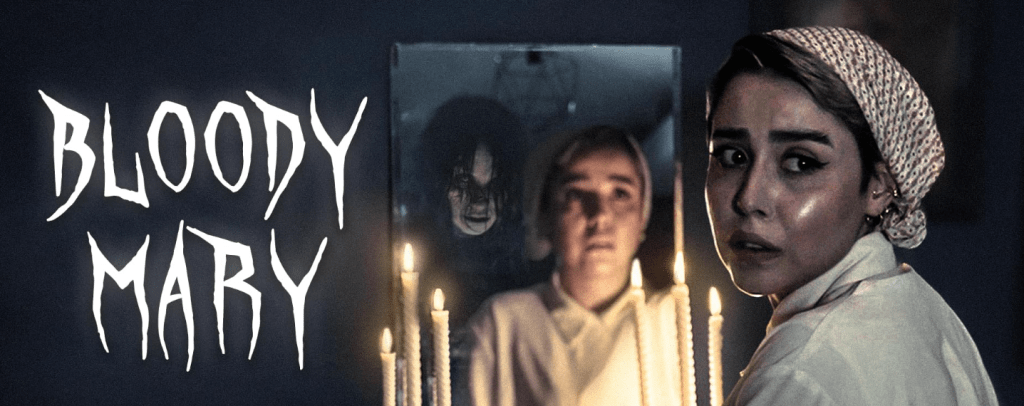
“Bloody Mary” (Dir/Writer Mostafa Nohekhan) Short Film Review By Case Wright


Happy Horrorthon! I’m writing this in July because I enjoy it, not this particular short- this short is garbage trash. It got 1.2 Million views and I’m certain at least 3 of those views were On Purpose! Mustafa Nohekhan should be featured on the Real Men of Genius ad campaign. Here’s to you Mr. Super Low-Budget Horror Film Maker [sung]. It’s hard to make a movie when all you have is your iPhone, Party City makeup, and some leftover jello for blood from your Sunday picnic, but you showed them- YOU SHOWED THEM ALL! Here’s to you – God of the bloody goop and unpaid crew. Mr. Super Low-Budget Horror Film Maker because when your critics said that this film couldn’t and shouldn’t be done. You responded, “I can do it!” They responded, “But why?”

This short does have a beginning, middle, and an end. The protagonist, an actress, says bloody mary in a mirror and is killed by “Mary” between takes. The acting is worthy of the finest 7th grade home movies. It has a we’ve got an iPhone let’s make a movie vibe. If you don’t want to take my word for it and wish to watch this piece of cinema- Here is the link:

Happy Horrorthon!