Horror Film Review: Kill, Baby…. Kill (dir by Mario Bava)


Kill, Baby…. Kill!, Mario Bava’s 1966 masterpiece, opens at the turn of the 20th Century.

In a small German village, a woman named Irena Hollander (Mirella Panfili) runs up a set of stairs at an abandoned church.  From the bell tower, she either falls or deliberately jumps and crashes into the sharp spikes of the gate below.  Agck!  Falling from that high of a spot is bad enough without then landing on a gate and getting pierced by several sharp points at once.  Making it even more disturbing is that it’s suggested that the spikes don’t instantly kill Irena.  It’s a grotesque and disturbing image, shown to us in bright color.  It’s death as pop art.  It’s the sort of thing that only Mario Bava could have paid off.

Dr. Paul Eswai (Giacomo Rossi Stuart) is summoned to the village by Inspector Kruger (Piero Lulli).  Kruger suspects that Irena may have been intentionally pushed and he wants Paul to conduct an autopsy.  However, the superstitious townspeople say that her body must be buried immediately and Paul and Kruger actually have to rush out to the local cemetery to prevent the Irena from being buried.  The gravediggers warn Paul and Kruger that they will be bringing a curse on themselves by not burying Irena.  Paul and Kruger don’t listen.  At the autopsy, a local medical student named Monica (Erika Blanc) is assigned to serve as the witness.  Paul discovers that a silver coin has somehow been embedded in Irena’s heart.
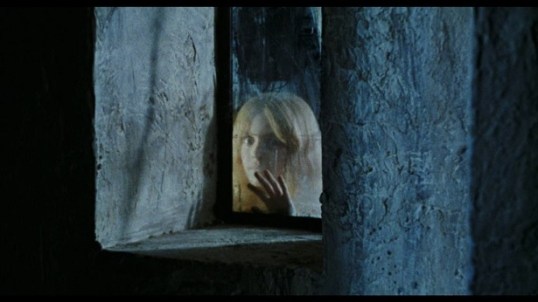
Paul discovers that the villagers live in fear of the ghost a little girl.  They claim that if you see the girl, that means you are cursed to die.  Paul, being a man of science, is skeptical.  When the daughter of the local innkeeper becomes horrified after saying that she has seen the little girl, Paul is critical of the treatment offered up by her superstitious parents.  (That treatment include a chain of leeches — agck!)  Meanwhile, Kruger goes to the estate of the mysterious Baroness Graps (Giovanna Galletti) and disappears!  It soon becomes clear that the key to mystery lies in the estate of the Baroness and her past.  Karl (Luciano Catenacci), the burgomaster, knows the secret of the Baroness but soon, he finds himself being targeted by the little girl.
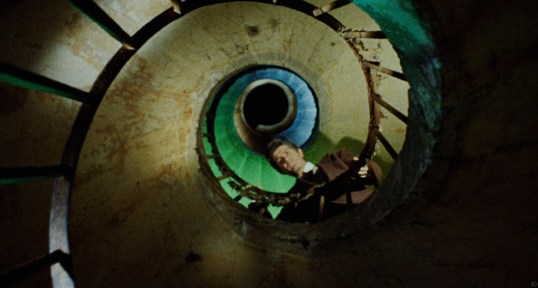
Maria Bava is a director who has been cited as an influence by everyone from David Lynch to Martin Scorsese and Kill, Baby…. Kill! is his masterpiece, a work of horrific pop art that is full of atmosphere, creative use of color, and an intentionally surreal style of plotting that makes the film less a standard story and more of a filmed nightmare.  Towards the end, as Paul pursues the ghost of the little girl, an overhead view of a special staircase, lit in blues and greens, brings to mind Hitchock’s Vertigo while the village itself feels as if it could have been transported over from a Hammer horror film.  Paul is a man of science and the villages are people of superstition and, in the end, both seem to be equally destructive.  Paul is too quick to dismiss the old traditions while the villagers are too quick to put their faith in herbs and incantations.  Bava creates an atmosphere in which everyone seems to be equally doomed.

Of course, the main reason why Kill, Baby…. Kill! works is because that little girl (played by Valerio Vali, about whom little is known) is absolutely terrifying.  When she suddenly shows up at a window and stares straight at her latest victim, it’s a true jump scare.  She had an intense stare but, even worse, she seems to be so happy after she’s cursed someone.  The true horror is that she can basically pop up anywhere.  It doesn’t matter if you’re a good person or a rational person or someone who doesn’t even believe in ghosts.  Fate cannot be escaped.

Kill, Baby…. Kill! is a both a story of nightmarish horror and a love letter to pure cinema.

Kill, Baby, Kill

October True Crime: The Texas RailRoad Killer (dir by Luis Antonio Rodriguez)


Angel Maturino Resendiz, now there was a scary person.

Resendiz was a drifter who hitched rides on trains and who killed at least 15 people over the course of 13 years.  Because he traveled by stowing away on trains, his first few crimes went undetected.  Even when people realized that there was a serial killer haunting the nation’s railroads, no one knew exactly where Resendiz would next turn up.  He committed the majority of his murders in Texas, killing random people and using whatever method happened to be most convenient at the time.  However, he also killed people in Florida, Georgia, California, Kentucky, and Illinois.  He would steal his victim’s jewelry but leave behind their money.  (He would return to his home in Mexico to give the jewelry to his sister and mother, both of whom apparently had no idea where he was getting his gifts from.)  After he was placed on the FBI’s Most Wanted List, Resendiz eventually surrendered himself in 1999.  Resendiz was apparently under the impression that he would not be given the death penalty if voluntarily turned himself in.  Resendiz was wrong about that and he was executed in 2006.

Until Resendiz surrendered himself, everyone living near a railroad track was nervous.  I know this from personal experience because, in 1999, my family lived close enough to the tracks that I could lay in bed in the middle of the night and listen to the sound of the trains rumbling in the distance.  Resendiz was a killer who targeted those who were smaller and weaker than him, which basically would have included me, my mom, and my sisters.  Apparently, whenever he did a home invasion, he would also eat whatever food he could find in the refrigerator.  Whereas most killers would probably want to get away from the scene as quickly as possible, Resendiz would sit down and eat leftovers.  For whatever reason, that little detail is the one that creeps me out the most.

2020’s The Texas Railroad Killer is loosely based on the crimes of Angel Resendiz.  The film features Resendiz (Lino Aquino) as he wanders around South Texas, randomly killing.  As played by Aquino, Resendiz comes across as being a somewhat dazed, paranoid shell of a human being, a shadow of death who doesn’t seem to be aware of the difference between reality and what’s only happening in his mind.  Does he really witness a group of strippers being gunned down by law enforcement or is it something that he only imagined?  It’s hard to tell.  After Resendiz commits a murder, he looks over his victim’s identification as if he’s trying to absorb the life that he just ended.  And yes, he does eat in a victim’s house.  Agck!

The Texas Railroad Killer is an extremely low-budget film.  Lino Aquino is convincingly out-of-it as Resendiz but some of the other performers are noticeably less convincing in their roles.  The film is largely plotless and the slow pace will be a turn-off for many viewers.  And yet, there’s a disturbing power to the film’s sun-drenched visuals.  The images of the sweaty Resendiz walking down broken streets or stumbling dazed out of someone’s home stick with you.  Flaws and all, the film captures the soulless existence of a man who lives for no other reason than to kill.

Personally, it makes me glad that he’s dead.

Horror Film Review: Willy’s Wonderland (dir by Kevin Lewis)


2021’s Willy’s Wonderland takes place in an dilapidated restaurant.

Back in the day, Willy’s Wonderland was the ideal place to go if you were young and celebrating your birthday.  The animatronic mascots would sing “Happy birthday” and maybe meet your parents.  Willy Weasel, Arty Alligator, Cammy Chameleon, Ozzie Ostrich, Tito Turtle, Knighty Knight, Gus Gorilla, and Siren Sara promised fun and cheesy entertainment to anyone looking for a nice family meal!

Unfortunately, people stopped going to Willy’s once it was discovered that the owner was a serial killer.  Jerry Robert Willis (Grant Cramer) and his seven friends were cannibals who regularly sacrificed families.  Eventually, the police caught up to him but, even under new ownership, no one wanted to eat at Willy’s.  There were rumors that Willis and his friends had transferred their souls into the animatronic figures but surely, that could not have been true!

Right?

Nicolas Cage plays a man with no name.  When his car breaks down, the local mechanic agrees to fix the car if the man agrees to spend the night as the janitor at Willy’s.  Apparently, it’s been a struggle to keep a night janitor at the place.  People find the location to be creepy and, of course, the animatronic mascots keep killing anyone dumb enough to try to mop the floors.  Cage’s man with no name silently agrees.  Everything that Cage does, he does without a word.  This is one of the rare films where Nicolas Cage, usually a champion talker, says absolutely nothing.

Now, I should mention that there actually is a plot to Willy’s Wonderland.  Liv (Emily Tosta) and her friends are trying to burn the place down because, years ago, Liv’s parents were murdered by the mascots.  Unfortunately, Liv and her friends aren’t that smart and they end up trapped in Willy’s Wonderland.  The majority of them quickly fall victim to the mascots.  The deaths are appropriately gruesome, though tinged with the dark humor that would come from essentially being killed by a knock-off version of Chuck E. Cheese.

But really, the plot isn’t important.  This film is entirely about Nicolas Cage, playing a man with no name.  Cage takes the janitorial job and, over the course of the night, he battles the mascots.  At the same time, he also makes it a point to continue to do his job.  Besieged or not, he agreed to clean the place up.  He takes his breaks and plays pinball exactly as scheduled, even if that means abandoning Liv and her friends.  Normally, you might think that this would be bad behavior on the part of Cage’s character.  Abandoning someone in the middle of a battle is not usually encouraged.  But Liv and her friends are very annoying.  Cage is ultimately the hero by default.  Yes, he’s fighting and killing the mascots but he’s really only doing it because they’re getting in his way while he’s trying to do his job.  The fact that he helps out Liv is largely coincidental.

Willy’s Wonderland proves that Cage doesn’t need a lot of lines to be the center of a film.  Even without speaking, he’s such a wonderfully eccentric presence that you can’t help but watch him and cheer him on.  Admittedly, Willy’s Wonderland is never that scary, though the “Happy Birthday” song is definitely creepy.  The mascots are a bit too cartoonish to be truly frightening.  But, if the film doesn’t really work as a horror film, it does work as an adrenaline-fueled Cage match.  And that’s nearly as good.

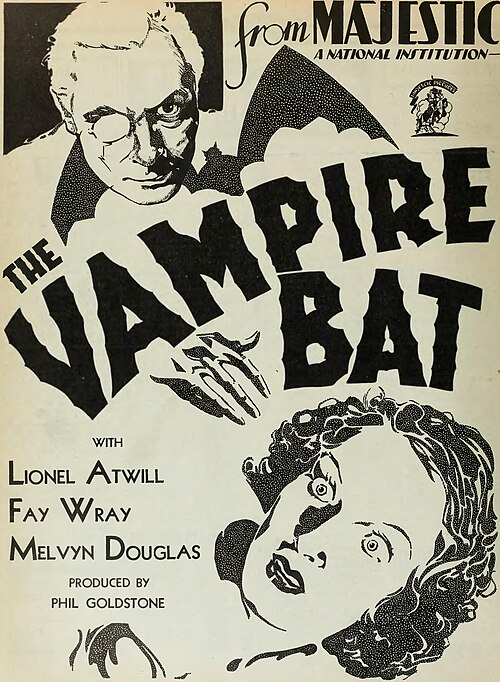
Horror Film Review: The Vampire Bat (dir by Frank R. Strayer)


In 1933’s The Vampire Bat, people are dying in a small German village, victims of blood loss.  A woman named Martha Mueller (Rita Carlisle) was recently attacked by a bat, leading to rumors of a vampire.  When the local town eccentric, a twitchy man named Hermann Glieb (Dwight Frye), argues that bats are actually harmless and admits that he likes bats because they are “soft” and “nice,” people start to suspect that he might be the vampire.  Another man named Kringen (George E. Stone) claims that he was attacked by a vampire and insinuates that it was Glieb.  Glieb may seems like a strange man who likes to collect bats but could he be something even more sinister?

Two town leaders have opposite feelings about the claim that a vampire is attacking the town.  Karl Brettschneider (Melvyn Douglas) is the local police inspector and he deals with facts.  He doesn’t believe in superstition and he initially scoffs at the idea that a vampire is attacking the village.  Meanwhile, Dr. Otto von Niemann (Lionel Atwill) is the town’s doctor.  He’s been treating the victims of the bat attacks and he’s even be letting some of his patients live at his home.  Everyone knows that Dr. von Neimann is a kindly man of science.  Karl is even dating Ruth (Fay Wray), one of Otto’s boarders.  But is the doctor as benevolent as everyone assumes?

When answering that question, consider these four facts:

  1.  Dr. von Neimann is the one who encouraged Kringen to spread stories about a vampire haunting the town, despite the fact that Kringen himself said that he didn’t want to start a panic.
  2. Dr. van Niemann is played by Lionel Atwill.
  3. Glieb is played by Dwight Frye.
  4. Karl is played by Melvyn Douglas.

Indeed, for horror fans, the casting of Lionel Atwill gives the game away.  Lionel Atwill appeared in a number of horror films and it was rare that he wasn’t cast as the villain.  (One of his non-villainous role was as the one-armed Inspector Krogh in The Son of Frankenstein.)  From the minute the viewer sees Atwill, he seem to give off sinister vibes and it’s not really a surprise when he turns out to be less than trustworthy.

As for Dwight Frye, horror fans love him for playing a number of unhinged weirdos, like Renfield in the Lugosi-version of Dracula and the torch-bearing servant in Karloff’s Frankenstein.  Frye was good at playing twitchy types but one thing that all of Frye’s characters had in common is that they were pretty much destined to be victims.  Even when Frye played an unlikeable character,  like in Frankenstein, it was obvious that he was going to end up getting killed at the hands of the Monster.

Finally, Melvyn Douglas was the epitome of propriety in every film in which he appeared.  If Douglas thinks that there is something more going on than just a vampire attacking people, there probably is.  And since we know Douglas can’t be the main bad guy, that pretty much just leaves Lionel Atwill.

The Vampire Bat is a short and enjoyable B-movie that puts an interesting spin on the typical vampire legend.  Though the budget may be low, the cast of Atwill, Douglas, Frye, and Wray can’t be beat and all of them give fully committed performances.  Dwight Frye, in particular, gives one of his best performance as the unfortunate Glieb.  As always, Lionel Atwill makes for an entertaining villain.  At its best, The Vampire Bat comments on the power of hysteria.  Convinced that there is a vampire in their midst, the town goes mad and it directs its anger towards those who are seen as being on the outside, men like Glieb.

The Vampire Bat is more than worthy of your Halloween viewing.

Horror On The Lens: Where Have All The People Gone? (dir by John Llewellyn Moxey)


In the creepy 1974 film, Peter Graves plays a father who goes on a camping trip with his two teenage children (one of whom is played by Kathleen Quinlan).  A sudden earthquake and a solar flare causes the trio to try to return to civilization, where they discover that almost everyone has been reduced to a powdery substance and there are only a few crazed survivors.  They try to make their way back to their home in Malibu, facing danger at every leg of their journey.

(It’s almost a low-budget and far more dramatic version of Night of the Comet.)

Effective despite its made-for-TV origins, Where Have All The People Gone? was obviously mean to serve as a pilot for a television series.  The series didn’t happen but, even with a somewhat open-ended conclusion, the movie still works.


Unidentified, Short Film Review by Case Wright


I was unable to find anything on IMDB for this film; so, I used this photo from a previous review where it looked like they were going for a Santa Pedo vibe. Read that review below:

https://unobtainium13.com/2021/10/23/creepshow-time-out-the-things-in-oakwoods-past/: Unidentified, Short Film Review by Case Wright

Unidentified is about an ordinary guy who sees an alien invasion. This concept is so overdone that it is really its own subgenre of suckiness. Some random schmoe sees aliens and is unable to do anything about it accept die?! Mr. Filmmaker of Unidentified, why you are bothering me this garbage? Who cares?!

Hear me, it’s one thing if the ordinary person is heroic or we are setting up the story or he causes a resolution, but when it’s just some doofus driving around for 60% of the short, you are wasting my time! Mr. Filmmaker of Unidentified, I understand that creating a story is hard like how you must be always confused when you try to get the mail or turn on your phone, but that doesn’t mean you should pursue the art of film. Instead of making these terrible shorts that lack even a basic story let alone an ending, how about working on a simplistic craft? I’ll even consider putting it on my fridge! Really, my fridge has some prime real estate on it: magnets, shopping list sticky notes, and stains if it’s my housecleaning day.

If this terrible film did pique your interest…..somehow, the story is a British man in a sedan who drives for several minutes and sees a big monster- yep, that’s it. UGHHH. Maybe Alex Magana has a British cousin?

October Positivity: Holyman Undercover (dir by David A.R. White)


In 2010’s Holyman Undercover, David A.R. White plays Roy.  Roy is an 18 year-old Amish dude from Kansas.  It’s time for him to experience Rumspringa, a period in which he can live life amongst “the English” and decide whether or not he wants to commit to being Amish.  Roy decides to go Los Angeles so he can track down his uncle and work with him as a missionary.

Roy struggles in Los Angeles.  Giving money to one homeless man leads to him nearly getting mugged.  When he meets his uncle, he discovers that Brian (also played by David A.R. White) is now a struggling actor who has a taste for cocaine.  (Brian claims that he’s a holyman working undercover.)  Accompanying Brian to an audition leads to Roy getting cast as Satan on a primetime soap opera.  His wife is played by vapid supermodel Tiffany Towers (Jennifer Lyons).  Meanwhile, the show’s producer is a former country girl named Annie (Andrea Logan White) and soon, Roy is having fantasies about Annie dressing up like an Amish woman and dancing in a field with him.  However, the head of the network (Fred Willard) wants Roy to date Tiffany because it’ll be good publicity for the show.

Throughout it all, Roy remains innocent and confused about the modern world.  He’s never watched television.  He doesn’t know how to use a phone.  He doesn’t understand what a credit card is.  He’s earnest and honest to a fault and, even after Tiffany makes out with him, he continues to insist that he only has eyes for Annie.

Of course, in reality, I imagine that the typical Amish person knows how to use a phone.  I imagine that they probably also know what a television is and they probably even understand that you’re expected to pay your credit card debt.  The Amish may choose to reject a good deal of the modern world but that doesn’t mean that they don’t know what the modern world is.  But this film isn’t meant to be a realistic portrayal of the Amish or of Hollywood or of really anything.

Indeed, I’m not really sure what to make of this film.  It’s faith-based and it ends with Roy delivering a simple message about loving others but the film’s humor is often rather mean-spirited and there’s several jokes that are more than a little racist and homophobic.  (Japanese tourists take pictures while shouting, “Godzilla!”  When Brian ends up in jail, his cellmate is a hulking black man who says his name is Beef because “it’s what’s for dinner.”)  David A.R. White is not bad as Roy but his performance as Brian is incredibly shrill and there’s really no reason, beyond ego, for director White to have cast himself in both roles.

Probably the best thing that one can say about the film is that the name actors — Fred Willard, Clint Howard, Edie McClurg, and Staci Keanan — all manage to survive with their dignity intact.  Indeed, the highlight of the film is, believe it or not, John Schneider earnestly playing himself as the actor who replaces Roy as Satan and who then promptly launches a presidential campaign.  “The country’s going to Hell anyway!” he says, with just the right amount of self-awareness.

Interestingly enough, the film does end with one particularly prophetic scene, as Roy and Annie leave Hollywood to produce an Amish dating show.  Tiffany moves with them to the farm and a group of Amish men compete for her hand in marriage.  Farmer Wants A Wife, anyone?

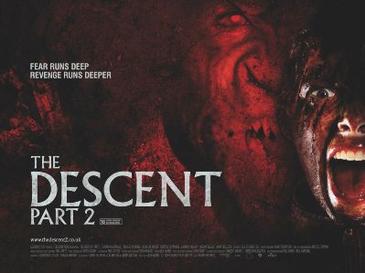
So, I Watched The Descent Part 2 (2009, Dir. by Jon Harris)


The Descent Part 2: Back to the Cave!

That’s what I would have called it.

Sarah (Shauna Macdonald) goes back to the caves that she barely escaped from during the first Descent to help the police look for the remains of her friends.  Sarah is suspected of killing all of them so I don’t think the police would have gone into a narrow cave with her.  Sarah was also traumatized by what happened in the cave so I don’t think she would voluntarily go back down there either.  As soon as they enter the cave, they get attacked by the crawlers.  What did they think would happen?

I loved the first Descent because it was a horror film that featured interesting and multi-layered women who weren’t just put on screen to be whimpering victims.  When I watched The Descent, I was just as invested in the personal drama as I was the horror in the caves.  I also liked that the first Descent left it open to interpretation about what actually happened in the cave.  The sequel didn’t really do that and it also didn’t add anything to the story.  Juno (Natalie Mendoza) returns but I’m not sure how considering what happened during the first movie.

The Descent Part 2 also shows a lot more of the crawlers than the first film did.  They’re much more visible and much more busy but they aren’t as scary once you can actually see them.  Plus revealing the crawlers as much as this movie does also ruins the ambiguity that I loved about the first Descent.

The Descent Part 2: More Splatter, Less Heart.

I should get a job writing tag lines.


Wizards of the Lost Kingdom (1985, directed by Hector Olivera)


The kingdom has been conquered by an evil sorcerer named Shurka (Thom Christopher).  Young Simon (Vidal Peterson), the son of the king’s wizard, barely escapes with his best friend and pet, the white fur-covered Gufax (Eugenio Martin).  In the wilderness, they meet warrior Kor (Bo Svenson), who teams up with them to free the kingdom.

This is another Roger Corman-produced sword and sorcery film from Argentina.  Corman did a lot of these in the 80s.  Wizards of the Lost Kingdom stands out by being considerably more kid-friendly than the rest of them.  There’s no nudity.  The violence is not excessive and is largely directed at fake looking giant insects.  There’s no nudity and no scenes of the bad guys forcing themselves on women.  The hero even has a toy-friendly companion!

Wizards of the Lost Kingdom also has a lot of stock footage.  The entire pre-title sequence is stock footage lifted from movies like Death Stalker to explain how “King Tyler” came to control the kingdom.  (King Tyler sounds like someone who would be the kegger king of the local college.)  Wizards of the Lost Kingdom is a short movie with a barely 72-minute run-time.  Fourteen of those minutes is footage from other movies.

Wizards of the Lost Kingdom takes a lighter approach to the sword-and-sorcery genre and it pays off with a simple and easy-to-watch movie featuring swords, magic, and monstrous insects.  It’s not a film that demands much of the audience and Bo Svenson looks convincing grunting and carrying a sword.  It wasn’t a box office hit but found a second life on video.  Of course, it got a sequel.  None of the original cast returned.

October True Crime: Karla (dir by Joel Bender)


When it comes to true crime cases, few are as disturbing as the story of Paul Bernardo and Karla Homolka.

Paul and Karla were a young, married couple who lived in Ontario.  They were both attractive.  They were both popular.  They were both superficially charming, in the style of someone who you might have taken a class with but the only thing you can really remember about them is their smile.  And they were both killers.  Paul Bernardo, a wannabe rapper who had previously made his money by smuggling cigarettes and who was also a serial rapist, murdered at the least three teenage girls, including Karla’s sister, Tammy.  When Paul was arrested, Karla told prosecutors that she had helped Paul with his murders but only because he threatened and abused her.  Prosecutors, perhaps moved by a picture that Karla’s friend took of her bruised face after one of Paul’s beatings, made a deal with her for her testimony.  In return for testifying against Paul Bernardo, Karla was convicted only of manslaughter and given a 12-year prison sentence.  (She was 23 at the time and would only be 35 when released from prison, assuming that she served the full sentence.)  However, during the trial, video tapes of the murders were uncovered and showed that Karla had been a far more active participant in the murders than she had originally admitted.  That included the murder of her sister, Tammy.

There were calls to rescind Karla’s plea bargain and to try her for murder but since her plea bargain had only required her to provide enough evidence to convict Paul, it was ruled that she had upheld her end of the bargain.  While Paul Bernardo is currently serving his life sentence, Karla Homolka is now free and living somewhere in Canada.

Needless to say, the case drew international attention, both due to the circumstances of Karla’s plea bargain and also to Paul and Karla’s image of being the “Ken and Barbie Of Serial Killers.”  It’s a case that continue to haunt Canada, an example of how the accused was ultimately treated with more respect than the victims.  For her part, Karla continues to claim that it was all Paul and that she was forced into helping.  Paul claims that he and Karla were equal partners and that the actual murders were all committed by Karla.  Personally, I think they’re both lying.

2006’s Karla stars Laura Prepon as Karla Homolka.  The film opens with her already in prison and being interviewed by a psychiatrist (Patrick Bauchau) who has been assigned to determine if there’s a risk of her reoffending.  As Karla tells her story, we see flashbacks of Karla’s life with Paul (Misha Collins).  Prepon and Collins are both chillingly believable as the soulless Paul and Karla.  Laura Prepon plays Karla as being a narcissistic sociopath who is incapable of understand that she’s not the victim in this story.  I imagine that Prepon’s performance probably captures the essence of the real Karla, even if Prepon doesn’t really look like her.

That said, the film itself is largely a surface level exploration of the case.  The film’s script attempts to maintain some ambiguity as to whether or not Karla Homolka was a voluntarily participant in the murders or if she actually was just too scared of Bernardo to stop him.  Prepon plays her as being a sociopath but the script still tries to play both sides of the debate and, as a result, the film falls flat.  The film may be called Karla but it doesn’t really get into her head and, as a result, it has all the depth of an Investigative Discovery special.  In the end, the film feels like it’s trying to exploit the notoriety around a famous case without taking a firm position on the case’s biggest controversy.  When it comes to the crimes of Karla Homolka, that’s not an option.