Cleaning Out The DVR: The Love-Ins (dir by Arthur Dreifuss)


(Hi there!  So, as you may know because I’ve been talking about it on this site all year, I have got way too much stuff on my DVR.  Seriously, I currently have 179 things recorded!  I’ve decided that, on February 1st, I am going to erase everything on the DVR, regardless of whether I’ve watched it or not.  So, that means that I’ve now have only have a month to clean out the DVR!  Will I make it?  Keep checking this site to find out!  I recorded the 1967 film, The Love-Ins, off of TCM on September 28th, 2017!)

“We now enter Haight Ashbury.  The promised land of the love movement.  The utopia of LSD…and now we take you to Golden Gate Park for a hippie love-in!”

— A San Francisco Tour Guide in The Love-Ins (1967)

I doubt I could ever be a hippie.  I don’t mind the drugs, the free love, or the music but the whole lack of showers and underwear would be too much for me.  Add to that, from what I’ve seen, it appears that whenever there was a hippie gathering, it would inevitably lead to the arrival of mimes and who wants to deal with that?  That said, I certainly do enjoy watching movies about hippies.

Take The Love-Ins for instance!

This 1967 film is all about hippies, or at the very least the popular perception of hippies.  There’s even a lengthy sequence that takes place at a hippie gathering in San Francisco.  While the hippies plays bongo drums, blow bubbles, dance, and stare at multi-colored umbrellas with stoned eyes, they’re watched by Jonathan Barnett (Richard Todd).  Barnett used to be a respected philosophy professor but then he resigned his teaching position in protest after two students were expelled for publishing an underground newspaper.  This led to Barnett appearing on a right-wing talk show where the antagonistic host told him that, if he loved the hippies so much, maybe he should got to Haight Ashbury and see how they really live.  Barnett does just that and it blows his mind!

Soon, Barnett has re-invented himself.  He’s now a psychedelic prophet, living in a commune with the expelled students and encouraging everyone to “Be more.  Sense more.  Love more.”  That doesn’t quite have the same ring to it as “Tune in.  Turn On.  Drop out,” but it’s the same basic idea.  Soon, hippies from all over the country are flocking to Prof. Barnett, dropping LSD, and doing interpretive dances.  Not even the local outlaw bikers can stop Barnett from spreading his message.

Unfortunately, it doesn’t take long for his newfound fame to go to Barnett’s head.  He soon stops listening to Larry (James MacArthur), the student whose expulsion started the whole movement, and instead surrounds himself with sycophants like Elliott (Mark Goddard).  Barnett goes from being an idealist to a messianic cult leader.  Soon, hippies are fighting in the streets, setting fired to newspaper they don’t like, and jumping out of windows.  (“LSD told him he could fly.  Gravity had different plans.”  No one actually said that in the movie but I wish they had.)  After discovering that his girlfriend (Susan Oliver) has been impregnated by Barnett, Larry realizes that he has to stop his former professor, one way or the other.

The Love-Ins was made by the same people responsible for Riot on Sunset Strip but, whereas Sunset Strip at least pretended to take an even-handed, documentary-like approach, The Love-Ins is a psychedelic freakout.  Whereas Sunset Strip features Mimsy Farmer taking LSD and then staring at her hand, The Love-Ins features Susan Oliver taking LSD, transforming into Alice in Wonderland, and then dancing with Tweedle Dee and Tweedle Dum.  And whereas Sunset Strip tried to be on the side of both the young and the old, The Love-Ins leaves little doubt that those hippies are no good!  (While Larry may be a the film’s hero, he looks like he would be more comfortable in the ROTC than at Woodstock.)  Barnett’s love-ins are revealed to be as choreographed as any political rally and, if there’s any doubt that he’s become a really bad guy, he even starts to perform impromptu wedding ceremonies.  “How dare you make a mockery of marriage!?”  an outraged observer shouts.

Seen today, the main value of The Love-Ins is a chance to see how many adults viewed the counter-culture and its leaders in 1967.  (Director Arthur Dreifuss was 60 when he directed this film and the film often views its young characters with the detachment of someone not sure of how close he can really get before being attacked.)  Of course, the main reason I liked The Love-Ins was because of the psychedelic dance scenes.  (Though no one’s going to mistake this film for another Face in the Crowd, I also enjoyed some of the film’s satiric jabs at the cult of celebrity, which was apparently just as big in 1967 as it is in 2018.)  It’s definitely a film of its time, though whether or not the people involved with the movie actually understood their time is another issue all together.


Cleaning Out The DVR: Riot on Sunset Strip (dir Arthur Dreifuss)


(Hi there!  So, as you may know because I’ve been talking about it on this site all year, I have got way too much stuff on my DVR.  Seriously, I currently have 180 things recorded!  I’ve decided that, on February 1st, I am going to erase everything on the DVR, regardless of whether I’ve watched it or not.  So, that means that I’ve now have only have a month to clean out the DVR!  Will I make it?  Keep checking this site to find out!  I recorded the 1967 film, Riot on Sunset Strip, off of TCM on September 28th, 2017!)

“Dig that scene!”

That’s a line that’s heard more than once in Riot on Sunset Strip, a film that’s all about digging that scene.

In this case, the scene is Hollywood’s Sunset Strip in 1966.  All the kids are going to the clubs and dancing to that strange rock and roll music.  Protesters are walking up and down the sidewalk, carrying signs that carry radical messages like: “Be Nice” and “Make Peace.”  (As far as I could tell, no one had a “Join the Conversation” sign.)  Some of the so-called “long hairs” are wearing red armbands to show that they are a member of the counter-culture police force, determined to keep peace on the Strip.  Meanwhile, the real police are a constant presence.  There’s a 10 o’clock curfew for anyone under the age of 18 and if the cops catch you, you’re going to the station where your parents will be called and your mom will probably freak out over the length of your skirt.  The kids want the police to change their attitude.  The local business owners — the ones who don’t own a club and who all look like they might be related to Dwight Eisenhower — want the police to get even more aggressive.

Stuck in the middle of it all is the local police captain, Walt Lormier (Aldo Ray).  Sure, Walt might be a member of the establishment, with his neckties and his J. Edgar Hoover haircut.  But Walt knows that the kids aren’t all bad.  Sure, their music sounds like noise to him.  And some of the boys may wear their hair a little bit longer than Walt thinks they should.  (In some scenes, it’s easy to imagine Walt thinking, “That haircut would have gotten you shot if you’d been in my unit in Korea…”)  But mostly, Walt wants to keep peace.  He’s even willing to meet with one of the protesters and listen to his concerns.

“Are you in college?” Walt asks the protester.

“Third year,” the protester replies, “Straight A’s.”

Of course, what Walt doesn’t realize is that his own daughter, Andy (Mismy Farmer, before she relocated to Italy), is one of the kids who is hanging out on the strip!  Of course, it’s been a while since he’s seen Andy.  Walt is divorced from Andy’s mother and says he really isn’t even sure where either Andy or his ex-wife lives now.  Of course, we know that they’re living in a shack, one that has only one room and where wet clothes are hung from the ceiling so that they can dry.  Andy’s mom is always drunk.  Can you blame Andy for wanting to spend all of her time on the Strip?

Of course, not everyone on the Strip is as reasonable as a third year college student.  Some of the kids actually are bad.  One of them slips Andy LSD, which leads to Andy staring at her hand and then doing an interpretive dance at a house party.  After discovering that his drugged daughter has been raped, Walt attacks her three rapists, which leads to the riot promised by the title.  Being a good middle-of-the-road liberal, Walt realizes that he now has to make amends with the good kids but can he stop things before they get out of control?  After all, those protesters are already passing out signs…

Based on an actual event. Riot on Sunset Strip is a real time capsule of a film.  Regardless of whether the film itself is any good or not, it’s worth watching as just a reflection of the time in which it was made.  Like a lot of the “social problem” films made in the mid-60s, it deals with a very real issue and then resolutely refuses to come down on either side.  Older viewers could watch Mimsy Farmer freaking out on LSD and say, “See, that’s why we need a curfew!”  Younger viewers could look at Andy’s drunk mother and the parents picking up their children at the station and say, “See, that’s why we need to burn down the establishment and move to Cuba!”  In the end, the film declares that the kids are all right except for the ones that aren’t.  Ultimately, it’s all the parents’ fault except for the parents who aren’t at fault.

(That said, I imagine that any truly committed 60s revolutionary would have rolled their eyes at the way they were portrayed in the film.  The protesters and their signs automatically made me think about the infamous Kendall Jenner Pepsi commercial.)

Seen today, the main thing that I noticed about Riot on Sunset Strip is that all of the wild kids on the Strip looked more like missionaries than revolutionaries.  One of Andy’s friend’s did occasionally let his hair fall in his eyes but otherwise, they were an amazingly clean-cut group of delinquents, the type who, today, would probably get blocked by every member of Resistance Twitter because everyone would assume that they were actually undercover Russian bots.

(At the end of the film, a narrators informs us, “Soon, half the world’s population will be under 25 years of age.  What will happen to them?  Where will they go?”  The answer, of course, is that most of them will go to the suburbs.)

Today, it’s easy to roll your eyes at something like Riot on the Sunset Strip.  Our modern culture of snark almost demands that you do.  But, honestly, I enjoyed this film.  Watching it was like having my own little time machine.

Film Review: A Tale of Two Coreys (dir by Steven Huffacker)


I just finished watching Lifetime’s first “big” film of the year, A Tale of Two Coreys, and I am probably just as shocked as anyone to say, “It wasn’t bad.”

In fact, I would even say that it was pretty good.

Shocking, I know.

A Tale of Two Coreys, of course, is a film about the tumultuous friendship between actors Corey Haim and Corey Feldman.  They were stars in the 80s and outcasts by the 90s.  They were infamous for their struggles with drugs and all the other demons that come with being famous at a young age.  Eventually, Feldman ended up in the direct-to-video dungeon while Haim found himself essentially unemployable.  Somewhat inevitably, they eventually found themselves reunited via reality television.  Corey Haim died in 2010, at the age of 38.  After his death, Feldman announced that, at the height of their stardom, both he and Haim were victimized by Hollywood pedophiles.

Over the past few years, Lifetime has aired several celebrity biopics and a few “unauthorized” movies about the behind-the-scenes drama on TV shows like Saved By The Bell, Full House, and Beverly Hills 90210.  With the exception of the 90210 movie, none of them have been particularly memorable.  Too often, they promised the “true story,” just to deliver a watered down version of what everyone already knew.  Combine that with some questionable casting choices and you’ll understand why veteran Lifetime watches often roll their eyes when Lifetime announces another celebrity biopic.

Somehow, A Tale of Two Coreys manages to escape the Lifetime biopic curse.

Now, just to make clear,  A Tale Of Two Coreys does not name names.  There’s a scene in which a Hollywood executive leads Corey Haim (played, as a teenager, by Justin Ellings) into a trailer but the man is never identified by name and the scene is shot in such a way that we don’t even get a clear look at his face.  Later, both Feldman (played, as a teen, by Elijah Marcano) and Haim discuss some of the new “friends” that they’ve acquired since becoming stars.  Again, no names are dropped but it’s not hard to read between the lines.  It’s not until they’re adults and reality show co-stars that Feldman (now played by Scott Bosely) and Haim (Casey Leach) discuss what happened to them when they were younger.

Of course, famous people do pop up throughout the film.  Brandon Howard plays Michael Jackson in two scenes.  Jennifer Peo plays Carrie Fisher, who is seen telling Feldman to get off the drugs.  If you watch carefully, an actor playing Tom Hanks shows up in the background of one scene.  He doesn’t get any lines but he certainly does get annoyed with Feldman.

The film continually returns to the theme that both Feldman and Haim were, essentially, dropped into the middle of Hollywood without any supervision.  Feldman’s parents (Ashley Scott and Patrick Muldoon) are portrayed as being leeches, more concerned with the money that Feldman could bring than Feldman’s mental or emotional health.  On the other hand, Haim’s parents (Paula Lindberg and Brian Huskey) are portrayed as being loving but hopelessly naive about the world that their son has entered.  The end result is that neither set of parents were there to provide any sort of guidance to their children.

It’s a deeply melancholy portrait of fame with Haim and Feldman quickly going from being innocent children to jaded, coke-snorting adolescents to eventually becoming adults who still haven’t come to terms with past.  Admittedly, their stardom was a little before my time so I can’t really attest as to whether the film is a hundred percent accurate but director Steven Huffacker kept the story moving at a steady and tragically inevitable pace and all four of the actors who played Feldman and Haim did a good job of bringing their characters to life.

All in all, it was a surprisingly good film.

Cleaning Out The DVR: Deadly Exchange (dir by Tom Shell)


(Hi there!  So, as you may know because I’ve been talking about it on this site all year, I have got way too much stuff on my DVR.  Seriously, I currently have 181 things recorded!  I’ve decided that, on February 1st, I am going to erase everything on the DVR, regardless of whether I’ve watched it or not.  So, that means that I’ve now have only have a month to clean out the DVR!  Will I make it?  Keep checking this site to find out!  I recorded Deadly Exchange off of the Lifetime Movie Network on December 6th, 2017!)


Thinking about opening up your home to a foreign exchange student?

Personally, I think that’s a great idea.  During my junior year of high school, I took an English class with a South African exchange student named Sean.  He was a swimmer with a charming accent and a killer smile and needless to say, nearly everyone in the school was in love with him.  He once approached my at a party, looked down at the diamond heart pendant that fell right above my cleavage, and said, “I like those,” before winking and moving on.  With his accent, he could get away with it.  He left after a semester, leaving many a broken heart behind.

So, I say open up your home to those foreign exchange students.  However, Deadly Exchange says, “Not so fast!”

Deadly Exchange is an example of a “Be Careful Who You Let Into Your House” Lifetime film.  Samantha (Lindsay Hartley) thinks it’ll be good idea to serve as host to a foreign exchange student.  Both her husband and her oldest daughter have died and her other daughter, Blake (Victoria Konefal), is still struggling to deal with the loss.  When Chloe (Valentina Novakovic) arrives from the UK, she almost seems too go to be true.  She’s nice, polite, and, like me, she has red hair.  Chloe is soon encouraging Blake to break out of her shell and hang out with more people than just her geeky friend, Jack (Rhys Matthew Bond).  With the help of Chloe, Blake even becomes a cheerleader!

However, there are a few drawbacks to having Chloe in the house.  For instance, Chloe has a habit of stealing people’s phones, drugging their drinks, flirting with their boyfriends, and drowning their other friends.  Whenever Samantha starts to get too concerned about Chloe and her influence on her daughter, an email shows up from Chloe’s parents, suggesting that Samantha throw Chloe a birthday party or do something else that would generally cheer Chloe up.  Of course, what Samantha doesn’t realize is that those emails are being sent by Chloe herself…

I really liked Deadly Exchange, largely because it was a good, old-fashioned Lifetime melodrama, one that didn’t take itself too seriously and wasn’t worried about going totally over the top.  Chloe may have been a little bit disturbed and she did kill a few people but she did it with so much style that it was fun to watch.  When Chloe wasn’t busy with murder and email, she was subtly but cleverly driving a wedge between Samantha, Blake, and everyone they knew.  Any experienced Lifetime viewer knew exactly what Chloe was doing and what would probably happen as a result but, largely thanks to Valentina Novakovic’s cheerfully evil performance, it was still a lot of fun to watch.  Of course, with a film like this, the villain is always the most interesting character but, as her unwitting victims, Linday Hartley, Victoria Konefal, Jason-Shane Scott, and Rhys Matthew Bond were all sympathetic and made a good impression as well.

(That said, I was definitely Team Chloe for most of the film.)

Deadly Exchange premiered during the days leading up to New Year’s Eve so I imagine a lot of people missed it when it originally aired.  But, since Lifetime repeats all of their movies about a hundred times a month, it’ll probably air again soon.  Keep an eye out for it!


Recipe for Disaster: THE POSEIDON ADVENTURE (20th Century-Fox 1972)


gary loggins's avatarcracked rear viewer

Although 1970’s AIRPORT is generally credited as the first “disaster movie”, it was 1972’s THE POSEIDON ADVENTURE that made the biggest splash for the genre. Producer Irwin Allen loaded up his cast with five- count ’em!- Academy Award winners, including the previous year’s winner Gene Hackman (THE FRENCH CONNECTION ). The special effects laden extravaganza wound up nominated for 9 Oscars, winning 2, and was the second highest grossing film of the year, behind only THE GODFATHER!

And unlike many of the “disasters” that followed in its wake, THE POSEIDON ADVENTURE holds up surprisingly well. The story serves as an instruction manual for all disaster movies to come. First, introduce your premise: The S.S. Poseidon is sailing on its final voyage, and Captain Leslie Nielsen is ordered by the new ownership to go full steam ahead, despite the ship no longer being in ship-shape. (You won’t be able to take…

View original post 539 more words

Cleaning Out The DVR: Tiny House of Terror (dir by Paul Shapiro)


(Hi there!  So, as you may know because I’ve been talking about it on this site all year, I have got way too much stuff on my DVR.  Seriously, I currently have 181 things recorded!  I’ve decided that, on February 1st, I am going to erase everything on the DVR, regardless of whether I’ve watched it or not.  So, that means that I’ve now have only have a month to clean out the DVR!  Will I make it?  Keep checking this site to find out!  I recorded Tiny House of Terror off of Lifetime on June 29th, 2017!)

Before I start this review, I have to admit that, when it comes to the tiny house movement, I lost interest as soon as I saw the words “tiny” and “house.”  I mean, I understand that they’re supposed to be better for the environment and easier to take care of.  And I get that right now, a lot of people are pretending that they don’t care about material possessions and all that stuff.  But, honestly, the only reason I would want a tiny house would be so I could keep it in the backyard of a bigger house.

That said, despite my lack of interest in the tiny house movement, I was a bit intrigued by the idea of a Lifetime movie set in a tiny house.  After all, one of the great things about Lifetime films is that everyone, regardless of how poor or criminal they may be, usually lives in a large and tastefully furnished house.  How, I wondered, would Lifetime handle setting a film in the type of house that is largely favored by retirees, hippies, and displaced persons?

Well, I’m glad to say that Lifetime handled it pretty well.  Of course, they were clever enough not to set the entire film in a tiny house.  There are several scenes that take place in a technologically advanced mansion and there are also several scenes that take place in Gravity Hill, a lovely little town where a magnetic field regularly plays havoc with electricity, cars, and cell phone reception.  Tiny House of Terror was a surprisingly lovely film to look at.  The small town was lovely.  The scenes set in the big city were properly dark and menacing.  The finale made great use of creepy shadow and light.  Credited with cinematography is Jon Joffin and he certainly did a great job.

The film itself tells the story of Samantha (Francia Raisa), who was married to a tech billionaire named Kyle (Jesse Hutch).  When Kyle disappears while climbing a mountain, Samantha is left distraught.  Even worse, she finds herself a prisoner of her technologically advanced mansion, which was apparently designed to only recognize Kyle’s voice commands.  (Imagine if Alexa suddenly got a passive aggressive attitude and you’ll understand what Samantha is going through.)  It turns out that Kyle was planning on opening up a tiny house community in Gravity Hill.  He was going to allow Samantha to do the landscaping.  Only one tiny house has been built and Samantha decides to move out there, both for her own sanity and to complete Kyle’s final project.

Of course, things are never simple in Gravity Hill.  It turns out that some people in town don’t want a tiny house community.  No sooner has Samantha moved into her tiny house then strange things start to happen.  Is it the magnetic field that’s making things (like kitchen knives) fly at Samantha or is something more sinister happening?  Is Samantha being targeted and does it have anything to do with Kyle’s mysterious disappearance?

I liked Tiny House of Terror far more than I thought I would.  Because it’s structured as a whodunit and there are a few flashbacks and time jumps, the film require a bit more concentration than the typical Lifetime film but that’s okay.  It pays off in the end.  Francia Raisa did a good job in the lead role, as did Nanzeen Contractor in the role of her sister.  I may not care much about the tiny house movement but Tiny House of Terror not only held my interest but rewarded it as well.


What Lisa Watched Last Night #173: Blood, Sweat, and Lies (dir by Lane Shefter Bishop)


On Friday night, I watched the first Lifetime film of 2018, Blood, Sweat, and Lies!

Why Was I Watching It?

I just told you.  It was the first Lifetime film of 2018.  There was no way I couldn’t watch it.

Of course, there was a slight conflict in that Blood, Sweat, and Lies premiered at the exact same time as the U.S. Figure Skating Championship.  So, while Blood, Sweat, and Lies was originally airing, I was busy yelling at the judges for the way they treated Ashley Wagner.  (Whatever controversy she may find herself in, I will always be on the side of Ashley Wagner.)  However, as soon as the I finished yelling, I switched over to the DVR and I watched Blood, Sweat, and Lies.

What Was It About?

Once upon a time, Mel (Hannah Barefoot) was a college track star.  In fact, she was such a committed athlete that she decided to major in something easy so she would have more time to run track.  Apparently, in the weird, alternative universe that this film takes place in, art history is an easy major.  However, Mel quickly fell in love with art and, when she graduated from college, she gave up athletics to become a curator.  (“That’s all you can do with an art history degree,” she said with a laugh while I, the proud recipient of a degree in art history, tried to resist the temptation to throw a show at the TV.)

So now, Mel is a successful curator but she misses being an athlete.  When she breaks up with her boyfriend, she decides to start a new chapter in her life.  She joins the local gym.  She gets a personal trainer named Trey (Adam Huber).  Since this is a Lifetime movie, it takes Trey about 60 minutes to go from being a supportive nice guy to a full-on psycho stalker.  When Mel starts dating a muscular art collector named Adam (Matt Cedeño), Trey is not happy…

What Worked?

I think the biggest mistake that anyone could make with Blood, Sweat, and Lie would be to take any of it too seriously.  If you take the movie seriously, then you’ll probably complain that it was predictable, the plot was full of holes, and Mel should have known better than to have trusted Trey in the first place.

However, if you’re like me, you’ll assume that this film was meant to be at least a little bit satirical and you’ll find a lot to be amused by.  For instance, consider the opening scene in which Mel is seen holding a knife and smearing what appears to be blood on her face.  At first, we assume that she’s just a typical Lifetime movie psycho but it’s soon revealed that she’s actually just trying to make a cake.

Or how about the scene where Trey and Adam meet at the gym and proceed to exchange passive aggressive insults.  That was like Overage Dudebros Gone Wild.

Or there’s Mel’s best friend, Leslie (Briana Lane), who is not only a brilliant hacker but who also apparently shares every single thought that pops into her head.  Often times, I got the feeling that Leslie understood that she was just a character in a movie and she was actually pretty okay with that.

And, of course, there’s the scene where, while Mel and Adam make love, Trey sits in his office and monitors Mel’s heart rate.  It was strange, wrong, weird, and hilarious all at the same time.  And really, that’s pretty much a perfect description of the entire film.  It was just so melodramatic and full of over the top emoting that it was hard not to find something about it to enjoy.

(Plus, while I was watching the movie, I came up with a drinking game where you take a drink every time Adam or Trey calls someone “bro.”)

What Did Not Work?

Art history is not an easy major!  (Admittedly, it was easy for me but I understand that there were others who definitely found it a little bit difficult.)

And you can do a lot of stuff with an art history degree … well, maybe not a lot of stuff but definitely some stuff…  Actually, I guess the film kind of has a point as far as that’s concerned.  But still…!

“OMG!  JUST LIKE ME!” Moments

Despite the fact that Mel and I were both art history majors, I actually found myself relating more to Leslie.  This was largely because both Leslie and I tend to say, “O. M. G” in politic conversation.

Lessons Learned

Art history majors never get the respect they deserve.


Cleaning Out The DVR: The Bachelor Next Door (dir by Michael Feifer)


(Hi there!  So, as you may know because I’ve been talking about it on this site all year, I have got way too much stuff on my DVR.  Seriously, I currently have 182 things recorded!  I’ve decided that, on January 15th, I am going to erase everything on the DVR, regardless of whether I’ve watched it or not.  So, that means that I’ve now have only have a month to clean out the DVR!  Will I make it?  Keep checking this site to find out!  I recorded The Bachelor Next Door off of Lifetime Move Network on December 2nd, 2017!)

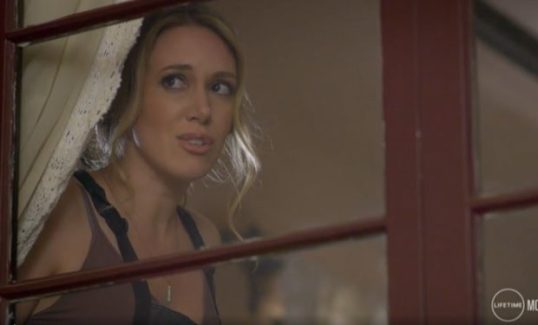
It’s time for yet another Lifetime film featuring Haylie Duff as a woman being menaced by a neighbor!

In this one, Haylie plays Alex.  Alex is a painter who lives with her boyfriend, Gavin (Stephen Bruns).  Alex hasn’t found much success as a painter but, fortunately, Gavin has one of those financial jobs where he spends all of his time talking about when the markets in London close.  So, even though Alex hasn’t sold a painting in forever, she still gets to live in a really big and pretty house.

But then one day, that house nearly burns down!  Fortunately, the new neighbor, Donnie (Michael Welch), just happens to notice that a fire has broken out in the kitchen so he runs over and he saves the day.  Or, at the very least, Donnie claims that he just happened to notice the fire.  Donnie seems to have some issues.  He’s way too nice and way too quick to want to help out around Gavin and Alex’s house.  Plus, sometimes he goes back to his own house and he throws a screaming fit.  Again, Donnie would appear to have some issues.  Still, Alex goes ahead and sets Donnie up with her sister, Sage (Brittany Underwood).

And for a while, it seems like everything’s just perfect.  Sage and Donnie make for a really cute couple.  Or at least they do until Donnie accidentally calls Sage by her sister’s name.  Uh oh!

Meanwhile, Gavin keeps asking Alex to marry him and Alex keeps saying no.  Alex says that she’s worried that, if she gets married, she’ll become complacent and boring and she’ll lose her edge as an artist.  I have to say that this part of the movie was handled very well.  Alex and Gavin seemed like a “real” couple and Haylie did a good job capturing all of Alex’s fears about commitment.  I could relate to Alex and, as a result, I was more emotionally invested in her story than I am in the typical Lifetime movie.

Anyway, Gavin refuses to give up.  He keeps asking her to marry him and when Alex finally says yes, everyone’s overjoyed.  Except for Donnie…

And why should Donnie care?  It all goes back to something that happened years ago.  Donnie is not as much of a stranger as everyone initially thinks that he is…

The Bachelor Next Door was actually pretty good.  I’ve gotten to the point where I really look forward to these Haylie-Duff-In-Danger Lifetime films.  Haylie always does a really good job in these movies and, in The Bachelor Next Door, she ably supported by Michael Welch, Steve Bruns, and Brittany Underwood.  The Bachelor Next Door has suspense, flashbacks, a great ending, and two great houses.  What more could you ask for?


Film Review: Insidious: The Last Key (dir by Adam Robitel)


Traditionally, good films are not released in January.

With most filmgoers more interested in catching up with the probable Oscar nominees and no one wanting to spend too much money after Christmas, January has become the month when the studios release all of the low-budget films that they’re hoping they can make a few bucks off before everyone forgets about them.  January is the month that sees sequels to the franchises that have a small but loyal fan base.  Just as last January saw the release of a new Underworld and a new Resident Evil, this January sees the release of Insidious: The Last Key.

Though it would subsequently be overshadowed by The Conjuring and its sequel, the Insidious franchise got off to a good start with the first film in the series.  Released in 2010, the first Insidious was a genuinely scary movie, one that can still give your nightmares if you watch it on a stormy night.  There are so many moments from that film that have stuck with me: the dancing ghost, the red demon suddenly appearing over Patrick Wilson’s shoulder, and the franchise’s first trip to the Further.  Of course, the thing that really elevated Insidious was the performance of Lin Shaye, in the role of demonologist Elise Rainier.  Lin Shaye played Elise with a combination of eccentricity and quiet authority and, from the minute she first showed up, you wanted to know more about Elise’s paranormal career.  Elise was the most popular character in the movie, which made it unfortunate that she was dead by the end of it.

Despite Elise’s death, she’s continued to be at the center of the Insidious franchise.  The first sequel dealt with her death by having her appear as a spirit, leading the hero through the Further.  The third film in the franchise was actually a prequel, dealing with one of Elise’s earlier investigations and showing how she first met her two comedy relief assistants, Tucker (Angus Sampson) and Specs (Leigh Whannell).  The Last Key is another prequel, revealing the details of Elise’s childhood and following her all the way through 2010.  The Last Key ends with a call back to the first Insidious movie, suggesting that the franchise has now come full circle.

The Last Key is another haunted house movie.  This time, the house in question is the one where Elise and her brother (played, as an adult, by Bruce Davison) grew up with their horribly abusive (and possibly demon-possessed) father.  In 2010, the house has been purchased by Ted (Kirk Acevedo).  No sooner has Ted bought the place then it becomes obvious that it’s haunted.  However, Ted can’t just abandon the place because he’s sunk all of his money into this house, which he was hoping to be able to then sell to someone else.  Apparently, you can’t get much money for a haunted house.

(Well, whatever.  I’d pay good money to buy a haunted house and then I would open it to the paying public every October.  I would make a fortune, assuming everyone didn’t get killed.)

Anyway, it all pretty much leads to everything you would expect to happen in an Insidious movie.  Doors open and close.  Malevolent beings appear in the shadows.  Everyone goes to the Further.  Lin Shaye gives another entertaining and fully committed performance, obviously enjoying the chance to be the star of the film.  Nothing about the film is particularly surprising but that doesn’t mean that it isn’t often effective.  Watching this film is a lot like listening to a skilled storyteller tell the story about the girl, her boyfriend, and the escaped mental patient who has a hook for a hand.  You know exactly what’s going to happen.  You know that it none of it really happened.  You know the story is borderline ludicrous.  But you still find yourself jumping at every unexpected sound.  You still find yourself staring into the shadows, wondering if you really saw something moving or if it was just your imagination.

Needless to say, The Last Key is never as effective or as scary as the first Insidious or either of The Conjuring films.  There were a few moments — mostly dealing with Elise’s childhood — where The Last Key showed the potential to be something a little deeper than what I was expecting but those moments were rarely followed up on.  In the end The Last Key is a rather modest and workmanlike horror film, the type that makes you jump while you’re watching it but which you will also probably end up forgetting about a day or two after seeing it. However, for a January horror film, it’s good enough.

Cleaning Out The DVR: Psycho Wedding Crasher (dir by David Langlois)


(Hi there!  So, as you may know because I’ve been talking about it on this site all year, I have got way too much stuff on my DVR.  Seriously, I currently have 183 things recorded!  I’ve decided that, on January 15th, I am going to erase everything on the DVR, regardless of whether I’ve watched it or not.  So, that means that I’ve now have only have a month to clean out the DVR!  Will I make it?  Keep checking this site to find out!  I recorded Psycho Wedding Crasher off of Lifetime on September 3rd, 2017!)

There were three “psycho” movies on Lifetime this year.  I’ve already watched and reviewed Psycho In-Law and Psycho Brother-in-Lawtwo films that I liked quite a bit.  But as insane as the psychos were in those films, neither of them can hold a candle to Jenna (Heather Morris), the title character in Psycho Wedding Crasher.

“Oh my God!  She did not just do that!”  That’s something that I shouted so many times, while watching Psycho Wedding Crasher, that I eventually lost track of the number of times Jenna’s behavior shocked me.

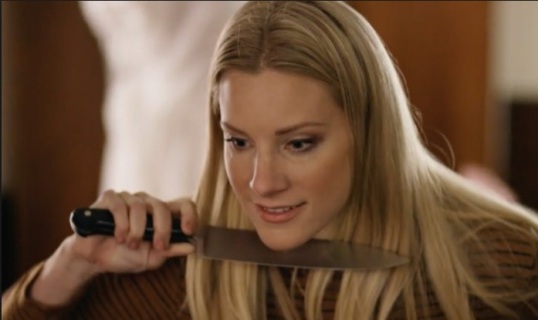
The first time I shouted it was when Jenna, while attending a party, searched her host’s bedroom and not only stole a pair of panties but actually put them on before leaving.  I shouted it again when Jenna started physically beating herself up in her car so that she could accuse Scott (Robert Salvador) of assaulting her.  This was followed by Jenna making use of a stranger’s bed, hiding in a closet so she could watch Glenn (Jason Cermak) take a shower, strangling someone with measuring tape, having an imaginary wedding, and of course engaging in a lot of knife action.  By the time the movie was over, I was nearly hoarse from yelling at the TV.

The title is correct.  Jenna is both psycho and a wedding crasher.  That said, she has her reasons.  For one thing, her parents are dead and she’s been raised by an abusive aunt (Joan Van Ark) who constantly tells Jenna that she’s neither smart nor pretty enough to ever find a man.  Jenna spends day after day sewing wedding dresses but when will she find love?  She spends all of her time haunting wedding receptions, hoping to meet the man of her dreams.  One gets the feeling that she’s had many dreams.

Jenna knows that Glenn is the man for her but there’s only one problem.  Glenn is married to Marci (Fiona Vroom).  Whatever can Jenna do to take care of this situation?  How about becoming Marci’s friend and then conspiring to try to break up her marriage?  Sure, why not?

Jenna is totally crazy but it’s impossible not to feel sorry for her.  Her aunt is just so cruel to her and no one else in the film seems to realize just how lucky they are to be happy and in love.  It helps that Heather Morris gives such a lively performance in the lead role.  While everyone else in the film tends to be a bit bland, Morris turns Jenna into a force of nature.  Eventually, of course, you do lose sympathy for her.  She just kills or tries to kill too many people.  That said, she is always entertaining to watch, even though I certainly wouldn’t want her at my wedding.