‘Annihilation’ Review (dir. Alex Garland)


wewewewe.PNG

It has been quite some time since I last wrote a review. But sometimes a film hits the right notes and sits with you and the only way to shake it is by getting your thoughts out in writing. ’Annihilation’ was one of the first films in awhile to have that effect on me. I should preface this by saying that I’ve been waiting 3 years for its release ever since I read Jeff VanderMeer’s brilliant ‘Southern Reach’ trilogy. That it was going to be directed by Alex Garland only heightened that excitement. It is fitting that the last film I reviewed on this site was ‘Ex Machina’ – another Garland film that I loved and ended up being my favorite of that year. It might only be February but I can honestly say I could see ‘Annihilation’ taking that spot this year.

Alex Garland has stated that he read the first book of the ‘Southern Reach’ trilogy – from which the film gets its title – only once and then wrote the screenplay as if remembering a dream. To him it was a “dream like” book – one that would be hard to adapt outright. So he wrote the screenplay as if recalling a dream – attempting to capture the tone but also offering up his own interpretation of the story.  I think that you could say that this is also how I approached this review. I’ve only seen the film once and in writing this it  really was like trying to remember a dream. The film is so layered and so visceral of an experience that to discuss it without multiple viewings doesn’t quite do it justice, because like a dream you only remember what stood out, the parts that affected you the most and things might get overlooked. Those things might not be the same for everyone so my interpretation of it may not mirror what others have thought – it might also just seem like pseudo intellectual babel! But I’ll do my best.

tumblr_p4oj9i62Jw1rr1756o6_1280.png

It would be damn near impossible to describe the plot of the film in any great detail without spoiling it but I will do my best to set it up. The film stars Natalie Portman as Lena – an ex army soldier turned biology professor. When we first meet her she is still grieving her missing husband Kane (Oscar Isaac) who was also in the military. He was sent on a mission a year prior and there has been no word of his status since. That is until one evening when he turns up to their house, his memory hazy, his explanation of his disappearance unclear. Before long he begins to have seizures and Lena rushes him to the hospital only to be intercepted by the Southern Reach – a secret government agency – and taken to a secure location.

There they explain to Lena that years prior something seemingly extraterrestrial crashed into the coastline. In subsequent days and weeks after the crash a shimmering pearl and translucent bubble began to grow and expand covering miles of swampland. It doesn’t seem to ever stop expanding and its presence is being monitored and kept secret. Their fear is that if it continues to grow at its current pace, it’ll eventually end up engulfing populated areas. They have sent in multiple exploratory teams over the years, consisting of trained military forces – to discover what lies within but none have returned. The prevailing theory/rumor? Something either killed them or they went crazy and killed each other. Lena learns that her husband – now on life support and quickly fading – was a part of one of those missions and is the first member to ever return. Determined to find out what happened – and possibly save him – Lena volunteers to join four other women on the next expedition into what the organization calls the “Shimmer”.

tumblr_p4oj9i62Jw1rr1756o10_1280.png

From there what Garland creates is a cerebral – at times haunting – sci-fi masterpiece. To me ‘Annihilation’ works brilliantly as two things. First as a genre film in the vein of ‘The Thing’ and ‘Alien’. It is at times bone chillingly eerie with a persistent sense of unease and paranoia from start to finish – and it contains one scene with a bear that is one of the more frightening scenes I’ve seen in awhile. This side of it raises a lot of questions about genetics, bioengineering and the effects of outside forces on an ecosystem. You could take it as a climate change allegory where human interference has altered the environment and now it has turned on them.

Second – and more importantly –  it is a metaphysical examination of depression, self destruction – and in my eyes – renewal that has ties to Tarkovsky and Kubrick. It is a film about characters dealing with issues that hang over them like a dark cloud. Addiction, the loss of a child, self harm, cancer. Each and every one of them goes on this mission not just because they want to know what lies within the Shimmer – but also because the unknown is better than what they currently know. In an almost subconscious way – and for some very conscious  – the threat of death doesn’t scare them and it perhaps would be a release. Once inside they are faced with an ever increasing state of anxiety. They can’t trust their eyes or their thoughts. Eventually even their bodies turn on them. Are they even any longer in control? Will they ever escape or be able to go back to being who or what they were before entering? Or will they be consumed by the Shimmer – the dark cloud that hangs over them?

For Lena specifically, the deeper she goes the more the Shimmer takes effect, the weight of guilt and grief consuming her, until she nears a breaking point. By the film’s end she must effectively confront herself head one – and for many people with depression that “self” is their worst enemy as it is here. She can’t get away from it, at one point it is literally suffocating and crushing the more she fights. It isn’t until she stops fighting that she is able to overcome. But still the question lingers – even once we get through the darkest moments in our life – when we shed that grief, guilt, loss or sadness – are we still the same? Has the effects of those things, of the Shimmer, changed us forever for better or for worse? That I think it open to interpretation. For me I found the ending hopeful. There was a sense of renewal, or rebirth, in the same way as ‘2001’ and the Starchild or the Titan-esque Ryan Stone crawling out of the “primordial soup” in the end of ‘Gravity’.

tumblr_p4qcibM26L1s8esgpo9_1280

Production wise I’d say the film is a marvel. The CGI is used to great effect creating a dreamy, gorgeous and colorful landscape. Garland has mentioned that although the film is set in Florida they shot the film in the UK and made the sets look like swampland. It is a minor production detail that I found interesting and in a way one that helps in making the Shimmer feel more unnatural. The score is equal parts hypnotic and kinetic. The finale in particular had my skin crawling as the images on screen danced along with the pounding score.

The two biggest complaints I have heard about the film are the pacing and the narrative structure. Neither bothered me. The pace was at times slow – but it felt deliberate as if building towards something great – which very much paid off. There are quiet moments but all serving a purpose to either further the progression of the story and Lena’s arc – or to build a sense of unease. As far as the structure of the film – which consists of flashbacks and jumps between the past and present – it didn’t hinder the film in any way. And to be quite honest, given the feeling of the unknown, I enjoyed the slow revelation of Lena’s past along with the questions about Lena’s state of mind in the present that the structure produced. One must remember she is an unreliable narrator at that point – something that I think could be rewarded with multiple viewings

tumblr_owy7rkOIBc1v6bg8ho2_540.gif

I do highly recommend that everyone see this on the big screen- especially because love it or hate it, we need to support these sorts of films. The studio already gave up on ‘Annihilation’ before it was even released. It won’t hit theaters overseas and hasn’t even opened in a lot of theaters in the US which is a shame.

Ultimately for me ‘Annihilation ‘ was a film that was as earthly – almost cosmic – as it was intimate. It is a horror story about how we change the world around us and how it changes us – as well as a fascinating examination of depression, anxiety and overcoming self destruction. It is a divisive film for sure. It won’t click with everyone and many will outright hate it. Even those that love it might not walk away with the same impression as I did. But that to me is the sign of a truly great film – one that is subversive, layered and truly unafraid to take risks.
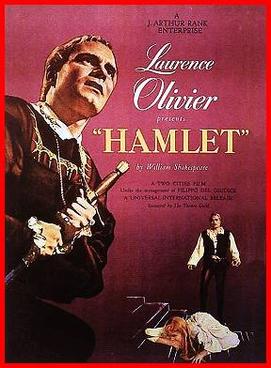
Lisa Reviews An Oscar Winner: Hamlet (dir by Laurence Olivier)


(With the Oscars scheduled to be awarded on March 4th, I have decided to review at least one Oscar-nominated film a day.  These films could be nominees or they could be winners.  They could be from this year’s Oscars or they could be a previous year’s nominee!  We’ll see how things play out.  Today, I take a look at the 1948 best picture winner, Hamlet!)

Hamlet is a film of firsts.

It was the first British production to win the Oscar for Best Picture.  In winning, it beat out three American films (Johnny Belinda, The Snake Pit, and The Treasure of the Sierra Madre) and one other British film (The Red Shoes).

It was also the first adaptation of Shakespeare to win Best Picture.  Of course, it wasn’t the first Shakespeare adaptation to be nominated.  That honor would go to 1935’s A Midsummer Night’s Dream.  Adaptations of Romeo and Juliet would be nominated in 1936, 1961, and 1968.  Henry V (which, like Hamlet, was directed by and starred Laurence Olivier) was a 1946 nominee.  Then there was 1953’s Julius Caesar.  The Dresser featured scenes from Shakespeare.  Shakespeare in Love imagined the circumstances behind the writing of Romeo and Juliet.  However, Hamlet was the first to win.

It also remains the only traditional Shakespearean adaptation to win.  West Side Story updated Romeo and Juliet while Shakespeare in Love … well, let’s just not get into it.

It was the first Best Picture winner to be directed by the man starring in the movie.  Laurence Olivier was nominated for both Best Director and Best Actor.  He lost the directing Oscar to John Huston but he won for his performance as Hamlet.  In winning, he became the first actor to direct himself to an Oscar.

Finally, Hamlet was the first of 24 films to feature both Peter Cushing and Christopher Lee!  In fact, this was Lee’s film debut.  Now, before anyone gets too excited, I should point out that Cushing and Lee don’t actually interact.  In fact, Lee doesn’t even speak in the film.  He appears in the background as a Spear Carrier and it’s pretty much impossible to spot him.  He has no dialogue and wasn’t even listed in the final credits.  From what I’ve read, I don’t think Lee and Cushing even knew each other at the time and, when they later met, they were surprised to learn that they had both appeared in the film.  For his part, Cushing plays Osiric, the courtier who everyone remembers because he had such a cool name.

It’s always fun to play “what if.”  Rosencrantz and Guildenstern do not appear in Olivier’s adaptation of the play.  To modern audiences, that might seem strange but, really, that’s just because we’re all familiar with the two characters from Tom Stoppard’s Rosencrantz and Guildenstern Are Dead.  When Olivier filmed Hamlet, he excised portions of the play in the interest of time.  (Hamlet uncut runs over four hours.  Olivier’s version clocks in at nearly three.)  Rosencrantz, Guildenstern, Fortinbras, and the second gravedigger are all dropped from Olivier’s version and, to be honest, none of them are particularly missed.

And yet … as I watched Hamlet, I found myself wondering what would have happened if Olivier had kept Rosencrantz and Guildenstern around and had cast Cushing and Lee in those roles.  It probably wouldn’t have happened, of course.  Cushing maybe but Lee was a total unknown at the time.  Still, how amazing would that have been?

As for the actual film, Olivier’s Hamlet turned out to be far more cinematic than I was anticipating.  Olivier’s camera snakes through the darkened hallways of Elsinore Castle while Olivier’s Hamlet veers between self-righteous fury and apparent madness as he seeks revenge on his Uncle Claudius (Basil Sydney).  As Hamlet grows more obsessed with death and vengeance, the castle seems to grow darker and the hallways even more maze-like, as if the castle’s changing shape to conform with the turmoil in Hamlet’s mind.  Among the cast, Jean Simmons is poignantly fragile as Ophelia while Eileen Herlie is the perfect Gertrude, despite being 12 years younger than the actor playing her son.  Olivier gives a wonderfully physical performance as Hamlet, killing Polonious with a demented gleam in his eye and literally leaping towards his uncle at the end of the film.

If you’re one of those people who thinks that Shakespeare is boring … well, Olivier’s Hamlet probably won’t change your mind.  One thing I’ve noticed about the “Shakespeare is boring” crowd is that nothing can change their minds.  But, for the rest of us, Olivier’s Hamlet is an exciting adaptation of Shakespeare’s more difficult play.

You won’t miss Rosencrantz and Guildenstern at all.  And seriously, Fortinbras who?

Lisa Reviews An Oscar Nominee: Four Weddings and a Funeral (dir by Mike Newell)


(With the Oscars scheduled to be awarded on March 4th, I have decided to review at least one Oscar-nominated film a day.  These films could be nominees or they could be winners.  They could be from this year’s Oscars or they could be a previous year’s nominee!  We’ll see how things play out.  Today, I take a look at the 1994 best picture nominee, Four Weddings and a Funeral!)

(SPOILERS)

Four Weddings and a Funeral is truly an oddity.  It’s a romantic comedy that works wonderfully well, despite the fact that there’s next to no chemistry between the two leads.

Hugh Grant plays Charles, a neurotic bachelor who lives in London and who, despite having been in several relationships, has yet to marry.  As he’s explains it, he’s spent his life expecting love to hit him like a thunderbolt and it hasn’t happened yet.  Andie MacDowell plays Carrie, an American who has one of those vaguely defined magazine jobs that are so popular in romantic comedies.  Carrie and Charles meet over the course of … well, four weddings and a funeral.  From the minute they first meet, they are attracted to one another but the path of true love is never an easy one.  After spending the night with him, Carrie leaves for America.  When Charles meet her for a second time, she’s now engaged to Sir Hamish Banks (Corin Redgrave), a rather boring politician.

Hugh Grant is perfectly cast as Charles.  It can be easy to make fun of an actor like Grant, what with all the stammering and the carefully calculated charm.  But it works perfectly in Four Weddings and a Funeral, in which Grant manages to believable as both a hopeless romantic and a committed cynic.  Within moments of his first scene (in which Charles wakes up and realizes he’s late for a friend’s wedding), you forget that you’re watching Hugh Grant.  He is Charles.

On the other hand, Andie MacDowell never convinces us that she’s Carrie.  That’s not totally MacDowell’s fault, of course.  Carrie is an underwritten character, one who serves more as a plot device than anything else.  We’re never quite sure how she feels about Charles.  For that matter, we never understand why she’s marrying Hamish.  When she shows up at the film’s funeral, we’re left wondering if she’s really mourning or if she’s just showing up to be polite.  Carrie never comes to life and MacDowell never feels comfortable in the role.  When she gives a warmly received speech at her own wedding reception, the scene feels false because you never feel as if the words are coming from Carrie.

The film ends with Charles and Carrie finally getting together.  Charles both swears his love for her and asks if she’ll agree to never marry him.  We later see them in a snapshot, with a child.  But, despite all of that, you never believe that Charles and Carrie are going to stay together.  There’s just not enough chemistry between Grant and MacDowell to convince you that Carrie isn’t going to get bored and run off with whoever it is she meets at the next wedding she attends.

So, why does this film work so well?  It works because it’s a love story.  However, it’s not about the love between Charles and Carrie.  Not really.  Instead, it’s about the love between Charles and his friends.  Because of the way the film is structured, we only get to see how these people behave at weddings and a funeral.  We never really get to see what these people do for a living or what they’re like during the week.  In fact, we don’t even find out how they all became friends in the first place.

But it doesn’t matter.  The friendships feels real.  The friendships feels authentic.  You might not know how they all became friends but that doesn’t matter.  By the end of the movie, you feel as if you could go to London and possibly run into any of these people going about their daily lives.  They become real in a way that Carrie never does.

There’s Scarlett (Charlotte Coleman), who is Charles’s roommate and who gets flirty when she has too much to drink.

And then there’s David (David Bower), who is Charles’s younger brother.  Both the actor and the character are deaf.  One of the sweetest scenes in the film is when a woman who has been crushing on David attempts to show off her sign language skills.  Everything she signs is wrong but David’s sweet smile tells us all we need to know about how he feels towards her.

Fiona (Kristin Scott Thomas) and Tom (James Fleet) are siblings.  Fiona, who dresses in black, presents a hard exterior but, in one of the film’s more poignant scenes, she admits that the reason she’s never gotten married is because she’s been in love with Charles for ten years.  Tom is a goofy optimist, the type who never doubts that he’s going to find happiness no matter what.

Gareth (Simon Callow) and Matthew (John Hannah) are as close to being married as anyone within Charles’s clique of friends.  (Four Weddings and a Funeral was released twenty years before the legalization of same-sex marriage in the UK.  If someone views the film 50 years from now, they’ll probably wonder why, exactly, Matthew is always described, by those outside of his central group of friends, as merely being a “close friend” of Garth’s.)  Sadly, the funeral of the title is for the fun-loving Gareth.

It’s during the funeral, when Matthew reads a poem from Auden, that it becomes apparent that the heart of this film belongs not to Charles and Carrie but to their friends.  Ultimately, Four Weddings and a Funeral is a celebration of the bonds of friendship.  At the end of the movie, you’re happy, not because Charles and Carrie are finally together but because this unique and wonderful group of friends have all found each other.  Everyone should be so lucky.

Four Weddings and a Funeral was nominated for best picture but lost to Forrest Gump.

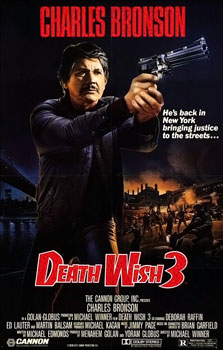
Bronson’s Old: Death Wish 3 (1985, directed by Michael Winner)


To quote Roger Murtaugh, “I’m too old for this shit.”

It has been ten years since Paul Kersey (Charles Bronson) left New York City and the place has gone to Hell.  It’s no longer just muggers that you have look out for.  Now, there are roving street gangs of directionless teenagers, terrorizing the elderly and forcing them to live like prisoners in their own apartment building.

One street corner now looks like a war zone, controlled by spiky-haired, face-painting punks who look like something from a Mad Max movie.  Manny Fraker (Gavan O’Herlihy) rules this street corner, supported by a gang that worships him as if he was some sort of god.  Manny thinks that he is immortal but he’s just targeted the wrong person.  The gang may think that Charley (Francis Drake) is just a defenseless old man but what they don’t know is that, when Charley served in Korea, his best friend was Paul Kersey.

The past few years have been busy for Paul.  He’s killed muggers and rapists in Los Angeles, Chicago, and Kansas City and now he’s returned to New York City, to visit his old friend Charley.  Paul arrives at Charley’s apartment just in time to witness Fraker’s gang murdering him.  The gang flees and when the police arrive, they take Paul into custody.

While public defender Kathryn Davis (Deborah Raffin) tries to figure out why Paul is being held in jail, Paul has a conversation with Lt. Shriker (Ed Lauter).  Shriker remembers Paul as being the New York vigilante and he has a proposition for him.  Paul can kill as many members of Fraker’s gang as he wants, as long as he allows the police to take the credit and reports everything that he discovers to Shriker.  Paul agrees.

In the neighborhood, Paul starts to put Fraker and his gang (one of whom is played by pre-Bill and Ted Alex Winter) in their place.  In a scene borrowed from Brian Garfield’s original Death Wish novel, he uses a used car as bait to gun down two aspiring car thieves.  When Paul gets a new gun, he tests it out on a depraved mugger known as the Giggler.  Though some might call him a serial killer, Paul is soon a hero to the entire neighborhood.  Though Charley may be gone, Paul befriends the other residents of the apartment.  He shows the elderly Kaprovs how to catch anyone trying to climb through their window.  He protects Maria Rodriguez (Marina Sirtis) from the gang.  Best of all, he befriend Bennett Miller (Martin Balsam), a World War II vet who still remembers how to load a machine gun.

(Balsam and Bronson previously co-starred in The Stone Killer, though in that one Bronson was a cop and Balsam was on the other side of the law.)

He also finds time to pursue a relationship with Kathryn Davis.  This is one recurring element in the Death Wish franchise that has never made sense to me.  Paul always has a new girlfriend, despite the fact that almost every woman that he ever gets involved with ends up getting killed.  Paul also only seems to go out with women who would be upset to discover that they were dating a notorious vigilante.  In Death Wish II, he went out with a crusading journalist who was against the death penalty.  In Death Wish 3, he falls for a public defender whose job is to provide legal counsel to the very people that Paul is trying to kill.  After Death Wish 3, Paul would date yet another crusading journalist and, finally, the ex-wife of a notorious mobster.  Maybe Paul should just give up and concentrate on mourning his wife.

Michael Winner returned to direct Death Wish 3 and, this time around, he imagines New York City as being a post-apocalyptic wasteland, full of abandoned buildings and murderous scavengers.  Imagine A Clockwork Orange if Charles Bronson suddenly showed up to shoot Alex and the Droogs.  As played by Gavan O’Herlihy, Manny Fraker is the type of seemingly indestructible bad guy who can actually give Paul Kersey a challenge, something that was missing from the previous films.

The other thing that distinguishes Death Wish 3 is that it was one the only film in the franchise to directly confront an obvious truth.  Charles Bronson was 53 when the first Death Wish was released.  By the time he made Death Wish 3, he was 64 and decades older than the typical action star.  (As way of comparison, Clint Eastwood was 55 when Death Wish 3 was released and was already experimenting with less action-orientated roles.)  By partnering him with Martin Balsam and the other elderly residents of the neighborhood, Death Wish 3 not only acknowledged Bronson’s advanced age but also took advantage of it.  Death Wish 3 is a film where the old folks finally get to teach the young punks a thing or two.  If the other Death Wish films were about one man fighting a lonely war, Death Wish 3 is about a community refusing to be silenced.  The chance to put those kids in their place even seems to perk up Charles Bronson, who gives one of his best performances in Death Wish 3.

Death Wish 3 may have been roundly despised by the critics but it’s the best of the Death Wish sequels.  It made a fortune at the box office so naturally, another sequel would follow.

Tomorrow: Death Wish 4: The Crackdown!

Glory Daze: Peter O’Toole in MY FAVORITE YEAR (MGM 1982)


gary loggins's avatarcracked rear viewer

The world of 1950’s live TV gets the comic treatment in Richard Benjamin’s MY FAVORITE YEAR, a hilarious homage to those golden days of yore. Executive producer Mel Brooks had first-hand knowledge of the era, and much of the hysterical Norman Steinberg/Dennis Palumbo screenplay is based on his experiences, though completely exaggerated and laugh-out-loud funny. The film earned star Peter O’Toole an Oscar nomination for his role as Alan Swann, a dissipated movie star based on swashbuckling Errol Flynn .

Swann arrives at NBC’s 30 Rock, scheduled to be the week’s special guest on “Comedy Calvacade”, totally smashed, much to the displeasure of gruff show host Stan ‘King’ Kaiser (Joseph Bologna in a brilliant Sid Caesar parody), who immediately wants to fire him. But young comedy writer Benjy Stone (Mark Linn-Baker, later of TV’s PERFECT STRANGERS), who idolizes the movie great, pleads with Kaiser to give Swann another chance. He…

View original post 428 more words

Lisa Reviews An Oscar Nominee: The Heiress (dir by William Wyler)


(With the Oscars scheduled to be awarded on March 4th, I have decided to review at least one Oscar-nominated film a day.  These films could be nominees or they could be winners.  They could be from this year’s Oscars or they could be a previous year’s nominee!  We’ll see how things play out.  Today, I take a look at the 1949 best picture nominee, The Heiress!)

“I have been taught by the masters.”

— Catherine Sloper (Olivia De Havilland) in The Heiress (1949)

I’m not going to spoil too much of the ending of The Heiress, beyond saying that those are the words with which Catherine ends the film.  Taken out of context, they may not seem like much.  However, after you’ve spent two hours with Catherine, her father, and the man who claims that he’s in love with her, these are perhaps seven of the most chilling words ever uttered.  When you hear them, you don’t know if you should cheer or be very, very afraid.  Myself, I had both reactions but, then again, I often do.

The Heiress, which is based on a play that’s based on a novel by Henry James, takes place in 19th century New York City.  Austin Sloper (Sir Ralph Richardson) is a widely admired and very successful physician.  He’s also a very cold man, one who has never recovered from the death of his wife.  He lives with his daughter, Catherine (Olivia de Havilland).  Catherine is shy and is continually told that she’s plain and boring.  She’s devoted to her father, though Austin is cruelly manipulative of her.  Catherine, who has never been in a relationship, has pretty much accepted that she’s destined to be alone.

Or, at least, she has until she meets Morris Townsend (Montgomery Clift).

From the first minute that Catherine meets him, Morris seems to be perfect.  He’s handsome.  He’s intelligent.  He’s witty.  He’s charming.  He’s Montgomery Clift, for God’s sake!  For Catherine, it’s love at first sight and Morris says that it’s the same for him.  Suddenly, Catherine’s life no longer revolves around her father.  Now, she dreams of marrying Morris.

Austin isn’t happy about this.  Despite showing his daughter nothing but disdain for most of her life, Austin suddenly become protective of her.  He says that Morris only wants to marry her because she stands to come into a great deal of money.  To prove his point, he announces that, if Catherine and Morris get married, he will disinherit Catherine and neither she nor her husband will ever get their hands on his money.

How will Morris respond to Austin’s threat?  Well, you’ll have to watch the movie to find out and you really should!  The Heiress is a great movie, featuring noirish direction from William Wyler and brilliant performances from by de Havilland, Richardson, and Clift.  Dr. Sloper may be a monster but Richardson plays him with so much authority that it’s hard to dismiss his worries about Morris, no matter how much you may want to.  Montgomery Clift, meanwhile, keeps you guessing about Morris’s intentions.  And, finally, the great Olivia de Havilland deservedly won an Oscar for her performance as Catherine Sloper.  Over the course of the film, Catherine goes from being a withdrawn wallflower to being a … well, I can’t tell you anymore.  I don’t want to spoil the film any more than I already have.  The ending will leave you shaken in the best possible way.

The Heiress was nominated for best picture but lost to All The King’s Men.

Update: The Lullaby movie theatrical release cities


This is an update to my The Lullaby Preview and Review.

Poster

Confirmations of cities offering the limited release for the new supernatural horror film The Lullaby from South African filmmaker Darrel James Roodt (“Sarafina!“), opens March 2, 2018 in the following theaters:

LA – Laemmle Music Hall
NY – Cinema Village
Atlanta – Plaza Theater
Cleveland – Tower City Cinemas
San Francisco – The Roxie
Miami – Cinema Paradiso
Chicago – Facets Cinema
Boston – Apple Cinemas
Dallas – AMC Grapevine 30
Phoenix – AMC Arizona Center 24

The Lullaby also will be available on the same day, March 2, 2018, on VOD.

Credits:

Uncork’d Entertainment presents a Phoenix Film with Valhalla Productions Directed by Darrell James Roodt

You can check out the trailer here:

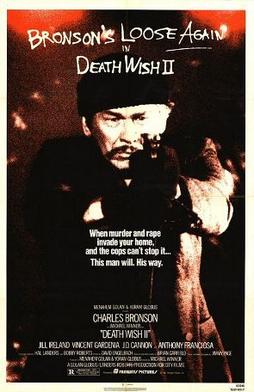
Bronson’s Back!: Death Wish II (1982, directed by Michael Winner)


To quote John McClane, “How can the same shit happen to the same guy twice?”
It has been eight years since Paul Kersey (Charles Bronson) lost his wife and single-handedly cleaned up New York City.  The first Death Wish ended with Paul in Chicago, preparing to gun down a new group of criminals.  I guess Chicago didn’t take because, at the start of Death Wish II, Paul is in Los Angeles and he’s working as an architect again.  He has a new girlfriend, a bleeding heart liberal reporter named Geri (Jill Ireland, Bronson’s real-life wife) who is against the death penalty and who has no idea that Paul used to be New York’s most notorious vigilante.  Having finally been released from the mental institution, Carol (Robin Sherwood) is living with her father but is now mute.

Crime rates are soaring in Los Angeles and why not?  The legal system is more concerned with the rights of the criminals than the victims and Paul has retired from patrolling the streets.  But when a group of cartoonish thugs rape and kill his housekeeper and cause his daughter to fall out of a window while trying to escape them, Paul picks up his gun and sets out for revenge.

Death Wish II was not the first sequel to Death Wish.  Brian Garfield, the author of the novel on which Death Wish was based, never intended for Paul to be seen as a hero and was disgusted by what he saw as being the film’s glorification of violence.  As “penance,” he wrote a sequel called Death Sentence, in which Paul discovered that he had inspired an even more dangerous vigilante.  When Menahem Golan and Yoram Globus bought the rights to produce a second Death Wish film, they decided not to use Garfield’s sequel and instead went with a story that was co-written by Golan.

It’s the same basic story as the first film.  Again, Paul is a mild-mannered architect who is a liberal during the day and a gun-toting reactionary at night.  Again, it’s a home invasion and a death in the family that sets Paul off.  Again, Paul gets help from sympathetic citizens who don’t care that the police commissioner (Anthony Franciosa) wants him off the streets.  Jeff Goldblum played a rapist with a switch blade in the first film.  This time, it’s Laurence Fishburne who fills the role.  (Fishburne also carries a radio, which he eventually learns cannot be used to block bullets.)  Even Detective Ochoa (Vincent Gardenia) returns, coming down to Los Angeles to see if Paul has returned to his old ways.

The main difference between the first two Death Wish films is that Death Wish II is a Cannon film, which means that it is even less concerned with reality than the first film.  In Death Wish II, the criminals are more flamboyant, the violence is more graphic, and Paul is even more of a relentless avenger than in the first film.  In the first Death Wish, Paul threw up after fighting a mugger.  In the second Death Wish, he sees that one of the men who raped his daughter is wearing a cross, leading to the following exchange:

“Do you believe in Jesus?”

“Yes, I do.”

“Well, you’re going to meet him.”

BLAM!

Death Wish II is the best known of the Death Wish sequels.  It made the most money and, when I was a kid, it used to show on TV constantly.  The commercials always featured the “You believe in Jesus?” exchange and, every morning after we saw those commercials, all the kids at school would walk up to each other and say, “You believe in Jesus?  Well, you’re going to meet him.”  It drove the teachers crazy.

Overall, Death Wish II is a lousy film.  Michael Winner, who was always more concerned with getting people into the theaters than anything else, directs in a sledgehammer manner that makes his work on the first film look subtle.  He obscenely lingers over every rape and murder, leaving no doubt that he is more interested in titillating the audience than getting them to share Paul’s outrage.  The script is also weak, with Geri so poorly written that she actually gets more upset about Paul going out at night than she does when she learns that Paul’s daughter has died.  When Paul sets out to track down the gang, his method is to merely wander around Los Angeles until he stumbles across them.  It doesn’t take long for Paul to start taking them out but no one in the gang ever seems to be upset or worried that someone is obviously stalking and killing them.

There are a few good things about the film.  Charles Bronson was always a better actor than he was given credit for and it’s always fun to watch Paul try to balance his normal daily routine with his violent night life.  Whenever Geri demands to know if he’s been shooting people, Paul looks at her like he is personally offended that she could possibly think such a thing.  Also, the criminals themselves are all so cartoonishly evil that there’s never any question that Paul is doing the world a favor by gunning them down.  For many otherwise sensible viewers, a movie like Death Wish II may be bad but it is also cathartic.  It offers up a simple solution to a complex issue.  In real life, a city full of Paul Kerseys would lead to innocent people getting killed for no good reason.  But in the world of Death Wish II, no one out after nightfall is innocent so there’s no need to worry about shooting the wrong person.

Finally, the film’s score was written by the legendary Jimmy Page.  The studio wanted Isaac Hayes to do the score but Winner asked his neighbor, Page.  Page took the film, retreated into his studio, and returned with a bluesy score that would turn out to be the best thing about the movie.  The soundtrack was the only one of Page’s solo projects to be released on Led Zeppelin’s record label, Swan Song Records.

Tomorrow, Bronson returns with Death Wish 3!

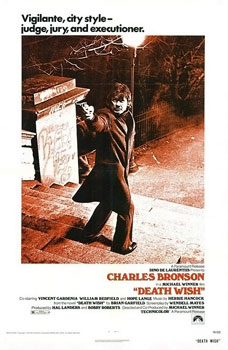
Bronson’s Revenge: Death Wish (1974, directed by Michael Winner)


To quote “Dirty” Harry Callahan, “I’m all broken up about his rights.”
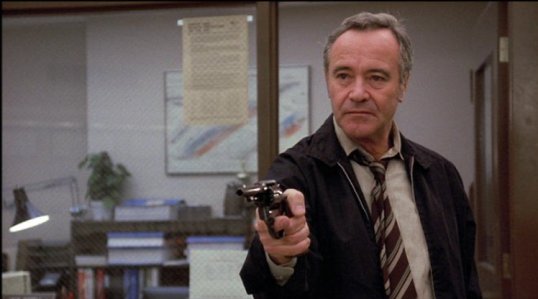
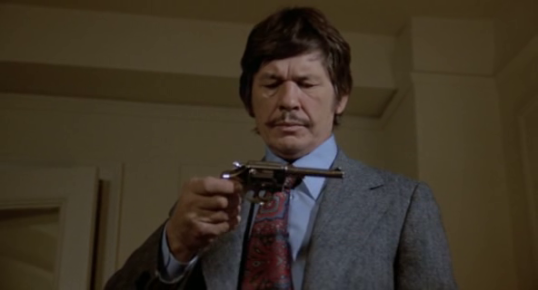
In 1972, a novel by Brian Garfield was published.  The novel was about a meek New York City accountant named Paul Benjamin.  After Paul’s wife is murdered and his daughter is raped, Paul suffers a nervous breakdown.  A self-described bleeding heart liberal, Paul starts to stalk the streets at night while carrying a gun.  He is hunting muggers.  At first, he just kills the muggers who approach him but soon, he starts to deliberately set traps.  Sinking into insanity, Paul becomes just as dangerous as the men he is hunting.  Garfield later said that the book was inspired by two real-life incidents, one in which his wife’s purse was stolen and another in which his car was vandalized.  Garfield said that his initial response was one of primitive anger.  He wondered what would happen if a man had these rageful thoughts and could not escape them.

The title of that novel was Death Wish.  Though it was never a best seller, it received respectful reviews and Garfield subsequently sold the film rights.  At first, Sidney Lumet was attached to direct and, keeping with Garfield’s portrayal of Paul Benjamin, Jack Lemmon was cast as the unlikely vigilante.

Lumet, ultimately, left the project so that he could concentrate on another film about crime in New York City, Serpico.  When Lumet left, Jack Lemmon also dropped out of the film.  Lumet was replaced by Michael Winner, a director who may not have been as thoughtful as Lumet but who had a solid box office record and a reputation for making tough and gritty action films.

Winner immediately realized that audiences would not be interested in seeing an anti-vigilante film.  Instead of casting an actor with an intellectual image, like Jack Lemmon, Winner instead offered the lead role (now named Paul Kersey and no longer an accountant but an architect) to Charles Bronson.  When Winner told Bronson that the script was about a man who shot muggers, Bronson replied, “I’d like to do that.”

“The script?” Winner asked.

“No, shoot muggers.”

At the time that he was cast, Charles Bronson was 52 years old.  He was the biggest star in the world, except for in America where he was still viewed as being a B-talent at best.  Bronson was known for playing tough, violent men who were not afraid to use violence to accomplish their goals.  (Ironically, in real life, Bronson was as much of an ardent liberal as Paul Kersey was meant to be at the beginning of the movie.)  Among those complaining that Charles Bronson was all wrong for Paul Kersey was Brian Garfield.  However, Bronson accepted the role and the huge box office success of Death Wish finally made him a star in America.

To an extent, Brian Garfield was right.  Charles Bronson was a better actor than he is often given credit for but, in the early scenes of Death Wish, he does seem miscast.  When Paul is first seen frolicking with his wife (Hope Lange) in Hawaii, Bronson seems stiff and awkward.  In New York City, when Paul tells his right-wing colleague (William Redfield) that “my heart does bleed for the less fortunate,” it doesn’t sound natural.  But once Paul finds out that his wife has been murdered and his daughter, Carol (Kathleen Tolan), has been raped, Paul gets mad and Bronson finally seems comfortable in the role.

In both the book and the original screenplay, both the murder and the rape happened off-screen.  Never a subtle director, Winner instead opted to show them in a brutal and ugly scene designed to get the audience as eager to shoot muggers as Bronson was.  Today, the power of the scene is diluted by the presence of Jeff Goldblum, making his screen debut as a very unlikely street thug.  Everyone has to start somewhere and Goldblum got his start kicking Hope Lange while wearing a hat that made him look like he belonged in an Archie comic.

With his wife dead and his daughter traumatized, Paul discovers that no one can help him get justice.  The police have no leads.  His son-in-law (Steven Keats) is a weak and emotional mess.  (As an actor, some of Bronson’s best moments are when Paul makes no effort to hide how much he loathes his son-in-law.)  When a mugger approaches Paul shortly after his wife’s funeral, Paul shocks himself by punching the mugger in the face.

When Paul is sent down to Arizona on business, he meets Ames Jainchill (Stuart Margolin), a land developer who calls New York a “toilet” and who takes Paul to see a wild west show.  Later at a gun club, Paul explains that he was a conscientious objects during the Korean War but he knows how to shoot.  His father was a hunter and Paul grew up around guns.  When Paul returns to New York, Ames gives him a present, a revolver.  Paul is soon using that revolver to bring old west justice to the streets of New York City.

As muggers start to show up dead, the NYPD is outraged that a vigilante is stalking the street.  Detective Frank Ochoa (Vincent Gardenia) is assigned to bring the vigilante in.  But the citizens of New York love the vigilante.  Witnesses refuse to give an accurate description of Paul.  When Paul is wounded, a young patrolman (Christopher Guest, making almost as unlikely a film debut as Jeff Goldblum) conspires to keep Paul’s revolver from being turned over as evidence.

The critics hated Death Wish, with many of them calling it an “immoral” film.  Brian Garfield was so disgusted by how Winner changed his story that he wrote a follow-up novel in which Paul is confronted by an even more dangerous vigilante who claims to have been inspired by him.  Audiences, however, loved it.  Death Wish was one of the top films at the box office and it spawned a whole host of other vigilante films.

Death Wish is a crude movie, without any hint of subtlety and nuance.  It is also brutally effective, as anyone who has ever felt as if they were the victim of a crime can attest.  In a complicated and often unfair world, Kersey’s approach may not be realistic or ideal but it is emotionally cathartic.  Watching Death Wish, it is easy to see why critics hated it and why audiences loved it.

It is also to see why the movie made Bronson a star.  Miscast in the role or not, Bronson exudes a quiet authority and determination that suggests that if anyone could single-handedly clean-up New York City, it’s him.  An underrated actor, Bronson’s best moment comes after he punches his first mugger and he triumphantly reenters his apartment.  After he commits his first killing, Bronson gets another good scene where he is so keyed up that he collapses to the floor and then staggers into the bathroom and throws up.  Garfield may have complained that the Death Wish made his madman into a hero but Bronson’s best moments are the ones the suggest Paul has gone mad.  The real difference between the book and the movie is that the movie portrays madness as a necessary survival skill.

This Friday, a new version of Death Wish will be playing in theaters.  Directed by Eli Roth, this version starts Bruce Willis as Dr. Paul Kersey.  Will the new Death Wish be as effective as the original?  Judging from the trailer, I doubt it.  Bruce Willis or Charles Bronson?  I’ll pick Bronson every time.

Tomorrow, Bronson returns in Death Wish II!

Playing Catch Up: First Daughter, Ice Girls, Raising The Bar, Walk Like A Man


So, this year I am making a sincere effort to review every film that I see.  I know I say that every year but this time, I really mean it.  Unfortunately, over the past two weeks, real life has interfered with my movie reviewing, if not my move watching.

So, in an effort to catch up, here are four quick reviews of some of the movies that I watched over the past two weeks!

  • First Daughter
  • Released: 2004
  • Directed by Forest Whitaker
  • Starring Katie Holmes, Marc Blucas, Amerie, Michael Keaton, Margaret Colin, Lela Rochon

Michael Keaton as the President of the United States!?  Now, that’s a great idea.  Michael Keaton plays President Mackenzie.  First Daughter was made long before Birdman so Michael Keaton doesn’t really have a huge part but, whenever he does appear, he is totally believable as a world leader.  You buy the idea that this guy could win an election and that he’d probably be a good (if not necessarily a great) President.  Someone really needs to make another movie where Michael Keaton plays the President.  Maybe President Birdman.  Just don’t give it to Inarritu to direct because he’ll make it too political…

Anyway, the majority of the film is about Katie Holmes as the President’s daughter, Samantha.  Samantha has been accepted to a college in California.  She’s excited because it means that she’ll finally be able to have a life outside of the White House.  The President is concerned because he loves his daughter and he knows that, if she makes any mistakes in California, his political opponents will try to use her against him.  Samantha goes off to college and tries to have a good (but rather chaste) time.  Making that somewhat difficult is her secret service entourage.  Fortunately, Samantha meets a guy (Marc Blucas) who loves her for who she is and not because her father is the President.

It’s all pretty silly and shallow but I have to admit that I get nostalgic whenever I see this movie.  Much like From Justin To Kelly, it’s definitely a film from a more innocent and less angry time.  To date, it’s also the last film to be directed by actor Forest Whitaker.

  • Ice Girls
  • Released in 2016
  • Directed by Damian Lee
  • Starring Michaela du Toit, Lara Daans, Arcadia Kendal, Sheila McCarthy, Taylor Hunsley, Shane Harte, Elvis Stojko

Struggling financially, Kelly (Lara Daans) is forced to move back to her hometown and move in with her sister (Sheila McCarthy).  Until she got married and gave up that part of her life, Kelly was once an up-and-coming figure skater.  Fortunately, her daughter, Mattie (Michaela du Toit), has inherited her mother’s talent.  However, a serious injury shook Mattie’s confidence.  Now, she says she doesn’t want to skate anymore.  Still, she’s willing to accept a job from Mercury (Elvis Stojko) at the local rink and it’s not too long before, under Mercury’s guidance, Mattie is skating once again.  Mattie also befriends another skater, Heather (Taylor Hunsley).  Heather happens to be the daughter of Rose (Natasha Henstridge), who was once in love with Kelly’s father…

It sounds like the set-up of a melodramatic Lifetime movie but actually, Ice Girls is a sweet-natured film about two ice skaters, one who has a mother who is too protective and the other who has a mother who is too driven.  In the end, both of them end up skating for themselves and not their mothers and that’s a good message for the film’s target audience of young skate fans.  The majority of the cast is made up of actual ice skaters, so the skating footage is pretty impressive.  It’s a predictable movie but I enjoyed it when I watched it on Netflix.

  • Raising the Bar
  • Released in 2016
  • Directed by Clay Glen
  • Starring Kelli Berglund, Lili Karamalikis, Tess Fowler, Emily Morris, Peta Shannon

I also watched this one on Netflix, a day after I watched Ice Girls.  (I was in an Olympics sort of mood, even though neither film took place at the Olympics.)  Raising the Bar feels a lot like Ice Girls, except that the ice skaters were now gymnasts and instead of relocating to Toronto, the family in Raising the Bar relocates all the way to Australia.  Once in Australia, Kelly (Kelly Johnson) finds the courage to re-enter gymnastics and ends up competing against her former teammates.

Kelly Johnson gives a good performance in the lead role.  Though it may be predictable, Raising the Bar is an effective and sweet-natured family film.  Perhaps the most interesting thing about watching the film was that I quickly found myself rooting against the American team.  Australia all the way!

  • Walk Like A Man
  • Released 1987
  • Directed by Melvin Frank
  • Starring Howie Mandel, Amy Steel, Cloris Leachman, Christopher Lloyd, Colleen Camp, Stephen Elliott, George DiCenzo, John McLiam, Earl Boen

Oh, what sweet Hell is this?

Okay, I’m going to try to explain what happens in this movie.  You’re not going to believe me.  You’re going to think that I’m just making all of this up.  But I swear to a God … this is an actual movie.

When he was a baby, Boba Shand (Howie Mandel) got separated from his family.  His mother and his father assumed that he was gone forever but what they didn’t know was that Bobo was found and raised by a pack of wild dogs.  For twenty years, Bobo lives as a dog.  Then he’s discovered by Penny (Amy Steel), an animal researcher who tries to teach Bobo how to be a human.  However, as time passes, Penny comes to realize that maybe she’s making a mistake trying to change Bobo.  Bobo is innocent and child-like and obsessed with chasing fire engines.  When he has too much to drink, he runs around on all fours.  And … PENNY’S IN LOVE WITH HIM!

Seriously, she’s in love with a man who thinks he’s a dog.

However, Bobo stands to inherit a fortune and his evil brother (Christopher Lloyd) is planning on having him committed.  Penny has to prove that Bobo is human enough to manage his own affairs while also respecting his desire to continue living like a dog.

I’m serious.  This is a real movie.

Anyway, making things even worse is the performance as Howie Mandel.  Mandel has always been a rather needy performer and the role of a man who thinks he’s a dog only serves to bring out his worst instincts.  Remember when Ben Stiller played Simple Jack in Tropical Thunder?  Well, Mandel’s performance is kinda like that only worse.  At one point, Bobo walks up to a mannequin in a mall and says, “I have to go pee pee.  Come with me,” and I nearly threw a shoe at the TV.  Oh my God, it was so bad.

The main problem with Walk Like A Man is that it wants to have it both ways.  It wants to be a wild comedy about Howie Mandel chasing fire engines but it also makes us want to tear up when Penny explains why Bobo should be allowed to live as a dog.

All in all, it’s a really bad movie.  And yes, it does actually exist.