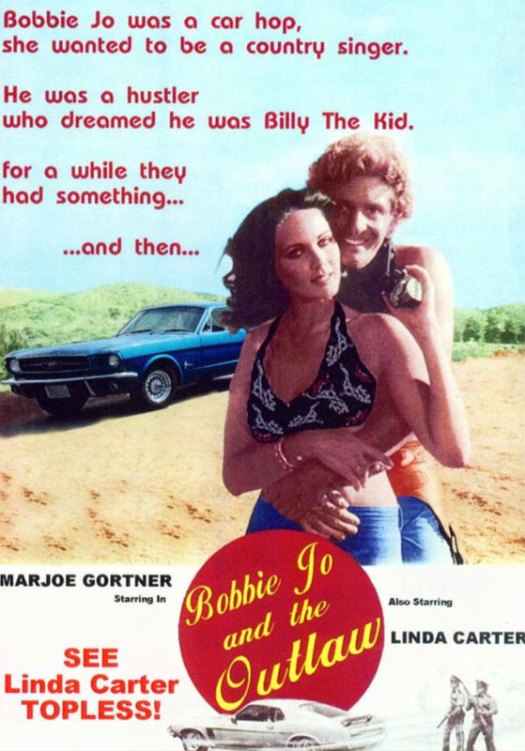
I discussed filmmaker Vernon Zimmerman in a post on his UNHOLY ROLLERS back in January. Zimmerman wrote the script (but did not direct) for 1976’s BOBBIE JO & THE OUTLAW, which on the surface is just another sex’n’violence laden redneck exploitation film. Yet after a recent viewing, it seemed to me Zimmerman was not just delving into exploitation, but exploring something more: disaffected youth, gun culture, the cult of personality, and violence in America, themes that still resonate today.
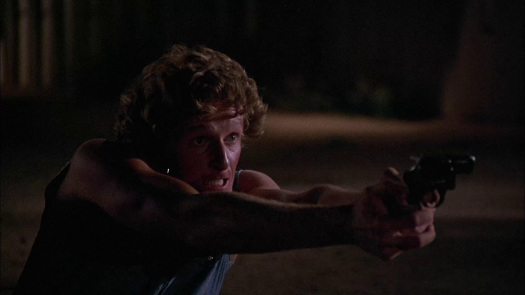
Former child evangelist turned rock star turned actor Marjoe Gortner is Lyle Wheeler, a drifter who enters quick draw contests and idolizes Billy the Kid. Lyle’s a hustler, as we find out as he pulls into a gas station and steals a Mustang from a travelling salesman. Lyle outruns a police car hot on his tail, causing the cop to go off the road, and revs into the next town, where…
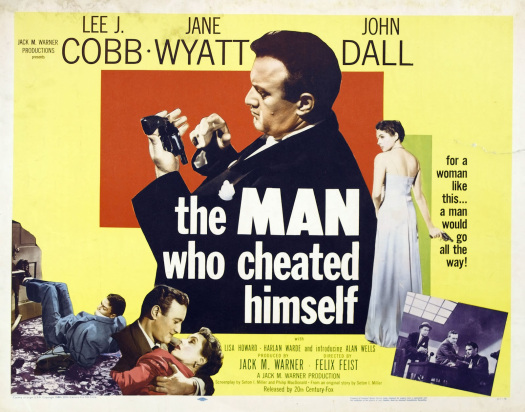
THE MAN WHO CHEATED HIMSELF made it’s TCM debut last Saturday night on Noir Alley, hosted by “The Czar of Noir” Eddie Muller. This is a ‘B’ film I’d never heard of before, and since you all know how much I love discovering new/old ‘B’ movies, I stayed up past the midnight hour to give it a watch (which I usually do on Saturday nights anyway, being a Noir Alley fan!).
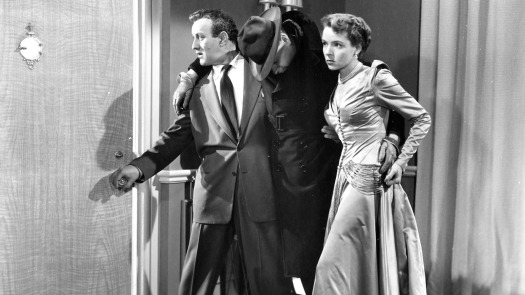
The film doesn’t waste any time, quickly introducing the main characters and getting right into the story. Thinking her husband is planning to murder her, rich San Francisco socialite Lois Frazer guns him down in cold blood directly in front of her lover, Homicide Lt. Ed Cullen. Ed dumps the body at the airport to make it look like a robbery/murder, tossing the murder weapon off the Golden Gate Bridge. Then he takes the lead in the investigation, along…
As the day draws to a close, I’m going to recommend one final film.
It’s not, by any means, a perfect film. In fact, it’s pretty damn imperfect. It’s a film that occasionally tries too hard to be profound. It’s based on a play and it never quite escapes its theatrical origins. What was undoubtedly exciting on the stage, drags a bit on the screen. It’s a fairly obscure film. I just happened to catch it on This TV a month ago and the main reason that I watched it was because of the cast.
But no matter! I still think you should watch this film if you get a chance.
The name of that film is Fool For Love.
First released in 1985 and based on a play by Sam Shepard, Fool For Love takes place over the course of one long night at a motel in the Southwest. Staying at the motel is May (Kim Basinger), who is hoping to escape from her past. Not eager to allow her to escape is her former lover, Eddie (Sam Shepard). An aging cowboy, Eddie shows up at the motel and tries to convince May to return with him to his ranch. As they argue, clues are dropped to the terrible secret that haunts their past. Martin (Randy Quaid), a buffoonish but well-meaning “gentleman caller,” shows up to take May on a date and finds himself sucked into the drama between her and Eddie.
Meanwhile, on the edge of every scene, there’s the Old Man (Harry Dean Stanton). The Old Man watches Eddie and May and offers up his own frequently sarcastic commentary. It becomes obvious that he not only knows about the secret in their past but that he’s determined that they not get together. Is the Old Man really there or is he just a figment of everyone’s imagination or is he something else all together?
As I said earlier, the film never quite escapes its theatrical origins. As well, while Shepard and Kim Basinger both give authentic and charismatic performance, they don’t quite have the right romantic chemistry to really convince us that Eddie would chase May all the way to that isolated motel. It’s hard not to feel that if May had been played by Shepard’s then-partner Jessica Lange or his Right Stuff co-star, Barbara Hershey, the film would have worked better.
And yet, even if it never comes together as a whole, Fool For Love is a film that should be seen just for its display of individual talent. Of the film’s five main creative forces, only Kim Basinger is still with us. Director Robert Altman died in 2006 while Sam Shepard and Harry Dean Stanton both passed away in 2017. While Randy Quaid is still alive, it’s doubtful he’ll ever again get the type of roles that earlier established him as one of America’s best character actors. Whenever I read another snarky article about Quaid hiding out in Vermont and ranting about the “star whackers,” I can’t help but sadly think about the perfect performances that Quaid used to regularly give in imperfect films like this one.
So, definitely track down Fool For Love. Watch it and pay a little tribute to all of the wonderful talent that we’ve lost over the last 10 or so years. Watch it for Robert Altman’s ability to turn kitsch into art. Watch it for the rugged individualism of Sam Shepard and the once-empathetic eccentricity of Randy Quaid. Watch it for Harry Dean Stanton, the legendary actor who, more than any other performer, seemed to epitomize the southwest and Americana.
Watch it and spare a little thought for all of them.
As a part of my continuing effort to get caught up with reviewing all of the movies that I’ve seen this year, here’s two courtroom dramas that I recently caught on This TV.
Suspect
Released in 1987
Directed by Peter Yates
Starring Cher, Dennis Quaid, Liam Neeson, John Mahoney, Joe Mantegna, Philip Bosco, Fred Melamed, Bernie McInerney, Bill Cobbs, Richard Gant, Jim Walton, Michael Beach, Ralph Cosham, Djanet Sears
Suspect is a hilariously dumb movie. How dumb is it? Let me count the ways.
First off, Cher plays a highly successful if rather stressed public defender. And don’t get me wrong. It’s not that Cher is a bad actress or anything. She’s actually pretty good when she’s playing Cher. But, in this movie, she’s playing someone who managed to graduate from law school and pass the DC bar.
Secondly, Cher is assigned to defend a homeless man when he’s accused of murdering a clerk who works for the Justice Department. The homeless man is deaf and mute, which isn’t funny. What is funny is when he gets a shave and a shower and he’s magically revealed to be a rather handsome and fresh-faced Liam Neeson. Liam doesn’t give a bad performance in the role. In fact, he probably gives the best performance in the film. But still, it’s hard to escape the fact that he’s Liam Neeson and he basically looks like he just arrived for a weekend at Cannes.
Third, during the trial, one of the jurors (Dennis Quaid) decides to investigate the case on his own. Cher even helps him do it, which is the type of thing that would get a real-life attorney disbarred. However, I guess Cher thinks that it’s worth the risk. I guess that’s the power of Dennis Quaid’s smile.
Fourth, the prosecuting attorney is played by Joe Mantegna and he gives such a good performance that you find yourself hoping that he wins the case.
Fifth, while it’s true that real-life attorneys are rarely as slick or well-dressed as they are portrayed in the movies, one would think that Cher would at least take off her leather jacket before cross-examining a witness.
Sixth, it’s not a spoiler to tell you that the homeless man is innocent. We know he’s innocent from the minute that we see he’s Liam Neeson. Liam only kills who people deserve it. The real murderer is revealed at the end of the film and it turns out to be the last person you would suspect, mostly because we haven’t been given any reason to suspect him. The ending is less of a twist and more an extended middle finger to any viewer actually trying to solve the damn mystery.
I usually enjoy a good courtroom drama but bad courtroom dramas put me to sleep. Guess which one Suspect was.
12 Angry Men
Released 1997
Directed by William Friedkin
Starring Courtney B. Vance, Ossie Davis, George C. Scott, Armin Mueller-Stahl, Dorian Harewood, James Gandolfini, Tony Danza, Jack Lemmon, Hume Cronyn, Mykelti Williamson, Edward James Olmos, William Petersen, Mary McDonnell, Tyrees Allen, Douglas Spain
The 12 Angry Men are back!
Well, no, not actually. This is a remake of the classic 1957 film and it was produced for Showtime. It’s updated in that not all of the jurors are white and bigoted Juror #10 (Mykelti Williamson) is now a member of the Nation of Islam. Otherwise, it’s the same script, with Juror #8 (Jack Lemmon) trying to convince the other jurors not to send a young man to Death Row while Juror #3 (George C. Scott) deals with his family issues.
I really wanted to like this production, as it had a strong cast and a strong director and it was a remake of one of my favorite films. Unfortunately, the remake just didn’t work for me. As good an actor as Jack Lemmon was, he just didn’t project the same moral authority as Henry Fonda did the original. If Fonda seemed to be the voice of truth and integrity, Lemmon just came across like an old man who had too much time on his hands. Without Fonda’s moral certitude, 12 Angry Men simply becomes a story about how 12 men acquitted a boy of murder because they assumed that a woman would be too vain to wear her glasses to court. The brilliance of the original is that it keeps you from dwelling on the fact that the accused was probably guilty. The remake, however, feels like almost an argument for abandoning the jury system.
You have to give the makers of the 1996 film, Unforgettable, some credit. It takes a certain amount of courage to give your movie a title like Unforgettable. You’re practically asking some snarky critic to comment on the fact that she can’t remember your movie.
Well, I’ll resist the temptation because I can remember enough about this movie to review it. I saw it a few days ago on This TV and, at first, I was excited because it was a Ray Liotta movie. Ray Liotta is an entertaining and likable actor who, nowadays, only seems to get cast in small, tough guy roles. Nowadays, a typical Liotta role seems to be something like the character he played in Killing Me Softly. He showed up. He was tough. He got killed for no good reason. So, whenever you come across a film in which Liotta gets to do something more than just get shot, you kind of have an obligation to watch.
In Unforgettable, Liotta plays Dr. David Krane, who is haunted by the unsolved murder of his wife. Fortunately (or perhaps, unfortunately), Dr. Martha Briggs (Linda Fiorentino) has developed a formula that can be used to transfer memories from one person to another. All you have to do is extract some spinal fluid! Or something like that. It doesn’t make any sense to me and I have to admit that I kinda suspect that the science might not actually check out.
Anyway, Dr. Krane is all like, “I want to inject myself with my dead wife’s spinal fluid so I can experience her final moments!”
And Dr. Briggs is all like, “But this could kill you because there’s all these vaguely defined side effects!”
But Dr. Krane does it anyway and he discovers that his wife was murdered by a lowlife criminal named Eddie Dutton (Kim Coates)! So, Dr. Krane chases Eddie all ocer the city and it’s interesting to see that a doctor can apparently keep up with a career criminal. I mean, you would think that Eddie’s experience with being chased and Krane’s inexperience with chasing would give Eddie an advantage. Anyway, regardless, it doesn’t matter because Eddie is eventually gunned down by the police and Dr. Krane is fired from his job.
Hmmm … well, that was quick. I guess the movie’s over…
No, not quite! It turns out that someone hired Eddie to kill Dr. Krane’s wife! And it turns out that person was a cop! But which cop!? Well, there’s only two cops in the film who actually have any lines so it has to be one of them. And one of the cops is so unlikable that it’s obvious from the start that he’s a red herring. So, I guess that means the actual murderer is the one that you’ll suspect from the first moment he shows up.
(For the record, the two cops are played by Christopher McDonald and Peter Coyote. I won’t reveal which one is unlikable and which one is a murderer but seriously, you’ve already guessed, haven’t you?)
Anyway, it’s all pretty stupid and a waste of everyone involved. Ray Liotta is likable and sympathetic but the film gets bogged down with trying to convince us that crimes can be solved through spinal fluid. It’s a dumb premise that the movie takes way too seriously and it never quite works.
Still, I hope that someone will give Ray Liotta another good role at some point in the future. He deserves better than supporting roles and Chantix commercials.
The 1977 film, Tracks, opens somewhere in America.
Jack Falen (Dennis Hopper) sits on a bench, waiting for a train. He’s wearing a military uniform. He claims that he’s a 1st sergeant. He claims that he’s just returned from Vietnam. He’s traveling with a flag-draped coffin. He says that the coffin contains the remains of his best friend from Nam. Jack is accompanying the coffin back to his friend’s hometown. Jack says that he’s going to make sure that his friend gets a proper burial.
From the minute we meet Jack, we get the feeling that there’s something off about him. He’s a little bit too quick to smile and, when he laughs, it’s the guttural sound of someone who has learned how to show joy by watching other people but who has perhaps never felt it himself. Sometimes, he’s quiet. Sometimes, he is loquacious and verbose. When he does speak, he rarely looks anyone in the eyes. Jack is jumpy, as if he’s constantly afraid that he’s about to be exposed as a liar.
Soon, Jack is riding a train across the country. While the rest of the passengers look out the windows and takes in the American landscape, Jack nervously wanders around the train. He gets involved in a regular chess game. He befriends a mysterious man named Mark (Dean Stockwell). He starts a tentative relationship with a student named Stephanie (Taryn Power). He tells anyone who will listen that he’s traveling with the body of his best friend. When a black Korean war vet complains that Jack is acting like he’s the only person who lost a friend in a war, an offended Jack replies that his friend was black.
Jack sees things. When he sees that the other passengers are assaulting Stepanie, he pulls out a small gun and aims it at the back of the train, just to suddenly realize that Stephanie is sitting unbothered at the back of the train. While we know that Jack was hallucinating the attack on Stephanie, we still wonder if he really pulled out that gun. If he did, no one else seems to have noticed.
Sometimes, the passengers say things to Jack that don’t seem to make any sense, leaving Jack staring at them in confusion. Other times, Jack sees dark figures walking through the train. At night, he wanders around naked. Jack spends the trip watching the other passengers with a slightly dazed look on his face. He plays chess with a man who later insists that he’s never played chess with Jack. Sometimes, he thinks that he and Stephanie are outside of the train. When Mark approaches Jack and asks for help, Jack explains that he can’t help anyone. While a soundtrack of old World War II propaganda songs thunders in the background, Jack struggles to keep track of what’s real and what isn’t.
And so does the audience. As we watch, it occurs to us that Jack’s stories about Vietnam don’t really seem to add up. Add to that, we never actually saw Jack board the train. Instead, we saw him sitting on a bench and waiting for the train. We’re left to wonder if the train’s real or if the whole movie is just a figment of Jack’s damaged imagination. And what about the coffin? Tracks is full of unanswered questions but, in the film’s incendiary final moments, we do learn the truth about that coffin … maybe.
Henry Jaglom has been making independent films for several decades now. Tracks is one of his better films, if just because Jaglom’s loose, seemingly improvised style actually works well at communicating Jack’s own struggle to keep up with what’s really happening and what he’s imagining. As deceptively random as the film’s collections of scenes may appear, it’s all anchored by Dennis Hopper’s wonderfully unhinged performance. Hopper brings a method actor’s intensity to Jack’s struggle to not only keep straight what’s real and what isn’t but also to keep his fellow passengers from understanding that he’s deeply unbalanced. This film was made during Hopper’s drug-fueled lost years and he plays Jack like a man who is desperately trying to keep the world from seeing that he’s in the throes of withdrawal. Unlike Hopper, Jack’s addiction isn’t to drugs. Instead, Jack’s addicted to war, or at the very least his obsession with war. (By the end of the movie, you have your doubts about whether Jack’s ever been to Vietnam or not.) The use of World War II propaganda songs on the soundtrack may occasionally get annoying but they actually play up the contrast between our often simplistic view of war and the far more complex reality.
If nothing else, I would recommend Tracks for Hopper’s performance. As well, since he co-stars with Dean Stockwell, it’s easy to imagine Tracks as being a bit of a prequel to Blue Velvet. Who’s to say that Jack Falen didn’t change his name to Frank Booth?
I recorded 1973’s Night Watch off of TCM on March 17th!
There’s a tendency, among critics, to dismiss almost every film that Elizabeth Taylor made after Who’s Afraid of Virginia Woolf? Sure, Reflections In A Golden Eye has its defenders but, otherwise, Taylor’s later films are often viewed as being overproduced and self-indulgent with Taylor giving uncertain, occasionally histrionic performances.
Those criticisms aren’t entirely unjustified. Some of it may have been due to her own notoriously poor health and her troubled marriage to Richard Burton. Even more of it was probably due to Taylor’s struggle to remain relevant as a middle-aged actress working in the 1970s. I have to admit that I’m strangely fascinated by the latter half of Taylor’s film career, just because it does feature so many bizarre films and strange performances. Taylor was always a good actress but, in her later films, it was hard not to get feeling that her stardom was her own worst enemy. Taylor was often cast specifically because of her notoriety and she often seemed to work with directors who weren’t willing to reign her in whenever she started to go overboard.
That, however, doesn’t mean that every film that she made in the 70s was a bad one.
Take Night Watch, for instance. Yesterday, as I watched Night Watch, I asked myself, “How is it that I’ve never seen or even heard of this film before!?”
Because seriously, Night Watch was really good.
Liz plays Ellen Wheeler, an apparently unstable woman living in the UK. She’s haunted by the night that her first husband was killed in a car crash, along with his mistress. Ellen has remarried but she worries that her new husband, John (Laurence Harvey), might be cheating on her with her best friend, Sarah (Billie Whitelaw). It turns out that she has good reason to be worried because that’s exactly what John is doing! It’s not that John doesn’t love Ellen. It’s just that he doesn’t know how to deal with her constant nightmares and delusions.
For instance, Ellen is convinced that she’s witnessed a murder! She says that, in the abandoned house next door, she saw a man with a slit throat. Later, she claims that she saw a woman murdered over there as well. When the police investigate, they find no one in the house. But Ellen swears she saw something. She even suspects that her neighbor, Mr. Appleby (Robert Lang), may have buried the bodies in his garden.
(Mr. Appleby is not amused by the suggestion.)
Is Ellen going crazy or did she really see something? I bet you think you already know the answer. I know that I did. But then Night Watch ends with a twist that is shockingly effective and unexpected. For once, I didn’t know how the movie was going to end and now, a day later, I’m still thinking about those final scenes.
Night Watch has its flaws. With the exception of when he played Col. Travis in The Alamo, Laurence Harvey was never a particularly sympathetic actor and he comes across as his usual cold self in Night Watch. And, as good as Taylor is, there are still a few moments where she does go a bit overboard. During the first half of the film, you have to make your way through a lot of yelling to get to the good part.
But that good part is so good that it’s worth it! Night Watch is a genuinely atmospheric and surprising film, one that catches you off guard and one in which the tension does not relent until the final credit has rolled across the screen. Ellen’s nightmares are especially well-realized and the film’s final moments are both frightening and surprisingly graphic. This is a film that sticks with you.
I recorded the 1967 film, The Day The Fish Came Out, off of FXM on May 11th, 2017! It took me a while to get around to watching this one.
Ugh, what a mess.
The Day The Fish Came Out is kind of a comedy and kinda of a drama and it really doesn’t succeed as either. It takes place on a Greek island that is populated by four goat herders and one village full of disgruntled people. The biggest news of their lives comes when it’s announced that Greeks will now be allowed to immigrate to Greenland. All of the people of the village stand up and run through the streets but — and this is typical of the film — we never actually see anyone go to Greenland. A potentially funny joke is set up and then promptly abandoned.
Because the island is so remote, it seems like the perfect place for a damaged NATO plane to dump its nuclear payload. Two nuclear missiles end up in the ocean. Meanwhile, a radioactive crate known as Container Q ends up landing near a goatherd (Nicolas Alexios), who promptly takes it home and starts trying to pry it open. Meanwhile, the plane’s pilot (Colin Wakely) and its navigator (Tom Courtenay) end up wandering around the island in their underwear, trying to retrieve the crate without letting anyone know that they’re there. And while it may not sound like a bad thing that, for once, it’s the guys who spend the entire movie in their underwear, let’s just say that Wakely and Courtenay spend a lot of time rolling around in the dirt and it doesn’t take long for those tighty whities to get disgustingly grimy. Bleh!
Meanwhile, a group of American secret agents have been sent to the island to look for the crate and the missiles and hopefully retrieve them without causing an international crisis. The problem is that the Americans are pretending to be real estate developers and they think the pilot and the navigator are dead. And the pilot and the navigator don’t know that the brash Americans are actually secret agents so they keep hiding from them. In other news, everyone in this movie is really stupid.
The townspeople — or at least the ones who didn’t go to Greenland — assume that their island is now a hot tourist location because of all the interest from the “developers.” Through an annoyingly complicated series of events, this leads to the discovery of an ancient statue. Electra Brown (Candice Bergen) comes to the island to investigate the statue and pose in the latest 60s fashions. She then gets on a boat and leaves the movie.
Meanwhile, the ocean starts to glow and fish start to show up dead on the beach, proof that the radiation is spreading. However, the townspeople and the tourists who have recently arrived assume that it’s just a part of the island’s newfound charm…
The poster for The Day The Fish Came Out announces, “Dr. Strangelove, move over!” and that pretty much defines the approach this movie takes to its material. It wants to be even more outrageous and satirical than Stanley Kubrick’s anti-bomb classic. However, The Day The Fish Came Out lacks both Dr. Strangelove‘s focus and it’s chillingly detached world view. (One reason why Dr. Strangelove works is because Kubrick isn’t scared to suggest that maybe the world would be better off if humanity did just blow itself up.) The Day The Fish Came Out also lacks the right type of cast for this material. There’s no equivalent to be found to the performances that Peter Sellers, George C. Scott, Slim Pickens, Sterling Hayden, and even Peter Bull gave in Kubrick’s film. Among the members of The Day The Fish Came Out‘s ensemble, Sam Wanamaker, as the delusionally positive leader of the American agents, comes the closest to capturing the satirical feel that the film was obviously going for but the rest of the cast flails about in apparent confusion.
When the townspeople and the tourists blithely dance in the radioactive water and ignore the NATO man frantically yelling, “Attention!,” the film briefly achieves the satirical grandeur that it was going for. But otherwise, The Day The Fish Came Out is almost as messy as the doctrine of mutually assured destruction.
Last night, the Late Night Movie Gang and I watched Zydereen of Neptune!
Never heard of Zydereen of Neptune? Well, don’t feel bad. It’s not really a movie. Instead, it’s three episodes of an old 1950s TV series that someone edited together. According to The Complete Directory to Prime Time Network TV Shows, Flash Gordon aired in 1954 on a now defunct network called DuMont. The eponymous space hero was played by Steve Holland, a clean-cut model with an impressive head of hair. On the show, Flash was a member of the GBI, which is like a galactic version of the FBI. Working with him was scientist and love interest Dale Arden (Irene Champlin) and scientist and non-love interest Dr. Zarkov (Joseph Nash). Flash was not a scientist but he had really nice hair. Did I mention that?
(Seriously, the Late Night Movie Gang estimated that Flash was 90% hair spray.)
Anyway, in three episodes, Flash and the GBI had to defeat the machinations of Zydereen (Marie Powers), an evil witch who lived on Neptune and who yearned to escape and take over the universe. She caused quite a bit of panic on Neptune, the majority of which, according to Wikipedia, was portrayed via stock footage of a 1953 anti-communist demonstration by citizens of East Berlin. Having been made in 1954, it’s not surprising that Flash’s struggle to keep the universe safe feels a lot like America’s effort to keep the world safe from communism.
I was fulling expecting to be dismissive of this low-budget television show-turned-movie but actually, I enjoyed it. From the threadbare production values to the grainy stock footage to the model rocket that crossed the screen whenever Flash was on a mission, there was an undeniable charm to the film’s low budget aesthetic. Steve Holland grew on me as well. At first, he seemed like a stiff but by the 30 minute mark of the film (or the second episode, if you will), Holland seemed a lot more comfortable with the role. If nothing else, he had really impressive hair. (Did I already mention that?)
Plus, Marie Powers was a good villain. Again, it helps to remember that she was playing a space witch on a low-budget TV series that was mainly aimed at children. As a result, neither she nor her schemes are particularly subtle but who cares? It was right for the show.
As I’ve said many times in the past, I’m a history nerd. And, if nothing else, Zydereen of Neptune was definitely a piece of history!
Did you know that we are regularly visited by UFOs down here in Texas?
Well, maybe. To be honest, I tend to be a skeptic about most of these things, just because I can’t imagine any aliens wanting to visit this planet. However, it is true that — for centuries — mysterious lights have been spotted hovering over the desert that surrounds Marfa, Texas.
Some people down here prefer not to talk about the Marfa Lights, because they kind of play into the whole “Everyone in Texas is crazy” stereotype that certain folks have. If nothing else, we’re a state that loves to do business and sometimes aliens aren’t good for business.
The Gribbles in Marfa
But, honestly, most of us love the idea of aliens regularly visiting Marfa! If nothing else, those aliens have earned themselves a right to one of those “I wasn’t born in Texas but I got down here as fast as I could” bumper stickers!
Of course, it’s totally possible that the Marfa Lights are not UFO-related. There’s plenty of explanations that have been offered up but none of them are as much fun as aliens. So, let’s go with aliens.
The video below tells you all about The Marfa Lights and it’s pretty interesting. It has an interview with a Marfa old timer who claims her ancestors spotted the lights back in the 19th century. I’m not sure when the video is shot but judging from the cars and the fashion, I’m going to guess it’s from either the late 70s or the 80s. That said, Marfa pretty much still looks the same.
Except, of course, Marfa is now a leading artist’s colony and the home of a famous (and fake) Prada store. In fact, a few years ago, 60 Minutes did a whole story on Marfa and didn’t even mention the Marfa Lights. I guess the reporters were shocked to discover art in Texas. People up north are always so shocked to discover that there’s a world below Manhattan.



 Through the Shattered Lens