30 Days of Noir #28: Time Table (dir by Mark Stevens)


Like many good crime films, this 1956 film noir opens on a train.

A passenger has suddenly been taken ill and his wife, Linda (Felecia Farr), wants to know if there’s  a doctor on board!  Fortunately, there is!  Dr. Paul Bucker (Wesley Addy) just happens to be on the train and it only takes him a few minutes to figure out that the man is suffering from polio.  Paul arranges for the train to make an unscheduled stop in the next town so that the man can be taken to the hospital.  Paul also asks to be allowed to go to the baggage car, so that he can retrieve his doctor’s bag.  Of course, he can!  Who is going to say no to doctor, especially in a situation this serious?

Paul goes back to the baggage area to claim his little black bag and that’s when something unexpected happens.  He opens up his bag and pulls out a gun.  It turns out that Paul is not only a doctor but he’s a thief as well.  After tying up everyone in the car and knocking them out with a sleeping drug, Paul proceeds to blow open a safe and steal all the money within.

When the train makes it unscheduled stop, Paul, the man, and Linda (who is actually Paul’s wife), disembark.  They get into an ambulance driven by the shady Frankie Page (Jack Klugman) and they head off.  It’s only after Paul’s escaped that the robbery is discovered.

With authorities baffled by the crime, insurance investigator Charlie Norman (Mark Stevens) is assigned to investigate the robbery with railroad policeman, Joe Armstrong (King Calder).  Despite the fact that Charlie has been promising to take a vacation with his wife (Marianne Stewart), Charlie takes the case.  Everyone knows that Charlie is one of the best in the business.  If anyone’s going to catch these criminals, it’s going to be Charlie!

Of course, Charlie has another reason for taking the case.  It turns out that Charlie’s the one who masterminded the entire robbery!  He’s the one who first met Paul while the alcoholic doctor was attempting to file a false claim.  It also turns out that Charlie has been having an affair with Linda and that Charlie’s planning on running off with her as soon as they take care of Paul.

Mark Stevens both directed and starred in Time Table and the end result is a well-made and genuinely exciting film noir, one that features all of the hard-boiled dialogue, shadowy interiors, and twisty complications that one could hope for from a good heist film.  Stevens not only keeps the action moving at a steady pace but he also keeps you guessing about whether our band of criminals are going to make it to Mexico or if they’re going to all fall victim to one betrayal too many.  The film is full of nice character turns, though the strongest performance comes from Wesley Addy, who brings a wounded dignity to his duplicitous character.

For fans of film noir, this is definitely one to watch.

30 Days of Noir #27: Parole, Inc. (dir by Alfred Zeisler)


The 1948 film noir, Parole, Inc., begins with a lengthy opening crawl, informing the viewer that this film — though fictional — deals with a real-world problem.

Apparently, too many people are getting out of prison!

That’s right!  The opening crawl informs us that half of all crimes are committed by people who have already served time in prison.  Apparently, there would be less crime if we just never released people from prison but, unfortunately, state parole boards are way too quick to let some criminals out early.  Is it because the members of the board truly believe that these offenders have been rehabilitated in prison?  Or is it because they’ve been bribed?

That’s what FBI Agent Richard Hendricks (Michael O’Shea) is going to find out!

Now, we already kind of know what he’s going to discover and what’s going to happen to him as a result because, for some reason, the film opens with Hendricks in a hospital bed, dictating the events of his latest case.  The rest of the film is largely an extended flashback, occasionally interrupted by a shot of Hendricks recovering from his injuries.  I’m not sure why the filmmakers decided that this would be a good format to go with.  It basically robs the story of any suspense.  Whenever a gangster says that he’s going to kill Hendricks, the declaration doesn’t carry any weight because we know that Hendricks is alive and that he managed to solve the case.

Anyway, in the flashback, Richard is working directly for the governor of California.  The governor is worried that the state parole board is accepting bribes so Richard goes undercover as an ex-con who wants to buy a parole for a friend of his who is still in jail.  As a part of his assignment, Richard befriends a recently paroled criminal named Harry Palmer (Charles Bradstreet).  It turns out that, for a criminal, Harry isn’t that bad of a guy.  He may still have underworld connections but, for the most part, Harry seems like he could easily go straight.  Of course, that doesn’t make much difference to the nefarious crows that Harry runs around with and Harry ends up getting gunned down about halfway through the film.  Richard seems to be more annoyed over the inconvenience of Harry dying than anything else.  Now, he’s going to have to do all sorts of extra work!

Though Michael O’Shea has just enough screen presence to be an acceptable hero, the main reason to see the film is for Turhan Bey and Evelyn Ankers.  Bey plays the crooked attorney who is in charge of the parole buying ring.  Evelyn Ankers play the wonderfully named JoJo Dumont, who owns the bar out of which the gangsters operate.  These two actors both throw themselves into their roles, bringing just the right amount of B-movie grit to their characters.  Horror fans may recognize Evelyn Ankers from her performance as Lon Chaney Jr.’s girlfriend in The Wolf Man.  Ankers appeared in several classic Universal horror films and was menaced by everyone from Dracula to Frankenstein’s Monster to the Invisible Man.  Turhan Bey also appeared in his share of horror films, even co-starring with Evelyn Ankers in The Mad Ghoul.

Parole, Inc is a largely forgettable movie but worth seeing if you’re a fan of Universal horror and you’re interested in seeing Turhan Bey and Evelyn Ankers in a change-of-pace film.

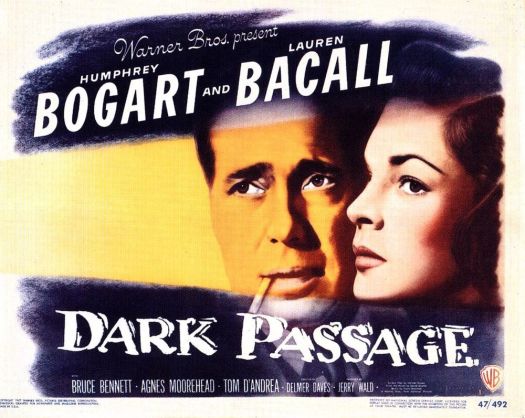
Face the Darkness: Bogie & Bacall in DARK PASSAGE (Warner Brothers 1947)


gary loggins's avatarcracked rear viewer

“Tuesdays in Noirvember” concludes with the genre’s biggest icon, Humphrey Bogart (and he’s bringing Lauren Bacall along for the ride!):

The year 1947 belonged to filmnoir, as some of the dark genre’s true classics saw the light of day: Robert Mitchum donned that iconic trenchcoat in OUT OF THE PAST , Richard Widmark snarled his way through KISS OF DEATH, Burt Lancaster battled sadistic Hume Cronyn with BRUTE FORCE , Tyrone Power got trapped in NIGHTMARE ALLEY , Rita Hayworth bedeviled Orson Welles as THE LADY FROM SHANGHAI , Ronald Colman won an Oscar as a cracked actor leading A DOUBLE LIFE, and Lawrence Tierney terrorized the hell out of everyone in his path in BORN TO KILL . Humphrey Bogart and Lauren Bacall, noir’s power couple thanks to the previous year’s THE BIG SLEEP , teamed again for DARK PASSAGE, an slam-bang crime drama that may not…

View original post 554 more words

30 Days of Noir #26: Behind Green Lights (dir by Otto Brower)


The 1946 film, Behind Green Lights, takes over the course of one night at one police station.

When tough-but-fair Police Lt. Sam Carson (William Gargan) shows up for work, he discovers that a car has been haphazardly parked in front of the station.  Inside the car is bullet-ridden body of Walter Bard, a somewhat notorious private investigator.  If the brazenness of the crime wasn’t already enough to indicate that there’s more going on here than just a detective following the wrong lead, it is soon discovered that Bard was acquainted with Janet Bradley (Carole Landis), the daughter of a reform-minded mayoral candidate.  As Janet explains it to Lt. Carson, Bard was blackmailing a friend of hers.  Janet admits that she had a gun with her the last time that she saw Bard but she swears that she didn’t murder him.

Corrupt newspaper publisher Max Calvert (Roy Roberts) views Janet’s father as being a potential rival and he immediately starts to pressure Lt. Carson to make an arrest in the case.  Not convinced of Janet’s guilt, Carson refuses.  Meanwhile, the crooked coroner (Don Beddoe) comes across evidence that could change the entire case but, as a favor to Calvert, tries to cover it up….

But that’s not all.  It’s a very busy night at the precinct.  Not only does Carson have to deal with the murder and all of the political fallout, he also has to deal with an escapes prisoner and a collection of snarky crime reports who spend all of their hanging out at the station house and waiting for a big story to drop.

Largely set in one location and featuring a cast made up of fast-talking, quick-witted cynics, Behind Green Lights sometimes feel more like a play than a film.  (One could easily imagine it taking place in the same cinematic universe as The Front Page.  Call it the MacArthur/Hecht Cinematic Universe, or MHCU for short.)  Though the film only has a running time of 64 minutes, it manages to pack a lot of twists and turns into that hour.  For the most part, it all works.  The mystery is intriguing, the cast is made up of properly tough character actors, and the tragic Carole Landis is well-cast as a character who could be an innocent victim or a dangerous femme fatale.  The film and her performance will keep you guessing.  (It has been written that Landis, a talented actress who never quite got the roles that roles that she deserved, was heart-broken when Rex Harrison refused to divorce his wife and marry her.  Two years after the release of Behind Green Lights, she was found dead at the age of 29.  The official ruling was suicide, though members of Landis’s family dispute that.)

Behind Green Lights may be a minor noir but it’s still an entertaining one.  And it can be viewed for free on YouTube!  Just remember, when doing an online search, that the film is called Behind Green Lights and not Behind the Green Door.  Don’t make the same mistake that I did!


30 Days of Noir #25: Gangster Story (dir by Walter Matthau)


The 1959 film, Gangster Story, holds the distinction of being the only film ever directed by the Oscar-winning actor, Walter Matthau.

That’s right, this low-budget film about a bank robber and the people who want to kill him was directed by TCM’s favorite curmudgeon.  The man who would later be nominated for multiple Oscars and who would star in numerous Neil Simon adaptations only directed one film and that movie was a low-budget, 68-minute, black-and-white movie about cops and robbers.

(And no, Jack Lemmon is nowhere to be found.)

Walter Matthau not only directed this film but he starred in it as well.  He plays Jack Martin, a career criminal who pulls off a daring bank robbery.  How does he do it?  Well, first, he rents an office in the same building as the bank.  He gets to know everyone at the bank.  He wins their trust.  No one can resist the charms of Jack Martin, which I guess is the advantage of getting to direct yourself.

On the day of the robbery, Jack approaches the cops who are hanging around outside the bank.  He tells them that he’s from Hollywood and he’s going to be shooting a scene in which he pretends to rob the bank.  He assures them that it will look realistic.  They might even see a rather flustered bank manager leading him into the vault.  But it’s just a movie and therefore, it’s very important that the cops not rush into the bank with their guns drawn or anything silly like that.

Of course, the cops fall for it.  While Jack is busy robbing the bank, the cops are just hanging around and shooting the breeze outside.  When Jack walks out of the bank, he thanks the cops for not ruining the scene and then promptly leaves.  Needless to say, the cops are humiliated when they realize how they’ve been tricked.  For them, tracking down Jack isn’t just about upholding the law.  It’s about vengeance.

Meanwhile, the local mob boss is upset because not only did Jack rob the bank without permission but he also failed to shared any of the stolen money.  Not only does Jack have the cops after him but he also has all the local gangsters!

What a mess!

However, Jack isn’t worried.  He’s happy because he’s met and fallen in with a local librarian, Carol (played by Carol Grace).  Will Jack find love or will his criminal past find him?

It’s always a bit strange to watch a film that’s been directed by an actor with a firmly entrenched persona.  Matthau was famous for playing urban misanthropes and, when watching Gangster Story, your natural instinct is to look for signs of that curmudgeonly worldview.  There are hints of it in the scene where Jack tricks the cops outside the bank but, for the most part, there’s really not much personality to be found in any of the film’s scenes.  Matthau’s direction is workmanlike but never particularly memorable.  For reasons that will soon become clear, as a director, Matthau seems far more interested in the unlikely love story between Jack and Carol than in the film’s criminal-on-the-run storyline.  After making this film together, Walter Matthau and Carol Grace married.  It was her third marriage and Matthau’s second and it lasted for 41 years, ending only with Walter Matthau’s death in 2000.

Not surprisingly, the scenes between Jack and Carol are the best in the film.  As for the rest of it, it’s pretty much a standard crime film.  As a director, Matthau struggles to keep the story moving at a steady pace and the film’s low-budget certainly doesn’t help.  Watching the film, you can tell why Walter Matthau devoted the rest of his career to acting as opposed to directing.  It’s hard not to feel that he made the right choice.

30 Days of Noir #24: Fourteen Hours (dir by Henry Hathaway)


As a genre, film noir has always been associated with crime: murder, brutish gangsters, seductive femme fatales, and occasionally a cynical private detective doing the right thing almost despite himself.  However, not all film noirs are about criminals.  Some are just about desperate characters who have found themselves on the fringes, living in a shadow-filled world that appears to be monstrously indifferent to all human suffering.

That’s certainly the case with the 1951 noir, 14 Hours.  The film centers around Robert Cosick (Richard Basehart, who previously played a murderer in another classic noir, He Walked By Night).  Robert isn’t a gangster.  He’s not a private detective.  He doesn’t carry a gun and he doesn’t provide any sort of hard-boiled narration.  In fact, for the majority of the film, Robert is defined by less who he is and more by what he’s doing.  Robert Cosick, having earlier checked into a room on the 15th floor of a New York hotel, has climbed out of a window and is now standing on a ledge.  Robert says that he’s going to jump.

What has driven Robert Cosik to consider such an extreme action?  The film never settles on any one reason, though it gives us several clues.  When his father (Robert Keith) and his mother (Agnes Moorehead) show up at the scene, they immediately start bickering about old family dramas.  When Robert’s ex-fiancee (Barbara Bel Geddes) begs him to step in from the ledge, he listens a bit more to her than he did to his parents but he still refuses to come in from the ledge.

But perhaps the real reason that Robert Cosick is out on that ledge can be found in the film’s shadowy visuals.  Directed in a semi-documentary fashion by Henry Hathaway and featuring harsh, black-and-white cinematography that’s credited to Joe MacDonald, Fourteen Hours emphasizes the indifference of the city.  From the menacing landscape of concrete buildings to the crowds gathering below the ledge to see if Robert lives or dies,  New York City is as much as a character in this film as Robert, his family, or the cop (played by Paul Douglas) who finds himself trying to talk Robert into reentering his hotel room.  When night falls, the city may light up but it does nothing to alleviate the shadows that seem to be wrapping themselves around Robert.  For the fourteen hours that Robert is on that ledge, he may be the center of the world but the film leaves little doubt that New York City will continue to exist in all of its glory and its horror regardless of how Robert’s drama plays out.  Whether he lives or dies, Robert appears to be destined to be forgotten.

When the film isn’t concentrating on the cops trying to talk Robert into getting back in the hotel room, it shows us the reactions of the people who see him standing out on that ledge.  (If this film were made today, everyone would be holding up their phones and uploading Robert’s plight to social media.)  Some people are moved by Robert’s struggle.  For instance, a young woman played by Grace Kelly (in her film debut) reaches a decision on whether or not to get a divorce based on what she sees happening on the ledge.  Two office workers (played by Jeffrey Hunter and Debra Paget) even strike up a romance as they wait to see what will happen.  Some people view Robert as being a madman.  Others see him as being a victim.  And then there’s the many others who view him as being either a minor distraction or a piece of entertainment.  For them, it’s less important why Robert’s on the ledge or even who Robert is.  What’s important to them is how the story is going to end.

It’s not a particularly happy film but it’s made watchable by Hathaway’s intelligent direction and the performances of Paul Douglas and Richard Basehart.  With its theme of instant fame and hollow indifference, it’s a film that remains as relevant today as when it was initially released.

What Lisa Watched Last Night #196: Killer Vacation (dir by Tamar Halpern)


Last night, I watched the latest Lifetime Movie Network premiere, Killer Vacation!

Why Was I Watching It?

Because it was new and it was on the Lifetime Movie Network, of course!

Also, I watched it because the Christmas season has begun, which means that Lifetime is mostly going to be showing holiday movies for the next few weeks.  I absolutely love Christmas movies but, even during the holidays, there are times when you just want to see an over-the-top melodrama about someone trying to go on vacation without dying.  Killer Vacation offered a beak from the relentless holiday cheer so, of course, I was going to watch it while shopping online for Christmas decorations.

What Was It About?

Lindsey (Alexa Havins) is having an affair with her boss, Jake (Jacob Young).  Unfortunately, Jake’s married.  He swears that he’s getting divorced but Lindsey can’t help but notice that he still wears his wedding ring.  When Lindsey learns that she’s pregnant, Jake suggests that they go on a vacation together.  Soon, they’re at a resort in New Mexico and strange things are happening!

Could it have anything to do with the fact that Jake’s wife is wandering around the resort as well?  And what about the passive-aggressive private detective who keeps popping up at the most awkward possible moments?  And then there’s that handsome and overly friendly yoga instructor.  Is he trying to help or does he have ulterior motives?

One thing’s for sure.  This vacation is taking a deadly turn!

What Worked?

Never underestimate just how big a factor wish-fulfillment is when it comes to understanding the appeal of a good Lifetime film.  When a Lifetime film has the word “vacation” in the title, that means that the film is promising you lot of pretty scenery and a nice resort.  On that front, Killer Vacation definitely delivered!  New Mexico looked beautiful and I really liked the hotel where Jake and Lindsey were staying.

(In fact, that hotel reminded me of Paradise Hotel.  Remember that old reality show?  I used to watch marathons of it on the much-missed Fox Reality Channel.  The fact that we only got two seasons of Paradise Hotel is a crime!)

What Did Not Work?

At times, Lindsey seemed almost too dumb to be believed.  I mean, don’t get me wrong.  We’ve all been there.  At some point, we’ve all fallen for the wrong guy and ignored all of our friends telling us we were making a mistake and accepted some pretty flimsy excuses for some unforgivable behavior.  So, it’s not that I couldn’t sympathize with Lindsey but seriously, it took Lindsey a really long time to reach the point that most people would reach right away.  Myself, I would buy a plane ticket home as soon as I suspected that my married lover had tried to push me off a cliff.  Maybe that’s just me.

As well, the identity of the murderer was just a bit too obvious.  The film did attempt to introduce some red herrings but it was pretty obvious who the killer was going to turn out to be.

“Oh my God!  Just like me!” Moments

I related to the scene where Lindsey slipped on a mountain path and nearly fell to her death.  That’s one reason why I rarely go to the desert because I would totally end up being the girl who got distracted and accidentally walked over the edge of a cliff.

Lessons Learned

Never pass up the opportunity to take a free yoga class!  Seriously, your life might depend upon it!

Rockin’ in the Film World #18: The Who’s TOMMY (Columbia 1975)


gary loggins's avatarcracked rear viewer


Before MTV ever hit the airwaves, there was TOMMY, Ken Russell’s stylized cinematic vision of The Who’s 1969 ‘rock opera’. It was a match made in heaven, teaming Britain’s Wild Man of Cinema with the anarchic rock and roll of Pete Townshend, Roger Daltrey, John Entwistle, and Keith Moon (not to mention England’s own enfant terrible,Oliver Reed ). Russell both captures the spirit of Townsend’s hard rock opus and expands on it visually with an all-out assault-on-the-senses musical featuring an all-star cast that includes an Oscar-nominated performance by Ann-Margret as the mother of “that deaf, dumb, and blind kid” who “sure plays a mean pinball”!

The Who’s original album cover

Townshend, the group’s primary songwriter, had been experimenting with long-form rock’n’roll since the beginning, notably the nine minute suite “A Quick One While He’s Away” on their second album A QUICK ONE (retitled in America HAPPY JACK). TOMMY was…

View original post 467 more words

The Christmas Chronicles (Dir: Clay Kaytis), Review by Case Wright


Netflix is known for taking risks and “The Christmas Chronicles” is no exception. There are six felonies in this film: 2 Grand Theft Autos, a kidnapping, money laundering, attempted murder, and whatever they did to that partridge in the pear tree.  Yet, it worked! I will admit that I am of the Y-Generation and Kurt Russell remains forever cool in my book, but this movie had some good story writing, great acting from veterans like Kurt Russell and Stevie Van Zandt, but great performances by up and comers Judah Lewis (The Babysitter) and Darby Camp (Big Little Lies) as well.

Clay Kaytis had his directorial debut with this film.  He is famous for being an animator for a panoply of films that you have taken your daughters to see: Frozen, Tangled, and Mulan…etc.  Clay was a pretty good choice considering the amount of animation that is in this film.  Honestly, it was a family movie that would have been a HUGE box office draw.

The film begins with a series of home movies featuring a classic nuclear family enjoying Christmas over the years…until 2017.  We learn that the father was a fireman who lost his life saving a family, leaving his family grieving and without the spirit of Christmas.  The mom is now taking extra shifts as a nurse, the daughter is REALLY into Santa, and the son is now a no-kidding degenerate car thief.  There are enough dark scenes in this film to classify it as Film Noir.

The family is trying to live as best they can and the daughter Kate is trying to reconnect with the memory of her late father by watching old home movies.  In one of the films, she sees a mystery arm delivering a package.  She convinces her brother that it could be Santa in the film and they decide to set a trap for him…..and IT WORKS!!! Not only do they catch Santa on film, they stow away onto his sleigh and cause Santa to crash.  He loses his sleigh, reindeer, bag of toys, and his magic hat.  The main ticking clock for the film is that Santa needs to get his presents delivered before christmas is up or christmas spirit will tick down to zero and it will be like the Hills Have Eyes or something.  The rest of the film is spent helping Santa retrieve these lost items and busting Santa out of jail to prevent the After Times.

And yes, Santa ends up in jail, charged with multiple felonies, and does a pretty amazing blues number with the E Street Band.  Yes, the E Street Band.  I know that a lot of this movie is starting to sound like a Christmas fever dream, but it works and my 7 and 9 year old girls were riveted and didn’t hurt each other for the duration of the film.  Thank you, Clay Kaytis…THANK YOU!

I would recommend this film and for you to subscribe to Netflix.  Otherwise, how will you understand half of my reviews?!!!!!

Merry Christmas!


30 Days of Noir #23: Framed (dir by Richard Wallace)


The 1947 film noir, Framed, is the story of a loser.

That, in itself, is not a surprise.  The loser who finds himself stranded in a strange place where he’s manipulated by nearly everyone he meets is a film noir archetype.  This is especially true when it comes to movies about men who end up getting manipulated by another film noir archetype, the femme fatale.  I mean, let’s be honest.  Most film noir “heroes” fall victim to their own desperation.  If they weren’t so obviously desperate to find money or sex, they probably wouldn’t end up in the trouble that always seems to follow them around.

Framed tells the story of Mike Lambert (Glenn Ford).  When we first meet Mike, he’s sitting behind the wheel of an out-of-control truck.  While the truck recklessly speeds down a steep hill, Mike desperately tries to keep from crashing.  It’s not until Mike pulls into a small town that he finally gets the truck to stop.  Of course, in the process of stopping, he also dings the back of someone else’s pickup truck.

It turns out that, until recently, Mike was a mining engineer.  After he lost his job, he found temporary employment as a truck driver.  He needed the money so he didn’t bother to find out what he was hauling or even if the truck had working brakes.  When Mike calls up the man who hired him and tells him that the owner of the pickup is demanding that Mike’s employer pay for the damage, the man hangs up on him.  To recap, before we’re even 10 minutes into the movie, we’ve seen that Mike can be tricked into driving a truck with no brakes and that he can’t even convince his employer to help pay for the damage caused by those faulty brakes.  In other words: Loser!

Anyway, the local cops are planning on tossing Mike in jail for reckless driving but fortunately, a local waitress, Paula Craig (Janis Carter), is willing to pay Mike’s fine.  She even helps a drunken Mike find a hotel room.  Is Paula doing all of this out of the goodness of her heart or is it all just a part of an elaborate scheme?  While Mike is getting a job with a local prospector (Edgar Buchanan), Paula is meeting with her married boyfriend, Steve Price (Barry Sullivan), and bragging about how she’s finally found the perfect patsy.

Yes, to no one’s surprise, Paula and Steve have hatched a nefarious scheme and Mike is about to find himself stuck right in the middle of it.  Of course, since this is a film noir, it should come as no surprise to learn that Paula and Steve are just as willing to double cross each other as they are Mike….

Framed is an entertaining if slightly predictable noir.  From the minute that Paula first appears, we know that she’s not to be trusted but part of the fun of the film is that those of us in the audience are always a step or two ahead of poor Mike.  You watch Mike in amazement that someone could be so dense but, at the same time, Glenn Ford is likable enough that you do hope that everything will turn out okay for him.  As for the film’s main villains, Barry Sullivan is perfectly slick and sleazy as Steve Price but the film is really stolen by Janis Carter, who plays Paula as if she were a panther waiting to pounce on her prey.

Framed is a film that will definitely be enjoyed by those who appreciate the shadowy landscape of an old school film noir.  It may not rewrite the rules of genre but it’s still an undeniably entertaining film about a loser and the people who use him.