Continuing my quest to watch all these movies sitting in my DVR (so I can record more movies!), here are six more capsule reviews for you Dear Readers:
FIFTH AVENUE GIRL (RKO 1939; D: Gregory LaCava) – A minor but entertaining bit of screwball froth revolving around rich old Walter Connolly , who’s got problems galore: his wife (the criminally underrated Veree Teasdale) is cheating on him, his son (Tim Holt in a rare comedy role) is a polo-playing twit, his daughter (Kathryn Adams) in love with the socialism-spouting chauffer (James Ellison ), and his business is facing bankruptcy because of labor union troubles. On top of all that, no one remembers his birthday! The downcast Connolly wanders around Central Park, where he meets jobless, penniless, and practically homeless Ginger Rogers, and soon life on 5th Avenue gets turned upside-down! Ellison’s in rare form as the proletariat Marxist driver,
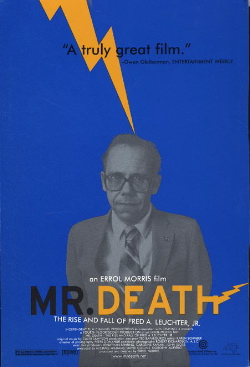
This 1999 documentary provides a disturbing portrait of an absolute moron.
Of course, when we first see and hear Fred Leuchter, Jr., he doesn’t seem like a moron. He definitely comes across as being a bit eccentric and maybe just a little bit off but, at first sight, he’s actually kind of likable. As he explains it, he grew up in the United States prison system. His father worked in prison administration and one of Fred’s earliest memories was sitting in an electric chair. Fred grew up to be an engineer and, concerned that America’s execution methods were cruel and potentially dangerous to even those who weren’t being executed, he decided to dedicate his life to redesigning electric chairs and gas chambers. He even built his own lethal injection machine, all designed to make sure that the condemned felt as little pain as possible while dying. As Fred explains it, he supports capital punishment but “I don’t support torture.”
Fred Leuchter soon came to be recognized as one of America’s leading experts on execution devices. As he himself admits, that’s largely because he was American’s only expert on the way that people are legally executed. Whereas most people deliberately went out of their way not to learn the specifics of what happens when someone is put to death, Fred made it his life’s purpose. After redesigning an electric chair in Tennessee, Fred was soon being summoned to other states so that he could refurbish and, in many cases, redesign their execution machinery. For the first 30 minutes of the documentary, Fred explains what it’s like to be an expert on executions and it’s hard not to like this nerdy, self-described “humanitarian.” If anything, you spend the first part of this documentary considering the oddness of finding a humane way to execute the condemned. America prides itself on both it’s rejection of cruel and unusual punishment and it’s willingness to put criminals to death. It’s an odd combination and, briefly, Leuchter seems like the embodiment of those two contrasting positions.
This changes during the documentary’s second half. That’s when we learn how, in 1988, Leuchter was hired by a German anti-Semite named Ernst Zundel. Zundel was being tried in Canada, charged with publishing and shipping works of Holocaust denial. For a fee of $30,000, Leuchter spent his honeymoon in Poland, went to Auschwitz, and personally “inspected” the gas chambers. Because Leuchter brought a camera crew with him, his every action was recorded.
We watch as Leuchter and his assistants sneak into the gas chamber and proceed to clumsily start chipping away at the walls. We listen as Leuchter goes on and on about how he doesn’t feel that the gas chamber was actually a gas chamber because it just seems too impractical to him. If they wanted to executed a large group of people at once, why didn’t the Nazis use the gallows? Leuchter wonders. (They did.) Why didn’t the Nazis use firing squads? Leuchter asks. (They did.) Even before Leuchter returns to America, he’s made it clear that his mind is made up. He can’t understand why the Nazis would have done what they did and therefore, in his mind, that means they didn’t do it. After all, Leuchter’s an expert. He’s Mr. Death.
He’s also a moron and, by the time he starts cheerfully talking about all the effort that went into smuggling the wall chips out of Germany, whatever likability he once had has vanished. Watching this film, I found myself wishing for a time machine so that I could go back in the past and throw something at him. You just want him to shut up for a minute and realize that what he’s saying makes no sense. Not that it would make any difference, of course. Leuchter is too proud of himself for having discovered “the truth” to actually consider that he could be wrong.
When Leuchter’s samples are tested for trace amounts of poison gas, they come back negative. Leuchter announces that this means that the Holocaust never happened and he writes up the infamous Leuchter Report, which is still regularly cited as evidence by Neo-Nazi groups and anti-Semitic historians like David Irving. However, as Dutch historian Robert Jan van Pelt explains (and, as we’ve already seen in the video that Leuchter himself shot at Auschwitz), Leuchter not only did not take a big enough sample but he was so clumsy in the way that he transported it that he diluted the sample as well. Even beyond all that, it would be very unusual for cyanide residue to still present after forty years of everyday wear and tear.
None of this matters, of course, to Fred Leuchter. With the publication of the Leuchter Report, he becomes a fixture on the Holocaust denial circuit. (We see an edition of the Leuchter Report that was published and distributed by the Aryan Nations.) Suddenly, Leuchter has fans. In his own sad and pathetic way, he’s become a celebrity and we see him beaming as he stands on the stage of a Neo-Nazi conference. Meanwhile, his wife leaves him. And prisons stop using him as a consultant, especially after they discover that he was never actually licensed to practice engineering. Financially bereft, Leuchter even resorts to trying to sell one of his beloved “execution devices,” putting an ad in the classifieds. (Needless to say, things don’t go well.) Looking over the ruins of his life, who does Leuchter blame for his troubles? “Jewish groups,” he says before then going on to assure us that some of his best friends were and are Jewish. Was Leuchter always an anti-Semite or did he become one because he needed someone to blame for his own self-destruction? That’s a question that the viewer will have to answer for themselves.
Mr. Death is a disturbing portrait of a rather sad and pathetic figure, a man who fell victim to his own arrogance and hubris and who, as opposed to seeking redemption, instead allied himself with the only people ignorant and hateful enough to still embrace him. As is his style, documentarian Errol Morris interviews Leuchter’s critics but refrains from personally arguing with Leuchter, instead basically giving the self-described execution expert just enough rope to hang himself. (Morris does, at one point, ask Leuchter if he’s ever considered that he might be wrong. Not surprisingly, Leuchter claims that he has not and seems to be confused by the question.) In the end, it’s impossible to feel sorry for Leuchter. The nerdy humanitarian who opposed torture had been replaced by a self-pitying Holocaust denier. By the end of the film, Fred A Leuchter, Jr. and his report have become a reminder of the damage that can be done by one dangerously ignorant man.
First of all, it’s always so fun to read Lisa’s reviews. I hope she wants to review another one of these episodes. She always sees things that I don’t like HERE!!!! and HERE!!!!. It has been a true pleasure working with/for her over these years. This series is making me already plan for my October reviews!!! Weren’t they awesome last October?! Yes…Yes…They were.
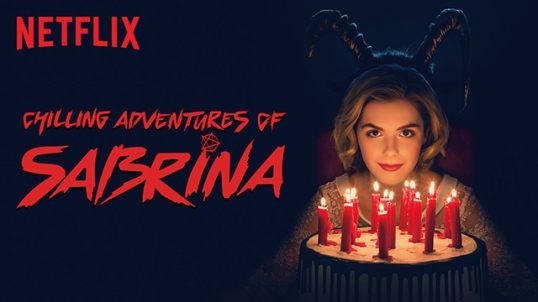
Is this season getting better? Yes, but that’s mostly because the first episode of the second season was so very unsatisfying and disappointing. The series seems to be evolving into a Tales From The Crypt over the top fest. I loved TFTC, but that’s not what I expected Sabrina to become. I saw this series as a scary in your face we’re mad as hell at the patriarchy and we’re not gonna take it anymore! The feminism is still there, but it really hits you over the head with its agenda ….every….single…episode; It comes across as a PSA sometimes. When done right, like last season, you root for the agenda, but now I’m lectured by it. It’s kind of annoying when you already agree.
This episode was directed by Alex Pillai (Riverdale) and he did a fine paint by numbers job with the episode. It got the job done….fine, not great, but definitely fine like the Chicago Cubs in the 2000s or Two Buck Chuck (Charles Shaw). The episode was all about marriage, the loss of feminine identity, and misogyny…lots and lots of misogyny. Really, this Church of Night is a bunch of knuckle dragging dirtbags. I get the whole- we’re evil bit, but it doesn’t really work all the time. The characters are mostly strong women and the constant subjugation that the Church imposes seems kinda silly that anyone would put up with it let alone these powerful heroines. Also, the constant “for Hell’s Sake” “Your Unholiness” “Your Dishonor” just makes me laugh; I look like loon when I’m on the elliptical watching this.
In the episode, Aunt Z is getting married and she’s all jittery and worried about being exposed for stealing one of the Blackwood babies. Also, Father Blackwood is going full-on misogynist pig. He wants the church of night to go back to its old ways of chauvinism. His plan is to write up the basic philosophy and give it to the Anti-Pope (Ray Wise). (Side Note: God, I love Ray Wise. He’s awesome in everything he does and was the best devil ever in Reaper. Unfortunately, he’s only in the show for a couple of minutes.) Sabrina catches wind of Blackwood’s Misogynist plan because Ambrose tells her .
The Solution: Sabrina gets her Dad’s manifesto that’s all women and men are equal, witches should marry mortals, and powertrain warranties are bullshit. Sabrina has Nick retrieve it from the bottom of the sea. Just as the Anti-Pope will read it, Father Blackwood has him murdered and frames Ambrose for it!!! DUN DUN DUN!!!! Basically, all of Sabrina’s plans fail: Aunt Z and Blackwood marry, Blackwood has Aunt Z walk behind him (bleh), Ambrose is jailed, Sabrina and Nick are expelled, and Aunt Hilda becomes lactose intolerant. Bad all the way around.
I normally don’t get into subplots, but spring is in the air. Ms Wardwell and Adam are falling in love. It’s really sweet. She explains that marriage is a complete destruction of a woman’s identity. Wardwell looks at Adam expecting a fight, but instead he accepts her, her values, and just wants to be with her. It’s …well….sweet. I was a bit moved. Satan gets jealous and wants her to kill him, but instead she makes him a ring of protection. I hope these crazy kids make it work.
The show is moving in the right direction, but the show seems to collapse under its own weight sometimes. It has these big themes and plots, but can’t quite deliver them this season because of the campiness, clunky dialogue, and endless subplots that grind the suspense and gravitas to dust. Maybe this is the way Riverdale is? I never wanted to watch that show and now I really don’t want to. My guess is that season 1 was Ruth Chris Steakhouse and season 2 is Red Robin and yes I did get food poisoning from them once.
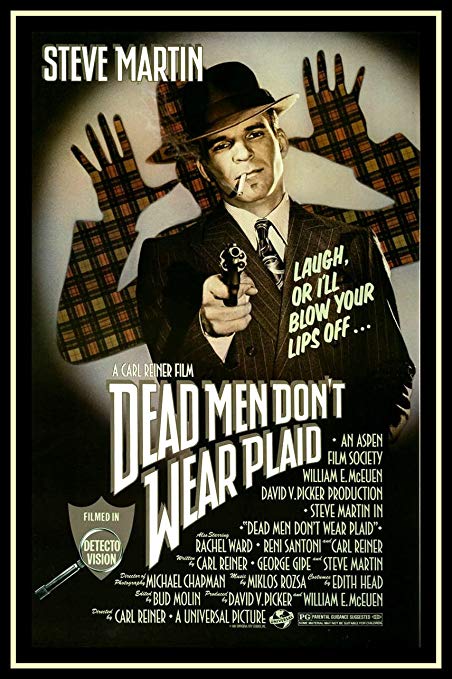
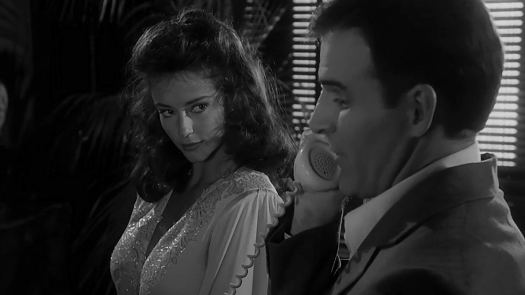
Quick, name a film noir that stars Humphrey Bogart, James Cagney, Joan Crawford, Bette Davis, Ava Gardner, Cary Grant, Veronica Lake, Alan Ladd, Vincent Price, and… Steve Martin? There’s only one: 1982’s DEAD MEN DON’T WEAR PLAID, the second collaboration between that “wild and crazy guy” Martin and comedy legend Carl Reiner. I remember, back in 1982, being dazzled by editor Bud Molin’s seamless job of incorporating classic film footage into the new narrative while simultaneously laughing my ass off. Things haven’t changed – the editing still dazzles, and I’m still laughing!
Martin and Reiner’s first comedy, 1979’s THE JERK, was an absurdist lover’s delight, and this time around the two, along with cowriter George Gipe, concocted this cockeyed detective saga after combing through old black and white crime dramas (we didn’t call ’em film noir back then) and cherry picking scenes to build their screenplay around. Martin plays PI…
It was a year ago today that we learned of the passing of Tim Bergling, who was better known as Avicii. For those of us who loved Avicii’s music and who followed him throughout not only his career but also through his multiple health issues and his widely publicized retirement from touring, the loss of Avicii is one that we have yet to recover from.
On this sad anniversary, I’m thinking about the first time that I watched Avicii: True Stories on Netflix. This documentary, which covered the majority of Avicii’s career — from his rise to his eventual retirement, was released in Europe six months before his death. In the U.S., it was released on Netflix on December 14th, 2018. It’s not always an easy documentary to watch but I recommend it to anyone who loved Avicii’s music or to anyone who is just curious about the pressures that go with being a star.
Featuring interviews with not only Avicii but also his collaborators, the film follows Avicii as he quickly goes from being just being one of the many people posting remixes on online forums to being one of the top and most important DJs in the world. We watch as Avicii maintains a hectic schedule of nonstop touring, often sacrificing both his physical and mental health in the process. Avicii ends up in the hospital, suffering from acute pancreatitis. Later, he again ends up in the hospital, this time to have both his appendix and his gall bladder removed. The film makes no attempt to hide the decadence that goes along with touring but, in its best moments, it also highlights the conflict that arises from having to be both Tim Bergling, an anxious young man who finds a much-needed escape in music, and Avicii, the superstar who has to be on every night.
When we first meet Tim, he seems young and hopeful and enthusiastic. Halfway through the film, an exhaustion starts to creep into his voice and, by the end of the film, he’s become far more world-weary. As we watch Tim struggle with the weight of being Avicii, we’re also aware of the people around him, whose careers and finances are pretty much dependent on making sure that Tim never stops being Avicii, regardless of how much damage it does to him mentally and physically. Throughout it all, one thing remains consistent and that is Tim’s love of music. It’s only when creating and talking about music that Tim seems to be truly happy. It’s his escape from a world that often seems like it’s conspiring to swallow him whole.
The film ends on what should have been a happy note. Tim announces his retirement from touring and the film ends with him, in good spirits, on a beautiful beach. Tim seems like he’s finally found some happiness and a chance at the inner peace that stardom often denied him. Beyond a title card (which was added for the film’s U.S. release), Avicii: True Stories does not deal with Tim’s death but it still haunts every minute of the film. Watching this documentary, it’s impossible not to mourn what the world lost when it lost Tim Bergling. The film stands as both a tribute to his talent and a portrait of a good and likable man struggling to escape his demons.
The comedy team of Bert Wheeler and Robert Woosley join forces with Our Gang’s Spanky McFarland in KENTUCKY KERNALS, directed by Hal Roach vet George Stevens. Sounds like the perfect recipe for a barrel of laughs, right? Well, while there are some laughs to be had, the (then) recent enforcement of the Production Code finds W&W much more subdued than in their earlier zany efforts, and playing second fiddle to both Spanky’s admittedly funny antics and the plot at hand, a takeoff on the famed Hatfield-McCoy feud.
Weirdly enough, the film starts off with a lovelorn man attempting suicide by jumping off a bridge. Fortunately for him, he lands in a fishing net owned by down-on-their luck vaudevillians Elmer (Woolsey) and Willie (Wheeler), living in a waterfront shack. The two convince him to adopt a child, and go to the orphanage, where they find cute little Spanky, who has a…
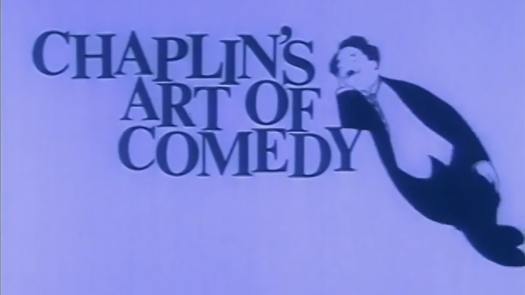
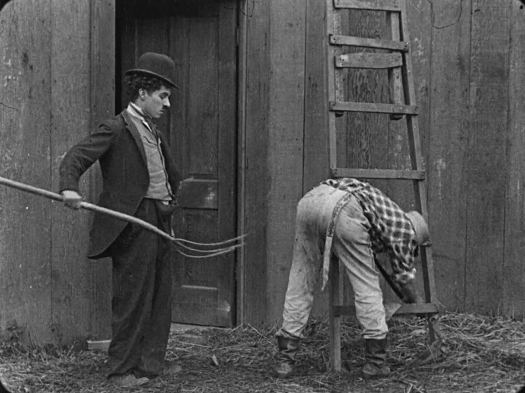
Today we celebrate the birthday of the immortal Charlie Chaplin , born on this date 130 years ago. Chaplin made his film debut 105 years ago this year, and the world hasn’t stopped laughing since! His silent comedies featuring the endurable character “The Little Tramp” (or as Chaplin called him, “The Little Fellow”) have stood the test of time, and his mix of humor and pathos elevated slapstick comedy to high art. The compilation film CHAPLIN’S ART OF COMEDY highlights Chaplin’s early efforts at Essanay Studios from 1914-15, and contains some of his best work.
The success of Robert Youngson’s 1959 film THE GOLDEN AGE OF COMEDY (spotlighting silent luminaries like Laurel & Hardy, Ben Turpin, and others) had spawned a whole host of imitators over the next decade utilizing low-to-no cost silent footage and repackaging it into a new feature film. Some were good, others lackadaisically put together, most…
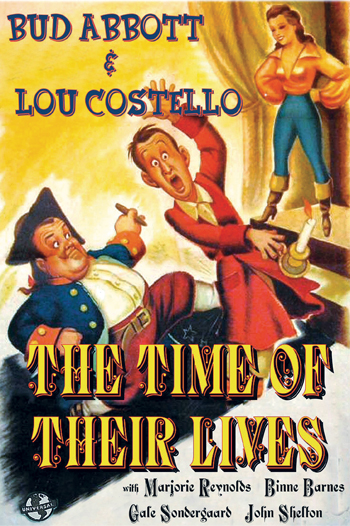
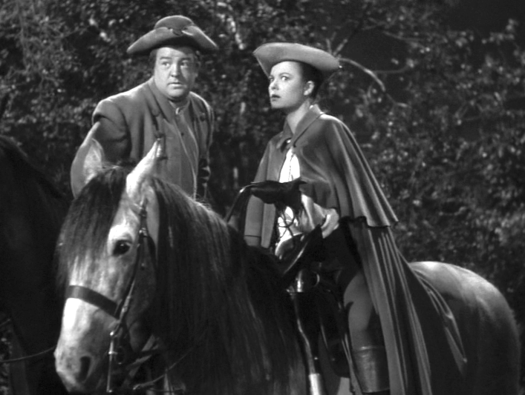
Good morning! While most of you in America are fretting over Tax Day, here in Massachusetts we’re celebrating Patriots Day, commemorating the 1775 Battles of Lexington and Concord that kicked off the American Revolution. It’s a state holiday, and the Boston Marathon is held every year on this date, with the Red Sox playing their traditional 11:00am game. It’s been a tradition on this blog (well, since last year, anyway ) to feature Revolutionary War-themed films, and today we’ll take a look at THE TIME OF THEIR LIVES, an Abbott & Costello comedy that’s one of the duo’s best.
THE TIME OF THEIR LIVES differs from the usual A&C formula, with Bud and Lou playing separate characters rather than working as a team. The film begins in 1780, as Costello’s Horatio Prim, tinker by trade and true patriot, rides to visit his lady-love Nora. In his possession is a letter…
The trio that brought you KANSAS CITY CONFIDENTIAL – star John Payne, director Phil Karlson, and producer Edward Small – teamed again for 99 RIVER STREET, and while it’s not quite on a par with their film noir classic, it’s crammed with enough sex’n’violence to hold your interest for an hour and a half. Karlson’s direction is solid, as is the cast (including a knockout performance by Evelyn Keyes), and the camerawork of the great Austrian cinematographer Franz Planer gives it a wonderfully brooding touch of darkness.
The story itself is highly improbable yet highly entertaining: ex-boxer Ernie Driscoll (Payne), once a heavyweight contender now reduced to driving a cab, is married to ex-showgirl Pauline (the delectable Peggie Castle), who’s two-timing him with crook Victor Rawlins (slimebag Brad Dexter ). Ernie catches them making out through the window of the flower shop Pauline works at, and his PTSD is triggered…
Hello friends. Last time we spoke, it was really hard. I wondered if my second favorite show after Santa Clarita Diet went Lost Season 2 on me. The season opener was bad…really bad. It was scary for me to watch the second episode. I was actually worried that the show was a season 1 fluke or maybe I misread or willfully blinded myself to a meh show. Well, I’m happy to write that this episode was a solid …. Not Bad. Its flaws were LEGION (and we’ll go over those), but the story had a theme, character growth, and despair. Honestly, through in some Adele and Ben and Jerry’s and you got the makings of a lonely night in as you watch yourself age and love sulks away from you, broken, and never to return.
The episode is all about unrequited love and who We should be, but who We really are. It’s fun, if you’re in the mood for it. It was written by new writer Mj Kaufman and Christina Ham (Orphan Black) and these writers capture the loneliness of all of the most interesting characters.
The Devil talks to Ms Wardwell who we know is Lilith (Adam’s First Wife). He not too gently casts her aside and tells Wardwell/Lilith that Sabrina is to be Satan’s Prophet and Queen, not Her. The heartbreak is palpable, but the Devil’s Costume looks like a step above Party City and it really takes me out of it. Lilith asserts that Sabrina is too goody goody to be the Devil’s main squeeze and they wager on it: have Sabrina steal a stick of gum. Sabrina resists.
I gotta ask why? She seemed all on board the Midnight Train to Gethsemane with Old Scratch, but she just can’t bring herself to steal the forbidden Fruit Stripe. I would’ve been all in for the Freshen Up gum…ya know the one with the goo inside…I liked it….Whatever. Because she refused, Satan starts hurting people around Sabrina by giving them Chickenpox. WHAAAA? Chickenpox?! What kind of anti-vax town is Greendale?! Let it burn to the ground! They’ll give us all measles! To make amends to Satan, she starts to burn the school down as per Satan’s command. Well, why bother?! They’ll all get Whooping Cough soon enough away. Come on, Lucifer…this town is doomed and weird.
There are good subplots the Lilith story, which is a nice evil love story where Ms Wardwell watches her life portrayed as entertainment. The Evil Dean wrote and produces a play of Lilith and Satan falling in sort of love. It might of brought her a smile, but instead it brings tears because Satan has found a new special lady and Lilith’s destined to be eternally alone. We see in Ms Wardwell AKA Lilith how love is supposed to be, but how it withers and dies.
Suzie is now Theo is the focus of the other subplot. She should be accepted as a boy, but it doesn’t quite work out that way. Theo tries to change in the boy’s locker room and is mocked by some, but gawked at by all. The shot is done very well. We close up on the known bullies from the previous episodes, but then the camera pulls back and ALL of the boys are gawking silently, waiting to see female nudity regardless of her gender identity. They simply can’t help it. Where we should be, but who we are. It’s disappointing, realistic, and sad.
Sabrina and Harvey react to a sensual spark and begin making out, but her tie to Satan destroys the encounter and ends their love affair forever. What their love should be and the reality cannot be.
This was a good episode overall. It allowed you to see and not be told Lilith’s story and the struggles that everyone has against loneliness and despair.








 Through the Shattered Lens