No title card; so, I used this as the title card. *sigh* This AI short gave me a little jump. It did have some suspense; so, I won’t feed the creator to the sharks. Sorry Sharks.
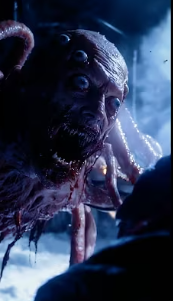
Woman alone brushing her teeth, but there is a malevolent force in there with her. The bathroom is by definition private and you’re almost always vulnerable. The film has some suspense and payoff. It is worth watching.
“So it’s a fucking coin toss? That’s what 50 billion dollars buys us?” — Secretary of Defense Reid Baker
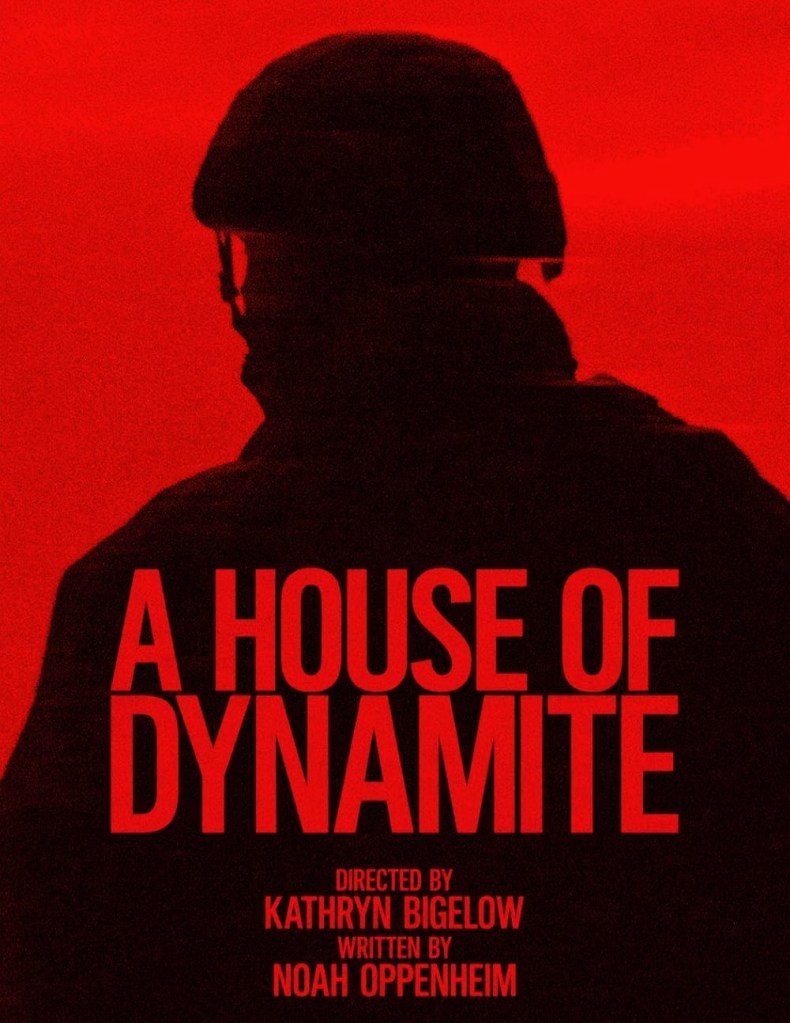
The end of the Cold War was supposed to close a chapter of fear. With the superpowers stepping back from the brink, the world briefly believed it had entered an era of stability. Yet that promise never held. The weapons remained, the rivalries adapted, and the global machinery of deterrence continued to hum beneath the surface. Kathryn Bigelow’s A House of Dynamite faces this reality head-on, transforming the mechanics of modern nuclear defense into something unnervingly human. On the surface, it plays as a high-tension political technothriller, but beneath that precision lies a deeply existential horror film—one built not on shadows or monsters, but on daylight, competence, and the narrow margins of human fallibility.
The premise is piercingly simple. An unidentified missile is detected over the Pacific. Analysts assume it’s a test or a glitch—another false alarm in a world overflowing with them. But within minutes, as conflicting data streams converge, what seemed routine begins to look real. The film unfolds in real time over twenty excruciating minutes, charting the reactions of those charged with interpreting and responding to the potential catastrophe. Bigelow divides the film into three interwoven perspectives: the White House Situation Room, the missile intercept base at Fort Greely, and the President’s mobile command aboard Marine One. The structure allows tension to grow from every direction at once, each perspective magnifying the other until the screen feels ready to collapse under its own pressure.
Capt. Olivia Walker (Rebecca Ferguson), commanding officer of the Situation Room, anchors the story with calm professionalism that gradually frays into disbelief. Ferguson’s performance is clear-eyed and tightly modulated—precise, disciplined, and quietly devastating. She stands as the rational center inside chaos, her composure the last gesture of control in a world that no longer follows reason.
Over her is Adm. Mark Miller (Jason Clarke), Director of the Situation Room, who represents the institutional embodiment of confidence. Clarke plays him with methodical restraint, a man who trusts procedure long after it stops earning trust. Miller’s authority is both comforting and horrifying: a portrait of leadership built on ritual rather than certainty.
At Fort Greely, Anthony Ramos brings an intimate immediacy as the officer charged with the missile intercept. His scenes hum with kinetic dread—the physical execution of decisions made thousands of miles away. Through him, the film captures the most primal kind of fear: acting when hesitation could mean extinction, knowing that success and failure are separated only by chance.
The President, portrayed by Idris Elba, spends much of the crisis in motion—first within the cocoon of the presidential limousine, and later, aboard Marine One as it carves through blinding daylight. Elba gives a performance of subtle, steady erosion. At first, he embodies unshakeable calm, a figure of poise and authority; but as the situation deepens, his steadiness wanes. Words become shorter, pauses longer. Every decision carries consequences too vast for resolution. It is a measured, understated portrait of power giving way to human uncertainty.
Bigelow’s direction is stripped of ornament and focused on precision. Barry Ackroyd’s cinematography heightens the claustrophobia of command centers—the sterile light, the reflective glass, the sense that every surface observes its occupants—while his exterior scenes pierce with harsh brightness, suggesting that no sanctuary exists under full exposure. Kirk Baxter’s editing maintains an unrelenting pulse, cutting with mathematical precision while preserving the eerie stillness of the moments where no one dares to speak.
A House of Dynamite also shows how even with the most competent experts—military, intelligence, and political—working to manage an escalating crisis, there is no path to victory. The professionals at every level stop seeking to prevent the worst and instead focus on saving what they can when the worst becomes inevitable. The film’s scariest revelation is not the potential for destruction, but the paralysis that intelligence creates. If the brightest, most disciplined people in the world cannot find an answer, what happens when power falls into the hands of those less prepared or less rational? In its quiet way, the film poses that question that we see more and more each day on the news and on social media and we are left with silence and realization of the horror of it all.
Despite its precision, the film isn’t without flaws. Bigelow’s triptych structure—cutting between the three perspectives—works brilliantly to escalate tension, yet the repetition of similar beats slightly blunts the impact. Each segment revisits the same crisis rhythms—a data discrepancy, an argument over authority, another uncertain update—sometimes slowing the natural momentum. While the repetition underlines the futility of bureaucratic systems in chaos, the transitions don’t flow as fluidly as the rest of the film’s airtight craftsmanship. The result is a film that is gripping overall, occasionally uneven in rhythm, but never less than absorbing.
When the final minutes arrive, Bigelow declines to deliver resolution. No mushroom clouds, no catharsis. The President sits in Marine One, head down with the weight of the world on his shoulders as he contemplates his options in the Black Book (options in how to retaliate) and knowing that he has no good choices in front of him. The world remains suspended between survival and oblivion, and the silence that follows feels heavier than sound. The ending resists closure because endings, in the nuclear age, are an illusion—the fear continues no matter what happens next.
In a year crowded with strong horror releases—Sinners, Weapons, The Long Walk and Frankenstein among them—A House of Dynamite stands apart. Dressed in the crisp realism of a technothriller, it’s a horror film defined by procedure, light, and silence. Bigelow builds terror from competence, from the steady voices and confident gestures of people trying to manage the unmanageable. This is not the chaos of fiction but the dread of reality, a reminder that the systems meant to preserve and protect might one day fail to deliver on its promise. For all its precision and restraint, A House of Dynamite shakes in the memory long after it ends—the year’s most quietly terrifying film.
Nuclear Close Calls: The situation and question brought up in the film has basis in history as there has been many instances of close calls and false alarms. The film itself doesn’t confirm that the missile detonated, but the implications in past confirmed events just shows how close the world has been to a completed catastrophe.
Whenever it’s time to share this film for Horrorthon, I have a little story that I like to tell:
Enter singing.
Little Shop.…Little Shop of Horrors.…Little Shop.…Little Shop of Terrors….
When I was 19 years old, I was in a community theater production of the musical Little Shop of Horrors. Though I think I would have made the perfect Audrey, everybody always snickered whenever I sang so I ended up as a part of “the ensemble.” Being in the ensemble basically meant that I spent a lot of time dancing and showing off lots of cleavage. And you know what? The girl who did play Audrey was screechy, off-key, and annoying and after every show, all the old people in the audience always came back stage and ignored her and went straight over to me. So there.
Anyway, during rehearsals, our director thought it would be so funny if we all watched the original film. Now, I’m sorry to say, much like just about everyone else in the cast, this was my first exposure to the original and I even had to be told that the masochistic dentist patient was being played by Jack Nicholson. However, I’m also very proud to say that — out of that entire cast — I’m the only one who understood that the zero-budget film I was watching was actually better than the big spectacle we were attempting to perform on stage. Certainly, I understood the film better than that screechy little thing that was playing Audrey.
The first Little Shop of Horrors certainly isn’t scary and there’s nobody singing about somewhere that’s green (I always tear up when I hear that song, by the way). However, it is a very, very funny film with the just the right amount of a dark streak to make it perfect Halloween viewing.
So, if you have 72 minutes to kill, check out the original and the best Little Shop of Horrors….
I was hoping that he might be, even though his name didn’t appear in the credits. Quite a few cast members from the first two films return for the third film. David A.R. White is back as Josh McManus, the former super soldier who now drives his souped-car through the wastelands of America. Bruce Marchiano is back, credited as the Stranger though we all know he’s actually Jesus. (Since Marchiano appeared in all three films, I can only assume the RevelationRoad films all take place in the same cinematic universe as TheEncounter films and Sarah’sChoice.) Brian Bosworth shows up briefly.
But there is no Eric Roberts. Not even Eliza Roberts appears in this film! It’s a shame and they are both missed.
However, Kevin Sorbo does show up.
Kevin Sorbo plays Honcho, a bandit leader who lives in the wastelands and who is worshipped by those who follow him. Honcho occasionally speaks with an Australian accent. Occasionally, the accent slips or disappears all together. At first, I thought this was a case of bad editing, bad dubbing, or maybe Sorbo not really being that into the character. However, there’s actually a rather clever moment in which Honcho tells Josh that he’s not actually from Australia. He just speaks with the accent because it impresses his followers. Without the accent, he’s just some guy who used to work at a gas station. With the accent, he’s a warlord.
It’s a moment that made me laugh, largely because it’s true. People love and fear accents. If you’ve got a posh British accent, most Americans will assume that you’re planning a heist of some sort and that Sylvester Stallone or Harrison Ford is somewhere nearby, trying to stop you. If you’ve got an Australian accent, the assumption amongst Americans is that you can survive harsh conditions, handle your alcohol, and jump out of a plane without a second thought.
However, Sorbo’s fake Australian accent also pays a sort of homage to the MadMax films. The RevelationRoad trilogy was obviously envisioned as being a faith-based version of the Mad Max films, with David A.R. White cheerfully stepping into the somber shoes of Mel Gibson and Tom Hardy. Using MadMax as a model for a faith-based apocalypse film actually isn’t that bad of an idea. Indeed, Gibson’s style of beatific madness opens up the original Mad Max trilogy to a similar interpretation. Unfortunately, RevelationRoad3 is at time a bit too faithful to the MadMax films, to the extent that it struggles to establish an identity outside of the films that inspired it. That’s one reason why Kevin Sorbo’s character stands out. He’s a character who genuinely surprises us.
As for the plot of RevelationRoad3, it finds Josh being sent on a mission to find The Shepherd (Robert Gossett), a mysterious figure who is gathering together a religious flock in the desert despite the fact that the new world government has outlawed things like religion and individual freedom. While Josh’s wounded companion waits in a town ruled over by Mayor Drake (James Denton), Josh searches the desert and occasionally sees a mysterious rider on a horse. The film mixes action and theology and the results are definitely mixed, with a few well-done chase scenes mixed with a lot of scenes of people talking. That said, at its best, TheBlackRider achieves a sort of desolate grandeur.
For today’s horror on television, we have a made-for-TV monster movie from 1972, Gargoyles!
What happens when a somewhat condescending anthropologist (Cornel Wilde) and his daughter (Jennifer Salt) head out to the desert? Well, they stop by a crazy old man’s shack so that they can look at his genuine monster skeleton. Before Wilde can thoroughly debunk the old man’s claims, the shack is attacked by real monsters!
That’s right! Gargoyles exist and they apparently live in Arizona! There’s nothing particularly surprising about the plot but the gargoyles are memorable creations and Bernie Casey gives a good performance as their leader. The gargoyle makeup was designed by none other than Stan Winston, who won an Emmy for his work here and who went on to win Oscars for his work on Aliens, Terminator 2, and Jurassic Park.
As well, a very young Scott Glenn shows up in the cast. I like to think that he’s playing the same character in both Gargoyles and Sucker Punch.
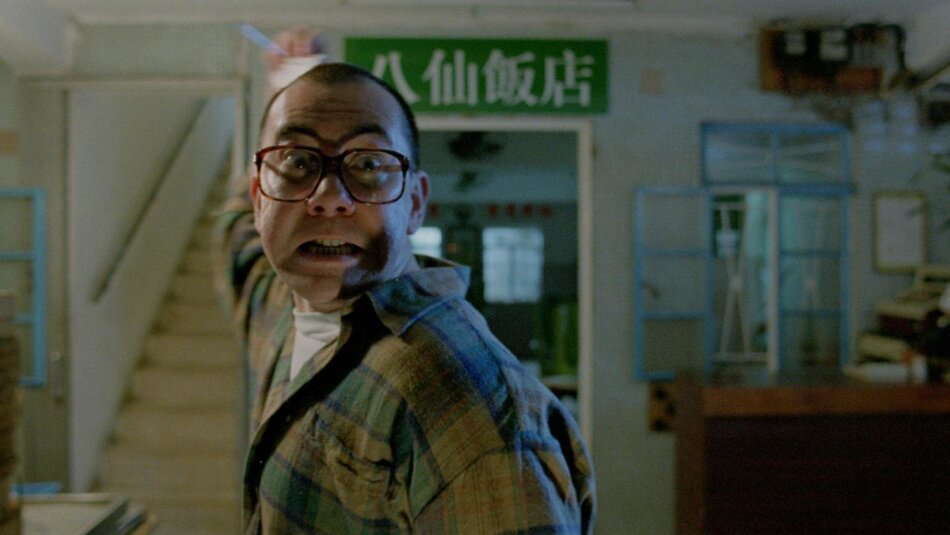
Loosely based on the real-life exploits of a serial killer in Hong Kong in the mid-80’s, THE UNTOLD STORY (1993) unfolds over a couple of different timelines. The film opens with a flashback to Hong Kong circa 1978, where we witness a horrific murder committed by Chan Chi-Leung (Anthony Wong) over a game of mahjong. In order to try to conceal the murder, we see the killer as he destroys his old identification documents and creates a completely new identity. As the opening credits end, we’re “in the present” and join a group of kids playing on the beach when they discover a plastic bag containing severed human body parts. Soon the police are on the scene, led by Inspector Lee (Danny Lee) and a ragtag team of wisecracking detectives. Their investigation leads them to the Eight Immortals Restaurant, a place that is known for its barbecued pork buns, and its seemingly polite but evasive owner, Wong Chi Hang, who just happens to be the same guy we saw committing vicious murder at the opening of the film. Wong claims he bought the place from Cheng Lam (Siu-Ming Lau), who along with his entire family, has mysteriously vanished. As the cops dig deeper, too many things just aren’t adding up, like the restaurant’s high employee turnover rate and Wong’s inability to produce ownership papers. The cops eventually arrest him and attempt to torture a confession out of him. The flashback timeline kicks back in after Wong is arrested and put through hell by his fellow jailbirds and by the police themselves. When he finally cracks, we learn the secrets of “the untold story!”
Right off the bat, I want to make the statement that THE UNTOLD STORY is not a film that’s meant for everyone. Unless you have a strong stomach and can handle extreme gore and vicious cruelty (of both a violent and sexual nature) depicted in graphic detail, you may want to stay away. As I’m definitely a squeamish viewer, I stayed away from this film for many years due to its reputation. My curiosity eventually overcame my good sense, and I gave it a watch a number of years ago. I mean, the film is a Hong Kong “Category III” rated landmark, and Anthony Wong did win the Best Actor Award at the Hong Kong Film Awards for his performance in the movie. It stands to reason that a guy who calls himself a true fan of Hong Kong cinema should give THE UNTOLD STORY a go! Let me just say this, as someone who grew up on Hollywood films, even the goriest films had certain lines that they would not cross. There are no such lines in this film. Director Herman Yau’s 1993 Hong Kong exploitation film is an unflinching punch to the gut in its willingness to go to unacceptable extremes without any apology to the viewer. Just know that going in.
Now that I’ve properly prepared you for the excessively cruel and gruesome nature of the violence in the film, I now have to try to put into words my actual thoughts on the film itself. One of the things that stood out to me as I watched the movie is the stark contrast between the horrific nature of the violence on screen and the “zany antics” of the police who are working the case. Led by THE KILLER’s Danny Lee as the distracted Inspector Lee, who always has a beautiful prostitute on his arm as he visits crimes scenes and the police station, this group of investigators spends a lot of their time acting like immature teenagers rather than serious cops. Imagine if you and your friends in high school were trying to solve a serial killer case, and we got to watch how you acted on stakeouts and in the police locker room, and you might get an idea of what I mean. My guess is that this is meant to make the violent content a little easier to swallow, as well as poke some fun at the “macho men” who are in charge of solving these kinds of crimes. In some ways it works, but there’s still no protection once Wong goes bonkers.
And speaking of Anthony Wong, he is absolutely incredible in this film as the unimaginably disturbed killer. We watch him explode with rage, commit the most heinous acts imaginable, and then just clean up his mess like he’s doing his daily household chores. I guess it helps that he’s a good cook! Hell, there’s a point near the end of the film where his performance almost leads you to having sympathy for him as the police and his fellow inmates are torturing him! Almost, because the worst flashbacks are still yet to come. Wong is one of the best actors to have ever worked in Hong Kong cinema, and his masterful acting elevates the film to a level of cinematic respectability not yet afforded to such a grisly exploitation film. This is the first of five Hong Kong Film awards won by Anthony Wong.
Overall, THE UNTOLD STORY is cinema as an endurance test, delivering an all too real depiction of a vicious killer committing unspeakable violence on screen. The goofy police squad provides some tonal relief, but this movie is not for the faint of stomach. However, for those brave viewers who can handle the graphic violence and who enjoy dramatizations of true crime from incredible actors, you will be rewarded because the filmmakers were able to come up with something special. As I type this, it’s streaming on Tubi for free!
1957’s I Was A Teenage Werewolf combines two genres that were very popular in the late 50s.
On the one hand, it’s a film about a teenage rebel. Tony Rivers (Michael Landon) is a teenager that means well but he keeps losing his temper. If he can’t learn to control his anger, he could very well be looking at a life behind bars.
On the other hand, it’s also a horror film. When Tony visits a hypnotist (Whit Bissell), the end result is Tony turning into a werewolf and going on a rampage, all while still wearing his letterman jacket.
The opening of Dario Argento’s 1977 masterpiece, Suspiria, is about as perfect an opening as one could hope for. American ballet student Suzy Banyon (Jessica Harper) arrives in Frieburg, Germany. Both Argento and Harper perfectly portray Suzy’s confusion as she makes her way through the airport and, as torrential rain drenches her, attempts to hail a taxi and get a ride to the dance academy. (What Suzy doesn’t know, of course, is that the dance academy is home to the ancient witch known as Our Mother of Sighs.) With this opening scene, Argento both immediately establishes the off-center, nightmarish atmosphere of Suspiria and establishes Suzy as a character who we, as the audience, relate to and care about. Suspiria is a great film and certainly one that didn’t need a pretentious remake. The greatness of the original Suspiria all begins with this brilliant opening.
1995’s Stolen Innocence opens with 18 year-old Stacy Sapp (Tracey Gold) trying to sneak back into her house after a long night of drinking and partying. Unfortunately for her, Stacey isn’t very good at sneaking around and she’s caught by her mother (Bess Armstrong) and her father (Nick Searcy).
“I’m 18!” Stacy argues.
“You’re going to end up pregnant!” her mother yells.
Stacy says that that her mother is just scared that she’s going to end up a loser “like you!” Well …. yeah, Stacy, that’s kind of the point. If your mother has experience with the life decisions necessary to become a loser, maybe you should listen to her warnings.
Anyway, Stacy runs away with a friend of her’s. After her friend decides to go back home, Stacy hitches a ride with a trucker. When the trucker stops off at a truck stop so he can get his brakes looked at, Stacy meets Richard Brown (Thomas Calabro, wearing a really bad wig). Richard is long-haired and has got a tough guy beard and a cheesy tattoo of a heart on his scrawny forearm. Stacy, of course, is totally smitten and she goes off with Richard and his “friend,” Eddie (Matt Letscher).
It doesn’t take long for us to figure out what Richard is bad news. He carries a gun. He’s financing his trip through stolen checks. He might not even own the truck that he’s driving. He and Eddie have a bizarre relationship in which Richard continually abuses Eddie but Eddie refuses to leave. Richard is obviously a bad guy and we can all see it. When Stacy finally calls her parents from the road, they immediately figure out that Stacy is in trouble. However, it takes Stacy forever to figure it out because Stacy’s kind of an idiot.
I cringed a lot while watching Stolen Innocence, not so much because of the film’s depiction of Richard’s criminal lifestyle but because I used to have a definite weakness for bad boys and I could kind of understand what was going through Stacy’s mind when she first met Richard. That said, I’m pretty sure that I would have figured things out a lot quicker than Stacy did. Stacy quickly goes from being a somewhat sympathetic rebellious teenager to being someone who you really start to get annoyed with. Oh, he’s threatening you with a gun? Okay, that’s when you leave! That’s when you start plotting your escape. You don’t make excuses for him. He’s financing his trip with stolen checks? I’m sorry, is that not a red flag? Add to that, as played by a miscast Thomas Calabro, it’s not like Richard is some boiling cauldron of charisma. From the first minute we see him, with his long hair and his cowboy hat and his tattoo, the guy seems like a joke.
Eventually, Stacy does figure out the truth but, by that point, Richard and her are holed up in a motel room and Richard is exchanging gunfire with the FBI. The film ends with a title card, reminding us that this was a true story. “He’s not a bad person!” Stacy wails to the police. I guess some people really are that stupid.
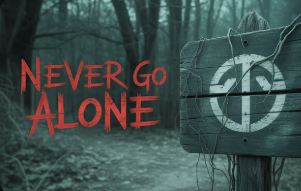
There’s the Summer of the Shark; so, this is the Horrorthon of the Terrible AI shorts. Technically, I don’t need to review these things, BUT I feel like we at the beginning of a new way to tell stories and if the technology gets better and it will, maybe it will attract some people who are good at things? Maybe?
I’m not saying that the people who create these films should be parachuted into an actively shark-infested section of the ocean wearing a meat-based wetsuit and slathered in a blood-based suntan oil, but if you’ve already left with these people and you had parachutes, the suits, and lotion ready; then, I’m not getting in your way. Who knows? Maybe stopping bad AI art could bring us together? Also, the market share for meat wetsuits is wide open for the taking!
So, let’s determine if “Whisper in the Woods” is cause for shark-time!
There is a car driving in a haunted forest. A woman sees a spooky woman standing in the road. The driver investigates. Then, a hooded figures presumably kill her. Technically, it had a beginning, middle, and an end. So, it’s as good as anything Alex Magana ever made, but I’m Team Shark!




 Through the Shattered Lens