The International Lens: Past Life (dir by Avi Nesher)


First released in 2016, Past Life is an Israeli film about two sisters, their father, and their efforts to understand and reconcile with the past.

The year is 1977 and Sephi Milch (Joy Reiger) is determined to become a renowned classical music composer.  While she has the talent and the drive, she’s also a young woman trying to find success in a field that has always been male-dominated.  As a woman, she is expected to just sing and leave the composing for the men.  One of her condescending teachers even smirks about how he “allows” her to take a composition class, even though everyone knows that her cause is hopeless.

As a singer, she and her class are invited to perform in Berlin.  She goes to Germany, despite the objections of her father, Baruch Milch (Doron Tavory), a Polish Holocaust survivor.  Following her performance, Sephi attends a reception.  While her best friend admires the handsome, tuxedo-wearing men standing around them, Sephi point out that, just 40 years ago, all of those men would have been wearing swastika armbands and giving each other the Nazi salute.  Sephi approached by a woman who appears to be slightly older than her father.  The woman says that she recognized Sephi’s last name.  She asks if Sephi is the daughter of Baruch Milch.  When Sephi says that she is, the woman tells Sephi that Baruch Milch is a murderer.

Back in Israel, Sephi tells her sister, Nana (Nelly Tagar), about what happened.  While Sephi wants to put the matter behind her, Nana is intrigued.  Nana is a journalist who works for the type of underground newspaper where the walls are decorated with pictures of Lenin.  Nana is as disorganized as Sephi is driven.  Whereas Sephi keeps her emotions under control, Nana always seems to be shouting at someone and it’s rare that she’s seen without a cigarette.  In fact, it turns out that the main thing that Nana and Sephi have in common is that they both have very mixed feelings about their father.

Baruch, we learn, was hardly the perfect father.  He put constant pressure on his daughters when they were growing up and was seen as being a fearsome and temperamental figure.  While Baruch’s disciplinary style led to Sephi being determined to succeed, it also led to Nana becoming bitter with her father.  Nana goes as far as to describe him as being abusive and she speculates that he very well could have murdered someone when he was younger.  (She points out that Baruch used to perform illegal abortions as proof that their father is not a squeamish man.)  As Sephi and Nana discuss it, they realize that they really don’t know much about their father’s early life in Poland or what he did to survive the Holocaust.  It’s something that, until now, Baruch has never discussed withe either of them.

Even when their father finally gives them an explanation, Nana suspects that he’s lying.  Meanwhile, Sephi’s attempts to move on are complicated when she meets and falls in love with the son of the woman who accused her father of being a murderer….

Past Life is a frequently enthralling film, one that is all the more powerful because it’s based on a true story.  It’s a film that not only inspires us to wonder about how much we truly know about the people who are the closest to us but it’s also one that forces us to consider the different ways that people deal with trauma.  Every character in the film is, in one way or another, dealing with the past.  Some do it through anger and some do it through denial.  Baruch’s story becomes almost a Rorschach test.  The two sisters each interpret it in their own way and each has their own reaction, one that is based not only on what Baruch says but also on their own unique relationship with him.  The film also works as an examination of sisterhood.  Nelly Tagar and Joy Reiger are instantly believable as sisters, capturing both the love and the annoyance that comes from their closeness.

Past Life is available on Prime so watch it the next time you want to be challenged.

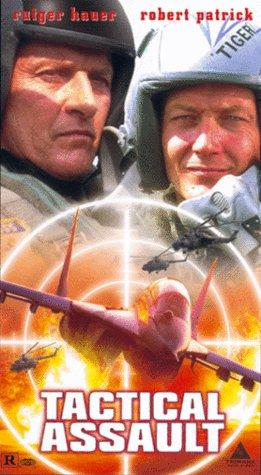
Cinemax Friday: Tactical Assault (1998, directed by Mark Griffiths)


War does strange things to people.

Captain Doc Holiday (Rutger Hauer!) was a damn good air force pilot until 1991.  During the Gulf War, he snapped and tried to shoot down a civilian airline that was flying over Iraqi airspace.  The only thing that stopped Holiday from committing a crime against humanity was his best friend, Capt. Lee Banning (Robert Patrick!!).  Banning fired on Holiday, shooting down his plane.  As a result, while Banning’s been moving up the ranks, Holiday has spent the last six years in an Iraqi POW camp.

By the time Holiday gets out, Banning is now a colonel and he’s married.  His wife (Isabel Glasser) is pregnant.  Banning seems to have everything he could want but he’s haunted by guilt over what happened to Holiday.  He arranges for Holiday to be assigned to his unit and tries to make amends.  Unfortunately, for Banning and his wife, Holiday holds a grudge and he’s played by Rutger Hauer so you know he’s not going to let things go anytime soon.

Is Tactical Assault worth tracking down?  It’s a low budge action movie that stars not only Robert Patrick but also Rutger Hauer so the answer should be obvious.  Of course it’s worth tracking down!  Robert Patrick and Rutger Hauer were direct-to-video film gods and putting them in the same movie is like getting the ghosts of Laurence Olivier, John Gielgud, and Ralph Richardson to all star in an afterlife production of Macbeth.  Along with being convincing in action scenes, both Robert Patrick and Rutger Hauer could actually act so there’s a little more more depth to Tactical Assault than just Top Gun-style dogfights.  Of course, if all you’re looking for is Top Gun-style dogfights, Tactical Assault has got you covered.  This is a movie that understands that some things can only be settled in the sky.

Finally, the main reason you should see Tactical Assault is because it has a scene where Rutger Hauer chases Robert Patrick … in a tank!  It doesn’t get much better than that!

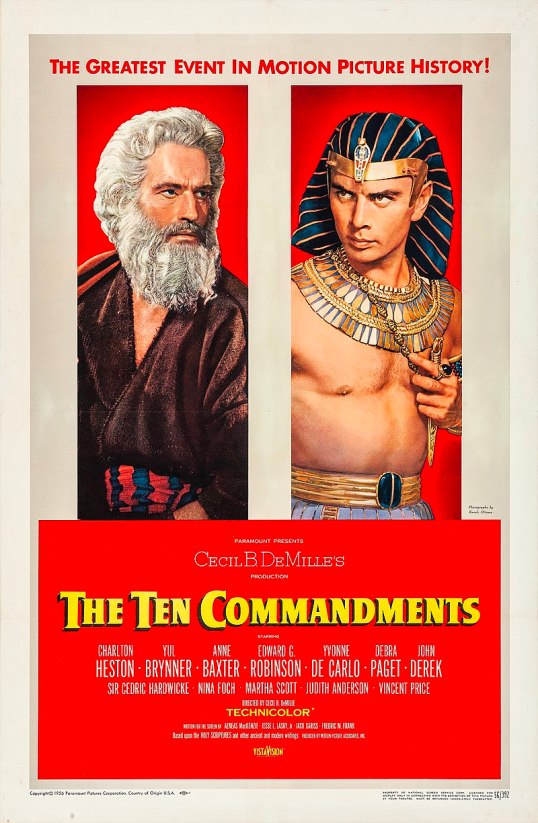
Film Review: The Ten Commandments (dir by Cecil B. DeMille)


Though you may not know it if you’ve only seen the film during one of its annual showings on television, the 1956 religious epic, The Ten Commandments, originally opened with director Cecil B. DeMille standing on a stage.  Speaking directly to the audience, DeMille explains that, though the film they’re about to see me take some dramatic license with the story of Moses, it still based on not just the Bible but also the accounts of Philo, Josephus and Eusebius.  He also tells us that The Ten Commandments is more than just an adaptation of the Book of Exodus.  Instead, it’s a film about every man’s desire to be free.

Demille concludes with: “The story will take 3 hours and 29 minutes to unfold.  There will be an intermission. Thank you for your attention.”

To be honest, it’s kind of a sweet moment.  Cecil B. DeMille is a name that is so associated with (occasionally overblown) epic filmmaking that it’s easy to forget that DeMille was one of the most important names in the artistic development of American cinema.  He was there from the beginning and, unlike a lot of other filmmakers, he was equally successful in both the silent and the sound era.  Say what you will about his films, DeMille was a showman and he handles the introduction like a pro.  At the same time, there’s a real sincerity to DeMille’s tone.  After you listen to him, you’d almost feel guilty if you didn’t sit through all 3 hours and 29 minutes of his film.

That sincerity extends throughout the entire film.  Yes, The Ten Commandments is a big, long epic and some members of its all-star cast are more convincing in their roles than others.  And yes, the film can seem a bit campy to modern viewers.  (In fact, it wouldn’t surprise me if it seemed a bit campy to viewers in 1956 as well.)  Yes, The Ten Commandments does feature Anne Baxter saying, “Oh Moses!  You sweet adorable fool!”  But it doesn’t matter.  Even the most ludicrous of dialogue just seem right.  The film is just so sincere that it’s difficult not to enjoy it.

In the Book of Exodus, Moses is described as having a speech impediment and even tries to use it as an excuse to get out of going to Egypt.  That’s actually one of the reasons why Moses brought Aaron with him to Egypt, so that Aaron could speak for him.  In the movie, Moses is played by Charlton Heston, who comes across as if he’s never felt a moment of insecurity over the course of his entire life.  But no matter.  Heston may not by the Moses of Exodus but he’s the perfect Moses for the DeMille version.  When Heston says that Egypt will be visited by plagues until his adopted brother Ramses (Yul Brynner) agrees to allow the Jews to leave Egypt, you believe every word.  (Aaron, incidentally, is played by the legendary John Carradine.  He doesn’t get too much other than respectfully stand a few feet behind Charlton Heston but still: John Carradine!)

And really, anyone who dismisses The Ten Commandments out-of-hand should go back and, at the very least, watch the scene where the Angel of Death descends upon Egypt.  The scene where Moses and his family shelter in place while the screams of distraught mothers echo throughout the city is chilling.  Ramses may spend most of the film as a petulant villain but you almost feel sorry for him when you see him mourning over his dead son.  When he sets off after Moses, it’s not just because he’s doing what villains do.  He’s seeking vengeance for the loss of his first born.  For that brief moment, Ramses goes form being a melodramatic bad guy to being someone with whom the viewer can empathize.  Brynner, with his burning intensity, gives a great performance as Ramses.

As I said before, this film has what, in 1956, would have been considered an all-star cast.  Watching the names as they show up during the opening credits — Cedrick Hardwicke!  Yvonne DeCarlo!  Woody Strode!  Debra Paget! — is like stepping into a TCM fever dream.  Some of the performers give better performance than others.  And yet, even the worst performer feels as if they just naturally belong in the world that DeMille has created.  John Derek may seem rather smarmy as Joshua but his callowness provides a good contrast to the upright sincerity of Heston’s performance as Moses.  Edward G. Robinson’s cries of, “Where is your God now!?” may have provided endless fodder for impersonators but just try to imagine the film without him.  Even Vincent Price is in this thing!  He doesn’t have his famous mustache but, as soon as you hear his voice and see that famous glare, you know that it’s him.

Of course, when you’re growing up and The Ten Commandments is on TV every year, you mostly just want to see the scene where Moses parts the Red Sea.  The Ten Commandments was nominated for seven Oscars but it only won one, for its special effects.  (The prize for Best Picture went to another epic, Around The World In 80 Days.)  Today, the film’s special effects may no longer amaze viewers but there’s still something rather charming about the Red Sea parting and then crashing in on the Egyptian army.  The scene where the Earth opens up and swallows those who worshiped the Golden Calf remains impressive, if just because all of the extras really look terrified that they might die.  And while the Pillar of Fire may look a bit cartoonish to modern eyes, that’s a huge part of the film’s appeal.

The Ten Commandments is a big, long, sometimes silly, sometimes effective, and always entertaining epic.  It’s a grand spectacle and one that I usually watch every year when it shows up on television.  I missed this year’s showing but, fortunately, I own it on DVD.  It’s a sincere epic and a difficult one not to like.


The International Lens: Breathless (dir by Jean-Luc Godard)


The 1960 French film, Breathless, tells the story two people, a French criminal named Michel (Jean-Paul Belmondo) and an American student named Patricia (Jean Seberg).

Michel is a criminal but it’s hard not to like him.  Some of that is due to the fact that he’s played by Jean-Paul Belmondo, a charmingly off-center actor whose confidence and refusal to pretend to be anything other than what he was made him appealing even if he was not exactly handsome.  The other reason why it’s easy to like Michel is because, no matter how many crimes he commits, you get the feeling that he’s just playing a role.  He dresses like he belongs in a 30s gangster movie and a lot of his attitude has obviously been borrowed from Humphrey Bogart and James Cagney.  Even the way he smokes a cigarette feels like an affectation.  He’s a kid, playing dress-up.  One almost gets the feeling that he knows he’s a character in a movie and he’s going out of his way to give the audience what they expect.

When we first see Michel, he’s stealing a car.  He drives around the French countryside.  He dismissively observes two hitchhikers.  A few times, he appears to speak directly to the audience.  Is he musing out loud or is he acknowledging that there’s a film camera in the passenger’s seat?  It’s hard to say.  When Michel gets pulled over by a cop, Michel shoots him.  Or does he?  The scene is edited in such a way that it’s hard to say for sure.  Maybe the cameraman shot the cop.  Maybe director Jean-Luc Godard shot the cop.  Not that it matters.  Michel is the one who is now wanted for murder.

With the authorities now determined to catch him and his face in all of the newspapers, Michel flees to Paris.  That’s where his girlfriend, Patricia, lives.  Patricia is an American student who aspires to be a journalist.  She sells copies of the New York Herald Tribune while walking around Paris.  Despite her journalistic ambitions, Patricia does not know that her boyfriend is wanted for murder.  Then again, boyfriend might not be the right word.  That would suggest more of a commitment than either one shows much interest in maintaining.

Michel hides out at Patricia’s apartment and, at one point, Patricia tells Michel that she might be pregnant with his baby.  Michel promptly blames her for not being “careful” and we’re never quite sure if Patricia is telling the truth or not.  While Michel hides out from the police and tries to figure out how to get enough money to flee to Italy, he and Patricia discuss …. things.  (It is a French film, after all.  It’s also a Godard film and, even if this film does feature Godard at his least pretentious, there’s still no way you’re going to get through a Godard film without at least a little conversation about the meaning of life.)  Michel is resigned to the idea of living in the moment and seems to be somewhat death obsessed.  Patricia remains optimistic and looks forward to the future.  Michel complains that Americans always make heroes out of the wrong Frenchmen.

Do Michel and Patricia love each other?  Who knows?  By the end of the film, one of them has betrayed the other and we’re not quite sure why.  One is dead and the other seems oddly ambivalent and rather confused about the whole thing.

One of the seminal works of the French new wave, Breathless was the directorial debut of Jean-Luc Godard, who was working from a story treatment that was originally written by Francois Truffaut and Claude Chabrol.  When it was first released, Breathless reportedly stunned audience by using techniques — like frequent jump cuts, location shooting, and the use of a handheld camera — that are now so familiar that we take them for granted.  That said, even if Godard’s techniques are no longer shocking, Breathless remains an exciting film to watch.  It’s not just the Michel and Patricia are frequently breathless.  One also gets the feeling that Godard was breathless behind the camera, trying to keep up with the story that he was telling.  This is a film that, much like it’s lead characters, never stops moving.  Indeed, a huge reason why the film’s finale remains powerful is because it’s the first time that anyone in the film truly seems to be still.  The viewer has gotten so used to the film’s frenetic energy that it’s a shock when it all comes to an end.

It’s been written that there are two eras of cinema — pre-Breathless and post-Breathless.  I don’t know if that’s true but it is impossible to watch Breathless and not see what a huge influence it’s had on every crime film that has followed.  Every film about lovers-on-the-run probably owes at least a minor debt to Breathless.  It’s one of those films that you simply have to see, both because of it’s historic importance and also just because it’s a damn good movie.  It’s a film that’s in love with cinema and, by the time things come to a close, you’ll be in love with it too.

Get Christie Love! (1974, directed by William A. Graham)


When Captain Reardon (Harry Guardino) discovers that there’s a ledger that contains information that could bring down Los Angeles drug lord Enzo Cortino (Paul Stevens), he decides that the best way to get the ledger is through the drug lord’s mistress, Helena Varga (Louise Sorel).  To get Helena to betray Cortino, he’s going to have to discover what makes her tick.  He’s going to have to send someone undercover to find out all there is to know about Helena.  It’s time to get Christie Love!

Teresa Graves plays Christie Love, a tough and beautiful woman who is also the best undercover cop in Los Angeles.  She goes from busting a serial killer (played by Ron Rifkin) and investigating Helena’s life.  Along the way, she deals with by-the-book superiors, incompetent assassins, and hapless bureaucrats.  She throws one killer bellboy off of a hotel balcony and she lets a crook know that, “You’re under arrest, sugar!”

Get Christie Love! was an attempt to a do a made-for-TV version of a Blaxploitation film and the results are mixed.  While the movie features the expected car chases and a handful of fights, it’s still limited by what was considered to be acceptable for prime time in 1974.  Pam Grier may have blown someone’s head off in close-up in Coffy but, in Get Christie Love!, the camera always cuts away as soon as Christie throws her final punch.  Teresa Graves is likable as Christie Love but, unlike the best Blaxploitation heroes, she’s working inside the system and she never has any mixed feelings about being a cop.  The fight scenes are particularly disappointing because they’re edited in such a way that it’s obvious that most of the work was being done by the stunt crew.  The best scenes are not the action scenes but the ones that emphasize Christie’s intelligence and that feature her doing old-fashioned detective work, investigating Helena’s life and putting the clues together.

Get Christie Love! was enough of a rating success that it led to a short-lived television series.  It’s historically significant because it was the first hour-long drama to feature an African-American female in the lead role.  (It was the second series to do so overall, after Julia, which starred Diahann Carroll.)  The show only lasted a season but it achieved pop cultural immortality when, years later, Quentin Tarantino used it as a reference in Reservoir Dogs.


The Ballad of Andy Crocker (1969, directed by George McCowan)


Andy Crocker (Lee Majors) is a earnest young Texan who enlists in Vietnam, is injured in a firefight, and returns home with a purple heart.  Upon landing in California, he discovers that America has changed.  A group of hippies (led by Stuart Margolin, who also wrote this film’s script and the folk-style song that’s played throughout the action) taunts him for wearing his uniform.  After Andy steals a motorcycle from them and makes his way back down to Dallas, he discovers that his girlfriend, Lisa (Joey Heatherton), has left him for another man and that his best friend (played by singer Jimmy Dean) has sold Andy’s business.  Lisa’s mother (Agnes Moorehead) orders Andy to stay away from her family while she’s skeet shooting.  Even though everyone tells him how proud they are of him, no one seems to want Andy around.  Finally, Andy ends up back in California without any direction home.

This made-for-television movie (which was produced by Aaron Spelling) was important in that it was the first film to attempt to explore the issues that would face servicemen as they returned home after serving in an unpopular war.  It was actually meant to be a pilot for a series called Corporal Crocker, which would have followed Andy Crocker as he traveled across the country, Route 66-style.  Since the series wasn’t picked up, The Ballad of Andy Crocker instead becomes a downbeat look at a man discovering that he no longer has any place in the world.  It’s only 72-minutes long so it doesn’t examine any issues in depth but it’s still sincere in its intentions and Lee Majors gives a good performance in the lead role.  Andy Crocker is an interesting character.  Despite the fact that he just returned from fighting in it, he doesn’t seem to have any strong opinion about the war in Vietnam.  He’s hardly a pacifist and he does steal a motorcycle but, at the same time, he’s not a gung ho warrior either.  He’s just an ordinary man who is trying to figure out where he fits in.  By the end of the movie, he’s more scarred by society’s indifference than he has been by the war.

Keep an eye out for Marvin Gaye, who has a small role as Crocker’s best friend from Vietnam.

Dead Presidents (1995, directed by the Hughes Brothers)


In 1969, Anthony (Larenz Tate) graduates from high school in the Bronx and shocks his family by announcing that he will not be following in his brother’s footsteps by enrolling in city college but that he will instead be enlisting in the Marines and going off to fight in Vietnam.  While his friends taunt him for choosing to fight in a “white man’s war,” Anthony thinks that serving in the Marines will make him a man.  His two biggest heroes, his father and the local numbers boss, Kirby (Keith David), both served in Korea.  Kirby’s even lost his his leg in the war but he can still keep order in the neighborhood.

Vietnam doesn’t turn out to be what Anthony was expecting.  He serves two tours of duty and becomes an efficient killing machine but he is also forced to do things that will haunt him long after the war is over.  When Anthony finally returns to the Bronx in 1971, the old neighborhood has changed.  Crime, drugs, and poverty are destroying the community and Anthony struggles to support his girlfriend (Rose Jackson) and his daughter.

Finally, with no other opportunities available and feeling as if his country has abandoned him, Anthony agrees to take part in an armored car robbery.  Working with him are a few friends from the old days and a few members of the revolutionary Nat Turner Cadre.  Anthony thinks that he has the robbery planned out perfectly but nothing ever goes as planned.

In 1993, The Hughes Brothers made their directorial debut with Menace II Society, an incendiary film that holds up as one of the best feature debuts of any filmmaker.  Their follow-up to Menace II Society was Dead Presidents.  While Dead Presidents operates on a more epic scale than Menace II Society, it’s also a far more uneven film.  While the first part of the film (which follows Anthony and his friends during their final days of high school) is strong, things start to fall apart once the action moves to Vietnam.  The Hughes Brothers tried to recreate the Vietnam War on a Grenada Invasion budget and the action never feels credible.  When Anthony returns to the Bronx, Dead Presidents regains some of its footing but the eventual armored car heist is never as exciting as it could be.

Still, Dead Presidents has enough good moments that it’s always watchable.  Larenz Tate gives a good performance as Anthony and he’s surrounded by the some of the best black character actors of the 90s.  Keep an eye out for a young and incredibly obnoxious Terrence Howard, playing an aspiring gangster and getting a deserved beating at the hands of Anthony.  Though the movie often bites off more than it can chew, it does do a good job of seriously dealing with the issues that returning vets have to contend with when they come back home.  Anthony suffers from PTSD, which is something that a lot of people didn’t talk about in 1995, and the Hughes Brothers deserve much credit for their sensitive handling of the topic.  Dead Presidents may not be perfect but it’s impossible not to admire the film’s ambition.

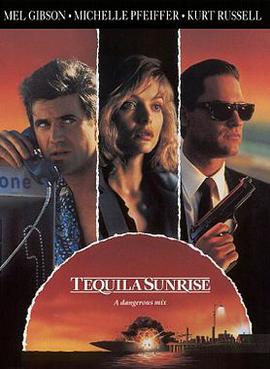
Tequila Sunrise (1988, directed by Robert Towne)


Mac (Mel Gibson) and Nick (Kurt Russell) are old friends who are on opposite sides of the law.  Mac was once a legendary drug dealer though he says that he’s now retired.  Nick is a narcotics detective with the Los Angeles County Sheriff’s Department.  Early on, Nick warns Mac that, if he is dealing again, he’s going to have to arrest him.  Mac says that he has no interest in getting back into the business but no one believes him.

Mac is actually more interested in Jo Ann Valleneri, who owns his favorite restaurant.  Since Jo Ann is played by Michelle Pfeiffer, who can blame him?.  After tracks Mac to the restaurant, he becomes attracted to Jo Ann too and again, it’s impossible to blame him.  Soon, Jo Ann and Nick are a couple but is Nick just using her to find out about Mac’s relationship with a mysterious drug lord named Carlos?  And when Mac moves in and starts his own relationship with Jo Ann, does he really love her or is he using her to throw Nick off of his trail?

Tequila Sunrise should be a great film but instead, it’s only a good one.  It has all the elements of greatness — Michelle Pfeiffer at her sultriest, Kurt Russell at his coolest, and Mel Gibson before he lost his mind.  It also has a good supporting cast, including Raul Julia, J.T. Walsh, and Arliss Howard.  Ultimately, it doesn’t really come together because the film’s director and screenwriter, Robert Towne, doesn’t seem to be sure what type of story he wants to tell.  Tequila Sunrise could have either been a great crime thriller or a steamy love story but, by trying to be both, it gets bogged down in its own convoluted plot.  That probably won’t matter to most viewers, though.  Not when Russell, Gibson, and Pfeiffer are all on screen together at the same time.  Tequila Sunrise tries to be many things but it works best as a celebration of movie star charisma.

One final note: The film looks great.  Visually, this is one of the ultimate California films.  Cinematographer Conrad Hall received an Oscar nomination for his work on this film and it was more than deserved.

The International Lens: Aguirre, The Wrath of God (dir by Werner Herzog)


Take a moment to picture this: Klaus Kinski, drifting by on a raft with a bunch of monkeys.

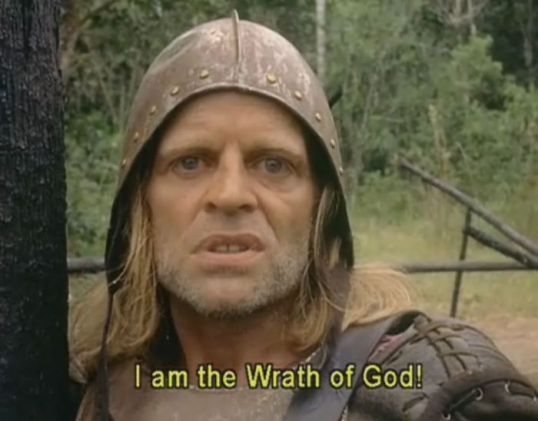
There’s a lot of memorable scenes in Werner Herzog’s 1972 film, Aguirre, The Wrath of God.  However, for me, this will always be the film where Klaus Kinski ends up on a raft with a bunch of monkeys.  It feels like an appropriate fate for Aguirre, the Spanish conquistador and proto-fascist who Kinski plays in this film.  After spending 90 minutes listening to Augirre rant and rave about how he’s destined to conquer South America and how he will always be known as “the wrath of God,” it’s easy to look forward to him being reduced to being a somewhat pathetic figure, commanding a raft full of monkeys.

And yet, what’s odd, is that Aguirre never quite become as ludicrous a figure as you’re expecting him too.  Even though he’s obviously been driven mad and the Amazon rain forest is closing in on him, there’s nothing desperate about Aguirre.  He still believes in himself.  He still believes in his destiny.  He still believes that every decision that he’s made has been the right one.  It’ll take more than a bunch of monkeys to defeat Aguirre!

Filmed on location in South America, Aguirre, The Wrath of God claims to be based on a true story.  We’re told that the film was adapted from a journal that was kept by a 16th century priest named Gaspar de Carvajal.  And while it is true that a Dominican missionary named Carvajal did publish several accounts of his journeys to the New World and while the film itself is full of people who share their names with actual historical figures (Pizarro, Pedro de Ursua, and Lope de Aguirre, being just three examples), the film’s story is itself fictional, though plausible.  This is one of those stories that may not have happened but the viewer can’t help but feel that maybe it should have.

The film deals with an expedition of Spanish conquistadors making their way through South America, searching for the fabled country of El Dorado.  The conquistadors, whio are first seen awkwardly climbing down a huge mountain in their full armor while dragging along cannons and treasure chests, are led by Pizarro (Alejandro Repullés).  Pizarro orders 40 members of the expedition to scout ahead by taking a raft down the Amazon River.  Pizarro places Ursua (Ruy Guerra) in charge of the scouting expedition while naming Aguirre (Klaus Kinski) as second-in-command.  The hope is that the scouting expedition will return in one week with news of what’s ahead.  Of course, it doesn’t work out that way.

Aguirre is Klaus Kinski’s signature role.  Herzog, who knew Kinski when the latter was a young actor renting a room in Herzog’s family’s apartment, specifically wrote the role with Kinski in mind.  Aguirre would be the first of several legendary collaborations between Herzog and Kinski.  In Kinski, Herzog found the perfect actor to embody his belief that chaos was the determining factor of the universe.  And, in Herzog, Kinski found one of the few directors who truly knew how to harness his manic acting style.  They were a perfect match and, of course, they often hated each other.  During the filming of Aguirre, Herzog and Kinski reportedly argued so frequently over how Aguirre should be portrayed that Kinski threatened to leave the jungle at one point.  Herzog responded by saying that, if Kinski tried to leave, Herzog would first shoot him and then himself.  It was not the last time that Herzog would threaten to kill Kinski.  In fact, after Kinski’s death, Herzog made My Best Fiend, an entire documentary about their difficult but often worthwhile collaboration.

Kinski reportedly wanted to play Aguirre as a ranting madman while Herzog wanted a subtler interpretation.  Judging from the end results, they agreed to meet somewhere in the middle.  From the first minute we see him, it’s obvious that Aguirre holds everyone and everything around him in contempt.  He hates the other members of the expedition.  He despises the jungle that surrounds them and the river that he’s soon be floating down.  Even when he’s dealing with his own teenage daughter (Cecilia Rivera), he never smiles or shows anything resembling affection.  He glares at the world with distrustful eyes.  And yet, everyone follows him because he seems to be the only member of the expedition who is not intimidated by the river or the jungle.  He promises his followers that they will be kings and that they will be rich and he says it with such authority that it doesn’t seem to occur to anyone to ask how he can be so sure.  Even when it starts to become apparent that Aguirre is losing his sanity, he’s too intimidating a figure for anyone to try to stop.  When one member of the group starts to complain about Aguirre’s leadership, Aguirre chops off his head.  (The head continues to talk for a few seconds before falling silent.)  As the film progresses, Aguirre grows progressively more and more unhinged.  By the end of the film, he’s come to stand-in for fanatics through history.  Every dictator, the film seems to be saying, started out as an Aguirre.

In fact, the only things that’s not intimidated by Aguirre is the jungle that is continually threaten to swallow up the expedition.  In typical Herzog fashion, the jungle is both lushly beautiful and also home to all sorts of unseen threats.  As more than a few people learn as they float along the river, stopping to admire the jungle is a good way to get hit by an arrow.  Amazingly, no matter how many times the expedition is attacked by the potent combination of nature and angry natives, Aguirre never seems to get a scratch.  It may be that, in the end, only the insane can survive in a world with no rules beyond random destruction.

Aguirre was Herzog’s first big hit and it remains perhaps his best-known film.  It’s certainly features some of Herzog’s best work as a director and Klaus Kinski’s best performance as an actor.  In the end, you’ll never forget Aguirre and the monkeys.

Film Review: Charge Over You (dir by Regardt Steenekamp)


Charge Over You, an independent Australian film from 2010, tells the story of Sarah Goodall (Danya Cox).

Having spent almost her entire adolescence dreaming of becoming a doctor so that she could find a cure for the illness that was killing her mother, Sarah finds herself struggling after her mother dies.  Whereas she was once an honors student and seemed destined for greatness, she’s now haunted by a feeling that everything is pointless.  Her grades are slipping.  Her mentor is disappointed in her.  Her friends are all turning into bad influences.  Her father wants to marry some bimbo that Sarah doesn’t even know.  Sarah is even starting to wonder if she even wants to become a doctor.

It’s a dark time and, even worse, Sarah makes the mistake of playing with a Ouija board!  Well, technically, it was some of her friends who were playing with the Ouija board but Sarah was in the room at the time.  Sarah may say that she doesn’t believe in the power of the Ouija board but does the board believe in her?  That’s the question.

Suddenly, Sarah has a boyfriend!  She’s not sure how she met Dane (James E. Lee).  All she knows is that he’s suddenly in her life and that he has a habit of showing up whenever she’s feeling at her weakest.  When she steps into her dorm room, he’s there waiting for her.  When she tries to talk to other people, she’ll sometimes see him materialize behind them.  Dane is cold and cruel and doesn’t even pretend to be sympathetic when she tells him about the death of her mother.  Instead, Dane demands that she spend all of her time with him.  Even though Sarah doesn’t even like Dane, she finds it impossible to resist him.

Of course, Dane isn’t the only man who has suddenly materialized into Sarah’s life.  There’s also Mike, who appears to be a nice guy and who obviously likes Sarah.  (He’s visibly hurt when Sarah tells him that she already has a mysterious boyfriend who materialized out of nowhere.)  And then there’s Sam, who seems like he’s kind of dorky but who is constantly warning Sarah about guys like Dane.  Sam even warns Sarah about agreeing to have dinner with her father.  The dinner, of course, turns out to be a disaster and Sarah’s father reveals himself to be a disappointing human being.  Why, it’s almost as if Sam can see the future…..

Charge Over You is a strange film.  It starts out as a typical college horror film and then, suddenly, it swerves into overly religious territory as Sarah learns that she has both demons and angels competing for her soul.  And yet, it’s an undeniably entertaining little film.  Danya Cox gives a strong and sympathetic performance as Sarah and James E. Lee is magnetically evil as Dane.  Director Regardt Steenekamp does an excellent job of creating an ominous atmosphere and some the scenes where Dane materializes out of nowhere are genuinely creepy.  For a low-budget indie film that was reportedly filmed in just 12 days, Charge Over You is a surprisingly well-made and effective film.

It’s on Prime, so check it out during your lockdown and remember …. leave the Ouija boards in the closet!