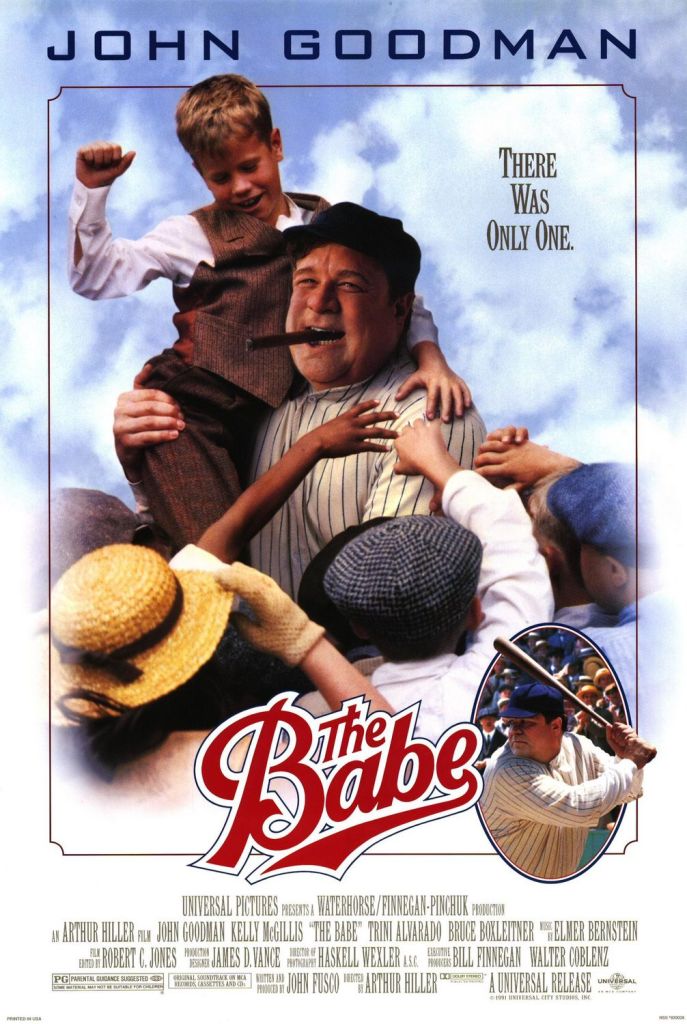
John Goodman. He’s a good actor but not a very convincing baseball player.
Last night, I watched The Babe, which starred John Goodman as Babe Ruth. Babe Ruth was one of the greatest baseball players of all time, the first of the great sluggers, and the holder of the career home run record from 1935 to 1974. He was the type of player that I wish The Rangers had right now because we’ve got a 22-27 records right now and the only bright spot is that we’re doing better than the Angels.
The Babe starts in 1902, with George Herman Ruth getting dropped off at reform school and learning how play baseball from Brother Matthias (James Cromwell) and then follows Ruth through his career, his first failed marriage, his attempts to become a manager, and his eventual retirement from the game. At first, everyone makes fun of the Babe because he’s not very sophisticated and all he wants to do is hit the ball. Then he shuts them all up by knocking ball after ball out of the park. Babe Ruth was a big man, like John Goodman. But he was also a great athlete. Goodman looked like he was in pain every time he had to swing the bat. Maybe that explains why Goodman plays the Babe as if he never actually enjoyed one minute of playing baseball.
The Babe is like a highlight reel of famous anecdotes. Babe Ruth hits his first home run in the Big Leagues. Babe Ruth promises a sick child that he’ll hit two home runs. Babe Ruth calls his shot. Babe Ruth hits three homers during his final game. In real life, Babe Ruth retired after he injured his knee. In the movie, he retires after he hears an owner talking about how having Babe on the team is only good for selling tickets to the rubes. All the famous Babe Ruth stories are here, along with all of the drinking and the womanizing. The movie never digs too deep into what made Babe tick or what it was like to be the most famous and popular athlete in America. It never even really explores how Babe Ruth changed the sport of baseball. Watching The Babe, you would never know that home runs weren’t even considered to be an important part of the game until Ruth established himself as someone who could hit one ball after another out of the park. The best baseball movies make you feel like you’re either out on the field with the player or you’re in the stands with the fans and they make you want to stand-up and cheer with every hit and every run across home plate. The Babe never does that. There’s no love of the game in The Babe.
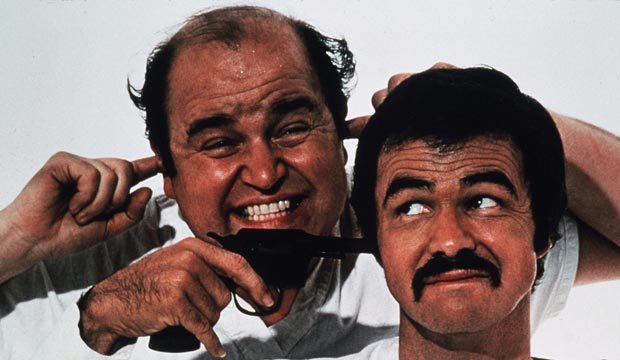
That is the theme of The End, which is probably the darkest film that Burt Reynolds ever starred in, let alone directed. Burt plays Sonny Lawson, a shallow real estate developer who is told that he has a fatal blood disease and that, over the next six months, he is going to die a slow and painful death. After seeking and failing to find comfort with both religion and sex, Sonny decides to kill himself. The only problem is that every time he tries, he fails. He can’t even successfully end things. When he meets an mental patient named Marlon Borunki (Dom DeLuise), he hires the man to murder him. Marlon is determined to get the job done, even if Sonny himself later changes his mind.
Yes, it’s a comedy.
The script for The End was written by Jerry Belson in 1971. Though Belson also worked on the scripts for Spielberg’s Close Encounters of the Third Kind and Always, he was best-known for his work on sitcoms. (Belson was an early collaborator of Garry Marshall’s.) The End was originally written with Woody Allen in mind but when Allen passed on it to concentrate on directing his own movies about death, the script spent five years in limbo. Reynolds later said that, when he eventually came across The End, he knew he had to do it because it was the only script that reflected “my strange sense of comedy.” United Artists was uncertain whether there was much box office potential in a film about a self-centered man dying and they required Reynolds to first make the commercially successful Hooper before they would produce The End.
The End was made for 3 million dollars and it went on to gross 40 million. That the film was a box office success is a testament to the late 70s starpower of Burt Reynolds because it’s hard to think of any other mainstream comedy that goes as much out of its way to alienate the audience as The End does. While watching The End for the first time, most viewers will probably expect two things to happen. First off, Sonny will learn to appreciate life and be a better person. Secondly, it will turn out that his fatal diagnosis was incorrect. Instead, neither of those happen. Sonny is going to die no matter what and he never becomes a better person. What’s more is that he never even shows any real interest in becoming a better person. The film’s signature scene comes when Sonny prays to God and offers to give up all of his money if he survives, just to immediately start backtracking on the amount. It’s funny but it’s also a sign that if you’re looking for traditional Hollywood sentiment, you’re not going to find it here.
Burt not only stared in The End but he also directed it and, as was usually the case whenever he directed a film, the cast is a mix of friends and Hollywood veterans. Sally Field plays Sonny’s flakey, hippie girlfriend while Robby Benson is cast as a young priest who fails to provide Sonny with any spiritual comfort. Joanne Woodward plays his estranged wife and Kristy McNichol plays his daughter. Myrna Loy and Pat O’Brien play his parents. Norman Fell, Carl Reiner, and Strother Martin play various doctors. The movie is stolen by Dom DeLuise, playing the only person who seems to care that Sonny’s dying, if just because it offers him an excuse to kill Sonny before the disease does. DeLuise was a brilliant comedic actor whose talents were often underused in films. The End sets DeLuise free and he gives a totally uninhibited performance.
Despite DeLuise’s performance, The End doesn’t always work as well as it seems like it should. Though Reynolds always said that this film perfectly captured his sense of humor, his direction often seems to be struggling to strike the right balance between comedy and tragedy and, until DeLuise shows up, the movie frequently drags. As a character, the only interesting thing about Sonny is that he’s being played by Burt Reynolds. That is both the film’s main flaw and the film’s biggest strength. Sonny may not be interesting but, because we’re not used to seeing Burt cast as such a self-loathing, self-pitying character, it is interesting to watch a major star so thoroughly reveal all of his fears and insecurities.
If you’re a Burt Reynolds fan, The End is an interesting film, despite all of its flaws. Burt often described this as being one of his favorite and most personal films. It’s a side of Burt Reynolds that few of his other films had the courage to show.
About ten minutes into Mortal Kombat, there’s a title card that reads, “Earthrealm is on the verge of catastrophe….”
As soon as I saw it, I shouted, “Oh my God, this is one of those films!”
And indeed, it is. Mortal Kombat is one of those films that has a lot of mythology that doesn’t quite make sense but which the audience is expected to blindly accept because it’s Mortal Kombat. The main idea here is that, of the last few Mortal Kombat tournaments, Earthworld has lost nine of them and, if it loses for a tenth time, the rules state that Outworld will then be able to conquer Earthworld. What I want to know is who agreed to those stupid rules in the first place? Were they drunk at the time? Who decided on the ten-victory arrangement? Does it have to be ten victories in a row or do they just have to win ten times? If Earthworld wins the next tournmant, does everything reset or are we now in a position where we have to win every single tournament until the end of time? The film tells us that Raiden, the God of the Thunder, is the protector of Earthworld. Can we get a new protector because Raiden obviously sucks at his job.
Anyway, with an opening like that, you would think that Mortal Kombat would be all about the tournament but we don’t actually get the tournament in this film. We get a lot of combat (or should I say, “kombat”) because the champions of Outworld keep trying to kill the champions of Earthworld before the tournament. That sounds like cheating to me but whatever. All of the fighters have a special power, though some powers are more impressive than others. Kano (played by Josh Lawson) may be loud and obnoxious but he eventually learns how to shoot a laser beam out of his eye, which seems pretty nice until you consider that Liu Kang (Ludi Lin) can do all sorts of cool stuff with fire and Raiden can turn his hat into a freaking buzzsaw. Jax (Mehcad Brooks) loses his arms early on but then he gets some replacement arms that he can use to tear people in half. “These motherfuckers really work,” Jax says after savagely killing an opponent. Excuse me, Jax, but that was someone’s child.
The main character is Cole Young (Lewis Tan), who is a washed-up MMA fighter who gets a chance to save the world. Cole is a boring characters and his powers kind of suck too. After watching the film, I checked and I discovered that Cole is apparently not a character in any of the Mortal Kombat video games so I guess he was created to give the audience someone to relate to. But I would think that the audience would want to relate to someone who can actually do spectacular things as opposed to just standing around and whining about how his powers are inadequate.
The film’s big attraction is watching Sub-Zero battle Scorpion at the end. I’ve never even played Mortal Kombat and even I know who Sub-Zero and Scorpion are. That’s how much they’ve become a part of pop culture. Sub-Zero (who is played by Joe Taslim) is actually portrayed fairly well in the film. Taslim moves like a confident killer and, visually, the film comes up with some striking images of his ice-covered existence. If you’re only watching for the big Scorpion/Sub-Zero fight, be aware that it doesn’t happen until the very end of the film and it’s a bit anti-climatic. But Scorpion does say, “Get over here!” He says it in English despite all of his other dialogue being in Japanese and he shouts it at a character who is also never heard to speak English but whatever. It’s Mortal Kombat. They might be able to get away with not showing the tournament but there’s no way they could have gotten away with not using the line.
Mortal Kombat is pretty forgettable. It gets bogged down in story when its should just be concentrating on combat and the fights themselves are pretty rudimentary. There’s a lot of blood but not much imagination. I’m going to write a movie called Moral Kombat, which will just be three hours of Benedictines and Jesuits arguing with each other. I think it’ll be a hit.
Some people are cult people and some people aren’t.
Me, I’ve never been a cult person. Some of that’s because, as a result of my ADD, I get bored way too easily to spend hours listening to some deranged cult leader give a speech. Some of that is because I’m naturally suspicious of people who try too hard to convince me that they’re always happy and excited and enthusiastic, which is something that I’ve noticed people in cults seem to do. I’m a big believer in doing what you want. I’m also a big believer in the idea that I already know all the answers to life’s big questions so I’m really not vulnerable to people who claim otherwise. That’s one of the many advantages of believing in yourself.
Another reason why I could never join a cult is because I hate the idea of living on a commune. The whole idea of being forced to create a community with a bunch of strangers just creeps me out. Add to that, I’m not a fan of living in impersonal dorms and I don’t really like doing farmwork and I’m not into sing-alongs around the campfire. I certainly don’t like camping and or living in buildings that don’t have any running water. Commune living is just not for me and fortunately, that will always make me immune to being brainwashed into joining a cult.
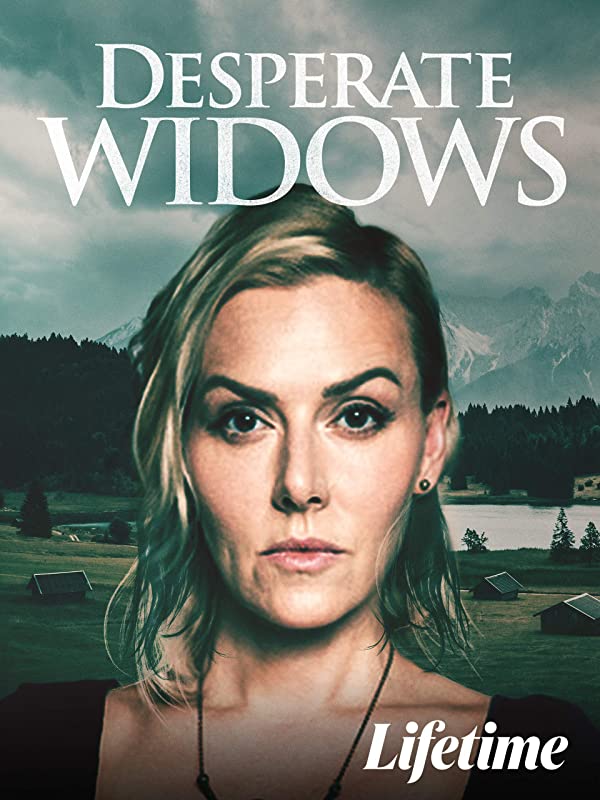
In the Lifetime film Desperate Widows, Dianne (Allison McAtee) insists that she doesn’t run a commune. Sure, it may look like a commune and it may have a lot of commune-style rules and everyone acts like they’re living on a commune but Dianne insists that she actually runs a …. wait for it …. a mommune! It’s a retreat for moms and their daughters, one that is especially popular with moms who have just lost a husband. It can do wonderful things for people, just as long as everyone’s willing to follow the rules. For one thing, the moms and daughters are separated and sent to live in separate dorms. For another thing, everyone has to do manual labor for most of the day and anyone who fails to take it seriously will run the risk of being put in isolation.
BUT IT’S TOTALLY NOT A COMMUNE!
As soon as recently widowed Paige (Justine Eyre) and her teenage daughter, Allie (Olivia Stuck) arrive at the comm …. sorry, excuse me …. mommune, they suspect that there’s something not quite right about the place. Allie figures it out pretty quickly. It takes Paige a day or two longer, despite the fact that Paige is a best-selling writer of thrillers and you would figure that she would know better than to trust a bunch of secretive people living out in the middle of nowhere. Soon, both Paige and Allie want to leave but it turns out that leaving is not going to be easy. This mommune is full of all sorts of sordid secrets that dangerous people do not want revealed to the rest of the world.
This Lifetime film required a healthy suspension of disbelief. The same can be said about most Lifetime films but this one required even more than usual. That said, if you can accept that Paige would ever have been stupid enough to go to the mommune in the first place, Desperate Widows is entertaining. I liked Allison McAtee’s performance as the sinister Dianne and Justine Eyre and Olivia Stuck were believable as mother and daughter. What I really appreciated is that it didn’t take long for Paige to be like, “This place is messed up,” and to realize that she needed to find her daughter and escape.
Most importantly, Desperate Widows served as a warning against commune living. That’s a message that everyone can get behind.
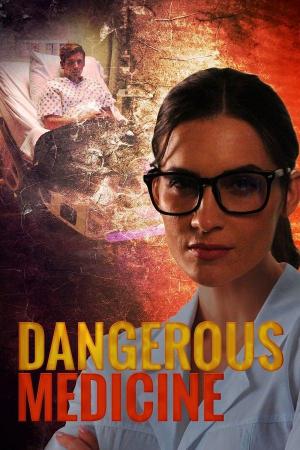
There’s a scene in Dangerous Medicine in which Daphne (Leeann Van Mol), the physical therapist who has abandonment issues, is seen looking up something online. The camera swings around so that we can see exactly what she’s looked up.
“HOW TO AMPUTATE AN ARM” the website reads. Underneath the big bold headline, there are drawings of an arm, highlighting the exact places where one should start chopping.
Having looked at the website and (we hope) studied it carefully, she then proceeds to get a hacksaw before heading into the bedroom, where her latest patient is tied to the bed.
That’s the moment that I shouted, “Oh my God, this is one of the greatest Lifetime films ever!”
And seriously, it is. This is why people like me watch Lifetime films. We watch them for scenes like this. We watch them for wonderfully self-aware moments like this, where an unstable but determined character quickly reads up on how to do something insanely complicated and then proceeds to try to do it in what will undoubtedly be the messiest way possible. Leave it to other networks to worry about the exact logic of amputation and hacksaws and removing limbs without anesthetic. Lifetime knows that we’re not watching for reality. We’re watching for gloriously over the top mayhem like this.
Dangerous Medicine delivers everything you could want from a Lifetime film. Tony (Chris Cimperman) is a high school track star who loses the use of his legs in a car crash. His mother, Ellen (Meredith Thomas), and his girlfriend, Jasmine (Choe Stafford), are determined to support him as he struggles to learn how to walk again. At first, Daphne seems like the perfect therapist but it turns out that she does have some issues. For instance, the first time that we see Daphne, a man is trying to kill her and, for a good deal of the film, that man keeps popping up and staring at Daphne as she goes about her day. There’s also the fact that Daphne sometimes seems to be determined to keep Tony away from both his mother and his girlfriend. Soon, both Ellen and Jasmine are suspicious of Daphne but Tony swears that she’s the best therapist ever. Are Ellen and Jasmine just being paranoid or has Daphne managed to brainwash her patient?
Well, you probably already know that answer to that. Actually, if you read the first four paragraphs of this review, you you already know the answer. The whole thing about looking up how to amputate an arm probably gave it away. But that’s okay. Part of the appeal of Lifetime films is that you know that the sexy stranger is always going to turn out to be dangerous, just as you know that the mother is always going to be right and usually, the loyal and bookish girlfriend is going to know what she’s talking about as well. From the start, you know that Daphne’s going to end up snapping. The entertainment comes from trying to predict what will be the exact moment that will push her over the edge and how many people she’ll end up killing as a result.
Dangerous Medicine, like all good Lifetime films, is a tremendous amount of fun. Leeann Van Mol especially deserves credit for going over the edge with style and keeping a straight face even when she’s carrying around a hacksaw. Dangerous Medicine is everything that we love about Lifetime.
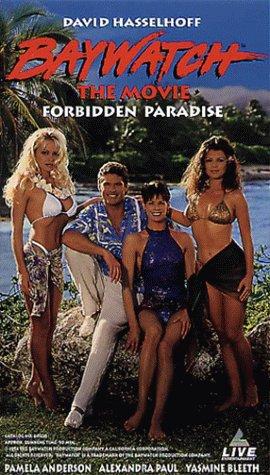
Earlier tonight, I watched the 1995 film Baywatch The Movie: Forbidden Paradise.
Why Was I Watching It?
The H&I network has been airing Baywatch every weekday at 5 and 6. I’ve been watching because the pure, unapologetic silliness of the show is a good way to unwind from whatever stress or annoyance I may have had to deal with during the day. Today, they aired Forbidden Paradise, which was originally released theatrically in Europe and straight-to-video in the United States. (To quote John Redcorn, “We are already straight-to-video. There is nowhere else left to go.”) A few months after its theatrical release, Forbidden Paradise was broadcast as a two-part episode of Baywatch, even though it featured characters who had since left the show. I imagine that was a bit confusing for some viewers.
(Or maybe it wasn’t. I doubt the majority Baywatch’s audience was particularly concerned with continuity.)
What Was It About?
The Baywatch team goes to Hawaii! Well, not all of them. Actually, it’s just Mitch (David Hasselhoff), CJ (Pamela Anderson), Stephanie (Alexandra Paul), Caroline (Yasmine Bleeth), Logan (Jaason Simmons), and Matt (David Charvet). They’re supposed to be taking part in a lifeguard exchange program but, as usual, it turns out that Stephanie is the only one who actually gives a damn about doing her job.
Instead, CJ considered whether or not she wants to model for a dorky photographer. Logan becomes obsessed with winning a surfing competition while Caroline obsesses on why Logan is always obsessing on stuff. Mitch and Matt end up getting lost in the jungle and briefly taken prisoner by a bunch of native villagers. It all leads to a chase through the jungle and an engagement on the beach. Stephanie helps that Hawaiian lifeguards save someone from drowning. At least Stephanie takes her job seriously.
What Worked?
Baywatch The Movie: Forbidden Paradise was actually filmed on location in Hawaii so the scenery was gorgeous. It was also apparently shot in approximately the same location as Lost so, whenever I got bored with the plot, I could think about Sawyer and the Others. This was especially true while David Hasselhoff and David Charvet were being chased through the jungle by all of the angry villagers. I felt like the Smoke Monster was going to pop out at any moment.
As with anything involving Baywatch, it could be argued that the whole film was so ludicrous that it worked as a self-parody. I’m certainly tempted to make that argument but I’m not really sure if any of the self-parody was intentional. That’s the great mystery when it comes to Baywatch.
What Did Not Work?
If you consider this movie to be a self-aware parody, than it all worked.
If you consider it to be an actual movie, with a plot and characters that you’re supposed to care about and interesting dialogue, than none of it worked. I mean, it’s Baywatch. It’s the adult version of Saved By The Bell. It’s entertainingly shallow but it’s never exactly good.
Probably the film’s biggest flaw is that the pacing is totally off. It seems to take forever for the film’s plot to actually get started and then, once it does, it keeps going off on these strange detours. For some reason, a lot of screen time is devoted to a model named Holly (Hedi Mark) and a remarkably unlucky photographer named Carlton Edwards (Ricky Dean Logan).
Myself, I was disappointed that David Chokachi (who played Cody, the lifeguard best-known for wearing a speedo in the opening credits) wasn’t even in the film.
“Oh my God! Just like me!” Moments
I’ve been to Hawaii! Seriously, I had a great time and I look forward to returning soon.
Sometimes, it takes a really good actor to give a really bad performance.
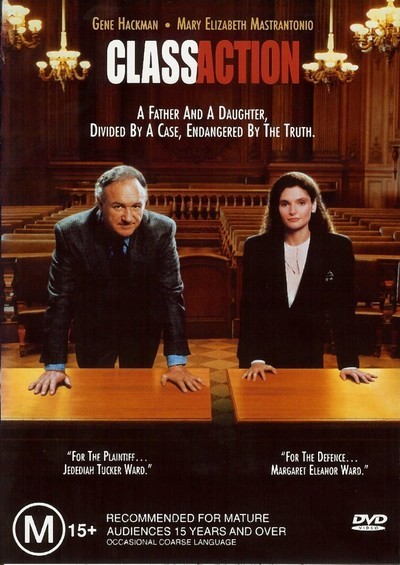
That’s what I found myself considering tonight as I watched the 1991 film, Class Action. I recorded this film off of Starz a few months ago, mostly due to the fact that I usually enjoy legal dramas. Class Action is about a father and a daughter, both of whom are attorneys, who find themselves facing each other in court. Gene Hackman plays Jedediah Ward Tucker while Mary Elizabeth Mastrantonio played Maggie, his daughter.
From the very first scenes, Jed Tucker is portrayed as being a firebrand, a crusader who stands up for the little guy against big corporate interests. (“Jed Ward is a great man!” one his clients exclaims while the other lawyers nod along in agreement.) Tucker is flamboyant, loud, perpetually outraged, in love with attention, and determined to make the world a better place. This is the type of role that would probably encourage any actor to overact just a bit. However, when you cast someone like Gene Hackman in the role, the performance becomes a masterclass in overacting. Gene Hackman was never a particularly subtle actor to begin with and casting him as Jed Tucker guarantees about two hours of Hackman bellowing, smirking, occasionally flirting, and basically coming across less like Gene Hackman and more like someone doing a particularly antic impersonation of Gene Hackman. Hackman goes so over overboard in the role that it becomes rather fascinating to watch. You watch and you ask yourself, “How much louder can he get? He much more obviously can he telegraph his intentions? Just how Gene Hackmanish is Gene Hackman going to get in this film?” Don’t get me wrong, Gene Hackman was a great actor. (He famously retired in 2004, after the indignity of appearing in Welcome to Mooseport.) One need only watch Bonnie and Clyde, The French Connection, Unforgiven, and The Royal Tennenbaums to see that Gene Hackman was a great actor. But sometimes, it takes a great actor to give a memorably bad performance.
Gene Hackman’s performance, as overbaked as it may be, is actually the only interesting thing about Class Action. It’s a well-made but ultimately rather silly mix legal maneuvering and family drama. Jed was a terrible father so Maggie becomes a corporate attorney in order to spite him. Class Action so embraces the idea that all professional women are motivated by daddy issues that even Aaron Sorkin would probably look at it and say, “Whoa, that’s really demeaning.” At one point, Maggie says to her father, “Have you ever considered that I might be a good attorney?,” just to have her father smirk and say that’s only because he’s her father. Jed’s response is to be expected, as he’s kind of an arrogant windbag. The problem is that the movie itself doesn’t seem to be willing to consider that Maggie could be a good attorney.
The other problem, of course, is that Class Action makes its good guys and its bad guys so painfully obvious that it’s hard to take any of the conflicts seriously. Of course, the big corporate law firm is going to be evil and of course, Jed Ward’s associates are going to be saints even if Jed isn’t. Laurence Fishburne plays Jed’s protégée and he gets stuck with all of the worst lines. Far more entertaining is future U.S. Senator and presidential contender Fred Dalton Thompson, playing a doctor who explains why it actually costs less for a car company to settle a lawsuit than to fix a design flaw.
Class Action is a forgettable film, not so much terrible as just bland. That said, if you want to hear some vintage Gene Hackman-style yelling, this might be the film for you.
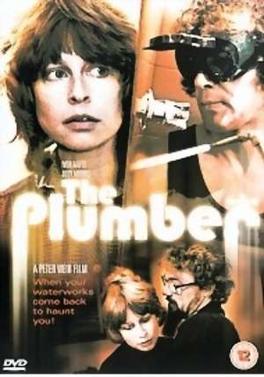
Peter Weir’s 1979 film, The Plumber, is essentially a battle of wills between two very different characters.
Jill Cowper (Judy Morris) is a masters student in anthropology. She’s educated, articulate, liberal-minded, and upper middle class. She’s married to Dr. Brian Cowper (Robert Coleby), a highly respected academic who is on the verge of being offered a position with the World Health Organization.
Max (Ivar Kants) is the plumber at the Cowpers’s building. We don’t find out much about his background, though it’s hinted that he’s had some previous trouble with the law. Max is friendly and talkative and, as soon becomes clear, amazingly determined. When he shows up at the Cowpers’s apartment, he tells Judy that he’s simply doing a check on all the building’s bathrooms. When Judy lets him in to do his inspection, Max announces that he needs to fix something with the plumbing. It should only take a day or two.
Except, of course, it takes more than a day or two. Max continually shows up at the apartment, usually waiting until Brian has left for the day. His comments to Jill become more and more intrusive and, whenever Jill takes offense, Max says that she’s misinterpreting him and that he’s just trying to be friendly. When Jill tells Brian that she thinks Max is intentionally destroying the plumbing so that he’ll have an excuse to be in the apartment, Brian refuses to believe her. When Jill tells her best friend, Meg (Candy Raymond), about what’s going on, Meg says that Max seems handsome and harmless.
Meanwhile, Max continues to work in the apartment’s bathroom, eventually turning it into a maze of pipes that seems to be constructed specifically to trap anyone unfortunate enough to enter the room….
The Plumber was originally made for Australian television. Though it was given a limited theatrical release in the United States (largely due to the arthouse success of Peter Weir’s previous films, The Last Wave and Picnic at Hanging Rock), The Plumber feels very much like a made-for-TV movie or perhaps an extended episode of an anthology series. It has a brisk 76-minute running time and visually, it features none of the striking imagery that one typically associates with Weir’s cinematic work. There’s no beautiful or majestic shots of the outback (like in Picnic at Hanging Rock) or the ocean (like in Master and Commander: Far Side of the World). Instead, the film takes place in the type of ugly and soulless cityscape that Harrison Ford was escaping from in Witness.
That said, The Plumber is still a memorable piece of work, one that feels perhaps more relevant today than when it was first released. Anyone who has ever dreaded having to take their car in for repairs or having to call someone out to fix an appliance will be able to relate to what Judy goes through with Max. The film is a reminder that, as much as we tell ourselves otherwise, we really are at the mercy of strangers. Judy may be better educated than Max and she may have more money than Max but what she doesn’t have, at least until the end of the film, is Max’s animal cunning. Max knows exactly what to say to get inside of the apartment and, once he’s inside, he knows exactly what to do to make it impossible for Judy to keep him from returning.
As upsetting as Max’s actions are, what’s even more upsetting is how everyone refuses to believe Judy when she tries to tell them what’s going on. Judy is told she is overreacting. Judy is told that she just doesn’t understand how these things work. Max gets offended that Judy doesn’t appreciate all of the hard work that he’s doing for her, despite the fact that she never asked him to do any of it. He does everything short of telling her that she needs to smile more. He’s the ultimate toxic presence, invading Judy’s life and refusing to leave. Everyone has had to deal with a Max but, for women, he’s an especially familiar and loathsome figure. The film may have clearly been made for Australian television but its themes are universal.
Because almost all of the action takes place in one small apartment, The Plumber is undeniably stagey. (It’s easy to imagine it as being a two-act play.) However, it’s also very well-acted and occasionally even darkly humorous. (As loathsome as Max is, it’s hard not to laugh a little when you see the maze of pipes he’s constructed in the bathroom.) It occasionally shows up on TCM so keep an eye out.
The Chase, a small-town Texas melodrama from 1966, opens with Robert Redford escaping from prison.
Redford is playing Bubber Reeves. Bubber, we’re told, has spent the last few years in a tough Texas prison, convicted of a murder that he didn’t commit. Now, he’s on the run and he’s probably returning to his hometown. His wife, Anna (Jane Fonda), still lives there, though Anna is now having an affair with Jake Rogers (James Fox). Jake is the son of the most powerful man in town, Val Rogers (E.G. Marshall). Jake also used to be Bubber’s best friend but now, he’s wracked with guilt about his affair with Anna.
Meanwhile, the townspeople are all worried that Bubber is going to seek revenge on the people who were responsible for him going to prison. Some of them know that he was actually innocent and some of them think that he’s actually the killer that he’s been made out to be but what they all have in common is that they’re worried about what Bubber’s gong to do when he shows up. Maybe they should have thought about the possibility of him getting mad and vengeful before they gave him a nickname like Bubber.
Anyway, Sheriff Calder (Marlon Brando) is convinced that Bubber is innocent but the townspeople still want him to allow them to gun Bubber down as soon as they see him. Sheriff Calder, however, is determined to keep the peace and make sure that the law prevails. He’s a man of unimpeachable integrity, working in a town full of people who are too cowardly to concern themselves with doing the right thing.
As everyone waits for Bubber to arrive. tempers come to the surface, a good deal of alcohol is consumed, and secrets are revealed. It all ends in tragedy, of course. One of the final scenes clumsily recreates the assassination of Lee Harvey Oswald. The Chase wouldn’t be an achingly self-serious film from 1966 if it didn’t.
There’s a few obvious problems with The Chase, the main one being that Robert Redford, who was 30 years-old when The Chase was released, looks surprisingly good for someone who has spent the last few years locked away in a tough Texas prison. Redford manage to escape from prison and run through a swamp without getting one single hair out of place. There’s nothing particularly dangerous about Redford in this film, which is surprising when you consider that The Chase was made just three years before Redford’s convincing turn as a laconic (if charming) killer in Butch Cassidy and the Sundance Kid. For The Chase to work, Bubber Reeves would have to be a force of nature but, whenever Redford’s on screen, you just find yourself wondering how someone who looks that good got stuck with a nickname like Bubber. The townspeople talk about Bubber like he’s a wild outlaw but Redford is just too laid back to pull it off. He comes across less like a wanted criminal and more like a California surfer who has somehow found himself in rural Texas.
As for the rest of the cast — well, there’s a lot of them. It’s a big ensemble film and good luck to anyone trying to keep track of who is related to who. Surprisingly enough, Marlon Brando is very convincing as a Texas sheriff, never allowing Sheriff Calder to turn into a stereotype. Less surprising is the fact that Robert Duvall, playing an frustrated husband, is also convincing in his role. Brando and Duvall, of course, would both go on to co-star in The Godfather. (Supposedly, when shooting of The Godfather began, Duvall was the only member of the cast with no fear of joking around with Brando, largely because they had bonded while working on The Chase.) Unfortunately, as good as Brando and Duvall are, they’re both let down in the hair department. Brando gets stuck with a hairpiece while Duvall is forced to go with a comb-over.
Some of the other performers are good and some of them are bad but none of them are particularly convincing as the residents of a small Texas town. James Fox, for instance, is very British. Jane Fonda and Angie Dickinson (cast as Calder’s wife) seem to be bored. E.G. Marshall is believably rich but never believably Southern. The other performers all tend to overact, especially once the people in town start drinking, shooting, hitting, and, in some cases, dancing. Somehow, Shelley Winters is not in the film, even though it seems like she should be.
The Chase was directed by Arthur Penn and written by Lillian Hellman. (The screenplay was based on a play and novel by Horton Foote.) Penn would follow up The Chase with Bonnie and Clyde and Alice’s Restaurant, two films that also dealt, for more successfully, with The Chase‘s themes of violence, community hypocrisy, and outlaw romanticism. Jane Fonda would go on to play Lillian Hellman in the 1977 film, Julia. For Julia, Fonda was nominated for an Oscar. For The Chase, she was not.
The Chase is one of those films that wants to say something important but doesn’t seem to be quite sure what. It’s a long and dramatic movie that doesn’t really add up to much. In the end, I think the main lesson to be learned here is not to allow your children to get a nickname like Bubber. There’s just no escape from a bad nickname.
One day, while defending Gotham City, Batman (Adam West) and Robin (Burt Ward) learn that there is a plot to abduct Commodore Schmidlap from his yacht. Quick! To the batcopter! Flying over the ocean, they locate the yacht but it turns out that the whole kidnapping plot was a ruse for a shark to attack Batman!
“Holy sardine!” Robin exclaims!
With the help of porpoise who bravely sacrifices its life to protect the Caped Crusader, Batman manages to escape. Back at police headquarters, Batman, Robin, Commissioner Gordon (Neil Hamilton), and Chief O’Hara (Stafford Repp) wonder which member of Batman’s rogue’s gallery of villainy could have been responsible for the ruse.
Batman says that it was pretty “fishy” what happened and that could possibly mean The Penguin (Burgess Meredith) was involved!
Robin points out that it happened “at sea” and C stands for Catwoman (Lee Meriweather)!
Batman then says that the shark was “pulling my leg” and that might mean it was working for The Joker (Cesar Romero)!
Chief O’Hara says that it all adds up to “a sinister riddle,” which can only mean one thing: The Riddler (Frank Gorshin)!
“The four of them,” Batman says, “working together…”
“Holy nightmare!” Robin exclaims!
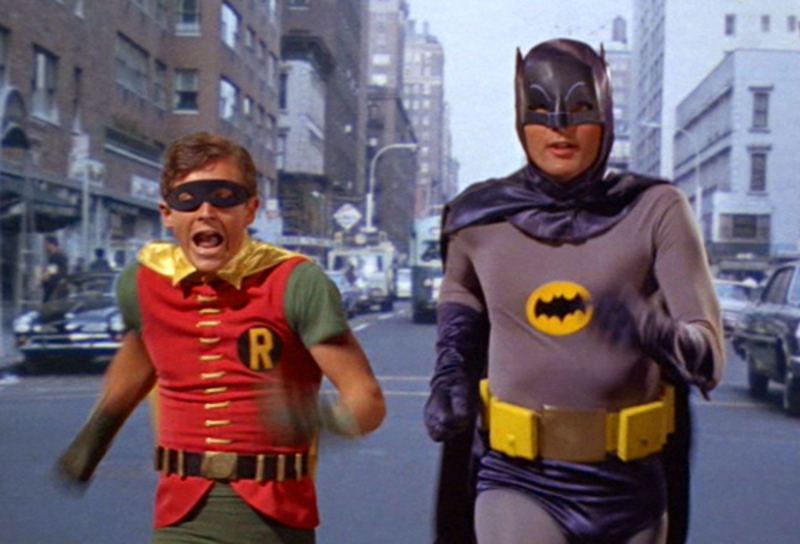
As you can probably guess, the tone of 1966’s Batman: The Movie is far different from the tone of more recent Batman films. That’s because Batman: The Movie was based on the light-hearted 60s TV show that made Batman a household name even while transforming the character from being a shadowy vigilante to being a comedic straight arrow, a proud square who regularly lectured the citizens of Gotham about respecting the forces of law and order.
Batman: The Movie was released after the conclusion of the first season of the Batman televisions series and it featured nearly the entire cast of the show. (Lee Meriweather replaced Julie Newman in the role of the purring Catwoman.) The movie feels like an extended episode of the show, still using the same famous music and featuring scenes of Batman and Robin running in place with a street scene projected behind them. The attitude is one of affectionate parody, as opposed to the more cynical campiness of Joel Schumacher’s infamous films from the 90s. Adam West expertly deadpans his way through the main role while the underrated Burt Ward energetically plays the naïve and easily amazed Robin. Of the villains, Lee Meriweather is a sexier Catwoman than Anne Hathaway and there’s never been a better Riddler than Frank Gorshin. (Of the many actors who played Batman’s villains on the TV series, Gorshin was always the only one who seemed to understand that he was supposed to be playing someone dangerous.) At 104 minutes, Batman: The Movie runs out of steam before it ends but there’s still much here to entertain fans of the television show.
Of course, when I was growing up in the 90s, there was no easier way to lose credibility with most diehard Batman films than to admit to liking anything about the television series. The Batman TV series was widely blamed for people thinking that comic books were only meant for kids. Tim Burton was a hero for treating Batman seriously. Joel Schumacher was hated for taking the opposite approach. Batman and Robin was criticized for being too much like the TV show, right down to George Clooney doing a poor man’s Adam West impersonation in the main role. Despite the acclaim that greeted Batman: The Animated Series, It wasn’t until Christopher Nolan took control of the character that the cinematic Batman truly returned to his grim roots.
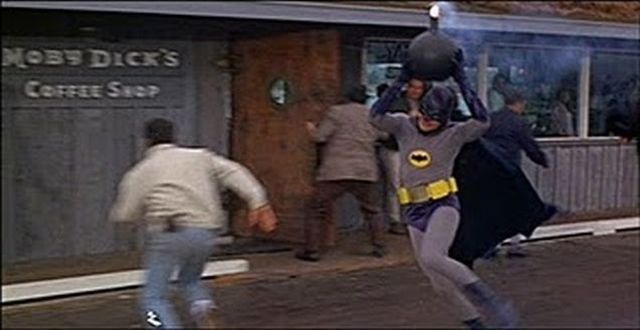
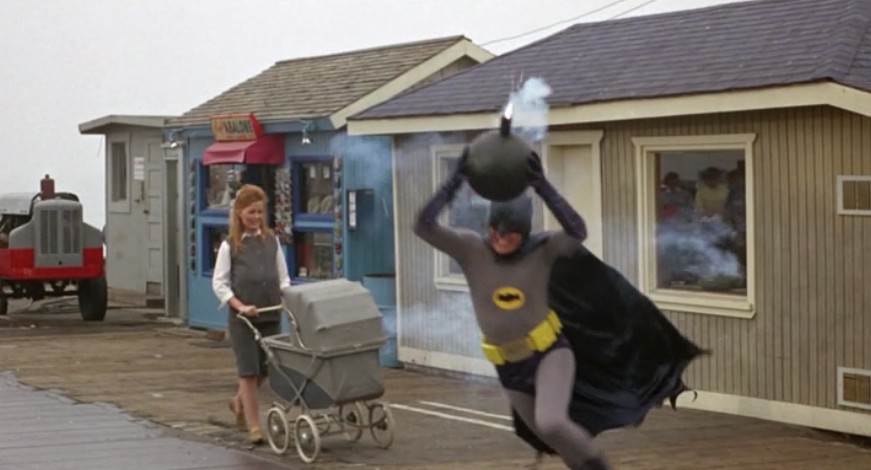
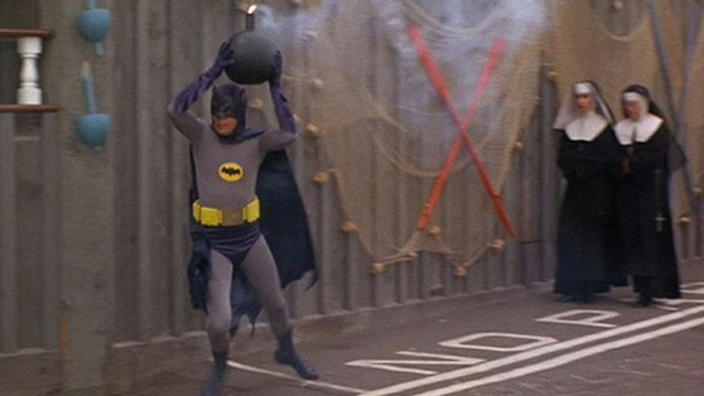
Since the conclusion of Nolan’s Dark Knight trilogy, there have been several versions of Batman. Ben Affleck took over the role for two films. Young Bruce Wayne and his doomed parents briefly appeared in Joker. Robert Pattinson is set to take over the role in The Batman. Now that everyone knows Batman as a grim avenger and countless actors have bragged about how they prepared for their roles in the Batverse by reading either The Killing Joke or The Dark Knight Returns, it’s easier to appreciate the more light-hearted approach of something like Batman: The Movie. After two decades of grim and serious Batmans being used as a metaphor for everything from PTSD to the surveillance state, the sight of a paunchy Adam West trying to find a place to safely dispose of a ridiculously oversized bomb can be a relief.
“Sometimes,” Batman says, “you just can’t get rid of a bomb!”


 Through the Shattered Lens