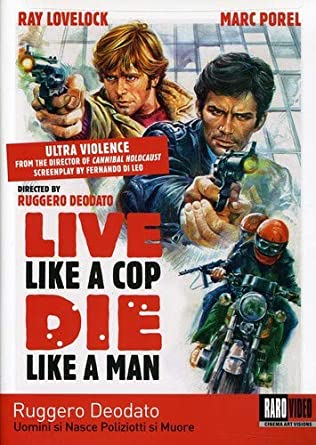
The TSL’s Grindhouse: Live Like A Cop, Die Like A Man (dir by Ruggero Deodato)


The 1976 film, Live Like A Cop Die Like A Man, takes place during the Christmas season.

We know this because the film opens with a man dressed like Santa Claus standing on a street corner in Rome and impotently watching as a woman is dragged behind a motorcycle by two men who were attempting to snatch her purse.  When she doesn’t let go of her purse, one of the men hops off the motorcycle and proceeds to kick her in the face until she stops moving.  Suddenly, two other men — our heroes, as it were — came driving up on a motorcycle of their own.  A chase ensues, through the streets of Rome, during which a blind man’s dog is graphically run over.  The chase which, it must be said, is very well-shot and directed, lasts for over 10 ten minutes and it ends with the two thieves being executed by, once again, our nominal heroes.

A lot of people are executed over the course of Live Like A Cop, Die Like A Man.  That’s because Detectives Fred (Marc Porel) and Tony (Ray Lovelock) have been given a license to kill anyone who breaks the law.  The film is a bit vague on just how exactly the license works and why, apparently, it’s only been given to Fred and Tony.  One major set piece features several dozen cops all waiting outside a house, powerless to get the three criminals within, until Fred and Tony arrive.  Fred and Tony, of course, solve the problem by killing everyone.  Why couldn’t the other cops have done that?  The film doesn’t really make that clear.

Admittedly, Fred and Tony aren’t the first movie cops to get results through unorthodox means.  The French Connection was a popular film in the 70s and it inspired a whole genre of Italian rip-offs, of which Live Like A Cop Die Like A Man is a definite example.  What sets Fred and Tony apart from cops like Popeye Doyle and Dirty Harry is the amount of joy that Fred and Tony seem to get out of killing people.  Early on, they show up at a party and proceed to set all of the cars on fire. They also set two criminals on fire, with Fred doing a happy little dance as the two men go up in flames.  It’s disturbing but there’s also a strange integrity to the film’s shameless embrace of violence.  Live Like A Cop, Die Like A Man doesn’t pretend to be about anything other than satisfying the vigilante fantasies of its audience.

And indeed, it should be considered that Live Like A Cop, Die Like A Man was released during the so-called Years of Lead, when a combination of political terrorism and open crime had made violence an almost daily part of Italian life.  When you’re living day-to-day with the knowledge that you could be blown up at any minute by the Red Brigade, the Ordine Nero, or the Mafia, I imagine that there would be something appealing about watching two young men who are perfectly willing to just shoot anyone who appears to be up to no-good.  It’s easy to imagine that, for audiences in 1976, the random violence of this episodic film mirrored the random violence of everyday life.  Though Live Like A Cop, Die Like A Man was obviously inspired by The French Connection, it perhaps has more in common with the original Death Wish, with the main difference being that Live Like A Cop’s vigilantes are officially sanctioned.

The film also places a good deal of importance on just how close Tony and Fred are supposed to be.  They live together in a ramshackle flat, they apparently spend all of their free time together, and, towards the end of the film, the only thing that keeps the two of them from taking part in a threesome is the sound of someone else being shot.  Unfortunately, Ray Lovelock and Marc Porel did not get along in real life and, as a result, there was never a Live Like A Cop Die Like A Man Part IILive Like A Cop would also be director Ruggero Deodato’s only stab at the polizieschi genre.  He went on, of course, to direct Cannibal Holocaust and The House on the Edge of the Park.  (Interestingly, Tony and Fred’s relationship is mirrored, to sinister effect, by the relationship between the characters played by David Hess and Giovanni Lombardo Radice in House On The Edge of the Park.)  Live Like A Cop, Die Like A Man has gone on to become a bit of a cult film and, as offensive as some will find it to be, it’s also so over-the-top in its violence and its celebration of officially sanctioned bad behavior that it becomes rather fascinating to watch.  It’s so without shame or apology that it’s hard to look away from it, even though you may want to.
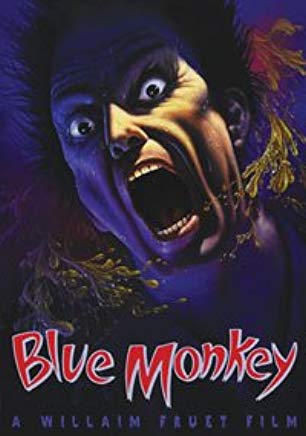
The TSL’s Grindhouse: Blue Monkey (dir by William Fruet)


1987 Blue Monkey

Last night, as I sat down to watch the 1987 Canadian film, Blue Monkey, I found myself singing a song in my head:

How does it feel
When you treat me like you do
And you’ve laid your hands upon me
And told me who you are?

I thought I was mistaken
And I thought I heard your words
Tell me, how do I feel?
Tell me now, how do I feel?

Unfortunately, it turned out that the only thing Blue Monkey had in common with the classic New Order song, Blue Monday, was an enigmatic title.  Just as the song never really mentions anything about Monday, Blue Monkey does not feature a single monkey.  One minor character does mention having a dream about a monkey but, otherwise, there are no monkeys in the film.  Speaking as someone who believes that almost any film can be improved the presence of a monkey, I was disappointed.

(Seriously, Nomadland would have been a hundred times better if Frances McDormand had a pet monkey.)

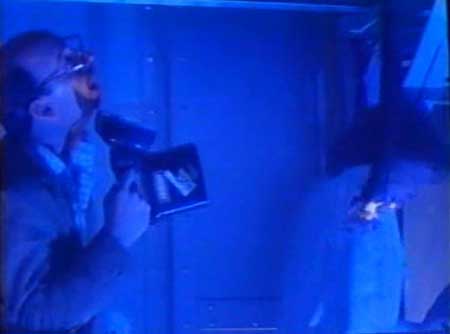
What Blue Monkey does have is a lot of blue.  The characters wear blue shirts and some wear blue uniforms.  Another wears a blue hat.  The film takes place in a hospital where almost all of the walls are painted blue.  Even worse, the majority of the film’s scenes are saturated with blue lighting.  

Here’s just two screenshots:

blue-monkey-1987-movie-image-7Blue-Monkey-1987-movie-William-Fruet-4

Seriously, some scenes were so blue that I was reminded of John Huston’s decision to suffuse Reflections in a Golden Eye with the color gold.  Personally, I think Huston made a mistake when he did that with Reflections but I can still understand the reasoning behind the decision and I can see what Huston was attempting to accomplish.  The blue in Blue Monkey feels like a distraction, as if someone realized, on the day before shooting, that the title didn’t make any damn sense.  “We’ll just make the whole movie blue!”

The problem, of course, is that the film goes so overboard with the blue lighting that it actually becomes difficult to look at the screen for more than a few minutes.  I had to keep looking away, specifically because all of those blue flashing lights were starting to make me nauseous and were on the verge of giving me a migraine.  At times, the image is so saturated in blue that you literally can’t make out what’s happening in the scene.  Of course, once you do figure out what’s happening, you realize that it doesn’t matter.

Blue Monkey takes place in a hospital.  A handyman has been having convulsions after pricking his finger on a plant that came from a mysterious island.  Perhaps that’s because a mutant larvae is now using his body for a host.  The larvae eventually develops into a giant grasshopper — NOT A MONKEY! — who stalks around the hospital and kills a few people.  The Canadian government is threatening to blow up the hospital unless something is done about the blue grasshopper.

It’s a Canadian exploitation film but Michael Ironside isn’t in it so it somehow feels incomplete.  That said, John Vernon plays a greedy hospital administrator and it’s fun to watch him get irritated with everyone.  A very young Sarah Polley has an early role as an annoying child.  There’s actually several children in this film and you’ll want to throw something at the screen whenever they show up, that’s just the type of film this is.  (Some of my fellow movie-watching friends were actually upset that the children survived that film.  I wouldn’t go that far but I still found myself hoping John Vernon would tell them all to shut up and let the adults handle things.)  Susan Anspach plays a doctor, showing that anyone can go from Five Easy Pieces to Canadian exploitation.  The film’s nominal star is Steve Railsback, playing a cop who comes to the hospital to check on his wounded partner and who ends up on grasshopper duty.  Steve Railsback has apparently said that he’s embarrassed to have appeared in this film.  Consider some of the other films that Steve Railsback has appeared in and then reread that sentence.  

In the end, Blue Monkey doesn’t add up too much.  There’s no Michael Ironside.  There’s no monkeys.  There’s just a lot of blue.

Film Review: Rad (dir by Hal Needham)


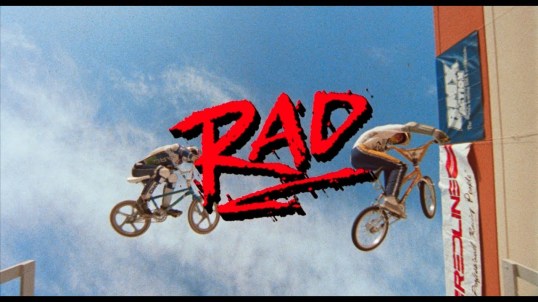
The 1986 film, Rad, tells the story of Christopher “Cru” Jones (Bill Allen).  Cru lives in a small, kind of ugly town in middle America.  Cru has a job delivering newspapers so, every morning, he rides around town on a bicycle and he throws rolled-up copies of USA Today at people.  He throws the papers fairly aggressively and doesn’t seem to have much concern about riding his bike through backyards or using his bike to jump over (or sometimes, onto) cars.  And yet, no one can stay mad at Cru because he has a plucky, can-do attitude and he can do all sorts of tricks on his bicycle.

Cru has a decision to make.  He can either go to college or he can compete in a bicycle race.  If he goes to college, he might actually be able to get a career and actually have a future.  If he wins the bicycle race, he’ll get a car and $100,000.  His mother (Talia Shire) feels that Cru should go to college.  Cru, however, says that his gut is telling him to enter the race….

Hey, Cru, your gut is lying to you!  Seriously, I’m all for Cru competing and showing off how good he is at a rather mundane and kind of boring sport but college is college.  There’s a scene early on in the film where one of Cru’s classmates is talking about all the schools to which he’s applied.  “UCLA, Princeton, SMU, Harvard….” Cru rides by and laughs but, 35 years later, who do you think currently has the nicer house?

Of course, despite his willingness to give up his future for $100,000 and a new car, it turns out that Cru might not even be able to compete.  The race’s evil sponsor (Jack Weston) is determined to make sure that his tea, wins the race and he keeps changing the rules to prevent Cru from being able to enter.  He demands that Cru find an official sponsor so Cru starts his own business.  He then demands that the business be worth at least $50,000!  Cru doesn’t have that type of money but — wait a minute — is that Ray Waltson, playing an eccentric businessman!?  Maybe he’s got $50,000!

Still, does Cru have the confidence necessary to enter the race and beat the best in the country?  Don’t worry, Cru’s little sister designs a t-shirt that reads, “Cru is Rad!”  Seriously, just try to beat that encouragement!

Anyway, you may be thinking that Rad sounds like it’s a pretty silly movie and it is.  Having now watched Rad, BMX Bandits, and Quicksilver, I am ready to announce that, in the 80s, there was absolutely no way to make BMX racing cinematic.  At the end of the movie, Cru performs a series of tricks while the end credits role and, instead of being impressed, you just notice how much Cru is struggling to maintain his balance.  Neither Bill Allen nor Bart Conner (who plays Cru’s main rival) have much screen presence and the whole film just looks and feels cheap.

And yet….

To be honest, it’s difficult to really dislike Rad.  For all of its many flaws, it’s all just so damn sincere.  Cru just wants to win that race so badly that it’s hard not to root for him and it is kind of touching to see the way the entire town rallies around him.  While the lead racers may have been blandly portrayed, Talia Shire, Jack Weston, Ray Waltson, and Lori Loughlin all turn in effective performances.  In fact, you could probably argue that Talia Shire is almost too good in her role.  She so effectively portrays the anguish of a mother watching her son throw his future away that you really do find yourself worrying about what’s going to happen to Cru when he’s older and he can’t get a job because he blew off college.  (I’m going to guess that Talia Shire’s presence in this film is due to the fact that it was produced by her late husband, Jack Schwartzman.)

Rad is sincere and unpretentious and rather silly.  Like a lot of 80s movies, it’s got a good soundtrack.  It especially makes good use of the song Send Me An Angel.  There’s also an out-of-nowhere scene where Cru and Lori Loughlin do a series of impromptu freestyle bike tricks on the middle of a dance floor and it’s just surreal enough to be memorable.

Rad is a simple but inoffensive tribute to throwing your life away.


Mr. Baseball (1992, dir. by Fred Schepisi)


I watched Mr. Baseball last night because I was feeling depressed over the Rangers 25-42 record and I thought that watching a movie about baseball (it’s right there in title!) might cheer me up.

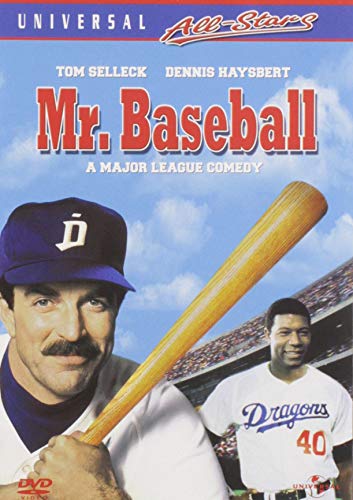
Tom Selleck plays Jack Elliott, an aging first baseman player who was once the MVP of the New York Yankees but whose best days are behind him.  Everyone realizes it but him.  Looking to sign a hotshot rookie, the Yankees put Jack on the trading block.  However, the only team that’s interesting in signing an arrogant veteran with a bad knee is a Japanese team, the Nagoya Chunichi Dragons.

Though he’s not happy about the trade, Jack move to Japan and takes his place as a member of the Dragons.  In Japan, he’s nicknamed “Mr. Baseball” and is told by the team’s owner that he’s expected to hit 54 home runs during the season.  However, Jack manages to alienate the team with his boorish attitude and his lack of understanding of Japanese culture.  With the help of another American player (Dennis Haysbert) and his girlfriend (Aya Takanashi), Jack finally sets aside his resentment, becomes a part of the team, and leads the Dragons into a pennant race.  He also learns how to improve his swing.

When Jack first arrived in Japan, I was worried that Mr. Baseball was going to be a culturally insensitive comedy, all about Jack teaching the Japanese players how to play baseball like the Americans.  I was dreading the thought of watching a movie full of stereotypes and cheap jokes about the way people talk.  Instead, Mr. Baseball actually treated Japanese baseball with respect and the emphasis was on Jack learning the importance of setting aside his ego, playing as a member of the team, and listening to the team’s manager, Uchimaya (Ken Takakurya).  Even though most of the film’s humor does come from the culture clash between the American Jack and his Japanese teammates, Mr. Baseball doesn’t really take any cheap shots at anyone and I appreciated that.  Instead, the theme of the film was that, cultural differences aside, everyone on the team loved the game of baseball.

Other than the fact that it was taking place in Japan, Mr. Baseball was a typical baseball film.  The plot did not hold many surprises.  Jack starts off as a star player, goes into a slump once he lets his ego get the better of him, and manages to come out of it just in time for the pennant race.  It’s predictable but Tom Selleck and Dennis Haysbert were convincing baseball players and I liked the film’s look at the culture surrounding baseball in Japan.  Mr. Baseball is hardly the greatest baseball movie ever made but it did cheer up this Rangers fan.

Film Review: Those Who Wish Me Dead (dir by Taylor Sheridan)


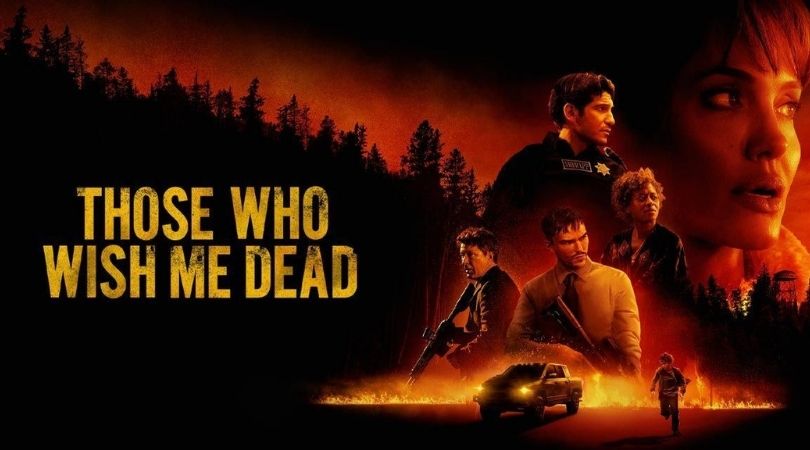
In Those Who Wish Me Dead, Angelina Jolie plays Hannah, a smokejumper who is haunted by a mistake that led to a family dying in a forest fire. All of her recent psych evals seem to indicate that Hannah is self-destructive and a danger to herself and potentially others. Of course, it doesn’t help that Hannah keeps doing things that are self-destructive and that put her and potentially others in danger. She’s watched over by her fellow smokejumpers and her ex-boyfriend, Ethan (Jon Bernthal). Even Ethan’s pregnant wife, Allison (Medina Senghorse) is looking out for Hannah.

Hannah, meanwhile, finds herself looking out for Connor (Finn Carter), a young boy whose father has been murdered by two ruthless assassins (Aidan Gillen and Nicholas Hoult). Because the boy has evidence that could lead to the downfall of an evil mob boss (played by Tyler Perry because, hey, why not?), the assassins search for Connor and they even set a forest fire to cover their tracks.

Trapped in the wilderness, Hannah, Connor, Ethan, and Allison have to somehow survive until the fire burns itself out and the smokejumpers can reach them. Meanwhile, the two assassins are closing in….

I was initially pretty enthusiastic about the prospect of watching Those Who Wish Me Dead on HBOMax but, ten minutes into the movie, I found myself wondering if maybe I was watching something that was made in 1998 and somehow not released until 2021. Everything about the film — from Hannah’s tortured backstory to the verbosely evil assassin played by Gillen — felt like it belonged in a direct-to-video thriller or maybe in a pilot for an old USA Network show starring Cynthia Rothrock and Lorenzo Lamas. It was very easy to watch this movie and to imagine Charlie Sheen and Patrick Swayze showing up as brothers fighting “the wildfire of the century!”

Oddly enough, Angelina Jolie probably could have starred in the 1998 version of this film. That’s how long we’ve been taking it for granted that Angelina Jolie can confront any crisis or any villain and basically kick its ass. That’s a huge reason why I was so looking forward to seeing Those Who Wish Me Dead. It’s been a while since we’ve had a chance to watch Angelina Jolie play an action hero and the fact that she was doing it in a film directed by Taylor Sheridan just made it all the more exciting. Unfortunately, though, Jolie doesn’t seem to be particularly invested in Those Who Wish Me Dead. There’s not much of the unpredictable spontaneity or the sense of danger that, in the past, made Angelina Jolie one of the most exciting actresses around. It’s easy to imagine that, just a few years ago, Jolie could have worked wonders playing someone as openly self-destructive as Hannah but, in Those Who Wish Me Dead, she instead often seems to just be going through the motions. If anything, Aidan Gillen makes a bigger impression, despite the fact that he’s just playing a standard bad guy.

(Speaking of bad guys, why is Tyler Perry playing a crime lord? There’s nothing menacing about Tyler Perry. The fact that Perry only appears in one scene makes his miscasting all the more obvious. As soon as you’ve said, “Wait — why is Tyler Perry in this movie?,” he’s gone. Perry needed at least two extra scenes where he could have killed someone or at least maybe cursed a little or anything else that could have established him as someone other than Tyler Perry making a strange cameo appearance.)

Taylor Sheridan both directed and had a hand in the script. Sheridan previously wrote Hell and High Water and Sicario and both directed and wrote Wind River. These are three of the best films of the past decade and, yet, in the early scenes especially, Those Who Wish Me Dead almost feels almost like a parody of those previous films. The early scenes, where Hannah hangs out with the other smokejumpers, especially ring false, with the blue collar dialogue feeling forced and artificial. Sheridan does better when directing the action scenes but there’s still an overwhelming blandness to the whole film. There’s too much talent involved for Those Who Wish Me Dead to be terrible but, at the same time, it’s hard not to feel that there’s also too much talent for it to be this forgettable.

Film Review: Nick Fury: Agent of S.H.I.E.L.D. (dir by Rod Hardy)


Uh-oh, Hydra is up to something!

If you don’t know who Hydra is, they’re an international group of villainous superspies. The organization was founded by a Nazi war criminal named Baron Von Strucker and they’re always trying to take over the world or destroy it. Hydra hasn’t had much success on either front but it’s not for lack of trying. Fortunately, there’s another super secret organization that’s been founded to keep Hydra from reaching their goals. The name of this organization is S.H.I.E.L.D. and they are headquartered in a big flying helicarrier thing. So, if you work for S.H.I.E.L.D., you not only get to save the world but you also have a hell of a work commute.

Anyway, Hydra’s latest plan is to steal the body of their founder and somehow not only bring him back to life but to also spread a deadly virus across the world. S.H.I.E.L.D. knows that it’s going to take the world’s greatest secret agent to defeat this plot but, unfortunately, Nick Fury (David Hasselhoff) is retired and living in an abandoned mine shaft in the Yukon. Nick wears an eye patch, smokes a cigar, and speaks in a permanently annoyed tone of voice. Nick’s done with saving the world. Or, at least, that’s what he thinks. When S.H.I.E.L.D. agent Valentina Allegra de Fontaine (Lina Rinna) informs him that Hydra killed an old friend of his while stealing the Baron’s body, Nick emerges from the Yukon in search of revenge!

Long before Samuel L. Jackson donned the iconic eye patch and brought Nick Fury to life as one of the mainstays of the MCU, David Hasselhoff played the character in this made-for-TV movie from 1998. The movie was meant to serve as the pilot for a Nick Fury television series. (Hasselhoff, by this point, was looking to move on from Baywatch.) Of course, it wasn’t picked up and today, whenever this early Marvel film is mentioned, it’s usually in a somewhat dismissive manner.

And, believe me, I can understand that instinct to preemptively dismiss Nick Fury: Agent of S.H.I.E.L.D. I mean, it’s David Hasselhoff and its from the 90s and it was made for TV. I get it. But, having watched the movie on Saturday night, I have to say that it’s actually not that bad. It’s low budget. It’s campy. It’s thoroughly silly. The film is full of actors giving uncertain line readings. And yet, it’s also fast-paced and, when taken on its own admittedly “special” terms, rather entertaining. In the role of Nick Fury, Hasselhoff plays the role with just enough self-awareness to indicate that he’s in on the joke. He delivers his lines with just the right amount of deadpan humor and he chews on that cigar as if the fate of the world depends upon it. In short, as opposed to almost everyone else in the film, Hasselhoff appears to be having a good time. In fact, one could argue that David Hasselhoff is a good Nick Fury for the same reason that Samuel L. Jackson is a good Nick Fury. Both of them play the character as if he’s someone who secretly realizes that he’s a character in a comic book film and who is determined to have as much fun with the role as he can.

The film’s plot does occasionally border on being incoherent but, honestly, who cares? Are you really watching a film like this for the plot? There’s a lot of explosions and one-liners. Hasselhoff has fun with the lead role, as does Sandra Hess in the role of Strucker’s daughter. It’s a dumb but entertaining. It’s also only 90 minutes long so it’s not like you’re having to sacrifice a major part of your life to watch it. Explosions and a short running time, who can complain about that?

Film Review: Save The Last Dance 2 (dir by David Petrarca)


Recently, I was shocked to discover that I had never reviewed the 2006 film, Save The Last Dance 2.

I mean, really, it seems like this is a film that I should have reviewed a long time ago. For one thing, it’s not only a dance film but it’s also a ballet film and, if you’ve been reading this site for a while, you know that I pretty much grew up going to dance class and doing pointe work and regularly injuring my ankle. Add to that, Saved The Last Dance 2 is a sequel to one of my favorite movies, the original Save The Last Dance. Really, why had I not already reviewed this film before tonight?

Well, some of it is because Save The Last Dance 2 isn’t very good. I mean, it’s basically a really forgettable sequel that lacks almost everything that made the original Save The Last Dance such a meaningful film. Oddly enough, despite preferring the original, I think I actually have watched Save The Last Dance 2 more times than I’ve watched the first film. For whatever reason, Save The Last Dance 2 is on Showtime constantly! It shows up early in the morning, when you’re still too tired to change the channel and you end up watching it because you’re lazy. This is a film that mocks you by both tarnishing the legacy of the first Save The Last Dance but by also reminding you that you don’t even have the willpower necessary to turn off the TV.

Save The Last Dance 2 continues the story of Sara, who has now been accepted to Julliard and who has broken up with her wonderful boyfriend from the first film. In the first film, Sara was played by Julia Stiles. In the second film, she’s played by Izabella Miko. On the one hand, Izabella Miko is far more convincing ballerina than Julia Stiles was. (Unlike Julia Stiles, Izabella Miko was a dancer who even studied at the School of American Ballet before she injured her back and decided to focus on acting instead.) On the other hand, Julia Stiles brought some needed edginess to the role whereas Izabella Miko is so constantly cheerful that it’s hard to really believe that the Sara in the sequel is the same Sara from the original film. Izabella Miko is likable as Sara but, in this sequel, the character has been robbed of everything that made her interesting in the first film. She’s just another cheerful teenager looking for success in an MTV Film.

Once Sara arrives at Julliard, she meets the usual collection of jealous classmates, demanding teachers, and quirky roommates. She also meets Miles (Columbus Short), a guest lecturer who is impressed by Sara’s hip-hop skills. Sara and Miles fall in love. Miles wants Sara to help him choreograph his next show but the demanding Monique Delacroix (Jacqueline Bisset) wants Sara to play the lead in Giselle. Playing the lead will demand all of Sara’s time and attention but it could also be her ticket to stardom. Unfortunately, it also means that she won’t be able to help out Miles, which this film portrays as somehow being the ultimate betrayal despite the fact that one assumes that Miles, being a guest lecturer on hip hop dance, knows more than one choreographer.

If the message of the first film was that Sara didn’t have to choose between loving ballet and loving hip hop, the message of the sequel is, “Actually, she does have to choose and she better pick the one that will allow us to put together a successful soundtrack.” It’s a bit depressing and hollow, to be honest. It goes against everything that made the first film special.

That said, I’ll probably watch Save The Last Dance 2 the next time I turn on the TV and it’s playing on Showtime. Changing the channel would require too much effort.

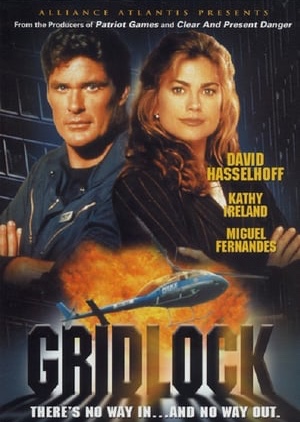
Film Review: Gridlock (dir by Sandor Stern)


Jake Gorsky is a tough New York cop who flies a helicopter and who gets results …. HIS WAY! He’s also played by David Hasselhoff and, as a result, you never look at him and really buy the idea that he’s a tough New York cop who gets results …. HIS WAY! Instead, you just assume that he’s the Hoff, cheerfully making his way through yet another silly made-for-TV movie.

In Gridlock, criminals have blown up all of the bridges leading out of Manhattan! The entire borough is gridlocked! Why would they do this? Are they hoping to make a quasi-philosophical statement, like Bane in The Dark Knight Rises? No, of course not. (That, to be honest, didn’t even make sense when Bane did it.) Instead, it’s all a part of a plot to rob the Federal Reserve. How are they going to escape if they’ve blown up all the bridges out of town? That question is never really answered, or if it was, I was too blinded by the Hoffness of it all to notice. I assume that Mr. One (Miguel Ferandes) and Mr. Two (Gotz Otto) have a plan. I assume that there’s also a reason why almost all of the bad guys are bald. For that matter, many members of the police are bald as well. You know who isn’t bald? The Hoff.

Anyway, it turns out that the Hoff’s girlfriend, Michelle (Kathy Ireland), works in the Federal Reserve. She gives tours to tourists who presumably flock to New York to see “where they keep all the money.” Michelle is trapped in the building while the robbery is taking place. It’s up to the Hoff to sneak into the building, rescue Michelle, and prevent the robbery. This leads to a scene where the Hoff uses two bags of nickels to take out some henchmen. Woo hoo!

Of course, while watching this film, you have to wonder how the crooks possibly thought they could get away with robbing the Federal Reserve. I mean, let’s just ignore the fact that they blew up all the bridges out of town. How are you going to launder that much money? We’ve all seen Breaking Bad. We all know Walter White ended up with a pile of money that he essentially could never touch. It’s hard not to feel that it would have been smarter for these crooks to just rob an ordinary bank. It also seems like there should have been a simpler way to commit their crimes than to blow up every bridge in Manhattan. How can these criminals be so smart and so dumb at the same time?

That said, you’re not really watching a film like this for the criminals or even the plot. You’re watching it because it features David Hasselhoff doing his thing. I wouldn’t exactly describe David Hasselhoff as being an actor with a particularly wide range but, when it comes to projecting an odd combination of earnest sincerity and mocking self-awareness, it’s hard to think of anyone who does it better. Much like William Shatner, the Hoff always leaves you wondering whether or not he’s actually in on the joke. Did David Hasselhoff realize he was appearing in a silly Die Hard rip-off (“Die Hard in an office building …. wait a minute, that’s just Die Hard!”) or did he earnestly call his agent and say, “Baywatch isn’t challenging anymore. I want to play a copy who doesn’t always follow the rules!” One gets the feeling that both possibilities are true.

Anyway, Gridlock is a made-for-TV movie from the 90s, which means no blood and no cursing. A lot of guns are fired but hardly anyone gets shot. I’ll give it a 6 out of 10, just for the Hasselhoff of it all.

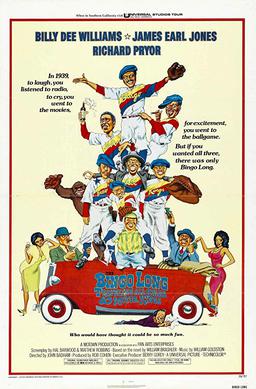
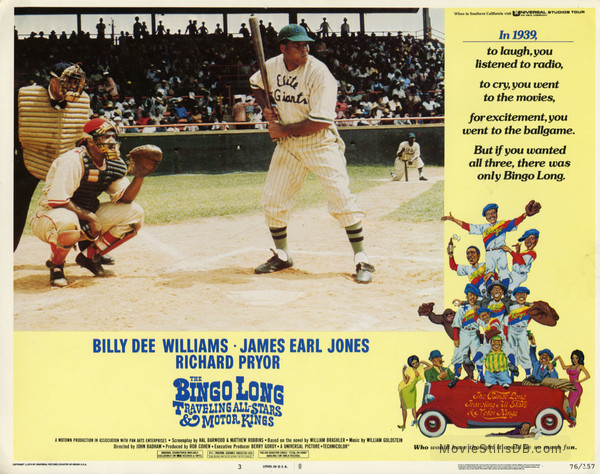
The Bingo Longo Traveling All-Stars & Motor Kings (1976, dir. by John Badham)


Up until 1947, Major League Baseball was segregated. Though there was no written rule barring blacks from playing on major league teams, there was an agreement among the team owners that no blacks would be signed to a major or minor league contract. Instead, starting in the 1920s, black players could only play for the teams in the Negro League. It was in the Negro Leagues that future greats like Jackie Robinson and Willie Mays got their start. Josh Gibson, who spent his entire career playing in the Negro Leagues, is believed to have hit more home runs in a season than Babe Ruth ever did. For that reason, many baseball fans believe that any MLB records set before 1947 should come with an asterisk included. How can you determine who was the best when many of the best players in the game were never allowed to compete against each other?

The Bingo Longo Traveling All-Stars & Motor Kings is a comedy that pays tribute to those players. Billy Dee Williams plays Bingo Longo, a charismatic pitcher who plays in the Negro Leagues but who, frustrated with the money that he’s earning and the owner’s callous attitude towards the players, breaks away and forms his own independent, barnstorming baseball team, the All-Stars Among the players that he recruits are catcher and power hitter Leon Carter (James Earl Jones) and Charlie Snow (Richard Pryor), who is constantly changing his name and lying about his background in an attempt to get signed to the major leagues. Bingo also steals a player named Esquire Joe (Stan Shaw) away from one of the teams that the All-Stars defeat.

Going across the country and playing other teams, the Bingo Longo Traveling All-Stars make a name for themselves as both players and showmen. Though Leon just wants to concentrate on playing the game, Bingo understands that importance of putting on a show for the people in the stands. They start out playing other independent black teams but soon, they’re even playing against amateur white teams. The games against the white teams are tense, as the All-Stars ever know how the people in the stands are going to react when the All-Stars win. The All-Stars usually do win, though. They’re the best and they’re not going to let the people watching forget it.

The Bing Longo Traveling All-Stars is a good film, especially if you’re interested in the history of baseball. It’s an episodic comedy with the emphasis on the various situations that the members of the All-Stars find themselves in as they travel from town to town but there’s also a serious subtext. The All-Stars are proving to a League that refuses to let them play that they are the best. At the same time, no matter how many games they win, the All-Stars still have to deal with living a society that treats them like second-class citizens. Even though they win on the field, they still have a hard time finding a hotel to stay at. It’s a movie that will make you laugh but it also makes you think. Billy Dee Williams is perfect in the role of Bingo Longo and James Earl Jones is the type of player that anyone would want on their team. The Bingo Longo Traveling All-Star & Motor Kings is a good film for both baseball fans and people who have never even heard of the designated hitter rule.

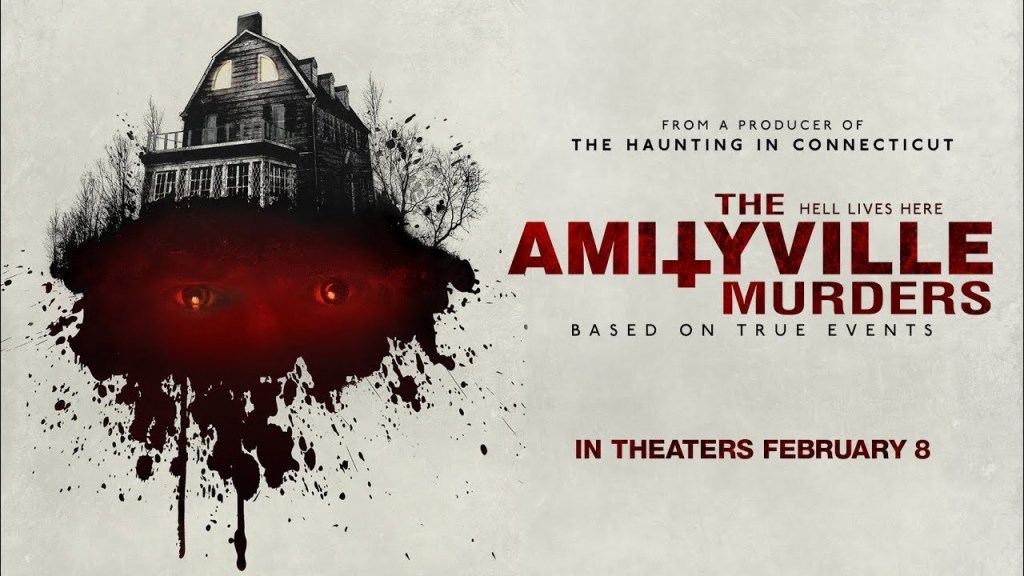
The TSL’s Grindhouse: The Amityville Murders (dir by Daniel Farrands)


Ronald DeFeo, Jr. may not be a household name but he’s someone who was indirectly responsible for a lot of cinematic schlock.

Of course, that’s the least of DeFeo’s crimes. When the 69 year-old DeFeo passed away in March, he was serving a life sentence in the state of New York. That’s because, back in 1974, the 23 year-old DeFeo grabbed a rifle and killed his entire family while they slept. When he was brought to trial, DeFeo claimed that he heard Satanic voices that urged him to kill his parents and his siblings. His lawyers tried for an insanity defense, though the prosecution successfully argued that DeFeo was lying about the voices and that he was in full control of his actions on the night that he killed his family. After being convicted and sentenced to life imprisonment, DeFeo sometimes claimed that he had been possessed by the devil and sometimes said that he committed the murders in self-defense and then other times, he said that he did it because he was hoping to inherit his father’s money. Out of all the excuses that he gave for his brutal crimes, DeFeo’s claims of being demon-possessed were the claims that everyone remembered.

Years later, the DeFeo house — which sat in Amityville, New York — was purchased the George and Kathy Lutz. The Lutzes made a small fortune by claiming that the house was haunted and that they had been forced to leave their new home by demonic spirits. (Their claims were apparently supported by paranormal investigators Ed and Lorraine Warren of Conjuring fame.) The Lutzes told their story to Jay Anson, who wrote a book called The Amityville Horror. That book was later turned into a movie and the success of that movie led to a series of sequels and spin-offs. At last count, there’s been at least ten books written about the Amityville case and there have been 30 films that, in one way or another, claim to be connected to the Amityville haunting. Few of those films share much, other than a haunting and the word “Amityville” in the title. There’s not a great deal of continuity to be found in the Amityville films.

One of the latest of the Amityville films, 2018’s The Amityville Murders, deals with the actual murders that supposedly started off the whole cycle of possession and violence. (1982’s Amityville II: The Possession also dealt with the murders, albeit with Ronald DeFeo renamed Sonny Montelli. Two of the stars of that film — Burt Young and Diane Franklin — appear in The Amityville Murders.) John Robinson plays the bearded and withdrawn Ronald DeFeo, Jr. Chelsea Ricketts plays his concerned sister. Paul Ben-Victor plays their abusive father. The film covers the general facts of the DeFeo murders while trying to have it both ways as to whether or not Ronald was in control of his actions. Ronald DeFeo is portrayed as being genuinely unbalanced but, at the same time, potentially demon-possessed as well. The talented John Robinson does a good job of playing Ronald and there’s a few effective shots of his looking unbalanced but, for the most part, there’s nothing here that you haven’t seen in a dozen other Amityville-influenced horror films. As well, since you know from the start that Ronald is going to end up murdering his family, there’s really not any suspense to be found in the film. Instead, the entire movie is just about waiting for Ronald to pick up that rifle and start shooting people, including two children. It’s more than a bit icky, to be honest.

Whenever it comes to an Amityville prequel, the main question is always just how stereotypically the DeFeos are going to be portrayed. It only takes five minutes for DeFeo, Sr. to admonish Ronald with, “Oh! Watch how you talk to your mother!” Every cliché about Italian-American family life is present in The Amityville Murders, from the father hulking around in his undershirt to the mother decorating the house with religious iconography to the superstitious grandmother. Watching the film, I found myself imagining Tony Soprano watching a cheap Amityville film and exclaiming, “Oh! The mouth on this fucking kid over here, like he’s possessed by the devil or something!” The Amityville Murders hints that the DeFeos themselves may have had mafia connections. Indeed, before he decided to blame demonic possession for his crimes, Ronald DeFeo, Jr. claimed that his family had been taken out by hitmen from New York.

This film was directed by Daniel Farrands, who also directed The Haunting of Sharon Tate and The Murder of Nicole Brown Simpson. The Amityville Murders is neither as well put-together as the Sharon Tate film nor as offensive as the Nicole Simpson film. It’s somewhere in between, just another link in the endless chain of Amityville films. I will say that I personally think Farrands is a talented director and I’d like to see what he could do with a budget and a decent script. The Amityville Murders has its share of impressive shots, even if the end result isn’t exactly the last word in Amityville horror.