The TSL’s Horror Grindhouse: Dolls (dir by Stuart Gordon)


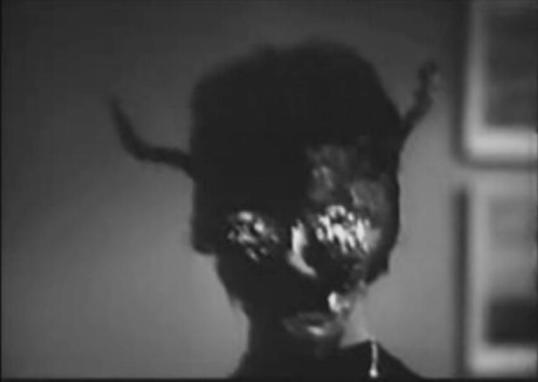
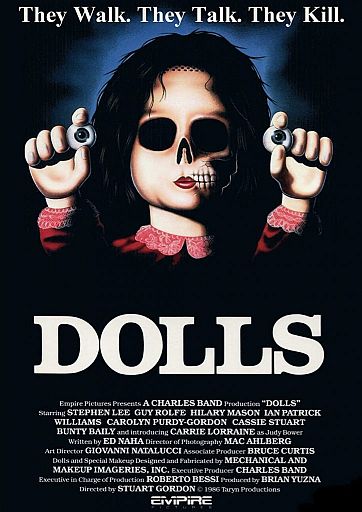
Sitting out of the middle of nowhere, there’s a house. And in this house, there lives an old man and an old woman. They appear to be very friendly, the type who will happily open up their home to anyone needing a place to stay and have a cup of coffee. They make dolls for a living. They make the type of dolls that smirk at you whenever you trip and that glare at you whenever you say that you don’t care about toys. They’re living dolls and they’re actually kind of vicious. Don’t get on their bad side.

That is exactly the mistake that a few people make when they arrive at the house on one stormy night. Two punk rock girls with exaggerated British accents make the mistake of trying to find something to steal. Uh-oh, here come the dolls! A self-centered man and his wife make the mistake of not caring about their daughter. The dolls aren’t going to stand for that!  Seriously, the dolls may be cute but if they don’t like you, you are doomed!

The dolls, however, do like the daughter. And they appear to be willing to tolerate Ralph, the goofy traveling salesman who made the mistake of picking up the two punk rock girls while they were hitchhiking. Will the dolls continue to like the daughter and Ralph or will they eventually turn on everyone in the house? They may be small but again, you seriously do not want to get these dolls mad.

First released in 1986, Dolls is a seriously strange movie from director Stuart Gordon and producer Charles Band. There’s a lot of good things to be said for Dolls. The house is atmospheric. The dolls are truly creepy. The acting really isn’t that bad, though I do think most viewers won’t necessarily miss the two punks girls.  The movie does take the characters and the dolls in some unexpected directions. But the movie’s tone is all over the place. It starts out as a broad comedy before then turning into a surprisingly violent and bloody horror film and then it turns into this strangely macabre family drama. The movie can’t seem to decide whether it wants you touch your heart or scar your soul. Imagine Home Alone if the movie kept all the heart-warming stuff but then had the kid brutally kill the burglars and laugh while stuffing their corpses in a furnace and you have some idea of what the tone of Dolls is like.

It’s an odd film but it’s hard not to like. Stuart Gordon’s direction is energetic and, since the movie only has a running time of 77 minutes, the whole thing feels like an extra weird episode of Tales From The Crypt or The Twilight Zone. Even the film’s mix of humor and disturbing violence feels strangely appropriate, as if the film itself is an adaptation of a particularly grisly fairy tale.

Watch Dolls and you’ll never look at a toy the same way again!
Biohazard (1985, directed by Fred Olen Ray)


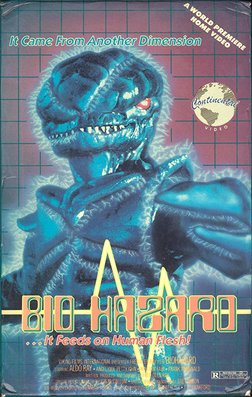
At a government research lab in the middle of the desert, Lisa (Angelique Pettyjohn) is a psychic who has the ability to go into different dimensions and bring things back with her.  While demonstrating her abilities for Gen. Randolph (Aldo Ray), she accidentally brings back a container that is carrying a small, humanoid/lizard hybrid.  (Inside the costume was director Fred Olen Ray’s six year-old son, Christopher.)  The monster goes on a rampage, killing hoboes and other random people who live in a nearby town.  Lisa and Carter (William Fair) try to track down the creature before it can cause too much damage and kill too many people.  Meanwhile, the town drunk wants to sell the monster’s story to the newspapers.

Biohazard is a typical early Ray film.  Hire some veterans, like Aldo Ray and Carroll Borland.  (Fred Olen Ray, if nothing else, was good about finding work for Hollywood veterans who, otherwise, would have spent their final years in obscurity.)  Unleash someone in a monster costume.  Toss in some gratuitous nudity.  Spill some fake blood.  Pad it out so that the film reaches feature-length.  Biohazard goes the Hal Needham route when it comes to padding out the film and gives us several minutes of blown takes and other mistakes.  The takes start out amusing but, eventually, there’s only so many times you can watch actors blow lines that weren’t that good to begin with.  It’s still not as bad as having to watch Burt Reynolds slap Dom DeLuise a hundred times during the closing credits of Cannonball Run.  At least most of the actors actually look like they enjoyed being on the set of Biohazard.  

With Fred Olen Ray, you know what you’re going to get and Biohazard delivers all of Ray’s trademark moments, including ineptly lit day-for-night scenes, overacted comedy relief, and one or two scenes that work despite themselves.  As bad as the end result was, the film does have a DIY aesthetic that will appeal to anyone who has ever thought about getting a couple of friends together and just making a movie.  Supposedly, it took Ray two years to complete Biohazard.  Today, an aspiring filmmaker could just film it on his phone over two weekends and then upload it to YouTube and get a few thousand likes.  In some ways, independent filmmakers like Fred Olen Ray were ahead of their time.

Horror Film Review: The Wasp Woman (dir by Roger Corman)


Aging sucks!

I mean, let’s just be honest about that. No one wants to get older. No one wakes up in the morning and thinks to themselves, “Yay! I’m one day closer to death!” People do not celebrate the appearance of a wrinkle or a laugh line. No one is happy when their vision gets blurrier or when they start to ache more and more frequently. No one wants to get old! That’s a simple truth and it’s the truth that is at the heart of the 1958 film, The Wasp Woman.

Directed by B-movie maestro Roger Corman, The Wasp Woman tells the story of Janice Starlin (Susan Cabot). Janice owns a cosmetic company. She’s made a fortune helping people defy their age. Unfortunately, the company’s sales are down because Janice herself cannot defy the passage of time. She’s looking older and apparently, people across the world are saying, “Why would I buy makeup for a mortal? I only buy my makeup from ageless mythological goddesses, who never age.”

So, Janice does what anyone would do. She tries to find a way to stop herself from getting old. When she discovers that a scientist is experimenting with using the enzymes from the royal jelly of a queen wasp to reverse the aging process, she agrees to fund his work. However, she has one condition. She has to be the test subject …. which, now that I think about it, makes absolutely no sense. Surely Janice could hire someone else to be the test subject before undergoing a highly experimental and unproven scientific process herself. I mean, Janice is extremely wealthy! Or maybe Janice could just hire a model to be the new face of her company. Or she could retire and take her millions to Europe and spend the rest of her life living in luxury. My point is that it seems like Janice is acting a bit impulsively here.

Anyway, Dr. Eric Zinthrop (Michael Mark) reluctantly agrees to Janice’s demands. He really needs the money, I guess. And if Janice dies, it’ll just means that he’ll probably go to prison for life. He certainly won’t ever be allowed to experiment with any more wasps. Is anyone in this movie capable of thinking ahead?

At first, the experiments seem to work. After one weekend, Janice looks 20 years younger! However, there is an unfortunate side effect. Janice occasionally transforms into a wasp/human hybrid! Uh-oh! That’s not good….

Clocking in at barely 70 minutes, The Wasp Woman is an entertainingly daft movie. As I’ve already pointed out, this is one of those movies where so much drama could be avoided if people would just consider the possible consequences of their actions. That said, the pace is fast and Susan Cabot is enjoyably bitchy in the role of Janice. The Wasp Woman costume manages to be both ludicrous and effective at the same time. Laugh? Scream? Why not do both!?

In the end, this is a silly but entertaining movie. If nothing else, it proves that sometimes it’s best just to accept that no one stays young forever.

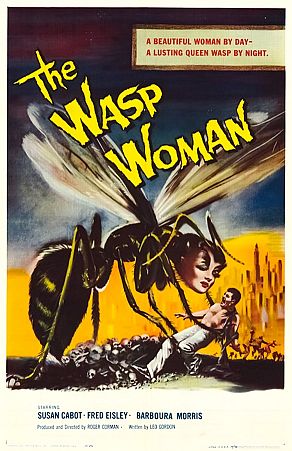
One final note: This film has a great poster, even if it is totally misleading.

Horror on the Lens: The Night Stalker (dir by John Llewelyn Moxey)


For today’s horror on the lens, we have a real treat!  (We’ll get to the tricks later…)

Long before he achieved holiday immortality by playing the father in A Christmas Story, Darren McGavin played journalist Carl Kolchak in the 1972 made-for-TV movie, The Night Stalker.  Kolchak is investigating a series of murders in Las Vegas, all of which involve victims being drained of their blood.  Kolchak thinks that the murderer might be a vampire.  Everyone else thinks that he’s crazy.

When this movie first aired, it was the highest rated made-for-TV movie of all time.  Eventually, it led to a weekly TV series in which Kolchak investigated various paranormal happenings.  Though the TV series did not last long, it’s still regularly cited as one of the most influential shows ever made.

Anyway, The Night Stalker is an effective little vampire movie and Darren McGavin gives a great performance as Carl Kolchak.

Enjoy!

October Positivity: Nite Song (dir by Russell S. Daughten)


Wow, Iowa’s a dangerous place.

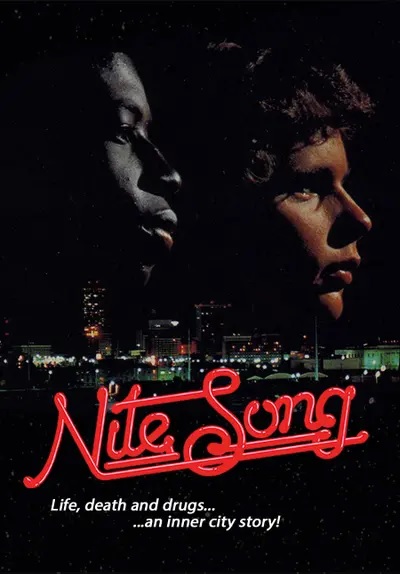
The 1978 film, Nite Song, takes place on the mean streets of Des Moines, Iowa.  Pete (Bobby Hoffman) and his best friend, Joe (Tom Hoffman), are neighbors in the local tenement.  They also both play on the high school basketball team.  In fact, the only reason that this movie is over an hour long is because there’s about five minutes of slow motion basketball footage.

Life’s not easy in Des Moines.  The local drug lord wants Pete to work for him.  Joe’s sister is addicted to heroin and his father is out of work.  Joe has recently become a Christian, which Pete finds to be kind of strange.  Even stranger is that Joe often sits outside on the balcony of the tenement and sings a song called I Will Serve Thee.  Later in the film, another character will spontaneously start singing I Will Serve Thee while staring up at the night sky.  I guess that’s the “nite” song of the title but what’s interesting is that the film itself isn’t a musical.

Anyway, the local drug lord wants Joe to help him rob the local pharmacy.  Joe refuses so the dealer refuses to give Joe’s sister any more heroin.  Joe and Pete decide to start following the drug dealer around town, in order to gather enough evidence to find a way to stop him.  Unfortunately, that plan doesn’t really work out that well.  Joe ends up with a knife in his back and Pete is left to struggle with whether he should go to the police or just sit out on the balcony and pray about it.  It turns out that all of the other kids at the high school are also Christians, specifically because of Joe.  They decide to clean up the streets themselves!  Fortunately, that won’t be hard because there’s only three criminals in Des Moines and they all hang out together….

It’s actually probably a little bit too easy to be snarky about a film like Nite Song, if just because it’s a low-budget, amateur film about life and death in Iowa.  But actually, the film deserves a bit more credit than I’m giving it.  Taken on its own terms, it’s actually an achingly sincere and earnest film and, as opposed to a lot of other faith-based films, it never makes the mistake of getting preachy or being overly judgmental.  (The film’s sympathetic portrayal of Joe’s drug-addicted sister actually deserve a good deal of praise.)  Even though the actors are all obviously amateurs and the singing gets a bit weird, everyone brings a certain authenticity to their roles.  This is a film about Iowa that was actually populated with people who were from Iowa and yes, that does make a difference.

Plus, there’s something charmingly naïve about the idea of the high school basketball team taking out the local drug dealers.  All those weapons and tough talk prove useless against a 15 year-old with a dream and jump shot.  Nite Song‘s a well-intentioned film.  Des Moines has nothing to be ashamed of.

The TSL’s Horror Grindhouse: Food Of The Gods (dir by Bert I. Gordon)


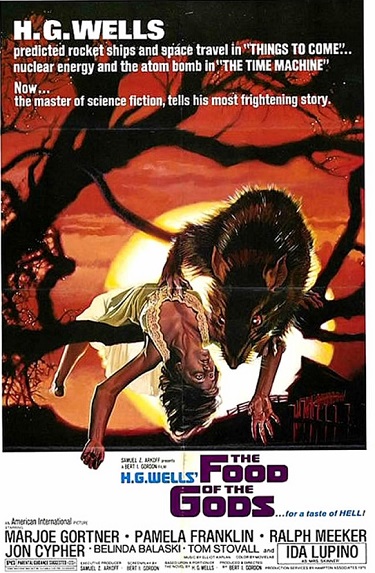
Uh-oh! Something weird has bubbled up to the ground on an island near British Columbia and a farmer and his wife (played by John McLaim and Ida Lupino) foolishly decided to feed it to their farm animals! Soon, they’ve got giant chickens! And listen, that might sound like a good thing to some but I’ve spent enough time around farms to know that giant chickens are not a good thing! Seriously, normal-sized chickens are messy enough. Giant ones? I don’t even want to thinking about it.

Unfortunately, it’s not just the chickens that are eating the food. Rats are eating the food. Wasps are eating the food. All of the animals are turning into giants and now, they’re hunting humans! After his best friend is attacked and killed by giant wasp, a football player named Morgan (Marjoe Gortner) decides to investigate on his own. You would think that a football player would be busy preparing for his next game or something like that but no, not Morgan! Morgan’s determined to find out why there are giant animals off the coast of Canada.

Of course, Morgan isn’t the only one interested in the so-called Food of the Gods. There’s also Jack Bensington (Ralph Meeker), who owns a dog food company. Jack wants to sell the food. Why would Jack want to do that? Does he actually think that causing dogs to transform into giants who would undoubtedly try to kill their masters is somehow going to be good for his company’s reputation? Jack’s main motivation seems to be that he’s a businessman and, in this film’s moral universe, that automatically makes him one of the bad guys. But it seems like even an evil businessman would know better than to kill off all of his customers.

This 1976 film, which is loosely (very loosely) based on a novel by H.G. Wells, was directed by Bert I. Gordon and, if you think the plot sounds a little ludicrous …. well, it is. Nothing about the film really makes much sense but that’s kind of to expected from a Bert I. Gordon film. Gordon specialized in making films about giants destroying stuff. The films were never particularly good but Gordon obviously understood that American filmgoers love big things. Food of the Gods, as silly as it may be, apparently made a lot of money when it was first released.

Today, of course, it’s impossible to watch the film without noticing just how terrible the special effects are. Between the unconvincing use of super-imposed images and the obviously fake rats that are tossed at some of the actors, there’s not a single shot that doesn’t somehow look totally ridiculous. In fact, it’s all so silly and obviously done on the cheap that it becomes rather charming, or at least as charming as the superimposed image of giant wasp ever could possibly be. You have to admire the film’s determination to tell its story despite not having the resources to do so. As for the rest of the film, it’s dumb but it doesn’t take itself too seriously. If you’re specifically searching for a bad giant animal movie, The Food of the Gods is fun in its own goofy, nonsensical, low-budget way.

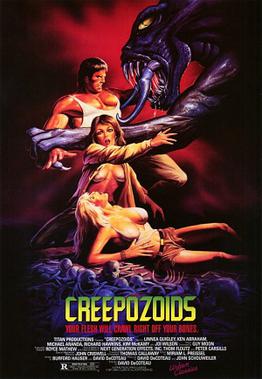
Creepozoids (1987, directed by David DeCoteau)


In 1992, society collapses due to a nuclear war.  In 1998, a group of army deserters are looking for a place to hide from the authorities when they come across an underground bunker in Los Angeles.  The bunker was once home to a research lab.  Even though all of the scientists are dead, the monster that they created is not and soon, the deserters are fighting for their lives, battling not just the monster but also giant rats.

Creepozoids is a low-budget Alien rip-off.  It’s actually a little incredible just how closely Creepozoids copies Alien, right down to a monster that can spit acid and a scene where someone has a fatal seizure while eating dinner.  The monster itself is not badly realized but the giant rats are obviously just stuffed animals that are being tossed on the cast by crew members standing off-camera.  Though the film takes place in what was then the “near future,” it’s an 80s production all the way through.  The top secret government lab as a bulky computer that only one of the deserters knows how to use.  The secrets to genetic modification are stored on a 8-inch floppy disk.  Most 80s and 90s kids will get nostalgic watching this movie.

One of the deserters is played by Linnea Quigley, which is the main reason why Creepozoids retains a cult following.  While the rest of the deserters want to search the bunker and look for supplies, Linnea’s main concern is trying out the facility’s shower.  (Good news, it works!)  Linnea Quigley appeared in many bad films but she always brought a lot of sincerity and good humor to her performances.  In Creepozoids she gamely wrestles with a stuffed rat and proves herself to be one of the best screamers of the 80s DTV horror industry.  The rest of the cast is interchangeable but, as always, Linnea earns her screen queen crown.

Creepozoids is a lesser imitation of Alien but, seen today, it benefits from nostalgia.  I can still remember Creepozoids showing up on Cinemax, late at night and with a warning that the movie featured not only adult language but also nudity and violence.  (Was anyone ever dissuaded by the Cinemax content warnings?)  This is one of the B-movies that made being an 90s kid fun!

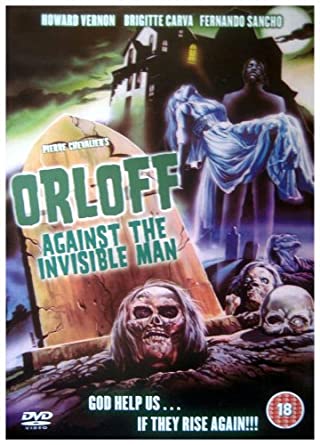
International Horror Film Review: Orloff Against The Invisible Man (dir by Pierre Chevalier)


In 1970’s Orloff Against The Invisible Man, Paco Valladares stars as Dr. Garondet, a turn-of-the-century psychologist.  One morning, Garondet is at his office when a mysterious child delivers a letter requesting that he travel to the castle of Prof. Orloff.  Apparently, Orloff’s daughter feels that her father is losing his mind and is in deep need of therapy.

The castle is located in one of those remote villages that always seem to be home to mad scientists and vampires.  As soon as Garondet arrives, he discovers that none of the villagers are willing to talk about Orloff or his castle.  Instead, they all fear him and, if the audience has seen The Awful Dr. Orlof or any of the other dozen or so films that Jess Franco made about the mad doctor, that shouldn’t be a surprise.

What is a surprise is that Franco apparently had nothing to do with this particular Orloff film.  Instead, Orloff Against The Invisible Man was directed by a French director named Pierre Chevalier.  Chevalier does direct in a very Franco-like manner, making frequent use of the zoom lens and often highlighting odd visual details that have nothing to do with the overall plot.  That said, Chevalier also direct with considerably less energy than Franco.  That is a polite way of saying that this is a surprisingly slow movie.

Eventually, Gardonet does reach the castle.  Orloff’s daughter, Cecile (Brigitte Carva), insists that she did not send the message.  Orloff (played by the great Howard Vernon) tells the doctor that he is not only totally sane but that he also lives with an invisible man.  Orloff proves his claim by having the invisible man pick up a few things in a room while Gardonet watches.  Oddly, Gardonet doesn’t seem to be particularly surprised to learn that Orloff has an invisible servant.

Orloff says that he’s going to tell Gardonet the story of how he got an invisible servant but then it turns out that the story actually has very little to do with that.  Cecile, it turns out, was once mistakenly pronounced dead and put in a coffin.  Two of Orloff’s servants decided to break open the coffin and steal Cecile’s jewelry.  However, when they opened the coffin, Cecile woke up and screamed.  One of the gravediggers stabbed Cecile before the two of them ran from the crypt.  Cecile survived but Orloff was so angry that he tracked down the graverobbers.  He killed one and whipped the other.  (Actually, he may have killed both of them.  Due to some truly bad dubbing, the film isn’t clear on this point.)  He then revived the dead servant, turned him invisible, and now uses him to rule over the village.  Or at least, I think that’s what Orloff was claiming.  Again, the editing of the film was so haphazard and the dubbing some incompetent that the plot wasn’t always easy to follow.  Interestingly enough, there is one scene where we briefly do see what the Invisible Man looks like and he looks nothing like the dead servant but instead appears to be some sort of ape.

Orloff Against the Invisible Man is a mess of bad special effects and sexualized violence.  If Jess Franco could be counted on to make films that were sleazy but enjoyably decadent, Orloff Against The Invisible Man is just sleazy and kind of boring.  The best thing that the film has going for it is Howard Vernon, who brings just the right mix of haughtiness and cynicism to the role of Orloff.  Vernon always played Orloff as being an amoral aristocrat, one whose evil is more the result of ennui than actual maliciousness.  Vernon’s the best thing about Orloff Against The Invisible Man.

As with most of the Orloff films, this one has actually been released under several different titles.  My favorite was The Love Life of an Invisible Man.  Interestingly enough, the film’s American tagline was “God Help Us …. If They Rise Again!” despite the fact that the film didn’t feature any zombies or ghosts.  Instead, it just features a few flashbacks and a lot of exposition.  Orloff Against The Invisible Man could have used the demented imagination of Jess Franco.

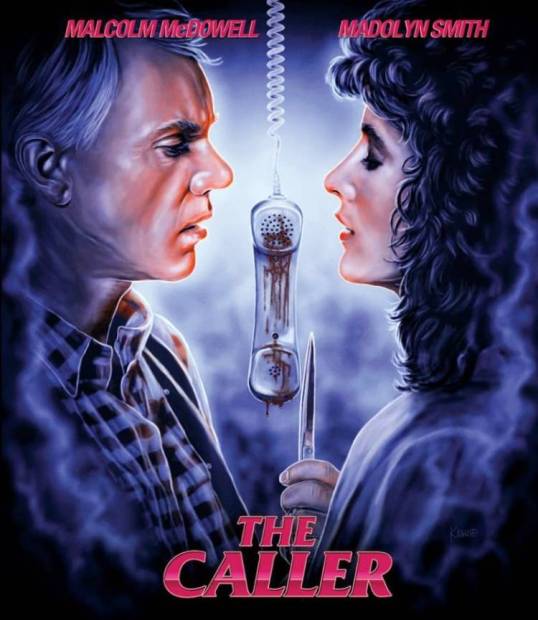
Horror Film Review: The Caller (dir by Arthur Allan Seidelman)


The Caller is a odd little film from 1987.

How odd is it?

It’s so odd that it’s difficult to know how to even describe it. On the surface, it’s a film about two people in a house. The Girl (Madolyn Smith) — and that’s how she’s credited at the end of the film — is staying in a secluded house in the woods. There’s a nearby town but, when the Girl stops there to get some gas, it’s impossible not to notice that there aren’t any other people around. When the Girl reaches the house, she makes a phone call and asks to speak to her daughter. From what we hear of her say to her daughter, it sounds as if The Girl is recovering from some sort of trauma.

After the Girl hangs up the phone, the Caller (played by Malcolm McDowell) knocks on her front door. The Caller seems to be a polite Englishman. He says that he’s recently had some car trouble and he asks if he can come in the house to use the Girl’s phone. The Girl lets him in but, as soon as The Caller enters, it becomes apparent that he was lying about having car trouble.

The Girl and the Caller talk. In fact, they spend several days talking. Sometimes, they’re friendly to each other and other times, they’re not. Their stories keep changing. At one point, the Caller claims that he’s a police detective and that he’s investigating a murder in the area. At another point, the Girl claims that she was responsible for the Caller’s car not working. We start to get the feeling that the Girl and the Caller might know each other and that each knows that the other is lying. Things get stranger as the night turns into day and then night again. The Caller appears to be leave but, just as mysteriously, he shows up again. The Caller tries to enter one particular room in the house. The Girl fights to keep him from doing so. The two of them taunt each other. Sometimes, they threaten each other. At times, they seem to be almost dependent on each other and you wonder if the Girl really wants the Caller to leave. They start keeping track of who is collecting the most points as they play a game that only the two of them seem to understand.

And it just keeps going and going. As many times as the Girl and the Caller both say that they’re done with conversation or that they’re leaving, neither can seem to abandon they other. Instead, they keep circling each other, like two trapped animals continually challenging one another for control. It all leads to a twist, one that you probably won’t see coming. Admittedly, the twist itself does seem to come out of nowhere but, because the film has been so weird up until that moment, the bizarre randomness of it all seems totally appropriate.

At times, The Caller can feel like a bit of an endurance test. McDowell and Smith are the only two people in the film and they spend the entire movie engaging in cryptic conversations that only seem to make sense to themselves. It’s not always easy to follow them as they go from one topic to another. Fortunately, both Smith and McDowell give excellent performances, ones that keep us guessing as to their true motivations and which also keep us interested in their enigmatic characters. You become invested in their drama, even if you don’t always understand it. The Caller is not a film for everyone but horror fans looking to take a chance on something a little different will be well-rewarded.

Horror on the Lens: Manos: The Hands of Fate (dir by Harold P. Warren)


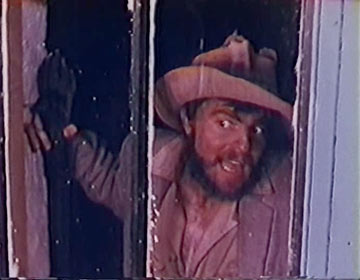
torgo

I should start things off with a confession.  This is actually not the first time that I’ve shared Manos: The Hands of Fate here on the Shattered Lens.  I previously shared it during the 2013, 2015, and 2020 Horrorthons and, each time, I even used the exact same picture of Torgo.

However, Manos proved to be such a popular choice that I simply had to post it again. Manos has a reputation for being one of the worst films ever made.  And, honestly, who am I to disagree?  However, it’s also a film that is so bad that it simply has to be seen.

(As well, I love regional horror and there are a few films as regional as Manos, a film that was filmed in my home state of Texas and directed by a fertilizer salesman.)

By the way, everyone who watches Manos ends up making fun of Torgo, who was played by John Reynolds.  What they may not know is that Reynolds committed suicide shortly after filming on Manos wrapped.  So, as tempting at it may be to ridicule poor Mr. Reynolds’s performance, save your barbs for Torgo and leave John Reynolds alone.

And be sure to enjoy Manos: The Hands of Fate!