Horror on the Lens: Night of the Ghouls (dir by Edward D. Wood, Jr.)


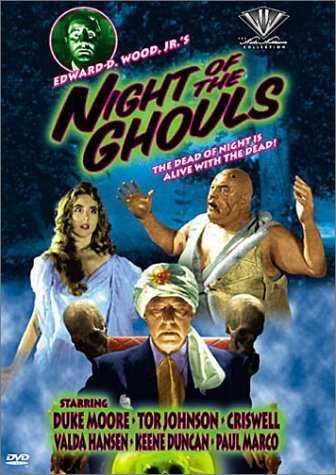
GhoulsdvdToday’s movie is Ed Wood’s sequel to Bride of the Monsters.  In Night of the Ghouls, con man Dr. Alcula (Kenne Duncan) moves into Bela Lugosi’s old mansion and pretends to talk to the dead.  What Alcula doesn’t realize is that the house is actually haunted (by Tor Johnson’s Lobo, among others) and real ghosts don’t appreciate pretend ghosts.

What can you say about a film like of Night of the Ghouls?  It’s an Ed Wood film, with all that suggests.  However, how can you resist a film that starts with Criswell sitting up in his coffin and providing commentary?

The role of Dr. Alcula was originally written for Bela Lugosi.  After Lugosi’s death, veteran actor and longtime Wood friend Kenne Duncan got the role instead.  Also of note, Wood appears twice in this film.  Not only does his picture appear on a wanted poster in the police station but Wood also plays one of the ghouls.

October Positivity: Pamela’s Prayer (dir by Dave Christiano)


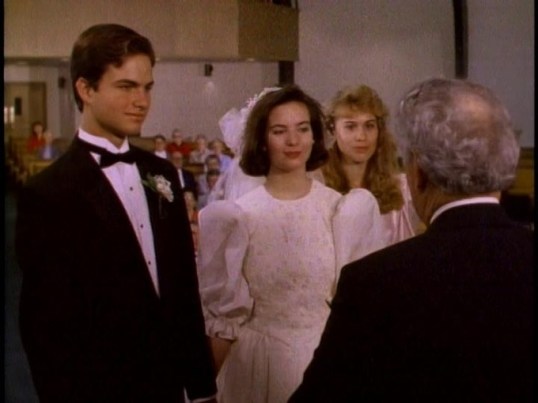
The 1998 film, Pamela’s Prayer, opens with a title card that informs us that “Pamela Bucklin” got married in 1992 when she was 22 years old.  It’s a bit of an odd opening, because I imagine that there were a lot of 22 year-olds who got married in 1992.

The film then flashes back to the 70s and we learn that, after her mother died in childbirth, Pamela was raised by her father, Wayne (Rick Scheiderman).  Wayne works at the family business, a Christian film library which specializes in sending films (like this one!) to church groups and evangelical retreats.  Wayne prays with Pamela every night.  As Pamela grows up, he makes clear to her that she’s to wait until marriage.  From Wayne’s point of view, that means no dating, no kissing, no male friends at all.  Needless to say, once Pamela becomes a teenager, she starts to resent Wayne’s protectiveness but, since this is a faith-based film, Pamela’s rebellion is not only very chaste but it only lasts for one night and it leads to a sleazy boy spreading rumors about her.  Later, that same boy goes on a date with Jessica, who is also Pamela’s best friend, and things do not end well.  When Pamela informs Wayne about all of this, Wayne can barely suppress smirk.  It’s a real “I Told You So” moment.

Fortunately, there’s a nice boy working at the Christian Film Library and eventually, he and Pamela have one of those courtships where they don’t even hold hands.  After getting Wayne’s permission, they marry.  (Jessica, being the maid of honor, can only wonder why she has yet to find the one.)  Having waited 22 years to even kiss a boy, Jessica decides that she can wait for a few minutes more and she calls her father …. ON HER WEDDING NIGHT! …. so that they can pray together over the phone.

I think that I’ve proven over the years that I can be fair when it comes to judging faith-based films on their own merits but seriously, Pamela’s Prayer is exactly the type of faith film that drives other people crazy.  I mean, don’t get me wrong.  Some people choose not to have sex before marriage and, if that’s their decision, that’s fine.  Personally, I think it’s a bit foolish to go into a commitment like marriage blind but whatever.  The problem with Pamela’s Prayer, though, is that its emphasis on purity feels rather cult-like and it’s never really Pamela’s decision not to date or to kiss.  Instead, it’s all due to Pamela’s father ordering her to wait.  One gets the feeling that Pamela spent the first 22 years of her life being controlled by father and now she’ll spend the next 60 or 70 years being controlled by her husband.  What does Pamela want?  The film seems to suggest that it really doesn’t matter.

Christian films always seem to struggle when it comes to dealing with sex.  I guess it’s understandable when you consider that, especially in the 90s, the majority of these films were made to be shown at church meetings and to youth groups.  An honest discussion about sex and attraction and the suggestion that sex can be more than just a marital obligation would probably have scandalized the film’s target audience.  That’s one reason why films like this always seem to resort to the best friend who gets “in trouble.”  In this film, it leads to a telling of the story of Jesus and the woman accused of adultery, with the emphasis being not on Jesus ordering people not to cast stones but instead on Jesus saying, “Go and sin no more.”  To me, that’s missing the most important part of the story.  Don’t throw stones, people!

In the end, Pamela’s Prayer is about as effective as an old purity ring.

The TSL’s Horror Grindhouse: Creature of Destruction (dir by Larry Buchanan)


In this 1967 film from venerable B-movie director Larry Buchanan, a psychic con artist uses hypnosis to bring back into existence a prehistoric, humanoid amphibian.

Wait?

What?

Okay, so the story doesn’t make much sense.  In fact, I would be lying if I said that I fully understood the film, despite the fact that I sat through all 88 minutes of it on Saturday night.  Basically, Dr. Basso (Les Tremayne) is a hypnotist and an occult historian.  He’s bitter about the fact that the world doesn’t appreciate him or take him seriously, despite the fact that he spends almost the entire film wearing a tuxedo and he has a head of silver hair that would have made even the great Criswell jealous.  So, Basso decides that the best way to prove his powers would be start predicting when people are going to die.  And the way he does that is by hypnotizing his assistant, Doreena (Pat Delaney).

Somehow, hypnotizing Doreena causes this prehistoric humanoid monster thing to rise out of the nearby lake so that it can kill whoever Dr. Basso wants dead.  It’s interesting that Dr. Basso could figure out how to bring an extinct creature back to life but he could come up with a less destructive way to prove his powers.  This is just my opinion but it seems like he could have just displayed the prehistoric monster and that would have proven his powers far more effectively than committing murders.  Dr. Basso’s plan is needlessly complicated.  Neither Dr. Basso nor the film ever seem to consider what would happen if he was asked to prove his powers while performing somewhere that wasn’t conveniently located near a lake.  If Dr.  Basso ever plays Vegas, he’s in trouble.

Anyway, it falls of Lt. Blake (Roger Ready) and Captain Dell (Aron Kincaid) to figure out how to stop Dr. Basso.  Captain Dell is not just an expert on the occult but he’s also an Air Force psychiatrist, so he goes through the entire movie wearing his uniform.  Dell being in the Air Force doesn’t really figure into the plot otherwise.  He could just as easily be in private practice.  One gets the feeling that he was made an Air Force captain just because someone had the uniform and it looked good on Aron Kincaid.

Creature of Destruction is a fairly confusing film.  Unfortunately, it’s also a rather boring film.  Larry Buchanan was a prolific director but he was never a particularly good one.  Some directors knew how to take advantage of a low budget and less than compelling actors.  Unfortunately, Buchanan really wasn’t one of them.  Still, the lake scenery is nice and it’s kind of fun to watch the monster waddle across the screen.  As  well, there are two musical interludes that come out of nowhere but which are amusing in a late 60s beach movie sort of way.  So, the film has that going for it.  Otherwise, not even hypnosis will help you get through Creature of Destruction.

Shrieker (1998, directed by David DeCoteau)


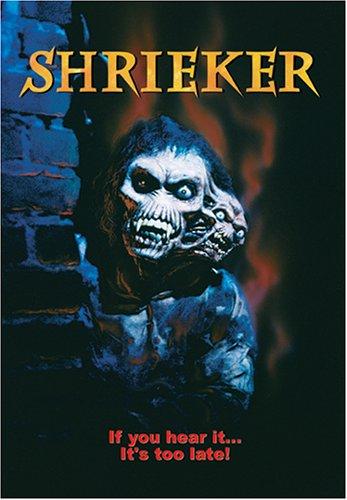
Six college students decide to stick it to the man by avoiding pricey dorm living and instead squatting in an abandoned hospital.  That makes sense because we all know that college is too damn expensive and that student housing is rip-off.  The students may have made a mistake picking the hospital, though.  Guess what?  That hospital was abandoned for a reason!  Years ago, a “shrieking” murderer killed all of the doctors and the nurses.  Some say the murderer was a crazed patient while others say it was a monster summoned by Satanists.  No sooner has mathematics major Clark (Tanya Dempey) moved into the hospital than everyone starts to hear the sound of shrieks coming from the basement.  Not only is there someone else already living in the basement but, somehow, the Shrieker has also been summoned!  Once people start dying, the suspicion is directed at Clark because she’s the newest resident.  But Clark thinks that, thanks to her skill with numbers and computers, she’s figured out who is actually responsible and how the Shrieker selects its victims.  She may have even figured out how to defeat the Shrieker but will she be able to get anyone to listen to her?

From Charles Band’s Full Moon Entertainment, this is one of those low-budget direct-to-video horror films that used to show up on late night Cinemax.  Unfortunately, it’s pretty tame, with none of the gore or anything else that we typically associate with Full Moon Entertainment.  The Shrieker itself looks good but it’s never around for long and too many of its attacks are just filmed as a sudden close-up of the Shrieker’s face.  The characters are all obnoxious but most of them die so it’s not a problem.  Alison Cuffe plays the role of the token communist with a lot of relish but it’s hard not to wonder what Linnea Quigley could have done with that role.  That would have been something to shriek about.

International Horror Film: Robo Vampire 3: Counter Destroy (dir by Godfrey Ho)


In 1989, Hong Kong director Godfrey Ho made what might be the most confusing film of all time.  It has been released under many different name.  The Vampire Is Still Alive was one.  Another was Counter Destroy.  And finally, there’s  the title that I’m choosing to use for this review — Robo Vampire 3!  This is indeed the third part of the Robo Vampire trilogy, though the guy in the robot suit doesn’t show up until the very end of the movie and even then, it’s never quite clear whether he’s really there or if he’s just a figment of someone’s imagination.

Robo Vampire 3 is actually two movies in one.  Half of the film deals with a private detective named Jackie.  Jackie has been hired by a movie mogul named Lawrence.  Lawrence is producing a film about the last emperor of China but, apparently, there are several other film companies that want to make a movie about the same subject.  (Uhmmm, guys …. Bernado Bertolucci beat all of you to it by about two years.)  Lawrence is concerned that the other film companies and their gangster allies are going to try to disrupt his production so he hires Jackie to find out what their plans are.  Jackie accepts the assignment and then go around killing all of the other studio heads and gang bosses.  Jackie is presented as being one of the film’s heroes, even though she’s basically just tracking down middle-aged men and murdering them in cold blood.  Now, in fairness to Godfrey Ho, the efforts of the Triads to control the Hong Kong film industry are fairly well-documented so, when seen in that context, Lawrence and Jackie’s action might make more sense.  It’s still kind of jarring to watch Jackie assassinate a man, at close range, with a crossbow.

Meanwhile, Joyce has been assigned to write the script for Lawrence’s Last Emperor movie and she’s been given a week to do all the research and get the script done.  Joyce and her assistant, Cindy, are working in a villa.  However, after Joyce and Cindy have a conversation with a mysterious monk, a scarred guy who has a Freddy Krueger-style glove knife shows up at the villa and starts to haunt Joyce’s nightmares.  Meanwhile, a bunch of hopping vampires (in Chinese folklore, vampires hop) are approaching the house.  Who do they work for?  Are they connected to all of the other productions of The Last Emperor?  Are they college students who have been brainwashed by Bertolucci’s Marxist cinema?  It’s never really made clear.

But where is Robo Vampire?  As I said, he shows up eventually.  Long after Joyce has been possessed by an evil spirit and it appears that the film set is going to be overrun by hopping vampires, the director of this film’s version of The Last Emperor suddenly spins around and is transformed into the cyborg Shadow Warrior dude from the previous two films.  No one is particularly shocked when this happens.

As you may have guessed, Robo Vampire 3 is a bit of a disjointed film but it’s pretty much what we’ve come to expect from Godfrey Ho.  One gets the feeling that Robo Vampire 3 was stitched together with stock footage and outtakes from several unrelated movies.  It also wouldn’t surprise me to discover that there were several different versions of the film out there.  The version I saw was badly dubbed so who knows what the film’s plot actually was.  The whole thing has a “make it up as you go along” feel to it.  With the previous Robo Vampire films, the shoddiness was kind of charming but Robo Vampire 3 takes forever to get going.  It needed more hopping vampires.

As far as I know, this was the last Robo Vampire film.  Hopefully, Robo Vampire’s version of The Last Emperor was a big enough success that he could retire from shadow warrioring and devote himself to cinema.  Now, that’s a happy ending!

Horror Film Review: The Fog (dir by John Carpenter)


“Time for one more story,” Mr. Machen (John Houseman) declares the beginning of John Carpenter’s 1980 horror film, The Fog.

Mr. Machen is a resident of Antonio Bay, California, a coastal town that was founded with the help of gold stolen from a ship that was owned by a wealthy man named Blake (Rob Bottin). Blake wanted to start a leper colony. Instead, he was betrayed by six sailors who sank Blake’s ship, stole the gold, and used it to start the town of Antonio Bay.

At 12 midnight, on the day that the town is to celebrate its 100 anniversary, strange things start to happen. Windows shatter. Masonry falls from walls. A thick fog rolls across the ocean and seems to move from house to house. Inside the fog are several angry spirits, led by Blake. They not only want their gold back but they also want to take six lives as a way of getting revenge on the six conspirators who stole their gold and sank their ship.

It all starts with knock at the door and, if you look out a window, maybe you’ll see a dark shadow standing in an all-enveloping fog. Answering the door is a mistake. At the same time, so is not answering the door. It’s not easy to escape the vengeful spirits in the fog.

The Fog (1980, dir by John Carpenter, DP: Dean Cudney)

The Fog plays out like a disaster film, albeit one with a supernatural twist. The film follows several characters who are trying to survive the night and the majority of them don’t even meet until the final half of the film. There’s a truck driver (Tom Atkins) and a hitchhiker (Jamie Lee Curtis). There’s the alcoholic priest (Hal Halbrook) and the chairwoman (Janet Leigh) of the anniversary committee. Nancy Loomis, who co-starred with Curtis in Carpenter’s Halloween, plays an administrative assistant while Carpenter’s wife, Adrienne Barbeau, plays the local radio DJ whose son is briefly targeted by the fog. There’s even a coroner named Dr. Phibes!

In fact, the whole film is full of references to other films. The Fog finds John Carpenter in a rather playful mood, with characters named after Carpenter associates like Dan O’Bannon, Tommy Wallace, and Nick Castle. There’s even a mention of Arkham, the fictional New England town that served as the setting for many of H.P. Lovecraft’s stories.

42 years after it was made, The Fog holds up as a very well-told ghost story. I mean, fog is just creepy in itself. Then you add in a bunch of silent shadows standing in the fog and it gets even scarier! For the most part, the actors all do a good job playing rather thinly-drawn characters. Tom Atkins is always fun to watch! The true stars of the film, of course, are the ghosts and they will definitely give you nightmares.

The Fog is a good film for Halloween viewing so watch it and don’t answer the door!

The Fog (1980, dir by John Carpenter, DP: Dean Cundey)

(Don’t just take my word for it!  Be sure to read Leonard’s review of The Fog!)
Horror on the Lens: Bride of the Monster (dir by Edward D. Wood, Jr.)


Bride of The Monster (1955, dir by Ed Wood)

Since yesterday was the great man’s birthday, it seems appropriate that today’s horror film on the lens is Edward D. Wood’s 1955 epic, Bride of the Monster.

(Much like Plan 9 From Outer Space, around here, it is a tradition to watch Bride of the Monster in October.)

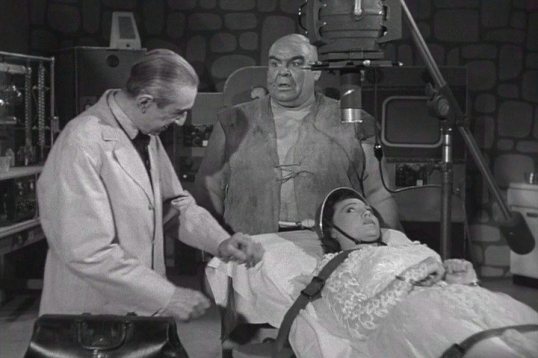
The film itself doesn’t feature a bride but it does feature a monster, a giant octopus who guards the mansion of the mysterious Dr. Vornoff (Bela Lugosi).  Vornoff and his hulking henchman Lobo (Tor Johnson) have been kidnapping men and using nuclear power to try to create a race of super soldiers.  Or something like that.  The plot has a make-it-up-as-you-go-along feel to it.  That’s actually a huge part of the film’s appeal.

Bride of the Monster is regularly described as being one of the worst films ever made but I think that’s rather unfair.   Appearing in his last speaking role, Lugosi actually gives a pretty good performance, bringing a wounded dignity to the role of Vornoff.  If judged solely against other movies directed by Ed Wood, this is actually one of the best films ever made.

(For a longer review, click here!)

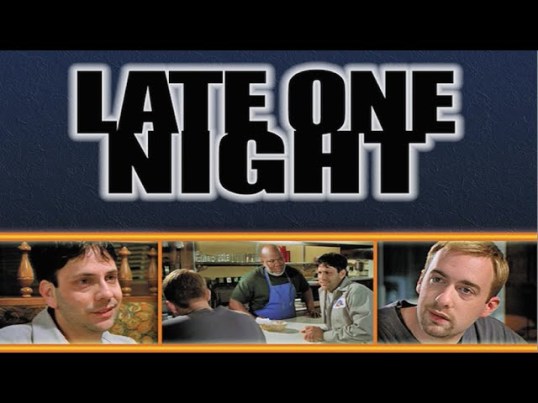
October Positivity: Late One Night (dir by Dave Christiano)


The 2001 film, Late One Night, takes place in a diner.  As you can probably guess from the title, it also takes place late one night.  It’s so late that there are only five people in the diner.  There’s a cook.  There’s three men who work at a local factory, the main one of which is named Larry (Brad Heller).  And then, there’s a quiet guy (John Gaffga) sitting at the counter.  Though the guy never introduces himself, Larry decides to call him Jesus.

To say that Larry is a bit of an obnoxious character really doesn’t do justice to just how grating a human being Larry is.  At work, Larry sexually harasses the only woman working at the factory.  In the diner, he sexually harasses a waitress as her shift ends.  When he sees the quiet man sitting at the counter, Larry starts to harass him.  Larry is angry.  Larry, as we learn, was abandoned by his father, raised by an unstable mother, and he spent several years in jail before ending up at a go-nowhere job at a bottling factory.  Larry has his reasons but that doesn’t make him any more likable.

In fact, Larry is such a jerk that you kind of wonder why the cook even allows him to hang out in the diner.  From the dialogue, it becomes clear that Larry has a long history of harassing people.  At one point, Larry does point out that he spends a lot of money at the diner but you have to consider how many people probably avoid the place whenever they see Larry and his co-workers sitting in their booth.  No matter how much money Larry spends, it seems likely that he keeps even more money out.  Really, the cook should call the cops whenever he sees Larry and maybe slap with him a trespassing charge.  I imagine Larry probably isn’t even a good tipper.

Anyway, on this night, Larry is obsessed with the quiet stranger.  When the stranger briefly goes into the restroom, Larry searches the stranger’s jacket and finds a pamphlet about Christianity.  When the stranger returns, he’s been given the nickname “Jesus” and he now has to deal with Larry mocking him by asking, “Am I going to Hell when I die?”  “Jesus” controls his temper, no matter how much he is taunted.

If you’ve seen any other films from director Dave Christiano, you might be excused for expecting “Jesus” to reveal himself to actually be Jesus.  In this case, though, I think he’s simply meant to be a believer who simply wants to eat in peace.  For that matter, you might also expect the film to end with Larry converting but instead, he’s as confused and angry at the end of this short film as he was at the beginning.  Particularly when compared to the films that he was making in the 80s and the 90s, Late One Night shows a certain dramatic restraint on the part of Christiano.  The main theme, of course, still seems to be that non-believers are going to suffer forever but, for once, Christiano doesn’t seem to be asking the viewer to take any pleasure out of that.

That said, I do have to say that, in college, I spent a lot of time in a lot of late night diners and I never once saw anyone get into the type of random verbal altercation that Larry gets into in this film.  I kind of suspect that might not happen in the real world as often as it happens in the movies.

The TSL’s Horror Grindhouse: Studio 666 (dir by B.J. McDonnell)


In Studio 666, the members of Foo Fighters play themselves.  Struggling with writer’s block and hoping to remain musically relevant in a world where the culture belongs to the young, the band heads to an Encino mansion so that they can work on their latest album.  The mansion is infamous because years ago, another band was murdered while attempting to record there.  (Oddly enough, Jenna Ortega plays the drummer of the murdered band.  Ortega had quite a year as far as the horror genre is concerned.)

The band arrives at the mansion and things quickly go downhill.  The band isn’t getting along.  Lead singer Dave Grohl is revealed to be a bit of megalomaniac.  One of the band’s electricians is killed in what appears to be a freak accident.  Most people would move out of a house after someone dies under mysterious circumstances but not this band!  Instead, the band decides to dedicate the album to the memory of the dead guy.

Soon, however, there are a lot more dead people at the mansion.  Why are there so many dead people there?  This is going to sound like a spoiler but it’s not….

DAVE GROHL IS KILLING THEM!

Yes, Dave Grohl has been possessed by the evil spirit of mansion.  On the one hand, it’s given him the inspiration necessary to get over his writer’s block.  On the other hand, it also leads to him killing the other members of the band in various grotesque ways.  Studio 666 is a horror comedy that doesn’t shy away from the gore.  If you’ve ever wanted to see a member of Foo Fighters get cut in half with a chainsaw while having sex with Whitney Cummings, I guess this is the film to track down.  (Cummings, I should note, does not play herself.  This film stars the band as themselves but it’s also filled with recognizable actors who are not playing themselves.)

Studio 666 is a bit of a lark, a horror film starring a band that most people don’t really associate with the horror genre.  Indeed, a good deal of the film’s humor comes from the fact that it’s Dave Grohl doing all of the killing.  In real life, a good deal of Dave Grohl’s appeal is that he comes across as being as close to a regular guy as a rock star can be.  He’s one those famous guys who most people could imagine having a beer with.  Studio 666 gets a lot of mileage out of presenting Dave Grohl as being a pretentious taskmaster who would happily sell his soul for the chance to have a successful solo career.  It helps that Dave Grohl seems to be having a blast playing such an exaggerated version of himself.  It’s hard not to be happy for him because he really does appear to having the time of his life.

That said, once Grohl is revealed to be the killer (and that happens very early in the film so, again, this is not a spoiler), the film really has nowhere else to go.  The whole thing simply becomes Grohl tracking down various members of the band and killing them in grotesque ways and it gets to be a little boring.  There’s little suspense and, since the Foo Fighters are playing themselves, there really aren’t any stakes because we know the band wasn’t actually murdered while recording a new album.  With a 106-minute running time, Studio 666 really grinds its one joke into the ground.

I will say that longtime fans of Foo Fighters will probably enjoy the film, if just because there’s several jokes and comments that are obviously meant to be inside jokes that only a select few will get.  Personally, I think it’s nice that the band did something for the fans, even if the movie itself doesn’t really work.

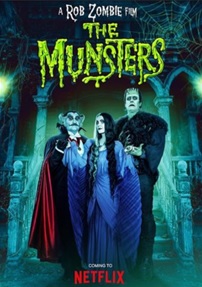
The Munsters (2022, directed by Rob Zombie)


Have you ever wondered how Herman and Lily Munster came to live at 1313 Mockingbird Lane?

No?

That’s too bad, because Rob Zombie is going to tell you anyways.

Rob Zombie’s The Munsters is a prequel to the 60s sitcom of the same name.  It shows how Herman Munster (Jeff Daniel Phillips) came to be created, how he became a Rob Zombie-style rock star, and how he overcame the opposition of the Count (Daniel Roebuck) and married Lily (Sheri Moon Zombie).  It also shows how Lily’s brother, Lester (Tomas Boykin), tricked Herman into signing over the deed for the Count’s castle in Transylvania.  There’s not much of a plot but there was never much of a plot when it came to the original sitcom either.  Just like the show that the movie is based on, The Munsters exists to show classic monsters making corny jokes and freaking out at the prospect of dealing with what the rest of the world considers to be normalcy.  Unlike the multi-faceted Addams Family, The Munsters have always been a one-joke family.

There have always been elements of satire and subversive humor in everything that Rob Zombie has done, as both a musician and a director.  Those who claim that Rob Zombie does not have a sense of humor are mistaken.  However, the comedy in The Munsters is deliberately broad and vaudevillian, like the show on which the movie is based.  As a director, Zombie doesn’t always seem to know how to best present that type of humor.  The Munsters is the rare movie that would have benefitted from a laugh track because the jokes are definitely sitcom-level.  They were designed to be followed by canned laughter.  Zombie’s affection for the material and the characters come through and the deliberately artificial production and costume design actually works better than I was expecting but, at nearly two hours, The Munsters often feels directionless.  

Jeff Daniel Phillips and Daniel Roebuck do adequate imitations of Fred Gwynne and Al Lewis, respectively, but its Sheri Moon Zombie who steals the show, bringing a lot of mischievous energy to Lily.  Of the principle cast, Sheri Moon Zombie is the only one makes her character feel like something more than just a tribute to an old sitcom.  The camera loves her and she convinces us that she loves Herman, no matter how childishly he behaves.

One final note: Sylvester McCoy — the seventh doctor, himself! — plays the Count’s assistant, Igor.  McCoy doesn’t get to do much but it was still good to see him.  Igor was the type of role that Tom Baker used to specialize in before he was cast as the Fourth Doctor.  By casting McCoy as Igor, it almost felt as if Zombie was keeping the role in the family.