International Horror Review: Robo Vampire 2: Devil’s Dynamite (dir by Godfrey Ho)


There are some films that just defy description.

Sometimes, as with the films of David Lynch, it’s because the films themselves are so surreal and visually stunning that there’s no way to actually describe them.  They have to be experienced.  The same can be said of films that are so experimental and unique that they simply have to be watched.  For instance, if I told you that Derek Jarman’s final film Blue, was 70 minutes of people talking over a blue screen, you’d probably think it was pretty boring.  But if you’ve actually seen the film, you know that the opposite is true.

And then there are films that are impossible to describe because they don’t make any damn sense.  These are films where the storyline is so nonsensical and the direction is so random and the editing is so ragged that it is essentially impossible to understand what’s going on from one scene to the next.  That brings us to 1987’s Robo Vampire 2: Devil’s Dynamite.

And really, it shouldn’t be a surprise that Robo Vampire 2 is impossible to follow.  It was directed by Godfrey Ho, the Hong Kong director who built a career out of his ability to build a brand new film out of stock footage and unused takes from other movies.  If Robo Vampire 2 feels like it’s a dozen different films rolled into one, that’s probably because it actually is a dozen different films rolled into one.

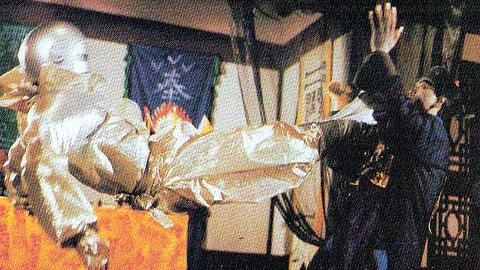
As you can tell from the title (one of the many titles that the film was released under), this film was sold in a few territories as being a sequel to Robo VampireRobo Vampire 2: Devil’s Dynamite does feature a cop who wears a uniform that makes him look like a knock-off Robocop and it does feature vampires but otherwise, it has little in common with the first Robo Vampire.  (Indeed the cop is actually referred to as being the Shadow Warrior, instead of a cyborg as was the hero of Robo Vampire.Robo Vampire 2 deals with the plans of Madame Mary (Angela Mao), who is concerned that her criminal empire will be taken down by a combination of the cops and a rival gangster named Steve (Tsung Hua).  Madame Mary employs a monk who creates an army of vampires.  When the vampires go on a rampage, killing cops and threatening random children, Alex (Lin Yun) turns into Shadow Warrior and fights them off.

Interestingly, no one is surprised to see the Shadow Warrior, so I guess he’s a pretty well-known figure.  But it’s never really clear whether everyone also knows that Alex is the Shadow Warrior nor is it ever that clear just how exactly Alex became the Shadow Warrior in the first place.  (The film’s title would seem to suggest that Alex is the meant to be the same hero from the first Robo Vampire but the hero from the first Robo Vampire was a cyborg whereas Alex is not.)  Even more surprisingly, no one is shocked by the sudden appearance of the vampires so I guess vampire attacks are a common thing in the world of Robo Vampire 2.  Why would Hong Kong’s biggest crime lord need to create any army of vampires in the first place?  The film never quite says.

That said, there are a few entertaining fights.  Even better, the vampires hop from place to place and they usually have their arms extended in front of them, like kids pretending to be zombies.  That’s actually kind of fun to watch.  If you’re going to unleash any army of vampires on a town, at least make sure they hop.
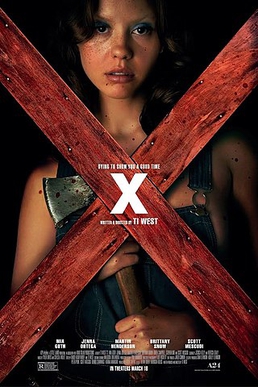
Horror Film Review: X (dir by Ti West)


The year is 1979 and the easiest way to get rich and become a star is to appear in a porno film.  At least, that’s what Maxine (Mia Goth) and her older boyfriend, Wayne (Martin Henderson), think.  Wayne’s the producer.  Maxine is one of the stars.  The name of the movie is going to be The Farmer’s Daughter and it’s going to star Jackson Hole (Kid Cudi) as a man who stumbles across as a farm and gets to know the farmer’s daughters, played by Maxine and Bobby-Lynne (Brittany Snow).  Directing the film will be a film student-turned-director named RJ Nichols (Owen Campbell).  Holding the boom mic and otherwise helping out will be RJ’s girlfriend, Lorraine (Jenna Ortega).  Lorraine may say that she’s not impressed with the idea of working on a pornographic film but everyone an tell that’s a lie.  Everyone except for RJ, of course….

Wayne has even found a farm where they can shoot.  The farm belongs to Howard (Stephen Ure) and Pearl (Mia Goth, made up to look like she’s in her 80s).  Howard suspects that Wayne is making an adult film and he doesn’t exactly approve of it but it also appears that he and Pearl could use the money.  Howard warns Wayne not to bother Pearl while they’re filming.  However, it doesn’t take long for Pearl to wander out of the house and to discover what’s going on in the guest house.  That night, people start to die….

X caused quite a stir when it was released earlier this year, with critics declaring it be a horror classic.  I finally watched the film last week.  X is undeniably a well-made film and it deserves a huge amount of  credit, in this repressed era of trigger warnings, for not holding back on either the violence or the sex.  Mia Goth deserves all of the praise that she’s received for playing both Pearl and Maxine.  At first, it might seem like stunt casting to cast Goth in both roles but actually, it works well with the film’s subtext.  Pearl wants to kill Maxine (and her friends) because they represent the youth that she’s lost.  Maxine initially fears Pearl because she represents the inevitability of getting older.  Unless you die young, you’re going to get old and much of Maxine’s actions are all about doing whatever it takes not to get old.  If that means running straight into danger while fueled only on cocaine and fury, that’s what Maxine is going to do.  The cocaine that Maxine snorts is as important to the story as Pearl’s resentment, Wayne’s greed, and the preacher who continually appears on television.  Maxine probably couldn’t do half of what she does in the film if she wasn’t continually snorting coke and it’s significant that the other characters in the film remain relatively drug-free.  Cocaine is a drug for those who want to confident and free of the worries and the self-doubt that comes with age.  X becomes a film about the battle between the young and the old, a conflict that has defined much of recent history as the younger generation wonders when the older generation is finally going to surrender their power.

At the same time, it’s hard not to feel that the film itself was a bit overpraised by critics who were stunned to discover that a horror film could feature good acting, carefully composed shots, and clever editing.  Judging from some of the reviews, you would get the feeling that some of these critics have never seen a subversive horror film before.  X is a well-made slasher film that refuses to buy into the old trope that one has to be an innocent or a good person to survive a film like this.  Indeed, the biggest mistake that people make in X is to trying to do the right thing.  But it’s hardly the first film to comment on the rules of the genre by breaking them.

In the end, the most important thing about X is that it’s an effective and well-made horror movie.  Visually, the film does a great job of capturing the isolation of rural Texas and all the members of the cast do a good job bringing their characters to life, even if some of the country accents a bit overdone.  Martin Henderson is amusing playing a role that seems like it was written for Matthew McConaughey and Jenna Ortega does a good job playing a character who manages to be both annoying and sympathetic.  (She’s far better here than she was in The Fallout.)  The film ultimately belongs to Mia Goth, playing two different characters who both seem destined to meet the same fate.

As far as Ti West horror films go, X is never as energetic or as much fun as The House of the Devil.  But still, it’s a good rural slasher film.

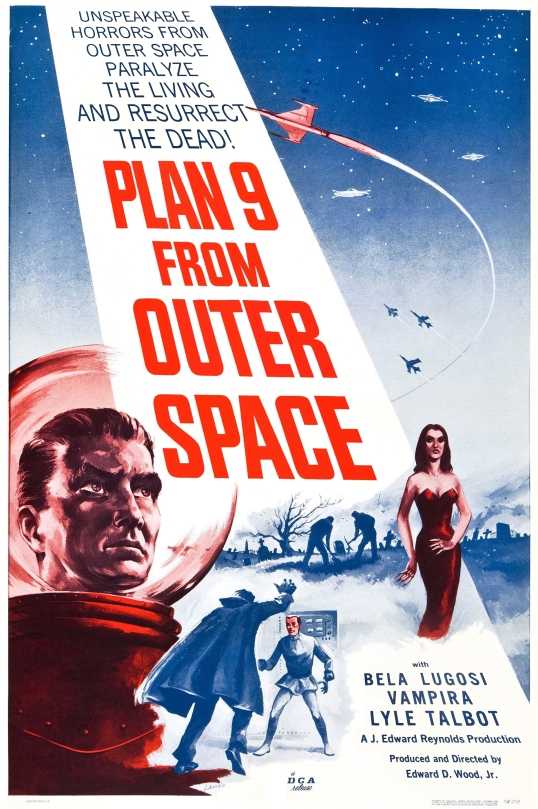
Horror on the Lens: Plan 9 From Outer Space (dir by Edward D. Wood, Jr.)


Viewing Plan 9 From Outer Space during October is a bit of a tradition around these parts and here at the Shattered Lens, we’re all about tradition.  And since today is the 97th anniversary of the birth of Ed Wood, Jr., it just seems appropriate to watch his best-known film.

Speaking of tradition, this 1959 sci-fi/horror flick is traditionally cited as the worst film ever made but I don’t quite agree.  For one thing, the film is way too low-budget to be fairly judged against other big budget fiascoes.  If I have to watch a bad movie, I’ll always go for the low budget, independent feature as opposed to the big studio production.  To attack Ed Wood for making a bad film is to let every other bad filmmaker off the hook.  Ed Wood had his problems but he also had a lot of ambition and a lot of determination and, eventually, a lot of addictions.  One thing that is often forgotten by those who mock Ed Wood is that he drank himself to death and died living in squalor.  The least we can do is cut the tragic figure some slack.

Plan 9 From Outer Space is a ludicrous film but it’s also a surprisingly ambitious one and it’s got an anti-war, anti-military message so all of you folks who have hopped down the progressive rabbit hole over the past few years should have a new appreciation for this film.  I mean, do you want the government to blow up a Solarnite bomb?  DO YOU!?

Also, Gregory Walcott actually did a pretty good job in the lead role.  He was one of the few members of the cast to have a mainstream film career after Plan 9.

Finally, Plan 9 is a tribute to one man’s determination to bring his vision to life.  Ed Wood tried and refused to surrender and made a film with a message that he believed in and, for that, he deserves to be remembered.

Now, sit back, and enjoy a little Halloween tradition.  Take it away, Criswell!

Can you prove it didn’t happen?

WELL, CAN YOU!?

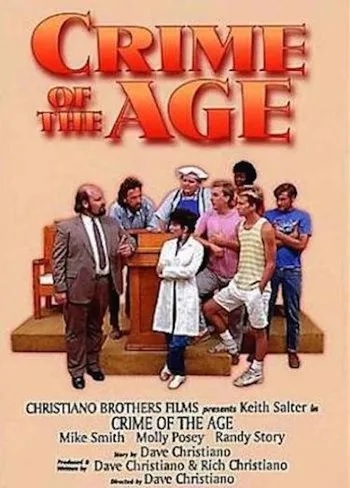
October Positivity: Crime of the Age (dir by Dave Christiano)


“Do you like carrots?”

The question gets asked a lot over the course of the 1988 film, Crime of the AgeCrime of the Age deals with the theft of a book.  The director of the local Christian summer camp discovers that someone broke into his office and stole a book called How To Be A Christian.  The only clue is a carrot, which was left behind by the thief.

When the Detective (played by Keith Salter, who has previously played the world’s most obnoxious atheist in The Daylight Zone) shows up, he takes a look at the carrot.  He realizes that the carrot is the only clue that he and the Director have towards solving a very serious crime.  As the Detective explains it, only someone on staff could have stolen the book.  And that means that one of the staff members is …. wait for it …. NOT A CHRISTIAN!

*Cue the Dramatic Music*

No, seriously, I’m not kidding.  There are a lot of dramatic music cues in this film.

The Detective proceeds to interview the rest of the staff.  He asks them all if they saw anything suspicious.  He asks them what they were doing the previous night.  He asks them all if they like carrots.  Every member of the staff says that they saw someone else going into the director’s office.  Every member says that they like carrots.  Every member reveals something that leads the Detective to doubt their faith.

“That’s odd,” the detective says to himself, after one interview, “A Christian who only listens to music.”

“That’s odd,” the detective says after another interview, “A Christian who doesn’t like to go to church.”

After talking to the Groundskeeper, the detective says to himself, “That’s odd.  A Christian who doesn’t care about sin.”

You may be getting the feeling that this is a bit of repetitive movie and indeed, the dialogue is made up of about five or six lines that are continually repeated from scene to scene.  On the one hand, the structure mirrors any number of Biblical parables.  On the other hand, it doesn’t make the conversations sound any less awkward.  Of the suspects, the Groundskeeper is the only one who manages to project any sort of individual personality and that’s because he seems to be so genuinely annoyed with the whole thing.  While everyone else is very polite about being asked if they like carrots, the Groundskeeper replies, “Yeah, I like carrots!” with a tone that suggests that he’s prepared to throw a punch over it.

This is another early Christian film from the Christiano Brothers.  Like almost all of their films, the film is disguised as a genre film but the main message is that everyone is one misstep away from going to Hell.  If you’re not excited about going to Church, you’re going to Hell.  If you don’t talk about your faith with everyone you meet, you’re going to Hell.  If you only listen to music, you’re going to Hell.  And I presume that if you steal a book, you’ll be going there as well.  Despite the film’s attempts at comedy, it’s a bit of a harsh message.  For the most part, the cast looks like they had fun shooting the film and that’s always a plus.  But I have to confess that I’ve never liked carrots.

The TSL’s Horror Grindhouse: Night of the Ghouls (dir by Edward D. Wood, Jr.)


Night of the Ghouls (1958, dir by Edward D. Wood, Jr)

From the one and only Edward D. Wood, Jr. …. it’s Night of the Ghouls!

Night of the Ghouls begins with Criswell, the “psychic” who also provided the introduction for Wood’s best known film, Plan 9 From Outer Space, sitting up in a coffin and telling us that we’re about to see a film about the dead and the problems of everyday Americans. This is followed by one of Wood’s trademark stock footage montages. Cars crash. Teenagers fight. Drunken bums stare at the camera. It’s a scary world out there!

And it’s about to get scarier. The police have received reports that a deserted old mansion that was previously destroyed by lightning has been rebuilt! Lt. Dan Bradford (Duke Moore) is assigned to investigate the case with the help of cowardly Patrolman Kelton (Paul Marco). Bradford was called away from the opera so he wanders through the entire film in a tuxedo. Apparently, this case is so important that he couldn’t even change clothes before investigating.

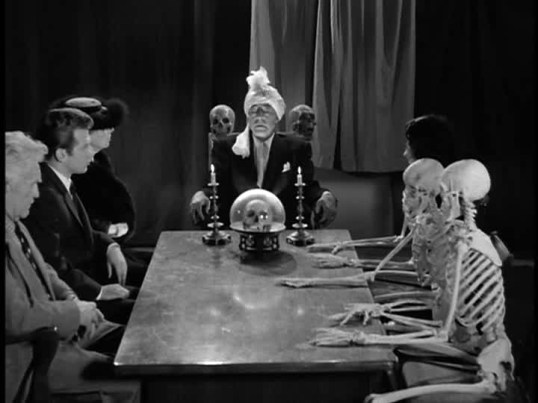
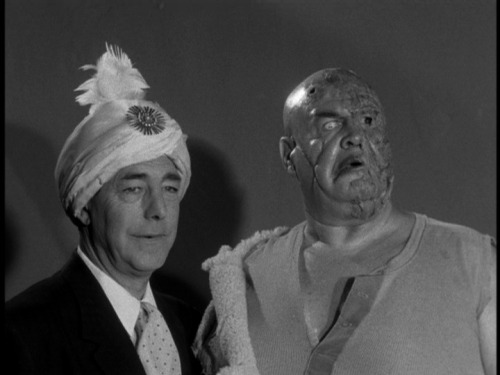
Anyway, it turns out that the house has been rebuilt by Dr. Acula (Kenne Duncan), who wears a turban and claims that he can speak to the dead. Acula lives in the house with his silent and scarred assistant, Lobo (Tor Johnson). A typical Dr. Acula seance involves a floating trumpet playing off-key, several skeletons sitting at a table, and a mysterious woman in white. Acula says that the house is full of spirits but it turn out that Acula is juts a guy named Karl and that even the woman in white is just an actress that he hired. ACULA’S A FRUAD!

Well, fraud or not, it turns out that Acula is right about one thing. There are actual ghosts in the house and it turns out that they’re not happy about the house’s new inhabitant!

Night of the Ghouls (1960, dir by Ed Wood)

Night of the Ghouls was filmed in 1959 but it went largely unreleased, largely because Wood didn’t have the money to pay off the lab fees. The film was erroneously thought to be lost until 1984, seven years after Wood’s passing. That was when a fan named Wade Williams discovered that a copy of the film was still being held by the post-production house. Williams paid the overdue lab fees and the film was finally released.

Night of the Ghouls is a typical Ed Wood film, which is to say that it’s in black-and-white, it’s extremely low budget, and it’s a lot of fun even though it’s not very good. The film’s plot has a make-it-up-as-you-go feel to it and, with a running time of only 70 minutes, it’s over before you can get too bored. While the cast may be largely inept, they’re also rather enthusiastic and it’s hard not to enjoy watching them try their best to sell Wood’s uniquely overbaked dialogue. The film also features not one but two appearances from Ed Wood himself! Not only is his picture hanging on the wall of the police station but Wood himself appears as a female ghoul.

Finally, fans of Ed Wood will also be happy to know that Night of the Ghouls contains references to both Bride of the Monster and Plan 9 From Outer Space, establishing that the Ed Wood cinematic universe existed long before Marvel made their first movie.

Ed and His Dead Mother (1993, directed by Jonathan Wacks)


After the death of his mother (Miriam Margoyles), shy Ed (Steve Buscemi) inherits the family hardware store.  Even though Ed now has his own business and maybe even a chance at having a relationship with Storm Reynolds (Sam Jenkins), Ed simply cannot leave the memory of his mother behind.  One day, he is approached by a salesman named A.J. Peddle (John Glover).  Peddle explains that he can bring Ed’s mother back to life for a thousand dollars.  Ed agrees and soon, Ed’s mother is once again living with Ed and Ed’s Uncle Benny (Ned Beatty).  Benny is upset because he doesn’t think that it’s proper to tamper in matters of morality and he never liked his sister to begin but, at first, Ed is happy to have her back.  However, Ed soon discovers that his mother has changed now that she’s come back to life.  She now has a craving for blood and soon, she’s chasing the neighborhood dogs while holding a knife.  Ed’s mom has returned as a zombie!  Can Ed finally move on and commit to sending his mother back to the grave?

This quirky comedy came out in 1993, a few years too early to take advantage of either the zombie boom or the horror comedy boom.  The movie never really find the right balance between scares and laughs.  The script is full of funny lines and Steve Buscemi and Ned Beatty are a good comedic team but the direction is as flat and as lifeless as Ed’s mom before she was resurrected.  Today, the movie is mostly interesting as a precursor for later trends in horror.  It’s also a chance to see Steve Buscemi is rare starring role.  Buscemi is ideally cast as the gentle Ed, who eventually learns the importance of letting go, accepting death, and moving on.  Buscemi is good, even in a misfire like this one.

Just two years after starring in this movie, Buscemi would appear on Homicide: Life on the Streets, playing a white supremacist murderer named Gordon Pratt.  Among the detectives assigned to arrest Pratt was Stanley Bolander, played by Ned Beatty.  As far as I know, that’s the only other pairing of Buscemi and Beatty and there wasn’t much to laugh about in that episode of Homicide.  It’s too bad because, judging from their interactions in this movie, Ned Beatty and Steve Buscemi could have been one of the great comedy teams.

Retro Television Review: Scream of the Wolf (dir by Dan Curtis)


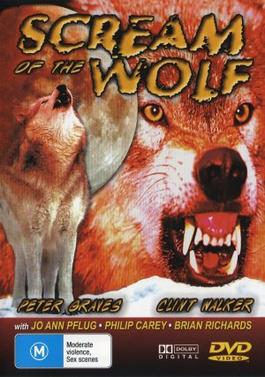
Welcome to Retro Television Reviews, a feature where we review some of our favorite and least favorite shows of the past!  On Sundays, I will be reviewing the made-for-television movies that used to be a primetime mainstay.  Today’s film is 1974’s Scream of the Wolf.  It  can be viewed on YouTube!

A small town in California is shocked when a series of brutal murders occur within the city limits.  Someone or something is killing people whenever the moon is full.  The only clue are the footprints that the killer leaves behind at every scene.  Strangely, there are time when the kill seems to walking on all fours, suggesting that it’s a wild animal.  But then, suddenly, there are only two footprints, indicating that the killer is a man.  Is the killer a beast or a human?

Maybe it’s both.

That’s the question that John Weatherby (Peter Graves) attempts to answer in Scream of the Wolf.  John is a former hunter who is now working on a book about his life.  He looks at the footprints and the savagery of the attacks and he says that the killer is obviously a wolf because no human could be capable of doing such a thing.  However, many people in town are convinced that the killer is a werewolf.  That includes John’s girlfriend, Sandy (Jo Ann Pflug).

In fact, Sandy thinks that she knows exactly who the werewolf is.  She thinks that Bryon Douglas (Clint Walker) is responsible for the murders.  Byron is an old friend of John’s.  They used to hunt together.  John eventually turned his back on hunting but Byron continues to insist that people are never more alive than when they are hunting another creature.  In fact, Byron claims that the murders are actually a good thing.  According to Byron, the murders have woken up the survival instinct in the spoiled inhabitants of the town.  And indeed, the citizens of the town do appear to be getting progressively more and more paranoid.

Okay, so Byron obviously has some issues.  But does that make him a werewolf?  John insists that there are no werewolves and that Byron is just a somewhat eccentric blowhard.  John better hope that he’s right because Byron has announced that he’s going to hunt down the werewolf and he’s invited John to join him on the hunt.

Running a brisk 78 minutes and not wasting a single one of them, Scream of the Wolf is an enjoyable and atmospheric werewolf film.  I don’t think I actually heard a wolf scream over the course of the film but I did hear plenty of people scream.  For a made for TV movie, Scream of the Wolf doesn’t shy away from showing the horror of being stalked by an unseen creature in the middle of the night.  Needless to say, any film featuring Peter Graves as a former big game hunter is going to have a bit of camp appeal but, in the end, Graves’s somewhat stolid acting style works well for the character that he is playing.  Clint Walker, who towers over everyone else in the film, gives an intimidating and creepy performance as Byron.  The film’s central mystery isn’t particularly complex but the story is told well.  Scream of the Wolf is a simple but entertaining film, one that’s ideal for October viewing.

Missing, Review By Case Wright


I wanted to include some picture or poster for this, but I can’t because nothing exists. Leave it to me to enjoy something that no one else does. I thoroughly enjoyed this film. Apparently, it came out in 2020 and no one liked it. Well, that all changed today because I liked it and that’s what matters!

A woman finds out that she’s missing. This film is two minutes of your life and it’s a fun two minutes. I recommend you take a pause and enjoy it!

International Horror Review: The City of the Dead (dir by John Llewellyn Moxey)


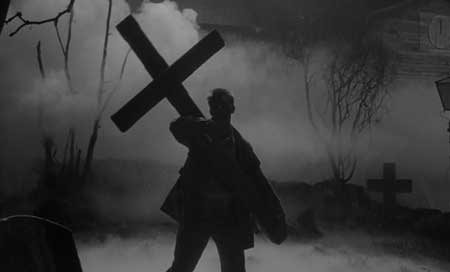
The City of the Dead, a 1960 British horror film that is also known as Horror Hotel, takes place in the town of Whitewood, Massachusetts.  (Though it takes place in America, this is a very British film, from the cast to the sensibility.)

Like most small New England towns (or, at the very least, the type of small New England towns that show up in movies like this), Whitewood has been around forever. And it apparently has quite a history, especially where witches and devil worshipers are concerned! In the 17th century, a witch was burned at the stake. Rumor has it that, before she died, she sold her soul to the devil. As long as she arranges for two virgin sacrifices a year, the spirit of the witch can torment Whitewood for as long as she likes.

Fortunately, a virgin has just arrived in town! Nan Barlow (Venetia Stevenson) is doing a term paper on the history of witchcraft and her very helpful professor, Alan Driscoll (played by the man himself, Christopher Lee), suggested that maybe Nan should visit town and stay at the Raven’s Inn.

As soon as Nan arrives, it becomes obvious to her that there’s something strange about Whitewood. All of the people are so strange and secretive and the streets always seem to be covered in fog. As Nan starts to do her research, she discovers that it will soon be time for the first annual sacrifice. The sacrifice is meant to happen at “The Hour of 13.” What does that mean? Why not go into the basement of the inn and search for some clues….

When Nan never returns from Whitewood, her brother, Dick (Denis Lotis), teams up with her fiance, Bill (Tom Naylor), and they head up to town to investigate. Once Dick arrives in town, he meets Whitewood’s only seemingly normal inhabitant, Pat (Bella St. John). Pat, who had previously befriended Nan and is the daughter of the local (and apparently quite ineffectual) reverend, agrees to help them in their search. Of course, Pat is also apparently the only virgin left in Massachusetts and the time for the second sacrifice is approaching….

Though set in America, The City of the Dead was produced in the UK and features British actors, all of whom do a fairly good job of sounding like natives of New England.  (Much like would happen later with the Italian zombie and cannibal films, this very British film was still made with the a focus on appealing to an American audience.) This deliberately paced film is a masterpiece of mood and menace. Director John Llewellyn Moxey emphasizes atmosphere over jump-scares and the black-and-white cinematography gives the entire film a gothic, dream-like feel. Though he’s not in the film as much as you might expect, Christopher Lee still makes the most of his scenes as Prof. Driscoll and the film’s fiery finale definitely makes an impression.

The City of the Dead is one of those films that, because it has fallen into the public domain, is very easy to find. (It seems to get included in every “50-DVD” box set released by Mill Creek.) It also plays frequently on TCM so keep an eye out for it!

Film Review: A Jazzman’s Blues (dir by Tyler Perry)


In 1987, a wealthy white attorney is running for Congress in Georgia.  After watching an interview in which he attacks affirmative action programs, an elderly black woman named Hattie Mae (Amirah Vann) collects a stack of old letters and drops them off at the attorney’s office.  As the attorney reads the letters, he learns the truth about his past.

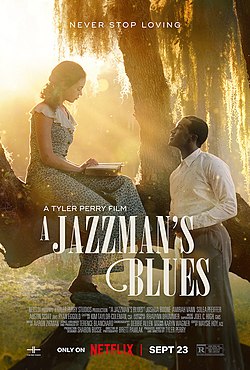
That’s the opening of Tyler Perry’s latest Netflix film, A Jazzman’s Blues.  The rest of the film is largely set in Georgia in the 30s and the 40s.  Hattie Mae is the mother of two sons, Bayou (Joshua Boone) and Willie Earl (Austin Scott).  Bayou is shy, innocent, and naïve.  He has a wonderful singing voice but no one takes him seriously.  Willie Earl is egotistical and temperamental.  Because he can play the trumpet, Willie Earl is his father’s favorite.  When Willie Earl and his father leave to seek fame in Chicago, Bayou remains in Georgia with his mother.

He also falls in love with Leanne (Solea Pfeiffer), who everyone calls “Bucket” because her mother abandoned her in a used bucket.  Leanne teaches Bayou to read.  Bayou tries to protect Leanne from he abusive grandfather.  Eventually, though, Leanne leaves Georgia.  Years later, she returns as the wife of the local sheriff’s political ambitious brother.  Leanne is now passing as white but Bayou still loves her.  Leanne’s mother, who is now back in the picture, lies to the sheriff and says that Bayou whistled at Leanne.  Bayou is forced to flee Georgia.  He ends up in Chicago, performing with Wille Earl, who is now junkie.

In Chicago, Bayou becomes a star while Wille Earl plays in his brother’s band.  Willie Earl grows jealous of his brother’s success.  When Bayou learns that Leanne has had a son and that he’s probably the father, Bayou makes plans to return to Georgia for a one-night performance.  Tragically, this provides Willie Earl with his opportunity to seek revenge….

Based on the first script that Tyler Perry ever wrote, A Jazzman’s Blues looks and feels like a real movie.  Netflix actually invested some money in this film and that alone represents a step up from Perry’s previous Netflix film.  Visually, the film does a good job contrasting the lushness of rural Georgia with the harshness of Chicago and the scenes in which Bayou performs in Capital Royale club are particularly well-shot.  Joshua Boone may not be the most expressive actor in the world but he’s got a great voice.  That said, this is still a Tyler Perry film and the story is still both melodramatic and predictable.  The framing device of the attorney reading the letters is rather clumsily handled and you’ll be able to guess the identity of the attorney long before the end credits roll.

The main problem with the film, to be honest, is that Willie Earl is a far more intriguing character than Bayou.  Willie Earl’s story is the interesting one and, as the film comes to a close, you find yourself wondering what Willie Earl did with the rest of his life.  Unfortunately, Perry doesn’t tell you or provide any hints.  His script uses Willie Earl as a dramatic device (and as an excuse to indulge in a bit of biblical allegory) but Austin Scott gives such a strong performance in the role that he takes over any scene in which he appears.  Can there be redemption for Willie Earl or is he doomed to spend the rest of his life in denial?  Does he regret his actions or is he so blinded by jealousy and hatred that he can justify the worst possible betrayal?  It’s the most interesting question that the film leaves us with but Perry doesn’t seem to realize that.

In the end, A Jazzman’s Blues indicates that, with the right resources, Tyler Perry can direct a real film.  But perhaps he should collaborate with another screenwriter.  A Jazzman’s Blues is not a bad film but it’s hard not to feel that Perry missed an opportunity to make it even better.